STEPHEN C. SMITH
ECONOMIC DEVELOPMENT
THIRTEENTH EDITION
Harlow, England • London • New York • Boston • San Francisco • Toronto • Sydney • Dubai • Singapore • Hong Kong Tokyo • Seoul • Taipei • New Delhi • Cape Town • São Paulo • Mexico City • Madrid • Amsterdam • Munich • Paris • Milan
ECONOMIC DEVELOPMENT
THIRTEENTH EDITION
MICHAEL P. TODARO
New York University
STEPHEN C. SMITH
The George Washington University
Harlow CM17 9SR United Kingdom Tel: +44 (0)1279 623623 Web: www.pearson.com/uk _________________________________
Twelfth edition published 2015 (print and electronic) Thirteenth edition published 2020 (print and electronic)
© Michael P. Todaro and Stephen C. Smith 2015, 2020 (print and electronic)
The rights of Michael P. Todaro and Stephen C. Smith to be identified as authors of this work have been asserted by them in accordance with the Copyright, Designs and Patents Act 1988.
The print publication is protected by copyright. Prior to any prohibited reproduction, storage in a retrieval system, distribution or transmission in any form or by any means, electronic, mechanical, recording or otherwise, permission should be obtained from the publisher or, where applicable, a licence permitting restricted copying in the United Kingdom should be obtained from the Copyright Licensing Agency Ltd, Barnard’s Inn, 86 Fetter Lane, London EC4A 1EN.
The ePublication is protected by copyright and must not be copied, reproduced, transferred, distributed, leased, licensed or publicly performed or used in any way except as specifically permitted in writing by the publishers, as allowed under the terms and conditions under which it was purchased, or as strictly permitted by applicable copyright law. Any unauthorised distribution or use of this text may be a direct infringement of the authors’ and the publisher’s rights and those responsible may be liable in law accordingly.
All trademarks used herein are the property of their respective owners. The use of any trademark in this text does not vest in the author or publisher any trademark ownership rights in such trademarks, nor does the use of such trademarks imply any affiliation with or endorsement of this book by such owners.
Pearson Education is not responsible for the content of third-party internet sites.
ISBN: 978-1-292-29115-4 (print) 978-1-292-29120-8 (PDF) 978-1-292-29119-2 (ePub)
British Library Cataloguing-in-Publication Data
A catalogue record for the print edition is available from the British Library Library of Congress Cataloging-in-Publication Data
Names: Todaro, Michael P, author. | Smith, Stephen C., 1955- author. Title: Economic development / Michael P. Todaro, New York University, Stephen C. Smith, The George Washington University.
Description: Thirteenth Edition. | Hoboken : Pearson, 2020. | Revised edition of the authors' Economic development, [2015] | Includes bibliographical references and index.
Identifiers: LCCN 2019035607 | ISBN 9781292291154 (paperback) | ISBN 9781292291208 | ISBN 9781292291192 (epub)
Subjects: LCSH: Economic development. | Developing countries—Economic policy.
Classification: LCC HD82 .T552 2020 | DDC 338.9009172/4—dc23 LC record available at https://lccn.loc.gov/2019035607
10 9 8 7 6 5 4 3 2 1 24 23 22 21 20
Cover: oxygen/Moment/Getty Images
Print edition typeset in 10/12 Palatino LT Std by SPi Gobal Printed and bound by Vivar in Malaysia
NOTE THAT ANY PAGE CROSS REFERENCES REFER TO THE PRINT EDITION
iii
1 Introducing Economic Development: A Global Perspective 1
2 Comparative Economic Development 35
3 Classic Theories of Economic Growth and Development 116 4 Contemporary Models of Development and Underdevelopment 164
5 Poverty, Inequality, and Development 220
6 Population Growth and Economic Development: Causes,
Consequences, and Controversies 293
7 Urbanisation and Rural–Urban Migration: Theory and Policy 340 8 Human Capital: Education and Health in Economic Development 390 9 Agricultural Transformation and Rural Development 447
10 The Environment and Development 503
11 Development Policymaking and the Roles of Market, State, and
Civil Society 557
12 International Trade Theory and Development Strategy 615 13 Balance of Payments, Debt, Financial Crises, and Sustainable
Recovery: Principles, Cases and Policies 697 14 Foreign Finance, Investment, Aid, and Conflict: Controversies
and Opportunities 749
15 Finance and Fiscal Policy for Development 800
Brief Contents
v
Case Studies and Boxes xv Figures and Tables xvii Preface xxi
1 Introducing Economic Development: A Global Perspective 1
1.1 Introduction to Some of the World’s Biggest Questions 1
1.2 How Living Levels Differ Around the World 2
1.3 How Countries Are Classified by Their Average Levels of Development:
A First Look 7
1.4 Economics and Development Studies 8
1.4.1 Wider Scope of Study 8 1.4.2 The Central Role of Women 10
1.5 The Meaning of Development: Amartya Sen’s “Capability” Approach 10
1.6 Happiness and Development 13
1.7 The Sustainable Development Goals: A Shared Development Mission 15
1.7.1 Seventeen Goals 15
1.7.2 The Millennium Development Goals, 2000–2015 16 1.7.3 Implementing the Sustainable Development Goals 19
1.8 Some Critical Questions for the Study of Development Economics 21
■ Case Study 1: Comparative Economic Development: Pakistan and Bangladesh 24
2 Comparative Economic Development 35
2.1 An Introduction 35
2.2 What is the Developing World? Classifying Levels of National
Economic Development 37
2.2.1 Conventional Comparisons of Average National Income 37 2.2.2 Adjusting for Purchasing Power Parity 43
2.2.3 Other Common Country Classifications 45
2.3 Comparing Countries by Health and Education, and the Human
Development Index 46
2.3.1 Comparing Health and Education Levels 46 2.3.2 Introducing the Human Development Index 46
2.3.3 Human Development Index Ranking: How Does it Differ from Income Rankings? 49 2.3.4 Human Development Index: Alternative Formulations 51
Contents
2.4 Key Similarities and Differences Among Developing Countries 54
2.4.1 Levels of Income and Productivity 54 2.4.2 Human Capital Attainments 55 2.4.3 Inequality and Absolute Poverty 57 2.4.4 Population Growth and Age Structure 58 2.4.5 Rural Economy and Rural-to-Urban Migration 59 2.4.6 Social Fractionalisation 59
2.4.7 Level of Industrialisation and Manufactured Exports 61 2.4.8 Geography and Natural Resource Endowments 61 2.4.9 Extent of Financial and Other Market Development 62 2.4.10 Quality of Institutions and External Dependence 63
2.5 Are Living Standards of Developing and Developed Nations Converging? 67
2.5.1 The Great Divergence 67
2.5.2 Two Major Reasons to Expect Convergence 69 2.5.3 Perspectives on Income Convergence 70
2.6 Long-Run Causes of Comparative Development 74
2.7 Concluding Observations 82
■ Case Study 2: Institutions, Colonial Legacies, and Economic Development: Ghana and Côte d’Ivoire 84 Appendix 2.1 The Traditional Human Development Index (HDI) 102 Appendix 2.2 How Low-Income Countries Today Differ from Developed Countries
in Their Earlier Stages 108
3 Classic Theories of Economic Growth and Development 116
3.1 Classic Theories of Economic Development: Four Approaches 116 3.2 Development as Growth and the Linear-Stages Theories 117
3.2.1 Rostow’s Stages of Growth 118 3.2.2 The Harrod-Domar Growth Model 118 3.2.3 Obstacles and Constraints 121
3.2.4 Necessary Versus Sufficient Conditions: Some Criticisms of the Stages Model 122
3.3 Structural-Change Models 122
3.3.1 The Lewis Theory of Economic Development 122 3.3.2 Structural Change and Patterns of Development 127 3.3.3 Conclusions and Implications 128
3.4 The International-Dependence Revolution 129
3.4.1 The Neocolonial Dependence Model 130 3.4.2 The False-Paradigm Model 131
3.4.3 The Dualistic-Development Thesis 131 3.4.4 Conclusions and Implications 132
3.5 The Neoclassical Counter-Revolution: Market Fundamentalism 133
3.5.1 Challenging the Statist Model: Free Markets, Public Choice, and Market-Friendly Approaches 133
3.5.2 Traditional Neoclassical Growth Theory 135 3.5.3 Conclusions and Implications 137
3.6 Classic Theories of Development: Reconciling the Differences 138
■ Case Study 3: Classic Schools of Thought in Context: South Korea and Argentina 140
Appendix 3.1 Components of Economic Growth 147
vii
Contents
Appendix 3.2 The Solow Neoclassical Growth Model 153
Appendix 3.3 Endogenous Growth Theory 158
4 Contemporary Models of Development and Underdevelopment 164
4.1 Underdevelopment as a Coordination Failure 165
4.2 Multiple Equilibria: A Diagrammatic Approach 168
4.3 Starting Economic Development: The Big Push 174
4.3.1 The Big Push: A Graphical Model 175
4.3.2 Other Cases in Which a Big Push May Be Necessary 180 4.3.3 Why the Problem Cannot Be Solved by a Super-Entrepreneur 181
4.4 Further Problems of Multiple Equilibria 183
4.4.1 Inefficient Advantages of Incumbency 183 4.4.2 Behaviour and Norms 183
4.4.3 Linkages 184
4.4.4 Inequality, Multiple Equilibria, and Growth 185
4.5 Michael Kremer’s O-Ring Theory of Economic Development 186
4.5.1 The O-Ring Model 186
4.5.2 Implications of the O-Ring Theory 189
4.6 Economic Development as Self-Discovery 191
4.7 The Hausmann-Rodrik-Velasco Growth Diagnostics Framework 192
4.8 Conclusions 199
■ Case Study 4: China: Understanding a Development “Miracle” 202
5 Poverty, Inequality, and Development 220
5.1 Measuring Inequality 222
5.1.1 Size Distributions 222 5.1.2 Lorenz Curves 224
5.1.3 Gini Coefficients and Aggregate Measures of Inequality 226 5.1.4 The Ahluwalia-Chenery Welfare Index (ACWI) 228
5.2 Measuring Absolute Poverty 228
5.2.1 Income Poverty 228
5.2.2 Multidimensional Poverty Measurement 233
5.3 Poverty, Inequality, and Social Welfare 233
5.3.1 What is it About Extreme Inequality That’s So Harmful to Economic Development? 233 5.3.2 Dualistic Development and Shifting Lorenz Curves: Some Stylised Typologies 235 5.3.3 Kuznets’s Inverted-U Hypothesis 239
5.3.4 Growth and Inequality 243
5.4 Absolute Poverty: Extent and Magnitude 244
5.4.1 The Multidimensional Poverty Index (MPI) 246
5.5 Economic Characteristics of High-Poverty Groups 251
5.5.1 Children and Poverty 252 5.5.2 Women and Poverty 252
5.5.3 Ethnic Minorities, Indigenous Populations, and Poverty 255
5.6 Growth and Poverty 257
5.7 Labour, the Functional Distribution of Income, and Inclusive Development 258
5.7.1 The Functional Distribution 258 5.7.2 Labour and Inclusive Development 260
5.8 Policy Options on Income Inequality and Poverty: Some Basic Considerations 262
5.8.1 Areas of Intervention 262
5.8.2 Altering the Functional Distribution of Income Through Relative Factor Prices: Minimum Wage and Capital Subsidy Debates 263
5.8.3 Modifying the Size Distribution Through Increasing Assets of the Poor 264 5.8.4 Progressive Income and Wealth Taxes 265
5.8.5 Direct Transfer Payments and the Public Provision of Goods and Services 266 5.8.6 Applying Insights from Behavioural Economics to Address Poverty 268
5.9 Summary and Conclusions: The Need for a Package of Policies 270
■ Case Study 5: India: Complex Challenges and Compelling Opportunities 272 Appendix 5.1 Appropriate Technology and Employment Generation: The Price Incentive Model 281
Appendix 5.2 The Ahluwalia-Chenery Welfare Index 284
6 Population Growth and Economic Development: Causes,
Consequences, and Controversies 293
6.1 The Basic Issue: Population Growth and the Quality of Life 293
6.2 Population Growth: Past, Present, and Future 294
6.2.1 World Population Growth Throughout History 294 6.2.2 Structure of the World’s Population 296
6.2.3 Demographic Structure and the Hidden Momentum of Population Growth 299
6.3 Demographic Structure and the Demographic Transition 303 6.4 The Causes of High Fertility in Developing Countries:
The Malthusian and Household Models 305
6.4.1 The Malthusian Population Trap 305 6.4.2 Criticisms of the Malthusian Model 309
6.4.3 The Microeconomic Household Theory of Fertility 311 6.4.4 The Demand for Children in Developing Countries 314 6.4.5 Implications for Development and Fertility 315
6.5 The Consequences of High Fertility: Some Conflicting Perspectives 316
6.5.1 It’s Not a Real Problem 317
6.5.2 It’s a Deliberately Contrived False Issue 318 6.5.3 It’s a Desirable Phenomenon 318
6.5.4 It Is a Real Problem 320
6.5.5 Goals and Objectives: Toward a Consensus 324
6.6 Some Policy Approaches 326
6.6.1 What Developing Countries Can Do 326 6.6.2 What the Developed Countries Can Do 329
6.6.3 How Developed Countries Can Help Developing Countries with Their Population Programmes 330
6.6.4 Policy for Still-Developing Countries Facing Population Declines 330
■ Case Study 6: “Twins” Growing Apart: Burundi and Rwanda 332
ix
Contents
7 Urbanisation and Rural–Urban Migration: Theory and Policy 340
7.1 Urbanisation: Trends and Living Conditions 341
7.2 The Role of Cities 349
7.2.1 Industrial Districts 349 7.2.2 Efficient Urban Scale 353
7.3 Understanding Urban Giants: Causes and Consequences 354
7.3.1 First-City Bias 355
7.3.2 The Political Economy of Urban Giants 356
7.4 The Urban Informal Sector 358
7.4.1 Policies for the Urban Informal Sector 359 7.4.2 Women in the Informal Sector 362
7.5 Migration and Development 363
7.6 Toward an Economic Theory of Rural–Urban Migration 366
7.6.1 A Verbal Description of the Todaro Model 366 7.6.2 A Diagrammatic Presentation 368
7.6.3 Policy Implications 370
7.7 Conclusion: A Comprehensive Urbanisation, Migration, and Employment Strategy 373
■ Case Study 7: Rural–Urban Migration and Urbanisation in Developing Countries: India and Botswana 377 Appendix 7.1 A Mathematical Formulation of the Todaro Migration Model 382
8 Human Capital: Education and Health in Economic Development 390
8.1 The Central Roles of Education and Health 390
8.1.1 Education and Health as Joint Investments for Development 392
8.1.2 Improving Health and Education: Why Increasing Income Is Not Sufficient 393
8.2 Investing in Education and Health: The Human Capital Approach 396
8.2.1 Social Versus Private Benefits and Costs 399
8.3 Child Labour 401
8.4 The Gender Gap: Discrimination in Education and Health 407
8.4.1 Education and Gender 407 8.4.2 Health and Gender 408
8.4.3 Consequences of Gender Bias in Health and Education 409
8.5 Educational Systems and Development 411
8.5.1 The Political Economy of Educational Supply and Demand: The Relationship Between Employment Opportunities and Educational Demands 411
8.5.2 Distribution of Education 413
8.6 Health Measurement and Disease Burden 416
8.6.1 HIV/AIDS 421 8.6.2 Malaria 424
8.6.3 Parasitic Worms and Other “Neglected Tropical Diseases” 426
8.7 Behavioural Economics Insights for Designing Health Policies and Programmes 428
8.8 Health, Productivity, and Policy 429
8.8.1 Productivity 429
8.8.2 Health Systems Policy 430
■ Case Study 8: Pathways Out of Poverty: Progresa/Oportunidades in Mexico 434
9 Agricultural Transformation and Rural Development 447
9.1 The Imperative of Agricultural Progress and Rural Development 447 9.2 Agricultural Growth: Past Progress and Current Challenges 450
9.2.1 Trends in Agricultural Productivity 450
9.2.2 Market Failures and the Need for Government Policy 456 9.2.3 Agricultural Extension 458
9.3 The Structure of Agrarian Systems in the Developing World 459
9.3.1 Three Systems of Agriculture 459
9.3.2 Traditional and Peasant Agriculture in Latin America, Asia, and Africa 462
9.3.3 Agrarian Patterns in Latin America: Progress and Remaining Poverty Challenges 462 9.3.4 Transforming Economies: Problems of Fragmentation and Subdivision of Peasant Land in
Asia 465
9.3.5 Subsistence Agriculture and Extensive Cultivation in Africa 468
9.4 The Important Role of Women 470
9.5 The Microeconomics of Farmer Behaviour and Agricultural Development 473
9.5.1 The Transition from Traditional Subsistence to Specialised Commercial Farming 473 9.5.2 Subsistence Farming: Risk Aversion, Uncertainty, and Survival 474
9.5.3 The Economics of Sharecropping and Interlocking Factor Markets 477 9.5.4 Intermediate Steps to Mixed or Diversified Farming 480
9.5.5 From Divergence to Specialisation: Modern Commercial Farming 481
9.6 Core Requirements of a Strategy of Agricultural and Rural
Development 483
9.6.1 Improving Small-Scale Agriculture 483
9.6.2 Institutional and Pricing Policies: Providing the Necessary Economic Incentives 484 9.6.3 Conditions for Rural Development 486
■ Case Study 9: The Need to Improve Agricultural Extension for Women Farmers:
Kenya and Uganda 489
10 The Environment and Development 503
10.1 Environment and Development: The Basic Issues 503
10.1.1 Economics and the Environment 503
10.1.2 Sustainable Development and Environmental Accounting 505
10.1.3 Environment Relationships to Population, Poverty, and Economic Growth 506 10.1.4 Environment and Rural and Urban Development 508
10.1.5 The Global Environment and Economy 509
10.1.6 Natural Resource–Based Livelihoods as a Pathway Out of Poverty: Promise and Limitations 510
10.1.7 The Scope of Domestic-Origin Environmental Degradation 511 10.1.8 Rural Development and the Environment: A Tale of Two Villages 513 10.1.9 Environmental Deterioration in Villages 514
10.2 Global Warming and Climate Change: Scope, Mitigation, and Adaptation 515
10.2.1 Scope of the Problem 515 10.2.2 Mitigation 518
10.2.3 Adaptation 519
10.3 Economic Models of Environmental Issues 521
10.3.1 Privately Owned Resources 521 10.3.2 Common Property Resources 526
xi
Contents
10.3.3 Public Goods and Bads: Regional Environmental Degradation and the Free-Rider Problem 528
10.3.4 Limitations of the Public-Good Framework 530
10.4 Urban Development and the Environment 531
10.4.1 Environmental Problems of Urban Slums 531 10.4.2 Industrialisation and Urban Air Pollution 532
10.4.3 Problems of Congestion, Clean Water, and Sanitation 535
10.5 The Local and Global Costs of Rain Forest Destruction 536 10.6 Policy Options in Developing and Developed Countries 539
10.6.1 What Developing Countries Can Do 539
10.6.2 How Developed Countries Can Help Developing Countries 541 10.6.3 What Developed Countries Can Do for the Global Environment 545
■ Case Study 10: A World of Contrasts on One Island: Haiti and the Dominican Republic 548
11 Development Policymaking and the Roles of Market,
State, and Civil Society 557
11.1 A Question of Balance 557
11.2 Development Planning: Concepts and Rationale 558
11.2.1 The Planning Mystique 558
11.2.2 The Nature of Development Planning 558 11.2.3 Planning in Mixed Developing Economies 559 11.2.4 The Rationale for Development Planning 560
11.3 The Development Planning Process: Some Basic Models 562
11.3.1 Three Stages of Planning 562
11.3.2 Aggregate Growth Models: Projecting Macro Variables 563 11.3.3 Multisector Models and Sectoral Projections 565
11.3.4 Project Appraisal and Social Cost–Benefit Analysis 566
11.4 Government Failure and Preferences for Markets Over Planning 570
11.4.1 Problems of Plan Implementation and Plan Failure 570 11.4.2 The 1980s Policy Shift Toward Free Markets 572 11.4.3 Government Failure 573
11.5 The Market Economy 574
11.5.1 Sociocultural Preconditions and Economic Requirements 574
11.6 The Washington Consensus on the Role of the State in Development
and Its Subsequent Evolution 575
11.6.1 Toward a New Consensus 577
11.7 Development Political Economy: Theories of Policy Formulation and Reform 578
11.7.1 Understanding Voting Patterns on Policy Reform 580 11.7.2 Institutions and Path Dependency 582
11.7.3 Democracy Versus Autocracy: Which Facilitates Faster Growth? 583
11.8 Development Roles of NGOs and the Broader Citizen Sector 585
11.9 Trends In Governance and Reform 593
11.9.1 Tackling the Problem of Corruption 593 11.9.2 Decentralisation 594
11.9.3 Development Participation 596
■ Case Study 11: The Role of Development NGOs: BRAC and the Grameen Bank 599
12 International Trade Theory and Development Strategy 615
12.1 Economic Globalisation: Meaning, Extent, and Limitations 615
12.2 International Trade: Some Key Issues 618
12.2.1 Five Basic Questions about Trade and Development 621 12.2.2 Importance of Exports to Different Developing Nations 623 12.2.3 Demand Elasticities and Export Earnings Instability 625 12.2.4 The Terms of Trade and the Prebisch-Singer Hypothesis 626
12.3 The Traditional Theory of International Trade 628
12.3.1 Comparative Advantage 628
12.3.2 Relative Factor Endowments and International Specialisation: The Neoclassical Model 629
12.3.3 Trade Theory and Development: The Traditional Arguments 634
12.4 The Critique of Traditional Free-Trade Theory in the Context of
Developing-Country Experience 634
12.4.1 Fixed Resources, Full Employment, and the International Immobility of Capital and Skilled Labour 635
12.4.2 Fixed, Freely Available Technology and Consumer Sovereignty 638
12.4.3 Internal Factor Mobility, Perfect Competition, and Uncertainty: Increasing Returns, Imperfect Competition, and Issues in Specialisation 639
12.4.4 The Absence of National Governments in Trading Relations 641 12.4.5 Balanced Trade and International Price Adjustments 642 12.4.6 Trade Gains Accruing to Nationals 642
12.4.7 Some Conclusions on Trade Theory and Economic Development Strategy 643
12.5 Traditional Trade Strategies and Policy Mechanisms for Development:
Export Promotion Versus Import Substitution 645
12.5.1 Export Promotion: Looking Outward and Seeing Trade Barriers 647 12.5.2 Import Substitution: Looking Inward but Still Paying Outward 651 12.5.3 Tariffs, Infant Industries, and the Theory of Protection 652 12.5.4 The IS Industrialisation Strategy and Results 654
12.5.5 Foreign-Exchange Rates, Exchange Controls, and the Devaluation Decision 659 12.5.6 Trade Optimists and Trade Pessimists: Summarising the Traditional Debate 663
12.6 The Industrialisation Strategy Approach to Export Policy 666
12.6.1 Export-Oriented Industrialisation Strategy 666
12.6.2 The New Firm-Level International Trade Research and the Developing Countries 670
12.7 South–South Trade and Economic Integration 672
12.7.1 Economic Integration and Development Strategy 672
12.7.2 Regional Trading Blocs and Prospects for South–South Cooperation 674
■ Case Study 12: Pioneers in Development Success through Trade and Industrialisation Strategy:
South Korea and Taiwan in Comparative Perspective 676
13 Balance of Payments, Debt, Financial Crises, and Sustainable
Recovery: Principles, Cases and Policies 697
13.1 Introduction 697
13.2 The Balance of Payments Account 698
13.2.1 General Considerations 698
13.2.2 A Hypothetical Illustration: Deficits and Debts 700
xiii
Contents
13.3 The Issue of Payments Deficits 704
13.3.1 Some Initial Policy Issues 704 13.3.2 Trends in the Balance of Payments 708
13.4 Accumulation of Debt and Developing-Country Crises:
The 1980s Debt Crisis, and its Resolutions and Repercussions 710
13.4.1 External Debt Accumulation and Crisis: The Basic Transfer Framework 710 13.4.2 The 1980s Crisis: Background and Analysis 712
13.4.3 Attempts at Alleviation: Classic IMF Stabilisation Policies, and Strategies for Debt Relief 714
13.5 The 2000s Global Financial Crisis: Economic Development Impacts and Lessons 725
13.5.1 Causes of the Crisis and Challenges to Lasting Recovery 725 13.5.2 Economic Impacts on Developing Countries 728
13.5.3 Differing Impacts across Regions and Developing Country Groups 732 13.5.4 Conditions Affecting Prospects for Stability and Growth 735
■ Case Study 13: Brazil: Meaningful Development or Middle-Income Trap? 737
14 Foreign Finance, Investment, Aid, and Conflict: Controversies and
Opportunities 749
14.1 The International Flow of Financial Resources 749
14.2 Private Foreign Direct Investment and The Multinational Corporation 750
14.2.1 Private Foreign Investment: Some Pros and Cons for Development 754 14.2.2 Private Portfolio Investment: Benefits and Risks 761
14.3 The Role and Growth of Remittances 762
14.4 Foreign Aid: The Development Assistance Debate 765
14.4.1 Conceptual and Measurement Problems 765 14.4.2 Amounts and Allocations: Public Aid 766 14.4.3 Why Donors Give Aid 768
14.4.4 Why Recipient Countries Accept Aid 772
14.4.5 The Role of Nongovernmental Organisations in Aid 773 14.4.6 The Effects of Aid 774
14.5 Conflict and Development 775
14.5.1 The Scope of Violent Conflict and Conflict Risks 775 14.5.2 The Consequences of Armed Conflict 776
14.5.3 The Causes of Armed Conflict and Risk Factors for Conflict 779 14.5.4 The Resolution and Prevention of Armed Conflict 781
■ Case Study 14: The Roots of Divergence Among Developing
Countries: Costa Rica, Guatemala, and Honduras 785
15 Finance and Fiscal Policy for Development 800
15.1 The Role of the Financial System in Economic Development 800
15.1.1 Differences Between Developed- and Developing-Country Financial Systems 802
15.2 The Role of Central Banks and Alternative Arrangements 806
15.2.1 Functions of a Fully-Fledged Central Bank 806 15.2.2 The Role of Development Banking 809
15.3 Informal Finance and the Rise of Microfinance 810
15.3.1 Traditional Informal Finance 810
15.3.2 Microfinance Institutions: How They Work 813 15.3.3 MFIs: Three Current Policy Debates 815
15.3.4 Potential Limitations of Microfinance as a Development Strategy 817
15.4 Formal Financial Systems and Reforms 818
15.4.1 Financial Liberalisation, Real Interest Rates, Savings, and Investment 818 15.4.2 Financial Policy and the Role of the State 820
15.4.3 Debate on the Role of Stock Markets 822
15.5 Fiscal Policy for Development 824
15.5.1 Macrostability and Resource Mobilisation 824 15.5.2 Taxation: Direct and Indirect 824
15.6 State-Owned Enterprises and Privatisation 829
15.6.1 The Nature and Scope of SOEs 829 15.6.2 Improving the Performance of SOEs 830 15.6.3 Privatisation: Theory and Experience 831
15.7 Public Administration: The Scarcest Resource 834
■ Case Study 15: How Two African Success Stories Have Addressed Challenges: Botswana and Mauritius 836
Glossary 850 Name Index 862 Subject Index 868
xv Case Studies
1 Comparative Economic Development: Pakistan and Bangladesh 24
2 Institutions, Colonial Legacies, and Economic Development: Ghana and Côte d’Ivoire 84 3 Classic Schools of Thought in Context: South Korea and Argentina 140
4 China: Understanding a Development “Miracle” 202
5 India: Complex Challenges and Compelling Opportunities 272
6 “Twins” Growing Apart: Burundi and Rwanda 332
7 Rural–Urban Migration and Urbanisation in Developing Countries: India and Botswana 377
8 Pathways Out of Poverty: Progresa/Oportunidades in Mexico 434
9 The Need to Improve Agricultural Extension for Women Farmers: Kenya and Uganda 489 10 A World of Contrasts on One Island: Haiti and the Dominican Republic 548
11 The Role of Development NGOs: BRAC and the Grameen Bank 599
12 Pioneers in Development Success through Trade and Industrialisation Strategy:
South Korea and Taiwan in Comparative Perspective 676
13 Brazil: Meaningful Development or Middle-Income Trap? 737
14 The Roots of Divergence Among Developing Countries: Costa Rica, Guatemala, and Honduras 785 15 How Two African Success Stories Have Addressed Challenges: Botswana and Mauritius 836 Boxes
1.1 Development Policy: The Experience of Poverty: Voices of the Poor 4 1.2 Development Policy: Comparing Living Conditions Commonly Found Across Four Strata 6 1.3 Development Policy: The 17 Goals, and Where They are Examined in This Text 20 2.1 Development Policy: Differences Between the Current Human Development Index and the
Traditional HDI 53
2.2 Findings: The Persistent Effects of Colonial Forced Labour on Poverty and Development 66 2.3 Findings: Instruments to Test Theories of Comparative Development: Inequality 79 2.4 Findings: Legacy of Colonial Land Tenure and Governance Systems 80 4.1 Development Policy: Synchronising Expectations: Resetting “Latin American Time” 171 4.2 Findings: Village Coordination and Monitoring for Better Health Outcomes 172 4.3 Findings: Three Country Case Study Applications of Growth Diagnostics 196 4.4 Findings: Inclusive Growth Diagnostics: The Case of Bangladesh 198
5.1 Development Policy: The Latin America Effect 242
5.2 Development Policy: Problems of Gender Relations in Developing Countries: Voices of the Poor 254 6.1 Findings: The 2017 Revised United Nations Population Projections 300 6.2 Findings: Social Norms and the Changing Patterns of Fertility in Bangladesh 308
6.3 Development Policy: Population Policy in China 321
6.4 Findings: Contraceptives Need and Use in Developing Countries, 2003 to 2012 327 7.1 Findings: The Emergence of Industrial Districts or Clusters in China 351
Case Studies
and Boxes
8.1 Development Policy: Health and Education: Voices of the Poor 391 8.2 Development Policy: Linkages Between Investments in Health and Education 392 8.3 Findings: Mothers’ Health Knowledge is Crucial for Raising Child Health 394 8.4 Findings: School Impact of a Low-Cost Health Intervention 395
8.5 Findings: Cash or Condition? Evidence from Malawi 405
8.6 Findings: Impacts of Tutor and Computer-Assisted Learning Programmes 415 8.7 Development Policy: Health Challenges Faced by Developing Countries 419
8.8 Development Policy: AIDS: Crisis and Response in Uganda 423
8.9 Findings: Applying Behavioural Economics to Improve Physical and Mental Health 428 9.1 Development Policy: Development Policy Issues: Famine in the Horn of Africa 454 9.2 Findings: Learning About Farming: The Diffusion of Pineapple Growing in Ghana 482 10.1 Development Policy: Autonomous Adaptation to Climate Change by Farmers in Africa 521 10.2 Development Policy: One of the World’s Poorest Countries Tries to Prepare for Climate
Change: Niger 522
10.3 Findings: Elinor Ostrom’s Design Principles Derived from Studies of Long-Enduring
Institutions for Governing Sustainable Resources 529
10.4 Development Policy: How Different Is Adaptation and Resilience Assistance from
Development Assistance? 542
11.1 Development Policy: The Former Washington Consensus and East Asia 576
11.2 Development Policy: The New Consensus 578
11.3 Findings: Reducing Teacher Absenteeism in an NGO School 592
12.1 Findings: Four Centuries of Evidence on the Prebisch-Singer Hypothesis 627 12.2 Findings: Exporting and the Performance of Artisan Rug Makers in Egypt 671 13.1 Development Policy: The History and Role of the International Monetary Fund 701 13.2 Development Policy: The History and Role of the World Bank 705 13.3 Development Policy: Mexico: Crisis, Debt Reduction, and the Struggle for Renewed Growth 719
13.4 Development Policy: “Odious Debt” and its Prevention 723
14.1 Development Policy: Seven Key Disputed Issues About the Role and Impact of
Multinational Corporations in Developing Countries 758
15.1 Findings: The Financial Lives of the Poor 812
15.2 Findings: Combining Microfinance with Training 816
15.3 Development Policy: Privatisation: What, When, and to Whom? Chile and Poland 833
xvii Figures
1.1 Income and Happiness: Comparing Countries 14
2.1 Nations of the World, Classified by GNI Per Capita 40
2.2 Income Comparisons for Selected Countries, 2017 42
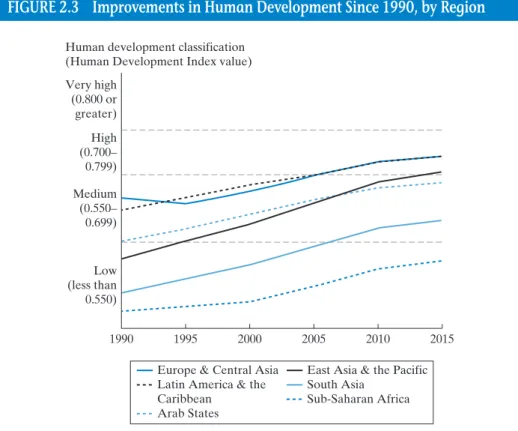
2.3 Improvements in Human Development Since 1990, by Region 52
2.4 Under-5 Mortality Rates, 1990 and 2017 56
2.5 The growth of real output per person since 1750 68
2.6 Relative Country Convergence 1970–1994 and 1994–2017 71
2.7 Relative Country Convergence: World, Developing Countries, and OECD 72
2.8 Growth Convergence versus Absolute Income Convergence 73
2.9 Schematic Representation of Leading Theories of Comparative Development 75 A2.1.1 Human Development Disparities Within Selected Countries 107 3.1 The Lewis Model of Modern-Sector Growth in a Two-Sector Surplus-Labour Economy 124 3.2 The Lewis Model Modified by Labour-Saving Capital Accumulation: Employment
Implications 126
A3.1.1 Effect of Increases in Physical and Human Resources on the Production Possibility Frontier 149 A3.1.2 Effect of Growth of Capital Stock and Land on the Production Possibility Frontier 150 A3.1.3 Effect of Technological Change in the Agricultural Sector on the Production
Possibility Frontier 151
A3.1.4 Effect of Technological Change in the Industrial Sector on the Production
Possibility Frontier 152
A3.2.1 Equilibrium in the Solow Growth Model 154
A3.2.2 The Long-Run Effect of Changing the Savings Rate in the Solow Model 156
4.1 Multiple Equilibria 169
4.2 The Big Push 176
4.3 Hausmann-Rodrik-Velasco Growth Diagnostics Decision Tree 193
5.1 The Lorenz Curve 224
5.2 The Greater the Curvature of the Lorenz Line, the Greater the Relative Degree of Inequality 225
5.3 Estimating the Gini Coefficient 226
5.4 Four Possible Lorenz Curves 227
5.5 Measuring the Total Poverty Gap 229
5.6 Improved Income Distribution under the Traditional-Sector Enrichment Growth Typology 236 5.7 Worsened Income Distribution under the Modern-Sector Enrichment Growth Typology 237 5.8 Crossing Lorenz Curves in the Modern-Sector Enlargement Growth Typology 238
5.9 The “Inverted-U” Kuznets Curve 239
5.10 Kuznets Curve with Latin American Countries Identified 242
5.11 Plot of Inequality Data for Selected Countries 243
Figures and Tables
5.12 Global and Regional Poverty Trends, 1981–2010 245 5.13 Functional Income Distribution in a Market Economy: An Illustration 260
A5.1.1 Choice of Techniques: The Price Incentive Model 281
6.1 World Population Growth, 1950–2050 295
6.2 World Population Distribution by Region, 2010 and 2050: The Big Story: Africa’s Steadily
Growing Share of World Population 297
6.3 Map with Country Sizes Proportional to Their Fraction of World Population 297 6.4 Population Pyramids: Low-, Middle-, and High-Income Countries, 1965; and 2016 301
6.5 The Demographic Transition in Western Europe 304
6.6 The Malthusian Population Trap 305
6.7 How Technological and Social Progress Allows Nations to Avoid the Population Trap 307
6.8 Microeconomic Theory of Fertility: An Illustration 312
7.1 Changes in Urban and Rural Population by Major Areas Between 2011 and 2050 (In Millions) 342 7.2 Relationship Between Urbanisation and Per Capita GDP, 2010, with Comparison to
Relationship in 1960 343
7.3 Proportion of Urban Population by Region, 1970–1995 343
7.4 Megacities: Cities with 10 Million or More Inhabitants 345
7.5 Total Population in Millions by City Size Class, 1970, 1990, 2011, and 2025 346 7.6 Estimated and Projected Urban and Rural Population of the More- and Less-Developed
Regions, 1950–2050 347
7.7 Politics and Urban Concentration 357
7.8 Components of Migration in Selected Countries 365
7.9 The Harris-Todaro Migration Model 368
8.1 Age-Earnings Profiles by Level of Education: Venezuela 397
8.2 Financial Trade-Offs in the Decision to Continue in School 398 8.3 Private Versus Social Benefits and Costs of Education: An Illustration 400
8.4 Child Labour as a Bad Equilibrium 403
8.5 Youth Literacy Rate, 2016 408
8.6 Estimated Percentage of Women “Missing” 410
8.7 Lorenz Curves for Education in India 414
8.8 Children’s Likelihood to Die in Selected Countries 417
8.9 Proportion of Children Under Five Who Are Underweight, by Household Wealth,
Around 2008 418
8.10 Proportion of Children Under Five Who are Underweight, 1990 and 2018 421 8.11 Wages, Education, and Height of Males in Brazil and the United States 431 9.1 As Countries Develop, the Shares of GDP and Labour in Agriculture Tend to Decline, But
With Many Idiosyncrasies 451
9.2 Cereal Yields by World Region, 1960–2005 452
9.3 World Prices for Agricultural Commodities, 1974–2012 456
9.4 Agriculture’s Contribution to Growth and the Rural Share in Poverty in
Three Types of Countries 460
9.5 Small-Farmer Attitudes Toward Risk: Why It Is Sometimes Rational to Resist Innovation
and Change 476
9.6 Crop Yield Probability Densities of Two Different Farming Techniques 477
9.7 Incentives Under Sharecropping 478
10.1 Hypothetical Income-Pollution Relationship: Environmental Kuznets Curves 508
10.2 Static Efficiency in Resource Allocation 524
10.3 Efficient Resource Allocation Over Time 525
10.4 Common Property Resources and Misallocation 526
xix
Figures and Tables
10.5 Public Goods, Private Goods, and the Free-Rider Problem 530
10.6 Pollution Externalities: Private Versus Social Costs and the Role of Taxation 533
10.7 Increasing Pollution Externalities with Economic Growth 534
10.8 The Earth at Night, Reflecting Inequality of Energy Use Across High-, Middle-, and
Low-Income Countries; and Concentration of Economic Activity Along Seacoasts 546
11.1 Global Trends in Governance, 1947–2017 581
11.2 Typology of Goods 587
11.3 Sector Overlap and Sector Extension: Contingency-Based Shifts in Organisational
Comparative Advantage, with the NGO example 591
11.4 Corruption as a Regressive Tax: The Case of Ecuador 594
11.5 The Association Between Rule of Law and Per Capita Income 595 12.1 Trade with Variable Factor Proportions and Different Factor Endowments 631
12.2 The Vent-for-Surplus Theory of Trade 638
12.3 Import Substitution and the Theory of Protection 653
12.4 Free-Market and Controlled Rates of Foreign Exchange 660
13.1 The Mechanics of Petrodollar Recycling 713
13.2 Global Imbalances 722
13.3 Debt Service Ratios for Selected HIPC Countries, 2002 and 2012 724 13.4 International Reserves (Index 2000 = 100, Three-Month Moving Average) 726 13.5 Indices of Commodity Prices (Total and Non-Fuel), 2000–2013 730 14.1 FDI Inflows, Global and By Group of Economies, 1980–2017 (Billions of Dollars) 751 14.2 Trend in Annual Growth Rates of FDI Inflows, by Groups of Economies, 1970–2017 (Per Cent) 752 14.3 Developing Economies: Sources of External Finance, 2009–2018 (Billions of Dollars) 753 14.4 Sources of External Financing for Developing Countries, 1990–2008 763
14.5 Global Trends in Armed Conflict, 1946–2017 776
15.1 The Effects of Interest-Rate Ceilings on Credit Allocation 819 Tables
1.1 The 17 Sustainable Development Goals 17
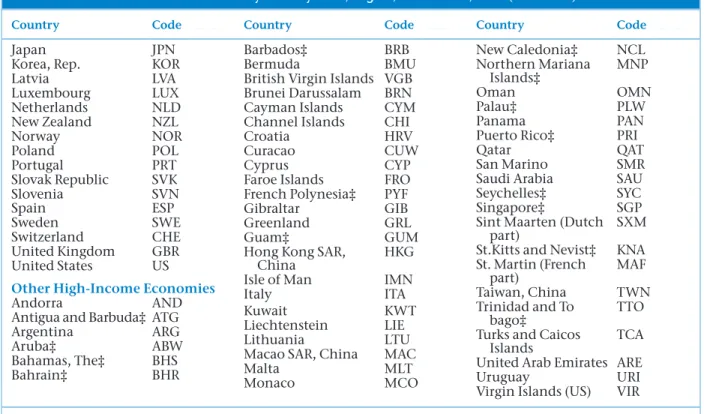
1.2 Global Ambitions: Selected Targets of the Sustainable Development Goals 18 2.1 Classification of Economies by Country Code, Region, and Income, 2018 38 2.2 Comparison of Per Capita GNI in Selected Developing Countries, Canada, the United
Kingdom, and the United States, Using Official Exchange-Rate and Purchasing Power
Parity Conversions, 2017 44
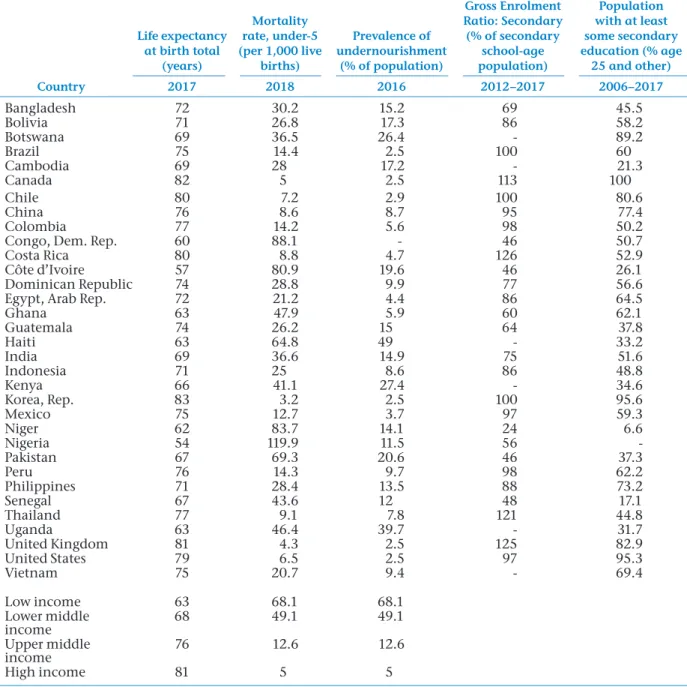
2.3 Commonality and Diversity: Some Basic Indicators of Health and Education 47 2.4 2018 Human Development Index and its Components for Selected Countries 50
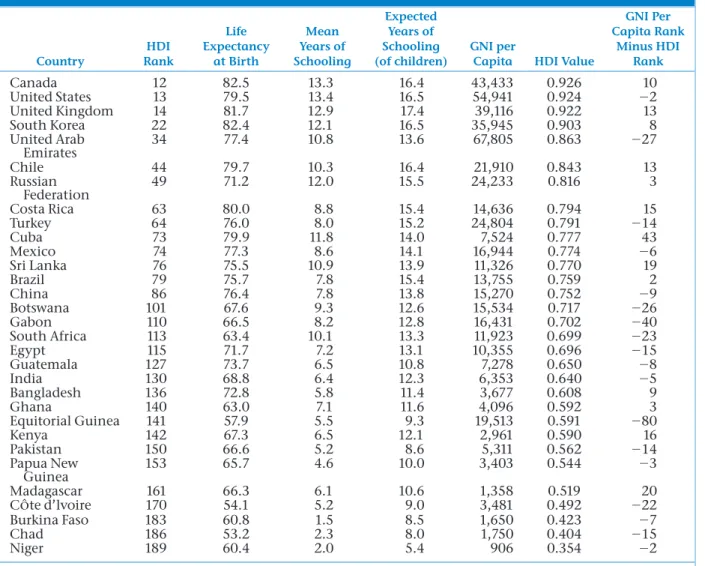
2.5 HDI for Countries with Similar Income Levels 51
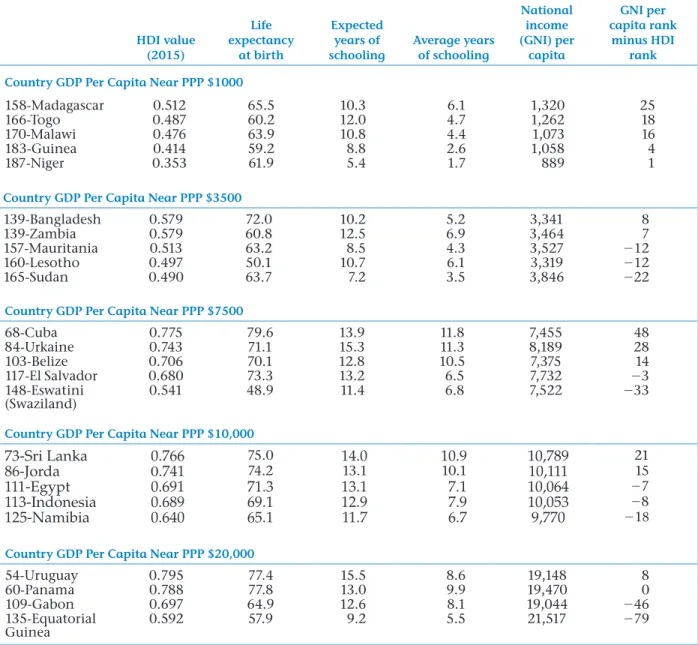
2.6 The 12 Most- and Least-Populated Countries and Their Per Capita Income, 2017 55
2.7 Primary School Enrolment and Pupil–Teacher Ratios, 2017 56
2.8 Crude Birth Rates Around the World, 2018 58
A2.1.1 2009 Traditional Human Development Index for 24 Selected Countries (2007 Data) 105 A2.1.2 2009 Human Development Index Variations for Similar Incomes (2007 Data) 106 5.1 Typical Size Distribution of Personal Income in a Developing Country by Income
Shares—Quintiles and Deciles 223
5.2 Selected Income Distribution Estimates 241
5.3 Income and Inequality in Selected Countries 244
5.4 Income Poverty Incidence in Selected Countries 246
5.5 Multidimensional Poverty Index for Selected Countries 250
5.6 Indigenous Poverty in Latin America 256
A5.2.1 Income Distribution and Growth in 12 Selected Countries 287
6.1 Estimated World Population Growth 294
6.2 Births Per Woman: Fertility Rate for Selected Countries, 1990 and 2017 298
6.3 Basic Comparisons between Burundi and Rwanda 334
8.1 Returns to Investment in Education by Level, Regional Averages (%) 398
8.2 Some Major Neglected Tropical Diseases 427
9.1 Average Annual Growth Rates of Agriculture, by Region (%) 451 9.2 Labour and Land Productivity in Developed and Developing Countries 461
9.3 Changes in Farm Size and Land Distribution 463
12.1 Structure of Merchandise Exports: Selected Countries, 2017 624
13.1 A Schematic Balance-of-Payments Account 699
13.2 Credits and Debits in the Balance-of-Payments Account 700
13.3 A Hypothetical Traditional Balance-of-Payments Table for a Developing Nation 703 13.4 Before and After the 1980s Debt Crisis: Current Account Balances and Capital Account
Net Financial Transfers of Developing Countries, 1978–1990 (Billions of Dollars) 703 13.5 Developing Country Payments Balance on Current Account, 1980–2018 (Billions of Dollars) 709 14.1 Major Remittance-Receiving Developing Countries, by Level and GDP Share, 2018 764 14.2 Official Development Assistance Net Disbursement from Major Donor Countries, 1985,
2002, 2008 and 2016 767
14.3 Official Development Assistance (ODA) by Region, 2017 767
14.4 Key Indicators foe Costa Rica, Guatemala and Honduras 786
15.1 Growth of Developing Country Stock Markets 822
15.2 Comparative Average Levels of Tax Revenue, as a Percentage of GDP 825 15.3 Comparative Composition of Tax Revenue, as a Percentage of GDP 828
xxi Economic Development, Thirteenth Edition, presents the latest thinking in eco-
nomic development with the clear and comprehensive approach that has been so well received in both the developed and developing worlds.
The pace and scope of economic development continues its rapid, uneven, and sometimes unexpected evolution. This text explains the unprecedented progress that has been made in many parts of the developing world but fully confronts the enormous problems and challenges that remain to be addressed in the years ahead. The text shows the wide diversity across the develop- ing world in their extent of economic development and other characteristics;
and the differing positions in the global economy that are held by developing countries.
The field of economic development is versatile and has much to contribute regarding these differing scenarios. Thus, the text also underlines common fea- tures that are exhibited by a majority of developing nations, using the insights of the study of economic development. The still relatively small number of coun- tries that have essentially completed the transformation to become developed economies, such as South Korea and Singapore, are also examined as potential models for other developing countries to follow. Both theory and empirical anal- ysis in development economics have made major strides, and the Thirteenth Edition brings these ideas and findings to students.
Development economics provides critical insights into how we got to where we are, how great progress has been made in recent years, and why many devel- opment problems remain so difficult to solve. The principles of development economics are also key to the design of successful economic development policy and programs as we look ahead. At the same time, international development is an interdisciplinary subject, in which approaches and insights from anthro- pology, finance, geography, health sciences, political science, psychology, and sociology have had significant influence on the subject, and are considered throughout the text. Some approaches that began as explicit critiques and alter- natives to what were then limits to development economics have become central to its study. For example, behavioural economics and experimental research now play central roles in the field.
Legitimate controversies are actively debated in development economics, and so the text presents contending theories and interpretations of evidence, with three goals. The first goal is to ensure that students understand real conditions and institutions across the developing world. The second is to help students develop analytic skills while broadening their perspectives of the wide scope
Preface
of the field. The third is to provide students with the resources to draw inde- pendent conclusions as they confront development problems, their sometimes ambiguous evidence, and real-life development policy choices—ultimately, to play an informed role in the struggle for economic development and ending extreme poverty.
Approach and Organisation of the Text
The text’s guiding approaches are the following:
1. To adopt a problem- and policy-oriented approach, because a central objec- tive of the development economics course is to foster a student’s ability to understand contemporary economic challenges of developing countries and to reach independent and informed judgements and policy conclusions about their possible resolution.
2. To teach economic development within the context of problems and potential solutions. These include challenges of absolute poverty, extreme inequalities, coordination failures, credit constraints, rapid population growth, impacts of very rapid urbanisation, persistent public health challenges, environ- mental degradation (from both domestic and climate change sources), rural stagnation, vulnerability to debt burdens and financial crises, recurrent chal- lenges in international trade and instability, low tax revenues, inadequacies of financial markets, civil conflict, and twin challenges of government failure and market failure. When formal models are presented they are used to elucidate real-world development problems.
3. To use the best available data from Africa, Asia, Latin America, and devel- oping Europe and the Middle East, and appropriate theoretical tools both to illuminate common developing-country problems, and to highlight the wide range of development levels and differing challenges across groups of countries.
4. To take a wide-angle view of developing countries, not only as independent nation states, but also in their growing relationships with one another, as well as in their interactions with rich nations in a globalising economy.
5. To consider development in both domestic and international contexts, stressing the increasing interdependence of the world economy in areas such as food, energy, natural resources, technology, information, and financial flows.
6. To provide at least a basic familiarity with research methods. The prob- lem of identifying causality is introduced by way of presenting examples of important research that also serve to build on major themes. There is no assumption that students have taken econometrics or, for that matter, basic regression analysis, but the findings boxes and other material in the text serve as a perfect entrée for instructors with students with sufficient back- ground to examine techniques introduced intuitively, including randomised controlled trials, use of instrumental variables, regression discontinuity design, differencing, and time series methods. These are all introduced in ways in which instructors may ignore the underlying econometric analysis, or build on it in supplemental course components.
xxiii
Preface
7. To treat the problems of development from an institutional and structural as well as a market perspective, with appropriate modifications of received general economic principles, theories, and policies. It thus attempts to com- bine relevant theory with realistic institutional analyses. Enormous strides have been made in the study of these aspects of economic development in recent years, which is reflected in this thirteenth edition.
8. To consider the economic, social, and institutional problems of underdevel- opment as closely interrelated and requiring coordinated approaches to their solution at the local, national, and international levels.
9. To cover some topics that are not found in other texts on economic devel- opment but that are important from our broader perspective, as part of the text’s commitment to its comprehensive approach. These unique features include growth diagnostics, industrialisation strategy, innovative policies for poverty reduction, the capability approach to well-being, the central role of women, child labour, the crucial role of health, new thinking on the role of cities, the economic character and comparative advantage of non- governmental organisations in economic development, emerging issues in environment and development, financial crises, violent conflict, and microfinance.
10. The in-depth case studies and comparative case studies appearing at the end of each chapter remain features unique to this text. Each chapter’s case study reflects and illustrates specific issues analysed in that chapter in the context of national development or specific policies. At the same time, there are common threads: the quality of institutions is considered in most of the country cases, as are indicators of poverty, inequality, and human development.
11. Boxes are used in a consistent way for two purposes. Findings boxes report on specific research findings; they serve as a vehicle to introduce students to research methods in development economics, as well as to show the con- nection between individual studies and the broader picture of economic development. Policy boxes describe major actors in development policy, including the World Bank and the IMF, and present less formal but essential approaches to policy analysis, covering topics ranging from growth diag- nostics to family planning.
12. To provide balanced coverage of differing and even explicitly opposed per- spectives wherever evidence, interpretations, and analytical frameworks are in contention.
Audience and Suggested Ways to Use the Text in Courses with Different Emphases
• Flexibility. This text provides an introduction to development economics and international development. It is designed for use in courses in econom- ics and other social sciences that focus on the economies of Africa, Asia, and Latin America, as well as developing Europe and the Middle East.
It is written for students who have had some basic training in economics
and for those with little formal economics background beyond principles (first micro- and macroeconomics courses). Essential concepts of economics that are relevant to understanding development problems are highlighted in boldface and explained at appropriate points throughout the text, with glossary terms defined in the margins and also collected together at the end of the book in a detailed glossary.
• Thus, the text should be of special value in undergraduate development courses that attract students from a variety of disciplines. It provides in-depth coverage of new institutional economic analysis and describes features of developing economies that cannot be taken for granted with a majority of students.
• Yet the material is sufficiently broad in scope and rigorous in coverage to satisfy any undergraduate and some graduate economics requirements in the field of development. For example, foundational models and empirical methods are introduced in several chapters and in about a dozen findings boxes. This text has been widely used, in courses taking both relatively qualitative and more quantitative approaches to the study of economic development and emphasising a variety of themes, including human development.
• The text features a 15-chapter structure, convenient for use in a comprehen- sive course and corresponding well to a 15-week semester but with enough breadth to easily form the basis for a two-semester sequence.
• The chapters are now further subdivided, making it easier to use the text in targeted ways. To give one example, some instructors have paired the sections on informal finance and microfinance (15.3) with Chapter 5 on poverty. Similarly, some have paired civil conflict (14.5) with poverty. With further subdivisions of sections, additional selections and orderings are possible.
• Courses with a qualitative focus. For qualitatively oriented courses, with an institutional focus and using fewer economic models, one or more chap- ters or subsections may be omitted, while placing primary emphasis on Chapters 1, 2, 5, 6, 8, and 9, plus parts of Chapters 7 and 10, and other selected sections, according to topics covered. The text is structured so that the limited number of graphical models found in those chapters may be omitted without losing the thread, while the intuition behind the models is explained in detail.
• Courses with a more analytic and methods focus. These courses would focus more on the growth and development theories in Chapter 3 (including appendices such as 3.3 on endogenous growth) and Chapter 4, and highlight and develop some of the core models of the text, including poverty and inequality measurement and analysis in Chapter 5, microeconomics of fer- tility and relationships between population growth and economic growth in Chapter 6, migration models in Chapter 7, human capital theory, including the child labour model and empirics in Chapter 8, sharecropping models in Chapter 9, environmental economics models in Chapter 10, tools such as
xxv net present benefit analysis in Chapters 8 and 11; and multisector models
along with political economy analysis in Chapter 11, and trade models in Chapter 12.
• Courses that also have an empirical methods focus. Regarding empirical methods, these courses would expand on material introduced in some of the findings boxes and subsections into more detailed treatments of methods topics, including randomised controlled trials (Boxes 4.2, 8.4, 8.5, 8.6, 8.9, 11.3, 12.2, and 15.2, Case Study 8), use of instrumental variables (Box 2.3 and Section 2.7), regression discontinuity (Boxes 2.2, 2.4), differencing (Box 9.2), and time series methods (Box 12.1). The introduction of several of the studies provides an excellent jumping-off point to using supplementary materials for examining methods in detail.
• Courses emphasizing human development and poverty alleviation. The thirteenth edition can be used for a course with a human development focus.
This would typically include the sections on Amartya Sen’s capabilities approach, the new section on the Sustainable Development Goals and the history of the MDGs in Chapter 1; a close and in-depth examination of the section on societal conflict in Chapter 14, the discussion of informal financial arrangements including ROSCAs, microfinance institutions in Chapter 15;
and a close and in-depth examination of Chapters 2 and 5. Sections on pop- ulation policy in Chapter 6; diseases of poverty and problems of illiteracy, low schooling, and child labour in Chapter 8; problems facing people in traditional agriculture in Chapter 9; relationships between poverty and envi- ronmental degradation in Chapter 10; and roles of nongovernmental organ- isations (NGOs) in Chapter 11; the section on societal conflict in Chapter 14;
and discussion of informal financial arrangements including ROSCAs, microfinance institutions in Chapter 15, as be likely highlights of this course.
• Courses emphasising macro and international topics. International and macro aspects of economic development could emphasise Sections 2.6 and 2.7 on convergence, and long-run growth and sources of comparative development; Chapter 3 on theories of growth (including the three detailed appendixes to that chapter); Chapter 4 on growth and multiple-equilibrium models; and Chapters 12 to 15 on international trade, international finance, debt and financial crises, direct foreign investment, aid, central banking, and domestic finance. The text also covers other aspects of the international context for development, including the in-depth cases on the 1980s debt crisis and the 2000s financial crisis in Chapter 13; implications of the rapid pace of globalisation and the rise of China (Chapter 12 and case studies of China (Chapter 4), India (Chapter 5), and Brazil (Chapter 13); the continuing struggle for more progress in sub-Saharan Africa, and controversies over debt relief and foreign aid (Chapter 14).
• Broad two-semester course using supplemental readings. Many of the chapters contain enough material for several class sessions, when their top- ics are covered in an in-depth manner, making the text also suitable for a year-long course or high-credit option. The endnotes and sources offer many starting points for such extensions.
Preface
Summary of Key Material New or Expanded for This Edition
In addition to a thorough updating and reporting the most recently available data, the Thirteenth Edition includes significant new material, including:
• A new presentation of the Sustainable Development Goals, which also pro- vides a brief history of the MDGs, and progress and challenges in imple- mentation (Section 1.7).
• How levels of living differ around the world, with an exploration of the household level—as distinct from country averages, inspired by the late Hans Rosling (Section 1.2).
• Newly added graphs and statistics on the great divergence in incomes over 250 years, and new evidence of a recent shift toward (re-)convergence (Section 2.5).
• Expanded section on growth diagnostics, including new material on growth diagnostics in practice, with an example of “inclusive” growth diagnostics applied to Bangladesh (Section 4.7 and Box 4.4).
• New material on how insights from behavioural economics and findings using experimental behavioural economics methods have been used to better understand and address poverty, physical health, and mental health problems (Section 5.8.6 and Box 8.9).
• A new section on labour that features material on characteristics of inclusive development in addition to the subsection on the functional distribution of income (Section 5.7).
• A new section discussing policy for still-developing middle-income coun- tries facing population declines (Section 6.6.4).
• A new section on agricultural extension that also serves to introduce the case study on extension for women farmers in Kenya and Uganda (Section 9.2.3 and Case Study 9)
• An expanded section on adaptation to climate change, which also considers the extent to which adaptation and resilience assistance differs from conven- tional development assistance (Section 10.2.3 and Box 10.4).
• The section on the new firm-level international trade approach features experimental findings on the effects of exporting on firm performance (Section 12.6.2 and Box 12.2).
• A restructuring of the presentation of much of Chapter 13 on debt and finan- cial crises as case studies of major events that draw out more general prin- ciples (Sections 13.4 and 13.5).
• The introduction of ROSCAs as a potentially beneficial financial arrange- ment is set out in a short subsection (Section 15.3.2).
• Case studies and findings boxes are described in the next section.
xxvii
In-Depth End of Chapter Case Studies
There is a strong focus on in-depth case studies, with new end of chapter cases and major updates of existing studies. A majority of them are comparative case studies.
The end of chapter Case Studies has been one of the most popular features of the text. These cases apply the general findings in development economics as discussed in the chapter to interpreting experiences in specific countries, and in some cases specific programs. The cases address important country topics and development experiences.
Three in-depth cases look at the economic development successes and challenges of a single major developing country: China, India, and Brazil.
Single-Country Case Studies The Case Study on China (Chapter 4, pages 202–214) has been substantially expanded in scope to provide a comprehensive view of the major argued sources of success and serious challenges going for- ward advanced in the scholarly literature. There is an entirely new full length case study of economic development in India (Chapter 5, pages 272–279), that offers a similarly comprehensive examination of major sources of success and challenges going forward. The case study of Brazil (Chapter 13, pages 737–744) has been extensively revised and updated and now provides, among other things, consideration of the potential for middle-income traps and elements for escaping them. In addition, there is one specialized single-country case study, on the Progresa-Oportunidades-Prospera program in Mexico, which has been updated for this edition.
Comparative cases The country comparative cases have received strong inter- est and active in-class use. This feature is now expanded further, so that there are 11 comparative studies (at the ends of Chapters 1, 2, 3, 6, 7, 9, 10, 11, 12, 14, and 15).
Nine major end of chapter cases assess successes and challenges in overall national economic development experiences in two countries selected for the relevance of addressing them in comparative perspective and in the context of the chapter.
There is a new comparative case study on Burundi and Rwanda (Chapter 6, pages 332–336), which has particular emphasis on demography, as well as i