f
Thisisanauthorizedfacsimile and was producedbymicrofilm-xerography
in
1980
byUNIVERSITY MICROFILMS INTERNATIONAL Ann
Arbor, Michigan, U.S.A.London, England
Copyrightedmaterial
Thismaterialwas produced froma microfilmcopyof theoriginaldocument. While themostadvanced technologicalmeanstophotograph andreproducethisdocument havebeen used, thequalitybheavilydependentuponthe quality of the original
The following explanationof techniquesis provided tohelp you understand markings or patternswhichmayappearonthisreproduction.
1.Thesignor"target"forpages apparentlylackingfromthedocument photographedis"MissingPage(s)".If itwaspossibleto obtainthemissing page(s)orsection,theyare splicedinto tnehtmalongwith adjacentpages.
Thismayhave necessitated cutting thru an imageandduplicatingadjacent pages toinsureyou completecontinuity.
2.Whenanimageonthefilmisobliteratedw<th alargeround black mark,it isanindicationthat the photographer suspectedthatthecopymayhave movedduringexposure andthuscause a blurred image.Youwillfind a goodimageofthepageintheadjacent frame.
3.When a map. drawingorchart,etc.waspartof thematerialbeing photographed the photographer followed a definite method in
•'sectioning"thematerial.Itiscustomaryto begin photoingattheupper lefthandcorner of alargesheetandto continue photoingfromleftto rightin equalsections withasmalloverlap.Ifnecessary, sectioningis continued again—beginningbelowthe hcstrowand continuingonuntil complete.
4.Themajorityof users indicatethatthe textualcontentisof greatest value, however, a so
m
ewhat higherqualifyreproductioncouldbemade from"photographs"ifessentialto the understanding of thedissertation. Silver printsof"photographs"maybe orderedatadditionalchargebywriting theOrder Department, giving the catalognumber, title, author and
i.PLEASE NOTE: Some pages may have indistinct print. Filmed as received.
XeroxUniversityMicrofilms 996HortftZstbRo#4
76-29,838 BHANDARI, Labdhi Pat Raj, 1948-
COMMUNICATIONS FOR SOCIAL MARKETING: A METHODOLOGY FOR DEVELOPING COMMUNICATION APPEALS FOR FAMILY PLANNING PROGRAMS.
Columbia University, Ph.D., 1976 Business Administration
XeroxUniversityMicrofilms,AnnArborM.ch.oMwoe
©
1976LABDHI PAT RAJ BHANDARI
ALL RIGHTS RESERVED
A METHODOLOGY FOR DEVELOPING COMMUNICATION APPEALS
Submittedinpartial fulfillment of the requirements for thedegreeof DoctorofPhilosophy
under the Executive Committee of the Graduate School of ArtsandSciences
FOR FAMILY PLANNING PROGRAMS
Columbia Uni ity 1976
Copyrightedmaterial
COMMUNICATIONS FORSOCIAL MARKETING:
AMETHODOLOGY FOR DEVELOPING COMMUNICATION APPEALS FOR FAMILY PLANNING PROGRAMS
LABDHI PAT RAJ BHANDARI
This study has developed and tested an appraoch andamethodology foridentifying persuasive conraunication appeals that have the best chances of influencing people's attitudes and behavior in the area of socialmarketing, specifically, family planning. It canbe used by socialmarketers for designing communication campaigns.
Social psychologists and sociologistshave emphasized that people's value systems and their perceptionsof how these values are
relatedtoan object (behaviororperson), have an important influenceon their attitudes and behavior towards that object. In designinga familyplanning conraunication, thechoiceof its two most important elements
—
'messageappeal1 and 'source'—requires an under- standingof the value system and perceived value-instrumentalities of the target population. Littleresearch in family planning has been addressed to the problem of 'appeal' determination.A methodology for generating relevant information about the target population, forthe purpose ofdesigningcocanunications, should elicit their value systems, andperceived value-instrumentalities, in addition to measures of communication effects, media, demographic and
<
socio-economic variables. The Instruments usedfor ascertaining values
Copyrightedmaterial
should have cross-cultural applicability, and should allow for the use of standard sanpling procedures.
Themethods usedincommercial advertising field involve pre- selection of dimensions and/or objects on which responses are sought, thus, restricting observation to target population's views about our concerns rather than their concerns and values. The methodology tested in thisstudy usesa relativelynew method, called ECHO technique, for generating value hierarchies of target populations as well as perceived patterns of influences operating on their lives. Themethod combines the advantagesofasurveymethod with those ofaphenomenological approach. Itpreselects valence—good orbad—but allows for thedimen- sions or objectstobeempirically generated. The value responses as well as sources of influence are classified into categories by indigen- ous classifiers. A measure of value-instrumentality that uses the values generated in the same interview has been developed and tested in this study. The fieldwork for the test was conducted in North India.
The results confirm the postulated relationships among subsets of values and the criteria variables
—
practiceof, attitude towards, intention to practice, and awareness of family planning. Similarly, strong and consistent relationships emerge between criteria variables and value-instrumentalities of family sire and family planning. Among themore important values of the sample concerm health, children's wel- fareand children turning out tobe 'worthy', family harmony, community disputes and occupation. The usersof familyplanning have a more positive outlook and perceivea greater control over events in theirlives than do nonusers. The valuesprovide content for messages.
Aframework for developing communication strategies that segments targetpopulation on the basis of:usage, intention, and attitude, isused inthe study. Among current users and those whointend to usein the future, favorable value- instrumentalities should be emphasized in coanu- nications, particularly those between family planning andgood health*
family harmony, children'swelfare and the chances of their turning out to be worthy, progress on farm, andinoccupation, etc. These appeals canalso be used with nonusers who do not intend to practice in the future, however, favorable instrumentalities will have to bepromoted as such perceptions are not widespread, and are sometimes unfavorable. Ctoearu- nications designedtocounter widespreadbeliefs about anti-Cod nature and adverse effects of birth control methods, particularly sterilization, are needed. Communications promoting appreciation of reduced infant- and child-mortality and negativeeconomic valueof having many children are also recommended.
The results indicate that influential people of a commun ity with whom the audience can identify, and religious leaders and holy men are more likely to be effective 'sources' of communication than urbanised change agents. Useof local dais—midwives—isrecommended for promoting family planning acceptance. Aproduct-mix that allows for more alternative methods
—
including thepill—
is also recommended inviewof the widespread anti-God and negative-health connotations of sterilization.Copyrightedmaterial
ACKNOWLEDGMENTS Chapter
X. INTRODUCTION 1
Problem Statement Background; The Need
Expected Contribution of the Research II. DEVELOPING COMMUNICATION APPEALS:
THEORETICAL FOUNDATIONS 7
Models of Communication: A Brief Review Segmentation Approach
Values and Valuc-Instrumentalites as Sources forCommunication Appeals
lit. THE METHODOLOGY 29
Requirements ofaMethodology Proposed Methodology
IV, DESCRIPTIONOFTHE STUDY -. ,47
Objectives Pretest location Sample
Recruitment and Training of Interviewers FieldWork
Adaption and Pretesting in Local Language Measures and Instruments
Classification and Coding
Summary of Variables and Codes V. EXAMINATION OF RELATIONSHIPSAMQSr.
COGNITIVE SYSTEM AND BEHAVIORAL VARIABLES 68 Organization
Classification of Variable Values of Variables
Relationships Among System Variables Discriminating Between Users and Non-Users-
Multivariate Analysis of Relationships Conclusion
VI. DETERMINING COMMUNICATION APPEAI.SFDR
TARGET POPULATION SEGMENTS 135
Organization
Segmenting the Target Population Suggested Communication Appeals Source Variables
Comparison with Current Communication Campaign
VII. CONCLUSIONS 184
Values. Value-Instrumentalities and Their Relationships with Attitude and Behavior An Evaluation of the Methodology
Implications for a Social Marketing Program inFamily Planning
APPENDIXBi
—— — — — —J m. • »—w *
Some Photographs of the Field Work inIndia . .
• • •
APPENDIXC»
APPENDIXE: Final Value Categories and Their Constituent Items . . 239
. .245
ILLUSTRATION
Figure
1. Segmentation Approach 13
2. Cognitive System 15
3. Target Population Segments 136
Map
1. Rajasthan, India 49
Copyrightedmaterial
1. Aspects of Message Variables 3
2. Models of Communication 9
3. FrameworkforCommunication Intervention 26 4. Values Included inThe Rokeach Value Survey 37 5. Rural and Urban Areas Sampled: Key Characteristics 51
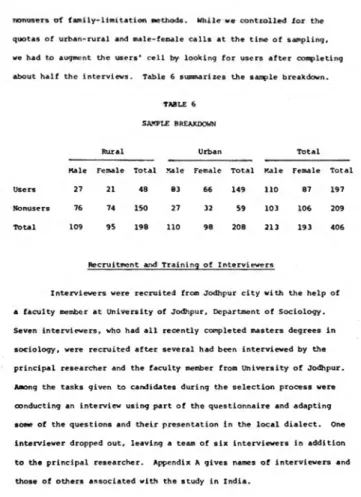
6. Sample Breakdown 52
7. BeliefsAbout Family Planning 58
8. Aggregate Values of Socio-Deoograihic and Media Variables, and Knowledge. Attitude. Perception and Beliefs About
Family Planning . 71
9. Values of Criteria Variables 70
10. Correlations Arong Criteria Variables 74
11. Chi Square Relationships Among Criteria Variables 76 12. Partial Correlations Among Criteria Variables 7?
13. Cross-Tabulation of Attitude by Awareness 78 14. Cross-Tabulation of Intention by Attitude 79
15. Cross-Tabulationof Usage by Attitude . 80
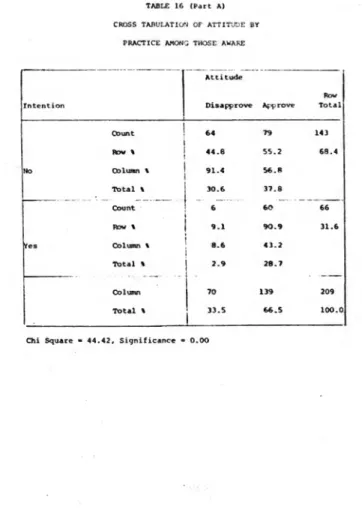
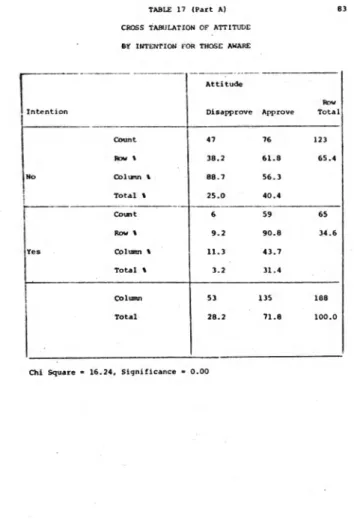
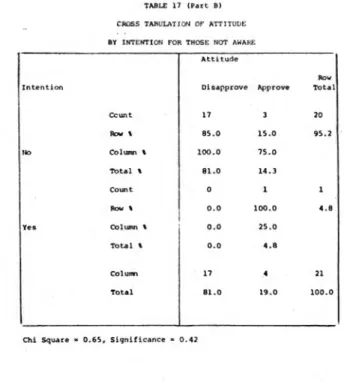
16. Cross-Tabulation of Attitude by Usage by Awareness 81 17. Cross-Tabulation of Attitude by Intention by Awareness
....
8318. Correlations between Criteria and Socio-Demographic and
Media Variables 86
19. ChiSquare Relations between Criteria and Socio-Dcraographic
and Media Variables 87
20. Partial Correlations between Criteria and Socio-Demographic
and Media Variables 89
21. Correlations of Criteria Variables with Beliefs About
Family Planning 90
22. Chi Square Relationships of Criteria Variables with Beliefs
about Family Planning 91
23. Partial Correlations Between Criteria Variables and
Beliefs about Family Planning 92
24. Correlations Among Beliefs About Family Planning 93 25. Factor Analysis of Beliefs About Family Planning 95 26. Values: Frequencies of 'Good ThingstoHappen' 98 27. Values:Frequencies of 'BadThingstoHappen'
...
9928. Values: Frequencies of 'Good Acts' 100
29. Values: Frequencies of 'BadActs'
...
101 30. FactorAnalyses of Values: Key Characteristics 104 31. Factor Analysis of All Value Responses 106 32. Value Categories: Frequencies for 'User-Nonuser* Subgroups . . **1 33. Value Categories: Frequencies for'Urban-Rural' and•Male-Female' Subgroups
U3
34. Correlations of Value Categories with Criteria Variables . . .
IM
35. ChiSquare Analysis of Relationships Between Value
Categories and Criteria Variables 12°
36. Partial Correlations Between. Value Categories and Criteria Variables
37. ChiSquare Relationsof Value-Instrumentalities of 'Having
Many Children' With Criteria Variables 125
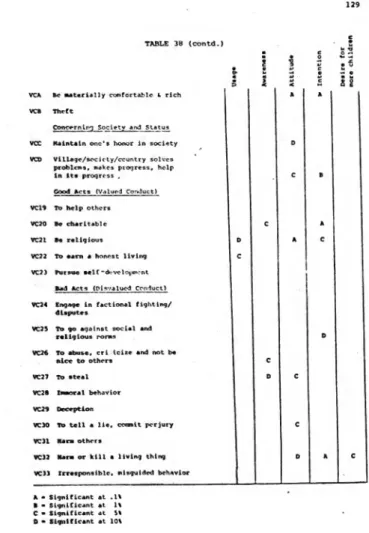
38. Chi Square Relationsof Value-Instrumentalities of
•Family Planning' with Criteria Variables 127
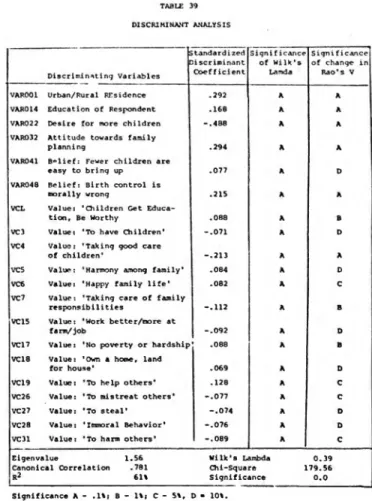
39. Discriminant Analysis
—
Coefficients 13140. Discriminant Analysis—Classification Results 133 41. Socio-Demographic and Media Characteristics of Segments . . .138 42. Knowledge, Attitude, Perceptions and Beliefsof Segments
about Family Planning 141
43. ValueHierarchies of Segments 145
Copyrightedmaterial
45. Instrumental Relationships of Values for Users and Nonusers . 150 46. Instrumental Relationships of Values forNonuser
Segments 154
47. Perceived Sources of Causation 176
48. Perceived Sources of Causation ofSom«»Values 177 49. Perceived Sources of Approval/Disapproval
...
1795JL. LocalNewsSources 1B0
ACKNOWLEDGMENTS
This dissertation would have been impossible without the contribution of agreat many people. That ithasbeen possible isdue, inno small measure, to the help and encouragement of my advisor, Professor JohnU. Farley. Professor Farley provided the inspiration necessary to convert what was onceamere hope, into this dissertation.
For his continued guidance, encouargement and support, I amdeeply grateful. Iowe aspecial debt of gratitude to Professor James M.Hulbert.
Professor Hulbert has not only been very helpful at various stages of thedissertation project, he has beena constant source of encouragement throughout my stay at Columbia University. Professor GaryR. Bridge isresponsible forintroducing me to the world of value-research. I am most grateful tohim for his invaluable advice and support at all stagesof the project. 1 am thankful to Mr. Philip Harvey and Professor Michael Cantor fo serving on my defense committee, along with Professors Farley, Hulbert and Bridge.
Agreat manypeople—village leaders, school teachers, government servants, friends, relatives andwellwishers—extendedtheir help and assistance at various stages of this project, and particularly during thefield work stage. 1 am most thankful toallof them. I oweadeep debt of gratitude to allthose who agreed to be interviewed and patiently respondedtothequestions, often interrupting their important daily chores. I am thankful to the field staff for their enthusiasm and hard work. I am specially grateful to Shri Copal Bhardwaj forhis invaluable assistance in starting the field workin India. I also thank
Copyrightedmaterial
of Management. Ahmedabad, forhelping to arrange keypunching of the data andpreparation of the final computer tape.
This project waspartially financed througharesearch grant (No. T74-029C) awarded by The Population Council. New York, andI gratefully acknowledge their support. I also thankColumbia University, Graduate School of Business, NewYork for providing facilities for this research. Mr. JohnHeuston and his staff deserve special thanks fordoing a fine joboftyping themanuscript while working under considerable time pressure.
My deepest debtof gratitude is tomy parents, and to my wife, Santosh, for their encouragement and affection without which this study would nothave been possible.
1
CHAPTERI
INTRODUCTION
Problem Statement
Social Marketing hasbeen defined as the "design implementation and control of programs calculated to influence the acceptability of social ideas andinvolving considerations of product-planning, pricing, communication, distribution and marketing research" (Kotler, 1971). The problem of developing communication appeals to influence attitudes and behavior has not received much attention inthearea of social marketing.
The present study isconcerned with the investigation of this problem, andwith thedevelopment of a methodology for selecting communication appeals inthe social marketing field, particularly family planning.
Back roundi The Weed
Studies in family planning communications have not seriously investigated theproblem of "appeal" or "message" determination (Bhan- dari, 1973i Schramm. 1971, Rao, 1974: Pareck&Rao, 1974). The only studies concerned with appeals have been pretests of communications or their executions incorporating predetermined alternative messages
(Farley&Harvey, 1972, Lieberman, 1973). Such studiescan result in potentially useful communication appeals only under conditions where
Copyrightedmaterial
*great deal is Known about the motives and valuesystemof target populations. In such instances the alternative messages that are tested are themselves chosen after the relevant motives and values have been ascertained systematically. This, however, isnot true inmost cases.
This problemis more acutewhenmethods (ofappeal selection) developed inone culture are applied in another culture.
Communication-Persuasion field has hada rich tradition of research among behavioral scientists as well as marketing and adver- tising researchers (see McGuire. 1973 and Holbrook. 1974 for reviews of communication-persuasion research and advertising research respec- tively). McGuire has analysed research under the five aspects of verbal communications: namely, source, message, channel, receiver, and destination (McGuire, 1973). Itis the message variables inpersua- sive communications thatweare most concerned within this study.
Several aspects of contentaswell as structural variables of messages have been studied. Content variables relate to appeals and style of delivery, structural variables,onthe other hand, concern organization of the content and inclusions and omissions, e.g., opposition arguments, conclusions, andrepititionsofthemessage (McGuire, 1973). Table 1 summarizes the aspects of message variables that have been researched.
Research on type of appealmadeinpersuasive messages has been primarily concerned with the questionof threat and fear arousal. The work done onstructural variables and stylistic content variables, while some of itis inconclusive, provides some guidelines for message design. The question of what specific appeals. goals. should persuasive communication be basedonhas receivedonlylimited attention (McGuire, 1973ip. 233)
3
TABLE 1
ASPECTS OF MESSAGE VARIABLES
Category of
Message Variables Sub-cateooric k Soociffcj^^v-wata>icawKactorscov»wa.•>
Content variables Stvlisticvariables Sneakina skills 1. Faulty grammar, poor
organization,pauses 2. Dynamicvs. subdued
- delivery style
3. Metaphorical vs.
Literal Expression
- Appeals 1. FearAppeals
•
2. Rationalvs. Emotional
• 3.Goal-instrumental Structural variables Inclusions and 1.Treatment of opposition
Omissions arguments
2. Implicit vs. Explicit conclusions
3. Repetition of persuasive message
Organisationof 1. Ordering content for Message Content desirability
2. Primacy- Recency
Based on McCuire, William, "Persuasion, Resistance and Attitude Change" in Handbook of Communication, Pool et al.. eds. (Chicagoi RandMcNally, 1973), pp. 233-7.
Copyrightedmaterial
The formulationof functional theoriststhata person's attitude toward anobject is a composite of his perception of how the object facilitates attainment of various goals and how highly he evaluates those goals, is highly relevantto thequestion of appeals to be used in message content.
This formulation has generated much interest and resulted in formulation and testing of models of attitude structure both inbehavioral science and marketing. However, the question of identification of the goals
(motives, values) and their usein communication appeals has been largely ignored. It isthis question whichis theprimary concern of the present study.
The formulation, (1) that an individual's behavior is influenced by hisattitude towards the relevant object, and (2) that his attitude as wellasbehavior are influenced by his values (motives or goals), and hisperception of instrumental relationships between the object and the values,has itstheoretical and philosophical basis in the field theo- retic concepts of Kurt Lewin (Deutsch, 1968). cognitive consistency theorists further hold that an individual strives to maintaina state of perceived consistency among his beliefs, attitudes, values and behavior.
Any discrepency among the cognitive and behavioral system variables is psychologically painful and an individual strives to reduceit (Heider, 1958, Osgood£Tannenbaum, 1955; Festinger, 1957;McGuire. 1960). Rokeach hasrecentlyprovideda systematic and detailed statement of cognitive- system variables, and hasemphasized the central role that an individual's value system playsin it (Rokeach, 1973). There isevidence that attitude and behavior can be altered by modifying an individual's value system or hia perceived instrumental relationships between attitude-object and
values (Katr, 1960; Carlson, 1956;Ttokeach, 1973). Thus,ifan individ- ual's values and perceived value -instrumentalities have such an important influenceon his attitudes and behavior, persuasive-communication appeals must reflect thevalues of the individual if they areto beeffectivein .
influencing his attitudes and behavior. An appeal thatisbasedona
ore
centrally held value and on its positive instrumentality with an object issore likelyto result in a favorable attitude towards that object than an appeal based onaless centrally held value. It is, there- fore, importantto identify and understand the value system ofa target population in order to attempt attitude and behavior modification. Since valuesand perceived value-instrumentalities differ across cultures and even subcultures, these must be uniquely determined for each homogenous groupof people. While no broad guidelines, asin thecaseof message- structure variables, can, therefore, be expected, amethodology that sytematically generatesatarget population's value-hierarchies, their perceived value-instrumentalities of object or behavior in question, as well as their attitudes toward the object and other relevant information, would be a useful contribution to this applied field of social marketing.This study attempts todevelop and-testsucha methodology of generating information useful for selecting communication appeals.
Expected Contribution of the Research
The present study belongs to thecategory of applied research.
Itexamines and interprets theoretical formulationsin thebehavioral sciences, specifically social pyschology, from the problem-orientation of selecting communication-appeals fora social marketing program; and
Copyrightedmaterial
6
developsa vehicle (methodology) for application of knowledge from behavioral science to help promote socially desirable programs (like family planning). Italso presentsa segmentation framework for formula- ting communication strategies. Themost important customer of this research isthe social marketer, the manager of social marketing pro- grams. The output of thisresearch—anapproach and methodology for designing communicationappeals—should, therefore, not only be useful tohim, butitshould also be feasible for himtouseitwithin the con- straints under which program managers generally operate.
This research isrelevant to at least two other important issues.
First, itexamines relationships among the entire hierarchy of cognitive systemvariables—values, perceived value-instrumentalities, attitude
—
cognitive, affective and co native (intention)—andbehavior. To our knowledge values and value-instrumentalities have not been included before inan examination of cognitive system relationships. Second, methodologies for measurement of values, and value instrumentalities areonly recently beginningto emerge; this research contributes towards development of suchamethodology. Other contributions of the research Include (i) substantive communication appeals for promoting family planning among an Indian sub-culture, and (ii) anapproach tounderstanding value-orientation and sources of attitude towards products among consumers, with potential application inthecommercial marketing field for value- segmentation and product-positioning.
7
CHAPTERII
DEVELOPING COMMUNICATION APPEALS: THEORETICAL FOUNDATIONS
Inthe introductory chapter abrief mention was made of the per- vasive influenceof values on attitudes and behavior. The need to understand the value system and perceived value-instrumentalities (of attitude-objects) of atarget population for influencing the attitudes andbehavior of its members was also emphasized. This chapter considers thetheoretical foundations of the hierarchy of behavioral and cognitive system variables with the objective of providing support for the approach taken inthis study. Specifically, theoretical basis isprovided for using: (i) values and value-instrumentalities as sources for selecting appeals for persuasive communications, (ii) cognitive-consistency approach as the basis for message-strategy, and (iii) asegmentation framework based on behavior, intention and attitude as segmenting variables for appeal strategy. A brief review of systematic positions Incommunication theoryIspresented first.
Models of Communication: A Brief Review
There IsanImpressivebodyof literature concerning commun- ication theories and research, inside andoutside of marketing. While different traditions have focused on differentaspectsofcommunications, almost all emphasize. In varying degrees, both the "process* and the
Copyrightedmaterial
-effects- of communi cations. We shall briefly review some of the impor- tant formulations of communication theories.
CU The hierarchy of effects model, as conceptualized by Lavidge and Steiner (1961), isessentiallya process model that assumesa chain of cognitive (awareness, knowledge), affective (liking, preference), and conative (conviction, purchase) stages through which the receiver (of communication) passes. This focuson process is shared, as can be seen inTable2, by most other models of communication, and has permeated much of the communication and advertising research. While this hierarchic- model providesan attractive and useful framework, it is not to be viewed asaone way flow of progression from message reception to behavior. As has been pointed out by Palda (1966), these stages need not be undircctional and are not always either necessary or sufficient for subsequent stages.
(2) Innovation adoption models, developed in the field of rural sociology, view the adopter as moving througha series of stages—awareness, interest, evaluation, trial and adoption (Rogers, 1962). These models recognize that different kinds of communications like impersonal (mass- communication) and personal (interpersonal) varyin the importance of their roles at different stages of adoption hierarchy (Rogers and Shoemaker, 1971).
Atmicro-level thefinal stage in the communication effects hierarchy is adoption, at macro-level itis diffusion. These approaches recognize the effects of social and psychological mediating variables (Rogers, 1962, Amdt, 1967).
(3) McGuire's communication-persuasion process framework ana- lyses"communication (independent-variable side of the attitude-change process) into five classes of components, and being persuaded (thedepen- dentvariable side of the process) into sixbehavioral steps" (McGuire,
9
TABLE 2
MODELS OFCONMUmCATION
Models
Cognitive Stage
Affective Sta<jC
Conative Stage
"AIDA" Model Strong (1925)
Attention Interest Desire
Action
"Hierarchy of Effects" Model Laridge&Steiner (1961)
Awareness Knowledge
Liking Conviction
"Innovation Adoption" Model Rogers (1962)
Awareness Interest Evaluation
Trial Adoption
"Communication-Persuasion Process"
McGuire (1973)
Attention Yielding Retention
Overt Behavior
"Theory of Buyer Behavior"
Howard& Sheth (1969)
Attention Comprehension
Attitude Intention Purchase
Copyrightedmaterial
1973, p. 219). The fivecomponcrrtsof
who says what to whom, via what medium, and with what effect, are: source, message, channel, receiver and destination. The six successive behavioral steps are: "Being presented with the communication (presentation), attend- ing to it (attention), comprehending its content (comprehension), yielding toit (yielding), retaining this new position (retention), and acting on thebasis of it (overtbehavior)- (McCuire, 1973, p. 221). The resultant- matrix of the components and the behavioral steps provides a very useful framework for evaluating the efficacy of a communication campaign, as well as for designing persuasive communications.
(4) The Howard-Sheth theory of buyer behavior, (Howard-Sheth, 1969) includes search, attention, comprehension, attitude and intention aspart of the buyer behavior process. More recently, HowardtHulbert (1973) have presentedamore information-processing-oriented approach that includes processes of short and long term memory.
Inaddition to the above-mentioned systematic treatments, indi- vidual variables like attention, perception, memory, or attitude have been studied by psychologists. The original cognitive-af fective-conative paradigm, the precursor of the hierarchy of effects and other models was provided by modelsinpsychology (Brown,1965, Krech.Crutchfield and Bal- lachy, 1962). Mass communication researchers have also renounced the
"hyperdermic effect," "one step flow" model in favor of "two step flow"
(Katxand Lazarsfeld, 1955), and "multi-step flow" (Rogers and Shoemaker, 1971) models which recognize social factors like word-of -mouth, and psychological factors like selective attention, perception, and retention thatmediate between exposure toacommunication and its effects.
11
The preceding review clearly suggests that design of commun- icationcampaigns should take into account the process variables commonly conceptualised as cognitive, affective and conative stages. These pro- cessvariables can serve as critieria or objectives for communication messages. At macro-level these process variables can serve as criteria for segmenting a target-audience and designing appropriate communication campaigns for each of the segments. Wedeal with this segmentation approach in the next section.
Segmentation Approach
Communication theory and research suggest hierarchical process models as frameworks for formulating communication strategy. It seems useful to identify the stage (inthishierarchy) at whichone's target population is. segment iton that basis anddesign messages and employ mediaaccordingly. Theoretical support for segmentation by level of audience awareness and interest also comes form Cartwright's analysis
of the influence process (Cartwright. 1949). According to Cartwright:
What happens pyschologically when someone attempts to influence the behavior of another person? The answer, inbroad outline, may be described as follows: To in- fluence behavior, achain ofprocesses must be initiated within the person. Theseprocessesare complex and inter- related,but in broad terms they may be character ired as (i) creatingaparticular cognitive structure, (ii) cre- ating a particular behavioral (action) structure. In other words, behavior isdetermined by the beliefs,opin- ions,and "facts" a person possesses; by the needs, goals, and values hehas; and by the momentary control held over hisbehavior by given features of his cognitive and mo- tivational structure. To influence behavior "from the outside" requires the ability to influence these deter- minantsinaparticular way.
Mostmodelsofcommunication processrecognise these stages. Hehave.
Copyrightedmaterial
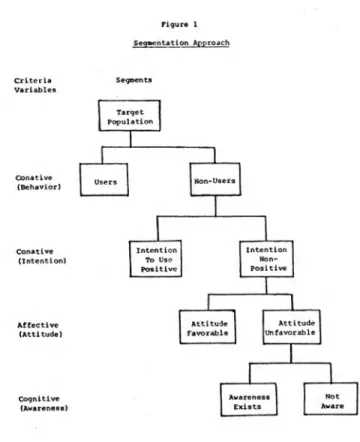
therefore,used variables thatreflect these stages as the criteria variables for segmenting the target population for formulating com- munication objectives and strategies. A schematic representationof theapproach isgiven inFigureI.
While there isconsiderable theoretical supportinthemodels of communicationfor this segmentation approach, it shouldbeborne inmind that sometimes some stages may be skipped or that reverse effects
—
behavior affecting attitude—
may exist. These, however, do not reduce the usefulness of the hierarchicalapproach (O'Brien, 1971),forthe task of designing messages forinfluencing behavior, inter- vening stages must be taken into account. Fromapragmatic viewpoint, such a segmentation approach ishighly attractive and the wide popu- larity of hierarchical approach for setting communication objectives anddesigning strategies confirms its pragmatic appeal (MSI, 1968?
Cooke, 1966). Marschner (1971) goes so far as totreat a company's use of chainof communication effects as prescribed by DAGMAR (Colley, 1961) toevaluate its advertising, asan index of its potentialfor success.
He supports his contention with high correlations across nine oil com- panies between the extenttowhich each used DAGMAR and three financial indicesof its success.
Values and Value-Instrumentaliti»s asSources for Communication Appeals
It was pointedoutin the introductorychapter that the problem ofdetermining the nature of appeals for communication-message-content hasnot been investigated systematically, with the exception of fear appeals. One possible reason for this lack of interest could be that
•
13
Figure 1 Segmentation Approach
Criteria Variables
[
Target Population
I
Conative
(Behavior) Users Non-Users
Conative (Intention)
Intention To Use Positive
Intention Non- positive
Affective (Attitude)
Cognitive (Awareness)
Attitude Favorable
Attitude Unfavorable
Awareness Exists
Not Aware
Copyrightedi
appealsfor message-content depend cm the natureof the issue or pro- duct about which communicationisbeing designed. Thus, being situa- tion-specific, a largevariety of appeals are employed and they do not lend themselves to a systematic investigation. However, tobe successful in Influencingthe attitude and behaviorof an audience, the importance of showingapositive connection between the object or behavior being promoted in the communication and the audience's "goals," "needs," "motives,"
or "values," has long been recognized (Cartwright, 1949; Katz, 1960;
Rosenberg, I960)' An individual's "goals," "needs." "motives."or "values"
and his perception of the relationship between theseand an object (or
-
behavior) would thus appeartobe instrumental in determininghis attitude toward that object, although their importance has been recognized byresearchers inbehavioral sciences and inmarketing, thesevalues and their perceived instrumentalities have rarely been studied and in- vestigated as sources of attitude structure.1 The only attempts in thisgeneral area have concentrated on identifying motives and needs throughprojective techniques, group discussions etc., and generating .
items forattitude scales.
Inthis study,where our concern iswith thedevelopment of a systematicapproach andamethodology forgenerating and selecting potentially effective communication appeals, we explicitly recognize thecentral role of values and perceived value-instrumentalities in determining the attitudes and behaviorof our target-population. We, thus, reach back into the cognitive system of target population for
*• Anotable exceptionisCarlson's studyof value-instrument- alities and attitude change (Carlson, 1956).
15
sourcesofatt irarftpand behavior. This view of cognitive system is shown inFigure2.
rigure2 CognitiveSystem
Value System
1 Value-
1Instrumentalities
Attitude Intention Behavior
1
Awareness 1
Wehave chosen "values" rather than "needs" or "native," and wehave posited relationships between values and attitudes, and, values andbehavior. In thefollowing section we provide thetheoretical and empirical support for thisformulation.
The Nature of Values and Value Systctis
the conceptofvalue (asa criterionaperson has and uses for makingevaluation) has been employed by many inthe social sciences (Allport. Vernon, and Lindzey, I960: Kluckhohn, 1951;Kluckhohn and Strodtbeck, 1961; Haslow. 1959. 1964; Charles Morris, 1956; Brewster Smith, 1969; Robin Williams, 1968;Woodruff and DiVesta, 1948); however.
Rokeach has provided the most thorough and systematic formulation of the natureofhuman values to date. Rokeach defines value asan "enduring
sectionisbased on Rokeach*s formulation inChapter1oft Rokeack. Hilton., The Nature of Hunan Values,New York; 1974.
Copyrightedmaterial
personally or socially preferable to an opposite or converse mode of conduct or end-state of existence." Avalue system, according to Rokeach. is "an enduring organisation of beliefs concerning preferable odesof conduct or end-states of existence alongacontinuum of realtive importance." The enduring quality-stability of values arises fromthe absolute learning of values in isolation from other values. Atthe same time, however, thereisa relative quality of values. When onevalueis salient It isregarded as absolute, without remembering others. But when one value isactivated along with others inany situation, the relative importance of these competing values influences the (behavioral) outcome. Avalue isa prescriptive belief, -abelief.uponwhicha man acts by preference" (Allport, 1961,p. 454).
Terminal and instrumental values; Rokeach defines beliefs concerning desirable end-states of existence as "terminal values"
andthose concerning desirable modes of conduct as "instrumental values." This distinctionisbetween means -and ends-values. Ter- minal values—end -states ofexistence—can be personal (self -centered) or social Cinterpersonal). People may vary in the relative importance theyplaceonpersonal versus social values, and their attitudes and behaviormayalso differ on the basis of their priority-structureof thesetwo types of terminal values. Similarly, instrumental values- modesofconduct—are of two types: moral values and competence values.
17
The number of values humans possess isassumedtobe small. Rokeach suggests that there are perhapsadozen andahalf terminal values and several tines that number instrumental values
—
fiveor six dozen. The idea that there are onlyacertain number of end-states of existence and many more, but limited, number of modes of behavior instrumental to their attainment, is intuitively appealing.Functions of Values; Values and value systems are seen as serving essentially two kinds of functions. First, values serve as standards that guide daily activities, and value systems, as learned organization of principles and rules, help choose between alternatives, resolve con- flicts, and make decisions. Thus, values predispose ustoprefer posi- tions andideologies, guide our presentation of selftoothers, evaluate own and others' actions, make comparisons, influence others, and finally, enable us to rationalize our beliefs, attitudes and actions that would otherwise be personally and socially unacceptable, and help maintain and enhance our self esteem. Second, values give expression tohuman needs. These are motivational functions of values. Values are motivat- ingnot only because terminal values represent the desired end-goals to strive for, andinstrumental values represent idealized modes of conduct forattainment of such goals; but also because they maintain and enhance themaster sentiment of self regard. This isdone by (i) helping a person adjust to his society (adjustive function), (ii) defending his ego against threat (ego-defensive function), and (iii) testing reality (knowledge function). These are similar to the functions of attitude in the formulations of attitudes presented by Katz(1960) and Smith,Bruner andWhite (1956)
.
Copyrightedmaterial
Values. Needs, and Motives; "Values,- "needs," and "motives"
have been regarded as equivalent by some writers inpsychology. Ma slow, inhis hierarchy-of-needs formulation, considers self actualization both as aneed and as ahigher-order value (1959. 1964). Howard and Sheth use
•needs," "motives." and "goals" interchangeably and do not make any mention of "values" (1969). Rokeach. however, distinguishes between values and needs. According to him. if values and needs are equivalent, infra- humans should also be said to possess values, to the extent that they possess needs. This view, however, is not accepted, as demonstrated by the concern for values in studies of human behavior and lack of concern for values in studies of animal behavior. Rokeach postulates that man is theonly animal who can be said to possess values. These values can be seen as the cognitive representation of individual needs as well as societal and institutional demands.
Personality traits have long been studied to describe and classify human beings and to explain and predict behavior (Allport. 1961). Howard andSheth consider personality traits as providing content to motives
(1969). The advantage, according to Rokeach, of thinking about aperson as a system of values rather than as a cluster of traitsisthat it enablesadynamic view of him. undergoing change asa resultof changes in social conditions.
Values and Attitudes
Attitudes have been widely studied both in marketing as well as insocialpsychology, whereas values have received relatively little attention. In fact, there isonly one studyinmarketing concerned with valuesi Roman (1970) investigated values and product concept preferences
19
(frank. Massy, and Wind, 1972). This greater emphasis on attitudes, according to Rokeach, seems to have been due to faster development of measurement methods and perhaps because of lack of clarity inconcep- tual differences between attitudes and values, and not duetoany strong belief that attitudes are aore important determinants of behavior than values. Some have seen values to be similar to (Campbell, 1963) or special cases of (Newcomb, Turner, and Converse, 1965) attitudes. The basic difference between attitude and value is thatwhile an attitude isan organization of beliefs arounda specific object, situation or behavior.avalue is a single belief of a very specific kind (Rokeach, 1973).
Values transcend objects, situation or behavior, where as an attitude isfocused at some specific object, situation or behavior. Thus, while numberof values is limited to the number of learned beliefsaperson hasabout desirable end-states of existence and modes of conduct, at- titudes may number inthe thousands depending on the number of objects, situations and behavior patterns a person has encountered. A value isa standard and favorable or unfavorable evaluations of attitude-objects may be based onarelatively small number of values serving as standards.
Moreover, valuesoccupy amore central position than attitudes in one's cognitive system, and are determinants of attitudes as well as of be- havior. This central role of values has been noted by manyi Allport
(1961) recognized that "attitudes themselves depend on pre-existing socialvalues," and Watson (1966) stated: "attitudes express values.
-
Value is a more dynamic concept with a more immediate link to motiva- 7Rokeach has since reported data on value systems of car and detergent consumers.
Copyrightedmaterial
tion. Finally, substantive content ofa*value nay relate directly to
•djustive, ego-defensive, knowledge or self-actualizing functions whereas the content of attitude is related to these functions only inferentially.
Relationship between values and attitudes;The functional relations between values and attitude have, at their core, the con- cept of perceived instrumentality (Peak, 1955, Carlson. 1956, Rosen- berg, 1960). Anattitude object is perceived to be instrumental to the attainment of one or more values, achange in an attitude object's perceived instrumentality for one or more values should result inachange in attitude, and strength of attitude and resistance to Change would depend on the relative importance of values with which an object isperceived to be instrumentally related. Thus, a subset of values relevant to a given attitude object (behavior or situation) is activated to determine attitude and behavior about that object. This sub- set of values may vary from one object to another, and from one group of people to another for the same object. A favorable attitudetoward*, con- traception, forexample, may serve the value of 'comfortable life' in one person and 'children's welfare in another. An unfavorable attitude towards contraception may serve the value of 'religiosity* and. at the same time, a favorable attitude towards small family may serve the value of 'economic well-being' forthe same person. Although the social sciences have not reacheda stage of develofe»ent which permits predicting all the values that night underlie attitude towardsagiven object, certain kinds of values can be expected to be related to certain kinds of attitudes
21
and behaviors, specially if they belong to the sane social-institutional doeiain.
Rokeach haspresented data which show some subsets or clusters ofvalues to be significantly associated with awidevariety of atti- tudes concerning civil rights, black militancy, Vietnam, communism, tudent-protest, religion, church activismand, car anddetergent brands (Rokeach, 1973). Functionalrelations between values and atti- tudes toward violence among American men have been found by Blumenthal, Kahn,Andrews, andHead (1972). Kats found that in thelongrun, atti- tudes can be changed by manipulating the underlying motivation (value) thatis served by the attitude (1960). Rokeach*sownexperiments on long-term value and attitude change indicate that value change preceded attitude change and that a pattern of change towards value-attitude consistency was noticeable (1973). Carlson's study showed that attitude change could be effected by altering the perceived instrumentality be- tween an attitude object and valuesit serves, and that such anapproach was more effective in bringing about attitude change than one that attempts changein valuesthemselves (1956).
Values and Behavior
Our interest in values and attitudes, both intervening variables, labecauseof theirrelationship with behavior. Itwas earliersuggested that terminal and instrumental valuesare standards that guide action as well as attitudes. This knowledgeof a person's values should enable pre- diction of his behavior. However, the relationship between values and behavior, as well as between attitudes and behavior, ismore complex.
Behavior is afunctionof cognitive interaction between attitude activated
Copyrightedr
by an object and attitudes activated by the situation within which the object isencountered. Both thesekinds of attitudes are functionally relatedtoasubset ofvalues that are activated by the attitude object on theone hand, and the situation on the other. Rokeach has reported data that showsignificantrelationships betweendifferent subsets of valuesand a wide range of behaviors (1973). Moreover, long term be- havioral effects of value changes which support the value- behavior re- lationship have also been reported by Rokeach (1973).
Much has been written about relationship between attitude and behavior and between attitude change and behavior change. While atti- tude-behavior relationships are controversial, there isgrowingevidence that attitude mediated by intention and situational variablesis strong- ly related with behavior (Sheth, 1970, reported inEngel, Kollat, and Blackwell, 1973). There isconsiderable theoretical support for tude behavior relationship and empirical evidence for it, thoughnot unequivocal, issufficiently supportive (Day, 1972j Engel, Kollat, and Blackwell, 1973).
Wehave devoted the foregoing section to values and their re- lationship with other variables inthecognitive system. We have not dealt with other variables like 'intention' and 'awareness' and their relationships, although they have an important role inthecognitive systemas we viewit. The tri-component approach of 'attitude' -cog- nitive, affective,and conative (intention, behavior) on the one hand andprocess models of communication mentioned earlier provideastrong theoretical foundation for these. We have,purposely, concentrated on those variables- values and value-instrumentalities-which represent a departure from formulations that have been previously employed and
23
This is not to say that attempts have not been nade in the past to reach beyond attitudes to more central, higher-order variables. Indeed the role of 'Botives'and 'needs' has been recognized for atleast as long as that of 'attitudes'. However, the problems of measurement and conceptual clari-
fication of motives and needs on the one hand, and failure of 'motivation research* inmarketing to provide systematic and reliable insights on the other have perhaps been responsible for lack of attention paid to these more central variables. Values, as cognitive transformations and representations of need, seem to be potentially useful variables that reach back into cognitive system for understanding sources of attitudes and behavior patterns.
Process of Change
Our discussion of the cognitive system has implicitly assumed that anunderstanding of its different variables issomehow useful not only in understanding behavior and attitudes but also in forming and modi- fying them-our primary interest inthisapplied field of social marketing. We make this assumption explicit in thissection as we turn our attention to the processes underlying cognitive and behavioral changes. We briefly present our strategy for the change process and then provide theoretical support for the same.
Our strategy for intervention calls for highlighting inconsistency in the cognitive systemof target population, either by creating inconsis- tency, or making salient any inconsistency that may already exist. Thus, inconsistency between attitude (favorable) and behavior (non-practiceof contraception), between attitude and intention, between values and beha-
Copyrightedmaterial
vior. value instrumentalities and attitude- behavior etc. can be highlight- ed using the information about the target population's cognitive system.
Inconsistency can also be created by usingasource towards who* the re- ceiver has favorable attitude, to advocateaposition discrepant from that of the receiver (Kelman, 1961).
Such data-based intervention derives its rationale frosicognitive consistency approach. The underlying reasoning is that human beings strive forconsistency within their cognitive system and, between their cognitive system and overt behavior, and that any inconsistency isamotivating force that results inmodification of their behavior and/or cognitive sys- tert variables to restore consistency. For example, a communication that highlights positive instrumental relation between contraception and the value of*family security* is likely to cause psychological tension among thosewho hold this value but have unfavorable attitude toward contracep- tion. This tension, caused by the inconsistency betweenavalue and atti- tude,should result inamodificationin theindividual's cognitive system, usually changein attitude rather than value whichis more centrally held.
And the favorable attitude, indue course, could motivate desired behavior practice of contraception.
Consistency theories; What has been mentioned above isthebasic tenent of cognitive consistency theories, of which there are three major formulations. These are (1) Haider'sbalance theory (1958), (2) Osgood and Tanncbaum's congruity theory (1955),and (3) Festinger's disonance theory (1957). They find their theoretical basis in the field theoretic concepts of Kurt Lewin. The balance theoryis concerned with the state of imbalance and seeking of balanced relations among cognitions, con-
25
gruity theory is concerned with incongruity and striving for consistency anwng attitudes, and dissonance theoryisconcerned with dissonant cog- nitions and reduction of dissonance. While dissonance theoryisthemost flexible and has generated the most empirical research, they all share the sane fundamental assumption that thereis atendency towards consis- tency.
functional approach; Support can also be derived from the func- tional approaches of Katz {I960),Smith, Bruner.andWhite (1958), and the related formulation of Kelman (1961). These functional approaches to attitudes are concerned with the motivational underpinnings of atti- tudes. Accordingtothem, the same attitude may be held by different people for different reasons (motivational bases), and therefore tech- niques for changing their attitudes should also be different. This sup- ports our approach of using the relevant values and value -instrumentali- tiesof different subgroups as sources for communication appeals. The utilization, knowledge, and value expressive functions of attitudes as posited by Katz (1960) are themanifestations of values into attitudes and underscore the need for consistency between values and attitudes.
Kelman's approachis somewhat different in that he recognizes three different processes of social influence: (i) compliance, (ii) identifi- cation, and (iii) internalization. While all three require consistency within cognitive system (including attitude toward source), the last one -internalization-explicitly recognizesthe roleof consistency between value system and attitudes in bringing about modification in cognitive systems and behavior (1961).
Behavioristlc approaches do not recognize cognitive system varia- bles as intervening influences on behavior and thus cannot be cited to
Copyrightedmaterial
Summary of Approach
Me have presented, in this chapter, theoretical bases for a value- oriented approach of cognitive consistency for selecting communication appeals. We have also presenteda segmentation framework for determining appropriate communication strategies. We now summarize these by presenting a framework for communication Intervention.The framework is designed to take care of different situations depending on the state of target popu- lation's cognitive system variables. Table 3 illustrates four such situ- ations and indicates the communication objectives for each depending on the level at which intervention is required in the hierarchy of cognitive system variables. These are briefly discussed below.
TABLE3
FRAMEWORK FOR COMMUNICATION INTERVENTION Situations
• 1 •2 •3 •4
Communication Objective
Reinforce behavior
Reinforce intention, provide method information
Alter conative attitude
Alter conative and affective attitude
Values ? ?
Value Instru-
mentalities ? ?
Practice Intention Attitude
Awareness *
Keyt Positive,-Negative, ?Not known
27
(U Si twit ion one involvesatarget population segment that practices family planning. Inthis case acolonication strategy aimed at reinforcing behavior and using relevant values and instrumentalies is needed to reduce any dissonance and strengthen consistencyin thecog- nitive system.
(2) The second situation depicts non-practitioners of family plan- ning who nevertheless have positive (favorable) intention, attitude and awareness, and share values and instrumentalities consistent with family limitation.This calls for an examination of inhibitors -reasons-for not practising family planning» itis possible that some of these people whointend to use a terminal method are awaiting completion of their des- ired family size, a strategy aimed at reinforcing their intention and favorable attitude by emphasizing their values and instrumentalities, and providing information about methods and services to facilitate a swift and smooth culmination of positive intentions into practice is appropri- ate here. Asmall family size ideal may also need to be emphasized.
(3) In the third situation the target segment although havea favorable attitude towards family planning, they neither practice it nor intend to practiceit in the future. Their values and value-instrumentali- tiesmay or may not be positively related to family planning. The situ- ation requires a change in the conative attitude -intention for moving the segment towards practice, and an examination of the segment's values and value instrumentalities, along with that of inhibitors, should pro- vide an Insight into the source of negative intention. If the cognitive system is consistent with family planning, inconsistency between that and negative Intention should be highlighted, while dealing with specific
Copyrightedmaterial
(h) Thefourthsituation represents themostdifficult and chal- lenging task. This may representasituationvith values that are in- consistentwith family planning, or values that need not be inconsistent but are perceived as having negative instrumental relationship. Another situation that this may represent involves consistent values and positive instrumentalities but negative attitudes.
The situation involving consistent values and positive instru- mentalities but negative attitude calls for highlighting cognitive in- consistency by making the positive instrumentalities salient. The situ- ation with negative instrumentalities requires an attack on the percep- tions of value-instrumentalities- thesewould have to be altered by promoting positive instrumentalities using attractive. credible and po- tentially effective sources. Finally, negative values, i.e. inconsistent with family planning. require modification in value system by highlighting internal inconsistency of value system. This is themostdifficult situ- ation and would require a long time to accomplish success (Katz. I960*
Rokeach, 1973). Torpragmatic reasons, an investment in a communication program for such a task may not be useful. Instead, amoregeneralized effort, not specifically related to family planning,maybemounted to influence values. Family planning communication appeals are more likely to be effective if they are based on existing value systems, rather than by attacking or altering them. For all the above mentioned situations, appealsdrawn from the relevant segment's values and value-instrumentali- tiesare likely to be potentially effective.
29
CHAPTER III
THE METHODOLOGY
Requirements of A Methodology
Our task, in this research, is to develop and test amethodology for applyingthe approach discussed in theprevious chapter for select- ingpotentially effective communication appeals. Our concern hereis with a methodology for data-collection.
Such amethodology should becapableof providingadescription of the relevant cognitive-system, behavioral, and socio-demographic variables of the target population, specifically, it should:
(1) obtain measures of communication process variables-awareness, attitude, intention, and behavior, foridentifying segments and formula- ting strategies! .
(2) elicit the value systems of target populations}
(3) ascertain the target population's perceptions of instrumental- relations between their values and the attituoe object or behavior to be promoted, e.g. family planning;
(4)determine the pattern of influences on their values and be- haviori and
(5) provide a description of demographic and socio-economic status of target populations, as well as that of their media habits.
Copyrighted
In addition, it should meet the following requirements:
(1) It should have cross-cultural applicability. It should be capable of obtaining all the measures mentioned above, including values, incultures or subcultures totally unfamiliar to the communications expert.
(2) The instruments used should produce •value-free* or uncon- strained responses. Conventional attitude measures, for example, place constraints on responses by pre-selecting objects and/or dimensions on which evaluation is desired.
(3) The methodology should be free of possible biased influences, particularly those of the researcher. The techniques of unstructured
•group discussion' and 'depth interviews' are, for example, susceptible tostrong biased influences at the data collection and interpretation stages.
(4) It should allow for the use of standard sampling procedures such thatdata collected from samples can be representative of the population under study. Manyprojective techniques are administratively difficult and prohibitively expensive for useonlarge and representative sample sizes.
(5) The methodology should be simple to use both from the point of view of the data collection and analysis. Thus, itshould be possible to useitby training interviewers normally available for such work in different parts of the world- such people usuallydonothave special skills or much experience. Itsanalytical requirements should also be relatively simple, since specialized statistical methods and computer
31
programs as well as personnel with such skills are not usually available.
At the same time, thedata generated should lend itself to sophisticated analyses.
ProposedMethodology
Forpragmatic reasons the vehicle chosen for data-collection is question-answer (interview) session conducted by trained interviewers.
Measures are therefore based on respondent's self -reports. As far as measures of demographic, socio-economic and media variables are con- cerned standard questions can be asked. Similarly, valid measures of attitude, intention, awareness and behavior have been developed through yearsof research in behavioral sciences and marketing (Fishbein, 1967;
Engel. KOllat, and Blackwell, 1973). We will briefly describe these, before taking up the measures of values, value-instrumentalities and sources of influence. A description of socio-demographic measures is provided in the next chapter. However, first a comment about scale of
Scale of Measurement
One of the important considerations for such a methodology is its usefulness across different cultures, amongdiverse populations with a wide range of characteristics in terms of their literacy and education levels,degree of exposure to the world outside their immediate environ- ments, andability for making abstract judgements. Thismethodology is likely to be potentially most useful in economically underdeveloped societies with the most need for social marketing programs, societies
Copyrightedmaterial
that are characterited bywide spread illiteracy,-very limited exposure toevents and ideas outside members' sphere of experience and little ex- periencein making fine gradations of judgements. For this reason, we have shown, in our choice of measures,a strong preference for those that makeminimum assumptions about respondent's ability to make fine grada- tionsin their judgements. Thismeans that we have preferred nominal scales to ordinal, interval or ratio scales. As will be seen in the next chapter, thispreferenceisvindicated by results obtained in the study.
Measures of Awareness, Attitude, and Intention
Thesemeasures are obtained by asking the respondent if he (she) isaware of the object (e.g. family planning methods), approves of their use, and intends touse such methodsin the future, respectively. For measures of attitudes-theaffective component-and intention, Likert -type scales are popularinnarketing research, usually extending to five levels ranging from strongly positive to strongly negative disposition.
These are rejected in favor of the simpler binary measure for the reasons mentioned above.
Forbeliefs- the cognitive component ofattitude-a Likert- type scale, ranging from strongly agree to strongly disagree (fivecate- gories) is used withstimuliconsisting of statements reflecting beliefs covering important dimensions of the attitude object (family planning) chosen from previous studies and other literature (e.g. 'birthcontrol isagainst religion'). Thechoice of Likert-type scale, influenced by itsInterval scale measures, isnot, however, without some reservations
33
inview of the assumptions about respondent's ability tostake fine judge-
«.«..»
Measures for Values and Value Instrumentalities
Measures for values and value-instrumentalities are of primary concern here. Such measures have not been used, nor developed in the con-
text of marketing research. Even inbehavioral sciences, relatively little work,hasbeen done onmeasures of values and value systems. Me firstbrief- ly review the nature of value-measures that have been developed and al- ternate approaches taken inmarketing to measure sources of attitudes, wethenpresent themeasures we propose.
A review of current practicesi As mentioned in theprevious chapter, attempts in marketingto reachbeyond attitudes in thecognitive system have consisted of obtaining measures of relevant motives of target population. These took the form of 'motivation research' in the fifties and sixties, and currently find some acceptance in the form of 'psycho- graphics'. The formerusually consisted of some projective techniques, most commonly 'group discussions' (also knownas 'focus sedgroup sessions') and 'depth interviews'. Psychographics, on the other hand, involve ratingsonavariety of middle range mainifestations of personality traits that are felt tobe relevant to theissueor object of interest (Ziff
,
1971). Sometimes, psychographic statements are generated with the help of 'group discussions' and 'depth interviews', which are also used to gener- atestatements for beliefs- the cognitive componentof attitude.
As will beseen inChapter IV, theuseof interval scale measures for beliefs was not very successful, confirming the reser- vations mentioned above.
Copyrightedmaterial
In both kinds of methods mentioned above, the object of interest is the focus of interest and measurement. This puts constraints on the re- sponses- inthat itgenerates only these motives that are activated by theobject. These do not provide an understanding of complete set of motives and their hierarchy, and theydo not measure values, as discussed in theprevious chapter, since values are cognitive representations of motives and needs. These methods may be satisfactory with commercial pro- ducts and services, where the beliefs about such products are usually lower order beliefs. In social marketing, beliefs about objects of inter- est (e.g. family planning, foodhabits, etc.) arehigher order beliefs, closely related to more central values.Thus, it becomes important to understand the value hierarchies of target populations, not only to under- stand the values considered relevant to theobject (family planning), but also to examine possibilities of linking the object to some of the more central values currently not seen as relevant by the target popu- lation.The importance of this will be underscored in Chapter VI when we consider the data collected on values and instrumentalities from the point ofviewofdeveloping persuasive appeals.
Among other disadvantages of 'motivation research' approaches are that, (i) their use often requires specialists for data collection and interpretation, not easily available to administrators of social marketing programs; and more importantly, (ii) these methods are admini- stratively and financially prohibitive for use on representative samples of population. Moreover, these suffer from the problem of biased influ- ences. However, our interest, in any case, is inmeasure of values and value systems and their instrumentalities, and notin those of motives
or needs. Me consider Alternative measures for values before presenting theones we use.
Regui repents of value measures; Before considering the measures developed and used by researchers, itis useful to elaborate on our requirements. Our interestinmeasures of values, as well as thoseof other cognitive system variables, is for thepurpose of d