Classifying pro-categories are fibrational, first-order analogues of the Lindenbaum-Tarski algebras of propositional logics. Taking submodels, homomorphic images, and products does not preserve the satisfaction of first-order theories in Tarskian semantics for classical first-order logic. For example, if Lis is first-order classical logic, then the Tarskian structures Sg are essentially the morphisms F: (CSg, PSg) → (Set, P), where P is the preimage function and (CSg, PSg) is the category of prop- classification of minimal theorySg.
We also have another reason for wanting to avoid variable capture: such a notion of term substitution can be used to define a consequence that preserves the notion of formula substitution for first-order logic. Furthermore, this notion of satisfaction can be defined without explicit reference to elements of sets, allowing an abstraction beyond sets to define the categorical (hyperdoctrine) semantics for first-order logic.
Well-formed Expressions-in-Context
The rules for expressions and formulas in context define a multiorder algebra of expressions/formulas over variablesV. Elements of type (Γ, τ) are expressions-in-context M :τ[Γ] and elements of type (Γ,p) are formulas-in-contextϕ: p [Γ]. Note that each expression in the context and formula in the context have a unique derivation, and the typeτ associated with the expression in the contextM :τ[Γ] is fully determined by M and Γ.
Term-substitution and α-equivalence
It follows that the contexts and the lists of terms in a context (with specified codomains) form a category that we denote CSg. Such an equivalence should identify formulas in the context so that each class corresponds to a unique formula in De Bruijn notation. We denote α-equivalence by ∼α and say that two terms in context are α-equivalent if they are equal.
Equivalence up to Change in Free-variable Name
One similarly shows that the operations defined by the formulation rules for the atomic formulas respect ∼. That the operations defined by the propositional conjunctions respect ∼ is immediate, and therefore we consider only the operations defined by the quantification symbols.
Formula Substitution
Later we will define morphisms between prop categories and see that the endomorphisms on (CSg, PSg) are in bijective correspondence with these formula substitution maps. As a result (it could also be shown directly) the formula substitution cards define an action on the formula algebra. Moreover, it is structural to see a first-order logic such as intuitionistic predicate logic with a complete derivation system.
Thus, first-order logics can be considered in the framework of abstract algebraic logic, where logic is a closing operator on some abstract set of formulas, which is structured according to the action of the monoid on the formulas. We will not cover this area of work here, since, as we have seen, prop-categories elegantly capture the syntactic structure of first-order logic and limit themselves locally (per fiber) to an abstract algebraic perspective.
First-order Logics
Prop-Categorical Semantics
There are cohesion conditions for the quantifiers{∀,∃}(See Example 1) originally due to Lawvere (2006) (originally 1969) who claims that for all objects, b ∈ Ob(C), ∀a,b,∃a, b are the left and right adjoints of P(π1a,b) respectively. However, for many important examples Lq ={∀,∃} and the quantifiers and equality do satisfy these aggregation conditions. Thus one can safely replace Conditions5and6 with these adjointness conditions provided corresponding "adjoint" derivation rules are added to the minimal logicLm in Section 3.2 to preserve the completeness results therein.
For setsX, Y, the quantifiers∃X,Y,∀X,Y are defined as the left and right nodes of Set(πX,Y1, L) respectively. In particular, Set(,2) is the prop-category whose semantics corresponds to the usual Tarskian semantics for. 3The proof of 6 from the union conditions requires some work and is proved in (Jacobs, 1999, p. 198) for a slightly different structure.
JΓK≤Jϕn+1[Γ]K. We define the theory of S, denoted as Th(S), as the Sg theory, where A(Th(S)) is the set of all statements that S satisfies. A non-standard Mostowski quantifier that Kaufmann (1985) took an early interest in is the "there exist uncountably many" quantifierQ1, where for any setA Q1(A) is the set of all uncountable subsets ofA. This extension of the syntax is conservative for existential and universal quantifiers, but not for counting.
To recover the results in this paper, one needs to add the following isomorphism invariance condition on the quantifiers: For each isomorphism:c→d,.
Classifying Prop-Categories and General Completeness Theorems
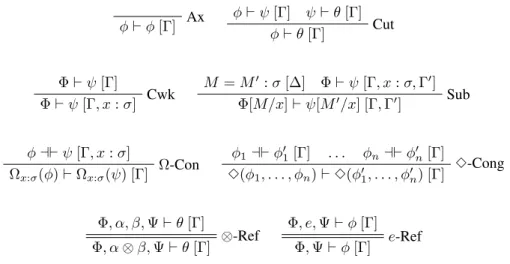
Given a logicL, let Ob(FAL) be the collection of all prop categories inOb(FA) such that Lis sound with respect to⊨Ob(FAL), that is, when T ⊢LT′, then T ⊨Ob( FAL)T′ . Composition of morphisms is by component-wise substitution and one can show using the rules of comparative logic that CT is a category with strictly associative finite products (Pitts, 2000, p. 30). Using the rules in Figure 3.1, one shows that these operations are well defined and(CT, PT)∈Ob(FA).
To show that ⊢Lm ⊆⊨Ob(FA), we check that every S ∈(C, P)∈Ob(FA) satisfies every interpretation of the rules defining Lm. In (CSg, PSg), the morphismsγ: Γ→ Γ′ are just lists of terms and the elements of PSg(Γ) are just formulas, both up to α-equivalence and the change of name of free variables, which are equivalences considered in mathematical practice. If Li is defined by the sequential calculus, we only need to show that every structure in the classification proportional category corresponds to the defining rules of L.
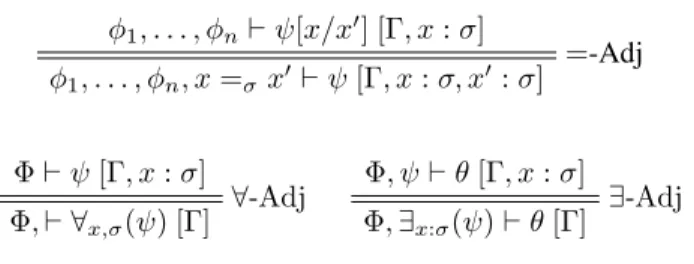
Suppose Lq = {∀,∃}andList an extension ofLpossible by=-Adj, ∃-Adj,∀-Adjshown in Figure 3.2 and any number of structural and propositional connecting rules8. 8 Propositional connection rules are sequential rules whose meta-formulas do not include equality or any quantifiers such as modus ponens.
The 2-Categorical View of the Prop-Categorical Semantics
For each sort symbolσ,F(S)JσK:=Fo(SJσK), for each function symbolf: σ1,. SJRK), whileΓ:Fo(SJΓK)→F(S)JΓKis the change-of-product morphism andΓ =x1:σ1,. A product-preserving functor preserves the satisfaction of equations-in-context since by induction on the complexity of an arbitrary term-in-contextM :τ[Γ],. It follows that F(S) is a T-model and so we only need to prove that Equation 3.5 holds.
Since it is a T-model, it is well-defined over morphisms and it is straightforward to show that So: CT → C is a product-conserving function such that S(G) =S, whereGis is the generic T-algebra inCT . It is also straightforward to verify that Sp: PT →P◦ Such is a natural transformation, and that SPΓ is an L-homomorphism for every context. IfK: (C, P)→(E, R) is another morphism, we say kerK≤kerF, if and only if the relations orkerKare contained in the corresponding relations orkerF.
We can define an action of HonSge equations and series in context that can be extended to T1 by taking the union: that is, H·T1. Therefore, all logics defined semantically by subcollections of Ob(FAL) are structural with respect to the actions by morphisms. This makes it possible to define a (first-order) logic as a closure operator ⊢SgL onThSg, for any signatureSg that is structural with respect to the action of a subset of morphismsGofFAL between formula prop categories.
Particularly interesting candidates are when G includes all morphisms between formula-plug categories and when G consists of all morphismsH: (CSg, PSg)→(CSg′, PSg′) which map single sorting contexts to single sorting contexts.
Basic Constructions in FA
It follows that η:ι◦S⇒ id(CT,PT)2-isomorphism, so (CT, PT) and (C, P) are equivalent. Since ιo is injective on objects and faithfully, ιpje is injective, for each d∈Ob(F(C)),Hs is uniquely defined such that H◦ι=F. ICi denote the product of categories {Ci}i∈I, i.e. the category whose objects define for each i∈ I the objects ∈Ob(Ci) and whose morphisms f:a →b define for each i∈ Ia the morphisms ∈ Ci( ai , would).
Since eachCi has finite products, we define1so that1i= 1Ciand fora, b∈Ob(Q . Ci), we define×bsothat(a×b)i:=ai×bi. As with the conditions for equality, the remaining conditions for the quantifiers follow from the fact that they hold coordinately. IPi(a) → Pj(aj), i.e.πj,ap is the (monotone) projection homomorphism. iPi→Pj◦πoj is a natural transformation.
Letd1, d2∈Ob(D)anda∈Mor(Q .ICi)such that for eachj∈I,aj: Fjo(d1×d2)→Fjod1×Fjod2is the product change isomorphism. It follows thatϕpd=⟨Fi⟩pI,d and soϕ=⟨Fi⟩I. IPi) = 1FA = (∗,1∗), which satisfies every sequence-in-context and equation-in-context.
Fibered Homomorphism Theorem
Since Hois is a functor, it preserves isomorphisms and soHo1E ∼=HoKo1C =Fo1C, and soHo1E is terminal inDsinceFo preserves finite products. Since Kis is full, surjective on objects and for every ∈Ob(E), Kepis surjective, there is only one possible definition for H. One can verify that ifkerK ≰kerF, then either Hois ill-defined or for some e∈Ob (E), Hepis poorly defined or not monotonous.
Furthermore, it is straightforward to check that morphisms in E are epimorphisms in FAL and soe is an epimorphism. From this fact, and the fact that the large rectangle and the small upper square commute, the small lower square must also commute.
Algebraic Characterizations of Logical Closure Operators
We define the (external) product of {Fi}i∈I as⟨Fi⟩i∈I and let P(Y) denote the closure of Yonder external products. We say H ◦Fis an (external) homomorphic image of F and let H(Y) denote the closure of Y under external homomorphic images. If H: (CSg, PSg)→(E, R)andι: (E, R)→(C, P) are morphisms inFAL, such that F=ι◦H andι is a subprop morphism, then we call Han (external) submodel ofFand letS(Y) denotes the closure of Yunder with external submodels.
To characterize the closure operatorOb(FA⊨(·)), we first restrict the logic inLog to a fixed signatureSg. Let LogSg be the set of all logic restricted to Sg statements and we denote the corresponding constraints of Ob(FA(·))and⊨(·),Ob(FASg(·))and⊨Sg(·), respectively. In the context of (the untyped) comparison logic, Addition 4.3 corresponds to the following: Let Lω be an algebraic signature and V a set of variables of cardinalityλ.
Let EqV be the collection of Lω-equations over V which we identify with F m2V, the square of the formula-algebra. Note that⊨SP(A)=⊨A, but SP(A) may not be the largest collection of algebras defining the same consequence. Taking as inspiration the operation Uλ, where λ up to renaming specifies the propositional signature, given a signatureSg and X a collection of prop categories, we define USg(X) such that (D, Q) ∈USg(X), if each sub -classifier prop-category (CT, PT) of (D, Q) is inX, where Sg(T) =Sg.
ForeX ⊆Ob(FA), we take (X) to be the conclusion of X in the assumption of products and for S(X) to be the conclusion of X in the assumption of subcategories.