FLEXIBILITY IN THE TENURE CLOCK:
Why the Time is Right to Adopt a 10‐Year Tenure Probationary Period at the Indiana University School of Medicine
An earlier version of this paper was written by Drs. David Burr and Michael Vasko
and was unanimously approved
by the School of Medicine Executive Committee on December 10, 2007
This expanded white paper was written by
Drs. Mary Dankoski, Megan Palmer, and Steve Bogdewic IUSM Dean’s Office for Faculty Affairs and Professional Development
Last updated Dec 2008
The authors gratefully acknowledge Nancy Eckerman, MLS for her assistance with the historical research regarding IU tenure policies
FLEXIBILITY IN THE TENURE CLOCK:
Why the Time is Right to Adopt a 10‐Year Tenure Probationary Period at the Indiana University School of Medicine
Statement of the Problem
The seven year tenure clock has been an institution in academia for nearly 70 years. Both higher education and academic medicine have changed rapidly over the last seven decades, yet the tenure system has remained largely unchanged. Overtime, the requirements for scholarship and tenure, in terms of both publication and research funding, have changed dramatically and become much more rigorous, especially in areas related to science. The challenge in institutions of higher education with academic medical centers is further complicated by the demands of clinical practice on clinician‐scientists and changes to reimbursement practices which have placed additional burdens on clinician‐scientists that often are at odds with the establishment of a productive research laboratory. The demographics of the academy have also evolved and faculty life is quite different than when the tenure system was first adopted. For example, more women, minorities, and dual career couples work in academe than ever before, diversifying the faculty and changing the balance between family and career for both men and women. Such diversity has generated an increased need for flexibility in faculty policies.
Indeed, many higher education leaders across the country are calling for major change.
The National Panel of Presidents and Chancellors, composed of 10 heads of major research universities or state university systems, supports a national move to create flexible tenure‐track faculty career paths at American colleges and university [1]. They argue against retaining the current rigid structure of the traditional tenure track and recommend that universities “develop policies and programs that encourage flexible career paths to help faculty members balance work‐life issues, avoid stagnation and burnout, and remain productive in various facets of
scholarship.” Dr. William Plater, former IUPUI Dean of the Faculties, has argued that “tenure, like the academic workforce, must be flexible and adaptable without losing its shape or purpose” [2].
Tenure policies, however, have not kept pace with the needs of higher education let alone the rapid rate of change in academic medicine. Consequently, we are now faced with a system that often requires a decision about lifetime tenure to be made with inadequate information, before a young scientist has had the opportunity to fully develop. Partly for this reason, and partly because of the increasing demands of clinical practice, more and more clinician‐scientists are dropping off tenure‐eligible tracks [3]. This is both a national and a local issue.
Between 2006‐2008, the Indiana University School of Medicine’s Basic Science Council (BSC) discussed this developing problem, and considered various options to address it. The BSC is composed of the chairs of the seven basic science departments and the directors of the major research centers within the School of Medicine. After considerable discussion, the BSC concluded that greater flexibility was warranted in the tenure system at IUSM to allow those who have potential, but have not yet achieved the level required for tenure, more time to develop.
Therefore, we propose that the IUSM extend the tenure clock from 7 to 10 years. Under such a
system, tenure should still be granted to faculty members who warrant it at the 7 year mark, yet all tenure‐eligible faculty members would have a maximum 10 year probationary period.
There are several compelling reasons to adopt this policy, which will be explained more fully below. We will first summarize briefly the history of the tenure system nationally and at IU, and explain the current context of the tenure debate in academic medicine in the U.S.
A Brief History of the Tenure System
In 1940, the American Association of University Professors (AAUP) published the paper,
“Statement of Principles on Academic Freedom and Tenure” and thus was born the current tenure system to which most academic institutions still adhere. In this document, the AAUP recommended: (a) that the academic tenure probationary period be seven years; and (b) that academic freedom be protected through narrowly outlining the ways in which a tenured faculty member could be dismissed (not without adequate cause, except "under extraordinary
circumstances, because of financial emergencies" and only after receiving written reasons and being heard in self‐defense). Another purpose of the recommended academic tenure system was to raise the performance standards of the faculty by pressing new professors to perform to the standard of the school's established faculty. This system was rapidly adopted at most U.S.
institutions of higher education after 1945, when institutions were flooded with enrollment from the influx of returning GI’s, resulting in the rapid expansion of universities and severe faculty shortages. The majority of institutions thus started offering formal tenure as a benefit in order to recruit faculty to fill these personnel needs [4].
The 1940s was also a decade of expansion extramural grants programs of the National Institutes of Health [5]. The authorization to conduct clinical research occurred in 1944. In 1946, the NIH created a Research Grants Office and began the use of study sections to review
applications for extramural funding, a practice which continues today. Many new categorical institutes were also established during the 40s. By 1948, there were enough institutes that the name was changed to plural, the National Institutes of Health, to reflect multiple institutes under one umbrella. This rapid growth continued for a number of years, and in academic medicine and science, independent NIH funding became – and still remains – a “gold standard” for the granting of tenure.
History of Tenure at Indiana University and the School of Medicine
Indiana University adopted its policy on tenure on September 11, 1943, after several revisions and approval by the American Association of University Professors [6; also see the Appendix]. Based on available documents, the process of promotion (if not tenure) began in academic year 1946‐1947; this was the first year that all School of Medicine faculty were identified as either professor, associate professor, assistant professor, or lecturer in the IUSM Bulletin. Additionally, the September 1946 issue of the Journal of the Indiana Medical Association announced promotions made by President Herman B Wells (i.e., Dr. C. P. Clark was promoted from associate to professor of ophthalmology, Dr. G. J. Garceau from associate to professor of orthopedic surgery, plus others), indicating the results of a promotion and tenure procedure. The
first reference to tenure in the IUSM internal faculty records is in a 1948 faculty file [7]. Prior to this time, ranks such as the term “professor,” were likely honorific titles.
As part of our institutional research, we obtained documents from the IU Archives which are included in the Appendix. The original tenure policy memo written by President Wells is included, as are excerpts from select IU faculty policies and faculty handbooks regarding tenure (1953, 1962, 1973, 2005 – the current handbook). Of note is how little the policies have changed over time – the policies in effect today contain much of the original language from 1943. We view this as problematic, given how vastly different higher education and academic medicine are today.
Framing the Context: The Tenure Debate in Academic Medicine
The tenure system is not without controversy. Across higher education, some argue that it can lead to the retention of unproductive faculty (“dead wood”), tie up resources, generate competition among junior faculty, and can codify gender and racial biases. Medical schools and academic health centers are not immune to these issues; yet there are additional contextual factors that have led to long‐standing debate regarding the meaning of tenure for both clinician scientists and PhD biomedical researchers. Over 30 years ago in 1977, Spellman and Meiklejohn [8] surveyed a number of medical school deans and concluded that “tenure in American medical schools is under progressively intensive scrutiny.” Since this time, many studies, conferences, and articles have been devoted to the meaning of tenure in academic medical centers. Consider the following few examples: a 1988 survey of faculty affairs deans revealing that a majority of schools were undergoing major revisions of their tenure criteria and establishing nontenure tracks [9]; a 1995 survey of the National Caucus of Basic Biomedical Science Department Chairs showing that modifications of tenure policies were under consideration at most institutions, with over 75% of the chairs reporting that tenure was becoming more difficult to achieve [10]; a 1996 conference hosted by the Association of American Medical Colleges (AAMC) devoted solely to the topic of tenure and career pathways [11]; and as recently as this year, when a central finding of a study of academic surgery departments was the unanimous opinion that the promotion and tenure system should be discontinued in its current form [12]. Indeed, the scrutiny predicted in 1977 has only intensified over the years.
There are several reasons for this heightened scrutiny, chief among them is the diversity and complexity of the missions of medical schools. Academic medical centers must merge both the business aspects of the health care industry with the university system and culture – not always a seamless blend – in addition to maintaining intense missions in research, education, and arguably the highest service obligation of any unit within a university [9]. This creates a highly complex, dynamic institution staffed by faculty members who experience a vastly different day‐
to‐day work life and organizational culture than their faculty counterparts in non‐health profession units within the university.
Moreover, these complex and diverse missions have had to be sustained amid escalating costs and shrinking resources, exacerbating tensions both within medical schools and between medical schools and their parent university systems. Over the past several decades, research funding has remained a roughly stable proportion of the funding base of academic health centers
at approximately one‐third of the budget, on average. However, clinical patient care revenue has increased at an accelerated rate over the past 45 years to support operational costs. In the 1960s, clinical revenue sources accounted for only 6% of operating revenues on average nationally; by the 1990s, clinical revenue accounted for approximately 50% of the overall budget on average of all medical schools (public and private) [13].
The IUSM, specifically, also relies heavily on clinical revenues to support its operating budget. For example, in fiscal year 2006, 45% of the IUSM annual operating revenues were from faculty practice plan income compared to the average of 33% at public medical schools. There are two reasons why IUSM varies from their peer public medical schools in this regard: 1) IUSM received 14% of its annual operating revenues from federal grants and contracts, while on average, public medical schools received 20% of their annual operating revenues from that source. More significant is the fact that public schools on average receive 12% of their annual operating revenues from state appropriations, net any parent university assessments, while IUSM receives only 5% of its annual revenue from that source. In fiscal year 2006, IUSM’s annual allocation of state appropriations from the parent university was $88.4 million, of which IUSM paid $52.0 million in mandatory assessments to cover its proportionate share of central campus and university costs, and many but not all physical plan costs. This left IUSM with only $36.4 million of net state appropriations to fund the medical school’s central operating costs, as well as many program costs. Thus, while most public schools receive an allocation from their parent universities that is already net of central costs, the IUSM receives roughly half of the “net” state appropriations than the average public medical school receives, and is significantly below average, causing it to rely much more heavily on other sources of revenue [14].
Thus IUSM has less state funding to support operational expenses and faculty salaries, and instead, almost half of the necessary funding to accomplish the various missions of the medical school must be generated by the “in the trenches” work of clinical patient care. To generate this needed revenue, the IUSM and medical schools across the country have had to hire increasingly large numbers of faculty whose primary obligation is clinical work and teaching students within such clinical practices. As the number of clinical faculty has risen, the number of tenure track MD faculty has declined. Consider the following: [below statistics from ref 15]
o Between 1985 to 1995, tenured and tenure‐track clinical MDs increased at an average rate of 4% per year, while non‐tenure track MDs grew at a rate of 8% per year.
o In the next 6 years, (from 1996 – 2002), the growth in tenure eligible clinical MD faculty slowed to an average rate of 1% per year.
o In 1985, 57% of full time MD faculty in clinical departments were either tenured or on the tenure track; in 2004, this percentage dropped to 42%.
o In 1985, 41% of all newly hired full time clinical MD faculty were on tenure eligible tracks, but in 2004, that percentage declined to 28%, as can be seen below in Figure 1.
FIGURE 1
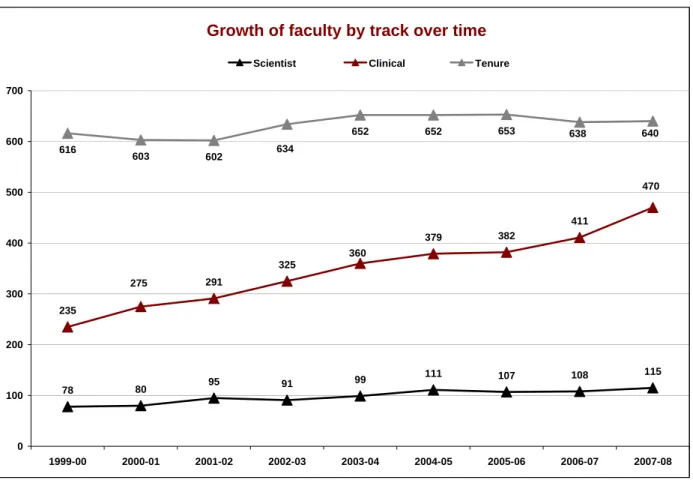
The IUSM is not vastly different from this national picture. Below, Figure 2 displays the rapid growth in the ranks of clinical non‐tenure track faculty since 1999‐2000, compared to the numbers of tenure eligible and tenured faculty members, which has been roughly the same over time. The total number of full time faculty (non‐affiliate) at IUSM grew from 921 in 1999‐2000 to 1225 in 2007‐2008, with virtually all of this expansion occurring through hiring more non‐tenure clinical track faculty. Faculty on this track accounted for approximately 25.5% of the total faculty in 1999‐2000; by 2007‐2008, this proportion has risen to 38% of the total faculty.
With this rise in clinical faculty, increasingly across the nation and here at IUSM,
departments and schools have developed faculty productivity expectations based on such issues as the amount of “revenue generating activity.” Such expectations are not directly reflected in promotion and tenure criteria; yet, this work is both typical of a clinical faculty member’s daily work life, and is essential to the operation of the medical school. Thus, for many faculty members, hiring expectations and their major contributions are not aligned with traditional expectations for academic advancement. Questions of how to value and reward such
contributions for the purposes of promotion and tenure emerged, and remain today, on both the national and local debates regarding the meaning of tenure in academic medicine.
FIGURE 2: IUSM FACULTY OVER TIME
Growth of faculty by track over time
78 80 95 91 99 111 107 108 115
235
291
325
379 382
411
616 603 602
652 652
275
360
470 640 638
634
653
0 100 200 300 400 500 600 700
1999-00 2000-01 2001-02 2002-03 2003-04 2004-05 2005-06 2006-07 2007-08
Scientist Clinical Tenure
In addition to prompting the increased hiring of clinical faculty members, shrinking financial resources has also changed the nature of the financial guarantee that has traditionally been linked with the awarding of tenure. Clearly, as indicated in the above information regarding the operating revenues of the IUSM, far less state appropriations are available to support faculty salaries than the national average, and than may be available in other schools in the IU system.
What was once a basic assumption ‐‐ that tenure affords faculty with financial stability ‐‐ is called into question in the fiscal environment of today’s academic medical center both at the IUSM and nationally. For example [below statistics from ref 15]:
o In 2005, of the 113 medical schools that offered tenure to clinical faculty, 56 (50%) had a financial guarantee associated with tenure, while 43 (38%) had none. Of those 56 with a guarantee, only 3 guaranteed total institutional salary, and all 3 of these schools were considering revising this policy. The majority of institutions with a guarantee for clinical faculty only guarantee the base salary and not the clinical portion, which is often a substantially larger amount.
o Of the 119 schools that offer tenure to basic science faculty, 62 (52%) have a financial guarantee, and 42 (35%) had no financial guarantee associated with tenure. Of those with a
Note: Data from the IUSM Academic Administration Office
guarantee for basic science faculty, only 8 schools (13%) guarantee the total institutional salary.
These policies continue to evolve. Within the three years prior to this particular AAMC survey (between 2002 – 2005), 12 schools (10%) had revised or clarified their tenure financial guarantee policies, and another 17 (14%) were in the midst of such a revision in 2005. The authors of this study conclude that “the changes in the financial guarantee associated with tenure during the last several decades have transformed the fundamental concept of tenure at many medical schools. At more than 40 institutions where tenure does not guarantee any level of salary support, the meaning of tenure is no longer clear. Does tenure protect job security or academic freedom if a tenured faculty member’s salary could effectively be reduced to zero?” [13, p. 283 – 284]. Indeed, for these reasons, many believe that tenure is moot or irrelevant for clinical faculty [16]. Within the IUSM, institutional policies do not specify a financial guarantee with the awarding of tenure.
Clearly, clinical faculty members have been impacted greatly by this changing context.
Additionally, faculty life among the basic science ranks has also been impacted. While less dramatic in numbers, there has also been a national decline in tenure eligible basic science faculty in the past several years.
o In 1985, 83% of PhD basic science faculty were either tenured or on the tenure track; by 2004, this number was 76% [15].
o Among newly hired PhD basic science faculty, 51% were on the tenure track in 2004, compared with 68% who were on the tenure track in 1985 [14].
o When comparing cohorts of graduates from a single year, Garrison and colleagues [17] found that in 1981, 34% of the biomedical PhDs with 5–6 years experience held tenured or tenure‐
track positions. In 2001, only 14% of the PhDs were in such positions 5–6 years after obtaining their degrees.
New biomedical PhD graduates may be increasingly choosing jobs in industry where they are not faced with the same pressure to achieve independent funding in a highly competitive grants environment under a ticking tenure clock – particularly if no financial guarantee comes with reaching the tenure milestone.
Against this backdrop of the complexity of medical school missions, shrinking financial resources, fewer tenure financial guarantees, expansion among non tenure track clinicians, and declining tenure track faculty, we offer below specific justifications for lengthening the
probationary period.
Justifications for Increasing the Tenure Probationary Period
Insufficient Time to Determine the Long‐Term Productiveness. Funding from the National Institutes of Health (NIH) has grown increasingly more competitive in the past several years, with the probability of a proposal being funded dropping from 32% in 1999, to as low as 10‐12% for
some institutes today (http://report.nih.gov/award_mapping.aspx). It is problematic to maintain the same standards and clock when faculty are approximately one‐third less likely to be
successfully funded. Most faculty members require 3‐5 years to receive their first grant and 2‐3 years (+several submissions) for renewal. Thus, a decision about tenure based on a dossier prepared at the end of five years may not allow adequate time (assuming a four year funding period) to determine whether that faculty member will be able to perform on that grant, successfully renew it, or expand into additional areas of investigation. Under a 7‐year tenure clock, a faculty member only has time to demonstrate that he/she is capable of obtaining an extramural grant, but does not have sufficient time to demonstrate an ability to sustain a productive research program or funding. The ability to sustain funding is necessary information upon which to base a decision about the longer‐term productivity and capability of a junior faculty member engaged in laboratory research. A 10‐year tenure clock would allow sufficient time to demonstrate an ability to sustain funding. For example, if the faculty member received a 4 year NIH grant in his/her 3rd year after appointment, this grant would be due for renewal during his/her 7th year (after a tenure decision is required under the current system). Under a 10 year tenure clock, however, the tenure dossier would be submitted at the end of the 8th or 9th year, faculty members would have had the opportunity to apply for grant renewal at least once, and the decision of the funding agency would be known by the review committees when the decision on tenure needs to be made.
Independent Research Support Occurs at a Later Age. Consistent with the increased competitiveness, recent data from the NIH show that the average age of a new NIH grant recipient is 42 years old. The age at which clinically trained scientists (MD’s and MD/PhD’s) receive their first NIH grants is even later. The average age of a recipient at the time of the first NIH grant has been increasing steadily over the past 25 years, from an average age of 37‐38 years in the early 1980’s. Even more troubling, perhaps, is that the difference between PhD’s and MD’s in average age at the time of first NIH award has been increasing steadily (Figure 3).
FIGURE 3. Independent Research Support Occurs at a Later Age
There is a Large Initial Investment in New Faculty. Startup expenses for new faculty in the sciences are very expensive. It is not unusual to have to provide $400,000‐$700,000 in startup funds to recruit the best and brightest junior faculty. Some of this funding is specific to an individual faculty member’s research program, or may be spent by the faculty for technical support in the lab. The loss of a faculty member results in the loss of much or all of this large initial investment. Given the investment in a new faculty member, it is judicious to allow that faculty member as much time to be successful as possible. While application for an extension to the tenure probationary clock is an option, it is not a guarantee and many faculty members don’t exercise this option. The act of requesting such an extension contains, for some, an implied message that such faculty are less competent, productive, or promising than their peers, despite information to the contrary. This is especially problematic for women and under‐represented minority faculty who, as indicated by reliable evidence outlined below, face significant barriers to advancement in academic medicine today. Under a 10 year tenure clock, however, the need to request extensions would likely be reduced. This would better serve the individual needs of the faculty and the long‐term interests of the university in a multitude of ways. In fact, one study using financial modeling of academic medicine faculty over time, found that tenure track faculty, especially those with laboratory research programs, generated the highest positive “central cash flows” for the university, with one important caveat: They must be retained “well in excess of 10 years to recoup the initial central investment required for their recruitment” [18]. Thus, the 10 year mark is a critical point in time for a number of reasons.
Recruitment and Retention of Excellent Faculty. Science has become highly competitive, and any policy that provides a slight edge in recruiting the best faculty is desirable. Faculty members of today are looking for a supportive and family‐friendly environment more than ever before, one which is not too rigid and can allow them to balance their work and professional lives. Inflexible tenure policies make it particularly difficult for women, who are often saddled with most of the child‐ or elder‐care responsibilities in a family. This may be one reason that women are less likely to pursue tenure‐track faculty positions at major research universities.
Women earn 51% of the doctoral degrees awarded to US citizens and now comprise
approximately 50% of entering medical students, yet represent only 33% of all full‐time faculty in medical schools (29% of basic science faculty and 34% of all clinical faculty); just 19% of tenured faculty are women [19]. Women and men enter the academic workforce at equal rates, but the rate of attrition for women is 2‐3 times the rate for men [20], and women with pre‐school children are half as likely to enter tenure‐track positions as married men with similar‐aged children. Further, there are more dual career couples than ever working in academe, and women faculty are more likely than men to have a partner in academics [21]. The previous concept of the
“ideal faculty member,” someone who can achieve excellence in research, teaching, and service through devoting countless hours to his/her career because a stay‐at‐home spouse handles all children and household duties, is not at all the typical experience of faculty life today.
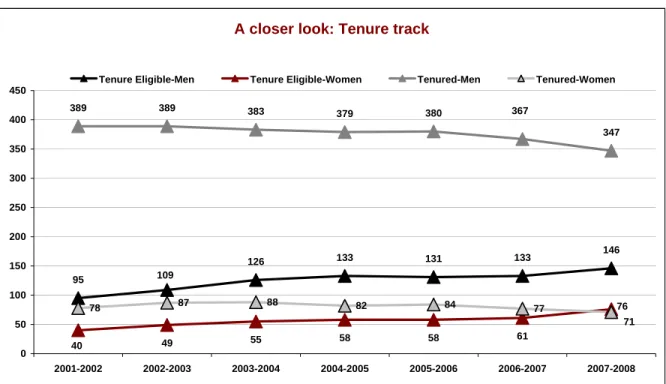
At the IUSM, only 30% of the full time faculty are women and only 17% of the tenured faculty are women. As can be seen in Figures 4 and 5, the majority of women faculty are in non‐
tenure tracks and the rate of tenure among women over the last several years is flat. The IUSM is below the national averages for the proportion of full time and tenured faculty who are women
by just a few percentage points. While the difference of a few percentage points may or may not be statistically significant, the growth of women among medical school faculties has been
remarkably slow (the proportion of women full professors has only increased by 1% in the past 15 years) and far behind what would be expected given the number of women earning doctoral and medical degrees and entering the academic workforce [22]. Thus, the difference of a few
percentage points between the IUSM and the national average could, in fact, have practical significance.
Studies have repeatedly found that promotion rates for women faculty lag behind the rates of their male counterparts. While many theorize that such differences can be accounted for by lower productivity, specialty choice, differences in rank, and lower desire for advancement among women, several studies have shown that gender differences exist in promotion and advancement even after controlling for these variables [23‐25]. In fact, studies show that, if nothing changes, there will not be equal numbers of women and men among the full professor rank until the year 2058 [20]. Figure 6 shows that over time, the number of male faculty at IUSM achieving tenure far out‐paces the number of women. Cumulatively, since 2001‐2002, 91 men have achieved tenure, compared to 39 women faculty.
FIGURE 4: IUSM GROWTH IN TRACKS BY GENDER
Growth in tracks by gender
32 33 37 43 42 46 45
189
209
227
246 251
266
102
116
145
161 367
347
78 87
63 58 62 68 65 62
70 309
133 133 131
95
109 126 133 131 133
146
40 49 55 58 58 61
76
389 389 383
379 380
88 82 84 77
71
0 50 100 150 200 250 300 350 400 450
2001-2002 2002-2003 2003-2004 2004-2005 2005-2006 2006-2007 2007-2008
Scientist-Men Scientist-Women Clinical-Men Clinical-Women
Tenure Eligible-Men Tenure Eligible-Women Tenured-Men Tenured-Women
Note: Data from the IUSM Academic Administration Office
FIGURE 5: IUSM TENURE TRACK FACULTY BY GENDER
A closer look: Tenure track
95
126 133 131 133 146
49 55 58 58 61
389 389 383 379 380
347
78 87 88 82 84 77
109
40
76 367
71
0 50 100 150 200 250 300 350 400 450
2001-2002 2002-2003 2003-2004 2004-2005 2005-2006 2006-2007 2007-2008 Tenure Eligible-Men Tenure Eligible-Women Tenured-Men Tenured-Women
FIGURE 6: IUSM TENURE DECISIONS OVER TIME BY GENDER
Tenure by gender over time
18
10 11
15 15
8 11
13
9
5 3
5 3
4
1
0 0 0 0 0
1 0 0 0
2 4 6 8 10 12 14 16 18 20
2001-2002 2002-2003 2003-2004 2004-2005 2005-2006 2006-2007 2007-2008
Men Approved Women Approved Men Denied Women Denied
Note: Data from the IUSM Academic Administration Office
There are parallel issues for under‐represented minority (URM) faculty as well (the URM definition includes Black/African American, Hispanic/Latino ethnic groups, Native Americans, Pacific Islander). Nationally, the medical school faculty community is predominantly white, with only 7.2% URM persons among the faculty [13]. The pipeline is slow; only about 6.9% of the graduating class of 2006 was comprised of minority students [26]. Similar to women faculty, URM faculty have lower rates of promotion and tenure compared to both white/Caucasian and Asian faculty members, are more likely to be on non‐tenure tracks, and to take longer time to tenure and promotion, even after controlling for multiple factors such as productivity, specialty choice, and rank [27, 28].
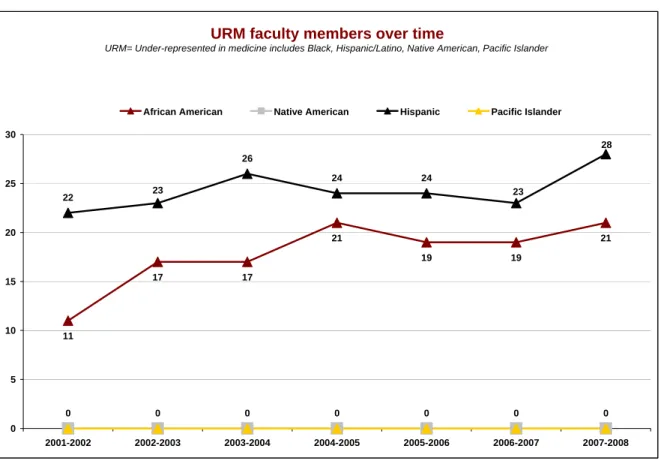
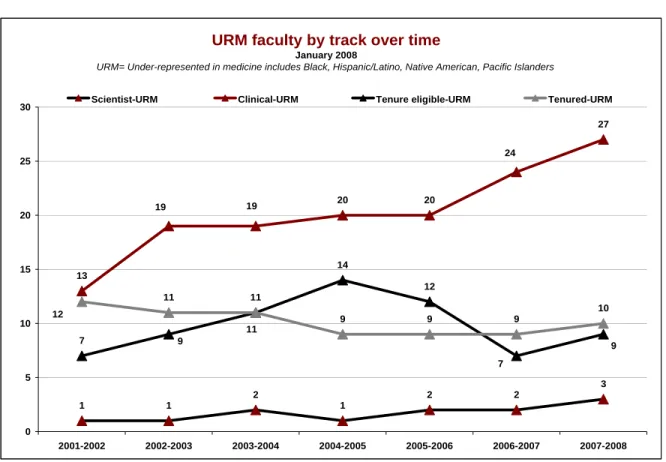
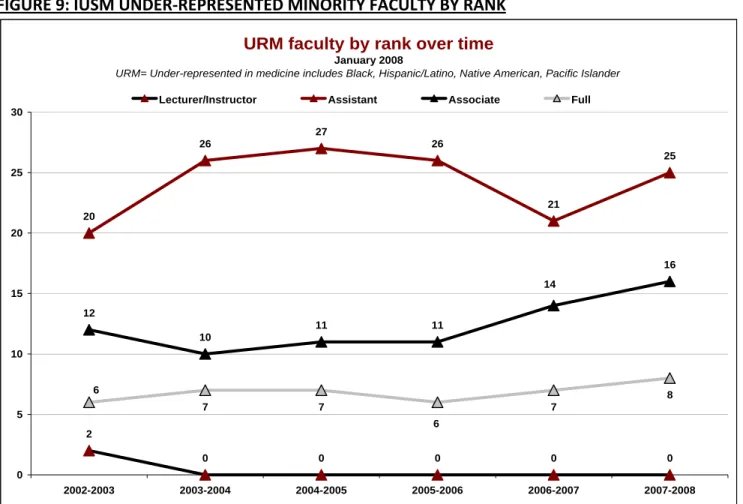
Figures 7‐9 show how few URM faculty members are currently part of the IUSM faculty
community – comprising only 4% of the full time faculty. We currently have just 10 tenured URM faculty members. This data shows that we are well behind the national average and must be more effective at recruiting URM faculty.
FIGURE 7: IUSM UNDER‐REPRESENTED MINORITY FACULTY MEMBERS OVER TIME
URM faculty members over time
URM= Under-represented in medicine includes Black, Hispanic/Latino, Native American, Pacific Islander
11
17 17
21
19 19
21 22
26
24 24
0 0 0 0 0 0 0
28
23 23
0 5 10 15 20 25 30
2001-2002 2002-2003 2003-2004 2004-2005 2005-2006 2006-2007 2007-2008
African American Native American Hispanic Pacific Islander
FIGURE 8: IUSM UNDER‐REPRESENTED MINORITY FACULTY BY TRACK
URM faculty by track over time
January 2008
URM= Under-represented in medicine includes Black, Hispanic/Latino, Native American, Pacific Islanders
1 1
2
1
2 2
3 13
20 20
27
7
14
12
11 11
9 9 9
10 19 19
24
7 9 9
11 12
0 5 10 15 20 25 30
2001-2002 2002-2003 2003-2004 2004-2005 2005-2006 2006-2007 2007-2008
Scientist-URM Clinical-URM Tenure eligible-URM Tenured-URM
Note: Data from the IUSM Academic Administration Office
FIGURE 9: IUSM UNDER‐REPRESENTED MINORITY FACULTY BY RANK
URM faculty by rank over time
January 2008
URM= Under-represented in medicine includes Black, Hispanic/Latino, Native American, Pacific Islander
2
0 0 0 0 0
20
26
27
26
21
25
12
10
11 11
16
7 7 7
8 14
6 6
0 5 10 15 20 25 30
2002-2003 2003-2004 2004-2005 2005-2006 2006-2007 2007-2008
Lecturer/Instructor Assistant Associate Full
Lack of diversity and gender equity can become a vicious circle. Without adequate numbers of URM and women faculty, it is harder to recruit talented women and URM students, residents, postdoctoral fellows, and junior faculty. Those who do join the school as students or faculty may feel isolated, experience a chilly climate, and may lack mentors with similar life experiences. For these reasons, equity is often seen as “a window into institutional effectiveness”
[29]. Many leading experts recommend increasing flexibility in faculty policies as a positive recruitment tool for women, URM faculty, and dual career faculty couples [30].
It’s possible that a longer tenure probationary period is in fact, helping in the recruitment of women faculty at other medical schools. Later in this paper, you’ll see that Table 3 contains the top 25 schools by research ranking according to the 2008 U.S. News and World Report. Of these 25 schools, 13 of them (52%) have a higher than average percentage of women on their full time faculty. Of these 13 schools, 11 have tenure probationary periods that are indefinite or a longer clock than 7 years (85%).
Note: Data from the IUSM Academic Administration Office; *Includes Librarians
These 11 schools include: (% of full time faculty who are women is in parentheses) o Harvard: (38%) ‐ 11 year clock (basic science); indefinite clock (clinical) o University of California San Francisco: (38%) ‐‐ 8 year clock
o Duke: (35%) ‐‐ 8 year clock (basic science); 11 year clock (clinical) o Yale: (36%) ‐‐ 10 year clock
o Columbia: (39%) ‐‐ 8 year clock
o University of Michigan: (37%) ‐‐ 8 year clock (requested extension to 10 years) o Baylor: (42%) ‐‐ 9 year clock
o Cornell: (36%) ‐‐ 9 year clock
o Northwestern Feinberg: (38%) ‐‐ 9 year clock (basic science); 10 years (clinical) o Mount Sinai: (38%) ‐‐ 17 year clock
o Johns Hopkins (35%) – indefinite clock
Of the schools with a 7 year clock, only two have greater than the average percentage of women on their full time faculty: University of Washington St. Louis (36% women; 7 year clock) and University of North Carolina, Chapel Hill (40% women; 7 year clock). The relationship between the length of the tenure clock and the percent of women faculty has not been empirically studied, and we are, of course, not claiming causality. However, this trend seems consistent with current national recommendations.
Current National Recommendations and Changing Trends in Tenure Policies
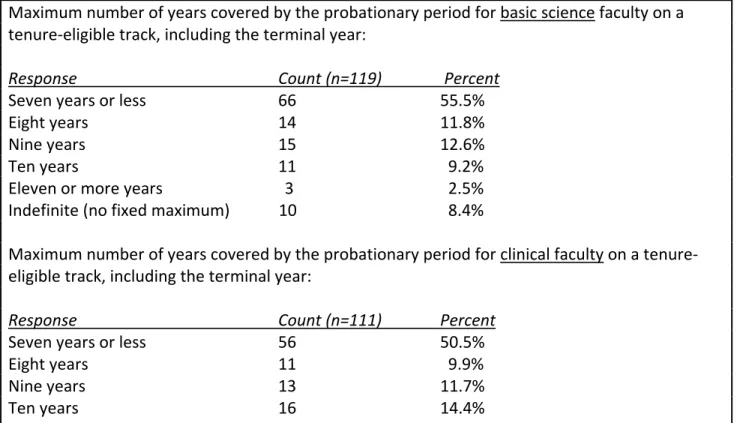
Lengthening the Tenure Probationary Period. Given the ongoing debate and changes in the context for both basic science and clinical faculty, it is not surprising that many U.S. medical schools and universities have begun to adopt more flexible and longer tenure probationary periods (Tables 1 and 2). 2008 data from the AAMC shows that half (49.5%) of all U.S. medical schools now have tenure probationary periods of 8 years or more for their clinical faculty, and 44.5% have clocks longer than 8 years for their basic science faculty.. Twenty‐five years ago in 1983, only 26% of medical schools had tenure probationary periods of longer than seven years.
TABLE 1. Percentage of U.S. Medical Schools with Various Tenure Probationary Periods for Clinical Faculty Over Time, 1983‐2008
Year/Probationary Period
1983 1994 1997 1999 2002 2005 2008
7 years or fewer (%)
74 69 59 58 53 57 50.5
8 years or more (%)
26 31 41 42 47 43 49.5
From: Association of American Medical Colleges, 2007 [3]; personal communication with AAMC staff, Dec 2008
TABLE 2: Frequency Report for Responses to the 2008 AAMC Faculty Personnel Policies Survey Maximum number of years covered by the probationary period for basic science faculty on a tenure‐eligible track, including the terminal year:
Response Count (n=119) Percent Seven years or less 66 55.5%
Eight years 14 11.8%
Nine years 15 12.6%
Ten years 11 9.2%
Eleven or more years 3 2.5%
Indefinite (no fixed maximum) 10 8.4%
Maximum number of years covered by the probationary period for clinical faculty on a tenure‐
eligible track, including the terminal year:
Response Count (n=111) Percent Seven years or less 56 50.5%
Eight years 11 9.9%
Nine years 13 11.7%
Ten years 16 14.4%
Eleven or more years 4 3.6%
Indefinite (no fixed maximum) 11 9.9%
From: personal communication via email with AAMC staff, Dec 2008
Our own survey of the top 25 medical schools in the U.S. (ranked by research funding according to the U.S. News and World Report) shows that 21 have tenure probationary periods longer than 7 years for either their clinical faculty, basic science faculty, or both (Table 3). [Mayo does not have a tenure system.] Thus, of the 24 top schools with a tenure system, only 3 of them have the traditional 7 year clock for both their clinical and basic science faculty; 21 of 24 have clocks longer than the AAUP guideline of 7 years. Additionally, several schools are currently considering lengthening their clocks, including among others, the University of Michigan [31], Ohio State University, Columbia, and the University of Pittsburgh Medical Center (UPMC).
This institution, UPMC, is most relevant to the thinking within the IUSM. The IUSM is embarking on a unified clinical practice plan that will merge all the clinical departments and entities of the school and in collaboration with Clarian Health Partners into one – what is currently being called “The Indiana Clinic.” This model is based on the successful clinical merger that UPMC adopted several years ago. Leaders from IUSM and Clarian have visited UPMC and are consulting with UPMC leaders about this major transition; more than any other institution, UPMC has informed the latest thinking about this major transition facing the IUSM. UPMC has risen steadily in the NIH rank list, and they credit this rise in research success to several factors, including the cost savings from this merged practice plan, but also due to lengthening their tenure clock to 10 years in 2000 for faculty with clinical responsibilities. More recently in October 2007, UPMC proposed lengthening the clock to 10 years for their basic science faculty as well.
They based their argument on (a) a funding environment that is “constrained, uncertain, and unpredictable” yet requires greater complexity, multidisciplinarity, and greater time to be
independently funded and with a national reputation; (b) increases in teaching obligations among their basic science faculty; (c) the fact that, of the 23 peer medical schools against which they benchmark their performance, 18 have probationary periods longer than 7 years; and (d) competition to recruit and retain excellent faculty [32]. Our proposal to lengthen the
probationary period at IUSM to 10 years would thus put us more in line with many of these top schools, including UPMC, many of whom compete with us for recruiting and retaining faculty.
TABLE 3. Tenure Clocks at the Top 25 Medical Schools in the U.S. (by research funding)
Top 25 Schools
Length of Tenure Probationary Period (Basic
Science Faculty)*
Length of Tenure Probationary Period
(Clinical Faculty)*
1. Harvard 11 Indefinite
2. Johns Hopkins Indefinite Indefinite
3. Washington U. in St. Louis 10 10
4. U. Pennsylvania 7 10
5. U. California‐San Francisco 8 8
6. Duke 8 11
7. U. Washington 7 7
8. Stanford 7 8
9. U. California‐Los Angeles 8 9
10. Yale 10 10
11. Columbia+ 8 8
12. U. Michigan+ 8 8
13. Baylor 9 9
14. U. California‐San Diego 8 8
15. U. Pittsburgh+ 7 10
16. U. Chicago (Pritzker) 7 7
17. Vanderbilt 9 9
18. Cornell 9 9
19. U. North Carolina‐Chapel Hill 7 7
20. Emory 9 9
21. Northwestern 9 10
22. U. Texas Southwestern
Medical Center‐Dallas 8 8
23. Case Western Reserve 10 10
24. Mayo Medical School NA (no tenure system) NA (no tenure system) 25. Mount Sinai School of
Medicine 17 17
Notes: Ranking from 2008 US News and World Report, Top Schools by Research Funding.
*From the 2008 Faculty AAMC Personnel Policies Survey, sent via email to the authors
+ University of Michigan has proposed a 10 year probationary period; University of Pittsburgh proposed a 10 year probationary period for basic science faculty in Oct 2007; Columbia proposed a 10 year clock for clinicians in 2008
Table 4 contains the most up‐to‐date list of all U.S. medical schools with 10 year or longer tenure clocks for either basic science faculty, clinical faculty, or both (from the 2008 Faculty Personnel Policy Database of the Association of American Medical Colleges, sent to the authors via email).
TABLE 4: U.S. Medical Schools with Tenure Clocks of 10 or More Years, including Indefinite Clocks+
Institution
Length of Tenure Probationary Period (Basic Science Faculty)
Length of Tenure Probationary Period
(Clinical Faculty)
Alabama 10 10
Virginia 10 10
Yale 10 10
Washington University. St. Louis 10 10
New Jersey 10 10
UMDNJ RW Johnson 10 10
New York University 10 10
Medical College of Wisconsin 10 10
Case Western 10 10
Maryland 10 10
Loma Linda 10 NA
Minnesota 7 10
Cincinnati 7 10
U Pennsylvania 7 10
Pittsburgh* 7 10
Jefferson 8 10
Northwestern 9 10
Duke 8 11
Ohio State* 7 12
Harvard 11 Indefinite
Rochester 12 12
Mt. Sinai 17 17
Wake Forest Indefinite Indefinite
Dartmouth Indefinite Indefinite
Einstein Indefinite Indefinite
Johns Hopkins Indefinite Indefinite
Nebraska Indefinite Indefinite
NY Medical College Indefinite Indefinite
Medical University of South Carolina Indefinite Indefinite
Toledo Indefinite Indefinite
Rush Indefinite Indefinite
Eastern Virginia Indefinite Indefinite
*Schools that have recently proposed lengthening the clock for either basic science or clinical faculty, or are studying the question, include: University of Pittsburgh, the University of Michigan, Columbia, Ohio State University, University of Massachusetts, East Carolina, University of Arkansas
Further, our proposal mirrors the recommendations of the American Council on Education and the Alfred E. Sloan Foundation, which have called for greater flexibility in tenure policies in their whitepaper, “An Agenda for Excellence: Creating Flexibility in Tenure Track Faculty Careers”
[1]. This report argues for universities to recognize the “diverse demographics” that make a one‐
size‐fits‐all academic career undesirable. The report is clear that the university’s ability to attract and retain the best faculty will be dependent upon creating an attractive and flexible
environment. Among many suggestions, they recommend that universities should “create flexibility in the probationary period for tenure review without altering the standards or criteria.
Longer probationary periods should not be required for all faculty, but flexible time frames of up to 10 years with reviews at set intervals should be offered.” IUPUI has examined such
recommendations in the past when the Task Force on “Enhancing Faculty Careers at IUPUI”
proposed an “Accelerator Plan” to “create and expand career flexibility policies and programs and widen the acceptance of career flexibility within the university.” Vice‐Chancellor and Dean of Faculties William Plater initiated this discussion before he left office.
Varying Tenure Probationary Periods Between Schools within the University. The table above not only shows that the 7 year clock is no longer the most common system at most top medical schools, it also shows that many schools have experimented with varying clocks based on whether a faculty member has clinical obligations or not. Another newer trend is that many institutions are now allowing units within their university system to determine their tenure clocks, which don’t have to be uniform across the entire university system. This recommendation can also be found in the American Council on Education and Sloan Foundation report [1] in the following recommendation that “. . . colleges, schools and departments within a university [be allowed] to establish their own agreed upon guidelines for interpreting criteria for promotion and tenure taking into account the special nature of the work of those distinct units. Not all units within a university have the same mission and goals, and the special missions of the individual schools within a university should be considered in developing policies specific to them.”
To determine whether this variation by school/unit was indeed occurring at other institutions, a query was sent to the Association of American Medical Colleges Group on Faculty Affairs listserv in June 2008. While not an official or representative sample by any means, this group is comprised of the faculty affairs deans at U.S. medical schools and was an expedient method for gathering such data. Below is a summary of the responses received:
o Washington University School of Medicine: 10 year clock. Each school of the university may set their clock as they wish from 6‐10 years.
o Emory: Gained approval for a 9 year tenure clock; all other components of Emory retain the 7 year clock.
o University of Alabama: Tenure clock is 10 years for the School of Medicine; the majority of the other units on campus have 7 years. “The other health professions schools have the 10 year clock (nursing, dentistry, health professions) but each school is empowered to make that choice.”