For Peer Review Only
Exploring the Effect of Intrinsic Religiousness, Extrinsic Religiousness, and Religious Fundamentalism on People’s
Attitude Towards Lesbians and Gays in Indonesia
Journal: Journal of Religion, Spirituality & Aging Manuscript ID WRSA-19-0009.R2
Manuscript Type: Article
Keywords: LGBT, Religion < Spirituality, Indonesia
For Peer Review Only
Exploring the Effect of Intrinsic Religiousness, Extrinsic Religiousness, and Religious Fundamentalism on People’s Attitude Towards Lesbians and
Gays in Indonesia
Abstract
Lesbians and gays hatred in Indonesia has significantly increased in the last few years. Since 2015, there have been raids on gay saunas, calls for the criminalization of homosexuality, and statements made by prominent politicians and religious leaders about the evils of lesbian and gay rights. Hence, the purpose of this study is to explore the impact of intrinsic religiousness, extrinsic religiousness, and religious fundamentalism on people’s attitudes towards
homosexuals and people’s perception of lesbian and gay people as immoral and dangerous.
This study uses a quantitative survey and samples from Indonesia (n=602), one of the most religious nations in the world. The results show intrinsic religiousness negatively influences people’s attitude towards gay men but not lesbians. Moreover, extrinsic social religiousness has no effect on people’s attitude towards gay men and lesbians. Both intrinsic and extrinsic religiousness have no effect on people’s perception of LGBT people as an immoral and dangerous group. Nonetheless, religious fundamentalism negatively influences people’s attitude towards gay men and lesbians. More important, religious fundamentalism perceives lesbian and gay people as an immoral and dangerous group. The results indicate a need for greater tolerance in Indonesia, especially protection from conservative and religious fundamentalist groups.
Keywords: LGBT, religion, Indonesia
Introduction
Lesbian and gay hatred in Indonesia has significantly increased in the last few years (Lamb, 2017). Recent incidents that violate human rights in Indonesia have shown that police in a conservative province of Indonesia forcibly shaved the hair of a group of transgender women and made them wear men's clothing in an effort to crack down on the lesbian and gay
community (Westcott, 2018). Since 2015, police and religious institutions have raided gay saunas, following calls for the criminalization of homosexuality and statements made by prominent politicians about the evils of lesbian and gay rights (Westcott, 2017). Recently, Indonesian politicians began discussions on revising the country's criminal code to make
3 4 5 6 7 8 9 10 11 12 13 14 15 16 17 18 19 20 21 22 23 24 25 26 27 28 29 30 31 32 33 34 35 36 37 38 39 40 41 42 43 44 45 46 47 48 49 50 51 52 53 54 55 56 57 58 59 60
For Peer Review Only
sexual relationship between unmarried couples illegal, which will also make homosexual relations unlawful (Harvey, 2018; Westcott, 2017). Consequently, despite increasing acceptance of lesbian and gay community around the globe, the majority of Indonesian people view lesbians and gays quite negatively (Sapiee, 2018). These conflicts in people’s perceptions have resulted in increased violence, intolerance, and human rights abuse towards the lesbian and gay community in Indonesia. Studies have explored perception of the LGBT community in Western countries (e.g. Buchanan et al., 2001; Rodriguez & Oulette, 2000;
Tan, 2005), but few studies have explored this issue in non-Western countries where there is no clear separation between church and state (Biçmen & Bekiroğulları, 2014). In a meta- analysis of literature on the relationship between religiousness and attitudes towards lesbians and gay men, Whitley (2009) concluded that most studies exploring this issue were primarily Christian and merely descriptive. Hence, the purpose of this study is specifically to explore the impact of intrinsic religiousness, extrinsic religiousness, and religious fundamentalism on people’s attitudes towards gay men and lesbians and people’s perception of the lesbian and gay community as immoral and dangerous in Indonesia, a country with a Muslim majority of the population. The results of this study will inform policy makers, human rights activists, and religious leaders regarding how to reduce violence, respect human rights, and increase acceptance of the LGBT community in non-Western countries.
Literature Review and Hypothesis Development Religiousness and Perception toward Lesbians and Gays
Extant studies indicate that most religions in Western countries have been intolerant of any form of homosexuality (Boswell, 1980; Fox, 1984; Haldeman, 1996; Jäckle & Wenzelburger, ,2015; Krull, 207; Tan, 2005). Individuals who are more religious are more likely to be homophobic (Coley 2017; Friednam & Downey, 1994; Nungesser, 1983; Reygan & Moane,
3 4 5 6 7 8 9 10 11 12 13 14 15 16 17 18 19 20 21 22 23 24 25 26 27 28 29 30 31 32 33 34 35 36 37 38 39 40 41 42 43 44 45 46 47 48 49 50 51 52 53 54 55 56 57 58 59 60
For Peer Review Only
2014). Whitley’s (2009) meta-analysis of research on the relationship between religiousness and attitudes towards lesbians and gay men found that most forms of religiousness are related to negative attitudes towards lesbians. Similarly, Herek and McLemore’s (2013) review of empirical research on sexual prejudice found, despite growing acceptance in U.S. public opinion and policy, homosexuals continue to be stigmatized. The authors found that high levels of religiousness are consistently associated with sexual prejudice for several reasons including condemnation of homosexuality by many religions and high levels of psychological authoritarianism by some religious individuals. Furthermore, Sarac’s (2015) investigation of the relationships between religiousness levels and attitudes towards lesbians and gay men among university students in Turkey found that both male and female freshmen students with higher levels of religiousness had more negative attitudes towards both lesbians and gay men.
Likewise, Harbaugh and Lindsey (2015)’s study to examine differences in attitudes towards homosexuality among young adult college students found that individual’s higher
commitment to religion was significantly related to higher levels of homophobia and
heteronormative beliefs. Olson and DeSouza’s (2017) study of undergraduate students in the Midwestern United States found that students with moderate levels of religiousness also showed moderate levels of homonegativity. Closer to home, Manalastas et al. (2017) found in their study of homonegativity in Southeast Asia that homosexuality was least acceptable, based on a moral justifiability measure, among Indonesians at 66%, followed by Vietnamese and Malaysians, whereas Singaporeans, Thais, and Filipinos were the least prejudiced against homosexual people in the region.
In general, there is an apparent negative relationship between religiousness and attitudes towards gay men and lesbians in most countries such as Australia (Patrick, et al., 2013); Greece (Papadaki et al., 2015); Israel (Eick et al., 2016); Jamaica (West & Cowell, 2015); Malaysia (Ng et al., 2015); Poland (Kossowska, Czernatowicz, & Sekerdej, 2017);
3 4 5 6 7 8 9 10 11 12 13 14 15 16 17 18 19 20 21 22 23 24 25 26 27 28 29 30 31 32 33 34 35 36 37 38 39 40 41 42 43 44 45 46 47 48 49 50 51 52 53 54 55 56 57 58 59 60
For Peer Review Only
Singapore (Detenber et al., 2007); South Korea (Rich, 2016), and Turkey (Saraç, 2015).
There is still a lack of research in Indonesia, the largest Muslim country in the world.
Intrinsic Religiousness
Religious motivations can be viewed in terms of intrinsic and extrinsic religiousness, which seems to differentiate religious motivation (Allport & Ross, 1967). The “extrinsically motivated person uses his religion, while intrinsically motivated person lives his religion”
(Allport & Ross, 1967, p. 434). Extrinsic religiousness is a behavioral dimension of
religiousness. An individual with strong extrinsic religiousness might be more influenced by social determinants and participate in religious activities to meet personal needs (e.g., source of comfort and peace) or for social goals (e.g., social support). In contrast, individuals with strong intrinsic religiousness tend to live daily life according to their religion. Someone with high intrinsic religiousness will consider the benefits of religion (e.g., meeting friends) less important than their relationship with their godhead. Tsang and Rowatt (2007) found that intrinsic religiousness was also associated with implicitly negative views of homosexuality.
Similarly, Krull (2017) found that people high in intrinsic religiousness indicated that homosexual behaviour is immoral but reported low levels of disrespectful comments and physical aggression towards homosexuals (Brennan-Ing et al. 2013; Krull 2017). Religious belief systems are main motivators for religious individuals to hold negative attitudes towards lesbians and gay men. Hence, we hypothesize:
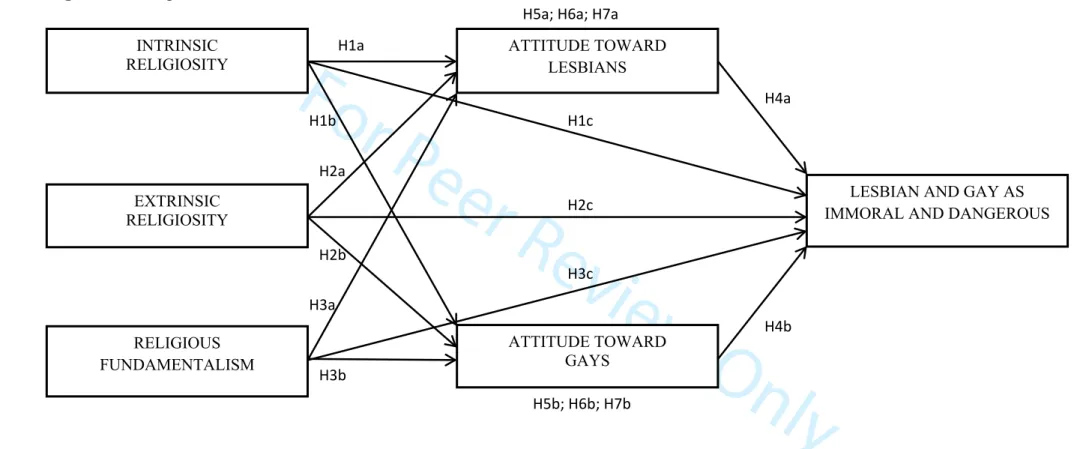
H1. Intrinsic religiousness negatively influences people’s: (a) attitude towards
lesbians; (b) attitude toward gays and (c) perception that lesbians and gay are immoral and dangerous.
Extrinsic Religiousness
Individuals with a high degree of extrinsic religiousness might not necessarily be committed to they religion as they might appear to be and are thus less likely to hold on to their religious
3 4 5 6 7 8 9 10 11 12 13 14 15 16 17 18 19 20 21 22 23 24 25 26 27 28 29 30 31 32 33 34 35 36 37 38 39 40 41 42 43 44 45 46 47 48 49 50 51 52 53 54 55 56 57 58 59 60
For Peer Review Only
beliefs. Consequently, these individuals are more likely to have neutral attitudes towards gays and lesbians than are individuals with high intrinsic religiousness (Vitell et al., 2005).
Extrinsic religiousness has been found to be correlated less with religious commitment (Donahue, 1985). Thus, we will test the following hypotheses
H2. Extrinsic religiousness does not significantly influence people’s: (a) attitude towards lesbians’ (b) attitude towards gay men and (c) perception that lesbians and gay are immoral and dangerous.
Religious Fundamentalism
Religious fundamentalism reflects “the belief that there is one set of religious teachings that clearly contain the . . . essential inerrant truth about humanity and the deity” (Altemeyer &
Hunsberger, 1992, p. 118). As previously mentioned, Krull (2017) found that people with high in intrinsic religiousness will display low levels of disrespectful comments and physical aggression towards homosexuals. Hence, individuals with religious fundamentalism will be more likely to condemn homosexuality. Devoutly religious people tend to internalize their religions’ objections and view homosexuality as immoral (Fulton, Gorsuch, & Maynard, 1999; Whitley 2009). Hence, in regards to religious fundamentalism, we suggest:
H3. Religious fundamentalism negatively influences people’s: (a) attitude towards lesbians; (b) people’s attitudes towards gays; (c) perception that lesbians and gay are immoral and dangerous.
H4. Attitudes towards: (a) lesbians and (b) gays significantly influence people’s view of lesbians and gays as immoral.
Mediating Effect—Attitude towards Lesbians and gays
In many Western countries, positive attitudes towards homosexuals have significantly increased in recent decades (Loftus, 2001; Sha et al. 2007). In the United States, the earliest opinion poll measuring attitudes towards homosexuals occurred in 1965, which found 70% of respondents held negative views of homosexuality and believed they were more “harmful
3 4 5 6 7 8 9 10 11 12 13 14 15 16 17 18 19 20 21 22 23 24 25 26 27 28 29 30 31 32 33 34 35 36 37 38 39 40 41 42 43 44 45 46 47 48 49 50 51 52 53 54 55 56 57 58 59 60
For Peer Review Only
than helpful to American life” (Harek, 2002). Attitudes towards homosexuality are complex and multifaceted (Davies, 2004) and can be influenced by characteristics of the population and participation in institutions (e.g., religion, education), the national context, government institutions, and legislation (Scheepers, Te Grotenhuis, & Van Der Slik, 2002). Hence, individuals’ attitudes will mediate the relationship between religiousness and perception of homosexuals as immoral and dangerous.
H5. Attitudes towards: (a) lesbians and (b) gays will mediate the relationship between intrinsic religiousness and perception that lesbians and gays are immoral and
dangerous.
H7. Attitude towards: (a) lesbians and (b) gays will mediate the relationship between extrinsic religiousness and the perception that lesbians and gays are immoral and dangerous.
H8. Attitudes towards: (a) lesbians and (b) gays will mediate the relationship between religious fundamentalism and the perception that lesbians and gays are immoral and dangerous.
Figure 1 summarized the conceptual framework of this study.
Insert Figure 1 About Here
Methodology Data Collection
Data were derived from a convenience sampling at large universities in three large cities in Indonesia (Surabaya, Denpasar, and Makassar). The final number of respondents was 602, with 36% male, 48% female and 16% undeclared. Most were single (77%) and heterosexual (56%). The majority were Muslims (62%). There are a large number of respondents failed to declare their gender and sexual orientation. This is a sensitive issue, hence many respondents decided to declare their preferences. Despite seeing gender in a binary way, sexual diversity are inherent in Indonesian societies (Hidayana, 2016). Table 1 summarises the demographic profile of respondents.
3 4 5 6 7 8 9 10 11 12 13 14 15 16 17 18 19 20 21 22 23 24 25 26 27 28 29 30 31 32 33 34 35 36 37 38 39 40 41 42 43 44 45 46 47 48 49 50 51 52 53 54 55 56 57 58 59 60
For Peer Review Only
Indonesia is the fourth most populous nation in the world, with around 240 million people, and the largest country in Southeast Asia (Population Reference Bureau, 2011).
Indonesia is a country of cultural diversity and home to the largest Muslim population in the world with 86.1% of the population, followed by 8.7% Christian, 1.8% Hindu, and 3.4%
other. Islam prohibits homosexuality, but homosexuality exists in Muslim countries (Siraj al- Haqq Kugle, 2010).
Insert Table 1 about Here
Measurement Instrument and Reliability
All the measures used 7-point Likert-type scales with anchors ranging from 1 (strongly disagree) to 5 (strongly agree). We adopted the scales from previous research. We adopted intrinsic and extrinsic religiousness from Allport and Ross’s (1967) religiousness scales. The authors’ religious orientation scale (ROS) is one of the most frequently used measures to determine the degree to which a person internalises and practices religious beliefs and values (Donahue, 1985; Vitell, 2009). Religious fundamentalism was adopted from Altemeyer and Hunsberger (2004), and attitude towards homosexuals was adapted from Herek (1987) and perceptions of homosexuals as immoral was adopted from Woodford et al. (2015). Table 2 summarizes the scale items used in this study. Using structural equation modeling (AMOS), we found the fit of the models was well above the recommended values X2 (df) =
1103.560(343); p < 0.000; CFI = .96; TLI = .96; NNFI = .95; RMSEA = .061; SRMR = .06 (Joreskor & Sorbom, 1993; Steiger, 1990). We calculated Cronbach’s alpha for each key variable to test for internal consistency reliability and assessed the convergent validity by determining that factor loadings were greater than 0.50 and statistically significant (p ≤ .05).
The minimum factor loading was 0.61. Values below the threshold of 0.60 indicate unsatisfactory internal consistency (Bagozzi & Yi; Malhotra & Birks, 2007). Confidence
3 4 5 6 7 8 9 10 11 12 13 14 15 16 17 18 19 20 21 22 23 24 25 26 27 28 29 30 31 32 33 34 35 36 37 38 39 40 41 42 43 44 45 46 47 48 49 50 51 52 53 54 55 56 57 58 59 60
For Peer Review Only
intervals around the correlation estimates between any two constructs were all significantly different from 1 (Anderson & Gerbing, 1988). To assess discriminant validity among the constructs, we compared the average variance extracted (AVE) values for each construct with the squared correlation estimates of paired measured constructs in the model (Fornell &
Larcker, 1981). The AVE ranged from 0.58 (religious fundamentalism) to a maximum of 0.85 (intrinsic religiousness). We calculated composite reliability (CR) values and compared them with a threshold benchmark of .60 (Bagozzi & Yi, 1988). The minimum CR of this study ranged from .91 (extrinsic religiousness; attitude towards lesbians) to .97 (intrinsic religiousness). The variance extracted was tested, and we found that the AVE for each factor was higher than the square of the correlation coefficient with each of the other factors (see Table 3). Thus, the test confirms the measurement model’s discriminant validity (Fornell &
Larcker, 1981).
Insert Table 2 and 3 about Here Mediation Analysis
To test for mediation effects, we conducted a separate bias-corrected bootstrap analysis with the mediator (i.e., attitudes towards lesbians and gays) using a series of multiple regression analyses (Preacher, 2004, 2008; Zhao, Lynch, & Chen, 2010). A bootstrap test resamples the data to estimate standard errors and to derive a confidence interval with the bootstrapped sampling distribution. The bias-corrected confidence interval is useful because it considers non-normal distributions of mediation effects and produces more accurate Type 1 error rates (Lau & Cheung, 2010). Meaningful mediating effects can occur without a significant direct relationship between independent and dependent variables (Zhao et al., 2010). Thus, the test only determines direct effects between the mediator and independent variable and between the mediator and dependent variable prior to assessment of mediation. A mediating effect is significant if the 95% confidence intervals do not bracket zero.
3 4 5 6 7 8 9 10 11 12 13 14 15 16 17 18 19 20 21 22 23 24 25 26 27 28 29 30 31 32 33 34 35 36 37 38 39 40 41 42 43 44 45 46 47 48 49 50 51 52 53 54 55 56 57 58 59 60
For Peer Review Only
Results Direct Effects
The results indicate that intrinsic religiousness significantly influenced people’s perception of lesbians (β = 0.289; p < 0.05) and gays (β = 0.531; p < 0.000). This means the higher
people’s intrinsic religiosities are, the more negatively they perceive lesbians and gay men.
Hence, H1a and H1b are supported. However, intrinsic religiousness did not significantly influence their perception on whether lesbians and gays are immoral and dangerous. Thus, H1c is not supported.
Moreover, extrinsic religiousness did not significantly influence people’s attitude towards lesbians and gays. Hence, H2a and H2b are supported. Extrinsic religiousness also did not influence their perception of whether lesbians and gays are immoral and dangerous.
Thus, H2c is supported. In regards to religious fundamentalism, the construct significantly influenced people’s attitudes towards lesbians (β = 0.673; p < 0.000) and gays (β = 0.419; p <
0.000). Therefore, H3a and H3b are supported. Moreover, religious fundamentalism significantly influenced people’s perception that lesbians and gays are immoral and dangerous (β = 1.008; p < 0.000). Thus, H3c is supported.
Finally, people’s attitudes towards lesbians and gays did not significantly influence people’ perception that lesbians and gays are immoral and dangerous. Therefore, H4a and H4b are not supported. Table 4 summarizes the results of H1 to H4.
Insert Table 4 about Here Mediating Effects
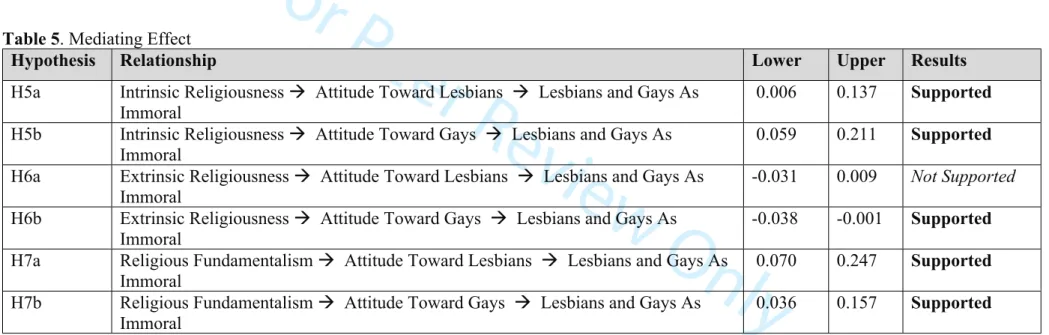
The results show that attitudes towards lesbians (0.006; 0.137) and gays (0.0059; 0.211) mediated the relationship between intrinsic religiousness and the perception that lesbians and gays are immoral and dangerous. Hence, H5a and H5b are supported. However, people’s attitudes towards lesbians did not mediate the relationship between extrinsic religiousness
3 4 5 6 7 8 9 10 11 12 13 14 15 16 17 18 19 20 21 22 23 24 25 26 27 28 29 30 31 32 33 34 35 36 37 38 39 40 41 42 43 44 45 46 47 48 49 50 51 52 53 54 55 56 57 58 59 60
For Peer Review Only
and the perception that lesbians and gays are immoral and dangerous. Therefore H6a is not supported. People’s attitudes towards gays (-0.038; -0.001) did mediate the relationship between extrinsic religiousness and the perception that lesbians and gays are immoral and dangerous. Thus, H6b is supported. Finally, attitudes towards lesbians and gays mediated the relationship between religious fundamentalism and the perception that lesbians (0.070; 0.247) and gays (0.036; 0.157) are immoral and dangerous. Hence, H7a and H7b are supported.
Table 5 shows the results of the mediating effect.
Insert Table 5 about Here
Discussion and Implications
The results reveal that religion and acceptance of lesbians and gays will continue to be a difficult issue to resolve. Individuals with high intrinsic religiousness and religious
fundamentalism are more likely to perceive lesbians and gays negatively. Violence towards LGBT people in Indonesia has worsened with escalating religious conservatism (Masli, 2018). In collaboration with religious leaders, law enforcement is urgently needed to stop people from becoming victims of disrespectful behaviour and even violence. The
international community should pressure Indonesia to protect LGBT rights, especially as the Indonesian government currently support intolerance of the LGBT community. In 2016, the Indonesian Minister of Education introduced a ban on all LGBT student groups from university campuses (ABC, 2016). Yet it is important to note that discrimination and prejudice against LGBT Indonesians in workplaces, schools, and social opportunities is pervasive and will eventually reduce that community’s ability to fully contribute to the Indonesian economy (Badgett et al., 2017). Indonesian society needs to be reminded of the social and economic contribution of the LGBT community, and violence, abuse, and discrimination towards the LGBT community should be eradicated. Social marketers can
3 4 5 6 7 8 9 10 11 12 13 14 15 16 17 18 19 20 21 22 23 24 25 26 27 28 29 30 31 32 33 34 35 36 37 38 39 40 41 42 43 44 45 46 47 48 49 50 51 52 53 54 55 56 57 58 59 60
For Peer Review Only
develop a social campaign to bridge the gap between religious individuals and the LGBT community. The greater visibility of gays and lesbians through activism and campaigns has encouraged individuals to come out to their friends and family in the hopes that visibility and transparency will generate acceptance (Decoo, 2014; Haider-Markel & Joslyn, 2008). Social services in Indonesia may collaborate with religious institutions to encourage their members to avoid violence and minimized hatred toward LGBT community through social
collaboration. For example, a religious not-for-profit in Indonesia namely House of Love Foundation provides education services, training and shelters for transgender who are cast out by their community (Pondok Kasih 2019). This is a positive step to ensure protection and support for the sexual minorities’ people.1 In addition, this study provides insights for older lesbian and gays adults in Indonesia. The government should provide protection from abuses and guarantee access to healthcare for senior citizens of LGBT. Access to healthcare is essential, especially for older gay adults, as HIV rates among gay men have increase five-fold since 2007 (Lipson 2018).
Moreover, the results show that attitudes mediate the relationships between religiousness and perception of the LGBT community as immoral. Positive attitudes will eventually reduce negative perceptions of the LGBT community. Hence, a concerted effort from international communities, local government, social marketers, and religious leader is needed to change attitudes towards the LGBT community. Indonesia should support the commission on human rights in affirming that human rights cannot be denied on the basis of sexual orientation or gender identity. When public attitudes change, individuals will start to accept others despite differences in sexual orientation.
Limitations and Future Research
1 We thank an anonymous reviewer for this feedback 3
4 5 6 7 8 9 10 11 12 13 14 15 16 17 18 19 20 21 22 23 24 25 26 27 28 29 30 31 32 33 34 35 36 37 38 39 40 41 42 43 44 45 46 47 48 49 50 51 52 53 54 55 56 57 58 59 60
For Peer Review Only
Limitations are inevitable in any convenience sampling. Similar to other studies that used student populations (e.g., Burnet et al., 2003; Nevins, et al., 2007), our samples were derived from student populations in few cities in Indonesia. Generalization are thus limited.
Moreover, respondents of this study were mostly single and young. Hence, future study may explore perception of the LGBT community among older adults. Are there generational differences on their perception of the LGBT community? Secondly, this study is focusing only on perception toward gays and lesbians in Indonesia and not on bisexuals and transgender. Future research should investigate people’s perception toward bisexuals and transgender2. Finally, the study did not explore differences between religions because there is an unequal number of different religion in the sample. Future research may investigate differences among religions. Rich (2007) found variation in acceptance of same-sex sexual relations among Buddhists, Catholics, and Protestants.
2 We thank an anonymous reviewer for this feedback.
3 4 5 6 7 8 9 10 11 12 13 14 15 16 17 18 19 20 21 22 23 24 25 26 27 28 29 30 31 32 33 34 35 36 37 38 39 40 41 42 43 44 45 46 47 48 49 50 51 52 53 54 55 56 57 58 59 60
For Peer Review Only
References
ABC (2016). Indonesia says there is 'no room' for an LGBT movement in the country.
Source: http://www.abc.net.au/news/2016-08-11/indonesia-says-no-room-for-lgbt- movement/7721838.
Allport, G. W. and Ross, J. M. (1967). Personal religious orientation and prejudice. Journal of Personality and Social Psychology, 5, 447-457.
Anderson, J. C., Gerbing, D. W. 1988. Structural equation modeling in practice: a review and recommended two-step approach. Psychological Bulletin, 103(3), 411.
Altemeyer, B., & Hunsberger, B. (1992). Authoritarianism, religious fundamentalism, and prejudice. The International Journal for the Psychology of Religion, 2, 113–133
Altemeyer, B., & Hunsberger, B. (2004). A revised religious fundamentalism scale: The short and sweet of it. The International Journal for the Psychology of Religion, 14(1), 47-54.
Badgett, M.V., Hasenbugh, A. & Luhur W.A. (2017). LGBT exclusion in Indonesia and its economic effect. https://williamsinstitute.law.ucla.edu/wp-content/uploads/LGBT-Exclusion- in-Indonesia-and-Its-Economic-Effects-March-2017.pdf.
Beagan, B. L., & Hattie, B. (2015). Religion, spirituality, and LGBTQ identity integration. Journal of LGBT Issues in Counselling, 9(2), 92-117.
Biçmen, Z., & Bekiroğulları, Z. (2014). Social problems of LGBT people in Turkey. Procedia-Social and Behavioral Sciences, 113, 224-233.
Boswell, J. (1980). Christianity, social tolerance, and homosexuality: Gay people in Western Europe from the beginning of the Christian era to the fourteenth century. Chicago, IL.:
University of Chicago Press.
Brennan-Ing, M., Seidel, L., Larson, B., & Karpiak, S. E. (2013). “I'm Created in God's Image, and God Don't Create Junk”: Religious Participation and Support Among Older GLBT Adults. Journal of Religion, Spirituality & Aging, 25(2), 70-92.
Buchanan, M., Dzelme, K., Harris, D., & Hecker, L. (2001). Challenges of being simultaneously gay or lesbian and spiritual and/or religious: A narrative
perspective. American Journal of Family Therapy, 29(5), 435-449.
Burnett, M., Keith, N. and Pettijohn, C. (2003, Spring). An empirical analysis of factors influencing student reactions to ethical advertising dilemmas: Educational experience, work experience, ethical philosophy, and demographics. Marketing Education Review 13, 33-46 Cárdenas, M., Barrientos, J., & Gómez, F. (2018). Determinants of heterosexual men's attitudes toward gay men and lesbians in Chile. Journal of Gay & Lesbian Mental Health, 1- 15.
Coley, J. S. (2017). Reconciling Religion and LGBT Rights: Christian Universities, Theological Orientations, and LGBT Inclusion. Social Currents, 4(1), 87-106.
3 4 5 6 7 8 9 10 11 12 13 14 15 16 17 18 19 20 21 22 23 24 25 26 27 28 29 30 31 32 33 34 35 36 37 38 39 40 41 42 43 44 45 46 47 48 49 50 51 52 53 54 55 56 57 58 59 60
For Peer Review Only
Decoo, Ellen, "Changing Attitudes Toward Homosexuality in the United States from 1977 to 2012" (2014). All Theses and Dissertations. 4091. https://scholarsarchive.byu.edu/etd/4091 Detenber, B. H., Cenite, M., Ku, M. Y., Ong, C. L., Tong, H. Y., & Yeow, M. H. (2007).
Singaporeans' attitudes toward lesbians and gay men and their tolerance of media portrayals of homosexuality. International Journal of Public Opinion Research, 19, 367-379.
doi:10.1093/ijpor/edm017
Donahue, M .J. (1985). Intrinsic and extrinsic religiousness: Review and meta analysis.
Journal of Personality and Social Psychology, 48(2), 400-419.
Eick, U., Rubinstein, T., Hertz, S., & Slater, A. (2016). Changing attitudes of high school students in Israel toward homosexuality. Journal of LGBT Youth, 13, 192-206.
doi:10.1080/19361653.2015.1087930
Fornell, C. & Larcker, D. F. (1981). Structural equation models with unobservable variables and measurement error: Algebra and statistics. Journal of Marketing Research, 8, 382-388 Friedman, R.C., & Downey, J. (1994). Special article: Homosexuality. The New England Journal of Medicine, 331, 923-930
Harbaugh, E., & Lindsey, E. W. (2015). Attitudes toward homosexuality among young adults: Connections to gender role identity, gender-typed activities, and religiousness.
Journal of Homosexuality, 62(8), 1098-1125.
Herek, Gregory M. (2002). Gender Gaps in Public Opinion about Lesbians and Gay Men.
Public Opinion Quarterly 66(1), 40-66.
Herek, G. M., & McLemore, K. A. (2013). Sexual prejudice. Annual review of psychology, 64, 309-333.
Herek, G.M. (1987). The gender gap in attitudes toward lesbians and gay men: Its
measurement and meaning. Manuscript submitted for publication. [published in 1988 in the Journal of Sex Research, 25, 451-477, as Heterosexuals’ attitudes toward lesbians and gay men: Correlates and gender differences.]
Herek, G. M., & Capitanio, J. P. (1995). Black heterosexuals’ attitudes toward lesbians and gay men in the United States. Journal of Sex Research, 32(2), 95-105.
Hidayana, I. M. (2016). Indonesia’s rich history of gender diversity and non-binary sexuality.
Source: https://international.thenewslens.com/article/104478
Jäckle, S., & Wenzelburger, G. (2015). Religion, religiousness, and the attitudes toward homosexuality—A multilevel analysis of 79 countries. Journal of Homosexuality, 62(2), 207- 241.
Jöreskog, K. G., & Sörbom, D. (1993). LISREL 8: Structural equation modeling with the SIMPLIS command language. Scientific Software International
3 4 5 6 7 8 9 10 11 12 13 14 15 16 17 18 19 20 21 22 23 24 25 26 27 28 29 30 31 32 33 34 35 36 37 38 39 40 41 42 43 44 45 46 47 48 49 50 51 52 53 54 55 56 57 58 59 60
For Peer Review Only
Kossowska, M., Czernatowicz, A., & Sekerdej, M. (2017). Many faces of dogmatism:
Prejudice as a way of protecting certainty against value violators among dogmatic believers and atheists. British Journal of Psychology, 108, 127-147. doi:10.1111/bjop.12186
Lau, R. S., & Cheung, G. W.(2010). Estimating and comparing specific mediation effects in complex latent variable models. Organizational Research Methods, 1094428110391673 Lamb, K. (2017). Why LGBT hatred suddenly spiked in Indonesia. Source:
https://www.theguardian.com/global-development-professionals-network/2017/feb/22/why- lgbt-hatred-suddenly-spiked-in-indonesia
Lipson, D. (2018). HIV rates among gay men in Indonesia have increased five-fold, Human Rights Watch says. Source: https://www.abc.net.au/news/2018-07-02/marginalisation-of- indonesia-lgbt-community-fuels-hiv-epidemic/9930558.
Loftus, J. (2001). America’s liberalization in attitudes toward homosexuality, 1973 to 1998.
American Journal of Sociology, 66(5), 762–782.
Manalastas, E. J., Ojanen, T. T., Ratanashevorn, R., Hong, B. C. C., Kumaresan, V., &
Veeramuthu, V. (2017). Homonegativity in Southeast Asia: Attitudes Toward Lesbians and Gay Men in Indonesia, Malaysia, the Philippines, Singapore, Thailand, and Vietnam. Asia- Pacific Social Science Review, 17(1), 1-1.
Maslim N. (2018). Being LGBT in Indonesia, why attacks on the community are growing.
Source: https://www.lifegate.com/people/news/lgbt-in-indonesia-attacks-increasing Michael R. Woodford, Jill M. Chonody, Alex Kulick, David J. Brennan & Kristen Renn (2015) The LGBQ Microaggressions on Campus Scale: A Scale Development and Validation Study, Journal of Homosexuality, 62:12, 1660-1687, DOI:
10.1080/00918369.2015.1078205
Nevins, J. L., Bearden, W. O. and Money, B. (2007). Ethical values and long-term orientation. Journal of Business Ethics 71, 261-274
Ng, C. G., Yee, A., Subramaniam, P., Loh, H. S., & Moreira, P. (2015). Attitudes toward homosexuality among nursing students in a public university in Malaysia: The religious factor. Sexuality Research & Social Policy: A Journal of The NSRC, 12, 182-187.
Olson, M. D., & DeSouza, E. (2017). The Influences of Socio-Cultural Factors on College Students' Attitudes toward Sexual Minorities. J. Soc. & Soc. Welfare, 44, 73.
Papadaki, V., Plotnikof, K., Gioumidou, M., Zisimou, V., & Papadaki, E. (2015). A
comparison of attitudes toward lesbians and gay men among students of KRULL 109 helping professions in Crete, Greece: The cases of social work, psychology, medicine, and nursing.
Journal of Homosexuality, 62, 735-762.
Patrick, K., Heywood, W., Simpson, J. M., Pitts, M. K., Richters, J., Shelley, J. M., & Smith, A. M. (2013). Demographic predictors of consistency and change in heterosexuals' attitudes toward homosexual behavior over a two-year period. Journal of Sex Research, 50, 611-619.
3 4 5 6 7 8 9 10 11 12 13 14 15 16 17 18 19 20 21 22 23 24 25 26 27 28 29 30 31 32 33 34 35 36 37 38 39 40 41 42 43 44 45 46 47 48 49 50 51 52 53 54 55 56 57 58 59 60
For Peer Review Only
Preacher, K. J., Hayes, A. F. 2008. Asymptotic and resampling strategies for assessing and comparing indirect effects in multiple mediator models. Behavior Research Methods, 40(3), 879-891
Reygan, F., & Moane, G. (2014). Religious homophobia: The experiences of a sample of lesbian, gay, bisexual and transgender (LGBT) people in Ireland. Culture and
Religion, 15(3), 298-312.
Rich, T. S. (2017). Religion and public perceptions of gays and lesbians in South Korea. Journal of Homosexuality, 64(5), 606-621.
Rodriguez, E. M., & Ouellette, S. C. (2000). Gay and lesbian Christians: Homosexual and religious identity integration in the members and participants of a gay-positive
church. Journal for the Scientific Study of Religion, 333-347.
Sakallı-Uğurlu, N., & Uğurlu, O. (2016). Predicting attitudes toward gay men with
ambivalence toward men, questioning religion, and gender differences. Sex Roles, 74(5-6), 195-205.
Sapiee, M.A. (2018). LGBT people viewed negatively, but accepted as Indonesian citizens.
Source: http://www.thejakartapost.com/news/2018/01/25/lgbt-followers-viewed-negatively- but-accepted-as-indonesian-citizens.html
Saraç, L. (2015). Relationships between religiousness level and attitudes toward lesbians and gay men among Turkish university students. Journal of Homosexuality, 62, 481-494.
doi:10.1080/00918369.2014.983386
Sha, O., Aung, M., Londerville, J., & Ralston, C. E. (2007). Understanding gay consumers’
clothing involvement and fashion consciousness. International Journal of Consumer Studies, 31(5), 453-459.
Siraj al-Haqq Kugle S. (2010). Homosexuality in Islam: critical Reflection on Gay, Lesbian, and Transgender Muslims Oxford, Oneworld Publication
Tan, P. P. (2005). The importance of spirituality among gay and lesbian individuals. Journal of Homosexuality, 49(2), 135-144.
Tsang, J., & Rowatt, W. C. (2007). The relationship between religious orientation, right-wing authoritarianism, and implicit sexual prejudice. The International Journal for the Psychology of Religion, 17, 99-120.
Vitell, S. J. (2009). The role of religiousness in business & consumer ethics: A review of the literature. Journal of Business Ethics, 90(2), 155-167.
Westcott, B (2018). Indonesian police shaved transgender women and made them dress as men. Source: https://edition.cnn.com/2018/01/29/asia/indonesian-forcibly-shaved-
transgender-women-intl/index.html
Westcott, B (2017). Never seen anything like this: inside Indonesia’s LGBT crackdown.
Source: https://edition.cnn.com/2017/05/31/asia/indonesia-lgbt-rights/index.html
3 4 5 6 7 8 9 10 11 12 13 14 15 16 17 18 19 20 21 22 23 24 25 26 27 28 29 30 31 32 33 34 35 36 37 38 39 40 41 42 43 44 45 46 47 48 49 50 51 52 53 54 55 56 57 58 59 60
For Peer Review Only
Whitley Jr, B. E. (2009). Religiousness and attitudes toward lesbians and gay men: A meta- analysis. International Journal for the Psychology of Religion, 19(1), 21-38.
Zhao, X., Lynch, J. G., Chen, Q. 2010. Reconsidering Baron and Kenny: Myths and truths about mediation analysis. Journal of Consumer Research, 37(2), 197-206.
3 4 5 6 7 8 9 10 11 12 13 14 15 16 17 18 19 20 21 22 23 24 25 26 27 28 29 30 31 32 33 34 35 36 37 38 39 40 41 42 43 44 45 46 47 48 49 50 51 52 53 54 55 56 57 58 59 60
For Peer Review Only
18 Appendix
Figure 1. Conceptual Framework
INTRINSIC RELIGIOSITY
EXTRINSIC RELIGIOSITY
ATTITUDE TOWARD LESBIANS
ATTITUDE TOWARD GAYS
RELIGIOUS FUNDAMENTALISM
LESBIAN AND GAY AS IMMORAL AND DANGEROUS H1a
H1c H1b
H2a
H2c
H2b
H3a
H3c
H3b
H4a
H4b H5a; H6a; H7a
H5b; H6b; H7b
URL: http://mc.manuscriptcentral.com/WRSA Email: [email protected] 3
4 5 6 7 8 9 10 11 12 13 14 15 16 17 18 19 20 21 22 23 24 25 26 27 28 29 30 31 32 33 34 35 36 37 38 39 40 41 42 43 44 45 46 47 48 49 50 51 52 53 54 55 56 57
For Peer Review Only
19 Table 1. Demographic
Demographic (N=602) Percentage
Gender
Male 36%
Female 48%
Undeclared 16%
Marital status
Single 77%
Married 3%
Divorced 0%
Widowed 0%
Undeclared 20%
Religion
Muslim 62%
Christian/ Catholic 5%
Hinduism 17%
Buddhism 0%
Confucius 0%
Undeclared 16%
Sexual Orientation
Heterosexual/ straight 56%
Gay/ lesbian 1%
Undeclared 43%
Education
Primary school 6%
Junior high school 9%
Senior high school 45%
College/ University 21%
Post graduate 2%
Undeclared 17%
URL: http://mc.manuscriptcentral.com/WRSA Email: [email protected] 3
4 5 6 7 8 9 10 11 12 13 14 15 16 17 18 19 20 21 22 23 24 25 26 27 28 29 30 31 32 33 34 35 36 37 38 39 40 41 42 43 44 45 46 47 48 49 50 51 52 53 54 55 56 57
For Peer Review Only
20 Table 2. Confirmatory Factor Analysis
Factor Item Convergent Validity Reliability
Factor Loading CR AVE
Intrinsic Religiousness
I enjoy reading about my religion. INTR01 0.94 0.97 0.85
It is important to me to spend time in private thought and prayer. INTR02 0.93 I have often had a strong sense of God’s presence. INTR03 0.91
My whole approach to life is based on religion. INTR04 0.90
I try hard to live all my life according to my religious beliefs. INTR05 0.92 1=Strongly Disagree; 5=Strongly Agree
Extrinsic Religiousness
I go to a religious service because I enjoy seeing people I know there. EXT01 0.85 0.91 0.77 I go to a religious service because it helps me to make friends. EXT02 0.95
I go to a religious service mostly to spend time with my friends. EXT03 0.83 1=Strongly Disagree; 5=Strongly Agree
Religious Fundamentalism
God has given humanity a complete, unfailing guide to happiness and
salvation, which must be totally followed FUND01 0.90 0.94 0.58
No single book of religious teachings contains all the intrinsic, fundamental truths about life
FUND02 0.65
The basic cause of evil in this world is Satan, who is still constantly and ferociously fighting against God
FUND03 0.81
It is more important to be a good person than to believe in God and the right religion
FUND04 0.50
There is a particular set of religious teachings in this world that are so true, you can’t go any “deeper” because they are the basic, bedrock message that God has given humanity
FUND05 0.86
When you get right down to it, there are basically only two kinds of people in the world: the Righteous, who will be rewarded by God; and the rest, who will not
FUND06 0.87
Scriptures may contain general truths, but they should NOT be considered completely, literally true from beginning to end
FUND07 0.61
URL: http://mc.manuscriptcentral.com/WRSA Email: [email protected] 3
4 5 6 7 8 9 10 11 12 13 14 15 16 17 18 19 20 21 22 23 24 25 26 27 28 29 30 31 32 33 34 35 36 37 38 39 40 41 42 43 44 45 46 47 48 49 50 51 52 53 54 55 56 57
For Peer Review Only
21 To lead the best, most meaningful life, one must belong to the one,
fundamentally true religion FUND08 0.88
“Satan” is just the name people give to their own bad impulses. There really is no such thing as a diabolical “Prince of Darkness” who tempts us
FUND09 0.75
Whenever science and sacred scripture conflict, science is probably right FUND10 0.63 The fundamentals of God’s religion should never be tampered with, or
compromised with others’ beliefs
FUND11 0.82
1=Strongly disagree; 5=Strongly agree
URL: http://mc.manuscriptcentral.com/WRSA Email: [email protected] 3
4 5 6 7 8 9 10 11 12 13 14 15 16 17 18 19 20 21 22 23 24 25 26 27 28 29 30 31 32 33 34 35 36 37 38 39 40 41 42 43 44 45 46 47 48 49 50 51 52 53 54 55 56 57
For Peer Review Only
22 Table 2. Confirmatory Factor Analysis
Factor Item Convergent Validity Reliability
Factor Loading CR AVE
Attitude Toward Lesbians
Lesbians just can't fit into our society. LESB01 0.83 0.91 0.70
Female homosexuality is a sin. LESB02 0.84
Lesbians are sick. LESB03 0.84
1=Strongly Disagree; 5=Strongly Agree Attitude Toward Gays
I think male homosexuals are disgusting. GAY01 0.88 0.95 0.79
Male homosexuality is a perversion GAY02 0.91
Homosexual behaviour between two men is just plain wrong GAY03 0.88 1=Strongly Disagree; 5=Strongly Agree
Lesbians and Gays As Immoral
People have said that being lesbian, gay, bisexual, or queer is a sin IMM01 0.89 0.95 0.83 Others have said that LGBQ people should not be around children. IMM02 0.92
Others said or implied that LGBQ people have mental health problems or
need to be “cured.” IMM03 0.93
Someone said or implied that LGBQ people engage in unsafe sex because of their sexual orientation
IMM04 0.91 1=Strongly disagree; 5=Strongly agree
URL: http://mc.manuscriptcentral.com/WRSA Email: [email protected] 3
4 5 6 7 8 9 10 11 12 13 14 15 16 17 18 19 20 21 22 23 24 25 26 27 28 29 30 31 32 33 34 35 36 37 38 39 40 41 42 43 44 45 46 47 48 49 50 51 52 53 54 55 56 57
For Peer Review Only
23 Table 3. Discriminant Validity
1 2 3 4 5 6
1. Intrinsic Religiousness 0.74 0.52 0.61 0.50 0.52 0.58
2. Extrinsic Religiousness 0.72** 0.78 0.55 0.32 0.33 0.36
3. Religious Fundamentalism 0.78** 0.74** 0.66 0.52 0.53 0.66
4. Attitude Toward Lesbians 0.71** 0.57** 0.72** 0.77 0.74 0.53
5. Attitude Toward Gays 0.72** 0.57** 0.73 0.86** 0.75 0.52
6. Lesbians and Gays as Immoral 0.76** 0.60** 0.81** 0.73** 0.72** 0.59
Mean 3.53 2.69 2.58 3.17 3.34 3.48
Std Dev 1.60 1.53 1.20 1.39 1.46 1.66
Notes: Values below the diagonal are bivariate correlations between the constructs, bold diagonal elements represent the Average Variance Extracted (AVEs) for the relevant construct; Values above the diagonal represent squared correlations; Values below the diagonal represent correlations
Table 4.
Hypothesis Path Path Coefficient p-value 95% C.I Result
H1a Intrinsic Religiousness Attitude Toward Lesbians
0.289 0.002 [0.50;0.53] Supported
H1b Intrinsic Religiousness Attitude Toward Gays 0.531 0.000 [0.34;0.73] Supported H1c Intrinsic Religiousness Lesbians and Gay as
Immoral
-0.119 0.148 [-0.35;0.08] Not Supported
H2a Extrinsic Religiousness Attitude Toward Lesbians
-0.058 0.370 [-0.16;0.04] Not Supported
H2b Extrinsic Religiousness Attitude Toward Gays -0.091 0.129 [-0.18;-0.00] Not Supported H2c Extrinsic Religiousness Lesbians and Gay as
Immoral
-0.083 0.055 [-0.16;0.00] Not Supported
H3a Religious Fundamentalism Attitude Toward
Lesbians 0.673 0.000 [0.42;0.94] Supported
H3b Religious Fundamentalism Attitude Toward Gays
0.419 0.000 [0.21;0.63] Supported
H3c Religious Fundamentalism Lesbians and Gay as Immoral
1.008 0.000 [6.97;1.21] Supported
URL: http://mc.manuscriptcentral.com/WRSA Email: [email protected] 3
4 5 6 7 8 9 10 11 12 13 14 15 16 17 18 19 20 21 22 23 24 25 26 27 28 29 30 31 32 33 34 35 36 37 38 39 40 41 42 43 44 45 46 47 48 49 50 51 52 53 54 55 56 57
For Peer Review Only
24 H4a Attitude Toward Lesbians Lesbians and Gay as
Immoral 0.050 0.795 [-0.25;0.95] Not Supported
H4b Attitude Toward Gays Lesbians and Gay as Immoral
0.186 0.326 [-0.59;0.57] Not Supported
Note: Fit Statistics: X2 (df) = 1103.560(343); CFI = .96; TLI = .96; NNFI = .95; RMSEA = .061; SRMR = .06
Table 5. Mediating Effect
Hypothesis Relationship Lower Upper Results
H5a Intrinsic Religiousness Attitude Toward Lesbians Lesbians and Gays As Immoral
0.006 0.137 Supported H5b Intrinsic Religiousness Attitude Toward Gays Lesbians and Gays As
Immoral 0.059 0.211 Supported
H6a Extrinsic Religiousness Attitude Toward Lesbians Lesbians and Gays As
Immoral -0.031 0.009 Not Supported
H6b Extrinsic Religiousness Attitude Toward Gays Lesbians and Gays As Immoral
-0.038 -0.001 Supported H7a Religious Fundamentalism Attitude Toward Lesbians Lesbians and Gays As
Immoral
0.070 0.247 Supported H7b Religious Fundamentalism Attitude Toward Gays Lesbians and Gays As
Immoral
0.036 0.157 Supported
Note: ** p< 0.001; * p<0.05; ns = not significant; 0 does not occur within the lower and upper limit of the 95% confidence interval
URL: http://mc.manuscriptcentral.com/WRSA Email: [email protected] 3
4 5 6 7 8 9 10 11 12 13 14 15 16 17 18 19 20 21 22 23 24 25 26 27 28 29 30 31 32 33 34 35 36 37 38 39 40 41 42 43 44 45 46 47 48 49 50 51 52 53 54 55 56 57
For Peer Review Only
25 --- END OF MANUSCRIPT ---
URL: http://mc.manuscriptcentral.com/WRSA Email: [email protected] 3
4 5 6 7 8 9 10 11 12 13 14 15 16 17 18 19 20 21 22 23 24 25 26 27 28 29 30 31 32 33 34 35 36 37 38 39 40 41 42 43 44 45 46 47 48 49 50 51 52 53 54 55 56 57