Selected Works
Volume III
The Art of Memory
London and New York
F R A N C E S YATES Selected Works
V O L U M E I The Valois Tapestries
V O L U M E I I
Giordano Bruno and the Hermetic Tradition
V O L U M E I I I The Art of Memory
V O L U M E I V The Rosicrucian Enlightenment
V O L U M E V Astraea
V O L U M E V I Shakespeare's Last Plays
V O L U M E V I I
The Occult Philosophy in the Elizabethan Age
V O L U M E V I I I Lull and Bruno
V O L U M E I X
Renaissance and Reform: The Italian Contribution
V O L U M E X
Ideas and Ideals in the North European Renaissance
Reprinted by Routledge 1999 11 New Fetter Lane London EC4I' 4EE
Simultaneously published in the USA and Canada by Routledge
29 West 35th Street, New York, NY 10001 Routledge is an imprint of the Taylor & Francis Croup
© 1966 Frances A. Yates
Printed and bound in Great Britain by Antony Rowe Ltd, Chippenham, Wiltshire
Publisher's note
The publisher has gone to great lengths to ensure the quality of this reprint but points out that some imperfections
in the original book may be apparent.
British Library Cataloguing in Publication Data A CIP record of this set is available from the British Library
Library of Congress Cataloging in Publication Data A catalogue record for this book has been requested
ISBN 0-415-22046-7 (Volume 3) 10 Volumes: ISBN 0-415-22043-2 (Set)
Hermetic Silence. From Achilles Bocchius, Symbolicarum
quaestionum . . . libri quinque, Bologna, 1555. Engraved by G. Bonasone (p. 170)
FRANCES A.YATES THE ART OF MEMORY
ARK PAPERBACKS
London, Melbourne and Henley
First published in 1966 ARK Edition 1984 ARK PAPERBACKS is an imprint of
Routledgc & Kcgan Paul plc
14 Leicester Square, London WC2II 7PH, Kngland.
464 St. Kilda Road, Melbourne, Victoria 3004, Australia and Broadway House, Newtown Road, Henley-on-Thames, Oxon RG9 1EN, Kngland.
Printed and bound in Great Britain by The Guernsey Press Co. Ltd.,
Guernsey, Channel Islands.
© Frances A. Yates 1966.
No part of this book may be reproduced in any form without permission from the publisher, except for the quotation of brief
passages in criticism.
ISBN 0-7448-0020-X
CONTENTS
Preface page xi I. The Three Latin Sources for the Classical Art
of Memory i II. The Art of Memory in Greece: Memory and
the Soul 27 III. The Art of Memory in the Middle Ages 50
IV. Mediaeval Memory and the Formation of
Imagery 82 V. The Memory Treatises 105
VI. Renaissance Memory: The Memory Theatre of
Giulio Camillo 129 VII. Camillo's Theatre and the Venetian Renais-
sance 160 VIII. Lullism as an Art of Memory 173
IX. Giordano Bruno: The Secret of Shadows 199
X. Ramism as an Art of Memory 231 XI. Giordano Bruno: The Secret of Seals 243
XII. Conflict between Brunian and Ramist Memory 266 XIII. Giordano Bruno: Last Works on Memory 287
XIV. The Art of Memory and Bruno's Italian
Dialogues 308 XV. The Theatre Memory System of Robert Fludd 320
XVI. Fludd's Memory Theatre and the Globe
Theatre 342 XVII. The Art of Memory and the Growth of Scienti-
fic Method 368
Index 390
I L L U S T R A T I O N S
PLATES
Hermetic Silence. From Achilles Boccbius, Symbolicarum quaestionum . . libri quinque,
Bologna, 1555. Engraved by G. Bonasone frontispiece 1. The Wisdom of Thomas Aquinas. Fresco by Andrea da
Firenze, Chapter House of Santa Maria Novella, Florence (photo: Alinari) facing page 80 2. Justice and Peace. Fresco by Ambrogio Lorenzetti
(Detail), Palazzo Pubblico, Siena {photo: Alinari) 81 3. (a) Charity (b) Envy
Frescoes by Giotto, Arena Capella, Padua (photos:
Alinari) 96 4. (a) Temperance, Prudence
(b) Justice, Fortitude
From a Fourteenth-Century Italian Manuscript, Vienna National Library (MS. 2639)
(c) Penance, From a Fifteenth-Century German Manu-
script, Biblioteca Casanatense, Rome (MS. 1404) 97 5. (a) Abbey Memory System
(b) Images to be used in the Abbey Memory System.
From Johannes Romberch, Congestorium artificiose
Memorie, ed. of Venice, 1533 112 6. (a) Grammar as a Memory Image
(b) and (c) Visual Alphabets used for the Inscriptions on Grammar
From Johannes Romberch, Congestorium Artificiose
Memorie, ed. of Venice, 1533 113 7. (a) Hell as Artificial Memory
(b) Paradise as Artificial Memory
From Cosmas Rossellius, Thesaurus Artificiosae Memo-
riae, Venice, 1579 128 vii
8. (a) The Places of Hell. Fresco by Nardo di Cione (Detail), Santa Maria Novella, Florence (photo:
Alinari)
(b) Titian, Allegory of Prudence (Swiss ownership) facing page 129 9. (a) Palladio's Reconstruction of the Roman Theatre.
From Vitruvius, De architectura cum commentariis Danielis Barbari, ed. of Venice, 1567
(b) The Teatro Olimpico, Vicenza (photo: Alinari) 192 10. Ramon Lull with the Ladders of his Art. Fourteenth-
Century Miniature, Karlsruhe (Cod. St Peter 92) 193 11. Memory System from Giordano Bruno's De umbris
idearum (Shadows), Paris, 1582 208 12. (a) Images of the Decans of Aries
(b) Images of the Decans of Taurus and Gemini From Giordano Bruno, De umbris idearum (Shadows),
ed. of Naples, 1886 209 13- (a), (b), (c), (d), (e), and (f)
Pictures Illustrating the Principles of the Art of Memory. From Agostino del Riccio, Arte della memoria locale, 1595, Biblioteca Nazionale, Florence (MS. II,
I, 13) 320 14. (a) The Heaven
(b) The Potter's Wheel
'Seals' from Bruno's Triginta Sigilli etc.
(c) Memory System from Bruno's Figuratio Aristotelici physici auditus, Paris, 1586
(d) Memory System from Bruno's De imaginum
compositione, Frankfort, 1591 321 15. First page of the Ars memoriae in Robert Fludd's
Utriusque Cosmi... Historia, Tomus Secundus, Oppen-
heim, 1619 336 16. The Zodiac. From Robert Fludd's Ars memoriae 336
17. The Theatre. From Robert Fludd's Ars memoriae 337 18. (a) Secondary Theatre
(b) Secondary Theatre
From Robert Fludd's Ars memoriae 337 19. The De Witt Sketch of the Swan Theatre. Library of
the University of Utrecht 352 20. Sketch of the Stage of the Globe Theatre based on
Fludd 353 viii
ILLUSTRATIONS FIGURES
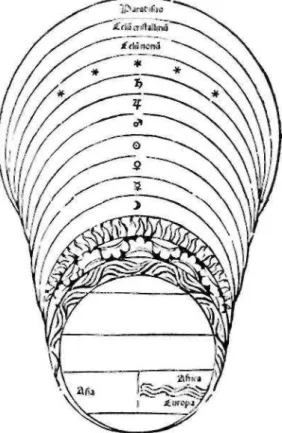
1. The Spheres of the Universe as a Memory System.
From J. Publicius, Oratoriae artis epitome, 1482 page 111 2. The Spheres of the Universe as a Memory System.
From J. Romberch, Congestorium artificiose memorie,
ed. of 1533 116 3. Human Image on a Memory Locus. From Romberch,
Congestorium artificiose memorie, ed. of 1533 118 4. The Ladder of Ascent and Descent. From Ramon
Lull's Liber de ascensu et descensu intellectus, ed. of
Valencia, 1512 180 5. 'A' Figure. From R. Lull's Ars brevis (Opera, Stras-
burg, 1617) 182 6. Combinatory Figure. From Lull's Ars brevis 183
7. Tree Diagram. From Lull's Arbor scientiae, ed. of
Lyons, 1515 186 8. Memory Wheels. From G. Bruno, De umbris idearum,
1582 209 9. Diagram of Faculty Psychology. Redrawn from a dia-
gram in Romberch, Congestorium artificiose memorie 256 10. Memory Theatre or Repository. From J. Willis,
Mnemonica, 1618 337 11. Suggested Plan of the Globe Theatre 358
Folder: The Memory Theatre of Giulio Camillo
between pages 144-5
ix
PREFACE
THE subject of this book will be unfamiliar to most readers. Few people know that the Greeks, who invented many arts, invented an art of memory which, like their other arts, was passed on to Rome whence it descended in the European tradition. This art seeks to memorise through a technique of impressing 'places' and 'images' on memory. It has usually been classed as 'mnemotechnics', which in modern times seems a rather unimportant branch of human activity. But in the ages before printing a trained memory was vitally important; and the manipulation of images in memory must always to some extent involve the psyche as a whole. Moreover an art which uses contemporary architecture for its memory places and contemporary imagery for its images will have its classical, Gothic, and Renaissance periods, like the other arts. Though the mnemotechnical side of the art is always present, both in antiquity and thereafter, and forms the factual basis for its investigation, the exploration of it must include more than the history of its tech- niques. Mnemosyne, said the Greeks, is the mother of the Muses;
the history of the training of this most fundamental and elusive of human powers will plunge us into deep waters.
My interest in the subject began about fifteen years ago when I hopefully set out to try to understand Giordano Bruno's works on memory. The memory system excavated from Bruno's Shadows (P1. II) was first displayed in a lecture at the Warburg Institute in May, 1952. Two years later, in January, 1955, the plan of Giulio Camillo's Memory Theatre (see Folder) was exhibited, also at a lecture at the Warburg Institute. I had realised by this time that there was some historical connection between Camillo's Theatre, Bruno's and Campanella's systems, and Robert Fludd's Theatre system, all of which were compared, very superficially, at this lecture. Encouraged by what seemed a slight progress, I began to write the history of the art of memory from Simonides onwards.
This stage was reflected in an article on 'The Ciceronian Art of Memory' .which was published in Italy in the volume of studies in honour of Bruno Nardi (Medioevo e Rinascimento, Florence, 1955).
xi
PREFACE
After this there was a rather long halt, caused by a difficulty. I could not understand what happened to the art of memory in the Middle Ages. Why did Albertus Magnus and Thomas Aquinas regard the use in memory of the places and images of Tullius' as a moral and religious duty ? The word 'mnemotechnics' seemed in- adequate to cover the scholastic recommendation of the art of memory as a part of the cardinal virtue of prudence. Gradually the idea began to dawn that the Middle Ages might think of figures of virtues and vices as memory images, formed according to the clas- sical rules, or of the divisions of Dante's Hell as memory places.
Attempts to tackle the mediaeval transformation of the classical art were made in lectures on 'The Classical Art of Memory in the Middle Ages' given to the Oxford Mediaeval Society in March, 1958, and on 'Rhetoric and the Art of Memory' at the Warburg Institute in December 1959. Parts of these lectures are incorpo- rated in chapters IV and V.
The greatest problem of all remained, the problem of the Renaissance magical or occult memory systems. Why, when the invention of printing seemed to have made the great Gothic artificial memories of the Middle Ages no longer necessary, was there this recrudescence of the interest in the art of memory in the strange forms in which we find it in the Renaissance systems of Camillo, Bruno, and Fludd ? I returned to the study of Giulio Camillo's Memory Theatre and realised that the stimulus behind Renaissance occult memory was the Renaissance Hermetic tradi- tion. It also became apparent that it would be necessary to write a book on this tradition before one could tackle the Renaissance memory systems. The Renaissance chapters in this book depend for their background on my Giordano Bruno amd the Hermetic
Tradition (London and Chicago, 1964).
I had thought that it might have been possible to keep Lullism out of this book and treat it separately, but it soon became clear that this was impossible. Though Lullism does not come out of the rhetoric tradition, like the classical art of memory, and though its procedures are very different, yet it is, in one of its aspects, an art of memory and as such it becomes conflated and confused with the classical art at the Renaissance. The interpretation of Lullism given in chapter VIII is based on my articles 'The Art of Ramon Lull: An Approach to it through Lull's Theory of the Elements', and 'Ramon Lull and John Scotus
xii
Erigena', Journal of the Warburg and Courtauld Institutes, XVII (1954) and XXIII (1960).
There is no modern book in English on the history of the art of memory and very few books or articles on it in any language. When I began, my chief aids were some old monographs in German and the later German studies by H. Hajdu, 1936, and L. Volkmann, 1937 (for full references, see p. 105). In 1960, Paolo Rossi's Clavis universalis was published. This book, which is in Italian, is a serious historical study of the art of memory; it prints a good deal of source material, and contains discussions of Camillo's Theatre, of Bruno's works, of Lullism, and much else. It has been valuable to me, particularly for the seventeenth century, though it is on quite different lines from this book. I have also consulted Rossi's numerous articles and one by Cesare Vasoli (references on pp. 105, 184, 194). Other books which have particularly helped me are H. Caplan's edition of Ad Herennium (1954); W. S. Howell, Logic and Rhetoric in England, 1500-1700 (1956); W. J. Ong, Ramus; Method and the Decay of Dialogue (1958); Beryl Smalley, English Friars and Antiquity (i960).
Though it uses a good deal of earlier work, this book in its present form is a new work, entirely rewritten and expanded in fresh directions during the past two years. Much that was obscure seems to have fallen into better shape, particularly the connections of the art of memory with Lullism and Ramism and the emergence of 'method'. Moreover what is perhaps one of the most exciting parts of the book has become prominent only quite recently.
This is the realisation that Fludd's Theatre memory system can throw light on Shakespeare's Globe Theatre. The imaginary architecture of the art of memory has preserved the memory of a real, but long vanished, building.
Like my Giordano Bruno and the Hermetic Tradition, the present book is orientated towards placing Bruno in a historical context but also aims at giving a survey of a whole tradition. It particularly endeavours to throw light, through the history of memory, on the nature of the impact which Bruno may have made on Elizabethan England. I have tried to strike out a pathway through a vast subject but at every stage the picture which I have drawn needs to be supplemented orcorrected by further studies. This is animmensely rich field for research, needing the collaboration of specialists in many disciplines.
xiii
PREFACE
Now that the Memory Book is at last ended, the memory of the late Gertrud Bing seems more poignantly present than ever. In the early days, she read and discussed my drafts, watching constantly over my progress, or lack of progress, encouraging and discourag- ing by turns, ever stimulating with her intense interest and vigilant criticism. She felt that the problems of the mental image, of the activation of images, of the grasp of reality through images—
problems ever present in the history of the art of memory—were close to those which preoccupied Aby Warburg, whom I only knew through her. Whether this book is what she hoped for I can now never know. She did not see even the first three chapters of it which were about to be sent to her when she was taken ill. I dedi- cate it to her memory, with deep gratitude for her friendship.
My debt to my colleagues and friends of the Warburg Institute, University of London, is, as always, profound. The Director, E. H.
Gombrich, has always taken a stimulating interest in my labours and much is owed to his wisdom. I believe that it was he who first put into my hands L'ldea del Theatro of Giulio Camillo. There have been many invaluable discussions with D. P. Walker whose specialist knowledge of certain aspects of the Renaissance has been of constant assistance. He read the early drafts and has also read this book in manuscript, kindly checking some of my translations. With J. Trapp there have been talks about the rhetoric tradition, and he has been a mine of bibliographical information. Some iconographical problems were laid before L. Ettlinger.
All the librarians have been endlessly patient with my efforts to find books. And the staff of the photographic collection has shown similar forbearance with my efforts to find photographs.
I am grateful for the comradeship of J. Hillgarth and R. Pring- Mill in Lull studies. And to Elspeth Jaffe, who knows much about arts of memory, for past conversations.
My sister, R. W. Yates, has read the chapters as they were written. Her reactions to them have been a most valuable guide and her clever advice of great help in revisions. With unfailing good humour she has given untiring assistance in countless ways. She has contributed above all to the plans and sketches. She drew the plan of Camillo's Theatre and the sketch of the Globe based on Fludd. The suggested plan of the Globe is very largely her work.
We shared together the excitement of the reconstruction of the xiv
Globe out of Fludd during memorable weeks of close collaboration.
The book owes to her one of its greatest debts.
I have constantly used the London Library to whose staff I am deeply grateful. And it goes without saying that the same is true of the library of the British Museum and its staff. I am also indebted to the librarians of the Bodleian Library, the Cambridge Univer- sity Library, the library of Emmanuel College, Cambridge, and of the following libraries abroad: Biblioteca Nazionale, Florence;
Biblioteca Ambrosiana, Milan; Bibliotheque Nationale, Paris;
Biblioteca Vaticana, Rome; Biblioteca Marciana, Venice.
I am indebted for their kind permissions to reproduce miniatures or pictures in their possession to the Directors of the Biblioteca Nazionale, Florence, of the Badische Landesbibliothek, Karlsruhe, of the Ostcrreichische Nationalbibliothek, Vienna, of the Biblioteca Casanatense, Rome, and the Swiss ownership of the picture by Titian.
FRANCES A. YATES
Warburg Institute, University of London
xv
Chapter I
T H E THREE LATIN SOURCES FOR THE CLASSICAL
ART OF MEMORY
1banquet given by a nobleman of Thessaly named Scopas, the poet Simonides of Ceos chanted a lyric poem in honour of his host but including a passage in praise of Castor and Pollux. Scopas meanly told the poet that he would only pay him half the sum agreed upon for the panegyric and that he must obtain the balance from the twin gods to whom he had devoted half the poem. A little later, a message was brought in to Simonides that two young men were waiting outside who wished to see him. He rose from the banquet and went out but could find no one. During his absence the roof of the banqueting hall fell in, crushing Scopas and all the guests to death beneath the ruins; the corpses were so mangled that the relatives who came to
1 The English translations of the three Latin sources used are those in
the Loeb edition of the classics: die Ad Herennium is translated by H.
Caplan; the De oratore by E. W. Sutton and H. Rackham; Quintilian's Inuitutio oratorio by H. E. Butler. When quoting from these translations I have sometimes modified them in the direction of literalness, particu- larly in repeating the actual terminology of the mnemonic rather than in using periphrases of the terms.
T h e best account known to me of the art of memory in antiquity is that given by H. Hajdu, Das Mnemotechnische Schriftum des Miitelalters, Vienna, 1936. I attempted a brief sketch of it in my article 'The Cicero- nian Art of Memory' in Medioeve e Rinascimento, Studi in onore di Bruno Nardi, Florence, 1955, I I , pp. 871 ff. On the whole, the subject has been curiously neglected.
C—A.O.M. I
take them away for burial were unable to identify them. But Simonides remembered the places at which they had been sitting at the table and was therefore able to indicate to the relatives which were their dead. The invisible callers, Castor and Pollux, had handsomely paid for their share in the panegyric by drawing Simonides away from the banquet just before the crash. And this experience suggested to the poet the principles of the art of memory of which he is said to have been the inventor. Noting that it was through his memory of the places at which the guests had been sitting that he had been able to identify the bodies, he realised that orderly arrangement is essential for good memory.
He inferred that persons desiring to train this faculty (of memory) must select places and form mental images of the things they wish to remember and store those images in the places, so that the order of the places will preserve the order of the things, and the images of the things will denote the things themselves, and wc shall employ the places and images respectively as a wax writing-tablet and the letters written on it.2
The vivid story of how Simonides invented the art of memory is told by Cicero in his De oratore when he is discussing memory as one of the five parts of rhetoric; the story introduces a brief des- cription of the mnemonic of places and images (loci and imagines) which was used by the Roman rhetors. Two other descriptions of the classical mnemonic, besides the one given by Cicero, have come down to us, both also in treatises on rhetoric when memory as a part of rhetoric is being discussed; one is in the anonymous Ad C. Herennium libri IV; the other is in Quintilian's Institutio oratorio.
The first basic fact which the student of the history of the clas- sical art of memory must remember is that the art belonged to rhetoric as a technique by which the orator could improve his memory, which would enable him to deliver long speeches from memory with unfailing accuracy. And it was as a part of the art of rhetoric that the art of memory travelled down through the Euro- pean tradition in which it was never forgotten, or not forgotten until comparatively modern times, that those infallible guides in all human activities, the ancients, had laid down rules and precepts for improving the memory.
2 Cicero, De oratore, I I , lxxxvi, 351-4.
2
THREE LATIN SOURCES FOR THE CLASSICAL ART OF MEMORY
It is not difficult to get hold of the general principles of the mnemonic. The first step was to imprint on the memory a series of loci or places. The commonest, though not the only, type of mnemonic place system used was the architectural type. The clearest description of the process is that given by Quintilian.3 In order to form a series of places in memory, he says, a building is to be remembered, as spacious and varied a one as possible, the fore- court, the living room, bedrooms, and parlours, not omitting statues and other ornaments with which the rooms are decorated.
The images by which the speech is to be remembered—as an example of these Quintilian says one may use an anchor or a weapon—are then placed in imagination on the places which have been memorised in the building. This done, as soon as the memory of the facts requires to be revived, all these places are visited in turn and the various deposits demanded of their custodians. We have to think of the ancient orator as moving in imagination through his memory building whilst he is making his speech, draw- ing from the memorised places the images he has placed on them.
The method ensures that the points are remembered in the right order, since the order is fixed by the sequence of places in the building. Quintilian's examples of the anchor and the weapon as images may suggest that he had in mind a speech which dealt at one point with naval matters (the anchor), at another with military operations (the weapon).
There is no doubt that this method will work for anyone who is prepared to labour seriously at these mnemonic gymnastics. I have never attempted to do so myself but I have been told of a professor who used to amuse his students at parties by asking each of them to name an object; one of them noted down all the objects in the order in which they had been named. Later in the evening the professor would cause general amazement by repeating the list of objects in the right order. He performed his little memory feat by placing the objects, as they were named, on the window sill, on the desk, on the wastepaper basket, and so on. Then, as Quintilian advises, he revisited those places in turn and demanded from them their deposits. He had never heard of the classical mnemonic but had discovered his technique quite independently. Had he ex- tended his efforts by attaching notions to the objects remembered on the places he might have caused still greater amazement by
3 Institutio oratorio, X I , ii, 17-22.
3
delivering his lectures from memory, as the classical orator delivered his speeches.
Whilst it is important to recognise that the classical art is based on workable mnemotechnic principles it may be misleading to dismiss it with the label 'mnemotechnics'. The classical sources seem to be describing inner techniques which depend on visual impressions of almost incredible intensity. Cicero emphasises that Simonides' invention of the art of memory rested, not only on his discovery of the importance of order for memory, but also on the discovery that the sense of sight is the strongest of all the senses.
It has been sagaciously discerned by Simonides or else discovered by some other person, that the most complete pictures are formed in our minds of the things that have been conveyed to them and imprinted on them by the senses, but that the keenest of all our senses is the sense of sight, and that consequently perceptions received by the ears or by reflexion can be most easily retained if they are also conveyed to our minds by the mediation of the eyes.4
T h e word 'mnemotechnics' hardly conveys what the artificial memory of Cicero may have been like, as it moved among the buildings of ancient Rome, seeing the places, seeing the images stored on the places, with a piercing inner vision which immedi- ately brought to his lips the thoughts and words of his speech. I prefer to use the expression 'art of memory' for this process.
We moderns who have no memories at all may, like the pro- fessor, employ from time to time some private mnemotechnic not of vital importance to us in our lives and professions. But in the ancient world, devoid of printing, without paper for note-taking or on which to type lectures, the trained memory was of vital importance. And the ancient memories were trained by an art which reflected the art and architecture of the ancient world, which could depend on faculties of intense visual memorisation which we have lost. T h e word 'mnemotechnics', though not actually wrong as a description of the classical art of memory, makes this very mysterious subject seem simpler than it is.
An unknown teacher of rhetoric in Rome5 compiled, circa 86- 82 B.C., a useful text-book for his students which immortalised,
* De oratore, II, lxxxvii, 357.
5 On the authorship and other problems of the Ad Herennium, see the excellent introduction by H. Caplan to the Loeb edition (1954).
4
THREE LATIN SOURCES FOR THE CLASSICAL ART OF MEMORY
not his own name, but the name of the man to whom it was dedi- cated. It is somewhat tiresome that this work, so vitally important for the history of the classical art of memory and which will be constantly referred to in the course of this book, has no other title save the uninformative Ad Herennium. The busy and efficient teacher goes through the five parts of rhetoric (inventio, dispositio, elocutio, memoria, pronuntiatio) in a rather dry text-book style. When he comes to memory6 as an essential part of the orator's equipment, he opens his treatment of it with the words: 'Now let us turn to the treasure-house of inventions, the custodian of all the parts of rhetoric, memory.' There are two kinds of memory, he continues, one natural, the other artificial. The natural memory is that which is engrafted in our minds, born simultaneously with thought.
The artificial memory is a memory strengthened or confirmed by training. A good natural memory can be improved by this dis- cipline and persons less well endowed can have their weak memo- ries improved by the art.
After this curt preamble the author announces abruptly, 'Now we will speak of the artificial memory.'
An immense weight of history presses on the memory section of Ad Herennium. It is drawing on Greek sources of memory teach- ing, probably in Greek treatises on rhetoric all of which are lost. It is the only Latin treatise on the subject to be preserved, for Cicero's and Quintilian's remarks are not full treatises and assume that the reader is already familiar with the artificial memory and its terminology. It is thus really the main source, and indeed the only complete source, for the classical art of memory both in the Greek and in the Latin world. Its role as the transmitter of the classical art to the Middle Ages and the Renaissance is also of unique importance. The Ad Herennium was a well known and much used text in the Middle Ages when it had an immense prestige because it was thought to be by Cicero. It was therefore believed that the precepts for the artificial memory which it expounded had been drawn up by 'Tullius' himself.
In short, all attempts to puzzle out what the classical art of memory was like must be mainly based on the memory section of Ad Herennium. And all attempts such as we are making in this book to puzzle out the history of that art in the Western tradition
6 T h e section on memory is in Ad Herennium, I I I , xvi-xxiv.
5
must refer back constantly to this text as the main source of the tradition. Every Ars memorativa treatise, with its rules for 'places', its rules for 'images', its discussion of 'memory for things' and 'memory for words', is repeating the plan, the subject matter, and as often as not the actual words of Ad Herennium. And the astonish- ing developments of the art of memory in the sixteenth century, which it is the chief object of this book to explore, still preserve the 'Ad Herennian' outlines below all their complex accretions. Even the wildest flights of fancy in such a work as Giordano Bruno's De umbris idearum cannot conceal the fact that the philosopher of the Renaissance is going through yet once again the old, old business of rules for places, rules for images, memory for things, memory for words.
Evidently, therefore, it is incumbent upon us to attempt the by no means easy task of trying to understand the memory section of Ad Herennium. What makes the task by no means easy is that the rhetoric teacher is not addressing us; he is not setting out to explain to people who know nothing about it what the artificial memory was. He is addressing his rhetoric students as they congregated around him circa 86-82 B.C., and they knew what he was talking about; for them he needed only to rattle off the 'rules' which they would know how to apply. We are in a different case and are often somewhat baffled by the strangeness of some of the memory rules.
In what follows I attempt to give the content of the memory section of Ad Herennium, emulating the brisk style of the author, but with pauses for reflection about what he is telling us.
The artificial memory is established from places and images {Constat igitur artificiosa memoria ex locis et imaginibus), the stock definition to be forever repeated down the ages. A locus is a place easily grasped by the memory, such as a house, an intercolumnar space, a corner, an arch, or the like. Images are forms, marks or simulacra {formae, notae, simulacra) of what we wish to remember.
For instance if we wish to recall the genus of a horse, of a lion, of an eagle, we must place their images on definite loci.
The art of memory is like an inner writing. Those who know the letters of the alphabet can write down what is dictated to them and read out what they have written. Likewise those who have learned mnemonics can set in places what they have heard and deliver it
6
THREE LATIN SOURCES FOR THE CLASSICAL ART OF MEMORY
from memory. 'For the places are very much like wax tablets or papyrus, the images like the letters, the arrangement and disposi- tion of the images like the script, and the delivery is like the reading.'
If we wish to remember much material we must equip ourselves with a large number of places. It is essential that the places should form a series and must be remembered in their order, so that we can start from any locus in the series and move either backwards or forwards from it. If we should see a number of our acquain- tances standing in a row, it would not make any difference to us whether we should tell their names beginning with the person standing at the head of the line or at the foot or in the middle. So with memory loci. 'If these have been arranged in order, the result will be that, reminded by the images, we can repeat orally what we have committed to the loci, proceeding in either direction from any locus we please.'
The formation of the loci is of the greatest importance, for the same set of loci can be used again and again for remembering different material. The images which we have placed on them for remembering one set of things fade and are effaced when we make no further use of them. But the loci remain in the memory and can be used again by placing another set of images for another set of material. The loci are like the wax tablets which remain when what is written on them has been effaced and are ready to be written on again.
In order to make sure that we do not err in remembering the order of the loci it is useful to give each fifth locus some distinguish- ing mark. We may for example mark the fifth locus with a golden hand, and place in the tenth the image of some acquaintance whose name is Decimus. We can then go on to station other marks on each succeeding fifth locus.
It is better to form one's memory loci in a deserted and solitary place for crowds of passing people tend to weaken the impressions.
Therefore the student intent on acquiring a sharp and well- defined set of loci will choose an unfrequented building in which to memorise places.
Memory loci should not be too much like one another, for instance too many intercolumnar spaces are not good, for their resemblance to one another will be confusing. They should be of moderate size, not too large for this renders the images placed
7
on them vague, and not too small for then an arrangement of images will be overcrowded. They must not be too brightly lighted for then the images placed on them will glitter and dazzle;
nor must they be too dark or the shadows will obscure the images.
The intervals between the loci should be of moderate extent, perhaps about thirty feet, 'for like the external eye, so the inner eye of thought is less powerful when you have moved the object of sight too near or too far away'.
A person with a relatively large experience can easily equip himself with as many suitable loci as he pleases, and even a person who thinks that he does not possess enough sufficiently good loci can remedy this. 'For thought can embrace any region whatsoever and in it and at will construct the setting of some locus.' (That is to say, mnemonics can use what were afterwards called 'fictitious places', in contrast to the 'real places' of the ordinary method.)
Pausing for reflection at the end of rules for places I would say that what strikes me most about them is the astonishing visual precision which they imply. In a classically trained memory the space between the loci can be measured, the lighting of the loci is allowed for. And the rules summon up a vision of a forgotten social habit. Who is that man moving slowly in the lonely building, stopping at intervals with an intent face ? He is a rhetoric student forming a set of memory loci.
'Enough has been said of places', continues the author of Ad Herennium, 'now we turn to the theory of images.' Rules for images now begin, the first of which is that there are two kinds of images, one for 'dungs' (res), thee other for 'words' (verba). That is to say 'memory for things' makes images to remind of an argu- ment, a notion, or a 'thing'; but 'memory for words' has to find images to remind of every single word.
I interrrupt the concise audior here for a moment in order to remind the reader that for the rhetoric student 'things' and 'words' would have an absolutely precise meaning in relation to the five parts of the rhetoric. Those five parts are defined by Cicero as follows:
Invention is the excogitation of true things (res), or things similar to truth to render one's cause plausible; disposition is the arrange- ment in order of the things thus discovered; elocution is the accomodation of suitable words to the invented (things); memory
8
THREE LATIN SOURCES FOR THE CLASSICAL ART OF MEMORY
is the firm perception in the soul of things and words; pronuncia- tion is the moderating of the voice and body to suit the dignity of the things and words.7
'Things' are thus the subject matter of the speech; 'words' are the language in which that subject matter is clothed. Are you aiming at an artificial memory to remind you only of the order of the notions, arguments, 'things' of your speech ? Or do you aim at memorising every single word in it in the right order ? T h e first kind of artificial memory is memoria rerum; the second kind is memoria verborum.
T h e ideal, as defined by Cicero in the above passage, would be to have a 'firm perception in the soul' of both things and words.
But 'memory for words' is much harder than 'memory for things';
the weaker brethren among the author of Ad Herenmum's rhetoric students evidently rather jibbed at memorising an image for every single word, and even Cicero himself, as we shall see later, allowed that 'memory for things' was enough.
To return to the rules for images. We have already been given the rules for places, what kind of places to choose for memorising.
What are the rules about what kind of images to choose for memo- rising on the places ? We now come to one of the most curious and surprising passages in the treatise, namely the psychological reasons which the author gives for the choice of mnemonic images.
Why is it, he asks, that some images are so strong and sharp and so suitable for awakening memory, whilst others are so weak and feeble that they hardly stimulate memory at all ? We must enquire into this so as to know which images to avoid and which to seek.
Now nature herself teaches us what we should do. When we see in every day life things that are petty, ordinary, and banal, we generally fail to remember them, because the mind is not being stirred by anything novel or marvellous. But if we see or hear something exceptionally base, dishonourable, unusual, great, un- believable, or ridiculous, that we are likely to remember for a long time. Accordingly, things immediate to our eye or ear we commonly forget; incidents of our childhood we often remember best. Nor could this be so for any other reason than that ordinary things easily slip from the memory while the striking and the novel stay longer in the mind. A sunrise, the sun's course, a sunset are
7 De inventione, I, vii, 9 (translation based on that by H. M. Hubbell in the Loeb edition, but made more literal in reproducing the technical terms res and verba).
9
marvellous to no one because they occur daily. But solar eclipses are a source of wonder because they occur seldom, and indeed are more marvellous than lunar eclipses, because these are more fre- quent. Thus nature shows that she is not aroused by the common ordinary event, but is moved by a new or striking occurrence. Let art, then, imitate nature, find what she desires, and follow as she directs. For in invention nature is never last, education never first;
rather the beginnings of things arise from natural talent, and the ends are reached by discipline.
We ought, then, to set up images of a kind that can adhere lon- gest in memory. And we shall do so if we establish similitudes as striking as possible; if we set up images that are not many or vague but active (imagines agentes); if we assign to them exceptional beauty or singular ugliness; if we ornament some of them, as with crowns or purple cloaks, so that the similitude may be more dis- tinct to us; or if we somehow disfigure them, as by introducing one stained with blood or soiled with mud or smeared with red paint, so that its form is more striking, or by assigning certain comic effects to our images, for that, too, will ensure our remembering them more readily. The things we easily remember when they are real we likewise remember without difficulty when they are fig- ments. But this will be essential—again and again to run over rapidly in the mind all the original places in order to refresh the images.8
Our author has clearly got hold of the idea of helping memory by arousing emotional affects through these striking and unusual images, beautiful or hideous, comic or obscene. And it is clear that he is thinking of human images, of human figures wearing crowns or purple cloaks, bloodstained or smeared with paint, of human figures dramatically engaged in some activity—doing something.
We feel that we have moved into an extraordinary world as we run over his places with the rhetoric student, imagining on the places such very peculiar images. Quintilian's anchor and weapon as memory images, though much less exciting, are easier to under- stand than the weirdly populated memory to which the author of Ad Herennium introduces us.
It is one of the many difficulties which confront the student of the history of the art of memory that an Ars memorativa treatise, though it will always give the rules, rarely gives any concrete
8 Ad Herennium, III, xxii.
10
THREE LATIN SOURCES FOR THE CLASSICAL ART OF MEMORY
application of the rules, that is to say it rarely sets out a system of mnemonic images on their places. This tradition was started by the author of Ad Herennium himself who says that the duty of an instructor in mnemonics is to teach the method of making images, give a few examples, and then encourage the student to form his own. When teaching 'introductions', he says, one does not draft a thousand set introductions and give them to the student to learn by heart; one teaches him the method and then leaves him to his own inventiveness. So also one should do in teaching mnemonic images.9 This is an admirable tutorial principle though one regrets that it prevents the author from showing us a whole set or gallery of striking and unusual imagines agentes. We must be content with the three specimens which he describes.
The first is an example of a 'memory for things' image. We have to suppose that we are the counsel for the defence in a law suit.
'The prosecutor has said that the defendant killed a man by poison, has charged that the motive of the crime was to gain an inheritance, and declared that there are many witnesses and accessories to this act.' We are forming a memory system about the whole case and we shall wish to put in our first memory locus an image to remind us of the accusation against our client. This is the image.
We shall imagine the man in question as lying ill in bed, if we know him personally. If we do not know him, we shall yet take some one to be our invalid, but not a man of the lowest class, so that he may come to mind at once. And we shall place the defendant at the bedside, holding in his right hand a cup, in his left, tablets, and on the fourth finger, a ram's testicles. In this way we can have in memory the man who was poisoned, the witnesses, and the inheritance.10
T h e cup would remind of the poisoning, the tablets, of the will or the inheritance, and the testicles of the ram through verbal similarity with testes—of the witnesses. T h e sick man is to be like the man himself, or like someone else whom we know (though not one of the anonymous lower classes). In the following loci we
* Ibid., I l l , xxiii, 39.
10 Ibid., I l l , xx( 33. On the translation of medico testiculos arietinos tenement as 'on the fourth finger a ram's testicles', see the translator's note, Loeb edition, p. 214. The digitus medicinalis was the fourth finger of the left hand. Mediaeval readers, unable to understand medico, intro- duced a doctor into the scene; see below, p. 65
I I
would put other counts in the charge, or the details of the rest of the case, and if we have properly imprinted the places and images we shall easily be able to remember any point that we wish to recall.
This, then, is an example of a classical memory image—con- sisting of human figures, active, dramatic, striking, with acces- sories to remind of the whole 'thing' which is being recorded in memory. Though everything appears to be explained, I yet find this image baffling. Like much else in Ad Herennium on memory it seems to belong to a world which is either impossible for us to understand or which is not being really fully explained to us.
The writer is not concerned in this example with remembering the speeches in the case but with recording the details or 'things' of the case. It is as though, as a lawyer, he is forming a filing cabinet in memory of his cases. The image given is put as a label on the first place of the memory file on which the records about the man accused of poisoning are kept. He wants to look up something about that case; he turns to the composite image in which it is recorded, and behind that image on the following places he finds the rest of the case. If this is at all a correct interpretation, the artificial memory would now be being used, not only to memorise speeches, but to hold in memory a mass of material which can be looked up at will.
The words of Cicero in the De oratore when he is speaking of the advantages of the artificial memory may tend to confirm this interpretation. He has just been saying that the loci preserve the order of the facts, and the images designate the facts themselves, and we employ the places and images like a wax writing tablet and the letters written on it. 'But what business is it of mine', he continues, 'to specify the value to a speaker and the usefulness and effectiveness of memory ? of retaining the information given you when you were briefed and the opinions you yourself have formed ? of having all your ideas firmly planted in your mind and all your resources of vocabulary neatly arranged, of giving such close attention to the instructions of your client and to the speech of the opponent you have to answer that they may seem not just to pour what they say into your ears but to imprint it on your mind?
Consequently only people with a powerful memory know what they are going to say and for how long they are going to speak and in what style, what points they have already answered and
12
THREE LATIN SOURCES FOR THE CLASSICAL ART OF MEMORY
what still remains; and they can also remember from other cases many arguments which they have previously advanced and many which they have heard from other people.'"
We are in the presence of amazing powers of memory. And, according to Cicero, these natural powers were indeed aided by training of the type described in Ad Herennium.
The specimen image just described was a 'memory for things' image; it was designed to recall the 'things' or facts of the case and the following loci of the system would presumably have held other 'memory for things' images, recording other facts about the case or arguments used in speeches by the defence or the prosecution. The other two specimen images given in Ad Herennium are 'memory for words' images.
The student wishing to acquire 'memory for words' begins in the same way as the 'memory for things' student; that is to say he memorises places which are to hold his images. But he is con- fronted with a harder task for far more places will be needed to memorise all the words of a speech than would be needed for its notions. The specimen images for 'memory for words' are of the same type as the 'memory for things' image, that is to say they represent human figures of a striking and unusual character and in striking dramatic situations—imagines agentes.
We are setting out to memorise this line of verse:
lam domum itionem reges Atridae parant12
(And now their homecoming the kings, the sons of Atreus are making ready)
The line is found only in the quotation of it in Ad Herennium and was either invented by the author to exhibit his mnemonic tech- nique or was taken for some lost work. It is to be memorised through two very extraordinary images.
One is 'Domitius raising his hands to heaven while he is lashed by the Marcii Reges'. The translator and editor of the text in the Loeb edition (H. Caplan) explains in a note that 'Rex was the name of one of the most distinguished families of the Marcian gens; the Domitian, of plebeian origin, was likewise a celebrated gens'. The image may reflect some street scene in which Domitius
11 De oratore, I I , lxxxvii, 355.
12 Ad Herennium, I I I , xxi, 34. See translator's notes on pp. 216-17 in
the Loeb edition.
13
of the plebeian gens (perhaps bloodstained to make him more memorable) is being beaten up by some members of the dis- tinguished Rex family. It was perhaps a scene which the author himself had witnessed. Or perhaps it was a scene in some play. It was a striking scene in every sense of the word and therefore suitable as a mnemonic image. It was put on a place for remember- ing this line. The vivid image immediately brought to mind 'Dornitius-Reges' and this reminded by sound resemblance of 'domum itionem reges'. It thus exhibits the principles of a 'memory for words' image which brings to mind the words which the memory is seeking through their sound resemblance to the notion suggested by the image.
We all know how, when groping in memory for a word or a name, some quite absurd and random association, something which has 'stuck' in the memory, will help us to dredge it up. The classical art is systematising that process.
The other image for memorising the rest of the line is 'Aesopus and Cimber being dressed for the roles of Agamemnon and Menelaus in Iphigenaia'. Aesopus was a well-known tragic actor, a friend of Cicero; Cimber, evidently also an actor, is only men- tioned in this text.'3 The play in which they are preparing to act also does not exist. In the image these actors are being dressed to play the parts of the sons of Atreus (Agamemnon and Menelaus).
It is an exciting off-stage glimpse of two famous actors being made up (to smear an image with red paint makes it memorable accord- ing to the rules) and dressed for their parts. Such a scene has all the elements of a good mnemonic image; we therefore use it to remember 'Atridae parant', the sons of Atreus are making ready. This image immediately gave the word 'Atridae' (though not by sound resemblance) and also suggested 'making ready' for the home-coming through the actors making ready for the stage.
This method for memorising the verse will not work by itself, says the author of Ad Herennium. We must go over the verse three or four times, that is learn it by heart in the usual way, and then represent the words by means of images. 'In this way art will sup- plement nature. For neither by itself will be strong enough, though we must note that theory and technique are much the
13 Loeb edition, translator's note, p. 217.
14
THREE LATIN SOURCES FOR THE CLASSICAL ART OF MEMORY
more reliable.'14 The fact that we have to learn the poem by heart as well, makes 'memory for words' a little less baffling.
Reflecting on the 'memory for words' images, we note that our author seems now concerned not with the rhetoric students' proper business of remembering a speech, but with memorising verse in poems or plays. To remember a whole poem or a whole play in this way one has to envisage 'places' extending one might almost say for miles within the memory, 'places' past which one moves in reciting, drawing from them the mnemonic cues. And perhaps that word 'cue' does give a clue to how the method might be workable.
Did one really learn the poem by heart but set up some places with 'cue' images on them at strategic intervals ?
Our author mentions that another type of 'memory for words' symbol has been elaborated by the Greeks. 'I know that most of the Greeks who have written on the memory have taken the course of listing images that correspond to a great many words, so that persons who wished to learn these images by heart would have them ready without expending effort in a search for them.'15 It is possible that these Greek images for words are shorthand symbols or notae the use of which was coming into fashion in the Latin world at this time.'6 As used in mnemonics, this would pre- sumably mean that, by a kind of inner stenography, the shorthand symbols were written down inwardly and memorised on the memory places. Fortunately our author disapproves of this method, since even a thousand of such ready-made symbols would not begin to cover all the words used. Indeed, he is rather lenient about 'memory for words' of any kind; it must be tackled just because it is more difficult than 'memory for things'. It is to be used as an exercise to strengthen 'that other kind of memory, the memory for things, which is of practical use. Thus we may without effort pass from this difficult training to ease in that other memory.'
The memory section closes with an exhortation to hard work.
14 Ad Herennium, loc. cit.
15 Ibid., I l l , xxiii, 38.
16 Cicero is said by Plutarch to have introduced shorthand to Rome;
the name of his frcedman, Tiro, became associated with the so-called 'Tironian notes'. See The Oxford Classical Dictionary, article Tachy- graphy; H. J. M. Milne, Greek Shorthand Manuals, London, 1934, introduction. There may be some connection between the introduction of Greek mnemonics into the Latin world, reflected in Ad Herennium, and the importation of stenography at about the same time.
15
'In every discipline artistic theory is of little avail without un- remitting exercise, but especially in mnemonics, theory is almost valueless unless made good by industry, devotion, toil, and care.
You can make sure that you have as many places as possible and that these conform as much as possible to the rules; in placing the images you should exercise every day.'17
We have been trying to understand inner gymnastics, invisible labours of concentration which are to us most strange, though the rules and examples of Ad Herennium give mysterious glimpses into the powers and organisation of antique memories. We think of memory feats which are recorded of the ancients, of how the elder Seneca, a teacher of rhetoric, could repeat two thousand names in the order in which they had been given; and when a class of two hundred students or more spoke each in turn a line of poetry, he could recite all the lines in reverse order, beginning from the last one said and going right back to the first.18 Or we remember that Augustine, also trained as a teacher of rhetoric, tells of a friend called Simplicius who could recite Virgil back- wards." We have learned from our text-book that if we have properly and firmly fixed our memory places we can move along them in either direction, backwards or forwards. The artificial memory may explain the awe inspiring ability to recite backwards of the elder Seneca and of Augustine's friend. Pointless though such feats may seem to us, they illustrate the respect accorded in antiquity to the man with the trained memory.
Very singular is the art of this invisible art of memory. It reflects ancient architecture but in an unclassical spirit, concen- trating its choice on irregular places and avoiding symmetrical orders. It is full of human imagery of a very personal kind; we mark the tenth place with a face like that of our friend Decimus; we see a number of our acquaintances standing in a row; we visualise a sick man like the man himself, or if we did not know him, like someone we do know. These human figures are active and dramatic, strikingly beautiful or grotesque. They remind one more of figures in some Gothic cathedral than of classical art proper.
They appear to be completely amoral, their function being solely to give an emotional impetus to memory by their personal
17 Ad Herennium, i l l , xxiv, 40.
18 Marcus Annaeus Seneca, Controversiarum Libri, Lib. I, Praef. 2.
19 Augustine, De anima, lib. IV. cap. vii.
16
THREE LATIN SOURCES FOR THE CLASSICAL ART OF MEMORY
idiosyncracy or their strangeness. This impression may, however, be due to the fact that we have not been given a specimen image of how to remember, for example, the 'things' justice or temperance and their parts, which are treated by the author of Ad Herennium when discussing the invention of the subject matter of a speech.20
The elusiveness of the art of memory is very trying to its historian.
Though the mediaeval tradition which assigned the authorship of Ad Herennium to 'Tullius' was wrong in fact, it was not wrong in its inference that the art of memory was practised and recom- mended by 'Tullius'. In his De oratore (which he finished in 55 B.C.) Cicero treats of the five parts of rhetoric in his elegant, dis- cursive, gentlemanly manner—a manner very different from that of our dry rhetoric teacher—and in this work he refers to a mnemonic which is obviously based on the same techniques as those described in Ad Herennium.
The first mention of the mnemonic comes in Crassus's speech in the first book in which he says that he does not altogether dislike as an aid to memory 'that method of places and images which is taught in an art.'21 Later, Anthony tells of how Themistocles refused to learn the art of memory 'which was then being intro- duced for the first time' saying that he preferred the science of forgetting to that of remembering. Anthony warns that this frivolous remark must not 'cause us to neglect the training of the memory'.22 The reader is thus prepared for Anthony's later bril- liant rendering of the story of the fatal banquet which occasioned the invention of the art by Simonides—the story with which I began this chapter. In the course of the discussion of the art of memory which follows Cicero gives a potted version of the rules.
Consequently (in order that I may not be prolix and tedious on a subject that is well known and familiar) one must employ a large number of places which must be well lighted, clearly set out in order, at moderate intervals apart (locis est utendum multis, illu- stribus, explicatis, modicis intervallis); and images which are active, sharply denned, unusual, and which have the power of speedily
20 Ad Herennium, I I I , iii.
21 De oratore, I, xxxiv, 157.
2 2 Ibid., I I , lxxiv, 2 9 9 - 3 0 0 . 17
encountering and penetrating the psyche {imaginibus autem agentibus, acribus, insignitis, quae occurrere celeriterque percutere animum possint).23
He has boiled down rules for places and rules for images to a minimum in order not to bore the reader by repeating the text- book instructions which are so well known and familiar.
Next he makes an obscurely worded reference to some extremely sophisticated types of memory for words.
. . . the ability to use these (images) will be supplied by practise which engenders habit, and (by images) of similar words changed and unchanged in case or drawn (from denoting) the part to denot- ing the genus, and by using the image of one word to remind of a whole sentence, as a consummate painter distinguishing the position of objects by modifying their shapes.24
He next speaks of the type of memory for words (described as 'Greek' by the author of Ad Herennium) which attempts to memo- rise an image for every word, but decides (like Ad Herennium) that memory for things is the branch of the art most useful to the orator.
Memory for words, which for us is essential, is given distinct- ness by a greater variety of images (in contrast to using the image of one word for a whole sentence of which he has just been speak- ing); for there are many words which serve as joints connecting the limbs of a sentence, and these cannot be formed by any use of similitudes—of these we have to model images for constant em- ployment; but a memory for things is the special property of the orator—this we can imprint on our minds by a skilful arrangement of the several masks (singulis personis) that represent them, so that we may grasp ideas by means of images and their order by means of places.25
T h e use of the word persona of the memory-for-things image is interesting and curious. Does it imply that the memory image heightens its striking effect by exaggerating its tragic or comic aspect, as the actor does by wearing a mask ? Does it suggest that the stage was a likely source of striking memory images ? Or docs the word mean in this context that the memory image is like a known individual person, as the author of Ad Herennium advises, but wears that personal mask only to jog the memory ?
23 Ibid., II, lxxxvii, 358.
24 Ibid., loc. cit.
25Ibid., II, lxxxviii, 359.
18
THREE LATIN SOURCES FOR THE CLASSICAL ART OF MEMORY
Cicero has provided a highly condensed little Ars memorativa treatise bringing in all the points in their usual order. Beginning with the statement, introduced by the Simonides story that the art consists in places and images and is like an inner writing on wax, he goes on to discuss natural and artificial memory, with the usual conclusion that nature can be improved by art. Then follow rules for places and rules for images; then the discussion of memory for things and memory for words. Though he agrees that memory for things is alone essential for the orator he has evidently put himself through a memory for words drill in which images for words move (?), change their cases (?), draw a whole sentence into one word image, in some extraordinary manner which he visualises within, as though it were the art of some consummate painter.
Nor is it true as unskilled people assert {quod ab inertibus dicitur) that memory is crushed beneath a weight of images and even what might have been retained by nature unassisted is obscured:
for I have myself met eminent people with almost divine powers of memory (summos homines et divinaprope memoria), Charmadas at Athens and Metrodorus of Scepsis in Asia, who is said to be still living, each of whom used to say that he wrote down what he wanted to remember in certain places in his possession by means of images, just as if he were inscribing letters on wax. It follows that this practice cannot be used to draw out the memory if no memory has been given by nature, but it can undoubtedly summon it to come forth if it is in hiding.26
From these concluding words of Cicero's on the art of memory we learn that the objection to the classical art which was always raised throughout its subsequent history—and is still raised by everyone who is told of it—was voiced in antiquity. There were inert or lazy or unskilled people in Cicero's time who took the common sense view, to which, personally, I heartily subscribe—as explained earlier I am a historian only of the art, not a practitioner of it—that all these places and images would only bury under a heap of rubble whatever little one does remember naturally. Cicero is a believer and a defender. He evidently had by nature a fantastically acute visual memory.
And what are we to think of those eminent men, Charmades and Metrodorus, whom he had met whose powers of memory were
26 Ibid., I I , lxxxviii, 360.
19
'almost divine' ? As well as being an orator with a phenomenal trained memory, Cicero was in philosophy a Platonist, and for the Platonist memory has very special connotations. What does an orator and a Platonist mean when he speaks of memories which arc 'almost divine' ?
The name of the mysterious Metrodorus of Scepsis will reverbe- rate on many later pages of this book.
Cicero's earliest work on rhetoric was the De inventione which he wrote about thirty years earlier than the De oratore, at about the same time that the unknown author of Ad Herennium was com- piling his text book. We can learn nothing new from the De inventione about Cicero on the artificial memory for the book is concerned with only the first part of the rhetoric, namely inventio, the inventing or composing of the subject matter of a speech, the collection of the 'things' with which it will deal. Nevertheless the De inventione was to play a very important part in the later history of the art of memory because it was through Cicero's definitions of the virtues in this work that the artificial memory became in the Middle Ages a part of the cardinal virtue of Prudence.
Towards the end of the De inventione, Cicero defines virtue as 'a habit of mind in harmony with reason and the order of nature' a stoic definition of virtue. He then states that virtue has four parts, namely Prudence, Justice, Fortitude, and Temperance. Each of these four main virtues he subdivides into parts of their own. The following is his definition of Prudence and its parts:
Prudence is the knowledge of what is good, what is bad and what is neither good nor bad. Its parts are memory, intelligence, foresight (memoria, intelligentia, providentia). Memory is the faculty by which the mind recalls what has happened. Intelligence is the faculty by which it ascertains what is. Foresight is the faculty by which it is seen that something is going to occur before it occurs.27
Cicero's definitions of the virtues and their parts in the De inventione were a very important source for the formulation of what afterwards became known as the four cardinal virtues. The definition by 'Tullius' of the three parts of Prudence is quoted by Albertus Magnus and Thomas Aquinas when discussing the vir- tues in their Summae. And the fact that 'Tullius' makes memory a part of Prudence was the main factor in their recommendation
27 De inventione, II, liii, 160 (trans. H. M. Hubbell in the Locb edition).
20
THREE LATIN SOURCES FOR THE CLASSICAL ART OF MEMORY
of the artificial memory. The argument was beautifully sym- metrical, and related to the fact that the Middle Ages grouped the De inventione with the Ad Herennium as both by Tullius; the two works were known respectively as the First and Second Rhetorics of Tullius. Tullius in his First Rhetoric states that memory is a part of Prudence; Tullius in his Second Rhetoric says that there is an artificial memory by which natural memory can be improved.
Therefore the practice of the artificial memory is a part of the virtue of Prudence. It is under memory as a part of Prudence that Albertus and Thomas quote and discuss the rules of the artificial memory.
The process by which the scholastics switched artificial memory from rhetoric to ethics will be discussed more fully in a later chapter.28 I briefly refer to it here in advance because one wonders whether the prudential or ethical use of artificial memory was entirely invented by the Middle Ages, or whether it too may have had an antique root. The stoics, as we know, attached great impor- tance to the moral control of the fantasy as an important part of ethics. As I mentioned earlier, we have no means of knowing how the 'things' Prudence, Justice, Fortitude, Temperance, and their parts would have been represented in the artificial memory.
Would Prudence, for example, have taken on a strikingly beautiful mnemonic form, a persona