The.Role.of.Government.in.E-Business.Adoption..65 Barbara Roberts, The University of Southern Queensland, Australia. Jing Zhang, Hebei Teachers University, China Bing Han, Hebei Teachers University, China Zhuopeng Deng, Hebei Teachers University, China Jie Lu, University of Technology, Sydney (UTS), Australia Chapter.XIV.
Abstract
Introduction
Democracy: An essential facet of modernization is the recognition of the importance of interaction between governments and their citizens in decision-making. Evidence shows that "the most innovative uses of the Internet for governance are emerging in the developing world" (InvoDev, 2002).
Advantage.and.Barriers
The chapter entitled "Requirements analysis and general functional model of seamless, citizen-oriented service delivery" describes the main requirements for the provision of seamless services and presents a general functional model (e-government service market) for the delivery of common services to citizens. at the transaction level (i.e. supporting the overall online management of the service). The chapter titled "Government's Role in E-Business Adoption" by Barbara Roberts and Mark Toleman shows that the influence of government is multifaceted.
Section.II..E-Government.Applications
Chapter XIII, titled "The Development of Urban E-Government in China", by Zi Lu, Jing Zhang, Bing Han, Zhuopeng Deng, and Jie Lu, assesses and acknowledges the development of urban e-government in China from two main aspects: functionality and complexity. Electronic delivery of government services (ie the National Health Service, defense and criminal justice systems) is becoming increasingly common in developing countries.
Section.III..E-Government:.Benchmarking
The chapter identifies future trends and research opportunities in user involvement in e-government development. To clarify the direction of digitalization, this chapter presents progress phases of the digitalization of local governments.
The editor is grateful to all those who helped him in completing this work. In particular, the editor would like to acknowledge his deepest appreciation to the many viewers for their time and effort.
List.of.Reviewers
A special thanks to the staff at the University of Southern Queensland for all their help in seeing this work through. Seung-Yong Rho Seoul Women's University, Seoul, Korea Barbara Roberts University of Southern Queensland, Australia Jeffrey Roy Dalhousie University, Canada.
Section.I
Chapter.I
Public.E-Services
According to (Berners-Lee, Hendler, & Lassila, 2001), "the semantic web is an extension of the current web in which information is given well-defined meaning, better enabling computers and humans to work together." While a more formal definition by the W3C (http://www.w3.org/2001/sw) refers to "the Semantic Web [as] the representation of data on the World Wide Web. The combination of Web mining and Semantic Web has created a new and rapidly emerging research area: Semantic Web Mining.
Background
City.Model.for.Personalised.Public.Services
The users of the portal are citizens and companies and can be classified according to their profiles (demography, interests, area of experience, etc.) in order to fit into the e-city domain. The efficient content management of the proposed e-city portal is a difficult and time-consuming task.
User’s Identification and Modelling
This facilitates the users of the website to locate the desired information in a quick and easy way. These are internal representations that consist of the characteristics (characteristics) of the users (identities), their interests, preferences, history, behavior, and so on.
User’s Classification
Semantc Web Mnng for Personalzed Publc E-Services or trivial as privacy and anonymity risks in the online world limit data availability (quantity and quality). When the data is collected, preprocessing activities are performed to remove and filter redundant and irrelevant data, predict and complete missing values, transform and encode the data, and resolve any discrepancies.
Users’.Navigational.Behaviour.Analysis
Recommendations’.Production
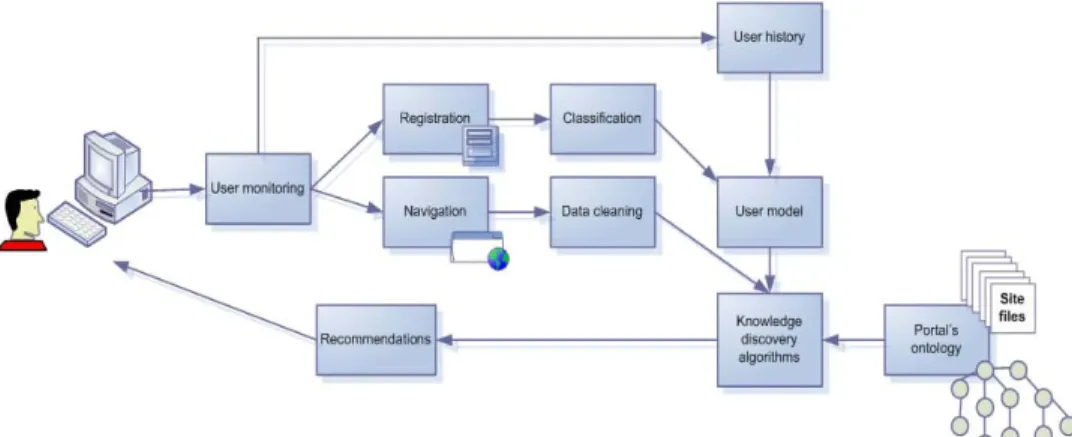
Consequently, a new list of recommendations is derived from the user's ontology and history file. Send the list of final recommendations back to the user in ascending order (page with the largest r first).
Evaluation
Finally, privacy violations must be encountered during the user modeling and profiling process (Volokh, 2000). Electronic privacy issues in the foreseeable future will become very important and intense (Markellos, Markellou, Rigou, Sirmakessis, & Tsakalidis, 2004b).
Conclusion
Web mining in soft computing framework: Relevance, state of the art and future directions. Semantic.Web: This is an extension of the current Web in which information is given well-defined meaning, better enabling computers and humans to work together.
Requirements.Analysis
Model.of.Seamless,
Service.Delivery
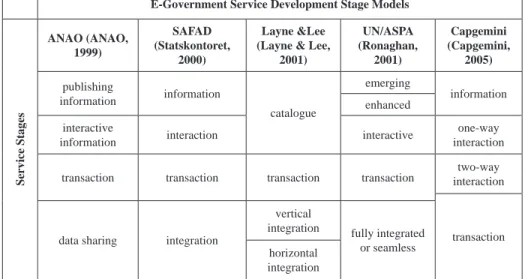
These models divide the development of e-government into several stages from simple information transfer to more complex services (Table 1). The initial impressive results of e-government activities - the rapid emergence of several government websites and the development of portals - made it possible to easily find information without the need for additional significant funding.
Requirements.for.Seamless.Service.Delivery
Seamless, Ctzen-Oriented Service Delivery According to the Capgemini report (Capgemini, 2005) on online availability of government services (the survey covered 17 countries and examined 20 basic public services), the online sophistication of public service delivery is located in Europe. between one-way interaction (stage 2) and two-way interaction (stage 3) (measurement October 2004). Reuse refers to the possibility of reusing services and information instead of duplicating them at different agencies.
Service.Marketplace
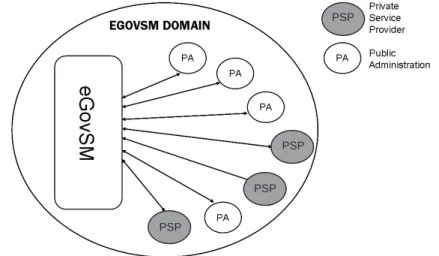
The e-government service market promotes the reuse of information as well as the sharing of services provided by different agencies. All the administrations and private service providers that subscribe to the e-government service market will be part of its domain.

Citizen.Interaction.Management
The citizen interaction manager is also responsible for updating life events and services according to changes in the law or in the administrative process related to the service. The citizen interaction manager component is responsible for managing all interactions between the citizen and the marketplace.
Citizen Identification
The identifier is stored on an electronic card; therefore only the citizen owns it (in those countries where an electronic identity card is already activated, it can be envisaged to keep the identifier on the identity card). The citizen identifier is a federated identifier, containing citizen personal data, that enables the e-government service marketplace to find out the government agencies that hold citizen data.
Administrative.Process.Coordination
If, on the contrary, the administration delegates this function to the marketplace for e-government services, the system will create the final document and deliver it to the citizen instead of the agency. The marketplace for e-government services implements a decentralized approach; it does not store a local copy of citizen data;.
Public.Administration.Interaction.Management
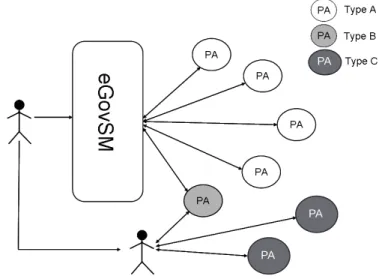
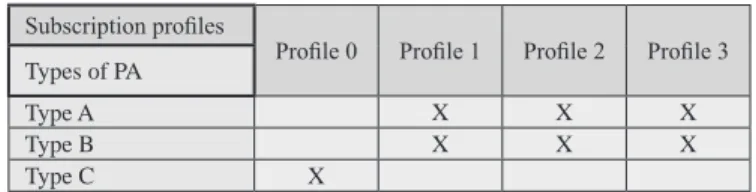
"Profile 2" refers to administrations that are able to provide a richer set of functionality (they can provide information or documents to the market). In terms of communicating data from eGovSM to government agencies, each agency has two opt-ins: they can accept or not accept data from the market.
The.Model-Driven.Approach
The definition of the concept of e-government service marketplace goes beyond country-specific requirements and identifies elements that can be transferred across different contexts. EGovSMs from different countries are part of the whole network and thus work together to provide pan-European seamless services.

The.Case.of.Provisional.Driving.License.Delivery
A citizen who wants to apply for a temporary driver's license enters the eGovSM through the portal and applies for the service (see Figure 8). The Department of Motor Vehicles must check the validity of the document, inform the eGovSM about it and issue the final document to the citizen.

The.Social.Perspective
Personalized.service: Increased opportunities for customized services (ie the ability to customize electronic service delivery). Personalized services will inform citizens about the progress of their request or they will allow citizens to customize the website of the e-Government Services Marketplace Portal to their needs.
The.Economical.Perspective
Increased efficiency: Improved information provision and service delivery contribute to increasing the efficiency (i.e. the ability to convert resources and inputs into effects and impacts) of public service delivery. Improved.collaboration: The concept of e-government service marketplace facilitates technical-level collaboration between agencies enabling seamless service delivery based on a shared service operating model.
Automating.Governmental
Cross-Agency.Processes
Orchestration
Gap.Analysis
The automation of service delivery processes between agencies is crucial for improving government services and reducing administrative burdens. A promising technology that offers many benefits in automating processes between different agencies is the orchestration of web services (Gortmaker, Janssen & Wagenaar, 2004).
Research.Approach
Next, we present a prototype to demonstrate the feasibility of web service orchestration for automating interagency processes, and conclude that several important organizational issues need to be addressed when using web service orchestration to support inter-agency business processes. .
Web.Service.Orchestration.Technology
Automating government cross-agency processes Web service technology consists of a collection of protocols needed to implement an SOA. The interface of a Web service is defined by means of Web Service Definition Language (WSDL), and the messages through which the services can be invoked are defined using SOAP (simple object access protocol).
Gap.Analysis
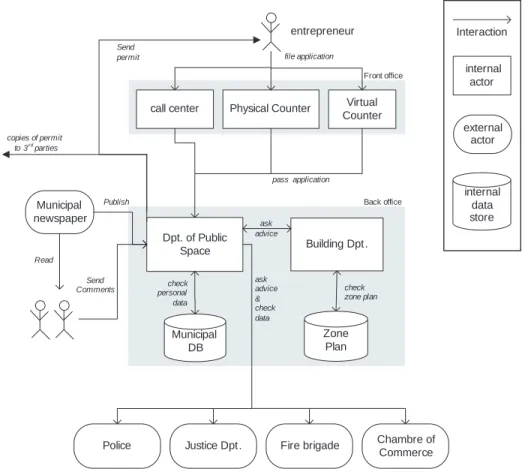
One of the key issues to be addressed when automating business processes is ensuring that each subservice in the interagency service delivery process is fully completed on time. One of the customers indicated that it took so long to obtain a liquor license.
Accountability.and.Responsibility
In the business desk case study, a number of problems related to inadequate communication of information were identified. The division of responsibilities between the front office and the back office was not always clear.
Future.Trends.in.Web.Service.Orchestration
Automation of government interagency processes Accountability is an important requirement for the entire public sector (Bovens, 1998). The objective of this chapter is to explore the feasibility of web service orchestration technology to automate inter-agency processes.
Endnote
Business.Adoption
An analysis of the role of government in e-business adoption is provided in this chapter, with empirical data from Australia. A review of the literature examining e-business adoption identifies government-related behavior as just one of many influential factors that have been identified from a wide range of sources.
TAM.Related.Theories
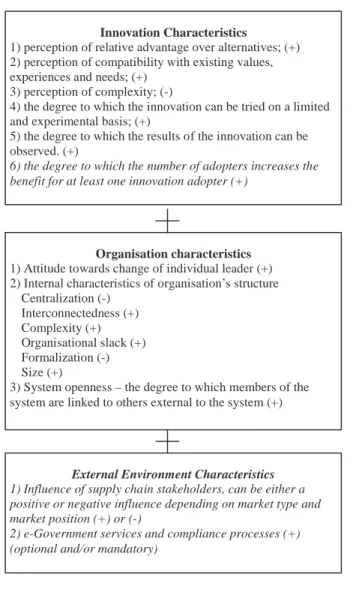
Research by Fichman (2001) on the adoption of IT innovations specifically supports the DOI findings that the degree of perceived benefit and the size/resource capacity of the adopting organization have significant explanatory power in understanding adoption and usage patterns. It is therefore reasonable to conclude that the factors influencing organizational adoption of e-business are many and drawn from numerous sources.
Government Power Influencing Adoption Numbers
The extent to which government activities have the potential to influence e-business adoption, and the areas of e-business in which government influence is likely to have more impact than others, are discussed in more detail after a brief discussion of implications related to the network externality characteristic of e-business. The reliance of many e-business ventures to achieve sufficient critical mass regarding adoption to be successful is due to the network externality effect (Katz, 1986).
Adoption.by.Australian.Wineries
Selection.of.Wineries.as.Unit.of.Analysis
Phase.1:.Interview.Methodology
All interviewees cited the Australian government as one of the driving forces behind their winery's e-business behavior. We use a package called Trident. The Trident system communicates directly with customs in a so-called Exit One package.
Phase.2:.Survey.Methodology
Regarding the use of external websites, the most common type that wineries acquire are the specific wine industry websites, some of which are operated by Australian government authorities (eg the Australian Wine and Brandy Corporation is the Australian government authority responsible for the promotion and regulation of Australian wine and brandy). The development and adoption of the ICS by the Australian government is an example of e-government designed to benefit the government and the nations citizens as a whole, with a particular focus on increasing security levels.
Future.Research
Retrieved from http://www.aciltasman.com.au/images/pdf/wine_report_v2.pdf Allen Consulting Group. Retrieved April 29, 2006, from http://www.dcita.gov.au/ie/publications/2002/november/advancing_with_e-business_case_studies.
Digital Public Sphere
Rhetoric or Reality
Especially in the fields of political science and public administration, the interaction between citizens and the government was studied primarily from the perspective of citizen participation.1. Public administration experts discussed the relationship between citizens and governments.
Technologies.and.Digital.Deliberation
An exemplary practice of digital consultation in government is CitizenSpace in the UK (http://www.ukonline.gov.uk/CitizenSpace/CitizenSpace/fs/en). In addition, some political issues were discussed on the websites of the Blue House.

Implications.and.Policy.Recommendations
The policy should be made by the will of citizens in democratic governance, but the current practice of digital deliberation did not support this statement. The citizens' strong will for active digital deliberation is a key to the success of digital deliberation in democratic government.
Acknowledgments
Heeks (Ed.), Reinventing Government in the information age: International practice in IT-enabled public sector reform (pp. 211-228). Reinventing public service delivery through ICT: Lessons from developments in the US, UK and the Netherlands.
Endnotes
This is illustrated by the rise of celebrity culture, the popularity of "Big Brother". This is not to say that the specter of panoptic society has completely disappeared.
Mechanisms.of.Surveillance
It appears that individuals are expected by the state and those in power to trust and rely on the security mechanisms of larger "abstract systems" (Giddens, 1991). An ICM poll which found that people are three times more likely to trust the BBC than the government (Daily Telegraph, 2004) is a clear indictment of public disillusionment and growing cynicism about government benevolence.
Power.vs..Consensual.Governance
Indeed, we might even interpret their reaction as further evidence of the correctness of Hobbes's observation (which echoes Machiavelli's position in The Discourses) that individuals ultimately act in their own self-interest. It's about how much we can trust that our elected government and the nation's custodians really have our best interests at heart.
Globalisation.Effects.of.Technology.on.Governance
Community.Facilitation
Model.for.E-Government
I ntroduction
Our model is designed within the generic e-government framework proposed by Grant and Chau (2005). A Communty Facltaton Model for E-Government partnership where the problem/problem originally defined by the government is solved through decentralized collaboration rather than centralized control.
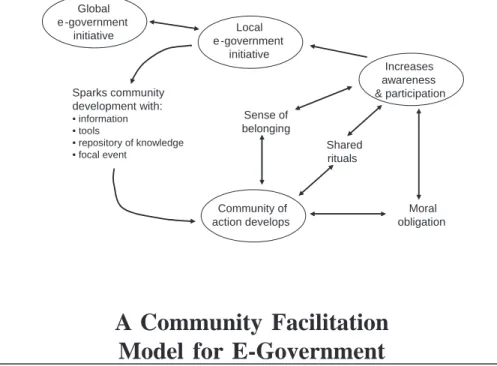
Sparking.Community.Development
Three.Critical.Components
Moreover, rituals can transmit the norms and values of the community to its members as well as to outsiders (Marshall, 1994). In fact, one of the main advantages of e-facilitating a community is that the community can be geographically diverse.
Alberta.Water.Quality.Awareness
Self-Sustaining.Community
Specifically, we propose that once a community develops to include three critical components (ie, a sense of belonging, shared rituals, and moral obligations), positive reinforcement helps maintain and grow the community beyond the initial spark provided by the government. On the other hand, greater participation in communal rituals can further increase the sense of belonging and moral obligation of community members.
Global.Adoption.and.Adaptation
Electronically supported monitoring programs such as WWMD and AWQA Day are still in the early stages of development. The case for e-government: Excerpts from the OECD report “The e-government imperative.” OECD Journal on Budgeting.
The Confluence of E-Health and E-Government
Already today, the impact of the increasingly more intensive IC2T use can be measured in the way local, national and global political, economic or social transactions are carried out. Because of the resulting chaos, the achievement (mission) of healthcare goals (goals) is uncertainty, rather than information-driven (von Lubitz & Wickramasinghe, 2005c).
Healthcare.Network.Centric.Operations.(HNCO)
Government.Applications
Glimpses.of.the.Problems,
Nigeria has over the years been one of the most corrupt nations in the world (TICP, 2003). Despite the abundance of crude oil in Nigeria, the country ranks as one of the poorest nations in the world (CIA: World Factbook, 2004).

Organizational.Problems
We can therefore say that the Nigerian political leadership has realized the need for change in the governance of the nation and believes that e-government can help bring about such change. Let us now turn our attention to the limitations and challenges facing the emergence of e-government initiatives in Nigeria.
Social.and.Cultural.Problems
Movement towards e-government in a developing society. This administration's emphasis, style and programs have always centered on the reorientation of officials and civil servants towards a change in the ways of conducting public business in a transparent, efficient and effective manner. We can therefore suggest that those with power or interests to protect in the SSA region, including Nigeria, may not see any benefits in e-government or may want to sabotage it.
Economic.Constraints
Findings from Straub et al.'s study suggest that sociocultural factors are critical in ICT-related issues for developing societies (Anakwe et al. Anandarajan et al., 2002). West (2004) argues that cultural norms and patterns of individual behavior influence the way a country's citizens and policy makers use technology.
Infrastructural.and.Technical.Constraints
The attitude or culture of self-motivation among government officials is widespread in Nigeria (Ojo, 1996). We will also use these categories to discuss the progressive initiatives on the ICT and e-Governance fronts in Nigeria.
Institutional.and.Organizational.Initiatives
The transformation of some services to the websites; provide service passively, not actively exchange information between governments and the public. It is a partnership between NITDA and the private sector, whose aim is to implement the backbone of the Nigerian e-government infrastructure.

Human.Capacity.Initiatives
Towards e-Government The development company model represents the “stages of growth” model based on the experiences of e-Government practices. Essentially, the goal is to improve organizational performance, service delivery and the participation of ordinary citizens in governance through ICT, and the shareholders provide the resources for the project.
Infrastructural.Support.Initiatives
Furthermore, we have highlighted some of the progressive initiatives undertaken in Nigeria aimed at providing an enabling environment for the emergence of e-government. As other nations in the region prepare for the rise of e-government, they may consider some of the efforts underway in Nigeria.

Chapter.X
Government
Organizational.Challenges
This means that they are carried out during all phases of the decision-making process and not just during one step in the process. One of the challenges facing this process is that the strategic environment is very dynamic.