
INTRODUCTION
THE SCIENCE OF CASCADE FAILURES
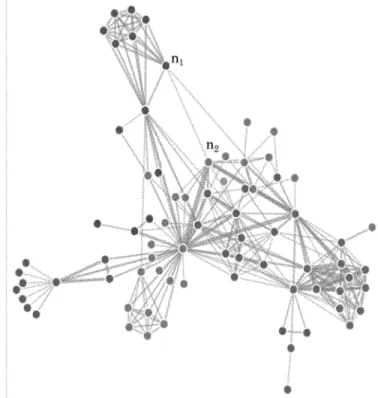
FROM ELECTROMAGNETIC PULSE (EMP) ATTACK, supra note 11, at 160; ASSIGNMENT TO ASSESS THE THREAT TO THE USA This network diagram is a famous graph by Mike Bostock of the character occurrences in the book Les Misfrables.
Systemic Risk
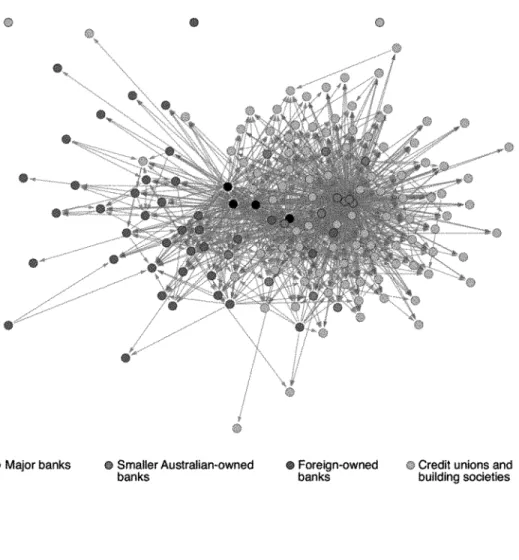
For example, Figure 3 shows the structure of the Australian banking system with different types of banks and linkages showing loan exposures between borrowers and lenders (arrows flow from borrower to lender). While this complexity of structure may make the system more robust in performing its functions, ironically it is also its source. The connection between different networks causes a dynamic process of successive failures; a failure of nodes in one network leads to a failure of dependent nodes in other networks, which in turn can cause further damage to the first network, and so on.
This sequence of cascading failures can completely fragment the entire system ...[T]he coupling strength of the networks, represented by the fraction q of interdependent nodes, determines how the system collapses. For strong coupling, that is, for a high fraction of interdependent joints, an initial damage event can lead to cascading failures that bring about an immediate collapse of the system, in a form of a first-order phase transition. Decreasing the coupling strength below a critical value, qc, leads to a change from a sudden collapse to a continuous decline of.
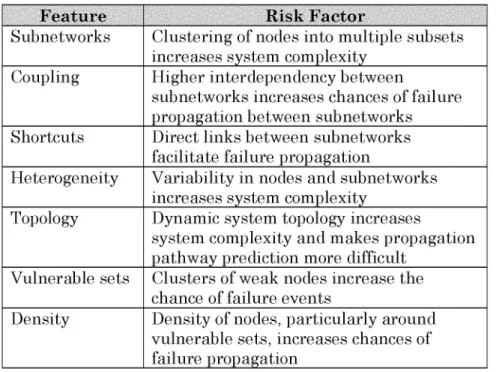
In systems-of-systems that exhibit high degrees of coupling—i.e. with coupling over the critical value qc - which nodes and which paths between subsystems matter and when do they matter. First, higher densities of shortcut connections between subsystems—the direct connections between two nodes across the subsystems that move critical flow from one to the other (or between both)—are associated with higher systemic risk.4 7 Second, there may be a small "vulnerable set" of nodes whose failure can trigger system-wide cascades.4 8 These nodes tend to be located in areas of the system with high density of connections and concentrated levels of flow load through the system (e.g. densely populated areas of a power supply network).4 9 Thus, "the primary failure of a few links within or near a vulnerable set of connections causes a disproportionately large number of large cascades."50 In a dynamic system, the exact set of However, vulnerable links can change, but the total number of vulnerable links is small51 and can be roughly identified by.
Failure Propagation
The propagation of overload failure is therefore not necessarily a node-by-node line of faults along direct node connection paths. Rather, a node fails at one network location, then at another potentially remote location, and so on in unpredictable patterns until the overload becomes a global feature of the system as a whole.56 As a number of network researchers explain, “In marked contrast to cascading structural failures, congestion failures usually interact in networks globally due to cooperating congestion pressures, without apparent or direct causal relationships, where primary failure of one set of nodes is followed by failure of another set of nodes located far away in the network from the first set, and so on. 5 8. Between the two propagation patterns, overload faults are by far the biggest management and response challenge. 5 9 Consider again the example of the power grid.
If the failure follows a node-by-node structural line model, the system manager can interrupt a cascade by disconnecting the links placed in front of the failed nodes. However, in congestion failures, the system manager cannot necessarily follow the propagation of the failure from node to node.60 A group of nodes could fail at one location, after which the congestion would move through the system without failure along many connection paths. joints before bringing another set of. For a stunning visualization of this effect in the context of the power grid, see Jun Yan, Demonstration of a Potential Cascade Failure in the San Francisco Bay Area, YOUTUBE (December https://www.youtube.com/watch?v= SGWDBsQNilU [https: //perma.cc/S99F-YNTU].
To stop the cascade, the system manager may have no choice but to shut down the entire system to minimize losses. Electric power distribution companies in the western United States, where fires were started by sparks from overload failures (eg, a wind-driven water fault causing transformers to explode elsewhere), have begun implementing this approach for.
Network Resilience
CASCADE FAILURE GOVERNANCE STRATEGIES
It is believed that automated stock trading algorithms used by investment firms "read" these tweets and immediately initiated trades. Over the course of a few minutes, the S&P 500 lost nearly 1 percent of its value — about $130 billion. As the Associated Press corrected the misinformation, the market recovered quickly, although the spread of winners and losers is likely gone.
Although the trading system quickly recovered from the criminal tweet, the incident illustrates how connected and tightly knit modern society has become. The social media system spreads misinformation faster than people can react with accurate information; that failure carried over to the stock trading system, which today, thanks to automated algorithmic trading ("algo-trading"),72 moves even faster on what are known as "subsecond networks".73 The whole incident - a swing of 260 dollars. billion in the S&P 500 alone - it only took a few minutes.
System Modeling and Monitoring
Research from a wide range of fields is converging on the need to model such broad SETs as complex adaptive systems "in which large networks of components without central control and simple operating rules bring about complex collective behavior, processing of sophisticated information, and adaptation through learning or evolution."7 9 Attributes of such systems include aspects of self-organization; network structure; output (the whole is different from the sum of its parts); As society builds robust models of various SETs using the complex adaptive systems framework, the failure of the governing cascade will require the capacity to install sensors and monitoring techniques to minimize time-to-failure detection.8 4 For example, monitoring of many power grid performance properties plays a major role in grid decision-making,8 5. An Zeng et al., The Science of Science: From the Complex Systems, 714-715 PHYSICS REP., Nov.
For more background on the use of complexity science in a wide range of disciplines including law, see J.B. model development has so far focused on energy networks, banking and social media.8 7 Of these, social media can represent more governance challenges, how platforms operate in the nebulous, global Internet system. In some senses, social media platforms like Twitter and Facebook are networks filled with short links—people connect directly to each other—as well as node-to-node paths (eg, through re-tweeting). .
Monitoring can be more efficient if it focuses on high-ranking nodes with high levels of recommunication, such as so-called "influencers" and important news media, such as the Associated Press. There are also large clusters of nodes on social media platforms that are self-organized into islands - more like echo chambers - within which cascading effects can be of high potential.8 8.
Event Prediction
In that case, to have done anything good, the observers would have had to, for example, have "read" the tweet, concluded that it was false, and predicted its impact on the algo trading network before triggering the algo trading network's cascade response . .
Event Prevention, Response, and Recovery
GOVERNANCE CHALLENGES
Institutional Design
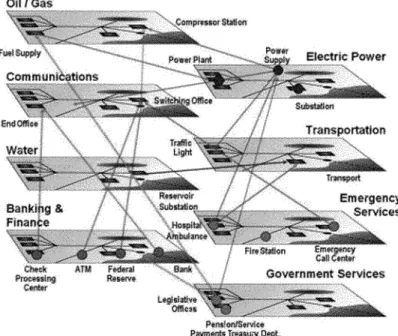
The transaction costs and time required to propagate these decisions through the system can make the decisions too late to prevent or mitigate the failure. Return to Figure 1 and consider some preliminary questions that need to be answered before you can begin designing. As Figure 1 illustrates, one could identify the banking and financial system for management, or one could take over altogether.
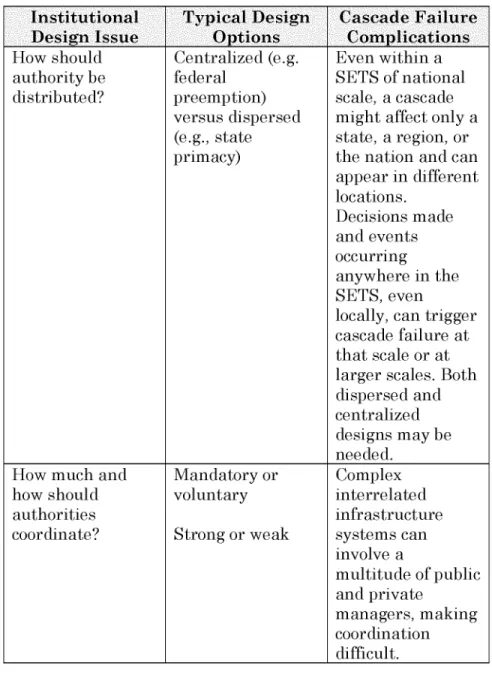
Any of the subsystems in Figure 1 could be the locus of initial failure, but then what happens when it goes offline—what are the failure propagation paths to other systems. The governing entity or entities will need to determine where the systemic risk characteristics (Table 1) are present in order to deploy resilience strategies (Table 2). At one level, the institutional design challenges for cascading failures appear to present familiar questions such as degree of centralization, degree of interagency coordination, and legal instruments for policy implementation, each and many more implied by the Executive Agent concept.
A cascading error can propagate faster than authorities can coordinate responses, in which case coordination requirements could exacerbate the error. Separation, isolation and other strategies may require very strict measures, and rigid regulatory regimes may impede development.
Trade-Offs
Normative Questions
- Defining Failure
- Allocating Harm
- Civil Liberties
- Social Justice
- THE FATE OF ECOLOGICAL SYSTEMS
- CONCLUSION
Many of the cascading failure control strategies involve imposing local damage to avoid global damage. In the case of power grids, for example, islanding areas of the grid and shutting them down during event response means that those areas have no power. There may be significant civil liberties limits on how far management oversight can go over the failure to implement prevention and response strategies.
Instead, the vulnerable population bore a disproportionate burden of damage from cascading failures – victims of fault propagation. For example, cutting off parts of the power grid to mitigate a cascading failure will affect those who can afford backup power. McMahon, The Physiological Ecology of the Zebra Mussel, Dreissena Polymorpha, in North America and Europe, 36 Am.
Second, almost none of the cascading failure governance strategies described in this article will work directly for ecological systems. Therefore, governing the systemic risk to cascading failure in SETS is as much a scientific challenge as a policy challenge.

![View of [Turnitin] PENERAPAN MODEL PEMBELAJARAN ROPES (REVIEW, OVERVIEW, PRESENTATION, EXERCISE ,SUMMARY) UNTUK MENINGKATKAN HASIL BELAJAR MATEMATIKA PADA SISWA MTs HIFZHIL QUR’AN MEDAN T.P 2020_2021](data:image/gif;base64,R0lGODlhAQABAIAAAP///wAAACH5BAEAAAAALAAAAAABAAEAAAICRAEAOw==)