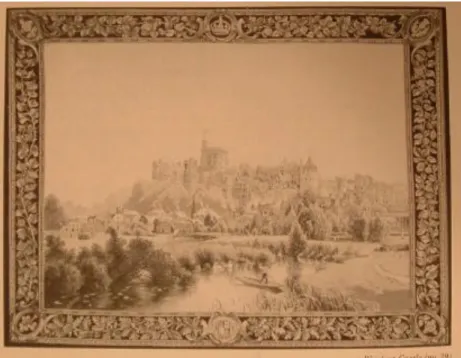
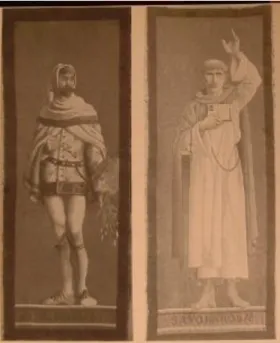
Gordon Graham Cullingham provided an overview of the history and production in The Royal Windsor Tapestry Manufactory an Illustrated Handlist of Tapestries Woven at the Old Windsor Works (1979).1 Cullingham compiled and synthesized a ground-breaking amount of information, and after a quarter of a century, his efforts have not been replaced. Cullingham's documentation of the Windsor tapestries is limited to a few pages, at most, for each design. The set was distributed at auction in 1896, and the location of the panels is currently unknown.
This obscurity is in many ways representative of the contemporary mediocre reputation of the Windsor tapestries, of which there are few in public collections.2. This thesis examines the Royal Idylls in the context of tapestry weaving in nineteenth-century England, from the founding of the Royal Windsor Tapestry Manufactory to 1890, when the Windsor tapestries began to be compared unfavorably with the Merton Abbey tapestries. The documents in the Royal Archives focus on the business operations of the Windsor Works, not on specific orders.
Despite these challenges, Herbert Bone's Idylls of the King stands out as one of the highest achievements of the Windsor Works. There was as yet no connection between the artistic achievement of the Royal Windsor Tapestry Works and its failure as a business.
Herbert Bone: the Early Years
The Design and Weaving of the Idylls of the King
Whatever the circumstances of the appointment, he quickly immersed himself in his new responsibilities at Windsor. His most important project from these years was the design for Idylls of the King, a tapestry series based on Tennyson's Arthurian cycle. Windsor atelier operations are expanding and more artisans are being hired.
An unknown number of scenes from the Idylls were completed by December 1880, when they were used for decoration at the New Year's Eve ball Henry hosted for the artists and weavers of the (now) Royal Windsor Tapestry Works.81. In June 1881 there was an exhibition at the Bassano Galleries in London of the latest Windsor production. 79 This tapestry is also known as The Arrival at Camelot of Elaine's Body.
Five cartoons by Herbert Bone on themes from Tennyson's Royal Idylls worked into a fine Windsor tapestry for Mr. 85. The statement is also ambiguous as it suggests that Bone's drawings for the Idylls were part of the exhibition.
A Description of the Idylls of the King
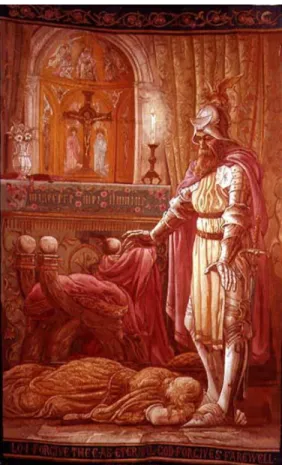
Tapestry design (Arras type)' was Herbert Bone's account of the years 1879 to 1888 in the professional specifications he compiled for Dulwich College late in his life.99 Indeed, tapestry design dominated his career as early, but little is known about his approach to these projects, particularly those from his early period at Windsor. In the case of Idylls, information is usually scant, and the nearly two dozen sketches in the Royal Library suggest little about the evolution of the design.100 Less obscure, however, is the choice of subject, which belongs squarely to the king's nineteenth-century revival. Arthur. After an interval of neglect dating from the late Middle Ages, writers and artists again turned to the legends of the Round Table for inspiration.101 In Idylls of the King, Tennyson recounts the destruction of Arthur's kingdom and the betrayal of his knights for the love of Guinevere. for Lancelot.
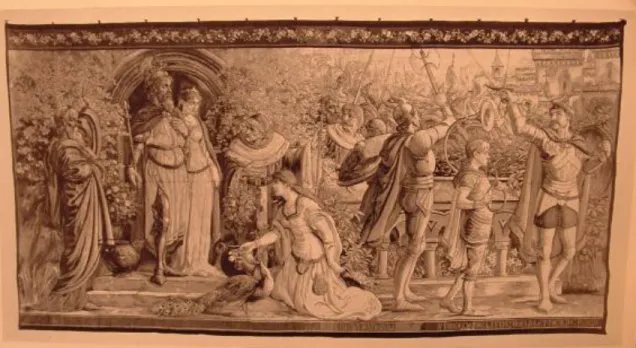
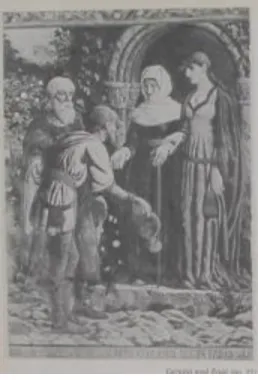
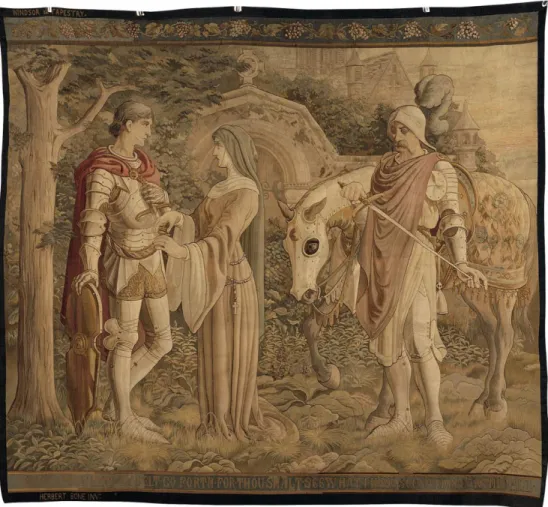
Arthur and Guinevere stand at the door of a church in which spring flowers are blooming. One example of an early Arthurian tapestry is the “Episode from the Arthurian Legend”, part of the Galehaut tapestry, ca. Characteristic of this practice was a copy of the Visitation (1491) by Ghirlandaia, woven by the Gobelins in the 1870s and donated to the South Kensington Museum in 1881.109 One was 'Trop tableau et pas assez décor'.
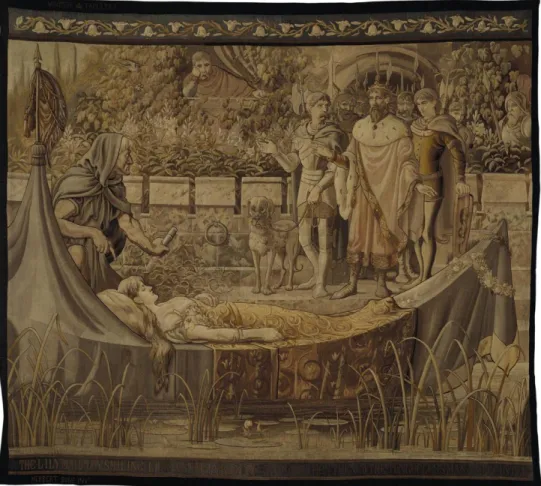
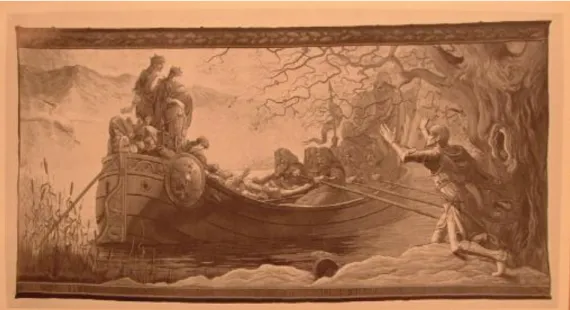
Arriving at Camelot of the Dead Elaine, (6ft 3in h x 6ft 11in l) (fig. 4), the fifth in the series, is also known as the Lily Maid of Astolat.114 Arthur hails the barge carrying the corpse of Elaine who died due to of her love for Lancelot and because of her shame at Lancelot's love for Guinevere.115 The Lily Maid was another scene from the Idylls that was familiar to painters, which explains, at least in part, why an adapted version of the cartoon was chosen by Bone for the Royal Academy Exhibition in 1880.116 Traditionally, the scene depicts the lone barge on the water, driven by the mute servant. Like most Idylls, The Holy Grail is as much greenery as it is a tapestry of pictures. Dore's version was executed for the edition of The King's Idylls, which was first published in 1868.
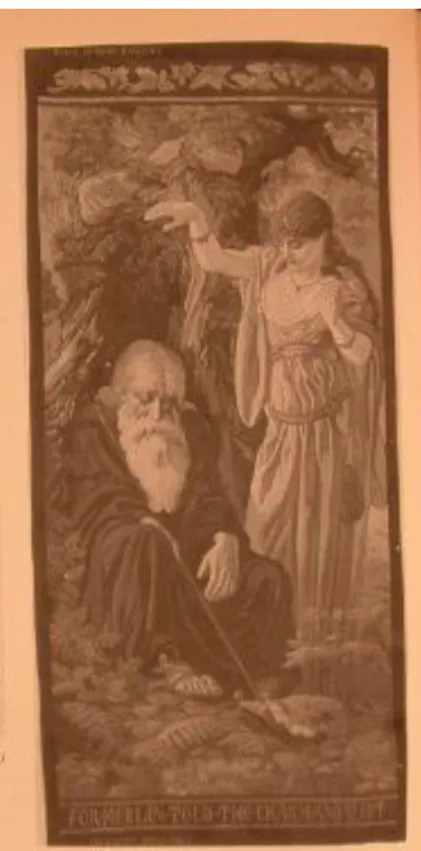
Each top has a floral motif and each bottom has a line from Tennyson's Idylls of the King. 129 "The left wall of the north wing of the school cloister is hung with fine pieces of French and Flemish tapestry of the fifteenth and sixteenth centuries" was the summary from the collection manual, which allowed more space for plaster casts and electrotype reproductions of plate and armour. By the end of the century, the ideal of the moth-eaten was sufficiently widespread, especially in the United States, to have become a source of satire, and anecdotes abounded of collectors passing on artistically important tapestries in good condition in favor of worn and deteriorated ones.
The Lesser Arts of Life', in Lectures on Art by Reginald Stuart Poole et al. Even parts of the design that are naturally brown, like a tree trunk or a nun's habit, look like they were once a much darker brown. In 1905, more than two decades after completing The Royal Idyll, Bone published an essay on tapestry design.141 In contrast to Morris's sad nostalgia, the work is full of practical advice.
William Morris and the Historic Reputation of the Royal Windsor Tapestry Manufactory
Burne-Jones and executed by Morris and Co., occupies the greater part of the end wall, but leaves space below for Mr. Burne-Jones sketches for other tapestries of the San Graal series.” The critic added: "It is to be hoped that the revival of English tapestries will soon admit of its being carried out."149. 147 At the second, fourth and fifth exhibitions of the Arts and Crafts Exhibition Society, Bone's work was exhibited on the balcony of the New Gallery at 121 Regent Street, London.
His best-known work from this period is How the Danes Came to the English Channel a Thousand Years Ago (c. 1890), a painting originally conceived by Bone as a tapestry and now in the collection of the Russell-Cotes Art Gallery & Museum, Bournemouth. Marillier, a tapestry historian who was also director of Merton Abbey from 1905.153 Significantly, William Morris and his supporters were the most articulate critics of the Windsor works, and their comments were so persistent that Windsor came to be regarded as merely foil of the establishment. to the more "authentic" production of the Merton Abbey workshops.154. The emergence of the Windsor Tapestry Manufactory added urgency to his ambitions because Morris understood – more so than the management at Windsor, it turned out – that the market for tapestries was limited.
154 This denigration continues today, with many critics and art historians expressing at best a guarded approval of the Windsor tapestry. 157 "The Empress Brown [that is, Queen Victoria] is hard at work on her rival establishment: I am sure she expects to get the whole ornamental upholstery business of the kingdom in her hands: let her tremble. Speaking of Windsor Works and Merton Abbey, he wrote: "In the course of the last forty years two earlier movements, though inaugurated, the one under the highest social, the other under the most favorable artistic auspices, have both run their course." (Knogle.
Although there is no record of his comments on specific Windsor designs, it is virtually impossible that Morris did not know that the Idylls of the King were being woven at Windsor. Due to his dislike of the Royal Academy, it is also likely that he missed Bone's watercolors for the Idylls 1879 and 1880. Nevertheless, there is evidence that Bone's designs for the Idylls were known to Morris & Co., who published a small edition. well-known series of embroidery panels about the Idylls of the King.170 It is significant that the Morris & Co.
Finally, the embroidered Arrival of Arthur has a fine border of Mayflowers, similar to the upper border of the tapestry. Some of these designs were created by William Morris, some by his daughter May, and the more elaborate figures by Burne-Jones.'' years after 1920.172 Multiple weavings contributed to its reputation in tapestry history history.
Herbert Bone's Idylls of the King remains an obscure tapestry set woven in a poorly regarded Victorian tapestry factory. During the 1870s and 1880s, Windsor tapestries were considered part of the revival of English craftsmanship. Bone's drawings in the Royal Library provide an incomplete picture of his design for the Idylls.
A greater appreciation of the King's Idylls would provide a more complete picture of Victorian tapestry design.