Edited By
Hilary Lumsden
RN RM BSC(HONS) MSC RMT ENB 405 Senior Lecturer in Midwifery,University of Wolverhampton; and External Examiner, University of Sheffield
Debbie Holmes
RN RM BSC(HONS) PCGE (HE) Senior Lecturer in Midwifery,University of Wolverhampton; and External Examiner, King’s College, London
http://www.hodderarnold.com
© 2010 Hodder Arnold (Publishers) Ltd
All rights reserved. Apart from any use permitted under UK copyright law, this publication may only be reproduced, stored or transmitted, in any form, or by any means with prior permission in writing of the publishers or in the case of reprographic production in accordance with the terms of licences issued by the Copyright Licensing Agency. In the United Kingdom such licences are issued by the Copyright Licensing Agency: Saffron House, 6–10 Kirby Street, London EC1N 8TS.
Whilst the advice and information in this book are believed to be true and accurate at the date of going to press, neither the author[s] nor the publisher can accept any legal responsibility or liability for any errors or omissions that may be made. In particular (but without limiting the generality of the preceding disclaimer) every effort has been made to check drug dosages; however it is still possible that errors have been missed. Furthermore, dosage schedules are constantly being revised and new side-effects recognized. For these reasons the reader is strongly urged to consult the drug companies' printed instructions before administering any of the drugs recommended in this book.
British Library Cataloguing in Publication Data
A catalogue record for this book is available from the British Library Library of Congress Cataloging-in-Publication Data
A catalog record for this book is available from the Library of Congress ISBN 978 0 340 968 413
ISBN (ISE) 978 0 340 971 550 (International Students Edition, restricted territorial availability) 1 2 3 4 5 6 7 8 9 10
Commissioning Editor: Naomi Wilkinson
Project Editors: Joanna Silman and Jane Tod Production Controller: Rachel Manguel
Cover Designer: Lynda King
Indexer: Shirley May
Typeset in 9.5 pt Minion by Phoenix Photosetting Ltd, Chatham, Kent, UK Printed in India
Cover image © Anna Kern/Etsa/Corbis
What do you think about this book? Or any other Hodder Arnold title?
Please visit our website: www.hodderarnold.com
Some figures in the printed version of this book are not available for inclusion in the eBook for copyright reasons.
Contents
The Ten Teachers vi
Preface vii
Acknowledgements viii
CHAPTER 1 Parenting – attachment, separation and loss 1 Sandra Sandbrook
CHAPTER 2 Transition to extrauterine life 11
Debbie Holmes
CHAPTER 3 Newborn screening and immunization 23 Linda Wylie
CHAPTER 4 Examination of the newborn 34
Hilary Lumsden
CHAPTER 5 Hereditary problems and genetics 51
Debbie Holmes
CHAPTER 6 Infant feeding 65
Debbie Holmes
CHAPTER 7 Neonatal skincare 78
Sharon Trotter
CHAPTER 8 Thermal care of the newborn 89
Hilary Lumsden
CHAPTER 9 Care of the jaundiced baby 99
Carole England
CHAPTER 10 Infection in the newborn period 113
Lynne Paterson
CHAPTER 11 Neonatal respiratory problems 122
Carole England
CHAPTER 12 Neonatal withdrawal syndromes 133
Hilary Lumsden
CHAPTER 13 Birth injury 146
Jane Henley
CHAPTER 14 Cultural and religious aspects of neonatal care 159 Marcia Edwards
CHAPTER 15 Teaching resuscitation to parents 168 Gillian Warwood
CHAPTER 16 Frequently asked questions 178
Debbie Holmes and Hilary Lumsden
Index 187
Marcia Edwards
RN RM ADM CERTED(HE) MA Senior Lecturer, School of Health, University of Wolverhampton, WalsallCarole England
RN RM CERTED(FE) ENB 405 BSC(HONS)Midwife Teacher, School of Nursing, Midwifery and Physiotherapy, University of Nottingham
Jane Henley
RN RM ENB 405 DPSN BSC(HONS) ENB A19 MSCAdvanced Neonatal Nurse Practitioner, Manor Hospital, Walsall
Debbie Holmes
RN RM BSC(HONS) PCGE (HE) Senior Lecturer, University of Wolverhampton, WalsallHilary Lumsden
RN RM BSC(HONS) MSCRMT ENB 405Senior Lecturer, University of Wolverhampton, Walsall
Lynne Paterson
RGN RM ENB 100 405 A19 DIPNEONATALNURSINGSCIENCESBSCMSC ANDPOSTREGDIPED
Nurse Consultant, Neonatal Unit, James Cook University Hospital, Middlesbrough
Sandra Sandbrook
BA(HONS) RN RM ADM MTD CERTED(FE)
Senior Lecturer, School of Health, University of Wolverhampton, Walsall
Sharon Trotter
RM BSCMidwife, Breastfeeding Consultant and Neonatal Skincare Advisor, TIPS Limited
Gillian Warwood
RGN RM ENB 405 A19 ANDHIGHERAWARDMSC
Advanced Neonatal Nurse Practitioner, Neonatal Unit, Sandwell and West Birmingham Hospitals NHS Trust, Birmingham
Linda Wylie
RGN RM BA MN RMT CERTED(HE) Programme Leader BSc Midwifery, University of West of Scotland, PaisleyPreface
The inspiration for this text came from many years’
experience of teaching the post-qualifying neonatal nurses’ course. It was identified that there are several suitable textbooks to support intensive care of the newborn but very few concentrate on the midwives’
role and essentially normal neonatal care. The aim of this book is to inform pre- and post-registration midwives about normal neonatal care in the UK and it is seen to be an excellent addition to the Ten Teachers series. The majority of undergraduate midwifery students will have to study many aspects of newborn care as well as having hands-on experience of neonates in both the community and hospital settings. The book is designed to support both theory and practice.
The aim of Care of the Newborn by Ten Teachersis to concentrate on the recognition of common prob- lems associated with newborn babies that student midwives will encounter on a daily basis as well as
addressing some of the less common conditions. In- depth knowledge providing theoretical underpinning and contemporary practice is core to each chapter.
Professional guidance is underpinned by the rules and code of practice for midwives, which are explicitly referred to throughout.
The contributors were recruited as enthusiastic experts in neonatal and midwifery care and come from wide geographical and practice areas. We see this as being a significant strength of Care of the Newborn by Ten Teachers that readers will find invaluable to their studies. The original proposal was made upon individual practitioner contributions and has resulted in a comprehensive collection of chapters by teachers of reputation.
Hilary Lumsden and Debbie Holmes 2010
We would like to thank our families, friends and colleagues for their support, time and encouragement during the writing and editing of this book.
Special thanks also goes to student midwives at the University of Wolverhampton who contributed so read- ily to Chapter 16 by providing their own questions as well as those of parents they have cared for in practice.
Finally to our colleague and friend Pauline Lim for her expert help, support and contributions to Chapter 6.
Hilary Lumsden Debbie Holmes
Attachment
When perinatal and infant mortality rates were high and infant death was the norm, parents did not expect to rear all their children to maturity. Child-rearing practices emphasized discipline and were aimed at promoting survival and moral strength. As mortality rates improved, with the expectation that the majority of children would survive childhood, the emphasis changed from survival to providing sensitive child- rearing practices that would promote the physical and psychological well-being of the child.
Sigmund Freud acknowledged that within suc- cessful child-rearing the mother–child relationship was of primary importance. He further identified that early childhood experiences were critical as they could affect the normal psychological functioning of the
adult. This was reinforced by John Bowlby’s work fol- lowing the Second World War on the profound emo- tional and cognitive consequences of maternal deprivation during the early years of a child’s life. In his Report for the World Health Organization in 1951, Maternal Care and Mental Health, Bowlby stated that essential for a child’s mental health is a reciprocal
‘warm, intimate and continuous relationship’ with a mother or caregiver (Figure 1.1). Bowlby is consid- ered the ‘Father of Attachment’ and this is the begin- nings of attachment theory that has evolved through research in the twentieth and twenty-first century.
The attachment relationship
Attachment describes the unique and enduring rela- tionships each individual seeks to forge with its care-
PA R E N T I N G – AT TAC H M E N T,
S E PA R AT I O N A N D LO S S
C H A P T E R 1
Attachment ...1
The birth of a sick or premature baby ...6
Loss and bereavement ...7
Attachment and loss ...8
Caring for bereaved parents ...9
References ...10
Further reading ...10
OV E R V I E W
This chapter explores the attachment relationship parents develop with their baby. Attachment is an interactional process that starts as acquaintance during pregnancy and develops through reciprocal interaction to become an exceptional, endur- ing and important relationship. Midwives should be aware of the many factors that may affect the developing relationship during pregnancy, childbirth and the early days following birth. The development of the relationship between the parents and their baby has implications for the parents if they are separated from their baby due to illness resulting in admission to a neonatal unit or due to the baby’s death.
This chapter will examine the possible psychological implications for the parents when they are separated from their baby due to illness or prematurity and how midwives and nurses can provide support to give the woman or couple confidence in their ability to parent. It ends with a discussion on attachment and loss, the devastation that can result from bereavement at the beginning of life. Grief and mourning will be considered, together with how the midwife can sympathetically facilitate the process of mourning and provide empathetic support.
Sandra Sandbrook
givers and a select group of special individuals. This relationship ensures survival, facilitates both commu- nication and socialization and assists cultural trans- mission. Initially this intimate relationship begins as maternal–fetal attachment during pregnancy and is then developed through reciprocal interactions between the infant, caregivers and a special group of chosen individuals during childhood. Indeed there is empirical evidence revealing that the majority of chil- dren during their first year of life become attached to a small group of familiar people whom the child cate- gorizes into a hierarchy of attachment figures – usu- ally with the child’s parents being the most important.
In most cultures the child’s attachment group consists of parents, siblings, grandparents, aunts, uncles and daycare providers.
Attachment has been described as an interactional process that begins as acquaintance and develops towards the unique and enduring attachment rela- tionship (Goulet et al., 1998).The acquaintance phase begins during pregnancy as the expectant woman seeks to get to know her ‘baby’ through assigning meanings to the physical and technical signs she expe-
riences: the increasingly strong fetal movements, lis- tening to the fetal heartbeat and visualizing the fetus on ultrasound scans. This is reinforced following birth with powerful sensori-motor interactions acti- vated through embracing, rocking and maintaining prolonged visual contact with her baby. The infant seeks physical and psychological closeness through clinging, following and calling behaviours, and if these are appropriately satisfied both parties experi- ence reciprocal feelings of love, security and joy. In the carer these feelings ensure altruistic commitment to the infant, placing the infant at the centre of his or her life. The reciprocal pleasure and synchronicity of the interaction serves as a catalyst for the continued strengthening of the attachment relationship.
Attachment is very important to the child’s physi- cal, social and psychological well-being. The success of the individual’s ability to form close attachment relationships is fundamental to his or her ability to develop and sustain all subsequent relationships throughout life. Bowlby suggests that relationship patterns are transmitted through social interaction across the generations. Interactions between child and caregiver are internalized and become almost a blue- print for subsequent relationships. These initial attachment relationships act as a basis for expecta- tion, belief and evaluation of intimate relationships across the individual’s lifespan.
Attachment relationships remain important throughout a person’s life. In adulthood stressful life events cause individuals to seek their secure attach- ment figures for help, soothing and safety. As with infants the adults will exhibit anguish if an attach- ment figure becomes unavailable. The loss of this attachment relationship can be catastrophic at any time during an individual’s lifespan, constituting a potent stressor. This suggests that attachment security remains important into adulthood.
Secure attachment
Mary Ainsworth (1963, 1967) through rigorous empirical work identified and explained the concept of secure attachment. She noted the importance of a par- ent’s sensitivity to their infant’s cues and that this sen- sitivity is essential to the successful development of the attachment relationship. Secure attachment is crucial to provide safety and comfort to a child that is tired, distressed or presented with a challenging situation;
the lack of opportunity to develop selective attach- Figure 1.1 The warm and intimate early mother–child
relationship
ments may damage the child’s social and emotional development. A secure attachment figure provides the child with a safe environment to explore their world and allow them a healthy mental development. Bowlby found that secure attachment facilitated the develop- ment of internal working models that socialize the child and allow them to make sense of the world they live in, responding appropriately and safely to the myr- iad social and environmental cues. These increasingly complex models operate outside consciousness and are formed through continued interpersonal and envi- ronmental transactions. Secure attachment also facili- tates the development of the child’s self-belief.
Optimal parenting style, described as responsive, reas- suring and comforting, promote the child’s autonomy and sense of self-confidence and worth.
Attachment as a developmental process
Attachment is a developmental process that continues throughout the life. For many years it was considered that birth marked the beginnings of the relationship between parents and baby; it is now recognized, how- ever, that the attachment relationship begins during pregnancy.
(i) Maternal–fetal attachment
Maternal–fetal attachment is an emotional response to the growing life within that develops as the pregnancy becomes more tangible. The woman becomes increas- ingly preoccupied with the physical realities of the pregnancy, actively focusing her attention on the developing life inside her. It would appear that the woman’s affectionate behaviour towards her fetus develops with each progressive trimester. Initially women fantasize about their fetus, but as pregnancy progresses they become more actively involved with their ‘baby’, stroking and talking to their pregnant abdomens, often giving their ‘baby’ a pet name. As pregnancy advances the woman perceives the fetus in increasingly human terms, attributing characteristics and personality traits to it. The physical reality and experiences of pregnancy appears to positively encour- age and intensify maternal attachment. Studies have shown that quickening, ultrasound visualization, the growing pregnant abdomen and progressively strong and distinctive fetal movements enhance attachment.
This developing maternal–fetal attachment throughout the trimesters has been aptly illustrated by Raphael-Leff (2005) as constituting three progres-
sive phases: belief in the pregnancy, belief in the fetus and ultimately belief in a baby who will survive his or her birth.
There are many factors that appear to influence the development of the maternal–fetal attachment:
the woman’s own experiences of being parented, social support, the support of a compassionate part- ner and previous personal experiences of pregnancy and childbirth. Personal experiences of being par- ented fundamentally affect the individual’s ability to parent. Once internalized and operating at an uncon- scious level the working model of attachment becomes a blueprint for future parenting. This consti- tutes intergenerational attachment. Parenting atti- tudes, behaviours and models are passed from generation to generation, with early experiences of secure selective attachment being associated with a greater capacity to be well-functioning parents.
Pregnancy is the catalyst that stimulates the woman to explore attachment relationships, particularly evalu- ating her relationship with her mother. Pregnant women actively seek increased contact with their mothers, particularly in the final trimester. Research has shown that women who have affectionate, loving relationships with their mothers are more able to estab- lish and maintain positive attachment (Siddiqui et al., 2000). It must be acknowledged, however, that individ- ual women will have both positive and negative parent- ing experiences and it would be over-simplistic to suggest that experiences of poor parenting result in poor maternal–fetal/infant attachment. If a woman has a clear understanding of her experiences of being par- ented and is able to fully discuss its impact with another attachment figure, supportive partner or within a ther- apeutic relationship, she will be able to develop mater- nal–fetal attachment and ultimately provide sensitive and responsive parenting.
Accommodation to pregnancy and subsequent attachment behaviours is influenced by the woman’s social, financial and health status. Inequalities and inadequacies may cause the woman to be so preoccu- pied with her dilemma that she is unable to respond effectively to the developing relationship. The woman’s satisfaction with her social networks and economic circumstances can have profound effects on the developing attachment relationship, competing with her ability to focus on her pregnancy and baby.
The transition to parenthood is a critical period in an individual’s life, causing substantial lifestyle and role changes. Responsive, sensitive and appropriate
3 Attachment
social support can have a positive effect and encour- age the development of attachment. Social support can be from a variety of people: friends, colleagues, helping healthcare professionals, family and partners.
However it is not simply the provision of support, it is the woman’s satisfaction with the quality of support provided that is most influential in promoting mater- nal–fetal attachment. Practical support provided by a partner is especially valued; doing household chores, shopping and generally paying close attention to the pregnant woman’s health and well-being, especially if this behaviour is new, is very beneficial for the devel- oping attachment relationship.
It would appear that the most influential social support is from a loving and empathetic partner.
Bowlby (1988) noted that expectant mothers had a strong desire to be cared for and supported by their partners. He suggested that the experience of being loved facilitates and enhances the woman’s ability to love. It has been found that women with positive and sustained support from their partners adapt more eas- ily to pregnancy. A supportive relationship strengthens and maintains the woman’s constructive feelings about motherhood and the fetus. Gjerdingen and Chaloner (1994) found that the partner’s sensitive, caring and appropriate practical help strongly impacted on the woman’s sense of emotional well- being and self-confidence, which results in a reduction in the incidence of postnatal depression. Siddiqui et al.
(1999) found that the woman’s partner’s attitude and reaction to her pregnancy are powerful contributors to the woman’s adjustment to pregnancy, her relation- ship to her fetus and mothering behaviour. The sup- port of a partner can positively affect the woman’s caregiving functions, providing a secure base from which she can explore and rectify any previous experi- ences of insecure attachment, allowing her to concen- trate on her pregnancy and develop attachment to her fetus. This security is provided through loving support and practical assistance during pregnancy, actively participating in some functional caregiving capacity.
It should also be noted that previous childbearing experiences will affect the woman’s ability to concen- trate on her pregnancy and develop an emotional attachment to her fetus. It would appear that within the first trimester of pregnancy most women are at times ambivalent towards the fetus. It is common knowledge that miscarriage within the first 12 weeks of pregnancy is not unusual; women are sometimes hesitant of becoming emotionally attached to a fetus that may not
be viable. This does not mean they have not developed feelings and aspirations for their pregnancy and will not be bereaved should miscarriage occur. However, if the woman has already experienced a miscarriage her fear of becoming emotionally attached is aggravated and she may attempt to withhold her emotion until viability is confirmed. Any experiences of pregnancy loss will affect the woman’s emotional experience of pregnancy: although she will become attached to her fetus, she will be fearful that events will be repeated and anxious until the previous time of loss has past. For some couples who suffered a previous late stillbirth this may mean a very anxious time that could predispose some women to develop antenatal depression. In some women a previous poor obstetric history may result in what Katz-Rothman (1986) identified as a ‘tentative pregnancy’. This is particularly pertinent to those women with a history of serious fetal anomaly and sub- sequent termination for abnormality. These women may withhold attachment until normality is estab- lished and the pregnancy viable in an attempt to limit the psychological loss. All women who have experi- enced loss need sensitive support from their carers. It is important that all the woman’s previous childbearing experiences are acknowledged, careful individual care- planning is negotiated and the woman’s emotional well-being is given priority.
Difficulties within the current pregnancy may also affect the development of the attachment relation- ship. It is well documented that pregnancy, the birth of a baby and the transition to parenting are critical developmental phases that involve change and reor- ganization within an individual’s life and relation- ships. This transition itself has been reported for some couples as resulting in decreased feelings of per- sonal well-being and distress at the considerable adaptations being made. For most this is a transitory and modest phase, reducing with the birth of a healthy baby. However for those couples whose preg- nancy is complicated by significant fetal or maternal risk, resulting in a ‘high-risk’ pregnancy, the fear of losing their baby may result in emotional instability, heightened anxiety, distress and depression. Research has shown that although both prospective parents may experience distress, this is often heightened within the woman. The woman may question her competence to protect her fetus and her capability to successfully mother. Studies exploring the conse- quences of high-risk pregnancy on developing attach- ment levels have given wide-ranging results.
Attachment is multifactorial in nature, therefore the effects on the woman of a pregnancy complicated by high risk to her or her fetus is unique and individual.
Results of research are inconclusive, ranging from lowered levels of attachment, though no significant alteration to heightened attachment. However the dis- tress and anxiety suffered by the woman or couple should always be acknowledged, ensuring sufficient understandable and contemporary information is given so that the couple are able to respond effectively.
(ii) Following birth
The process of attachment as described by Goulet et al.(1998) consists of four interdependent and contin- uing phases: interaction, proximity, reciprocity and commitment. The interactional stage that begins in pregnancy as the woman forms a mental picture of her fetus in response to physical and technical cues has been discussed earlier within this chapter. This interactional phase that begins as acquaintance and develops into an intimate relationship is facilitated by gaining and maintaining proximity. Extensive contact between the parents and the baby allows the parents the full sensory experience of their baby, fostering the continued development of affectional ties. Seeking and maintaining proximity arouses pleasurable feel- ings of intimacy. The ability of the parents and infant to communicate is important to the development of the relationship. Parents communicate through touch, cuddling and prolonged visualization; while the baby communicates through crying, grasping and visual contact. Babies are genetically programmed to respond to human interaction in order to provoke nurturing behaviour in their caregivers; within 16 hours of birth the newborn responds to human voice with coordinated, rhythmical movements. At two days old a baby can identify its mother’s face and odour; by three days the baby will demonstrate a clear preference for its mother’s voice.
Mothers make great efforts to establish eye con- tact with their babies; indeed women in all cultures instinctively interact with their babies at a distance of approximately 30 cm, which is the optimal distance to facilitate the newborn’s developing vision. When the baby reciprocates eye contact, the mother exaggerates her facial expressions, maintains visual contact, slows her speech patterns and raises her voice one octave, all of which is thought to be an instinctive adaptation to the infant’s developing visual and auditory ability.
Reciprocity is the adaptive process that leads parents
and infant to mutually satisfying behaviours. The par- ents adapt their behaviour to the signals from their baby. Parents who become sensitive to their baby’s needs and appropriately satisfy their baby are rewarded through the positive development of their own sense of their successful parenting ability. Parents place their infant at the centre of their life, developing a stable and permanent relationship in which they feel responsible for and committed to their baby. This commitment becomes an integral part of the relation- ship, ensuring the safety, growth and development of their child.
It was suggested by Klaus and Kennell (1976) that there is a critical period immediately following the birth, during which it is essential for continued con- tact in order that attachment can be instigated and developed. However this assumption was based on research that has been criticized for its questionable methodology and has been successfully refuted. The original research was conducted on only 28 women (14 having traditional care and 14 having extra time with their baby), results were not reported objectively and subsequent attempts to replicate the research have not been successful.
While some parents may find immediate and con- tinued physical ‘skin to skin’ contact with their baby pleasurable and fulfilling, this is by no means univer- sally experienced by all new parents and has no sig- nificant benefit to the development of the attachment relationship. Unfortunately this critical period has passed into midwifery folklore and many couples may feel pressurized into having prolonged contact with their baby at a time when they may be tired and pre- occupied with their own well-being and not yet ready to establish contact. It should be remembered that all couples are unique and should be asked as labour pro- gresses whether they want ‘skin to skin’ contact with their baby immediately following birth. Attachment is developmental in nature and does not operate within a limited timeframe.
Factors that may affect attachment
There are many factors within the multifactorial con- struct of attachment that can affect the developing relationship. Experiences of being parented, eco- nomic status, social support and perceived or actual threats to the viability of the fetus or health of the woman can have detrimental affects on the develop- ing attachment relationship. Fundamental to the
5 Attachment
development of attachment is whether the pregnancy was planned or wanted. This does not mean that an unplanned pregnancy will result in poor attachment as the support of a special attachment figure or thera- peutic counselling can facilitate the progressive devel- opment of attachment. The mother’s good physical and mental health is also important to the developing relationship. A mother who is preoccupied with her own debility will be unable to initially invest the time or commitment necessary to facilitate the develop- ment of this special relationship; the attachment rela- tionship may take longer to develop. The woman’s birthing experiences can affect her ability to attach, as can the appearance, gender and perceived personality of the baby. Any prolonged separation from the baby in the early postnatal days will lead to anxiety, distress and potential feelings of inadequacy as a parent.
The birth of a sick or premature baby
The birth of a sick or premature baby is an acute emo- tional crisis for the woman/parents. Many parents feel anxious and guilty, blaming themselves for their baby’s plight. In very preterm infants parental anxiety is often heightened by the appearance of the tiny, underdevel- oped and vulnerable baby, very different from the image of their term baby they had developed during preg- nancy. Parents have lost the expectation of a strong and healthy baby; as a result they initially suffer the shock and disbelief that is associated with a grief process. The potential uncertainty regarding the survival and ulti- mate health of very sick babies leads to intense distress, with the level of neonatal risk closely associated with the degree of emotional distress and depression experi- enced by the parents. This uncertainty regarding sur- vival can result in anticipatory grief and the withdrawal of emotional attachment as the parents seek strategies to cope with the potential loss of their infant. Studies have found that mothers often feel useless and helpless when they are separated from their babies.
The care of the baby is determined by the infant’s condition and the practices of the neonatal intensive care unit (NICU). As a result the women often report a lack of control over their baby’s continued health and survival. Women have stated that they feel power- less, unable to protect or help their baby. The mother goes from being the sole protector of her fetus to an onlooker, watching skilled professionals provide the care, support and protection she cannot give.
In studies women reported a feeling that their babies were not theirs; that they belonged more to the nursing staff who were more adept and skilled at pro- viding therapeutic care to the sick baby. Although research has shown that the separation caused by admission to the NICU results in disruption to the woman’s attachment relationship with her baby, it has also shown that the attachment relationship continues its development once the woman has taken her baby home and is competently providing appropriate care.
In the early days of NICU development the care provided was controlled by medical needs, parental visiting was severely restricted and parents were not allowed to touch, hold or feed their babies. This has now changed and the importance of the family within care is acknowledged, as is the particular importance of maintaining mother–infant proximity and interac- tion. Care provided within the NICU has evolved to become receptive to the needs of the parents, with the development of family-centred care and empowered decision-making for parents. Family-centred care aims to overcome the barriers that previously disem- powered the parents. It allows the parents full 24-hour access to their baby, participation in clinical decision- making and education to facilitate appropriate par- enting and caring skills. Neonatal staff actively empower parents through teaching and assessing par- enting skills and through the provision of appropriate information to help parents make decisions regarding their baby’s medical care.
The shock of their baby’s admission to NICU may result in the parents being unable to accept their par- enting role and responsibility. It is therefore impor- tant to provide psychological care at this stressful time. Parental control can be facilitated by the inclu- sion of the parents in decision-making at an early stage, emphasizing their responsibility and providing a sense of empowerment. Parents need to be prepared before they see their baby; it can be very frightening to see a tiny, vulnerable baby hooked up to machines and covered by tubes and sensors. Simple non-medical- ized explanations of the equipment being used, the baby’s condition and prognosis will facilitate under- standing and allow the parents to participate in deci- sion-making. During the early stages of intensive care professional expertise is required, but as the baby’s medical and care needs become less intense the par- ents can be taught to participate in their infant’s care, providing them some degree of control and parental skill.
As the baby gets stronger it is important to pro- vide some quiet time to promote the attachment rela- tionship. During this time medical intervention is at a minimum so that the parents and baby can spend time getting to know each other through reciprocal interaction: touching, cuddling and continued eye contact. The provision of accommodation on NICUs allows the family to spend time getting to know the new family member and facilitates the transition to care at home.
Parents may benefit from the psychological sup- port of parents who have previously experienced the trauma they are currently facing; this can be provided by voluntary organizations that specifically focus on offering practical and emotional support to parents and families of babies who need special or intensive care. National Information for Parents of Prematures:
Education, Resources & Support (NIPPERS) and BLISSLINK (BLISS Baby Life Support Systems) are proactive groups that provide information and put parents in touch with support networks. Various forms of support can be provided to suit individual needs, with one-to-one and group support offered.
NIPPERS also have a bereavement group that offers on-going support to parents whose baby has died. As the support is offered by individuals that have ‘walked the same path’ there is an empathy borne from expe- rience that facilitates understanding and effective communication. Carers should be aware of local groups that offer continuing support to parents and should be able to give them information on how to contact the specialized voluntary groups.
Loss and bereavement
It is only within the last 30–40 years that childbearing loss has been acknowledged and bereaved parents have been allowed to grieve. Every year approximately 6500 babies are stillborn or die within four weeks of their birth in the UK. This equates to the death of 18 babies each day of the year. Childbearing loss, whether this occurs early in pregnancy or following the birth, is unique and painful. The parents have lost their child, their hopes, aspirations and dreams for their future family. Most couples will have made plans to incorporate the baby into their life; they may have considered their ideal birth, their preferred method to feed their baby, chosen names and made a special place in their life for their baby. Even in early preg-
nancy the couple will probably have already shared their news with those close to them. The loss of the child will result in a special bereavement. When those we have got to know, our family, friends and acquain- tances die, they leave us with cherished memories that allow us to remember them in our own inimitable way. However when a pregnancy is lost, a baby is still- born or dies within the first few weeks or months of life, there will have been very little time for memories to be made. The woman/couple may be afraid they will forget their baby as they have very few tangible memories to facilitate their remembrance.
It is important that those caring for the bereaved family acknowledge the death and facilitate the fam- ily’s grief. Mourning is a process that takes time and psychological energy. It is important that the mid- wivery staff recognize that they are caring for the fam- ily at the beginning of this difficult and painful
7 Loss and bereavement
For bereaved parents During early pregnancy
• Miscarriage Association
www.miscarriageassociation.org.uk/
• Antenatal Results & Choices (ARC) www.arc-uk.org Following birth
• The Stillbirth & Neonatal Death Society (SANDS) www.uk-sands.org
• The Child Bereavement Trust www.childbereavement.org.uk
• The Compassionate Friends www.tcf.org.uk
• CRUSE – Bereavement Care www.crusebereavementcare.org.uk
For specific bereavement
National Information for Parents of Prematures: Education, Resources & Support (NIPPERS) 17–21 Emerald Street, London WC1N 3QL Tel: 020 7831 9393
Twins and Multiple Birth Association (TAMBA) – Bereavement Support Group www.tamba-bsg.org.uk
Heart Line Association – for parents with a child heart defect www.heartline.org.uk
Foundation for the Study of Infant Deaths – for those parents who have suffered a cot death www.fsid.org.uk
Support groups
journey. The family may need support long after the midwife’s role ends.
It may be useful to some women/families to have contact numbers for voluntary organizations that will continue to provide compassionate support for as long as it is needed (see box on page 7).
Attachment and loss
Attachment is fundamental to grief. During early life experience of attachment relationships provide the individual with security and safety. Should the attach- ment figure disappear the child becomes distressed and angry, they search for their attachment figure and when the attachment figure returns the attachment is restored, the grief countered and the distress allevi- ated. Over time the individual is conditioned to expect attachment to be restored, we expect those we love to remain with us forever. When that figure dies and restoration cannot occur, the individual suffers severe loss and grief takes over.
Attachment begins in pregnancy or even earlier.
Mary Ainsworth (1963, 1967) suggested that the attach- ment relation begins when a couple start to plan for a pregnancy, long before conception. Certainly during early pregnancy the majority of women/parents will be developing an attachment relationship with their baby, about whom they will be forming cognitive pictures, apportioning physical and behavioural characteristics based on family likenesses, idiosyncrasies and the fetus’ intrauterine behaviour. The loss of this baby will inevitably result in psychological trauma and a period of mourning will be necessary to facilitate the grief process and regain psychological equilibrium. Grief is the personal experience of loss, the price paid for loving. Mourning is the process that occurs after loss that helps the individual come to terms with their loss and eventually allows them to continue with their personal journey through life. Essential to the under- standing of bereavement and fundamental to the pro- vision of care and support is an undestanding that all loss is personal, individual and unique.
Normal grief reactions
Worden (2008) states that grief affects the whole per- son, affecting their feelings, thoughts, physical sensa- tions and behaviour. The individual may feel sad, anxious, shocked and numb. Very often the bereaved
parents become angry because they could not prevent loss and as a result of not being able to protect their child feel helpless and powerless. The woman may feel angry at being left alone; it is only she that felt her baby move within, now her womb is empty and she is alone.
The individual may also feel guilty that they in some way caused the death. Certain thought patterns are common to those that mourn. The loss results in dis- belief and confusion, particularly within the early days.
The individual may become preoccupied with the dead baby to the exclusion of everything and everyone else. This may cause friction within a relationship.
Some bereaved parents may hear their dead baby cry- ing; some parents have stated that their arms ache to hold their baby. The loss may also cause physical symptoms that may cause concern to the bereaved.
They may experience extreme fatigue, breathlessness, hollowness of the stomach and muscle weakness.
Some specific behaviours, crying for example, are frequently demonstrated by the bereaved. Most are usually transitory and resolve over time. Crying is the behaviour most associated with loss. It has been shown that tears from psychological distress are chemically different from physiological tears and may possess healing properties. The bereaved parent often becomes restless, absentminded and withdrawn, find- ing it difficult to sleep or eat. It should always be remembered that these reactions are individual and will take time to resolve.
The grief process
Mourning is the process that facilitates grief, it is the process that occurs following loss and gradually allows the acceptance of loss in order that the bereaved can continue their journey through life. The process is unique to each individual and has no time limits. The process has been described as being in stages or phases. However all theorists agree that the process is not sequential: the bereaved will pass through the process at their own pace, in their own sequence and may become stuck or revisit certain stages/phases. In general, the bereaved will experience disbelief, shock and numbness; yearning, anger and guilt; disorganization, depression and loss of self- esteem and finally acceptance, resolution and reor- ganization. Worden (2008) suggests the process of mourning is active and that the bereaved can influ- ence their progress through grief. This model accepts the individuality of each person and allows for inter-
vention if grief becomes protracted or abnormal.
Worden describes this model as the ‘tasks of mourn- ing’.This model empowers the bereaved to move at their on pace through the painful mourning process.
Caring for bereaved parents
For the parents the death of a baby is an intensely painful experience. There is little anyone can do to help alleviate the pain. It is a time no parent ever for- gets, a time of unbearable sorrow and psychological suffering. Nevertheless, the way the parents’ bereave- ment is managed can affect the severity and length of parental grief. Midwives, nurses and medical staff have a great responsibility to react sensitively and practi- cally to the parents’ loss. Parents will remember what was said to them and how their baby was handled. It is important to choose the words used carefully and sen- sitively, avoiding medical terminology that could be open to misunderstanding or misinterpretation. It is also important that other healthcare workers involved within the care are aware of the situation to avoid insensitivity or the need for parents to explain their loss, which could result in further distress.
The midwife should ensure she has all the neces- sary information and should answer the parent’s questions honestly and fully. Remember that in the first instance the parents will be shocked and may take in only part of the information offered. Patience is important as the information may need to be repeated on several occasions. The baby should be handled sensitively and tenderly with all the care that would be afforded a healthy baby. He or she should be called by the name the parents have chosen in any communication with the parents and family. Most of all, the parents should be given the privacy, time and space to be with their baby.
The parents should be treated with respect and dignity and the significance of their loss should be
acknowledged. For the health professionals it is painful to witness the suffering of the bereaved that they may feel impotent to help, but the acknowledge- ment of the parents’ loss and the expression of sympa- thy will facilitate the beginning of the mourning process. Grief is intensely personal and private; care should be non-intrusive to allow the parents time and privacy to express their grief. The health professional should be working to a timescale determined by the parents’ needs: some may want to spend many hours alone with their baby in the hospital setting, while others may feel more secure in their own homes, com- ing back later to spend time with their child. Some may even prefer to take their baby home.
It is important to enquire about the parents’
beliefs. Each individual comes from a culture – national, religious and family. Each culture has its tra- ditions and personal beliefs that need to be respected and honoured. The parents should be well informed so that they can, if they wish, participate in the man- agement of their loss, providing them with some con- trol over events.
Parents need accurate and comprehensive infor- mation that is communicated clearly, sensitively and in an understandable manner. The parents need to know in a factual and unbiased way about the circum- stances surrounding their baby’s death, the statutory and practical procedures and arrangements that must be made and the choices they have. This information is best given to the parents together. If the woman is single she will benefit from the support of trusted family or friends. Information should be consistent, coordinated and factual. If the parents do not speak fluent English, interpreters should be sought to facili- tate the parents’ understanding. The provision of written material in the appropriate language will rein- force the information given and allow the bereaved to revisit the information as and when they need. Effec- tive communication is fundamental. Sufficient time should be allowed for lengthy and unhurried discus- sion, questions should be encouraged and all ques- tions answered honestly.
Death at the beginning of life is a particularly dif- ficult bereavement: the parents are saying hello and goodbye to their baby at the same time. Memories are essential to facilitate mourning, so it is important to help the woman/parents to create memories to pro- vide a focus for their grief. The most evocative mem- ories will be gained by allowing the parents to spend uninterrupted time with their baby, getting to know
9 Caring for bereaved parents
• Task I – To accept the reality of the loss
• Task II – To work through the pain of grief
• Task III – Adjust to an environment in which the deceased is missing
• Task IV – To emotionally relocate the deceased and move on with life.
Tasks of mourning (Worden 2008)
him or her. The bereaved parents may also want their family and children to meet the baby. Some parents may wish to bathe their baby and dress them in the special clothes they had chosen to take them home. A memory box can be initiated with keepsakes of their baby: sensitively taken photographs of the baby and family, ultrasound scan photographs, a lock of hair,
footprints and handprints. The creation of memories will acknowledge the existence of the baby and in so doing gives permission for the woman/couple/family to grieve. Do not forget, however, that the parent’s permission must be sought first; some parents may find it distressing to discover that the baby they could no longer protect was touched without consent.
• Attachment is a unique, powerful and enduring relationship.
• The success of the individual’s ability to form close attachment relationships is fundamental to the individual’s ability to develop and sustain all subsequent relationships throughout their life.
• Attachment is an interactive process that begins in pregnancy and develops throughout life, it has no critical period.
• Many factors may affect the development of attachment.
• The baby will develop attachment relationships with a few important individuals, including parents, siblings, grandparents, uncles and aunts, consistent carers
• Secure attachment is crucial to provide safety and comfort to a child that is tired, distressed or presented with a challenging situation – lack of opportunity to develop selective attachments may damage the child’s social and emotional development.
• The birth of a sick or premature baby which results in separation threatens the attachment relationship and necessitates sensitive, family-centred care to encourage the development of parenting responsibility and skills.
• Attachment and loss are intrinsically linked – it is attachment that causes distress when the attachment figure is lost. Therefore the loss of the ‘baby’ will result in psychological trauma; a period of mourning will be necessary to facilitate the grief process and regain psychological equilibrium.
• Death at the beginning of life is a particularly difficult bereavement – the parents are saying hello and goodbye to their baby at the same time.
• Sensitive, thoughtful and evidence-based care is essential to support the bereaved parents.
Key Points
References
Ainsworth MDS (1963) The development of infant-mother interactions among the Ganda. In Floss BM (eds) Determinants of Infant Behaviour.New York: Wiley, pp.
67–112.
Ainsworth MDS (1967) Infancy in Uganda: Infant care and the growth of love. Baltimore: Johns Hopkins University Press.
Bowlby J (1951) Maternal care and mental health. World Health Organization Monograph (Serial No 2).
Bowlby J (1988) Attachment and Loss, Vol. 3: Loss: Sadness and Depression.London: Hogarth.
Gjerdingen DK and Chaloner K (1994) Mother’s experience with household roles and social support during the first postpartum year. Women and Health 21:
57–74.
Goulet C, Bell L, St CyrTribble D, Paul D and Lang A (1998) A concept analysis of parent-infant attachment.
Journal of Advanced Nursing 28: 1071–1081.
Katz-Rothman B (1986) The Tentative Pregnancy: Prenatal Diagnosis and the Future of Motherhood. New York:
Viking Penguin.
Klaus MH and Kennell JH (1976) Parent–Infant Bonding.
St Louis: Mosby.
Raphael-Leff J (2005) Psychological Processes of Childbearing, 4th edn. London: Chapman and Hall.
Siddiqui A, Hagglof B and Eisemann M (1999) An exploration of prenatal attachment in Swedish expectant women.Journal of Reproductive and Infant Psychology 17:
369–380.
Siddiqui A, Hagglof B and Eisemann M (2000) Own memories of upbringing as a determinant of prenatal attachment in expectant women. Journal of Reproductive and Infant Psychology 18: 67–74.
Worden JW (2008) Grief Counselling & Grief Therapy: A handbook for mental health practitioners, 4th edn. New York: Springer Publishing.
Further reading
Schott J, Henley A and Kohner N (2007) Pregnancy, Loss and the Death of a Baby: Guidelines for professionals, 3rd edn. London: SANDS.
Introduction
The transition from fetal life to the life of a neonate is, for most infants, a relatively straightforward process.
The complexities involved, however, mean that some infants experience a delay or, in some cases, major problems related to their anatomy or physiological status. Those infants who show serious signs of not adapting to extrauterine life may have a severe prob- lem such as a complex cardiac abnormality. A diffi- culty with transition can have a negative effect on subsequent development. It is imperative that mid- wives, nurses and doctors are alert to signs that the transition may not be progressing normally to enable intervention and optimize the infant’s chance for normal development.
The miraculous move from intrauterine to extrauterine life is reliant on anatomical and physio- logical processes during fetal development, the birth process and the early days of life as a newborn infant.
‘Parents to be’ should wherever possible consider their own health prior to conceiving, so as to give the fetus optimum conditions to begin normal development.
The mother then needs to take care of her health in
pregnancy and attend for antenatal care as soon as possible. This will not guarantee a smooth transition, but will increase the chances and enable detection of those fetuses who may be at risk of experiencing a problem.
Cardiovascular system Fetal development
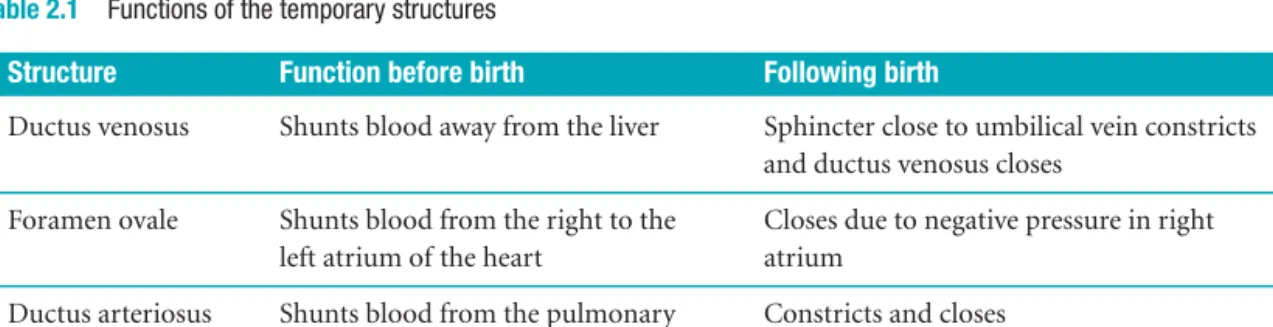
The cardiovascular system develops early as the embryo has increasing needs for nutrition and oxy- gen. The development may be influenced by both genetic and environmental factors. Malformations of the heart and vessels are possible as the cardiac devel- opment is such a complex process (Moore and Per- suad, 2007). The fetal circulatory system differs from that of the adult (Figure 2.1). The cardiovascular sys- tem, including the temporary structures, the ductus venosus, the foramen ovale and the ductus arteriosis, allow blood to be diverted from the lungs and allow for placental oxygenation to take place. The tempo- rary structures have specific functions (Table 2.1).
T R A N S I T I O N T O
E X T R AU T E R I N E L I F E
C H A P T E R 2
Introduction ...11
Cardiovascular system ...11
Pulmonary system ...13
Neurological ...14
Placenta ...14
Metabolism ...15
Gastrointestinal ...15
Cognitive development ...16
Immediate care for babies experiencing normal transition ...16
Delayed or abnormal transition ...17
Newborn life support ...17
Special circumstances ...20
Communication and documentation ...20
Care following resuscitation ...20
References ...22
OV E R V I E W
This chapter looks at fetal development, the birth process and the early days of the infant’s life in relation to the transition from life as a fetus to that of a newborn infant. Care by birth attendants is described. Newborn resuscitation procedures as recommended by the Resuscitation Council (UK) are included.
Debbie Holmes
Table 2.1 Functions of the temporary structures
Ductus venosus Shunts blood away from the liver Sphincter close to umbilical vein constricts and ductus venosus closes
Foramen ovale Shunts blood from the right to the Closes due to negative pressure in right left atrium of the heart atrium
Ductus arteriosus Shunts blood from the pulmonary Constricts and closes artery to the aorta
Structure Function before birth Following birth
Figure 2.1 Diagrammatic representation of fetal circulation. (Medical Illustration Copyright © 2009 Nucleus Medical Media, Inc., all rights reserved. www.nucleusinc.com)
Oxygenated blood from the placenta reaches the fetus via the umbilical vein which has two main branches, one that carries blood to the portal vein of the liver and one (the ductus venosus) that takes blood to the infe- rior vena cava. The blood in the ductus venosus is under high pressure because it has a narrow diameter;
the blood does not mix thoroughly with the blood in the vena cava and is therefore still rich in oxygen when
it arrives in the right atrium. Most of this blood is shunted directly from the right atrium into the left atrium via the foramen ovale, mixing with a small amount of deoxygenated blood from the lungs. (The fetal lungs provide no oxygen at this point, but they do utilize oxygenated blood for growth and development.) The blood then enters the left ventricle and is pumped to the body through the aorta. The most oxygenated
13 Pulmonary system
blood supplies the vital organs: the brain, the heart and the liver. The remainder of the blood from the ductus venosus passes from the right atrium to the right ven- tricle and is pumped into the pulmonary artery. The majority of the blood is diverted away from the lungs via the ductus arteriosus into the aorta.
At birth
The newborn’s circulatory system has to move from a placental exchange of oxygen and carbon dioxide to a pulmonary exchange of gases. Some of these changes are immediate, but some can take longer. Following birth and the cessation of blood flow in the umbilical cord the pressure in the right atrium falls as the blood in the ductus venosus ceases to flow and the sphincter close to the umbilical vein constricts. As the lungs expand, pulmonary vascular resistance falls and blood flows to the lungs which then become the organs of gas exchange. The foramen ovale and ductus ateriosus both close.
Cord clamping
There has been debate on whether or not there should be a delay in the clamping of the cord to enable the newborn to receive as much fetal blood via the umbil- ical cord as possible to improve iron levels. This does carry a small increased risk of jaundice and poly- cythemia (McDonald and Middleton, 2008). There is some evidence from high-income countries (where anaemia in babies is less prevalent than in low-income countries) that delayed cord clamping reduces the chance of an anaemic infant. This also applies to the evidence that delayed cord clamping could increase the risk of hyperbilirubinaemia known as jaundice (see Chapter 9).
In the UK, however, active management of the third stage (delivery of the placenta and control of haemorrhage) is recommended by the National Insti- tute for Health and Clinical Excellence (NICE) (2007). This includes early clamping and cutting of the cord following administration of a drug to con- tract the uterus. It is recognized, however, that a phys- iological third stage may be preferable for some women and this includes no drugs and no clamping of the cord until pulsation has ceased. Many women will choose this option and anyone doing so should be supported by the professionals caring for her.
Pulmonary system Fetal development
The development of the lungs is dependent upon the presence of adequate amniotic fluid and fetal breath- ing movements. Although the lungs are mostly inac- tive during fetal life and are not responsible for gaseous exchange, fetal breathing movements do occur and contribute to fetal development. These movements increase in frequency as term approaches.
While the fetus is in the uterus, the fetal lungs are filled with alveolar fluid. At birth this is no longer required and it ceases to be produced, a process thought to be under the influence of adrenaline.
Production of surfactant is another important part of the successful transition for the fetus. The alve- oli in the lungs are lined with surfactant, phospho- lipids that prevent the alveoli collapsing during expiration by lowering surface tension. The more mature the fetus, the more chance it has of having suf- ficient quantities of surfactant. A deficiency of surfac- tant in premature infants can be responsible for respiratory distress syndrome (see Chapter 11). The production of surfactant may be influenced by corti- sol, growth restriction of the fetus or ruptured mem- branes. Steroids are sometimes given in the antenatal period to mothers at risk of preterm birth to increase the production of this vital substance. Current evidence suggests a single course of two injections of corticosteroids to the mother 12–24 hours apart at between 28 and 34 weeks’ gestation may be helpful (Royal College of Obstetricians and Gynaecologists, 2004).
At birth
During a normal labour with a healthy fetus the amount of oxygen in the fetal blood decreases and the level of carbon dioxide increases. This is due to strong contractions of the uterus temporarily interrupting the flow of oxygenated blood to the fetus. The cord is also compressed during the descent of the fetus, again reducing oxygen. This is further exaggerated when the cord no longer supplies oxygenated blood after being cut or upon cessation of blood flow naturally at the time of birth. This gaseous status stimulates the respi- ratory centre in the brain.
Other factors affect the first inhalation at birth.
One is the compression of the chest wall of the fetus
during descent through the birth canal. As the body of the newborn is delivered the chest wall expands and this encourages inspiration, expanding the alveoli, which, in the presence of sufficient surfactant, will stay inflated. This process will also force out any remaining alveolar fluid which will subsequently be reabsorbed by lymphatics and the pulmonary capillaries. Some fluid will have been expelled as the chest wall has been compressed during the journey through the pelvis.
The neonate who is born by caesarean section will not have undergone the ‘physiological’ squeeze through the birth canal and if there has been no labour preceding the surgery the newborn will also not have experienced the stimulation of a rising car- bon dioxide level in the blood. Stimuli from the exter- nal world such as touch, temperature, noise and light also play a part in eliciting the first inhalation.
Neurological At birth
The respiratory effort and the movement of the muscles of the respiratory system are reliant on the respiratory centre in the brain which, if transition has been normal, has been stimulated into action by the carbon dioxide and oxygen ratios in the fetal blood and external stimuli such as the change in temperature and touch. As breath- ing becomes established the cells in the medulla respond to the circulating carbon dioxide levels in the blood. If a newborn has been subjected to severe hypoxia during labour the respiratory centre in the brain may not func- tion to stimulate respiration. These newborns will require life support from trained professionals. Certain drugs such as pethidine and heroin can also have this effect by crossing the placental site during labour and depressing the respiratory centre.
It is possible for the newborn infant to tolerate a longer period of hypoxia than a child or adult, but the ability to do this is dependent upon the experience of the fetus in the uterus during the labour. An already hypoxic newborn will have less capability than a baby born following a normal labour.
Placenta
Normal placental development is required for the transition to be normal. The placenta is responsible
for exchange of substances between the fetal and maternal circulations during pregnancy. Abnormali- ties in development of the placenta or pathology aris- ing in pregnancy can result in placental insufficieny compromising the process of transition. A poorly functioning placenta will present an already compro- mised fetus to the birth process, which may further exacerbate hypoxia, leading to a newborn requiring resuscitation to assist transition.
The placenta is an amazing fetal organ. It is responsible for gaseous exchange of oxygen and car- bon dioxide and maintains the acid–base status. The chorionic villi (finger-like projections of placental tis- sue) bathe in maternal blood that fills the intervillous spaces and by processes of diffusion (gases moving from an area of high concentration to an area of low concentration) take up the oxygen and supply the fetus with this via the umbilical vein. Carbon dioxide is transported back to the placenta via the umbilical arteries to the intervillous spaces around the chorionic villi and through the process of diffusion goes back to the maternal circulation for excretion. Nutrients for the fetus are also supplied in this manner and waste products transported back to the maternal circulation.
The placenta also forms a protective barrier to some substances and it also excretes hormones.
When abnormal placentation occurs the trophoblast invasion in early pregnancy fails or only partially occurs.
The maternal circulation plays an important role in sup- plying oxygen-rich blood to the placental site and to the fetus. Large amounts of maternal blood fill the intervil- lous spaces and 500–600 mL of blood pass over the area per minute (Holmes and Baker, 2006). If the placentation has not occurred under optimum circumstances the fetus may receive suboptimal oxygen and nutrient supplies for development. Abnormal placentation can result in condi- tions such as pre-eclampsia, a condition associated with high blood pressure in the mother. When the blood pass- ing over the placental site is under pressure the uptake of oxygen and nutrients can be affected, resulting in a fetus that is small for gestational age. The maternal spiral arter- ies that supply the chorionic villi are narrowed in this condition and blood flow is restricted due to the absence of normal developmental changes. Normally the spiral arteries undergo a transformation that reduces resistance and increases blood flow to the placenta.
Intrauterine growth restriction can also occur when the placenta has not developed sufficiently or has been subjected to damage by an antepartum haemorrhage and is unable to supply adequate nutri-
ents and oxygen for normal growth. Abruptio placen- tae, a condition in pregnancy where part of the pla- centa becomes detached from the uterine wall, can also result in poor growth and development because the detached placenta does not supply adequate nutri- tion and oxygen. Smoking in pregnancy may also reduce the optimum blood supply and uptake of nutrients, resulting in a fetus with restricted growth.
Other maternal conditions associated with reduced placental size and functioning include severe diabetes mellitus, antiphospholipid syndrome and chronic hypertension (Holmes and Baker, 2006).
Examining the placenta post birth can often reveal some answers as to why a newborn has experienced difficulty with transition. Areas of infarction (lobes of the placenta which have had no blood supply) are sometimes seen, explaining why a fetus was already compromised before undergoing the birth process.
Antenatal detection of abnormal fetal growth is important. The height of the uterus can be palpated and measured during the antenatal period and some regions of the UK have adopted customized growth charts to identify the fetus at risk. Attempts to detect abnormal fetal growth by abdominal measurements of the mother have had limited success (Neilson, 2000) but technologies such as ultrasound scanning and Doppler techniques are commonly used to iden- tify the fetus at risk of a complicated transition.
Metabolism
Healthy newborns utilize glucose to assist with their transition. This provides the energy to tolerate the birth process and the effort of initiating the first breaths. When the available glucose has been used, metabolism produces energy in the form of ketones and lactates (Cornblath et al., 2000). This is similar to the way athletes can produce energy when running a marathon. It is a protective measure and if the new- born is short of glucose it can assist to produce more energy prior to the liver taking over the function. A newborn who cannot use this type of metabolism may have difficulty during transition as low blood glucose in a compromised newborn can cause other problems. This type of metabolism can also assist during the establishment of milk production in the mother. Around day 3–4 newborns can begin to uti- lize the fat they are born with to process into ketones which are a form of energy. Ketones in the neonate
rise on days 2–3 even in a neonate who is able to ben- efit from a good lactation (Cornblath et al., 2000)
Hypoglycaemia
Healthy term babies are capable of managing their energy requirements and breastfed newborns do not need to be routinely monitored for blood glucose lev- els. Some newborns are more at risk of developing hypoglycaemia than others and do require the moni- toring of their blood glucose as part of early care:
•
Intrauterine growth-restricted newborns: these babies will have utilized protein breakdown in their adaptation to extrauterine life but will have little fat to convert to ketones as proteinbreakdown slows.
•
Newborns whose mothers are diabetic: these babies have become accustomed to higher levels of blood glucose during uterine life and are at risk of hypoglycaemia as they begin to regulate their own glycaemic status.•
Preterm newborns undergo ‘stress’ to be born and utilize readily available stores of glucose. Their reserves of brown fat are depleted as these are laid down in the latter weeks of fetal development.Preterm babies can rapidly become hypoglycaemic as it takes large amounts of energy to maintain their transition to extrauterine life.
•
Newborns who have experienced fetal distress:these babies may have used readily available stores during their transition to extrauterine life; they may well also have undergone varying degrees of resuscitation which also utilizes glucose energy.
Gastrointestinal
The normal term neonate who has made a successful transition to newborn life will usually have a digestive system ready to receive and digest breast milk. If the mother chooses to breast or artificially feed it is good practice to observe the baby feed initially.
Most newborns pass meconium (first stool) in the first 24 hours and this may happen at or around the time of birth. This initial bowel movement should be recorded to exclude anal atresia (absence of the anal opening). Meconium is composed of the contents of the gastrointestinal tract that were acquired during
15 Gastrointestinal