DESCRIPTIVE TEXT
(A Classroom Action Research of Eight Grade at Students MTS Muhammadiyah 1 Gemolong in the Academic Year of 2022/2023)
THESIS
Submitted as A Partial Requirements for the degree of Sarjana
Written By:
NUR CHOLIDA HANUM SRN. 183221219
ENGLISH LANGUAGE EDUCATION STUDY PROGRAM FACULTY OF CULTURES AND LANGUAGES
RADEN MAS SAID STATE ISLAMIC UNIVERSITY OF SURAKARTA 2022
i
ADVISOR’S SHEET
ii
RATIFICATION
iii
DEDICATION
This thesis is dedicated to:
My beloved parents, Sajidan and Rukini.
My beloved brothers and all of my big family.
My best friends who always support me.
My classmate.
Me, Myself, and I
My beloved teachers and students MTS Muhammadiyah 1 Gemolong
My beloved Almamater UIN Raden Mas Said Surakarta.
iv
MOTTO
"all problems will surely pass and replace with happiness"
v
PRONOUNCEMENT
vi
ACKNOWLEDGEMENT
vii
TABLE OF CONTENT
ADVISOR’S SHEET ... i
RATIFICATION ... ii
DEDICATION ... iii
MOTTO ... iv
PRONOUNCEMENT ... v
ACKNOWLEDGEMENT ... vi
TABLE OF CONTENT ... vii
LIST OF TABLES ... ix
LIST FIGURES ... x
LIST OF APPENDICES ... xi
ABSTRACT ... xii
CHAPTER I ... 1
INTRODUCTION ... 1
A. Background of the Study ... 1
B. Identification of the Problems ... 5
C. Limitation of the Problems ... 5
D. Formulation of the Problems ... 5
E. Objectives of the Study ... 6
F. Benefits of the Study ... 6
G. Definition of Key Terms ... 6
CHAPTER II ... 8
LITERATURE REVIEW... 8
viii
CHAPTER III ... 27
RESEARCH METHODOLOGY ... 27
A. Variable and Operational of Research Design ... 27
B. Research Setting ... 28
C. Subject of the Research ... 30
D. Action Plan ... 30
E. Techniques of Collecting the Data ... 32
F. Research Instrument ... 33
G. Techniques of Analyzing the Data ... 34
H. Indicators of Success ... 35
CHAPTER IV ... 36
RESEARCH FINDINGS AND DISCUSSION ... 36
A. The Research Findings ... 36
1. Implementation of Cycle 1 ... 37
2. Implementation of Cycle 2 ... 50
B. Discussions ... 59
CHAPTER V ... 64
CONCLUSIONS AND SUGGESTIONS ... 64
A. Conclusions ... 64
B. Suggestions ... 65
BIBLIOGRAPY ... 66
APPENDICES ... 68
ix
LIST OF TABLES
Tabel 2.1 The Comparison of Previous Studies with Current Research ... 23
Table 3. 1 Research Schedule Table ... 29
Table 4. 1 Pre-test Average score ... 37
Table 4. 2 Post-test average score ... 46
Table 4. 3 Post-test 2 average score ... 57
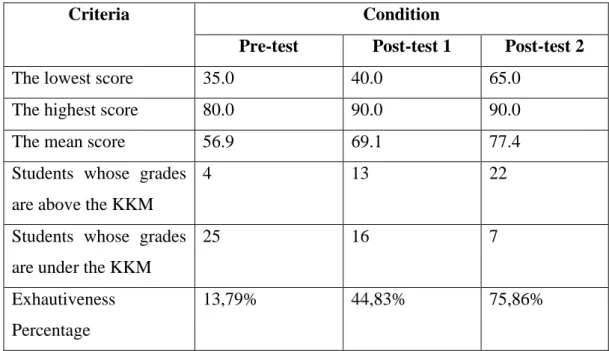
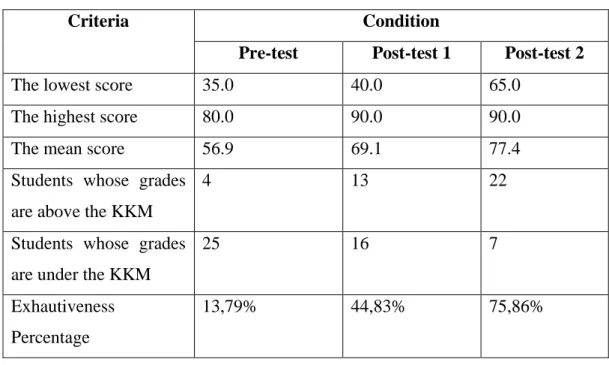
Table 4. 4 The Comparison of Average Score from Pre-test, Post-test 1, and Post-test 2 ... 58
x
LIST FIGURES
Figure 4. 1 Comparation of The Students’ at Pre-test and Post-test 1 ... 47 Figure 4. 2 The Comparison of The Students’ at Pre-test, Post-test 1 and Post-test 2 ... 58
xi
LIST OF APPENDICES
Appendix 1 Interview Transcripts ... 68
Appendix 2 Observation Sheets ... 76
Appendix 3 Students’ List of VIII-A ... 82
Appendix 4 Attendance List of VIII-A ... 83
Appendix 5 Reading Test ... 85
Appendix 6 Students’ Score of VIII-A ... 101
Appendix 7 Lesson Plans ... 103
Appendix 8 Photography ... 128
xii
ABSTRACT
Nur Cholida Hanum. 2022. Improving Students' Reading Comprehension By Using REDW (Read, Examine, Decide, Write) Strategy In Descriptive Text (A Classroom Action Research of Eight Grade at Students MTS Muhammadiyah 1 Gemolong in the Academic Year of 2022/2023). Thesis. English Language Education Study Program, Cultures and Languages Faculty.
This research was conducted to determine students' reading comprehension in descriptive text. Students are easily bored and have difficulty finding text information, main ideas, understanding English texts because teachers still use lecture strategies and are less attractive to students. The objective of this study was to improve the students' reading comprehension by using REDW strategy in descriptive text of eight grade at students MTS Muhammadiyah 1 Gemolong in the Academic Year of 2022/2023.
The research was classroom action research. The action research was carried out in pre-test and two cycle with total 9 meetings. The subject of the research was the students of VIII-A class. The english teacher, the researcher, and the students of VIII-A class were the team members of the research. In collecting the qualitative data, the researcher used observation and interview with the students and her collaborator. The collaborator in this research is the english teacher. The data were in the forms of observation sheets and interview transcripts. To support qualitative data, quantitative data were obtained from the pre-test and post-test scores. For qualitative data gathered through observations and interview, such as descriptions and reflections on what occured during the learning process. Meanwhile, quantitative method, was used to analyze the data from the mean scores of pre-test and post-test.
The result of this study showed that the implementation of the REDW strategy in this study is succesful to improve the students’ reading skill which deals with: (a) The students are able to find detailed information; (b) they are able to find the main idea; (c) they can understand the meaning of foreign words used in the text. Than class situation which deals with: (a) The teaching and learning process becomes more enjoyable for students; (b) the classroom situation becomes organized; (c) students become active. Looking at the scores, it was found that the students’
reading skill is improved by implementing the REDW strategy. The mean of the students’ scores in reading comprehension improved from 56.9 in the pre-test to 69.1 in cycle 1 and 77.4 in cycle 2.
Keywords : Reading Comprehension, REDW Strategys
CHAPTER I INTRODUCTION
A. Background of the Study
Reading has a very important role. Harmer (2007: 1) states that reading is useful for obtaining information, knowledge and values. When reading, readers will receive a lot of information from various sources that can add insight about world knowledge and its development. According to Brown (2004: 189), reading is a process of negotiating meaning. It can be seen that the reader's understanding of the text is the result of the interaction between his thoughts and the meaning of the text he reads.
According to Lore (2017) reading is the process of readers combining information from a text and their own background knowledge to construct meaning. While reading, the reader not only reads the text to get information but also to understand it. Based on observations, the facts show that many students have difficulty in reading comprehension when learning English.
According to Sweet & Snow (2003: 1), reading comprehension is a process of simultaneously extracting and constructing meaning through interaction and engagement with the text. In reading comprehension, students must be able to find the main idea of the text, find detailed information in a text, and understand the meaning of foreign words in the text.
Based on the results of an interview in February 2022 with an English teacher at MTS Muhammadiyah 1 Gemolong, in learning English so far it has been explained that the average student is unable to master reading
comprehension, especially in descriptive text. This can be seen from the scores of students' reading comprehension which are still not good. Students also look less active when asked to read and have difficulty understanding the contents of the text. The reading competence to be achieved in the curriculum used in schools is that students are able to understand the meaning of written discourse formally and informally in the form of recount texts, narrative texts, descriptive texts, procedure report texts, analytical texts, exposition texts, and explanatory texts according to the context.
Based on the results of observations, the students of MTS Muhammadiyah Gemolong still find some difficulties in reading, especially in descriptive texts. There are several problems in the climate class category experienced by students of MTS Muhammadiyah 1 Gemolong, namely: 1) The strategy used in teaching still uses the lecture method which is only done by the teacher, so students look bored in learning; 2) there is still a lack of student interest in reading because there are still students who are sleepy; 3) students are passively involved in the learning process, so if their teacher asks them a question, they don't answer the question; 4) students are noisy when the teacher gives an explanation, so the situation in the classroom becomes uncomfortable for learning. From the category of competency students, the problem indicators are: 1) students have difficulties in finding detailed text information; 2) students have difficulties in finding the main idea; 3) students have difficulties in understanding English words, phrases, sentences and conveying their meaning. In this
case, the teacher must try to overcome student problems by using appropriate methods, models, and strategies.
Related to the problems experienced by students, one strategy to improve students' reading comprehension is REDW or Read, Examine, Decide and Write. Wright (2004: 78) states that REDW is a good strategy in reading assignments to find the main idea in each paragraph. The use of this strategy has the advantage of being able to help students understand the information contained in reading texts. Students can paraphrase in their own sentences. Then it can increase the depth of the student's reading process thereby increasing the possibility of understanding and retention. Finally, in creating their own understanding, students gain a removable and permanent repository of important information available for review.
According to Strichart (2009) in cited by muktisari (2018), each letter of the REDW strategy represents a step in the strategy. This means that there are four steps in this strategy; (a) Read the entire paragraph for an idea of what the paragraph is about. (b) Examine each sentence in the passage to identify and write down the important words that tell what the sentence is about. (c) Decide which sentence contains the words that best describe the main idea and support the main idea. (d) Write the main idea of each paragraph in a notebook.
Researcher will apply the REDW strategy to improve basic reading comprehension competencies that have not been mastered by students. The first basic competency of reading comprehension is that students must be able to find the main idea of the text. By using the REDW strategy in the
read step, students read each paragraph to get an overview of the reading to get an idea. This step will stimulate the student's mind to read also to know what the text is about. The second basic competency is that students must be able to translate unfamiliar words used in a text. In the REDW strategy in the second step, namely examine, students check each sentence to identify and write important words. In this step students are directed to identify each word so that they are allowed to open a dictionary to translate.
The third basic competency of reading comprehension is that of reading comprehension, students must be able to find detailed information in the text. In the third step of REDW, decide suggests students decide which contains the words that best describe the main idea. Then the Write step, students can write the main idea of each paragraph so that they can conclude and understand the content of the text. Researchers consider that this method is very appropriate and effective in helping the learning process, especially in understanding the text. This method can give students the freedom to learn, thus making them enjoy and be active in the learning process
In this study, the researcher used three previous studies, the first of which was the thesis by Ananda Mega Ayu Lore (2017) entitled "The Effect Of Using Read-Examine-Decide-Write (REDW) Strategy On The Students' Achievement In Reading Comprehension". The second one was Yoga Aldy Papilaya's (2021) thesis entitled "The Influence Of Using REDW (Read, Examine, Decide, Write) Strategy Towards Students' Reading Comprehension". The previous third is a journal from Juristian Adi Nata 2020 entitled "The Effect of REDW (Read, Examine, Decide, Write)
Strategy on Student Reading Comprehension". Based on the explanation above, the writer wants to do a Classroom Action Research entitled
"Improving Students' Reading Comprehension by Using the REDW Strategy in Descriptive Text".
B. Identification of the Problems
Based on the background of the study above, the problems can be identified as follows:
1. Mostly, students have difficulties in finding details of text ideas because of the lack of interest in reading students.
2. Students have difficulties in finding the main idea because students have not mastered the main idea material and the main idea paragraph layout.
3. Students have difficulties understanding english words, phrases, sentences and conveying their meaning because there are still students who do not know foreign words.
C. Limitation of the Problems
Based on the identification of the problem, this research only focuses on the used of the REDW Strategy for improving reading comprehension in descriptive text at the eight grade students of MTS Muhammadiyah 1 Gemolong in the academic year of 2022/2023 which consist of 2 cycles.
D. Formulation of the Problems
The problem of the research formulated as follows:
"How does the implementation of REDW improve student's reading comprehension in descriptive text of eight grade at MTS Muhammadiyah 1 Gemolong in the academic year 2022/2023?"
E. Objectives of the Study
The objective of the research was to improve the students' reading comprehension by using REDW strategy in descriptive text of eight grade MTS Muhammadiyah 1 Gemolong in the Academic Year of 2022/2023.
F. Benefits of the Study
The result of this research hopefully are useful to provide input for:
1. The students
This research is expected to provide benefits for students to improve students' reading comprehension by using the REDW strategy.
2. The English teacher
The author hopes that this research will contribute to teachers related to students' reading comprehension and can be an additional strategy in teaching English. So, student achievement will be better.
3. The other researchers.
The author hopes that this research can be useful for readers and can be used as a reference for those who are interested in teaching English.
G. Definition of Key Terms
From the topic of research, the writer gives definition about the choosing of variable and subject of the study. The definitions of key terms are follows:
1. Reading Comprehension
According to Woolley (2011: 15) reading comprehension is the process of making meaning from the text, the goal is to get an overall understanding of what is described in the text rather than to get the meaning of isolated words or sentences.
2. REDW Strategy
Wright (2004: 78) stated that REDW is a good strategy in reading assignments to find the main idea in each paragraph. The purpose of this strategy is to provide opportunities for students to be active in the classroom.
3. CAR
According to Burns (2010: 2) action research is a self-reflective, systematic and critical approach to enquiry by participant members of the research community, which aims to identify problematic situations or issues considered by the participant to be worthy of investigation in order to bring about critically informed changes in practices.
CHAPTER II LITERATURE REVIEW
This chapter discussed about theoritical frame work, previous research and research hypotesis:
A. Theroritical Review 1. Teaching Reading
According to Brown (2007: 8) the definition of teaching is as showing or helping someone to learn, how to do something, giving instructions, guiding in learning something, imparting knowledge, telling or understanding. It can be seen that teaching is a process to tell someone information, how to do something to help other people to learn in everyday life.
According to Harmer (2007: 107) teaching is the transmission of knowledge from teacher to student or creating conditions in which students somehow learn on their own. Learning to teach with a teacher helps students to give instructions. Meanwhile, according to Dirgantara (2013) teaching reading is a process where individuals learn to get meaning from texts. When teaching reading, students learn to use critical thinking strategies and use context to "guess"
unfamiliar words.
In addition, in teaching reading the teacher also needs to pay attention to the principles that can be a guide. According to Harmer
(2001: 70) there are several principles in teaching reading are as follows:
1) Reading is not a passive skill
2) Students need to engage with what students read.
3) Students should be encouraged to respond to the content of the reading text, not just the language.
4) Prediction is a major factor in reading.
5) Match assignments with topics
6) A good teacher makes full use of the reading text.
2. General Concept of Reading a. Definition of Reading
Reading is one of the language skills (reading, writing, listening, and speaking) that is important for every individual to learn and master. By reading, one can gather information and increase knowledge. According to Harmer (2007: 99) reading is useful for language acquisition. However, one should be able to better understand what is read. The more one reads, the better at understanding.
According to Weaver (2009: 10) reading is a process to determine what the reader's brain, emotions, and beliefs bring into reading. It can be interpreted that reading is the way the reader interprets the printed words. Meanwhile, according to Macky (2006), reading is both a process and a product. This means that the reading process or processes that involve
interaction between the reader and the text will produce reading products. The product of reading is the construction of meaning or reading comprehension; have understanding.
Based on this definition, it can be concluded that reading is a process carried out by the reader to obtain information by understanding the meaning of the reading and also capturing the meaning of the text.
b. Purposes of Reading
Reading is an activity that has a purpose. One can read to get the information of existing knowledge. One can also read for pleasure, or to deepen one's knowledge of the language being read. Anderson (2014) also mentions three typical purposes of reading: reading for pleasure, reading for information, and reading to learn something new.
According to Grabe and stoller (2002: 13), point out that this is the purposes of reading:
1) Reading to search for simple information
Reading for simple information is a common reading skill, although some researchers consider it a relatively independent cognitive process. It is often used in reading assignments which are perhaps best considered a type of reading ability.
2) Reading to skim quickly
Speed reading is a common part of many reading exercises and is a useful skill. This involves a combination of guessing strategies where it may be important in the text, then using basic reading skills on segments of the text until a general idea is formed.
3) Reading to learn from text
Reading to learn often occurs in academic and professional contexts, where one needs to learn large amounts of information from a text. Therefore, it requires the ability to remember main ideas, recognize and build a rhetorical framework and relate the text to the reader.
4) Reading to integrate information
Reading to integrate information requires a more informed decision about the relative importance of mutually supportive or contradictory information and a possible restructuring of a rhetorical framework that takes information from multiple sources into account.
5) Reading to write and reading to critique texts
Reading to write and reading to critical texts may be variations of reading to integrate information. Both require the ability to select, organize, and critique information from a text.
6) Reading for general comprehension
Reading for general understanding if carried out by a fluent and skilled reader, requires very fast and automatic word processing, strong skills to form a general meaning representation of the main idea, effective and efficient coordination of many processes within a very limited time limit.
The purpose of reading is not only for students, but also for the whole general public. Everyone should read a lot to get information and knowledge about social life. It can help a person stay informed about his country's political, social and economic issues.
c. Types of Reading
According to Rasyid et al. (2021: 37), in reading there are many types of reading, and two significant types of reading can be presented in detail below.
1) Extensive Reading
Richards et al. (2002: 193), says Extensive reading is reading in large numbers to gain a general understanding of what is read, to develop.
2) Intensive Reading
Brown (1988) states that intense reading is an emphasis on grammatical forms, discourse markers, and deep text structures to better understand literal meaning, interaction ambiguity, and retention in the long term. Intense reading is
reading that asks students to find words, identify their meanings, and finally identify accurate readings.
d. Reading Comprehension
Reading comprehension is important for students in every subject, because most of the teaching materials consist of text.
Reading comprehension is the process of obtaining meaning from the text, which is the purpose of reading. Woolley (2011:
15) states that reading comprehension is the process of making meaning from the text, the goal is to get an overall understanding of what is described in the text rather than to get the meaning of isolated words or sentences. Meanwhile, according to Grabe and Stoller (2002: 17) argues that reading comprehension is the most important ability to understand clearly, the ability to understand information in a text and interpret it appropriately.
Reading comprehension is a process in which the reader must decide on linguistic symbols and reconstruct them into a meaningful whole. Comprehension includes recognizing and understanding ideas and related details. According to Klingner (2007: 2) reading comprehension is a process of constructing meaning by coordinating a number of complex processes which include word reading, word knowledge, and fluency.
3. General Concept of REDW Strategy a. Definition of REDW Strategy
Wright (2004: 78) stated that REDW is a good strategy in reading assignments to find the main idea in each paragraph.
This strategy helps in understanding the information contained in the reading text. The letters in REDW stand for Read, Examine, Decide, and Write. REDW is usually used for textbooks or material that is difficult for students to understand even though students have tried to understand the information by reading the material very slowly and carefully. The implementation of the REDW strategy can also help students to be active in the teaching and learning process.
Muktisari (2018) states that REDW (Read, Examine, Decide, and Write) can improve students' reading skills. This strategy helps students in understanding the reading text. In addition, it guides students to find the main idea in each paragraph. Meanwhile, Gupta (2008: 72) states that the REDW strategy is a reading and learning skill activity that is carried out by making short notes in the margins of the text. The purpose of this strategy is to provide opportunities for students to be active in the classroom. This strategy can also help increase students' interest and motivation in reading.
The components of REDW strategy are read, examine, decide, and write. The each step can be explained as follows (Nata, 2020):
1) Read
In this process, students need to read each paragraph of the text. However, there are students who do not understand the meaning of some words. Where to solve this problem the researcher asked students to use a dictionary.
2) Examine
Examine each sentence in the paragraph to identify important words that tell what the sentence is about. Ignore unnecessary words to tell what the sentence is about. And to find the main idea: (1) students must find the topic and theme of the first sentence; (2) observing the words/phrases that the author always uses for the topic being developed;
(3) Pay attention to the closing paragraph where the author will express the main idea; (4) the location of the main idea is always at the beginning, end, or middle of the sentence;
(5) the main idea always completes the sentence (has a subject and a predicate).
3) Decide
Decide in this strategy gives students more care in understanding the understanding of the text. The students then reread the words and write for each sentence in the
paragraph. They decide which sentences contain the words they wrote that best describe the idea of the main idea. To get the main idea of the paragraph. Words that are the main idea of the main idea.
4) Write
The last step, students should write down the main idea of each paragraph. This step will help students to remember what they have learned and provide good study notes for exams.
Based on the statement above, it can be concluded that the REDW strategy is a good and effective strategy in teaching reading comprehension because it helps students find the main idea in each paragraph of reading assignments and this strategy.
Help in understanding the information contained in the reading text and can also encourage interest, enthusiasm and motivation of students to be more active in reading activities.
b. The Implementation of REDW Strategy in Teaching Reading Comprehension
In this study, REDW (Read, Examine, Decide, and Write) was used for teaching reading comprehension. This is one way possible by following the steps of the teaching procedure below (Wright, 2004: 80):
a) Preparation:
1. Choose a subject of interest to students.
2. Find three or four suitable sources that deal with different aspects of the subject. This could be a reference book, website, audio or video lecture.
b) The lesson
1. The teacher distributes a copy of the text to the students.
2. Students are asked to read the entire paragraph text.
3. Students are asked to identify the main idea of the paragraph.
c. The Strength of REDW (Read, Examine, Decide, and Write) Wright (2004: 80) says that REDW (Read, Examine, Decide, and Write) as a strategy in reading comprehension, has several strengths as a useful strategy to help students understand reading comprehension. The strengths are:
1. Students must actively pay attention to the main ideas and choose important ideas to be stored in the reading text.
2. Students can paraphrase in their own sentences.
3. When students elaborate on the content by paraphrasing, showing the relationships between ideas, and developing their own examples by processing the content more deeply.
This increased processing depth of multiple encodings increases the chances of understanding and retention.
Finally, in creating their own understanding, students gain a movable and permanent repository of important information that is available for review.
4. General Concept of Text a. Genre of Text
Reading is one of the skills that need to be mastered when learning English. In the reading section we will find various types or forms of English text. But before learning about the type or types of text, we must first know the meaning of the text itself.
Text is spoken or written passage.
According to Khoiriyah (2021: 9), the text has various kinds or types of text. Kind or type of text is called Genre. The text genre must have the following 3 things:
1) Social function / Communicative purpose
Social function in a text is often referred to as communicative purpose. The social function or communicative purpose of the text is the goal the author wants to achieve through the written text.
2) Generic structure
The arrangement of writing a text according to its social function or communicative purpose.
3) Language features
The linguistic features of the text aim to distinguish it from other types of text. The use of linguistic elements must be in accordance with the social function or communicative purpose of each type of text.
Based on the composition of the text and the use of linguistic elements, the text genre is divided into 13 kinds, namely:
1) Descriptive Text, 2) Report Text, 3) Procedure Text, 4) Narrative Text, 5) Recount Text, 6) News ltem,
7) Analytical Exposition, 8) Hortatory Exposition, 9) Spoof
10) Explanation, 11) Discussion, 12) Review and, 13) Anecdote.
b. General Concept of Descriptive Text 1) Definition of Descriptive Text
Knapp & Watkins (2005: 98) explain that Descriptive text is a text to describe something such as place, thing, person, and animal. For example, it describes the characteristics of animal.
2) Social Function or Communicative Purpose
The social function or communicative purpose of descriptive text is to describe person, animal, place or thing.
3) Generic Structure of Descriptive text
According to Khoiriyah (2021: 11) states there are two generic structures of descriptive text as follows:
a) Identification: This section is in the first paragraph. It contains about the introduction of a person, animal, place or thing will bedescribed.
b) Description: This section is in the secondparagraph and so on. It contains the description of a person, animal, place or thing.
4) Language Features
a) Using specific participant b) Using Present Tense c) Using action verb d) Using adjective
5) Example of Descriptive text
Identification Mr. Tucker is my math teacher at school. He
teaches us at class IX.
Description He is a smart teacher. He can teach us very well.
He is a strict teacher. He doesn't like his students came late at class. He will be very angry. Besides that he doesn't like us cheating in the test. He always tells us to be honest. His students must pay attention to his explanation. Besides that
Mr. Tucker always does the same things everyday. Entering the classroom, he will wash his hands in the basin in the corner the class. After that he will walk over to his desk.
Sitting in her desk, he will look at and greet us formally.
Then he will put on her glasses, open his textbook and ask us what lesson w discussed the previous meeting. And then he starts teaching. I was really amazed by his habit. (Source: UN SMP 2017)
B. Previous Related Studies
To develop the original analysis, the researcher presents the previous study dealing with the topic.
The previous study was conducted by Ananda Mega Ayu Lore 2017 entitled "The Effect of Using Read-Examine-Decide-Write (REDW) Strategy On The Students' Achievement In Reading Comprehension".
This study aims to determine the significant effect of using the REDW strategy on achievement in reading comprehension. The similarity of research conducted by researcher Ananda Mega Ayu Lore is the use of the REDW strategy for learning reading comprehension. The difference between the research that the researcher conducted and the research conducted by Ananda Mega Ayu Lore used an experimental design and focused on narrative text. In this study, researcher used Classroom Action Research (CAR).
The other thesis that researcher used as the final project was conducted by Muslimaini 2017 entitled "The Effect of Using REDW
(Read, Examine, Decide, Write) Strategy On Reading Comprehension At Eight Grades Islamic Of Junior High School Tarbiyah Islamiyah Jambi". This study aims to determine whether or not there is a significant effect using the REDW strategy (Read, Examine, Decide, Write) on reading comprehension and to find out whether there is a significant difference between reading comprehension among students taught using the REDW Strategy (Read, Check, Decide, Write) and those that are not.
The similarity of the research carried out by this Muslim researcher is the use of the REDW strategy for learning reading comprehension. The difference between the research that the researcher conducted and the research conducted by Muslima was using a quasi-experimental design.
In this study, researcher used Classroom Action Research (CAR).
Next previous study is taken from journal was conducted by Juristian Adi Nata 2020 entitled "The Effect of REDW (Read, Examine, Decide, Write) Strategy on Student Reading Comprehension". The purpose of this study was to determine the effect of reading, reviewing, deciding, writing (REDW) on Reading Comprehension Students in Semester IV of the English Education Study Program, University of Muhammadiyah Bengkulu, 2018/2019 Academic Year. The similarity of the research conducted by researcher Juristian Adi Nata is the use of the REDW strategy for learning reading comprehension. The difference between the research that the researcher did and the research conducted by Juristian Adi Nata used an experimental study. In this study, researcher used Classroom Action Research (CAR).
Next previous study is taken from journal was conducted by P Sulistami, J Pahamzah, W Baratayaomi, S Syafriza 2018 entitled
“Improving Students' Reading Comprehension by Using Peer Assisted Learning Strategies (PALS) In EFL Contexts”. This study aims to describing the process of teaching reading comprehension and identifying whether Peer Assisted Learning Strategies (PALS) can improve students’ reading comprehension at the tenth grade of SMA Negeri 6 Kota Serang. The similiarity between the studies of researcher conducted by P Sulistami, J Pahamzah, W Baratayaomi, S Syafriza is the use of CAR (Classroom Action Research) as the research method.
The differences between the studies of researcher conducts and the research conducted by P Sulistami, J Pahamzah, W Baratayaomi, S Syafriza used Peer Assisted Learning Strategies (PALS) strategy as the independent variable. In this research, the researcher used a REDW strategy as the independent variable.
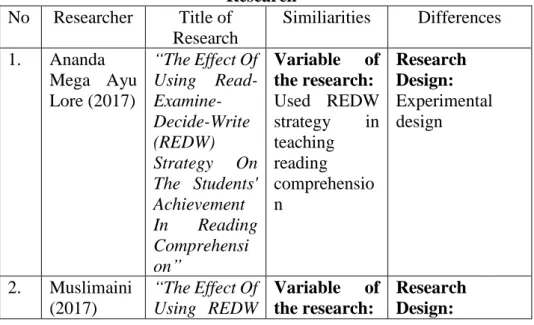
Tabel 2.1 The Comparison of Previous Studies with Current Research
No Researcher Title of Research
Similiarities Differences 1. Ananda
Mega Ayu Lore (2017)
“The Effect Of Using Read- Examine- Decide-Write (REDW) Strategy On The Students' Achievement In Reading Comprehensi on”
Variable of the research:
Used REDW strategy in teaching reading comprehensio n
Research Design:
Experimental design
2. Muslimaini (2017)
“The Effect Of Using REDW
Variable of the research:
Research Design:
(Read, Examine, Decide, Write)
Strategy On Reading Comprehensi on At Eight Grades
Islamic Of Junior High School
Tarbiyah Islamiyah Jambi”
Used REDW strategy in teaching reading comprehensio n
Quasi- experimental design
3. Juristian Adi Nata (2020)
The Effect of REDW (Read, Examine, Decide, Write)
Strategy on Student Reading Comprehensi on”
Variable of the research:
Used REDW strategy in teaching reading comprehensio n
Research Design:
Experimental study
4 P Sulistami, J
Pahamzah, W
Baratayaom i, S Syafriza (2018)
Improving Students' Reading Comprehensi on By Using Peer Assisted Learning Strategies (PALS) In EFL Contexts
Research Design:
CAR (Classroom Action Research)
Variable of the research:
Used Peer
Assisted Learning Strategies
(PALS) in
Improving the Students'
Reading
Comprehension
C. Rationale
Reading skills are very important for students to understand textbooks. Students are expected to be able to fully understand the text that is read. In reading comprehension, students must be able to find the
main idea of a text, find detailed information in a text, and guess or understand the meaning of foreign words in a text.
Based on observations, the facts show that many students have difficulty in reading comprehension when learning English, especially in descriptive texts. This can happen because of the problems that arise including the class situation and student competence. There are several problems in the climate class category experienced by students of MTS Muhammadiyah 1 Gemolong, namely: 1) The strategy used in teaching still uses the lecture method which is only done by the teacher, so students look bored in learning; 2) there is still a lack of student interest in reading because there are still students who are sleepy; 3) students are passively involved in the learning process, so if their teacher asks them a question, they don't answer the question; 4) students are noisy when the teacher gives an explanation, so the situation in the classroom becomes uncomfortable for learning.
From the category of competency students, the problem indicators are: 1) students have difficulty in finding detailed text information; 2) students have difficulty in finding the main idea; 3) students have difficulty in understanding English words, phrases, sentences and conveying their meaning. In this case, the teacher must try to overcome student problems by using appropriate methods, models, and strategies.
Related to these problems, the researcher intends to overcome these problems to improve students' reading comprehension by using the REDW strategy. As previously mentioned, the REDW strategy is an
effective strategy to achieve the reading goal of increasing students' understanding. Students can understand the meaning and understanding of reading texts. In addition, the use of the REDW strategy can help students become actively involved in the reading process.
D. Action Hypothesis
Based on the theories, thoughts, and explanation above the hypothesis of this research can be formulated as follows: REDW strategy can improve students' reading comprehension.
CHAPTER III
RESEARCH METHODOLOGY
This chapter discusses about variable and operational, research setting, subject and object of the research, action plan, techniques of collecting the data, research instrument, and techniques of analyzing the data.
A. Variable and Operational of Research Design 1. Variable
In this case study, there are two kinds of variables. There are independent and dependent variables. The independent variable in this study is the use of the REDW strategy (X), and the dependent variable in this study is students' reading comprehension (Y).
The research method used in conducting this research is CAR (Classroom Action Research). The action here uses a model developed by Kemmis and McTaggart (1998). According to Burns (2010:2) action research is a self-reflective, systematic and critical approach to enquiry by participant members of the research community, which aims to identify problematic situations or issues considered by the participants to be worthy of investigation in order to bring about critically informed changes in practices. The procedure of Classroom Action Research consist of 4 stages namely, planning, action, observating, revised a plan, and reflecting. In this case, the researcher used action research method because the research was done in the class so the method that was used is Classroom Action Research and this study consisted of two cycle.
2. Definition of Variable
Definition of variables in this research were:
1) Independent variable ( X )
The independent variable in this study is the REDW strategy. The REDW strategy is a strategy that will help students improve their reading comprehension, understand meaning, and help students answer questions from the text.
2) Dependent Variable ( Y )
The dependent variable is students' reading comprehension, which is the process of understanding the message the author wants to convey. In this study, students' reading comprehension is a variable that is influenced by the REDW strategy.
B. Research Setting
Setting of this research would give explanation about the setting of place and setting of time
1) Place of the research
The research will be conducted at MTS Muhammadiyah 1 Gemolong. Located in Ngembat Kembang, Kragilan, Gemolong, Sragen, Central Java 57274. The subjects of this study were class VIII students of MTS Muhammadiyah 1 Gemolong in the 2022/2023 academic year. The condition of the surrounding area is a trading area and most of the students' parents make a living as farmers, fishermen and laborers. The condition of the area with its good culture is used as a source of learning. MTS Muhammadiyah 1
Gemolong is a school that serves the teaching of Junior High School (SMP) education in Sragen Regency which is accredited B. The lessons provided include all compulsory subjects according to the national curriculum with additional Islamic religious values.
Madrasah Tsanawiyah Muhammadiyah 1 Gemolong has 21 teaching staff who are competent in their field of study so that they are of high quality. There are three classes, seventh grade, eight grade, and ninth grade. There are also various school facilities such as classrooms, science laboratories, biology laboratories, physics laboratories, chemistry laboratories, computer laboratories, language laboratories, libraries, sports fields, prayer rooms/mosques, UKS rooms, canteens and others.
2) Time of research
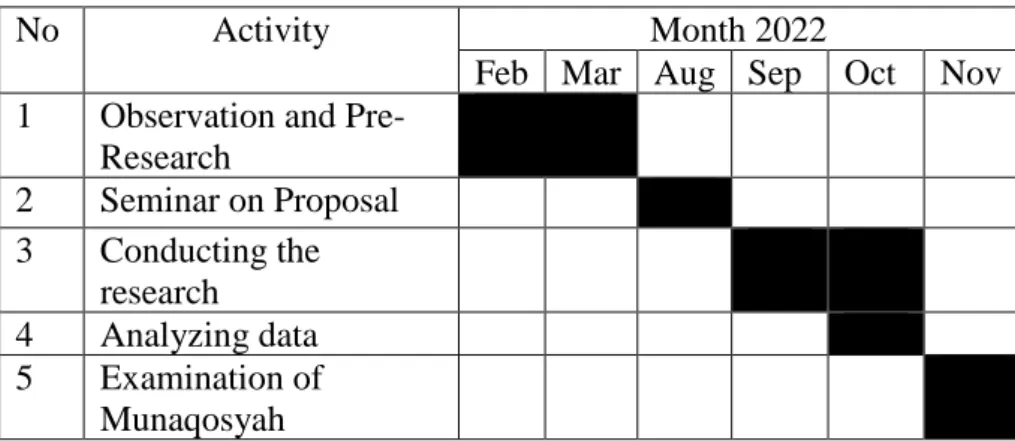
This research will be conducted in the 2022/2023 academic year at MTS Muhammadiyah 1 Gemolong. The completeness of this research timeline includes asking for permission, pre-research, writing research proposals, data collection, data analysis and thesis writing. The research timeline will be stated in the table below:
Table 3. 1 Research Schedule Table
No Activity Month 2022
Feb Mar Aug Sep Oct Nov 1 Observation and Pre-
Research
2 Seminar on Proposal 3 Conducting the
research 4 Analyzing data 5 Examination of
Munaqosyah
C. Subject of the Research
The subjects of this study were students of class VIII A Semester I of MTS Muhammadiyah 1 Gemolong in the 2021/2022 academic year.
This class consisted of 29 students, 15 female and 14 male. The researcher chose class VIII A as the research subject because there was only one class VIII and the English teacher said that the students of class VIII A had some problems in reading class. In this study, researchers collaborated with English teachers at MTS Muhammadiyah 1 Gemolong.
D. Action Plan
The research method used in this research is CAR (Classroom Action Research) which was developed by Kemmis and McTaggart (1998). To better understand this action research process, details related to the action plan are given as follows:
1. Identyfying the problem
At this stage, researchers have identified students' problems in reading activities. Researchers have used a number of techniques such as observation, interviews, and questionnaires to identify problems.
2. Caryying out the real Action Research 1) Planning
After conducting observations and interviews, the researcher prepares various things related to the action research that will be carried out. With that, the researcher made a lesson plan for the topic, material, media, instrument, time, and schedule of observations. Reading comprehension topics are selected based on the syllabus in the curriculum. The purpose of this action is to improve the reading skills of class VIII students of MTS Muhammadiyah 1 Gemolong through the REDW strategy.
2) Action
In this stage the researcher uses the REDW strategy for students' reading comprehension. This research consisted of two cycles, each cycle consisted of three to four meetings and each meeting took 40 to 60 minutes. The implementation stage is divided into three parts. Namely the opening, the core activity consisting of pre-reading, while reading, post-reading and closing. Thus, the researcher will conduct research in class according to the lesson plan that has been made. The researcher involved English teacher A as a collaborator to help observe the conditions and the researcher during the study.
3) Observation
At the observation stage, the researcher used to observe all teaching and learning activities including student understanding, student participation, classroom activities, and understanding
during the teaching and learning process. Observation results are recorded as data.
4) Reflection
After the teaching process using the REDW strategy, the researcher conducted an analysis of what had been observed to find out the advantages and disadvantages of the previous teaching activities. The results of this step will be the basis for the next activity or cycle, and will provide answers to the hypotheses proposed by the author before the action is taken.
3. Doing evaluation
After all of the teaching and learning activities were completed the students were given a test to assess their reading comprehension achievement. The researcher analyzed the test result and calculated the mean score to determine wheter or not the students' reading comprehension improved.
E. Techniques of Collecting the Data
In this classroom action research, the researcher uses qualitative and quantitative techniques to collect data:
1. Observation
Observation is an activity to focus all one's attention on an object of research. This will be used to determine the condition of the class, the teaching and learning process, as well as to find out the difficulties, problems and understanding of the material provided by the teacher. While in the form of an observation sheet, the researcher
observed the students' abilities and their motivation in learning English. Observation was used to collect qualitative data.
2. Test
In addition, quantitative data includes formative tests there are pre-test and post-test. Quantitative in the form of numbers, the researcher used the test taken from the tests carried out before and after the cycle was carried out. The test scores were used in the form of pre-test and post-test 1 and post-test 2. This study consisted of two cycles, each cycle consisting of two to four meetings. The test results are analyzed to compare the improvement of students' reading comprehension skills, the test results can show that REDW can improve students' reading comprehension or not
3. Interview
Interviews were also used by researchers as a means to collect information from students and teachers. Researchers also took careful notes to gather information about classroom events, teaching and learning processes, or student behavior. The data is in the form of interview transcripts.
F. Research Instrument
In this classroom action research, the researcher uses an instrument to collect data in this study, the instrument is:
1. Test
The test will be given three times; at the beginning of the study and at the end of cycle 1 and at the end of cycle 2. The scores in the pre-
test and post-test were obtained through reading assessment. Then the test results at the end of the cycle will be compared with the results of the student's test scores before the action is carried out. The researcher gave a test with 20 multiple choice questions. The researcher involved English teacher A as a collaborator to help observe the conditions and the researcher during the study.
2. Non-test instruments
While the non-test instrument data consisted of observations and interview transcripts. Observations will be used to identify problems related to students' reading ability and to determine the condition of the class. The researcher used interviews to guide the researcher in conducting interviews with English teachers and students.
G. Techniques of Analyzing the Data
After collecting data, the next step of this research is to analyze the data. The data to be collected above will be analyzed by qualitative and quantitative techniques. Descriptions, and reflections on what will happen in the teaching and learning process will be obtained from observations and interview transcripts.
Data from the pre-test, post-test 1, and post-test 2 scores will be analyzed using quantitative methods using the formula proposed by Arikunto (2010:15). In analyzing the data, the researcher used the average score of the pre-test and post-test using:
𝑋 = ∑ 𝑥
𝑛 𝑌 = ∑ 𝑦
𝑛
In which:
X : Mean of pre-test scores Y : Mean of post-test scores n : Number of the data
∑ 𝑥 : The sum of pre-test score
∑ 𝑦 : The sum of post-test score
In this research, the results of analyzing quantitative data will be used to compare students' ability before and after this research this done.
These will be used to find out whether any improvements between the student achievements before and after study.
H. Indicators of Success
The process and results of classroom action research are used to determine success. Researchers are considered successful when the increase in scores after the implementation of REDW is at least 70% of students achieving the MMC target at school and 70% of students actively participating in learning activities. The minimum mastery criteria (MMC) in English lesson is 75.
CHAPTER IV
RESEARCH FINDINGS AND DISCUSSION A. The Research Findings
The findings are from the implementation the beginning to the end of the eight grade lesson at MTS Muhammadiyah 1 Gemolong. This study consisted of a pretest and two cycles. Each cycle has four meetings and one meeting to complete the post-test. The findings can be described as follows:
1. Pre-Test
The pre-test was held on Monday, October 3rd, 2022. The duration of this pre-test was 2x30 minutes. This class starts at 09.00 until 10.00. The researcher gave a pre-test to determine the students' ability in reading comprehension. The results of the pre-test show that there are still many students who cannot know detailed information, main ideas and are less able to translate difficult words.
When the researcher gave a test to class VIII students, only four students reached the passing grade.
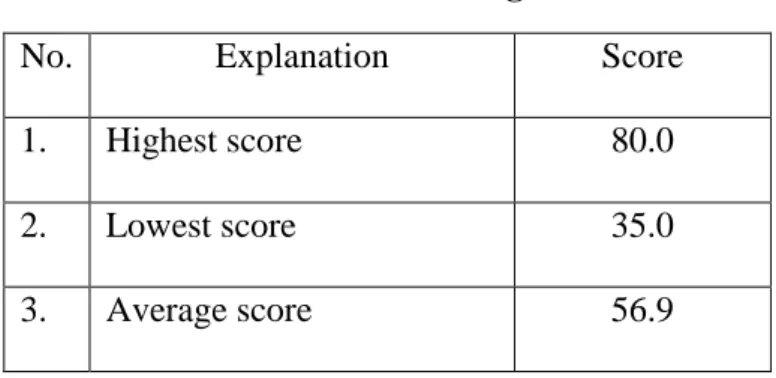
Based on the results of the pre-test of this study, the average score of students is 56.90 and the KKM is 75. It can be concluded that students' ability in reading comprehension must be improved to get better achievement. The highest score was 80.0 and the lowest score was 35.0. Briefly shown in the following table. Detail score is the appendix 6.
Table 4. 1 Pre-test Average score
No. Explanation Score
1. Highest score 80.0
2. Lowest score 35.0
3. Average score 56.9
2. Research Implementation
This Classroom Action Research was carried out in two cycles.
Each cycle consists of three meetings and one meeting for the implementation of the post-test. The steps of each cycle are: (1) planning an action; (2) carry out the action; (3) observing the action;
(4) reflects the action; (5) revise the plan. In the first cycle, the researcher introduced the REDW strategy for teaching reading comprehension. The first cycle is carried out from the 4th October 2022 up to 17th October 2022, while the second cycle is carried out from the 18th October 2022 up to 31th October 2022.
The research implementation in each cycle is described in the following section.
1. Implementation of Cycle 1
The process of cycle 1 is as follow:
a. Planning
Before carrying out the action, the researcher made observations and gave a pre-test to the students. The test aims to determine the students' basic ability in reading
comprehension. After identifying the students' problems and the causes of the problems, the researcher applied his research to improve students' reading comprehension using the REDW strategy.
In conducting the research, the researcher held 4 meetings and prepared what activities the students had to do before taking real action. The implementation of these actions is based on the teaching and learning activities contained in the lesson plans. The topic of reading comprehension was chosen based on the syllabus in the MTS Muhammadiyah 1 Gemolong curriculum. The material is related to descriptive text.
b. Action and observation
In the observation, the researcher involved English teacher A as a collaborator to help observe the conditions and the researcher during the study. This is done to determine student responses and the impact of these actions. The researcher took one cycle of action in three meetings and one meeting to conduct a post-test. The research activities were presenting the material, explaining how to understand the text effectively using the REDW strategy, doing exercises, and discussing student work. Briefly shown as follows:
1) First meeting
The first meeting was held on Tuesday, October 4th, 2022. The duration of this meeting was 2x30 minutes.
This class starts at 09.00 until 10.00. Before the researcher taught the students, the English teacher greeted the students. She told them that at the next meeting, the researcher would teach them English. The English teacher then gave the researcher the opportunity to act as a teacher. In the first session, before starting the lesson, the researcher greeted the students and checked their attendance.
Since this was the first meeting, she introduced sheself first. The researcher uses English at the time of introduction, the researcher then repeats it again in Indonesian. Then she gave an overview of the material that students would learn. The researcher also asked the students if they did it because they wanted to build interaction between themselves and the students.
Before distributing the descriptive text to the students, the researcher taught them about the REDW strategy. She explained how or steps in REDW first.
While he was explaining his strategy, the students listened intently. After he finished explaining the steps, he gave a text entitled “My House” to the students.
After sharing the text, he asked the students to read the text by applying the steps in REDW. The researcher guided them in the REDW stage, because this was their first meeting. First, he guides students to do the reading stage. He asked students to read each paragraph of the text. Students are allowed to use a dictionary to understand the meaning of some words. Then in the examine stage, the researcher asked students to examine each sentence in the paragraph to identify the important words that tell what the sentence is about. By finding the main sentence, main idea and conclusion. And to find the main idea: (1) students must find the main sentence where the main sentence contains the main idea or main idea; (2) the location of the main sentence is always at the beginning, end, or middle of the sentence; (3) the main sentence at the beginning usually has a repetition of words like that, this, they, he, etc. If the sentence at the end is usually marked with words such as therefore, so,
thus, and if in the middle of the sentence there are traits between at the beginning or the end of the paragraph.
But many students looked confused, then the researcher asked them to start the activity and asked if they found any difficulties. Here, it was found that the students had difficulties. There are still many students who have difficulty in identifying the important words that tell what the sentence is about. Thus, the researcher again explained how to deal with these stages. After explaining again, he gave an additional 5 minutes to complete the step.
After finishing the check stage, the researcher asked the students to proceed to the decide stage. At this stage, the researcher asked them to decide on this strategy to give students more care in understanding the understanding of the text. Students are asked to reread the words of each sentence in the paragraph. Then they were asked to decide which sentence contained the words they wrote that best described the main sentence and main idea.
After finishing the check stage, the researcher asked the students to proceed to the writing stage. At this stage, students must write down the main sentence and main idea of each paragraph. Then students are asked to
assemble the main idea of each paragraph into a text conclusion. This step will help students to remember what they have learned and provide good study notes for exams.
In the last stage, the researcher guides the students to reread or review what is mainly discussed in the text.
At the end of the class the researcher asked the students whether there were any questions or not. None of the students asked. Then the researcher did a reflection on the day's learning. Finally, he ended the class by saying goodbye.
2) Second meeting
The second meeting was held on Monday, October 10th 2022. The REDW strategy is still limited to understanding the description text. Before starting the lesson, the researcher greeted the students, checked the students' attendance and reviewed the last material. After that, the researcher started the class by telling them about the topic they would discuss today. In this meeting, the researcher first distributed the descriptive text entitled
"My Bedroom" to the students.
After sharing the text, he asked the students whether they still remember the stages in the REDW strategy or not. Some students said they still remember the stages and some have forgotten. The researcher tried to re- explain these stages to encourage students' memory.
After re-explaining, students start working on their assignments, they read the text, then students check each sentence in the paragraph to identify the important words that tell what the sentence is about in ten minutes.
However, there were some students who asked the researcher about the difficult words found. The researcher explained the meaning of the difficult word.
As a result of this condition there are also some students who do not do their assignments and there are also students who are busy with their friends. Then they were asked to decide which sentence contained the words they wrote that best described the main sentence and main idea. After that, students must write down the main
sentence and main idea of each paragraph. Then students are asked to assemble the main idea of each paragraph into a text conclusion.
After completing the stages, the researcher asked the students to discuss the text together. The researcher asks students to explain what they have learned about the main idea, generic structure and other detailed information. Most of the students were still silent when the researcher asked them questions. There were only 12 students who were active during the meeting. However, the students were more active than the first meeting.
When the time was running out, the researcher and the students reviewed the text about all the information in the class. At the end of the class the researcher asked the students whether there were any questions or not and also asked them to study the material again at home.
Then the researcher did a reflection on the day's learning.
He closed the class, said goodbye and left the class.
3) Third meeting
It was Tuesday, October 11th 2022. Class starts at 9:00 am The writers will have their third meeting today.
As usual, before starting the lesson the writer greeted the students, checked attendance and reviewed the last material. After that, the researcher conveyed the topic to
be studied that day. The topic of "My Father". The students seemed interested. They want to know in the description text.
After understanding the topic that will be studied today, the researcher asked the students to do their own work. The researcher also reminded students about how to read with the REDW strategy. The author and his collaborators observed class conditions and students worked on assignments that used the REDW strategy steps or not. However, there was one student who forgot to apply the REDW strategy steps. In this way the researcher must retell the stages of REDW. After that, the researcher started a discussion about the students' work.
Here, many students are enthusiastic and active in answering the assignments given by the author. Students are correct in finding the generic structure, main idea, and detailed information about the text.
After the time was running out, it was time for the researcher to close the lesson for the day. He announced to the students that at their next meeting they would have an exam. Hearing the teacher's announcement, the students responded very well. Finally, he ended the class by saying goodbye and leaving the class.
4) Four meeting
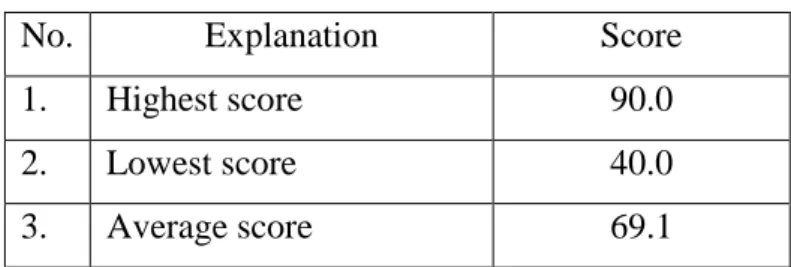
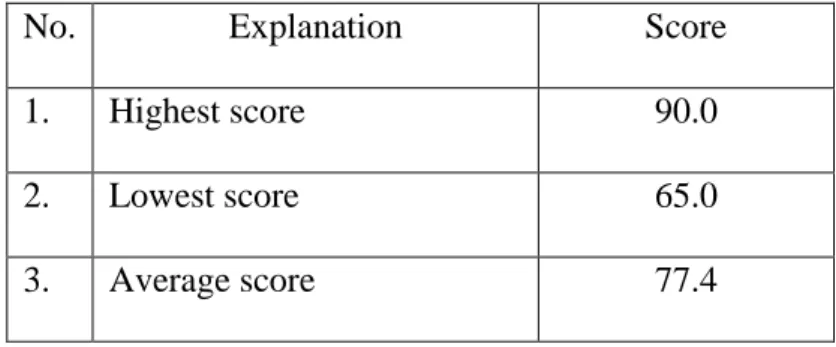
On Monday, October 17th 2022 at 09.00. That day the researcher made a post-test for students to complete the reading comprehension task. Researchers gave post- test to students to determine student achievement. There were 29 students who took the post-test. The researcher gave a test with 20 multiple choice questions. They were given sixty minutes to complete the test. Students take their assignments seriously. Some students were seen discussing with other friends. The researcher goes around the class during the test to prevent students from cheating. The results of the post-test (1) are shown in the following table. Detail score is the appendix 6.
Table 4. 2 Post-test average score
No. Explanation Score
1. Highest score 90.0
2. Lowest score 40.0
3. Average score 69.1
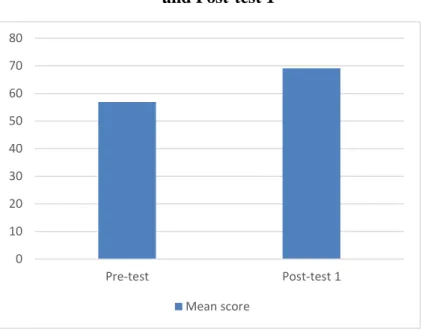
Figure 4. 1 Comparation of The Students’ at Pre-test and Post-test 1
Based on the table above, it can be concluded that the students experienced a significant improvement compared to the pre-test.
c. Reflection
After conducting the first cycle of action research on improving students' reading comprehension through the REDW strategy in the classroom, there were several advantages and disadvantages found. Strengths and weaknesses are shown as follows:
1. The strengths of cycle 1 a. The strengths in reading
1) There is an increase in students' reading comprehension achievement. Indicators of
0 10 20 30 40 50 60 70 80
Pre-test Post-test 1
Mean score
improved reading comprehension are finding detailed information in the text, finding main ideas, and understanding the meaning of foreign words from the text. In addition, the average score of students increased from 56.9 (pre-test mean score) to 69.1 (post-test score 1).
2) Students are able to understand the text well and can remember information based on the text in the long term.
b. The strength in Teaching learning activity
1) The REDW strategy can help students to organize their learning so that they can read texts effectively.
2) Student participation in class increases because there is good interaction between the researcher and students can also share their ideas effectively.
2. The weaknesses of cycle 1 a. The weakness in reading
1) There is still one indicator of reading comprehension where students are confused to understand the meaning of foreign words in the text. To understand foreign words there are some students who still use their dictionaries to translate the meaning.