Industry critical success factors and
their importance in strategy
Nicolas S. Graf
Conrad N. Hilton College of Hotel and Restaurant Management, University of Houston, Houston, TX 77204-3028
• • • • 4
In kitchens, Chefs have the same pots and knives. However, some keep them cleaner and sharper than others. In the end, some dishes taste and look better than others .
Franco Fontebasso, Chef and Owner
Introduction
The fundamental tenet in strategy states that, in order to per- form well, a firm must achieve a certain degree of alignment between environmentally driven imperatives and its compe- tencies and capabilities. At a micro level, such alignment is achieved by matching the firm strengths to the critical success factors (CSFs) specific to the existing structure of the industry and segment it is competing in.
Early literature on CSFs focuses on reporting systems and data gathering, and is essentially driven by executives ’ needs for more relevant information. In this initial attempt to pri- oritize business issues, scholars and practitioners delved into those few areas in which results need to be satisfactory for the organization to ensure successful competitive performance.
What emerged from these inquiries are lists of CSFs, organized by industries or functions.
Other works, more interested by the economic nature of CSFs, shed some light on the relationships between indus- try factors and firm-specific resources and capabilities. These efforts highlighted the dynamic relationships between organi- zations ’ strategic choices and the character of CSFs, which, in turn, influenced the performance potential and overall attrac- tiveness of the industry.
While these efforts all stressed the importance of CSFs in strategy, the questions of what those CSFs are in the hospitality industry, and how they relate to the environment and firm per- formance remain unanswered. This manuscript provides an over- view of past and current thinking about CSFs, their relationships to environmental forces and firm performance. In an attempt to synthesize the literature on the subject, both from the general man- agement literature and, more specifically from the hospitality field of study, it offers a conceptual definition of CSFs, and, through industry examples, illustrates their importance to strategic man- agement as applied to hospitality firms. Finally, a practical frame- work for the identification and management of CSFs is proposed.
Critical success factors and information needs
Strategic decision-making centres around two fundamental questions pertaining to domain definitional and navigational
issues. At the corporate level, top-management teams are faced with the daunting task of domain selection and definition which determines in which industry the firm is to be in. Such undertaking aims at aligning the corporation with the major remote environmental forces driving change. The second issue, usually referred to as business strategy, is narrower in its scope as it is primarily concerned with the task environment. At this level, the navigational concerns call on managers to align their business units or firms to the forces shaping the task environ- ment. In both cases, understanding the forces driving change requires managers to scan their environment and to cope with massive information flows.
Several frameworks have been provided by strategy manage- ment scholars and consultants to assist managers in their scan- ning duties. At the task level, Rockart (1979) suggested that companies could more effectively scan their environment by concentrating their information needs on those “ limited number of areas in which results, if they are satisfactory, will ensure suc- cessful competitive performance for the organization ” (p. 85).
These key areas in which success is necessary are industry-wide CSFs. Together, they characterize the structure of the industry and how firms compete in it and respond to environmental forces. Rockart (1979) provided examples of CSFs for varying industries. For instance, styling, quality dealer system, cost con- trol and meeting energy standards are typical CSFs shared by all automobile manufacturers. Rockart (1979) also posited that CSFs evolve over time and shape the boundaries of the industry.
Other authors have emphasized the importance of defining those areas that are critical to the long-term success of firms.
Freund (1988) stressed the importance of monitoring CSFs to avoid business failure rather than to gain competitive advan- tage. To him, CSFs need to be defined for the overall organi- zation, as well as for each business unit and function. Freund (1988) also pointed out that CSFs need to be generic enough to include means required to achieve strategic goals as opposed to specific and related only to performance indicators. He suggested that firms should identify CSFs using a top-down approach that would ensure the alignment of business units with the overall goals and objectives of the corporation.
Freund (1988) proposed a 5-step approach to CSFs:
1. Identify the success factors necessary to the attainment of the overall corporate objectives;
2. Determine the related CSFs for each business unit’s func- tional area. Only five to ten CSFs should be retained at each level;
3. Develop strategies that leverage strength and prevail over weaknesses in each CSF;
4. Develop lists of key performance indicators to monitor the performance on each CSF; and
5. Establish processes and procedures to monitor performance and provide timely feedback.
The use of CSFs as control or monitoring systems has been advocated by several other authors ( Green and Welsh, 1988 ).
This control approach suggests that CSFs are not only important areas to supervise during the strategy implementation phase, but also that they are detached from the strategy development stage and used primarily to manage exceptions or to detect early signs of failure. Other research however has shown that the CSFs approach is used more proactively by managers too.
Simons (1991) for instance discussed the potential advantages of using CSFs in the strategy-making process. While the author recognized that CSFs do not necessarily help managers reduce the uncertainties pertaining to the future changes that can occur in their environment, he argued that they could be used as sig- nalling tools providing information about how changes actually affect their firms. Accordingly, he suggested that top managers should use subset of control systems interactively while keeping the rest for diagnosis purposes. In his study of 16 large corpora- tions, Simons (1991) found that executives using some control systems and CSFs interactively had a much clearer vision and sense of direction than those not doing so.
Critical success factors and industry structure
While information and control-system scholars looked as CSFs as being things executives need to pay attention to, other streams of research in strategy have looked at them from an industry structure perspective. The idea that industry structure is crucial to the enduring success of firms has been central to the devel- opment of the industrial organization’s (IO) view of strategy.
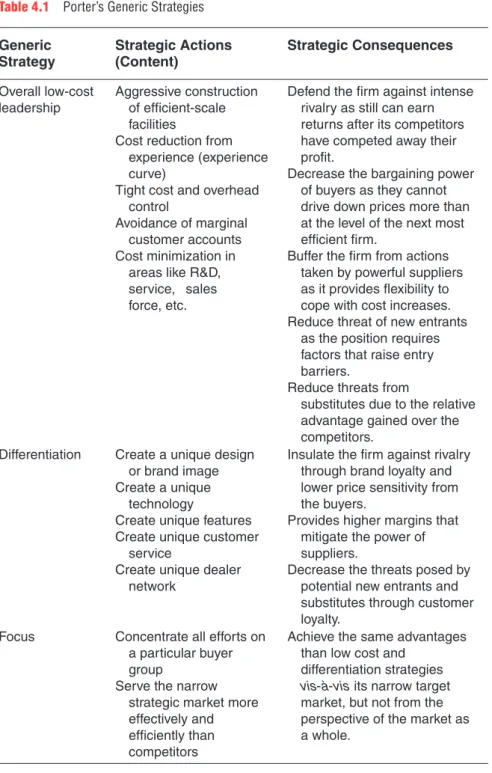
As suggested by Porter (1980) , the attractiveness of an industry depends on its relationships with the external forces present in the task environment. Firms ’ strategic actions are responses to environmental changes with the aim of increasing their bargain- ing power over suppliers and buyers, or raising entry barriers to prevent potential new competitors to enter the industry. The concepts of entry barriers and bargaining power are power- ful to explain what CSFs can be and why they are important to strategy. Table 4.1 provides examples of Porter’s (1980) generic strategies. Principally conceptual and prescriptive, these generic
Table 4.1 Porter’s Generic Strategies Generic
Strategy
Strategic Actions (Content)
Strategic Consequences
Overall low-cost leadership
Aggressive construction of efficient-scale facilities Cost reduction from experience (experience curve)
Tight cost and overhead control
Avoidance of marginal customer accounts Cost minimization in areas like R &D, service, sales force, etc.
Defend the firm against intense rivalry as still can earn returns after its competitors have competed away their profit.
Decrease the bargaining power of buyers as they cannot drive down prices more than at the level of the next most efficient firm.
Buffer the firm from actions taken by powerful suppliers as it provides flexibility to cope with cost increases.
Reduce threat of new entrants as the position requires factors that raise entry barriers.
Reduce threats from
substitutes due to the relative advantage gained over the competitors.
Differentiation
Create a unique design or brand image Create a unique technology Create unique features Create unique customer service
Create unique dealer network
Insulate the firm against rivalry through brand loyalty and lower price sensitivity from the buyers.
Provides higher margins that mitigate the power of suppliers.
Decrease the threats posed by potential new entrants and substitutes through customer loyalty.
Focus Concentrate all efforts on a particular buyer group
Serve the narrow strategic market more effectively and efficiently than competitors
Achieve the same advantages than low cost and
differentiation strategies vis-à-vis its narrow target market, but not from the perspective of the market as a whole.
Source: Porter (1980) .
strategies still suggest several propositions related to the rela- tionships between structural factors of the industry, strategic choices made by firms and their strategic consequences.
For instance, firms following a differentiation strategy would attempt to develop their businesses by focusing on unique areas which would be difficult to imitate and thus raise entry barriers.
Likewise, differentiators would prevent customers from select- ing other alternatives by increasing their switching costs. In both cases, the actions taken by these firms to establish their position would alter the structure of the industry. These areas in which the differentiator creates its uniqueness then become CSFs. For example, a restaurant franchisor could try to differentiate itself by developing superior site selection capabilities. If successful, the strategic action would likely become a benchmark in the industry and change the way franchisors compete. The superior site selection capabilities would ultimately become industry- wide CSFs and need constant attention from management.
The concepts of bargaining power and entry barriers are to be understood in the context of the five forces shaping the task environment of firms ( Porter, 1980 ). In the five forces frame- work, the relative bargaining power of the industry vis-à-vis its external forces, as well as the relative heights of the entry barriers, define the degree of rivalry among industry com- petitors. As industries and task environments evolve, different dynamics become apparent, and different CSFs emerge. These interactions have been described extensively from the perspec- tive of the industry or market life cycle. For example, Wasson (1974) suggested that strategic focus changes depending on the stage of the life cycle. He argued that product development, pricing strategy, distribution policy, and intelligence focus varied depending on the type of competition at each stage of the cycle. For instance, at the market development stage, the distribution policy should concentrate on selected distributors and provide them with high margin so that they could heavily advertise. In contrast, at the maturity stage, distribution policy should include as many dealers as possible, and provide them with a well supplied but low-cost inventory.
Synthesizing the literature on strategy and industry life cycle, Hofer (1975) presented a list of organizational, environ- mental, and resource variables that were deemed as strategi- cally significant at different stages of the cycle. While based on manufacturing industries, these variables are interesting as they illustrate the evolutionary nature of CSFs.
Table 4.2 presents some of the variables of Hofer (1975) that are closely related to CSFs. The evolutionary nature men- tioned above is exemplified by the importance of the rate of
technological change in product design at the introduction and growth stage, which evolved into the rate of change in process design at the maturity stage. As industries grow, new prod- uct development is a critical element to market share build- ing and sales growth, while as growth slows down, business processes that produce or distribute products or services become more important to sustain operating margin and profit Table 4.2 Strategically Significant Variables at Different Stages of the Life Cycle
Life Cycle Stages
Industry Structure Variables Organizational Characteristics and Resources
Introduction
Uniqueness of the product Rate of technological change in product design
Quality of products
Growth
Type of product
Rate of technological change in product design
No. of equal products Barriers to entry
Market share Quality of products Marketing intensity
Maturity
Type of product
Rate of technological change in process design
Degree of product differentiation No. of equal products
Transportation and distribution costs
Barriers to entry
Market share Quality of products Value added Degree of customer concentration Marketing intensity
Discretionary cash flow/gross capital investment
Saturation
Degree of product differentiation Price/cost structure
Experience curves Degree of integration Economies of scale
Market share Quality of products Length of the production cycle
Newness of plant and equipment Relative wage rate Marketing intensity Decline
Degree of products differentiation Price/cost structure Marginal plant size
Transportation and distribution costs
Market share Quality of products Length of the production cycle
Relative wage rate Degree of customer concentration
Source : Adapted from Hofer (1975) .
growth. It is also interesting to note that, as the industry (or market) matures, the number of critical variables increases; var- iables are more often added to the list than removed. Indeed, it appears that CSFs are cumulative rather than specific to stages in the life cycle. Consequently, it seems unlikely that firms actually gain a competitive advantage through CSFs, but rather avoid failure by considering them. This view is consistent with that of Simons (1991) and other information system scholars.
Another important notion put forth by Porter (1980) and IO students is the concept of strategic group and mobility barriers.
Strategic group represent clusters of firms within an industry that follow essentially the same strategy. In this context, strat- egy is defined by the actual activities undertaken by firms at all level of the organization. These activities include functional- level, pricing, and positioning strategies among others things.
The existence of such groups within industries rests on the assumption that firms not only attempt to raise entry barriers and leverage their bargaining power in relation to participants outside their industry, but also try to distinguish themselves from rivals by investing in mobility barriers ( Caves and Porter, 1977 ). Much like industry entry and exit barriers, these mobility barriers can be tangible or intangible assets firms developed or acquired, such as a strong brand name, a loyal customer base or some distribution channels ( Mascarenhas and Aaker, 1989 ).
They can also be skills and capabilities, such as the ability to perform a task better than others or to design products or serv- ices that are reliable and inexpensive to produce or deliver.
Mobility barriers are principally assets and capabilities that delineate strategic groups, and because strategic groups have been viewed as key determinants to success, they appear to be closely related to the CSFs concept. In other words, firms that enjoy sustained high performance due to their group belonging would have to pay special attention to the determinants of their mobility barriers which are CSFs to them. From this perspec- tive, CSFs are defined as being those resources (i.e., assets and capabilities) that help firms buffer themselves against external forces present in their task environment as well as from their competitors.
Critical success factors and the market for strategic resources and capabilities
While management scholars are still debating whether supe- rior performance is mostly driven by industry- or firm-specific factors ( Hawawini, Subramanian, and Verdin, 2003 ; McGahan and Porter, 1997 ; Schmalensee, 1985 ), it appears that both
are important to strategy. Where IO researchers saw firms ’ resources as determinant of strategic groups and industry structure, students of the resource-based view (RBV) of the firm envisioned resources as firm-specific factors and key differenti- ating elements among companies or business units. Wernerfelt (1984) advocated the value of analysing firms from a resource perspective instead of the product-market side. He argued that, unlike the entry barrier concept of IO students, resources cre- ated position barriers that provide its owner an advantage over other industry members as long as it is not replicated by other competing firms or new entrants.
Similarly, Barney (1986a) argued that the creation of imper- fectly competitive product markets (i.e., generic strategies) may not suffice to explain above normal economic performance. In his reasoning, abnormal economic performance can only exists when the cost of implementing product-market strategies (e.g., differentiation or cost leadership) is lower than the returns.
According to economic theories, this can only be achieved when competition is not perfect. Barney (1986a) suggested that the imperfections are more likely to reside in the way resources are distributed among firms. In other words, the principal competi- tive market is not about positions in industries, but more a mar- ket for strategic factors in which firms attempt to control unique resources or to acquire resources of which the future value has not been well recognized by competitors.
Building on this resource approach, Prahalad and Hamel (1990) suggested that the roots of competitive advantage were not product market related, but entrenched in the core compe- tencies of companies. Using historical examples of corporate successes and failures, they posited that “ the real sources of advantage are to be found in management’s ability to consoli- date corporatewide technologies and production skills into com- petencies that empower individual businesses to adapt quickly to changing opportunities ” (p. 81). They defined core compe- tencies as “ the collective learning in the organization, especially how to coordinate diverse production skills and integrate mul- tiple streams of technologies ” (p. 82). In terms of resource allo- cation, they distinguished between the traditional view of the firm, where capital is allocated to discrete business units, with a competence-based approach, where capital and talents are allo- cated to competencies and businesses at large.
In an attempt to formalize the RBV of the firm, Grant (1991) proposed a practical, 5-step framework to strategy analysis.
Synthesizing the work of RBV proponents such as Wernerfelt (1984) , Barney (1986a, 1986b) , Shoemaker (1990) , and Prahalad and Hamel (1990) , as well as prior works of Penrose (1959) ,
Andrews (1971) , and Thompson (1967) ; he suggested that firms should first analyse their resources, and appraise their strengths and weaknesses relative to their competitors, as well as identify opportunities to better utilize them. Then, firms should identify their capabilities (i.e., competencies) and understand what they do better than their competitors. They should gain an understanding on which resources are neces- sary to their capabilities. Next, firms should appraise the rent- generating potential of their resources and capabilities, and select their strategies on the basis of the best possible exploi- tation of their internal strength (i.e., resources and capabilities) relative to external opportunities. Finally, firms should identify any gap between the strategy pursued and their resources and capabilities endowment, and, if necessary, invest in refilling or maintaining their resource base. Grant (1991) concluded that “ key to a resource-based approach to strategy formulation is understanding relationships between resources, capabilities, competitive advantage, and profitability—in particular, an understanding of the mechanisms through which competitive advantage can be sustained over time ” (p. 133).
In an effort to integrate apparently contrasting views of strategy, Amit and Schoemaker (1993) developed theoreti- cal propositions that linked the RBV and the industry analysis perspectives. Drawing on the concept of key success factors ( Vasconcellos E Sa and Hambrick, 1989 ) and on the industrial economics notion of strategic factors ( Ghemawat, 1991 ), they linked firms ’ resources and capabilities to the structure of the industry. Using Ghemawat’s (1991) notion of sunk cost, they stated that “ When the industry (or product market) is the unit of analysis, one may observe that, at a given time, certainResources andCapabilities which are subject to market failure, have become the prime determinants of economic rents ” (p. 36). Additionally, they argued that these Resources and Capabilities —labelled stra- tegic industry factors—were characterized by their propen- sity to market failure and consequent asymmetric distribution over firms. In contrast, by focusing on the firm unit of analy- sis, unique bundles of resources and capabilities can be identi- fied that enable the firm to earn economic rents. The authors labelled these firm-specific resources and capabilities strategic assets. Further, they argued that the rent-generating potential of these strategic assets was dependent on their applicability to a particular industry setting; “ the overlap with the set of Strategic Industry Factors ” (p. 40). The authors concluded that strategic analysis would gain from a more multidimensional approach, including both industry structure, defined by strategic industry factors and environmental forces, and firms-specific strategic
assets that are asymmetrically distributed within the industry.
These constructs and relationships are depicted in Figure 4.1 . In another attempt to theoretically synthesize and clarify the earlier works on the RBV, Peteraf (1993) proposed a model describing four conditions to gaining a sustainable advantage through resources. To her, all four conditions need to be met if firms want to generate superior rents on the long run (i.e., earnings in excess of the cost of capital). The first condition is that firms should be heterogeneous in a given industry and that superior resources exist in limited supply. These superior resources enable firms to produce at a lower average cost than competitors with inferior resources, and as they are limited in supply, efficient firms are able to sustain that competitive cost advantage. The second condition results from the need to maintain some degree of heterogeneity across firms. What the author coined asex post limits to competition refer to forces that restrict competition for rents that have been gained by a firm. Some factors shaping these forces have been recognized in the RBV literature as resulting from imperfect imitability and imperfect substitutability. The third suggested condition Figure 4.1
Strategic assets and strategic industry factors. (Reproduced with permission from Amit and Schoemaker, Strategic Management Journal. © 1993 by John Wiley & Sons Limited.)
Resources Capabilities
Strategic assets
Strategic industry factors
Firm Industry
• Externally available and transferable
• Owned and controlled by the firm
• Convertible
• Information-based organizational processes
• Firm specific
• Tangible and intangible
• Intermediate goods
• A subset of the firm’s R&C subject to market failure
• Overlap with SIF
• Uncertain ex-ante
• Form the basis of the firm’s competitive strategy
• Determine organizational rents
• Non-tradable
• Scarce
• Appropriate
• Firm specific
• Industry specific
• R&C subject to market failure
• Affect industry profitability
• Change and subject to ex-ante uncertainty
Rivals Customers
Substitutes
Entrants
Suppliers Environmental Factors
(e.g. technology, regulation)
is what Peteraf (1993) labelled imperfect mobility. This notion is related to Ghemawat’s (1991) sunk costs and Shoemaker’s (1990) idea of asset specificity. Resources that are imperfectly mobile are hard to trade as their use and value is firm specific.
The fourth condition,ex ante limits to competition, refers to the importance of the cost of implementing strategies brought out by Barney (1986a) . The argument is that the future potential value of resources needs to be perceived differently by compet- ing firms so that one that perceives it as valuable can acquire it at a relatively low cost.
Whether taken from an industry structure perspective or from a firm’s resource side, some resources and capabilities appear to be major determinants of financial and competi- tive success. Thompson and Strickland (1996) noted that “ Key success factors point to the things a firm must concentrate on doing well, the specific kinds of skills and competences that are needed, and which aspects of the which internal operat- ing activities at the most crucial and why ” (p. 76). They also observed that these CSFs varied from industry-to-industry as well as from time-to-time. To them, because such factors have to be of utmost importance to the financial success of firms, CSFs are to be related to major value adding activities. Put dif- ferently, the way firms perform on these CSFs need to have a direct and major influence on its key value drivers, be them revenue or cost related. For example, in the beer industry, CSFs are the utilization of brewing capacity, the dealer distribution network, and the advertising effectiveness. In industries with high transportation costs, the location of production plants and the ability to sell products within an economical shipping dis- tance are CSFs. The authors highlighted that the identification CSFs, while necessary to successful planning, was a difficult task that had to be performed regularly and at industry level.
Critical success factors in the hospitality industry
Several authors have discussed or studied CSFs in the context of the hospitality industry. Some research were carried toward the identification of industry-wide competitive methods (CMs) and CSFs. These efforts principally looked at the strategic actions taken by hospitality firms and how quickly they were copied. For instance, Olsen, West, and Tse (1998) defined strat- egy choice as being investments in CMs and CSFs, which are products and services that are bundled in a unique way and that attract customers from within the overall demand curve of the industry. The authors also made a distinction between CMs and CSFs. To them, competitive advantages, resulting from
the investment in CMs, are rarely sustained for a long period of time as competitors, principally in the service sector, tend to quickly and successfully copy them. CMs that are copied become CSFs, and shape the boundaries of the industry as they develop into benchmarks. This idea is consistent with Porter’s (1985) mobility barriers, where he argued that “ firms, through their strategies, can influence the 5 forces ” (p. 7). It is through the dynamic evolution of CMs and CSFs that those firms define their industry domain. Consequently, CSFs are defined as those things that are necessary for firms to invest in if they aspire to compete within an industry ( Olsen et al. , 1998 ).
As shown in Olsen and Zhao (1997) , distinguishing between CMs and CSFs can be a daunting task as CMs “ frequently have very short life spans ” (p. 57). Reporting on Olsen’s (1995a) work, commissioned by the International Hotel and Restaurant Association (IH & RA), the authors also stated that “ the leading or innovative firms were always the first to come up with a new or better method and they were then copied within a very short period of time ” (p. 57). Thus, the primary distinguishing factor between CMs and CSFs appears to be time, where the leading firms take an advantage over the time period during which its CM is unique.
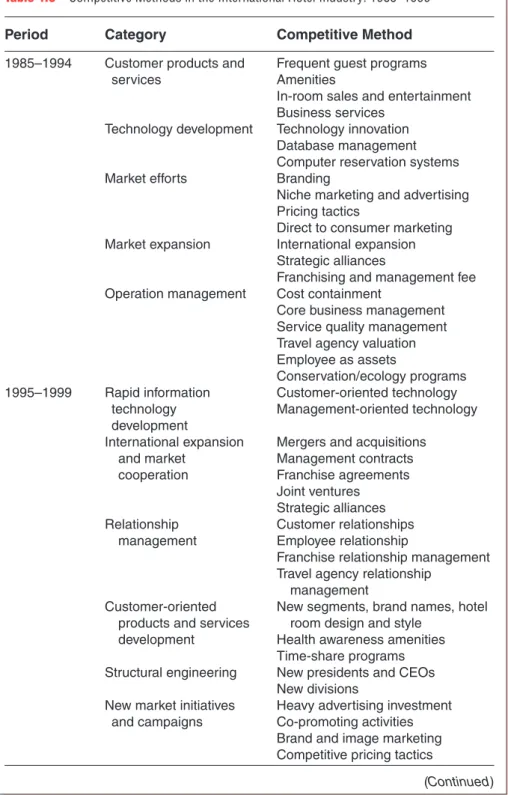
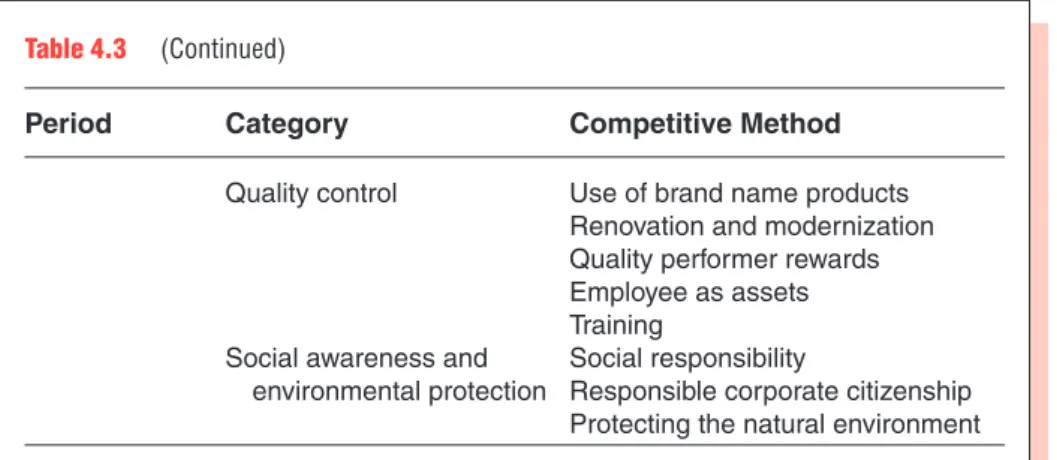
Olsen (1995a) and Olsen and Zhao (2000) researched the CMs used by international hotel firms during the 1985–1994 and 1995–1999 periods. Using content analysis techniques, information on 20 international hotel groups from 10 different countries were analysed and resulted in the identification of a number of CMs. These CMs are listed in Table 4.3 .
Other scholars have also tried to uncover key CSFs in the hospitality industry. Geller (1985) interviewed 74 executives of 27 hotel companies and asked them to identify the most important CSFs to the performance of their firm, to which stra- tegic goals they were related, and how they would track them.
The most frequently cited were employee attitude, guest sat- isfaction (service), superior product (physical plant), superior location, maximization of revenue, and cost control.
Another attempt to identify those CSFs can be found in the explanatory study of Brotherton and Shaw (1996) . Using mailed questionnaires, the authors initially attempted to identify cor- porate and unit level CSFs, yet they had to concentrate solely on unit level as they received only one response from corporate offices. In their study, they asked respondents to identify and rank CSFs, as well as to classify them according to functional areas.
Reporting on multiple studies performed on the U.S. lodg- ing industry, Dubé and Renaghan (1999) described the best
Table 4.3 Competitive Methods in the International Hotel Industry: 1985–1999
Period Category Competitive Method 1985–1994
Customer products and services
Frequent guest programs Amenities
In-room sales and entertainment Business services
Technology development
Technology innovation Database management Computer reservation systems Market efforts
Branding
Niche marketing and advertising Pricing tactics
Direct to consumer marketing Market expansion
International expansion Strategic alliances
Franchising and management fee Operation management
Cost containment
Core business management Service quality management Travel agency valuation Employee as assets
Conservation/ecology programs 1995–1999 Rapid information
technology development
Customer-oriented technology Management-oriented technology International expansion
and market cooperation
Mergers and acquisitions Management contracts Franchise agreements Joint ventures Strategic alliances Relationship
management
Customer relationships Employee relationship
Franchise relationship management Travel agency relationship
management Customer-oriented
products and services development
New segments, brand names, hotel room design and style
Health awareness amenities Time-share programs Structural engineering
New presidents and CEOs New divisions
New market initiatives and campaigns
Heavy advertising investment Co-promoting activities Brand and image marketing Competitive pricing tactics
(Continued)
Table 4.3 (Continued)
Period Category Competitive Method
Quality control
Use of brand name products Renovation and modernization Quality performer rewards Employee as assets Training
Social awareness and environmental protection
Social responsibility
Responsible corporate citizenship Protecting the natural environment
Sources: Adapted from Olsen (1995a) and Olsen and Zhao (2000) .
practices of “ 29 overall champions ” (p. 16). While not label- ling them CSFs, the authors established their ranking based on strategic actions commonly practiced in the industry. For instance, they classified Four Seasons as Deluxe-segment champion based on its leading performance in customer serv- ice that was attributed to investments in employees ’ training and selection. For Embassy Suites, the Upscale-segment cham- pion, the deciding factors were the physical attributes, ameni- ties and service, such as the size of the room, as well as quality service and breakfast quality.
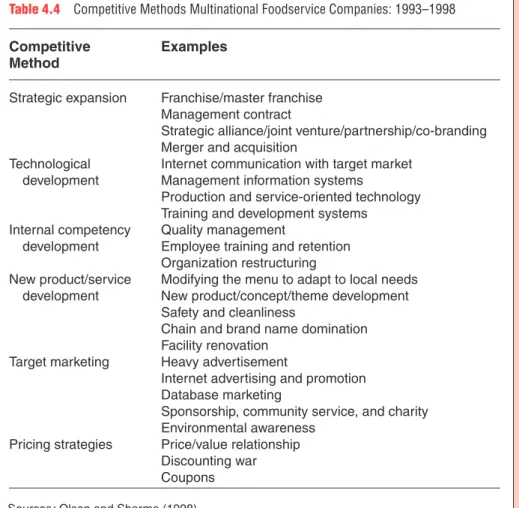
In the foodservice industry, Olsen and Sharma (1998) offered a review of the CMs used by multinational companies between 1993 and 1998. Using the content analysis research method, the author summarized the key CMs described in trade journals and magazine, company and consultant reports as well as aca- demic journals. Table 4.4 summarizes these CMs.
After more than two decades of applied research and theory development, it appears clear that CSFs are important to the enduring success of hospitality firms. What remains unclear, however, is what these CSFs really are. The next section pro- vides a synthesis of the definitions provided for the concept as well as illustrative examples.
Defining critical success factors for hospitality strategy
The business and academic literature offers several definitions of CSFs. While it appears that there are as many definitions as
articles or books published on the subject, several definitional attributes are commonly mentioned:
● CSFs are related to CMs and other strategic and tactical actions;
● CSFs are related to the cost structure of the industry (specifi- cally, to sunk costs);
● CSFs are tangible or intangible assets that are developed over time through investments rather than acquired.
Similarly, authors ’ perspectives on what CSFs actually do to firm performance varied. Yet again, several similarities can be observed:
● CSFs help managers concentrate on the few elements that are necessary to compete successfully in a given industry;
Table 4.4 Competitive Methods Multinational Foodservice Companies: 1993–1998 Competitive
Method
Examples
Strategic expansion
Franchise/master franchise Management contract
Strategic alliance/joint venture/partnership/co-branding Merger and acquisition
Technological development
Internet communication with target market Management information systems
Production and service-oriented technology Training and development systems
Internal competency development
Quality management
Employee training and retention Organization restructuring New product/service
development
Modifying the menu to adapt to local needs New product/concept/theme development Safety and cleanliness
Chain and brand name domination Facility renovation
Target marketing
Heavy advertisement
Internet advertising and promotion Database marketing
Sponsorship, community service, and charity Environmental awareness
Pricing strategies
Price/value relationship Discounting war Coupons
Sources: Olsen and Sharma (1998) .
● Sustained high performance on each CSFs is necessary for firms to sustain a positive performance;
● Failure to perform on CSFs is detrimental to the perform- ance of firms;
● The nature and evolution of CSFs in relation to the task environment influences the performance potential of the industry or strategic group participants.
What emerges from these similarities is that the CSFs con- cept is complex and multidimensional. While some CSFs are related to the ability of firms to optimize the use of some resources, others are actual resources directly part of the pro- duction or service process. This distinction is consistent with what Hansen, Perry, and Reese (2004) termed administrative and productive resources. Administrative resources refer to the ability of managers to make the right decisions as to the use of the resources they possess. This ability is related to the extent to which managers recognize the value-generating potential of their resources or of resources available to them through their development or acquisition. This idea is closely related to the notion of peripheral competences discussed by Olsen et al.
(1998) and to the concept of supporting activities in the value chain of Porter (1985) . Examples of peripheral competences and support activities include human resources, environmen- tal scanning, business development and financial systems, or procurement, and technology development activities, which facilitate the functioning of the core competencies of the firm and of its primary activities. For instance, firms with higher scanning capabilities are likely to make better investments in CMs as they can recognize opportunities and threats ahead of their competition. When companies fail to recognize impor- tant forces driving change, or fail to understand how these forces will influence their domain, their reactions tend to be delayed.
Such failure has been observed in the international hotel industry. While the industry recognized early that technology, and more specifically the Internet, represented a major envi- ronmental force, its participants fell short of understanding how that force would revolutionize the way hotel rooms were sold. The identification of technology as a major force was first documented by Olsen (1995b) . Motivated by industry recog- nized needs, and with the support of the IH & RA, the author initiated a series of visioning the future© workshops. These workshops were held across the globe, bringing together diverse groups of participants in order to obtain a broader view on issues facing the industry. The author used nominal
group techniques to monitor the sessions and to obtain con- sensus over the most central issues uncovered. The synthesis of the results of each workshop provided a global view of the forces driving change as reported by Olsen (1995b) .
On industry request, this early work was taken a step fur- ther with the objective to provide more specific insights on each of the forces. A team of researchers, under the umbrella of the IH & RA, conducted another series of workshops enti- tled Think Tanks . The outcomes of those Think Tanks helped recognize the causal nature of those forces and resulted in several executive summaries published by the IH & RA. The initial efforts of Olsen (1995b) permitted the identification of five original forces, to which two other were later added:
assets and capital, capacity control, new management, safety and security, technology, social responsibility, and sustainable development.
While the industry acknowledged the importance of tech- nology advancements, its participants apparently did not understand that Internet-based distribution would become a major channel and would challenge their ability to control prices and room availability. Despite the development of their own websites, hotel chains started by early 2000 to massively sell large amounts of rooms to third-party websites. Faced with low occupancy rates driven by a rapidly declining econ- omy (recession, Internet bubble, and 9/11), hoteliers perceived these third party websites as an opportunity to sell leftover inventory. By the end of 2002 and beginning of 2003, commen- taries similar to the followings could be found in almost every industry trade magazine or business journals:
At first, hotel executives like Homestead Chief Executive Gary DeLapp viewed discount sites as a way to get a few hard-core bargain hunters into otherwise empty beds. Today, those executives hold a dif- ferent view after watching the discount sites transform the way main- stream America buys travel. Instead of helping them, those sites have hurt the hotel firms ’ margins and made it difficult for the industry to rebound during tough economic times. Online discounters “are com- pletely disrupting the pricing integrity of hotels, ” said Henry Harteveldt, analyst at Forrester Research.
(The Atlanta Journal, September 2002)
Observers say the burgeoning corps of online bargain hunters has helped to keep room rates below 2000 levels, and industry profits down 28 percent from that peak year. And hotel companies, in many cases, made it easy for them to do so. In their early forays into cyber- space, many hotel companies handed over too much control of inven- tory and pricing to third-party online travel agencies, observers say.
And now they are in the unenviable position of trying to take back the reins after early shopping patterns have been established.
(Chicago Tribune, January 2003) “They found they were losing out on some of the direct consumer sales and allowing the Expedias and Hotel.coms to come in and take a direct role, ” she said. “The margins got bigger in terms of what they were making, and the rates were getting smaller. Once online pen- etration passed 10 percent, hotels realized, ‘This is a real important channel to us. ’ ” They also realized that they were losing control of their rates, Sileo said, which prompted hotel companies to launch new ini- tiatives luring customers to book directly with the hotel, either through its own Web site or over the phone.
(Fort Worth Star-Telegram, July 2003)
Now that ’03 is quickly coming to an end, let’s make a resolution for ’04 to do less whining about those big bad third-party suppliers that are ruining our average rates. As an industry, we chose to participate with them; we allocated rooms to them; and we gave them the low room rate ammunition to fire back at us. Let’s face it; they do a better job than we do. They are in the primary search results for most major and secondary hotel-city searches. That doesn’t happen by accident. Their sites are designed to lead people to make reservations, not to entertain users with fancy, but unnecessary flash animation. Few hotels make the extra effort and investment necessary to produce those results.
(Hotel-Online.com, December 2003) What lead the industry into such a weak position? Could it have been avoided?
While the causes of the loss of capacity control are cer- tainly many and complex, it is safe to argue that the indus- try’s capabilities in scanning and technology development have been weaknesses rather than strengths when compared to the capabilities of third party websites and other distribu- tion companies such as GDSs. These two types of capabilities are administrative CSFs, and clearly exhibit the characteristics discussed thus far. Indeed, when the performance on these CSFs is a relative weakness compared to the task environment, then the overall profit potential of the industry declines as the bargaining power shifts towards the upstream or downstream value chain participants.
When the unit of analysis is the firm, one can observe that some companies have been less negatively influenced by that loss of capacity control than others. For instance, Marriott International appears to have less suffered from the economic downturn and subsequent loss of capacity control than its peers. Over the 1998–2004 period, Marriott has consistently out- performed its direct rivals in both stock returns and operating
margins. Although this performance is certainly the result of a variety of ingredients, it is worth noticing that Marriott has been leading the industry in terms of technology, with the initial development of its Marriott Automated Reservation System for Hotel Accommodation (MARSHA) in the early 1980s, and with its $ 70 million investment in a centralized e-business system in 1998. As a consequence, the leading posi- tion of Marriott on the technology development CSF enabled the company to outperform its competitors and avoid the per- formance failures observed for other hotel chain companies.
This example illustrates the importance of administrative CSFs and how firms with superior capabilities in administra- tive CSFs are better able to develop, acquire, and use resources related to productive CSFs. As introduced earlier, productive CSFs are associated with primary activities and core compe- tences, and are directly related to the acquisition, and trans- formation of inputs into outputs. Examples of such productive CSFs include the operating system that organizes production and service activities, and marketing and sales systems. From a financial perspective, the use of most of these resources is translated into the statement of cash flows under operating, investing, and financing cash inflows and outflows. In every industry, a limited number of items in this statement have the most influence on the profitability of firms. For instance, in the fast-food segment of the restaurant industry, food and labour costs are critical to the ability of firms to generate oper- ating margin that are sufficient to pay for non-operating costs and generate a profit. Any failure to manage these costs effec- tively has a dramatic influence on the firm’s profit. In addition, as in most service-oriented industries, the aptitude of hotel and restaurant companies to constantly maximize the use of their perishable assets is of utmost importance. When one considers the drivers of most service firms ’ return on assets (ROA), the capability of continually generating a sufficient level of sales from the assets is paramount as most of the potential value from these assets is perishable and cannot be stocked in inven- tories. Consequently, the operation of these assets and the dis- tribution of their capacity are productive CSFs.
The significance of these productive CSFs has been exem- plified in the fast-food industry by the decline of McDonald’s corporation in the mid-1990s and early 2000s, followed by the widely reported turnaround strategy led by its late CEO Jim Cantalupo. While the decline of McDonald’s can be traced back to the early 1990s which witnessed a series of poor qual- ity ratings and law suits, it really fully came into view in January 2003 when the company posted its first loss ever of
$ 343.8 million for the last quarter of 2002. According to Matt Paull, McDonald’s CFO, “ The culture of the company was to pro- duce more restaurants. That wasn’t a healthy culture, given that the customers were shifting and we hadn’t focused on it. ” (Chicago Tribune, June 2004). This loss of focus was principally a lack of consideration of some productive CSFs such as production and service systems, which resulted in “ poor product and serv- ice quality ” (CNN Money, April 2004). While these two CSFs are well known in the foodservice industry (i.e., product and service quality), the failure of constantly monitoring the per- formance of the company on these two CSFs had immense consequences on the financial results of McDonald’s. This again highlights the importance of CSFs to the conduct of a firm’s strategy, and specifically, of performance evaluation of these CSFs. In the McDonald’s case, the company’s U.S. COO stated that “ McDonald’s had abandoned many of the measurement methods that had led to its success. The company hadn’t graded the performance of individual stores for 15 years. Store owners didn’t have to worry about mystery diners, either, company employees who secretly visited restaurants and judged their performance. ” (Chicago Tribune, June 2004).
The next section provides a framework of analysis for com- panies to incorporate CSFs into their strategic management practices and to develop performance metrics for monitoring their performance.
Critical success factors approach to strategy: a framework
As suggested earlier, the value chain ( Porter, 1985 ) and the concepts of core and peripheral competences ( Olsen et al. , 1998 ) provide some initial guidelines as to what firms need to consider when making strategic choices. Indeed, this chap- ter started by stressing the importance of aligning the firm’s resources and competences to the environmental forces driv- ing change. In order to do so, firms need only to develop innovative CMs which foster growth, but they also must con- tinuously ensure a minimum performance on those adminis- trative and productive CSFs that prevent them from failing.
Even though CSFs are not necessarily sources of competitive advantage in themselves, they can become sources of supe- rior performance when other firms in the industry fail to per- form on them as illustrated by the case of the hotel industry and third party websites. Often, these CSFs are well known to industry participants. Yet, a number of examples exist that demonstrate the lack of focus of firms on CSFs and their
subsequent poor performance. The following framework provides a systematic approach to the evaluation of CSFs in the context of strategic decision-making and performance review.
Identify value-preserving activities and assets
The initial step in the identification of CSFs is to develop a thorough understanding of the revenue and cost structure of the industry. At this stage, firms need to consider the drivers of both the demand and supply curves for the industry. The major issue at stake is about value-preservation. In other words, firms must identify the activities and assets that allow them to sustain a profit and maintain their margins. For the demand curve, the questions to answer are directed toward the com- prehension of what helps the industry prevents potential new competitors or substitute, or other external forces from eroding the demand (or shifting the curve to the left—the doted green
Figure 4.2
Value-preserving activities.
P
Q
Supply
Demand
P
Q
Supply
Demand P1
P2
Q2Q1
P1
P2
Q1Q2
Examples of activities and assets preventing a leftward shift of the demand curve:
• Marketing and sales (switching cost through branding)
• Production and service (differentiation through higher quality or lower cost)
• Purchasing (unique inputs)
• Distribution (differentiation through product and service availability)
• Environmental scanning system (differentiation through superior responsiveness)
Examples of activities and assets preventing a rightward shift of the supply curve:
• Marketing and sales (switching cost though loyalty)
• Production and service (low cost through economies of scale or superior efficiency)
• Purchasing (flexible inputs)
• Distribution (low cost through vertical integration or alliances)
• Environmental scanning system (low cost through risk management)
line in Figure 4.2 ). For the supply curve, attention should be paid to the threats that could potentially make the curve shift rightward (the doted red line in Figure 4.2 ). Examples of such threats include an increasing bargaining power from some suppliers following a wave of mergers and acquisition in this tangent industry. Figure 4.2 illustrates the idea of preserving the supply and demand curve balance and raising barriers to buffer the industry from environmental threats.
In many situations, because these activities and assets are well recognized, one can rely on the analysis of trade journals, analyst reports or companies ’ annual reports to identify them.
What is more difficult is to understand their relative impor- tance; developing this understanding can be facilitated by completing the framework of analysis presented in Table 4.5 .
This framework lists four steps—or questions—that can help clarifying the nature of the key value-preserving activities and assets. The first column asks for the identification of the key value-rich services, products, and processes. Value rich- ness, in this context, refers principally to the importance of the service, product, or process to the revenues and expenses of the firm. The example provided in Table 4.5 uses purchasing as an important value-rich process in the restaurant industry.
This process is deemed as important in terms of value poten- tial because it is directly related to some of the major expenses found on income statements of restaurant firms, such as food and beverage costs. This process typically includes activities such as the selection of suppliers and the negotiation of pur- chase contracts, which are to be listed in the second column.
In the third column, these activities or assets are detailed and their relationships with the supply and demand curves are explained. For instance, the negotiation of purchase contracts is directly related to the potential future price volatility of major food items such as beef or seafood. The sharp decline in stock price suffered by Darden Restaurants in the end of 2002 due to rising seafood prices is a good illustration of the value rich- ness of such activity. Not all activities of a process, and not all assets used in delivering a service or a product share the same degree of value-richness. In the example in Table 4.5 , storage and inventory-related decisions are not perceived as convey- ing as much value as other activities. While such activities can indeed help reduce part of the costs and volatility of impor- tant supplies, it is not considered as having as much influence on costs as other purchasing activities. The fourth column in the Table is designed to rate the relative importance of each activity. This rating will then be used in subsequent stages of
Handbook of hospitality strategic management
92 ●
Table 4.5 Identification of Value-Preserving Activities and Assets: Example of the Restaurant Industry
Identify and Briefly Describe the Key Value- Adding Services, Products and Processes Existing in Your Industry Segment
Using Key Words, List the Activities and Assets Significant to the Delivery of These Services and Products, or Part of These Processes
Briefly Describe How These Activities and Assets Influence the Supply and Demand Curves
Using a 3-Point Scale (High Value, Moderate Value, Low Value), Assess How Much Value is Linked with the Activities or Assets
Purchasing: efficient, safe, and cost-effective purchasing processes
a. Suppliers ’ selection a. A large number of suppliers offer more bargaining power as they will compete on price. Fewer suppliers may help develop a stronger relationship which could help shorten the lead time.
a. High value (cost)
b. Supply chain control
(including tracking and temperature control)
b. A strong control of the supply chain reduces potential defects and errors which lead to lower inventory levels and waste. The control of the temperature prevents waste and potential safety hazards.
b. High value (risk/cost)
c. Financing, contract
management
c. The management of contractual agreements and payment options reduces price volatility.
c. Moderate value (risk/cost)
d. Storage and inventory
management
d. Storage and inventory decisions affect the ability of dealing with changing prices.
d. Moderate value (risk/cost)
the analysis and permit the firm to prioritize its attention and focus more intensely on the most value-preserving CSFs.
Identify the administrative and productive CSFs (resources and competences) required to sustain a competitive performance in these activities and assets
The activities and assets identified in the previous stage are critical to the enduring success of firms and industries. The reason for performing well in these activities or maintaining the quality of these assets is to be found in the administrative and productive CSFs. For instance, if the relative age of the real-estate assets in a hotel or restaurant company is assumed to be a critical component of its sustained performance, man- agers need not only to acknowledge it, but they must also recognize the underlying causes to sustaining the quality of these assets at a competitive level. The ability to negotiate franchise agreements or management contracts that ensure the continued maintenance and preservation of the assets would then be an administrative CSF. Besides, the ability to operate the asset while preserving its original state would be a productive CSF.
As illustrated in the McDonald’s case, firms may lose their focus on these CSFs. McDonald’s strategy before the turnaround was to add value by growing its number of new restaurants at an exponential rate. Yet, the company witnessed its growth via expansion being offset by its decline in existing operations 1 as it failed to keep two crucial CSFs under control: the ability to control quality in its existing units (administrative CSF) and the ability to sustain quality in the delivery of its products and serv- ices (productive CSF). While it is always easier to discuss the past than to plan for the future, McDonald’s could have avoided these pitfalls by answering the following question:
● What are the administrative and productive CSFs that must be kept under control in order to sustain the current perform- ance on these critical value-preserving activities and assets?
The study and synthesis of the elements listed in Table 4.5 is a necessary step to answering this question. To achieve this synthesis, the concept mapping methodology is helpful as it permits to relate the activities of various processes as well as
1At some point, the decrease in McDonald’s existing units ’ sales accounted for more than 100% of its increase in revenue from new units.
diverse assets to identifiable abilities and competencies. Figure 4.3 provides an example of such concept map.
Identify the internal and external value drivers associated with these CSFs
Another chapter in this book discusses the notion of value drivers and their importance to strategy. Because these value drivers shed light on how and where value is created, they are necessary ingredients to the management of CSFs.
The necessity of measuring and assessing how one performs on each CSF calls for firms to identify these value drivers that are associated with them. As in the case of capacity control in the hotel industry, firms can keep track of how well they con- trol these critical activities and assets, and thus evaluate their performance on their CSFs. In this case, hotel chains could have tracked how much of their capacity they were control- ling by measuring the number of rooms sold through owned channels versus intermediaries. In the McDonald’s case, the lack of focus on service quality in its existing restaurants trans- lated into the absence of measurement of key internal value drivers such as customer complaints or restaurant cleanli- ness and appearance. Assessing and evaluating the perform- ance on CSFs requires firms to identify internal and external value drivers associated with their CSFs. Table 4.6 present a framework for listing and tracking these value drivers.
Figure 4.3
Identification of administrative and productive CSFs, example of the hotel industry.
Supply chain control
Financing/
contract management Suppliers’
selection
Procurement management Cost control/
reporting
Ability to control and manage supply cost, quality and timing
Product quality insurance