
Title of Thesis: Investigating Students' Emotional Intelligence in English Speaking of English Education Undergraduate Program in IAIN Parepare. Finally, I completed my research project report titled "Investigating Students' Emotional Intelligence in English Speaking of English Education Undergraduate Program in IAIN Parepare." Mahsyar as the Director of Postgraduate Program of IAIN Parepare and also Dr. as the chairman of English.
The English students of the bachelor's program in IAIN Parepare as my respondents who have taken the time. Investigation of Students' Emotional Intelligence in Speaking English of English Education Bachelor's Degree in IAIN Parepare. The informant of this study were ten students from the English Education Undergraduate Program in IAIN Parepare.
Penentuan Kecerdasan Emosional Mahasiswa Berbahasa Inggris Program Sarjana Bahasa Inggris IAIN Parepare. Informan penelitian ini adalah sepuluh mahasiswa program sarjana bahasa Inggris IAIN Parepare.
INTRODUCTION
- Questions of the Research
- Objectives of the Research
- Significances of the Research
- Focus of the Research
In other words, students should be aware that emotional intelligence becomes important and influential elements that give a great impact, especially on speaking ability. According to Reza Pishghadam, due to the nature of emotional intelligence (EQ), there seems to be a link between EQ and foreign language learning. 16 Indah Simamora, The Impact of Emotional Intelligence on Improving Speaking Skills of Students at SMp Kalam Kudus 1 Medan: A Psycholinguistic Analysis, 2018.P.2.
Accordingly, the researcher's interest in the study of speaking skills has increased after knowing that speaking skills are strongly influenced by emotional intelligence factors. In this research, the researcher is interested in investigating students' emotional intelligence in speaking English. The result of this research adds to readers' knowledge of emotional intelligence and speaking skills.
This research Provides new facts about the findings of similar studies, especially about the emotional intelligence of the students when speaking English. This study limited the content of the research to the discussion of students' emotional intelligence in speaking English.
REVIEW OF RELATED LITERATURE
Some Pertinent Ideas
To understand the concept of emotional intelligence, it is important to recognize what emotional intelligence is. In other words, emotional intelligence is the ability to aware and manage one's own emotions, as well as the emotions of others. Their pure theory of emotional intelligence integrates key ideas from the fields of intelligence and emotion.
It proposes that emotional intelligence consists of two domains: experiential (the ability to perceive, respond to, and manipulate emotional information without necessarily understanding it) and strategic (the ability to understand and manage emotions without necessarily perceiving emotions well or fully experiencing them them). Reuven Bar-On explained that emotional intelligence reflects our ability to deal with other people successfully and with our emotions. He developed the first measurement tool for emotional intelligence, which was used as the term "Emotional Quotient".
In 2001, Goleman said that emotional intelligence refers to the ability to recognize our own feelings and those of others, the ability to motivate ourselves and the ability to manage emotions well within ourselves in relationships with others. It means that understanding emotional intelligence is the ability to know what people are feeling, including the right way to deal with the problem. Emotional intelligence will provide benefits in the process and quality of decision making, communication and relationships.
The history of emotional intelligence leads to a consideration of the aspects involved in the abilities to monitor and control one's own behavior as well as to understand the behavior of other individuals.
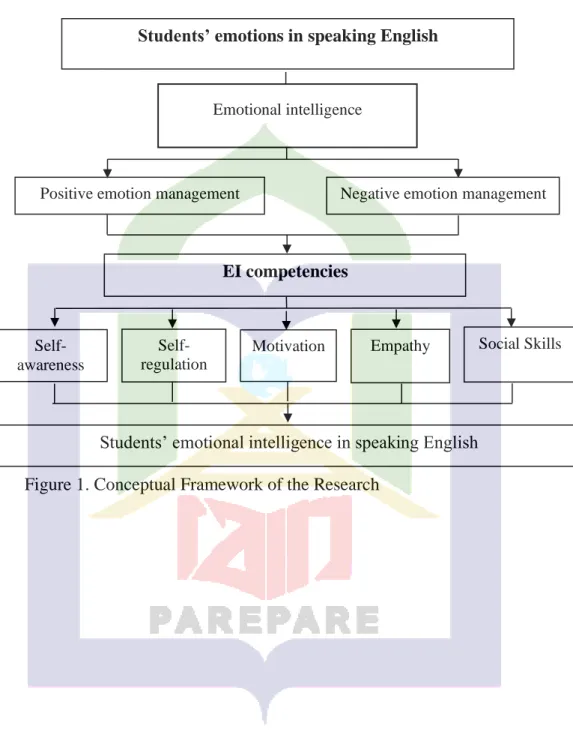
Conceptual Framework
Developing emotional intelligence in learning is really necessary so that learning takes place optimally and produces maximum learning results, especially when speaking.
METHODOLOGY OF THE RESEARCH
- Location and Duration of the Research
- Subject of the Research
- Instrument of the Research
- Technique of Data Analysis
- Data Validity
132 Daniel John, "The Effect of Smiling on Human Interactions: A Psychological Perspective", The International Journal of Indian Psychology p. Some students will not speak because they are too shy or have such a high level of anxiety before speaking.140 Regarding speaking in a foreign language, most students experienced a feeling of anxiety in the process of learning a foreign language. 139 Gaya Tridinanti, "Correlation between Speaking Anxiety, Self-Confidence and Speaking Achievement of Undergraduate EFL Students of a Private University in Palembang", International Journal of Education and Literacy Studies, p. 1.
It also supported one of the studies by Juhana in 2012 that there is especially the feeling of being afraid to make mistakes, lack of self-confidence and motivation, shyness and also anxiety that exists when the students have to speak in front of the class. 149 For example, the behavior of being shy, anxious and afraid of making mistakes is caused by opportunities that the students rarely get to speak as well as corrections given directly by the teacher when the students perform their speaking. 150 Another theory notes that it is important to highlight this. 161 Ramli Bakar, 'The Effect of Learning Motivation on Student'S Productive Competencies in Vocational High School, West Sumatra', International Journal of Asian Social Science p.723
Berntson, "The affect system has parallel and integrative processing components: Form follows function," Journal of Personality and Social Psychology. Fauzan, Umar, "Using Improvisation Technique to Improve EFL Students' Speaking Ability", Dinamika Ilmu. Mauss, 'Psychological Health Benefits of Accepting Negative Emotions and Thoughts: Laboratory, Diary, and Longitudinal Evidence', Journal of Personality and Social Psychology.
Ghani, Mohd Zuri, Wan Sharipahmira and Mohd Zain, “The Level of Emotional Intelligence among Special Education Teachers in Seberang Prai Tengah, Penang,” Global Journal of Interdisciplinary Social Sciences Goleman, R.J. Hirn, Sebastian Ludwig, Joachim Thomas, and Christof Zoelch, “The Role of Empathy in the Development of Social Competence: A Study of German School Leavers,” International Journal of Adolescence and Youth, 24.4. Kuppens, Peter, Anu Realo and Ed Diener, “The role of positive and negative emotions in judgments of life satisfaction across countries,” Journal of PersonalityandSocialPsychology.
Popa, Mirela dan Irina Iulia Salanta, 'Peran Emosi dalam Proses Motivasi', Tantangan Manajemen Masyarakat Kontemporer. Tevdovska, Elena Spirovska, 'Dampak kecerdasan emosional dalam konteks pembelajaran dan pengajaran bahasa', SEEU Review. 10, 11, 12, misalnya, “Apakah kamu mampu merasakan reaksi emosi atau perasaan orang lain terhadap kamu ketika kamu berbicara?”, “Bagaimana kamu menyikapi emosi negatif orang lain ketika kamu berbicara?”, dan sebagainya.
FINDINGS AND DISCUSSION
Discussion
So how do you respond to other people's negative emotions when you speak. How do you feel when you are able to establish good communication with other people. R: So how do you respond to other people's negative emotions when you speak.
R : Oh, so how do you feel when you are able to establish good communication with other people. R : Oh, so how do you maintain the positive emotions that arise while you speak. R : Oh ok, how do you respond to the negative feeling towards other people when you speak.
CONCLUSION AND SUGGESTION
Suggestions
R : Oh, and how do you feel when you are able to establish good communication with other people.

