ISLAMIC BANKING LOYALTY IN INDONESIA: THE ROLE BRAND IMAGE, PROMOTION, AND TRUST
Basrowi1*
Juhary Ali2 Tulus Suryanto3
Pertiwi Utami4
1Universitas Bina Bangsa, Indonesia
2Asia e University, Malaysia
3Universitas Islam Negeri Raden Intan Lampung, Indonesia
4Sekolah Tinggi Ekonomi dan Bisnis Islam Lampung, Indonesia
*Corresponding Email: [email protected]
ABSTRACT – This study aims to investigate the impact of brand image and promotion on customer loyalty in Islamic banking in Indonesia, with trust serving as a moderator variable. Specifically, the research aims to accomplish two objectives: (1) to examine the direct influence of brand image and promotion on trust and customer loyalty and (2) to investigate the indirect effect of brand image and promotion on customer loyalty through trust. The data were collected from 150 customers of Bank Syariah Indonesia, located in Jakarta Lenteng Agung Branch. To ensure the robustness of its findings, a rigorous quantitative analysis was conducted, utilizing structural equation modeling (SEM) and Smart PLS 3.3. The results indicate that each of the investigated variables holds statistical significance. In particular, it also reveals a partial direct relationship of brand image and promotion on trust. Moreover, the findings suggest that brand image and promotion have a significant influence on customer loyalty, either directly or indirectly through trust. Additionally, the study demonstrates a clear association between trust and customer loyalty. One of the original contributions of this study is the identification of trust's substantial mediating role in the relationship between brand image and promotion on customer loyalty at Bank Syariah Indonesia, Jakarta Lenteng Agung Branch.
Keywords: Brand Image, Promotion, Professional Service, Trust, Customer Loyalty
ABSTRAK – Loyalitas Nasabah pada Perbankan Syariah di Indonesia: Peran Citra Merek, Promosi, dan Kepercayaan. Tujuan pada penelitian ini adalah untuk menganalisis pengaruh citra merek dan promosi terhadap kepercayaan, dimana kepercayaan sebagai moderatornya. Secara khusus, kajian ini mengkaji: 1) pengaruh citra merek dan promosi terhadap kepercayaan dan kepuasan pelanggan, dan 2) pengaruh tidak langsung dari citra merek dan promosi terhadap loyalitas pelanggan yang dimoderasi oleh kepercayaan. Data primer diperoleh melalui survey kepada 150 sampel nasabah pada Bank Syariah Indonesia KCP Jakarta Lenteng Agung. Untuk melakukan analisis kuantitatif yang bagus, kajian ini menggunakan pendekatan structural equation modeling (SEM) dan Smart PLS 3.3. Temuan kajian menunjukkan bahwa masing-masing variabel yang diteliti secara statistik menghasilkan nilai yang signifikan. Secara parsial, ada hubungan langsung antara citra merek dan promosi terhadap kepercayaan. Faktor-faktor tersebut juga berpengaruh signifikan terhadap loyalitas pelanggan, baik secara langsung maupun tidak langsung melalui kepercayaan. Selain itu, penelitian ini juga menunjukkan adanya hubungan yang nyata antara kepercayaan dan loyalitas pelanggan. Penelitian ini berkontribusi dalam mengidentifikasi signifikansi fungsi mediasi dari variabel kepercayaan pada hubungan antara citra merek dan promosi terhadap loyalitas pelanggan Bank Syariah Indonesia KCP Jakarta Lenteng Agung.
Kata Kunci: Citra Merek, Promosi, Layanan Profesional, Kepercayaan, Loyalitas Pelanggan
INTRODUCTION
The Sharia banking industry in Indonesia has contributed greatly to the national economic growth (Kassim, 2016). As of 2021, total Sharia financial assets were recorded at IDR 593.95 trillion (Rosana & Setiawan, 2021). Bank Syariah Indonesia (BSI) is the seventh largest bank in Indonesia, with assets of IDR 239.56 trillion as of December 2020. Therefore, BSI is expected to contribute to the economic growth of society (Kurniasari, 2021; Porwati & Fasa, 2021;
Mailinda, Ibrahim, & Zainul, 2018). BSI was formed by the merger of three Islamic banks: PT. BRIsyariah Bank, PT. Bank Syariah Mandiri, and PT. Bank BNI Syariah. This consolidation into a single entity aims to improve business prospects and accelerate the development of the Sharia banking industry (Syahputra et al., 2021; Fatinah & Iqbal Fasa, 2021; Febrianti et al., 2021;
Muarif, Ibrahim, & Amri, 2021). According to the literature, the BSI merger improved the efficient allocation of funds, operations, and budgets (Alhusain, 2021; Aulia, Ibrahim, & Tarigan, 2020). Therefore, the merger allows the Islamic banking industry stronger and better than it was prior to its implementation. Despite the fact that mergers have a positive effect on business prospects, they must also be able to reach customers (Dimitha, Ibrahim, &
Ahmadsyah, 2021). Obviously, innovations, services, and products must be continuously enhanced to generate customer loyalty. This is due to the fact that BSI, as a competitor, will continue to compete with other financial institutions.
Brand image plays a significant role in brand development because it represents the emotional brand of a particular company or product and has a significant impact on consumer purchasing behavior. Religious branding is the extent to which individuals equate the meaning of a brand with that of their religion.
Consequently, brand religiosity is of great value to a product. In addition, the brand offers emotional and rational values, thus the religious brand becomes the brand's primary position in the eyes of its customers (Wahyuni & Fitriani, 2017).
The main success of banking services does not depend on the number of funds collected and loans disbursed, but rather on the trust and image of the bank (Sumadi & Soliha, 2015). These two factors are crucial to the success of the banking industry in providing customer satisfaction and loyalty. Apart from these two factors, bank image can have an impact on customer loyalty.
Customer satisfaction is influenced by the bank's image and good service synergy, which results in loyalty (repeat transactions). Customer loyalty is
defined as a customer's positive attitude toward a company or brand, which results in repeat purchase behavior and lower customer sensitivity to competitors' prices and offerings (Moretta Tartaglione et al., 2019; Ibrahim &
Kamri, 2017). The ultimate objective of the bank is to enhance service quality by establishing a brand and corporate image that fosters customer loyalty.
While efforts are made to enhance service quality, build brand image, and strengthen customer loyalty, management will follow up with loyal customers (Riyadi, 2019).
The enhancement of trust in the banking sector necessitates heightened attention to the factors that determine banking success. The efficacy with which a bank manages its operations and safeguards the confidential information of its clientele is widely believed to be the foundation of customer trust, which in turn, enhances overall customer satisfaction. A higher degree of customer satisfaction engenders greater levels of trust and serves as a potent driver of customer loyalty. It follows that banks must endeavor to amplify the quality of their products and services to bolster their standing in the market, retain existing clients, and attract new ones (Gillani & Cloud, 2014). In light of this, corporations seek to foster strong, effective bonds between their customers and their brands.
The emergence of customer relationship variables represents a sustained attempt to cultivate customer loyalty, which has far-reaching implications for the interplay of service quality, brand image, and bank image. This dynamic is not limited to customer loyalty but extends to the nature of relationships that banks establish with their clients. Against this backdrop, it is pertinent to ask:
how can customer relations be leveraged as a marketing strategy for Islamic banking to secure customer loyalty? The influence of economic and reputational factors of banks on the perceptions, preferences, and attitudes of the public towards Islamic banking is a critical consideration. Through a review of existing research, we posit the following research question: how do brand image and promotion impact the loyalty of customers in Islamic banks?
Previous studies have investigated the determinants of customer loyalty in companies, with several scholars emphasizing the pivotal role of a good brand image (Cassia et al., 2017; Chinomona, 2016; Hsieh & Li, 2008; Jin et al., 2012, 2012; Kittur & Chatterjee, 2021; Ogba & Tan, 2009). However, Hsieh & Li (2008) found that brand image had no significant effect on customer loyalty.
Promotion is another variable that has been shown to exert a substantial impact
on customer loyalty in companies (Choi & Kim, 2020; Empen et al., 2015;
Huang et al., 2014; Kendrick, 1998; Kumar Roy et al., 2014; Langga et al., 2021; McMullan & Gilmore, 2008). However, Chen et al. (2009) reported that promotion had no positive effect on customer loyalty. Given the importance of brand image and promotion, it is imperative for companies, especially those in the banking industry, to carefully consider these variables as part of their strategies to enhance customer loyalty.
The current study seeks to shed light on the relationship between brand image and promotion on customer loyalty in Islamic banking, while taking trust as a mediating variable, which has not been fully explored in prior research. The study aims to support the goal of BSI to become the largest Islamic bank in Indonesia, to serve as a market benchmark, and to compete globally. By focusing on these factors, we anticipate that customers will develop stronger loyalty towards BSI, which will, in turn, contribute to the nation's economic development.
LITERATURE REVIEW
The Relationship between Brand Image and Trust
Trust is a fundamental concept that plays a vital role in explaining consumer behavior, including brand loyalty, purchasing decisions, and word of mouth (Komunda & Osarenkhoe, 2012). Trust is a logical construct that is primarily based on previous experiences in building a relationship between a consumer and a brand (Thorbjørnsen & Supphellen, 2011). Trust is a critical determinant of customer commitment and loyalty, and brands that manage to cultivate high levels of trust are more likely to generate higher purchasing power and sales, as well as retain their customers over time.
The current study aims to investigate the relationship between trust and customer loyalty, and how trust acts as an intermediary variable in understanding the link between brand image and customer loyalty (Rios &
Riquelme, 2008). According to Tan et al., (2011), brand image has a positive impact on brand trust, suggesting that trust is a core component of relationship variables that can aid in predicting and assessing market behavior. Higher levels of brand trust can, in turn, enhance brand loyalty, resulting in increased customer retention and repeat purchases.
Trust is characterized as a behavioral intention that is reflected in a consumer's trust in their partners and the absence of doubts or weaknesses regarding a brand (Komunda & Osarenkhoe, 2012). Trust is identified as a crucial determinant of consumer behavior that drives loyalty, and it serves as an antecedent to loyalty (Thorbjørnsen & Supphellen, 2011). Thus, trust plays a crucial role in building customer loyalty, and there is a direct positive relationship between trust and loyalty. In sum, trust is a multifaceted construct that encompasses certainty, emotion, and reliability in the context of a brand- consumer relationship, and it is a key driver of customer loyalty.
Several studies have examined the impact of brand image on consumer trust, including Chinomona (2016), Erkmen and Hancer (2019), Ngoc Phan and Ghantous (2013), Rao et al. (2021), and Syed Alwi et al. (2016, 2016). These studies have consistently demonstrated that brand image has a significant positive effect on consumer trust. Specifically, a strong and positive brand image can engender high levels of trust among consumers, ultimately leading to increased customer loyalty and repeat purchases. Based on the aforementioned literature review, the present study posits the following hypothesis:
H1: There is a positive and significant relationship between brand image and customer trust.
The Relationship between Promotion and Trust
Trust is widely recognized as a cornerstone of successful business relationships.
Establishing and maintaining trust with customers is a critical factor in cultivating customer loyalty, and this trust must be earned through deliberate efforts to engender trust over time. As noted by Prasaranphanich (2007), customer trust plays a central role in driving repeat purchases and fostering customer willingness to share sensitive personal information with companies.
Jasfar (2009) has described customer trust as a critical element in facilitating effective collaboration and resource utilization across stakeholders, with trust serving as a crucial "glue" that binds companies together in pursuit of shared goals. In essence, customer trust represents an expectation that the other party will act in accordance with expectations, even in the absence of prior acquaintance or direct knowledge of one another.
In order to bolster customer trust and enhance the perceived value of goods and services, firms often employ various promotional strategies. As noted by Swastha and Irawan (2008), the promotion mix encompasses a strategic combination of advertising, personal selling, and other promotional tools, all designed to achieve the objectives of the sales program. Such efforts can serve to increase customer confidence in the quality and reliability of goods and services, thereby bolstering trust and promoting positive customer outcomes.
Drawing on the research findings of Lwin et al. (2016) in their study titled "The Privacy DYAD Antacendents of promotion and prevention-focused online privacy behaviors and the mediating role of trust and privacy concern," it can be posited that trust is influenced by two key factors: a company's reputation and the quality of its communication. Specifically, the study highlights the importance of promotional efforts in shaping the quality of communication and, in turn, influencing customer trust.
Similarly, numerous prior investigations have identified promotions as a key driver of customer trust, including research by Al-Khalaf and Choe (2020), Bansal et al. (2014), Gokmenoglu and Amir (2021), Guenzi (2002), Suh and Han (2003), Sun and Lin (2010), and Swan and Nolan (1985). These findings suggest that effective promotional activities can play a critical role in fostering customer trust and enhancing customer outcomes. Based on this evidence, we propose the following hypothesis:
H2: There is a significant and positive relationship between promotional activities (x2) and customer trust (y).
The Relationship between Brand Image and Customer Loyalty
Brand image is an important factor that influences consumer behavior, as it is the initial impression that consumers have of a brand prior to making a purchase. After purchase, the quality of the product or service determines whether a positive or negative brand image is formed. Kotler and Armstrong (2008) define brand image as the consumer's perception and preference of a brand based on various associations in their memory. A brand is not only a name on a product but also a representation of its characteristics and appeal.
According to Rangkuti (2003), consumers tend to choose a brand name first when making purchasing decisions, followed by price and other product attributes. This is because the brand image formed in consumers' minds can
lead to consistency in their purchasing behavior. The relationship between brand image and consumer loyalty is influenced by consumer preferences and attitudes towards a brand. Consumer attitudes towards a particular brand often play a significant role in determining whether they will remain loyal to the brand.
Good perception and consumer confidence in a particular brand will create consumer buying interest and even increase consumer loyalty to certain products. The theory of the link between brand image and consumer loyalty is quoted from Rangkuti (2003) which says: "If consumers think that a certain brand is physically different from competing brands, the brand image will be attached continuously so that it can form loyalty to a particular brand which is called brand loyalty".
The findings of research conducted by (Cassia et al., 2017; Chinomona, 2016;
Hsieh & Li, 2008; Jin et al., 2012, 2012; Kittur & Chatterjee, 2021; Ogba &
Tan, 2009) explained that brand image can significantly affect customer loyalty. It is certainly very clear that a good brand image for a company can produce good loyalty for customers. From this explanation, the researcher gives a hypothesis for this study as follows:
Perception and consumer confidence play a crucial role in shaping consumer behavior towards a brand. The association between brand image and consumer loyalty has been extensively discussed in the literature. Rangkuti (2003) posits that consumers tend to develop loyalty towards brands that are perceived to be distinct from their competitors. This loyalty, known as brand loyalty, is an outcome of the continuous attachment of the brand image to the consumer's consciousness.
The literature review highlights the significance of brand image in shaping customer loyalty. Several studies, including Cassia et al. (2017), Chinomona (2016), Hsieh and Li (2008), Jin et al. (2012, 2012), Kittur and Chatterjee (2021), and Ogba and Tan (2009), have reported that brand image has a significant impact on customer loyalty. Therefore, it is evident that a positive brand image can lead to increased customer loyalty towards a company's products or services. Based on the literature review, the following hypothesis is proposed:
H3: There is a positive and significant relationship between brand image (x1) and loyalty (z).
Promotion of Relationship to Customer Loyalty
Promotion is a form of direct persuasion through the use of various incentives that can be arranged to stimulate product purchases immediately and or increase the amount purchased by customers and make consumers satisfied so that they make repeat purchases (Iwan & Saputra, 2020). According to Lupiyoadi (2013), promotion is an activity carried out by companies to communicate the benefits of products and as a tool to influence consumers in purchasing activities or using services according to their needs. It can be concluded that promotion is an activity to communicate the advantages of products or services owned by the company to attract attention, create purchase decisions and provide satisfaction so that consumers will make repeat purchases. Promotion is the attraction of consumers to buy products produced by the company.
Promotion is one of the variables in the marketing mix that is very important for companies to market their products and services. If the company can incur large costs used to promote products and services which can be in the form of giving gifts, coupons, distributing brochures, and discounted prices, customers will be attracted to the products and services that have been offered by the company so that customers will grow an attitude of loyalty to the company.
The findings of research conducted by several scholars (Choi & Kim, 2020;
Empen et al., 2015; Huang et al., 2014; Kendrick, 1998; Kumar Roy et al., 2014; Langga et al., 2021; McMullan & Gilmore, 2008) explained that promotion can significantly affect customer loyalty. It is of course very clear that a good promotion for a company can produce good loyalty for customers in the company. From this explanation, the researcher gives a hypothesis for this study as follows:
The present study posits that promotion can have a substantial impact on customer loyalty, which is supported by the research conducted by Choi & Kim (2020), Empen et al. (2015), Huang et al. (2014), Kendrick (1998), Kumar Roy et al. (2014), Langga et al. (2021), and McMullan & Gilmore (2008). These scholars have provided evidence that effective promotional strategies can foster positive attitudes and behavior in customers towards a company, ultimately leading to increased customer loyalty. Based on the literature review, the following hypothesis is proposed:
H4: There is a significant and positive influence between promotions on customer loyalty
Relationship of Trust to Customer Loyalty
The cultivation of cooperative relationships with customers has been widely recognized as a competitive strategy for businesses. By establishing long-term relationships with customers, businesses can effectively reduce transaction costs and increase their competitiveness in the market. However, the establishment of such relationships hinges on the trust that customers have in the business. Trust can be defined as the willingness or belief in the ability of a partner to produce positive outcomes in long-term relationships.
Harumi (2016) argues that human beings are inherently limited and imperfect, and thus, mutual dependence on others is a necessary component of everyday life. This holds true in the business world, where cooperative relationships based on trust are necessary to solve problems and achieve mutually beneficial outcomes. Without customer trust, transactional activities cannot occur, and therefore, building trust becomes a critical aspect of business operations, particularly in industries such as banking. To instill trust in customers, businesses must provide not only convincing words but also quality services that demonstrate a commitment to meeting customer needs and expectations, thereby fostering customer loyalty.
The role of promotion in enhancing customer loyalty has been examined by numerous scholars, including Alam et al. (2021), Glaveli (2021), Iglesias et al.
(2020), Marakanon & Panjakajornsak (2017), Martínez & Rodríguez del Bosque (2013), Mornay et al. (2013), and Wah Yap et al. (2012). These researchers have found that effective promotional strategies can significantly influence customer loyalty, as a good promotion can enhance customer perception and attitude towards a company, leading to increased loyalty.
Building on this body of research, the present study hypothesizes as follow:
H5: There is a significant and positive influence between trust and customer loyalty
H8: There is a significant and positive between the brand image on customer loyalty through trust as an intervening variable
H9: There is a significant and positive influence between promotions on customer loyalty through trust as an intervening variable
METHODOLOGY
This study adopts a quantitative research design, specifically utilizing a structural equation modeling (SEM) approach. This approach is ideal for analyzing complex relationships between multiple variables, providing a powerful tool for examining the underlying mechanisms of customer loyalty in the context of Bank Syariah Indonesia (BSI) Jakarta Lenteng Agung Branch.
The population for this study comprises all customers of BSI in that branch, totaling 507 individuals. The sample was chosen through random sampling, which helps to minimize sampling bias and increase the generalizability of the findings. The sample size was determined using the following formula:
n = (Z^2 * P * (1-P)) / (E^2)
n = (1.96^2 * 0.5 * (1-0.5)) / (0.10^2) n = 96.04
where:
n = required sample size
Z = z-score for the desired confidence level (1.96 for a 95% confidence level) P = estimated population proportion (we can assume a 50% proportion to get the maximum sample size)
E = desired margin of error (0.10)
Based on the calculation, the minimum amount of sample for this study is 96.04. However, this study managed to receive 150 valid responses from the BSI customers. Data collection was carried out through the distribution of a questionnaire, which was developed based on dimensions and indicators previously identified by experts.
To ensure the validity and reliability of the data, various statistical measures were used in this study. Specifically, the cross-loading values were analyzed to determine the correlation between each construct and its indicators, as well as indicators from other block constructs. Discriminant validity was assessed by ensuring that the correlation between each construct and its indicators was higher than that with indicators from other block constructs. Data analysis was performed using SmartPLS 3.3, which is a widely used software program for Structural Equation Modeling (SEM) analysis.
Table 1. Discriminant Validity Cross Loading
X1 X2 Y Z
CT1 0.518 0.635 0.756 0.860
CT2 0.550 0.626 0.810 0.776
CT3 0.454 0.549 0.647 0.770
CT4 0.544 0.603 0.687 0.792
CT5 0.462 0.604 0.737 0.817
CT6 0.432 0.560 0.683 0.782
CT7 0.392 0.531 0.659 0.760
P1 0.467 0.884 0.643 0.645
P2 0.419 0.733 0.549 0.559
P3 0.534 0.968 0.715 0.700
P4 0.479 0.872 0.698 0.652
P5 0.543 0.879 0.628 0.649
P6 0.559 0.824 0.681 0.660
P7 0.505 0.874 0.642 0.648
P8 0.504 0.785 0.625 0.587
P9 0.360 0.710 0.500 0.483
P10 0.445 0.775 0.558 0.567
CM1 0.822 0.507 0.550 0.546
CM2 0.814 0.447 0.422 0.418
CM3 0.814 0.486 0.542 0.552
CM4 0.747 0.319 0.375 0.368
CM5 0.786 0.449 0.477 0.446
CM6 0.740 0.484 0.462 0.473
CM7 0.807 0.494 0.493 0.465
CM8 0.749 0.428 0.491 0.492
LP1 0.442 0.559 0.798 0.746
LP2 0.538 0.603 0.790 0.731
LP3 0.450 0.543 0.751 0.660
LP4 0.546 0.638 0.793 0.703
LP5 0.425 0.572 0.741 0.642
LP6 0.433 0.571 0.760 0.682
The results of the cross-loading analysis in Table 1 indicated that the correlation value of each construct with its indicators was greater than the correlation value with other constructs. Therefore, all constructs or latent variables exhibited good discriminant validity, with the indicators in the construct indicator block showing better performance than indicators in other blocks.
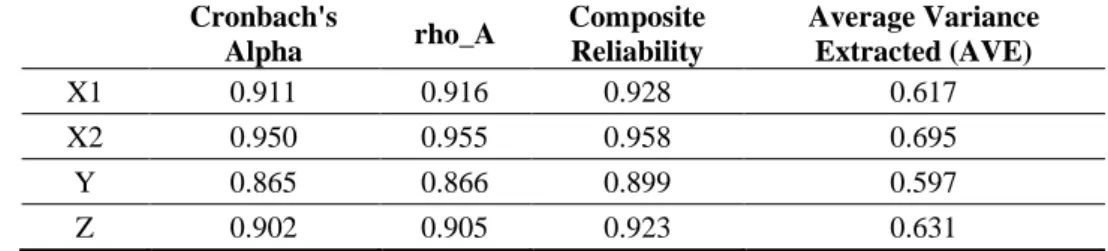
Furthermore, to assess the reliability of the data, composite reliability and Cronbach's alpha were calculated. As presented in Table 2, all composite reliability values for each construct exceeded 0.7, indicating that all constructs are reliable. This was further confirmed by the Cronbach's alpha values, which also exceeded 0.7 for all constructs.
Table 2. Composite Reliability
Cronbach's
Alpha rho_A Composite Reliability
Average Variance Extracted (AVE)
X1 0.911 0.916 0.928 0.617
X2 0.950 0.955 0.958 0.695
Y 0.865 0.866 0.899 0.597
Z 0.902 0.905 0.923 0.631
RESULTS AND DISCUSSION Results
The results of the model significance test can be seen in the following diagram.
Diagram 1. Results of Model Significance Test
Hypothesis Testing
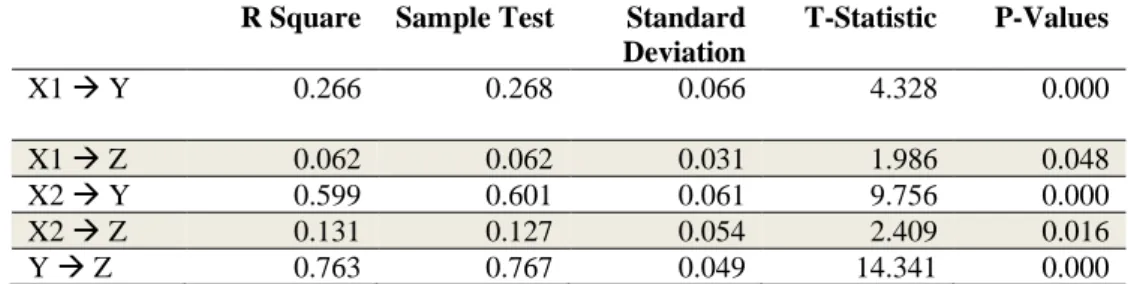
The results of the hypothesis testing are presented in Table 3. The first hypothesis tested whether there is a direct influence of brand image on trust in Bank Syariah Indonesia KCP Jakarta Lenteng Agung. The results of the hypothesis testing revealed that the coefficient of determination (R2) is 0.266 with a t-statistic of 4.328, which is greater than the critical value of 1.96, and a p-value of 0.000, which is less than the significance level of 0.05. Therefore, the null hypothesis (H01) was rejected, and the alternative hypothesis (Ha1) was accepted. The findings indicate that there is a significant direct influence of brand image on trust in Bank Syariah Indonesia KCP Jakarta Lenteng Agung.
Table 3. Hypothesis Test Results
R Square Sample Test Standard Deviation
T-Statistic P-Values
X1 → Y 0.266 0.268 0.066 4.328 0.000
X1 → Z 0.062 0.062 0.031 1.986 0.048
X2 → Y 0.599 0.601 0.061 9.756 0.000
X2 → Z 0.131 0.127 0.054 2.409 0.016
Y → Z 0.763 0.767 0.049 14.341 0.000
The second hypothesis tests whether there is a direct effect between the promotion of Trust at Bank Syariah Indonesia KCP Jakarta Lenteng Agung.
The coefficient R2 is 0.599, with a t-statistic of 9.756 > 1.96 and a p-value of 0.000 <0.05, indicating that H02 is rejected and Ha2 is accepted. Therefore, there is a significant direct effect between promotion and trust at Bank Syariah Indonesia KCP Jakarta Lenteng Agung.
The third hypothesis examines whether there is a direct influence between promotions and customer loyalty at Bank Syariah Indonesia KCP Jakarta Lenteng Agung. The coefficient R2 is 0.062, with a t-statistic of 1.986 > 1.96 and a p-value of 0.000 < 0.048, indicating that H03 is rejected and Ha3 is accepted. Thus, there is a significant direct effect between promotions and customer loyalty at Bank Syariah Indonesia KCP Jakarta Lenteng Agung.
Similarly, the fourth hypothesis examines whether there is a direct influence between promotions and customer loyalty at Bank Syariah Indonesia KCP Jakarta Lenteng Agung. The coefficient R2 is 0.131, with a t-statistic of 2.409
> 1.96 and a p-value of 0.000 <0.05. Therefore, H04 is rejected and Ha4 is accepted, implying that there is a significant direct effect between promotion and customer loyalty at Bank Syariah Indonesia KCP Jakarta Lenteng Agung.
Further, the fifth hypothesis examines whether there is a direct effect of promotion on trust at Bank Syariah Indonesia KCP Jakarta Lenteng Agung. The coefficient R2 is 0.763, with a t-statistic of 14.341 > 1.96 and a p-value of 0.000
<0.05, indicating that H05 is rejected and Ha5 is accepted. Hence, there is a significant direct effect between the promotion of trust at Bank Syariah Indonesia KCP Jakarta Lenteng Agung.
Table 4. Results of Hypothesis Tests 6 and 7
R Square Sample Test Standard Deviation
T-Statistic P-Values X1 → Y
X1 → Z 0.203 0.206 0.053 3.810 0.000
X2 → Y
X2 → Z 0.457 0.460 0.051 9.035 0.000
Y → Z
To determine if there is an indirect effect of brand image and promotions on customer loyalty through trust, two hypotheses were tested. The sixth hypothesis showed that there is a significant indirect effect between brand image and customer loyalty through trust. The coefficient R2 of 0.203, along with a t-statistic of 3.810 and a p-value of 0.003, indicates that H06 is rejected, and Ha6 is accepted. These findings suggest that trust plays an essential role in mediating the relationship between brand image and customer loyalty.
Similarly, the seventh hypothesis testing revealed that there is a significant indirect effect between promotions and customer loyalty through trust. The coefficient R2 of 0.457, along with a t-statistic of 9.035 and a p-value of 0.002, indicates that H07 is rejected, and Ha7 is accepted. These results suggest that promotions also play a crucial role in mediating the relationship between customer loyalty and trust at Bank Syariah Indonesia KCP Jakarta Lenteng Agung.
Discussions
The Influence of Brand Image on Trust
The results of the data analysis demonstrate that the first hypothesis, which posits a positive and significant relationship between brand image and trust, is supported at BSI KCP Jakarta Lenteng Agung. Specifically, the findings indicate that a higher level of brand image leads to a correspondingly higher level of customer trust. This underscores the crucial role of brand image in maximizing customer trust, and highlights its significance as a key driver of the company's growth.
Trust is a fundamental concept that explains brand loyalty, buying behavior, and word of mouth recommendations (Komunda & Osarenkhoe, 2012). It is a logical construct that is built over time through experience in the context of relationships (Thorbjørnsen & Supphellen, 2011). Trust engenders commitment and loyalty, and brands that enjoy high levels of trust are able to generate stronger purchasing power, sales, and customer retention rates.
Notably, trust is a key determinant of customer loyalty, and therefore, understanding the relationship between trust and brand image is critical for marketers seeking to enhance customer loyalty (Rios & Riquelme, 2008).
Tan et al. (2011) have revealed that brand image has a positive effect on brand trust. The introduction of trust as a core construct within the relationship variables can enable a better understanding of consumer behavior and provide a basis for predicting and assessing market outcomes. This highlights the direct impact of brand image on brand trust, with higher levels of trust serving to further reinforce brand loyalty. Trust is anchored on a foundation of certainty, emotional resonance, and reliability, with brand expertise serving as an essential determinant of partner exchange rate.
Trust is a crucial component of consumer behavior that leads to loyalty. It is an intentional disposition that reflects a belief in the dependability and reliability of a partner, and is characterized by a lack of doubt or suspicion toward the partner. The significance of trust in building customer loyalty has been well- established in the literature, with empirical evidence highlighting a direct relationship between trust and loyalty. It has been demonstrated that trust serves as an antecedent to loyalty and is an important factor in establishing customer loyalty. This finding is supported by the works of Rao et al. (2021) and Syed
Alwi et al. (2016, 2016), who emphasize the critical role of brand image in shaping customer trust in a company's performance.
Given the importance of building optimal customer trust, particularly at BSI KCP Jakarta Lenteng Agung, it is essential to prioritize the role of brand image in this process. Brand image is recognized as a crucial determinant of customer trust in a company, as the image or brand of the company is often closely associated with the quality and reliability of its products or services. Therefore, enhancing brand image is seen as a crucial strategy for building and maintaining customer trust in the company.
Effect of Promotion on Trust
The results of the data analysis indicate that the second hypothesis, which posits a significant positive effect of promotion on trust, is supported. The findings reveal that an increase in the level of promotion within a company is associated with a corresponding increase in customer trust. In other words, the role of promotion in enhancing customer trust is a crucial aspect of a company's growth and development.
This research corroborates the findings of previous studies such as those conducted by Gokmenoglu and Amir (2021), Guenzi (2002), Suh and Han (2003), Sun and Lin (2010), and Swan and Nolan (1985) which also establish the significant impact of promotions on customer trust. Specifically, the results of this study suggest that the effectiveness of promotions is contingent upon the ethical and procedural norms of the company. Therefore, companies must strive to ensure that their promotional activities align with established ethical standards in order to foster trust and enhance customer loyalty.
The Influence of Brand Image on Customer Loyalty
The results of the data analysis demonstrate that the third hypothesis has a significant positive effect of brand image on customer loyalty at BSI KCP Jakarta Lenteng Agung. These findings suggest that a higher level of brand image positively influences customer loyalty and their willingness to support the company's growth. Therefore, the crucial role of brand image in enhancing customer loyalty at BSI KCP Jakarta Lenteng Agung must be considered a significant priority for the company's progress.
Brand image is a crucial factor in shaping a consumer's perception of a product or service. After experiencing a product or service, a new consumer will gain insight into its quality and performance, which determines their overall opinion of the brand. Thus, the level of brand image is directly dependent on the service provider's ability to consistently meet customer expectations. According to Kotler & Armstrong (2008), brand image reflects a consumer's perception and preference for a brand, which is shaped by the various associations stored in their memory.
A brand represents more than just a name on a product. It encompasses a set of unique characteristics and appeal that differentiates the product from its competitors. As Rangkuti (2003) posits, when consumers are confronted with various attributes of a product such as brand names, prices, and others, they tend to prioritize the brand name first before considering the price. This preference is due to the brand image that has formed in the consumer's mind, leading to a consistent buying behavior. The connection between brand image and customer loyalty is based on the consumers' attitudes and preferences for a particular brand. Positive perceptions and trust in a brand can create buying interest and increase consumer loyalty towards the brand. Rangkuti (2003) contends that if consumers perceive a brand to be physically different from its competitors, a continuous attachment to the brand image will result, leading to brand loyalty.
The findings of this study align with previous research by Cassia et al. (2017), Chinomona (2016), Jin et al. (2012, 2012), Kittur & Chatterjee (2021), and Ogba & Tan (2009), which have demonstrated that brand image significantly impacts customer loyalty. The critical role of brand image in enhancing customer loyalty in sharia-based banking companies in Jakarta is evident in the study's results. Therefore, it is imperative that sharia-based banking companies focus on developing and maintaining a positive brand image to promote customer loyalty and support their overall progress.
The Effect of Promotion on Customer Loyalty
The data analysis revealed that the fourth hypothesis supports the notion that promotion exerts a significant positive effect on customer loyalty at BSI KCP Jakarta Lenteng Agung. Hence, companies with better levels of promotion tend to enjoy a higher level of customer loyalty, thereby leading to better business performance. This highlights the crucial role of promotion in enhancing
customer loyalty, which, in turn, is pivotal for the growth and success of any business organization.
Promotion represents a direct form of persuasion, characterized by various incentives and stimuli designed to drive immediate product purchases or to increase the volume of goods purchased by customers. According to Iwan and Saputra (2020), promotion is a tool that helps satisfy customers and encourages repeat purchases, while Lupiyoadi (2013) describes promotion as a communication tool utilized by businesses to convey the benefits of their products and services to customers and influence their purchase decisions.
In essence, promotion is an indispensable component of the marketing mix that can drive customer attention, purchasing decisions, and repeat purchases.
Companies that invest substantially in promotion, such as through the provision of gifts, coupons, brochures, and discounted prices, can attract customers and foster customer loyalty, leading to improved business performance.
This research corroborates previous studies conducted by Choi and Kim (2020), Empen et al. (2015), Huang et al. (2014), Kendrick (1998), Kumar Roy et al.
(2014), Langga et al. (2021), and McMullan and Gilmore (2008), which emphasize the significant influence of promotion on customer loyalty in business organizations. Given the importance of promotion in driving customer loyalty and business growth, it is essential for companies to prioritize promotional strategies to foster greater customer loyalty and enhance overall performance.
The Effect of Trust on Customer Loyalty
The data analysis output revealed that the fifth hypothesis positing the significant positive effect of trust on customer loyalty at BSI KCP Jakarta Lenteng Agung was supported. This finding highlights that higher levels of customer trust lead to greater customer loyalty toward the company. In other words, cultivating customer trust is essential to enhancing customer loyalty and fostering business growth. As a competitive strategy, businesses often aim to establish cooperative relationships with their customers. By fostering long-term cooperative relationships, businesses can operate more effectively, save transaction costs, and enhance competitiveness. Such relationships require trust, which refers to the will or belief to generate positive work for partners in long-term relationships (Harumi, 2016). Trust is therefore a critical element for
transaction activities in the business world, as without it, transaction activities cannot occur.
In the banking sector, trust-building is of paramount importance. To establish trust with customers, banks must not only provide convincing words but also deliver high-quality service that promotes customer satisfaction, which, in turn, engenders customer loyalty. For BSI, the Sharia-based bank image and the promotion strategy that it has implemented can bolster customer loyalty.
Furthermore, customer trust in BSI KCP Jakarta Lenteng Agung acts as a mediator of the impact of the bank's brand image and promotion efforts. Trust is, therefore, a fundamental principle that supports BSI's customer loyalty, particularly given its implications for the bank's ability to channel greater financing to the community.
Prior research studies by Alam et al. (2021), Glaveli (2021), Iglesias et al.
(2020), Marakanon and Panjakajornsak (2017), Martínez and Rodríguez del Bosque (2013), Mornay et al. (2013), and Wah Yap et al. (2012) have also emphasized the crucial role of customer trust in fostering customer loyalty in a company. The positive correlation between customer trust and customer loyalty implies that the progress or decline of a company can have significant implications for the level of customer trust and loyalty towards the company, which ultimately affects its overall performance.
The present study underscores the significance of customer trust as a novel factor that supports Islamic banking activities, with the goal of maximizing public funding. In this regard, the sharia-based image and promotional strategies are deemed essential for the development of sharia banking services for the community. The findings suggest that by enhancing its sharia-based image and executing effective promotional activities, BSI can augment customer loyalty. Furthermore, fostering customer trust is critical for nurturing strong relationships between Islamic banks and their clients, thereby enabling them to sustain customer loyalty. Notably, BSI has already established a well- recognized image as a sharia-based bank among its customers, and previous research has demonstrated that corporate image is positively associated with customer loyalty. Moreover, BSI has employed several promotional strategies to introduce its superior products, which have successfully increased awareness among target customers. Previous research has also emphasized the substantial impact of promotional activities on customer trust. Taken together, these three variables reveal that Islamic banking is anchored in fundamental principles that
serve as the bedrock of the industry, thereby driving community economic growth and fostering the achievement of common prosperity.
CONCLUSIONS
The results have shown that the seven hypotheses have a significant effect on customer loyalty in Islamic banking, particularly at BSI KCP Jakarta Lenteng Agung. The study has found that brand image and promotion have a direct effect on customer trust and loyalty, with trust being a significant mediator in the relationship between these variables. It can be concluded that BSI can increase customer loyalty by developing innovative sharia-based service quality and products, improving the company's image, and increasing promotion to the public. The novelty of this study lies in the discovery of the effective role of trust as an intervening variable in mediating the relationship between brand image and promotion on customer loyalty at BSI. However, the limitations of the study include the scope which only covers one Islamic banking in one region in Indonesia. Therefore, future studies can investigate various other factors affecting Islamic banking customer loyalty and broaden the scope of research to different types of Islamic banking in different regions of the world. It is hoped that future research can contribute to the development of Islamic banking globally.
REFERENCES
Al-Khalaf, E., & Choe, P. (2020). Increasing Customer Trust Towards Mobile Commerce in a Multicultural Society: A Case of Qatar. Journal of
Internet Commerce, 19(1), 32–61.
https://doi.org/10.1080/15332861.2019.1695179
Alam, MMD, Karim, R. Al, & Habiba, W. (2021). The relationship between CRM and customer loyalty: the moderating role of customer trust.
International Journal of Bank Marketing, 39(7), 1248–1272.
https://doi.org/10.1108/IJBM-12-2020-0607
Alhusain, AS (2021). Bank Syariah Indonesia: Challenges and Strategies in Encouraging the National Economy. Brief Information: Economics and
Public Policy, 13(3), 19–24.
http://berkas.dpr.go.id/puslit/files/info_singkat/Info Brief-XIII-3-I- P3DI-Februari-2021-197.pdf
Aulia, R., Ibrahim, A., & Tarigan, I. R. R. (2020). Operasionalisasi Lembaga Keuangan Baru Dan Dampaknya Terhadap Pertumbuhan Usaha Mikro.
JIHBIZ: Global Journal of Islamic Banking and Finance., 2(1), 57-81.
Nobles, MI (2017). The Existence of Islamic Economics (Study on the Development of Islamic Banking in Indonesia). Law and Justice, 2(1), 24–34. https://doi.org/https://doi.org/10.23917/laj.v2i1.4334
Bansal, SP, Singh, R., & Gangotia, A. (2014). Measuring the Impact of Sales Promotion, Service Quality and Customer Experience: A Case of e- Ticketing. Transnational Corporations Review, 6(4), 419–428.
https://doi.org/10.5148/tncr.2014.6407
Cassia, F., Cobelli, N., & Ugolini, M. (2017). The effects of goods-related and service-related B2B brand images on customer loyalty. Journal of Business & Industrial Marketing, 32(5), 722–732.
https://doi.org/10.1108/JBIM-05-2016-0095
Chen, Y.-C., Shen, Y.-C., & Liao, S. (2009). An integrated model of customer loyalty: an empirical examination in retailing practice. The Service
Industries Journal, 29(3), 267–280.
https://doi.org/10.1080/02642060701842886
Chinomona, R. (2016). Brand communication, brand image and brand trust as antecedents of brand loyalty in Gauteng Province of South Africa.
African Journal of Economic and Management Studies, 7(1), 124–139.
https://doi.org/10.1108/AJEMS-03-2013-0031
Choi, B., & Kim, HS (2020). Customer-to-customer interaction quality, promotion emotion, prevention emotion and attitudinal loyalty in mass services. Journal of Service Theory and Practice, 30(3), 257–276.
https://doi.org/10.1108/JSTP-08-2019-0172
Dimitha, D. V., Ibrahim, A., & Ahmadsyah, I. (2021). Analisis Persepsi Nasabah Terhadap Strategi Pemasaran Bank Aceh Syariah Di Kota Banda Aceh. Journal of Sharia Economics, 2(1), 42-58.
Empen, J., Loy, J.-P., & Weiss, C. (2015). Price promotions and brand loyalty.
European Journal of Marketing, 49(5/6), 736–759.
https://doi.org/10.1108/EJM-08-2013-0433
Erkmen, E., & Hancer, M. (2019). Building brand relationships for restaurants.
International Journal of Contemporary Hospitality Management, 31(3), 1469–1487. https://doi.org/10.1108/IJCHM-08-2017-0516
Faisal, M., Shabbir, MS, Javed, S., & Shabbir, MF (2016). Measuring service quality and customer satisfaction in Pakistan: Evidence based on the CARTER Model. International Business Management, 10(20), 5011–
5016. https://doi.org/http://dx.doi.org/10.1080/14783363.2015.1100517 Fatinah, A., & Iqbal Fasa, M. (2021). Analysis of Financial Performance,
Impact of Merger of 3 State-Owned Sharia Banks and Strategy of Indonesian Islamic Bank (BSI) in National Economic Development.
Journal of Business Management (JMB), 34(1), 23–33.
http://ejournal.stieibbi.ac.id/index.php/jmb
Febrianti, D., Hidayah, SAL, Abdullah, A., & Lawita, NF (2021). Application of Database in Banking Companies (Case Study on Application of Mobile Banking in Indonesian Islamic Banks). Tambusai Journal of
Education, 5(2), 3686–3693.
https://www.jptam.org/index.php/jptam/article/view/1449
Fitria, N., Troena, EA, & Hussein, AS (2016). The Influence of Relational Benefits and Bank Brand Image to Customer Loyalty Through Sharia Bank Customer Satisfaction (A Study on PT Bank Syariah Mandiri Kediri Branch). Imperial Journal of Interdisciplinary Research, 2(8), 31–
38. https://www.researchgate.net/journal/Imperial-Journal-of- Interdisciplinary-Research-IJIR-2454-1362
Gillani, SUA, & Clouds, AG (2014). Customer loyalty in financial sector: A case study of commercial banks in southern Punjab. International Journal of Accounting and Financial Reporting, 4(2), 587.
Glaveli, N. (2021). Corporate social responsibility toward stakeholders and customer loyalty: investigating the roles of trust and customer identification with the company. Social Responsibility Journal, 17(3), 367–383. https://doi.org/10.1108/SRJ-07-2019-0257
Gokmenoglu, KK, & Amir, A. (2021). The impact of perceived fairness and trustworthiness on customer trust within the banking sector. Journal of
Relationship Marketing, 20(3), 241–260.
https://doi.org/10.1080/15332667.2020.1802642
Guenzi, P. (2002). Sales Force Activities and Customer Trust. Journal of
Marketing Management, 18(7–8), 749–778.
https://doi.org/10.1362/0267257022780606
Harumi, SD (2016). The effect of trust and customer satisfaction on customer loyalty at the Seiko Laundry Company Medan. Analytica: Journal of Master of Psychology UMA, 8(2), 115–128.
Hsieh, A., & Li, C. (2008). The moderating effect of brand image on public relations perception and customer loyalty. Marketing Intelligence &
Planning, 26(1), 26–42. https://doi.org/10.1108/02634500810847138 Huang, H.-C., Chang, Y.-T., Yeh, C.-Y., & Liao, C.-W. (2014). Promote the
price promotion. International Journal of Contemporary Hospitality Management, 26(7), 1065–1082. https://doi.org/10.1108/IJCHM-05- 2013-0204
Ibrahim, A., & Kamri, N. A. (2017). The Ethical Practices of Islamic Banking:
An Analysis from Customer Satisfaction Perspective. MIQOT: Jurnal Ilmu-ilmu Keislaman, 41(1).
Iglesias, O., Markovic, S., Bagherzadeh, M., & Singh, JJ (2020). Co-creation:
A Key Link Between Corporate Social Responsibility, Customer Trust, and Customer Loyalty. Journal of Business Ethics, 163(1), 151–166.
https://doi.org/10.1007/s10551-018-4015-y
Iwan, & Saputra, A. (2020). The Influence of Brand Image And Promotion On The Purchase Decision Of Indocafe Products At Pt Prima Bintang Distributions. Magisma: Scientific Journal of Economics and Business, 8(2), 17–24. https://doi.org/10.35829/magisma.v8i2.94
Jasfar, F. (2009). Service Management. Bogo: Ghalia Indonesia.
Jin, N. (Paul), Lee, S., & Huffman, L. (2012). Impact of Restaurant Experience on Brand Image and Customer Loyalty: Moderating Role of Dining Motivation. Journal of Travel & Tourism Marketing, 29(6), 532–551.
https://doi.org/10.1080/10548408.2012.701552
Kassim, S. (2016). Islamic finance and economic growth: The Malaysian experience. Global Finance Journal, 30, 66–76.
https://doi.org/https://doi.org/10.1016/j.gfj.2015.11.007
Kendrick, A. (1998). Promotional products vs price promotion in fostering customer loyalty: a report of two controlled field experiments. Journal of
Services Marketing, 12(4), 312–326.
https://doi.org/10.1108/08876049810226982
Kittur, P., & Chatterjee, S. (2021). Goods and services related brand image and B2B customer loyalty: effects of construal level. Journal of Business &
Industrial Marketing, 36(1), 17–30. https://doi.org/10.1108/JBIM-06- 2019-0284
Komunda, M., & Osarenkhoe, A. (2012). Remedy or cure for service failure? . Business Process Management Journal, 18(1), 82–103.
https://doi.org/10.1108/14637151211215028
Kotler, P. & Armstrong, G. (2008). Principles of Marketing, Issue 12, Volume 1. Marketing Management.
Kumar Roy, S., M. Lassar, W., & T. Butaney, G. (2014). The mediating impact of stickiness and loyalty on word-of-mouth promotion of retail websites.
European Journal of Marketing, 48(9/10), 1828–1849.
https://doi.org/10.1108/EJM-04-2013-0193
Kurniasari, E. (2021). Future Prospects of Islamic Banks in Indonesia After the Merger of State-Owned Sharia Banks. Rechtenstudent Journal UIN KHAS Jember, 2(1), 35–45. https://rechtenstudent.iain- jember.ac.id/index.php/rch/article/view/52
Langga, A., Kusumawati, A., & Alhabsji, T. (2021). Intensive distribution and sales promotion for improving customer-based brand equity (CBBE), re- purchase intention and word-of-mouth (WOM). Journal of Economic and Administrative Sciences, 37(4), 577–595. https://doi.org/10.1108/JEAS- 03-2019-0041
Lupiyoadi, R. (2013). Service Marketing Management: Competency-Based Edition 3. In Salemba Publisher.
Lwin, MO, Wirtz, J., & Stanaland, AJS (2016). The privacy dyad. Internet Research, 26(4), 919–941. https://doi.org/10.1108/IntR-05-2014-0134 Mailinda, R., Ibrahim, A., & Zainul, Z. R. (2018). Pengaruh Leverage,
Likuiditas dan Ukuran Perusahaan terhadap Profitabilitas pada BNI Syariah di Indonesia Periode 2015-2017. Jurnal Ilmiah Mahasiswa
Ekonomi Manajemen, 3(4).
doi:https://doi.org/10.24815/jimen.v3i4.9794
Marakanon, L., & Panjakajornsak, V. (2017). Perceived quality, perceived risk and customer trust affect customer loyalty of environmentally friendly electronics products. Kasetsart Journal of Social Sciences, 38(1), 24–30.
https://doi.org/https://doi.org/10.1016/j.kjss.2016.08.012
Martínez, P., & Rodríguez del Bosque, I. (2013). CSR and customer loyalty:
The roles of trust, customer identification with the company and satisfaction. International Journal of Hospitality Management, 35, 89–99.
https://doi.org/https://doi.org/10.1016/j.ijhm.2013.05.009
McMullan, R., & Gilmore, A. (2008). Customer loyalty: an empirical study.
European Journal of Marketing, 42(9/10), 1084–1094.
https://doi.org/10.1108/03090560810891154
Moretta Tartaglione, A., Cavacece, Y., Russo, G., & Granata, G. (2019). A Systematic Mapping Study on Customer Loyalty and Brand Management. Administrative Sciences, 9(1), 8.
https://doi.org/10.3390/admsci9010008
Mornay, R.-L., Lauren, S., & Leon, DP (2013). The influence of trust, commitment and conflict-handling on customer loyalty: a parallel investigation. Journal of Economic and Financial Sciences, 6(1), 195–
215. https://doi.org/10.10520/EJC135915
Muarif, H., Ibrahim, A., & Amri, A. (2021). Likuiditas, Kecukupan Modal, Pembiayaan Bermasalah Dan Pengaruhnya Terhadap Profitabilitas Bank Umum Syariah Di Indonesia Periode 2016-2018. JIHBIZ: Global Journal of Islamic Banking and Finance., 3(1), 36-55.
Nafiah, N., & Pratama, AAN (2021). The Influence of Customer Intimacy, Promotion, and Islamic Brand Image on Customer Loyalty at Bank
Syariah Indonesia Kcp Godean 3 With Satisfaction As an Intervening Variable. JOURNAL OF TRANSFORMATIONS (ISLAMIC
STUDIES), 5(2), 177–190.
https://doi.org/https://doi.org/10.23971/tf.v5i2.3182
Ngoc Phan, K., & Ghantous, N. (2013). Managing brand associations to drive customers' trust and loyalty in Vietnamese banking. International Journal of Bank Marketing, 31(6), 456–480. https://doi.org/10.1108/IJBM-04- 2013-0038
Ogba, I., & Tan, Z. (2009). Exploring the impact of brand image on customer loyalty and commitment in China. Journal of Technology Management in China, 4(2), 132–144. https://doi.org/10.1108/17468770910964993 Porwati, V., & Fasa, MI (2021). Suharto 2021. Analysis of the Profitability
Potential of Islamic Banks Post-Merger Viewed From the Determinants That Can Affect It. Journal of Business Management, 34(1), 34–41.
https://doi.org/http://ejournal.stieibbi.ac.id/index.php/jmb
Prasaranphanich. (2007). Consumer Behavior: Decision Model Analysis.
Yogyakarta: Atma Jaya University Yogyakarta.
Rangkuti, F. (2003). Measuring Customer Satisfaction. Jakarta: PT. Main Library Gramedia.
Rao, KS, Rao, B., & Acharyulu, GVRK (2021). Examining ePWOM-purchase intention link in Facebook brand fan pages: Trust beliefs, value co- creation and brand image as mediators. IIMB Management Review,
33(4), 309–321.
https://doi.org/https://doi.org/10.1016/j.iimb.2021.11.002
Rios, RE, & Riquelme, HE (2008). Brand equity for online companies.
Marketing Intelligence & Planning, 26(7), 719–742.
https://doi.org/10.1108/02634500810916681
Riyadi, S. (2019). Influence between banking service quality and brand image against customer relationship and loyalty in sharia banks. European
Research Studies Journal, XXII, 322–342.
https://doi.org/https://doi.org/10.35808/ersj/1475
Rosana, FC, & Setiawan, K. (2021). Islamic Financial Assets Grow 21.48 Percent, OJK Boss: Better Than Conventional. Bisnis.Com.
https://business.tempo.co/read/1424632/asset-keuangan-
syariah%02tumbuh-2148-persen-bos-ojk-baik-dari-konvensional
Suh, B., & Han, I. (2003). The Impact of Customer Trust and Perception of Security Control on the Acceptance of Electronic Commerce.
International Journal of Electronic Commerce, 7(3), 135–161.
https://doi.org/10.1080/10864415.2003.11044270
Sumadi, S., & Soliha, E. (2015). The Effect of Bank Image and Trust on Loyalty Mediated by Customer Satisfaction. JDM (Journal of
Management Dynamics), 6(2).
https://journal.unnes.ac.id/nju/index.php/jdm/article/view/4301/0
Sun, P.-C., & Lin, C.-M. (2010). Building customer trust and loyalty: an empirical study in a retailing context. The Service Industries Journal, 30(9), 1439–1455. https://doi.org/10.1080/02642060802621478
Swan, JE, & Nolan, JJ (1985). Gaining Customer Trust: A Conceptual Guide for the Salesperson. Journal of Personal Selling & Sales Management, 5(2), 39–48. https://doi.org/10.1080/08853134.1985.10754400
Swastha, B., & Irawan. (2008). Modern Marketing Management. Yogyakarta:
Liberty Publishers.
Syahputra, A., Nasution, MS, Razali, R., & Nadilla, T. (2021). Sharia Economic Socialization for Millennial Generation (Case Study on Al- Muslimun Integrated Dayah Students). Dimasejati: Journal of
Community Service, 3(1), 19–28.
https://doi.org/https://doi.org/10.24235/dimasejati.v3i1.8093
Syed Alwi, SF, Nguyen, B., Melewar, TC, Loh, YH, & Liu, M. (2016). Explicit industrial brand equity. Industrial Management & Data Systems, 116(5), 858–882. https://doi.org/10.1108/IMDS-09-2015-0364
Tan, TM, Ismail, H. Bin, & Rasiah, D. (2011). Hierarchical chain of consumer- based brand equity: Review from the fast food industry. International Business & Economics Research Journal (IBER), 10(9), 67–80.
https://doi.org/https://doi.org/10.19030/iber.v10i9.5628
Thorbjørnsen, H., & Supphellen, M. (2011). Determinants of core value behavior in service brands. Journal of Services Marketing, 25(1), 68–76.
https://doi.org/10.1108/08876041111107078
Wah Yap, B., Ramayah, T., & Nushazelin Wan Shahidan, W. (2012).
Satisfaction and trust on customer loyalty: a PLS approach. Business
Strategy Series, 13(4), 154–167.
https://doi.org/10.1108/17515631211246221
Wahyuni, S., & Fitriani, N. (2017). Brand religiosity aura and brand loyalty in Indonesia Islamic banking. Journal of Islamic Marketing, 8(3), 361–372.
https://doi.org/10.1108/JIMA-06-2015-0044