The relationship between the Gospel of John and the Synoptic Gospels has been a perennial question ever since Clement of Alexandria described the Gospel of John as spiritual (pneumatiko&n). John's literary reliance on the synoptics shaped the consensus in the Critical Age and into the twentieth century. Hans Windisch subsequently argued that John knew the synoptics but intended to replace them.1 Some years later Percival Gardner-Smith declared Johannine's independence by arguing that John's synoptic parallels are the result of oral tradition and not literary dependence.2 Gardner-Smith's study marks.
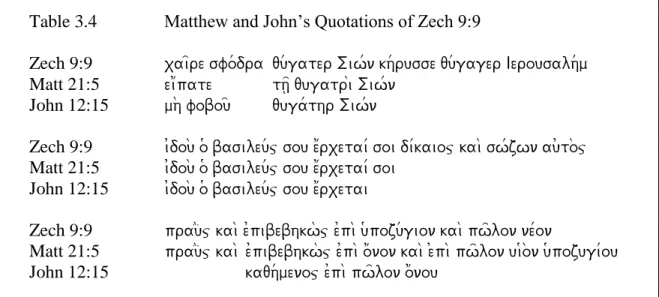
Regarding John's relationship to the Synoptics, it will discuss Windisch's taxonomy of theories: complementation, independence, interpretation, and substitution. Regarding John's specific points of contact with Matthew, the Forschungsbericht collects the parallels recognized thus far. Although the Evangelists' Zechariah quotations differ, I show that John's differences arise not only from Matthew's surrounding narrative, but also from Matthew's correct rendering, which seems to misunderstand the synonymous parallelism of the prophecy.
Chapter 4 argues that John's account of the resurrected Jesus empowering the disciples to forgive and retain the sins of the people (20:23) represents a reworking of Matthew's account in which, before the passion, Jesus empowered the disciples to bind and loose (18:18; cf. 16:19). Just before the confession of faith of the Samaritans, Jesus mentioned the disciples working in the harvest (4:35-38).
FORSCHUNGSBERICHT, METHODOLOGY, AND HERMENEUTIC
However, if John's use of Matthew can be determined, then John's assessment of Matthew must be explained. That ) and D line up against B, for example, casts doubt on Matthew and John's stadia parallel. With regard to John's addition, Maier harmonizes the endings of Matthew and John's accounts of Jesus' feeding of the 5,000.
For example, he cites John 12:15 (the prophetic prophecy of Zech 9:9),160 but Schnelle does not connect this reference with Matthew's use of the same prophecy (21:5); tacitly implying John's independence. In at least five other John/Matthew parallels, Thyen is less specific about John's use of Matthew. Lincoln's strongest parallels include John's healing of the clerk's son and Matthew's story of the centurion's child.
John's relationship to Matthew is not clearly defined, and von Wahlde does not refer to Matthew in the following eight parallels (among others) previously identified. Matthew's Gospel.235 As a variant form, John's echo of Matthew seems to have been unintentional in that case. Epiphanius in the fourth century and Weizsäcker in the nineteenth century have combined these two understandings of John's relationship with the Synoptics.
My thesis is that John's knowledge of the edited Gospel of Matthew answers all three questions.

BINDING AND LOOSING—FORGIVING AND RETAINING SINS
In Matthew 16:19, the same statement refers to Peter when Jesus promises to give him "the keys of the kingdom." John then constructed the forgiveness and retention of sins by saying based on the structure of the binding and liberating statement, but John reinterpreted the Matthew discourse so as to emphasize the disciples' responsibility not to forgive in every case. Since the prevailing explanations mistakenly equate the meanings of the Matthean and Johannine expressions, I posit as an alternative that John recognizes the binding and losing utterance in its redactional position in Matthew 18.
That is, Matthew's editorial transition from Jesus' statement about binding and loosing (v. 18) to Peter's question about forgiving sin (v. 21) explains how John adopted the structure of the Matthean logion and imported the notion of forgiveness. 56 Anderson, Fourth Gospel and the Quest for Jesus, 124; see also Christology of the Fourth Gospel, 239, where Anderson also relates Peter's teaching authority to bind and loose. 57 Anderson, Fourth Gospel and the Quest for Jesus, 124; similarly idem, Christology of the Fourth Gospel, 239.
Fifth, regarding chronology, I suggest that the missionary discourse in John 4 is supposed to occur as part of the same discourse recounted in Matthew 10. Johannine commentators pointed out the opposition between Jesus' command of the Twelve not to enter any city of the Samaritans (Matt 10:5b) and the disciples' accompanying Jesus to the. In Matthew's missionary discourse, Jesus commands the Twelve to proclaim that the kingdom of heaven has come, and He authorizes them to perform miracles (10:7–8).
In the Gospel of Matthew, only the Jews constitute the members of the house of Israel; for example, king of Israel (Matthew 27:42b) is synonymous with king of Judah (Matthew 27:37), but Matthew never uses the term Israelite. Dodd noted the tension between the future expectation and the present reality of the harvest [Historical Tradition in the Fourth Gospel (Cambridge: Cambridge University Press. 22. John's term for childbirth parallels his description of Jesus' weariness at the beginning of the episode (copy&w ; John 4:6).
I conclude that the combination of common elements meets the criteria for classifying the harvest in John 4 as an echo of the harvest in Matthew 9:23. Matthew—along with Mark and Luke—uses the account of the Baptist's death to transition to the Feeding of the Five. John's account of the feeding of the five thousand (6:1-13) does appear after the Samaritan mission.
When read together, John offers a recontextualization of Matthew's Samaritan exclusion, effectively explaining away Jesus' prohibition in Matthew: a Samaritan mission from that side. In other words, John would have reversed Matthew's order of the healing of the centurion's son and the missionary discourse.
SUMMARY OF CONCLUSIONS
These include – but are not necessarily limited to – the following ten: (1) Jesus' renaming of Simon son of John as Peter (John 1:42c; Matt 16:17b–18); (2) knowledge of Jesus going up the mountain and there at the. His main point was that Peter did not forgive post-baptism mortal sins - the clearest example being the sin of Ananias, who ―bound Peter with the bond of death‖ (Pud. Tertullian objected that ―the Church will indeed forgive sins forgive, but the Church which is spirit, by a.
10 Tertullian thus expressly stated earlier in the treatise: "The sins which are (thus) purged are such as a man may have committed against his brother, not against God" (Pud. Tabbernee concludes, "Whether or not whether or not the sinner received forgiveness from God in the afterlife would be God's prerogative, but only God."12 To explain the church's reluctance to forgive, Tertullian turned to the oracle of the new prophet, authorized by the Paraclete: "The church has the power to forgive sins, but I will not, lest others sin" (Pud. 21,7).13 This means that the Church not only has the ability to forgive sins, but also the responsibility to retain such power that mercy does not cause the opposite effect and encourage men into sin.14 Although he mentions the context surrounding it, Tertullian glosses over Matthew 18:18 itself by insisting on the uniqueness of Peter's—specifically not the disciples'—authority of binding and loosing (Pud. 21), a finding that offers a slight correction to Tabbernee, who says: ―The oracular acknowledgment of the church's authority to forgive sins is undoubtedly based primarily on Matthew 18:15-20, perhaps influenced by Matthew 16:18-19, and certainly influenced by John 21:22-23 [sic Tabbernee, ―To Forgive or Not to Forgive?‖ 384 ].
As with Cyprian, John 20:22b–23 nevertheless decided for Firmilian that “the power to forgive sins was given to the apostles and to the churches which they, sent by Christ, founded, and to the bishops who in turn succeeded those apostles, appointed to replace them" (Ep In general, Cyprian and Firmilian followed Tertullian in interpreting Matthew 16:19 in the light of John 20:23. We have a great concern for all brotherhood, O Christians, especially because of the criminal audacity of those poor men—the gamblers, who plunge souls into the pit of death. Regarding Peter's alleged superiority, a catenary referring to Matthew 16:19 had Cyril of Alexandria quote John 20:22b– 23, saying that "the gift was given to all together; therefore we consider the faith common to all the apostles and not to Peter alone." Chrysostom and Cyril respectively favored the authority given to a collective body of disciples (Matthew 18: 18; John 20:23) over Peter's sole authority (Matthew 16:19).
22 Which does not necessarily imply the primacy of the Bishop of Rome; For example, on Cyprian's use of Matthew 16:19, Michael Fahey writes: “The text, as Cyprian uses it, is not cited to argue for some form of jurisdictional primacy for the Roman bishop; rather, it is cited to emphasize the unity of the Church founded by Christ primarily on the person of Peter, thus providing an effective symbol of her unity. are kept for him to whom they have kept them, as afterward was spoken by the Lord. Whose sins,” he continues, “you forgive, they are forgiven; and whosoever saveth you, they are saved.' The love of the Church, which is shed abroad in our hearts by the Holy Spirit, redeemeth the sins of all who partake of themselves, but retaineth the sins of those who partake not of themselves . in there. The Death of the Messiah: From Gethsemane to the Grave; A commentary on the passion stories in the four Gospels.
A History of the Synoptic Problem: The Canon, Text, Composition, and Interpretation of the Gospels. The Orthodox Gospel': The Reception of John in the Great Church before Irenaeus.' Pages 233-300 in The Legacy of John: Second-Century Reception of the Fourth Gospel. The Text of the Synoptic Gospels in the Second Century.‖ Pages 19-37 in Gospel Traditions in the Second Century.
Patristic refutation of the claim that "Gospels were written for all Christians." New Testament studies. A Harmony of the Gospels for Students of the Life of Christ: Based on the Broadus Harmony in the Revised Version.