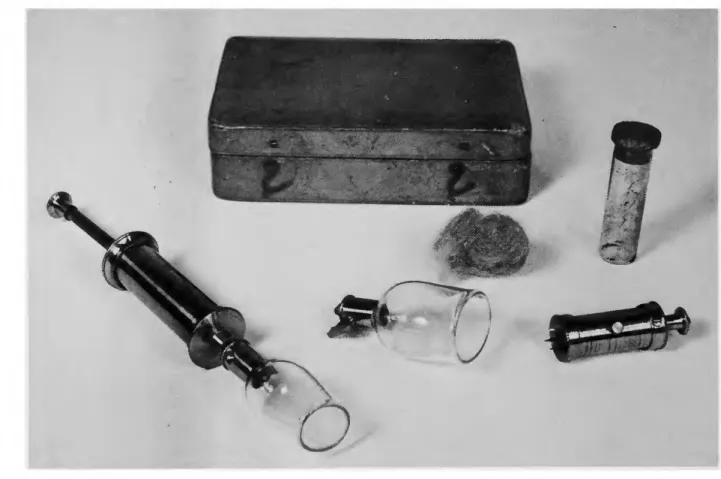
All the major equipment types and many variations are represented in this study of the collection at the National Museum of History and Technology. These instruments were used in a variety of treatments, supporting many theories of disease and therefore reflecting many different aspects of the history of medicine. The collection of instruments at the National Museum of History and Technology in the Smithsonian Institution contains several hundred pieces representing most of the major types of instruments.
Begun in the late nineteenth century, when the medical sciences were still part of the Department of Anthropology, the collection has grown steadily through donations and acquisitions. The Patent Office provides illustrations of the mechanism and a discussion of why the instrument was considered novel. Some have been separated to study spring mechanisms, and others have been examined at the Smithsonian Institution's Conservation Analytical Laboratory to determine their material content.
Bleeding: The History
The earliest formulation of humoralism was to be found in the physiological and pathological theory of the Hippocratic treatise. Controversy over the location of the veins to be opened erupted in the sixteenth century. The discovery of the circulation of the blood did not result in immediate changes in the methods or forms of blood excretion.
The case of the spring lancet was usually made of copper, silver, bronze or an alloy. While French and British surgeons remained critical of the spring lancet, it became popular in the United States. Approximately five US patents on variations of the spring lancet were issued in the nineteenth century.
As mentioned above, the ancients usually recommended cupping close to the seat of the disease. 34; inspire less fear in the patient's mind than a formidable display of numerous and complicated instruments." i^".

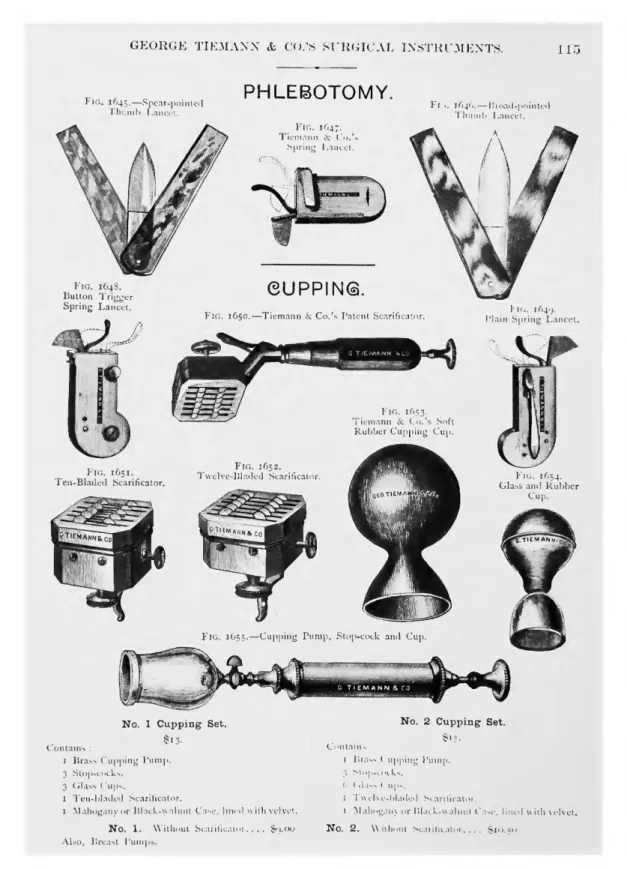
Since the burning rope could be placed in the hanging belly of the glass, away from the skin, it was easier to apply and remove the ordinary cup.i^i. It was too bulky and heavy, and it cost too much—the cheapest engraving machine produced by George Tiemann & Co. in 1889. was offered, cost $4,50.1. T he force of the lever moving against the casing of the scarificator made it impossible to use any but expensive materials (brass and German silver) to make the scarificator casing.
One end of each coil spring was attached to the scarifier body and the other end to one of the support rods. The blades were moved by a rack and pinion mechanism and activated by a button at the end of the handle. The novelty consisted of a new arrangement of the tension lever and the cantilever spring, which allowed the use of a lighter and cheaper housing.

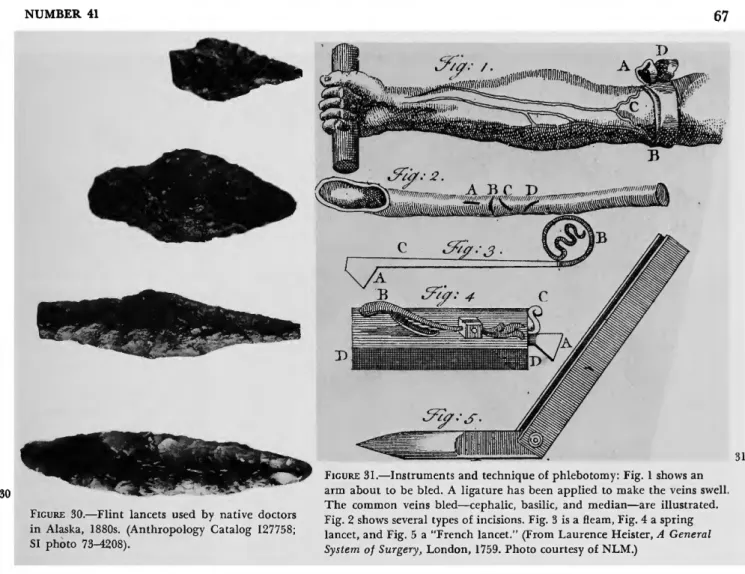
PHLEBOTOMY
If dry cupping was applied for ten minutes or longer, so that the capillaries burst, the action of the cups was said to be a counter-irritant. The blistering ability of the instrument was improved by applying Baunscheidt's special oil to the irritation (Figure 17). From Carl Baunscheidt, Baunscheidtismus, by the inventor of the new curing method, Bonn, 1859(?). Photo courtesy of NLM.).
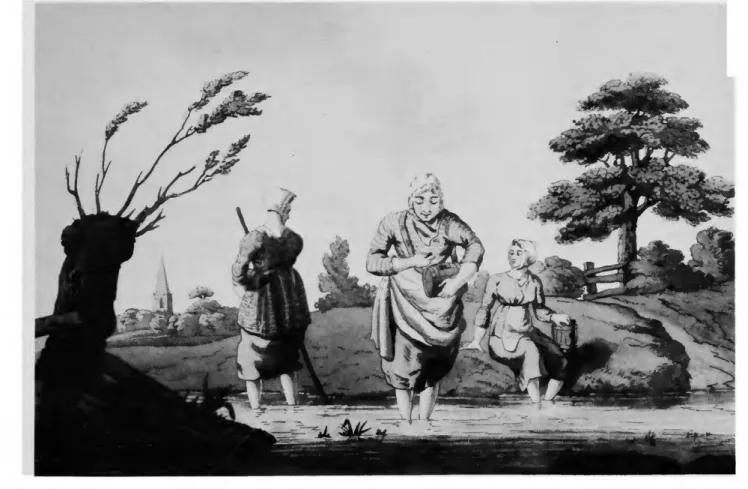
So much blood was withdrawn from the circulation by the use of the apparatus that the patient could easily faint. Of all instruments using the principle of the cup device, breast pumps were the most patented. Leeches were collected in the spring of the year either by means of a pole net, or, more primitively, by wading in the water and allowing the leeches to attach themselves to the legs.
The major advantage of the leech over the cup was that the leech could be used on virtually any part of the anatomy, including around the eyes, in the mouth, the anus and the vasrina. Sometimes the leech's tail was cut off so that it would continue to suck. Actually, only the day's supply of apothecary's leeches was kept in the beautiful shop windows; the rest was kept out of sight.
Given the properties of the natural leech, it is no wonder that inventors began looking for a mechanical alternative very early in the nineteenth century. It consisted of two pistons attached to a plate that had to be placed on the floor and held down by the operator's feet. One of the last conditions to be regularly treated by leeches was the common black eye.
Among the latter are leeches, prominently displayed in a series of glass jars in various parts of the store, including one in the display window.
Veterinary Bloodletting
In another improved "horse flem," Weiss mounted the blade on a pivot so that the blade drew a semicircle when the spring was released.i^^. Perhaps this diversity can best be illustrated by looking at two patent models in the collection. The first is the oval-shaped lancet, patented in 1849 by Joseph Ives of Bristol, Connecticut.^oo Using a wheel and axle mechanism, Ives made the blade draw an eccentric curve.
Patented in 1880 by Hermann Reinhold and August Schreiber of Davenport, Iowa, this instrument featured a cocking lever that expanded to form a coiled spring in the pistol grip section. Also attached to the cocking lever was an extended blade with detents so that pulling the cocking lever brought the blade into the housing and cocked the spring.
Physical Analysis of Artifacts
The hardness of the sheet metal indicated that it was carburized enough to be made of steel. These lancets were probably typical of the lancets advertised as silver in late nineteenth century trade catalogues. There are three blade height settings instead of the usual two.
Circular bleeding bowl made of pewter and typical of the bowls used to collect and measure blood in the 18th century. On top of the case is a silver plate with the name of the owner, “Mr. On top of the cylinder is both the brass pump and the attachment to the cups.
Case is made of wood and has a label on the inside top with an illustration of the set, the title: "Drs. The cocking lever is attached to both a coil spring in the handle of the pistol and to an extension of the Lancet knife with brass button end, a larger version of the spring lancet used in human bloodletting.
An example can be found in the collection of the Armed Forces Institute of Pathology. 1°^ Data on the number of breast pumps patented were obtained from the files of LEWIS DIEHL USA, "Report on the Progress of Pharmacy." Proceedings of the American Pharmaceutical Association, volume 25 (1876).
An example of this artificial leech can be found in the collection of the Armed Forces Institute of Pathology.
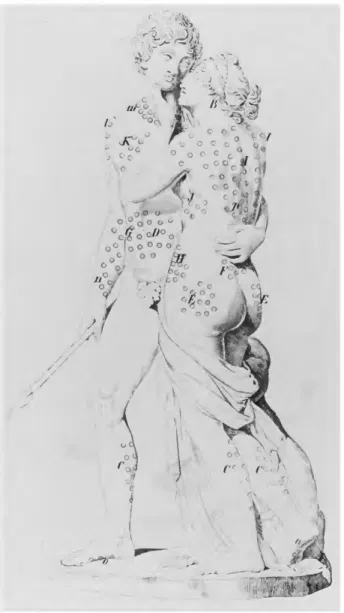
![FIGURE 25.—Bloodletting manikin. (NMHT 243033 [M-10288]; SI photo 76-13536.)](https://thumb-ap.123doks.com/thumbv2/123dok/11134610.0/51.866.102.765.115.1007/figure-25-bloodletting-manikin-nmht-m-si-photo.webp)
Ciafc, the World mayfay, oneofus twain arebotl^^
Lyars, or &t leaft foil of Errors* For, No place but is of Errors rife,
H Ere fits agiiri the \)Id An^rOmy,
Which ufe ;to plejfe the Country Peoples eye % VoT if they, in tliis place, do^nc fee his Features,
They'll not know at what time to Cut their Crcaures*
Neck>
Breft,
V Knees,
M The Feet '«
Mercury, D Luna, Q, Dragons head ^ y TailJ
DOUartilc
A 17th century traveler described the Indian method of bloodletting as follows: 'The patient sits on a stone in the river, and someone with a small bow shoots small arrows into the patient's naked body, up and down, shooting them down. as fast as he can and without missing any part. This board also contains one of the earliest illustrations of the syringe applied to cupping cups.
PETE*R GOOD
Cupping and Bleeding
Jl tie: 24
Notice the three blades on the scarifier that simulate the triangular sting of a leech. Review of Manuscripts and Artwork by the Press for Series Requirements J o - ^ ^ f completeness and clarity of copy and arrangement of all material as noted below shall govern, at the discretion of the Press, the acceptance or rejection of ^^e manuscripts and art. The first page of the text should contain the title and author at the top of the page and an unnumbered footnote at the bottom consisting of the author's name and professional mailing address.
Formal tables (numbered, with table headings, boxheads, stubs, lines) should be submitted as camera copy, but the author should contact the Series Section of the Press for editorial attention and preparation assistance before final typing of this matter. Taxonomic keys in natural history papers should use the aligned couple form in the zoology and paleobiology series and the multi-level indentation form in the botany series. Synonymy in the zoology and paleobiology series must use the short form (taxon, author, year page), with a full reference at the end of the article under "Literature Cited."
Footnotes, when few in number, whether annotative or bibliographical, should be typed at the bottom of the text page on which the reference occurs. If bibliographical footnotes are required, use the short form (author/short title/page) with the full reference in the bibliography. 34; For alignment and arrangement of elements, follow the format of the series for which the manuscript is intended.
Legends for illustrations should not accompany the artwork or be included in the text, but should be submitted at the end of the manuscript—with as many legends typed, double-spaced, per page as appropriate. If several "figures" are treated as components of a single larger figure, they should be indicated in small italics (underlined on the copy) in the illustration, in the legend, and in the text references: "Figure 9 b. 34; If the illustrations are intended for printing separately on the coated material behind the text, they should be called Plates, and all components should be labeled with letters, as in the figures: "Plate 9 ^. 34;.
Keys to each symbol within an illustration should appear in the art and not in the legend.