Center for Health Outcomes and Policy Research University of Pennsylvania School of Nursing Philadelphia, Pennsylvania. Kathleen Williams, RN, BSN, CORLN Assistant Nurse Manager, Department of Nursing University of Iowa Hospitals and Clinics.
REGISTER TODAY!
Evolve Student Learning Resources for Huber: Leadership and Nursing Care Management, Fourth Edition, offers the following features
Because all nurses are involved in coordinating client care, leadership and management principles are part of the core. It combines traditional management perspectives and theory with contemporary health trends and issues and consistently integrates leadership and management concepts.
Professionalism
Population-Based Program Planning, 495 Population-Based Risk Assessment, 496 Policy and Management Implications, 498 Current Issues and Trends, 499. Costs Associated with Poor Quality Health Care, 535 Policy and Management Implications, 538 Current Issues and Trends, 540.
Business Skills
Implications for leadership and management, 705 Alternative productivity measures, 708 Costs for nursing services, 709 Current issues and trends, 711. Standardized clinical terminology, 788 Minimum data set for nursing management, 789 Implications for leadership and management, 791 Current issues and trends, 792.
Leadership Principles
Leadership Principles 7
From an early awareness of the leader's need to be concerned with both tasks and human relationships (product and people) arose a long history of leadership theories that can be grouped as trait, attitudinal and situational (Hersey et al ., 2008). Leaders must be willing to make difficult choices and overcome the fears associated with them.
Leadership Principles 9
Bennis (1994) discussed what is now called “the vision thing.” The one specific defining quality of leaders is vision: the ability to create a vision and put it into action. Leadership is based on trust: “Trust is the emotional glue that binds leaders and employees together and is a measure of the legitimacy of leadership” (Malloch, 2002, p. 14).
Leadership Principles 13
Both the leadership style (task vs. attitude) and the leader's attitude toward leadership behavior are important. Leader-member relationships refer to the type and quality of the leader's personal relationships with followers.
Leadership Principles 15
The third dimension is the environment in which the leader operates and interacts with the leader's style. Psychological readiness is demonstrated by the willingness to take some risk and by accepting the demands of the job.
Leadership Principles 17
Transformational leadership occurs when people engage with others so that leaders and followers lift each other to higher levels of motivation and ethical decision-making (Burns, 1978). A transformational leadership style has been shown to generate greater follower commitment, follower satisfaction, and overall effectiveness (Kleinman, 2004).
Leadership Principles 19
Individuals can move between levels, but results in the business world seem to vary according to the level of leadership displayed by the leader. The Level 5 leader first addresses the "who" by getting the right people in the right jobs, and then addresses that.
Leadership Principles 21
Therefore, cooperation and collaboration between leader and followers and between followers and leader increases the effectiveness of the group. Alienated followers are capable of independence and critical thinking but appear passive because they resist open opposition; the result is frustration and disillusionment.
Leadership Principles 23
Nurses are the largest group of health care professionals in most institutions of service delivery and represent the largest human resource expenditure in most care institutions (O'Neil et al., 2008). Leadership is therefore needed to guide and motivate the nurses and healthcare delivery systems towards positive achievements for better patient care.
Leadership Principles 25
When she believes the document is polished, she completes the rest of the documentation to apply for the job. Outpatient clinic nurse managers have been reorganized to report to a physician Clinic Director.
Management Principles
Management Principles 33
The principles that guide the management process must be identified to be useful for greater efficiency. Steiner (1962, p. 28) described planning as “the conscious determination of a course of action to achieve predetermined goals”. Planning can be detailed, specific and rigid or broad, general and flexible.
Management Principles 35
The complexity of this aspect of the organization is related to the size of the organization and the number of employees and jobs. Along with communication and leadership, motivation is often involved with describing the activities of leading others.
Management Principles 37
However, the relative proportion of the nurse's role devoted to management and coordination functions varies within nursing by job category. But for a middle manager, only part of the working time can be spent on being clinically and technically competent.
Management Principles 39
Drucker (1954) suggested that the three tasks of management are to manage a business, manage managers and manage workers and work. As the nerve center of the organizational unit, information processing is a key part of the role.
Management Principles 41
At the information level, the associated management roles are to communicate and control information by using information to control the work of others. The basic principle is that managers must consider the situation and all its elements when making a decision.
Management Principles 43
The focus of complexity theory is the behavior over time of certain complex and dynamic changing systems. The main findings of complexity theory are the "effective ignorance" of the future and the understanding of the role of creative disorder.
Management Principles 45
Both chaos and order are important elements in the powerful and unpredictable effects created by iteration in nonlinear systems (Wheatley, 1999). However, for nonlinear variables and systems, randomness plays a key role in creating patterns of complexity and harmony of form (Wheatley 1999).
Management Principles 47
Balancing day-to-day business operations with transformative management and leadership is a creative synthesis of the best of the 'old' with the best of the 'new' management theories. This instrument can be used to measure and evaluate similarities and differences in management work, for example before and after a restructuring.
Management Principles 49
He criticized vertically integrated systems and managed care organizations and noted that they cannot provide the convenient, supportive, and cost-effective health care that the US desires. As health care is reconfigured, health care delivery settings are likely to be knowledge-based organizations.
Change and Innovation
Change and Innovation 57
The terms first-order change and second-order change can apply to individuals, small systems, and organizations. Second-order change is discontinuous and radical and occurs when the fundamental properties or states of systems are altered.
Change and Innovation 59
Unfreezing, the first stage of change, can be described as the process of "thawing" the system and creating motivation or readiness for change. Accurate analysis of opportunities for change is the best hope for successful economic or social innovation.
Change and Innovation 63
Because of the energy and resources needed to make a change, careful evaluation is critical to positive outcomes. In healthcare, with the continuous and rapid rate of change, nurse managers need skills in working with the change process.
Change and Innovation 65
It may appear to be a continuum from random drift at one end to structured and planned change at the other. Theories of planned change are engineering theories in that they use social science principles to plan change (Tiffany & Lutjens, 1998).
Change and Innovation 67
They play a key role in the initiation, planning and maintenance of change (Leeman et al., 2007). One way to reframe perceptions of resistance is to consider the positive effect resistors and resistance have played in history and in the development of the United States.
Change and Innovation 69
To help individuals adapt, they need to be supported and encouraged to control their own response to change. Emotional response to change is a psychological process related to an individual's attitude to change and is one of the factors over which the individual has control.
Change and Innovation 71
Due to constant change, nurses and health systems have had to learn and adapt. Health care is also changing as integrated networks are formed and care is increasingly moved into community settings.
Change and Innovation 73
Nurses can create new environments or establish new forms of organization that will lead and shape the direction of the healthcare system. The healthcare environment has been described as turbulent due to the rapid rate of change and perceived constant change.
Change and Innovation 75
Several RNs, licensed vocational nurses (LVNs), and one nursing assistant (NA) and clerk volunteered to serve on the change committee with Nurse Romero. In the end, they had two options that they had to present to the rest of the staff.
Organizational
Climate and Culture
Organizational Climate and Culture 81
Climate is easier to quantify than culture, and thus climate refers to aspects of the work environment that can be measured. Researchers studying climate describe various components of the work environment that influence outcomes behaviors (Sleutel, 2000).
Organizational Climate and Culture 83
For nurses who indicated they planned to leave, their responses were analyzed and divided into two groups: those who left due to retirement or promotion, and those who planned to leave due to working conditions. Professional practice (measured as nurses' involvement in hospital decision-making and opportunities for advancement), nurses' perception of other nurses' competence, and experience were found to reduce the likelihood of intention to leave by 48%, 39% and 3% respectively.
Organizational Climate and Culture 85
Team building at the unit level holds a collective vision for continuous learning. A review of the literature established that traumatic consequences resulted from the use of restraints.
Critical Thinking and Decision-Making
Explores the relationship between critical thinking, problem solving and decision making in nursing practice, leadership and management.
Skills
Critical Thinking and Decision-Making Skills 95
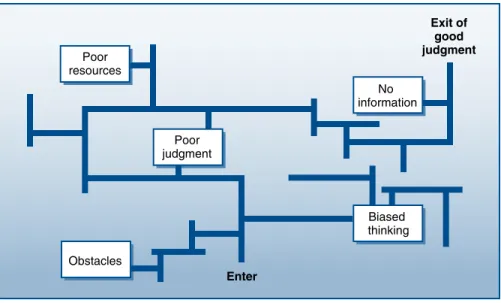
Critical thinking is not synonymous with problem solving and decision making (Figure 5.1), but effective problem solving and concurrent decision making certainly cannot occur without critical thinking (Lemire, 2002). Critical thinking is a skill developed for clarity of thinking and improving the effectiveness of problem solving.
Critical Thinking and Decision-Making Skills 97
Problem solving as a process can be linked to the delivery of nursing care and the organizational change process. If the problem is solved, the problem solving process will be rated as effective.
Critical Thinking and Decision-Making Skills 99
Clearly, problem formulation can be aided by refining a written statement of the problem (eg, “The problem is. The problem solver's values will play a role in the analysis and evaluation of the consequences.
Critical Thinking and Decision-Making Skills 101
The basic elements of problem solving and decision making can be summarized in the following two parts: (1) identification of. Nurse managers use decision making in resource management and the care delivery environment.
Critical Thinking and Decision-Making Skills 103
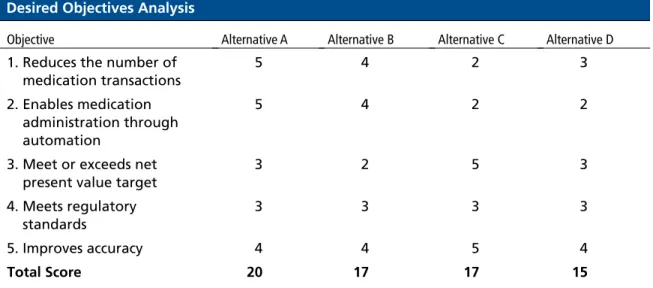
Due to rapid, continuous advances in medical technology, managers are often pressured to replace existing equipment before it is fully depreciated. It is important that managers objectively examine project planning assumptions in the decision-making process to ensure accurate projections.
Critical Thinking and Decision-Making Skills 105
Overlapping, unclear and changing roles for nurses due to new technology and services create complex decision-making situations and impact the quality of care provided (IOM, 2003). However, the full range of leadership styles can be used at some point in the decision-making process.
Critical Thinking and Decision-Making Skills 107
Personality and leadership style appear to influence the effectiveness of team or group problem solving and decision making (Saulo, 1996). Scenario planning is a problem-solving and decision-making strategy in an uncertain and changing future.
Critical Thinking and Decision-Making Skills 109
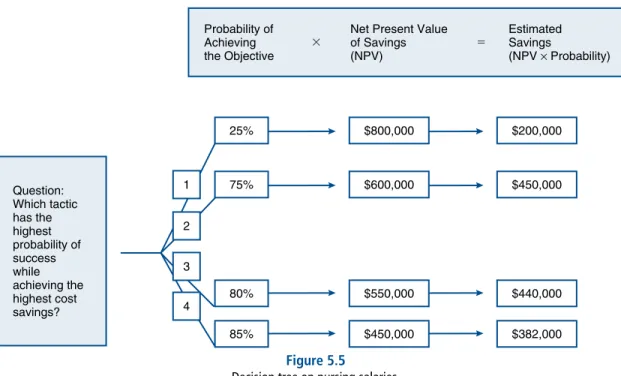
By running "virtual experiments," computational models can provide a "what-if" analysis of various tactics aimed at decision-making. Although a variety of methods can be used, the general process for computational modeling begins with encoding a series of statements in propositional computation, or “if.
Critical Thinking and Decision-Making Skills 111
It is controversial whether critical thinking is even encouraged in nursing education programs, as is its measurement (Adams, 1999; Walsh & Seldomridge, 2006). Nevertheless, nurturing, developing, and demonstrating critical thinking skills remain important issues in nursing education and practice.
Critical Thinking and Decision-Making Skills 113
Effective decision making depends in part on analyzing alternative levels of uncertainty or risk. Without focused training, much of the decision making that takes place can be trial and error and not based on principles of effective problem solving and decision making.
Critical Thinking and Decision-Making Skills 115
Unit manager Susan Smith has verbally admonished nurse Flint and placed a disciplinary warning in his personnel file. If Nurse Flint is not consistently on time for his shift over the next 3 months, he will be suspended without pay and possibly lose his job.
Critical Thinking and Decision-Making Skills 117
Managing Time and Stress
- Managing Time and Stress 121
- Managing Time and Stress 123
- Managing Time and Stress 125
- Managing Time and Stress 127
- Managing Time and Stress 129
The goal of time management is the efficient use of time resources to be effective in achieving goals. Closing the gap between how someone would like to spend their time and how they actually spend their time depends on deploying a range of time management strategies.
- Managing Time and Stress 131
- Managing Time and Stress 133
- Managing Time and Stress 137
- Managing Time and Stress 139
A tension that arises in a person related to the role or job requirements. For example, the role of the nurse can be a source of stress and strain (Dewe, 1987).

Current issues anD trenDs
Managing Time and Stress 141
Translating knowledge about the connection between the work nurses do and quality care with the science of time and stress management should be a core competency for nursing leaders in today's complex healthcare environment. Reforms in healthcare and the economy place stress and pressure on nurses both directly and indirectly.
Managing Time and Stress 143
Explain how the law and professional code of ethics give autonomy – both authority and accountability – to nurses and nurse managers. Describe the various steps nurse managers can take to protect themselves, the staff nurses who report to them, and their facilities from legal liability and its related costs.
Legal and Ethical Issues
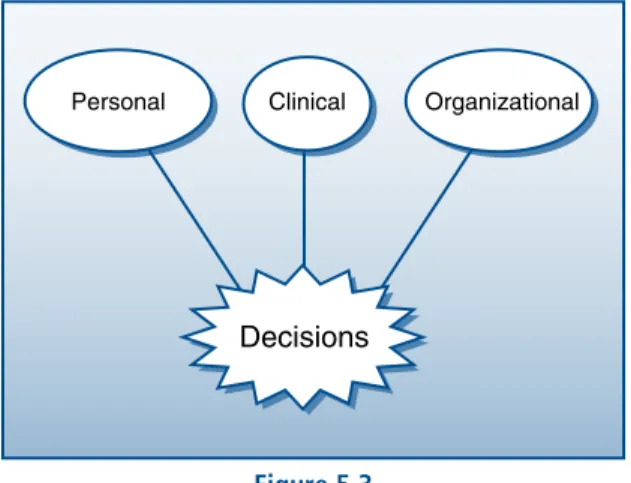
By the very nature of their work, nurses and nurse managers are decision makers constantly faced with making choices in personal, clinical and organizational situations. Explain the various steps nurse managers can take to prepare themselves and the staff nurses who report to them to deal effectively with the dilemmas that arise from the clash between clinical and organizational ethics.
LegaL aspeCts
Legal and Ethical Issues 149
Crucial in determining liability for malpractice (professional negligence) is the definition of the duty of care (standard) that the nurse owes to the client. Nor is it necessary to establish duties or standards of care in proving intentional tort.
Legal and Ethical Issues 151
Nurse managers can help a facility avoid corporate liability by, among other things, ensuring that those who report to them remain competent and qualified and hold valid licenses. First, because problems can generally be dealt with more effectively if they are anticipated, nurse managers must ensure that both they and the nurses who report to them are well informed.
Legal and Ethical Issues 153
Analysis of the actions that lead to a breach of practice includes tips for avoiding problems. Knowing the most common problem areas, using examples and showing prevention tips helps the nurse avoid problems.
- Legal and Ethical Issues 157
- Legal and Ethical Issues 159
- Legal and Ethical Issues 161
- Legal and Ethical Issues 163
Another area of agreement is reflected in 4 of the 8 ethical issues rated in the top 10 by both staff nurses and nurse managers. Both the 325 responding staff nurses and 295 responding nurse managers failed to provide the highest quality service (defined by both groups of respondents as service inconsistent with both the standards of the nursing profession and the ANA Code of Ethics) as a major problem facing healthcare facilities.
Communication, Persuasion, and
- Communication, Persuasion, and Negotiation 169
- Communication, Persuasion, and Negotiation 171
- Communication, Persuasion, and Negotiation 173
- Communication, Persuasion, and Negotiation 175
- Communication, Persuasion, and Negotiation 177
One of the issues for nursing leaders is the implementation of holistic care—particularly the spiritual dimension of this paradigm. For the nursing assessment, it is the BVMGR rubric—Dimensions of Patient Spirituality—that forms the basis for spiritual care.