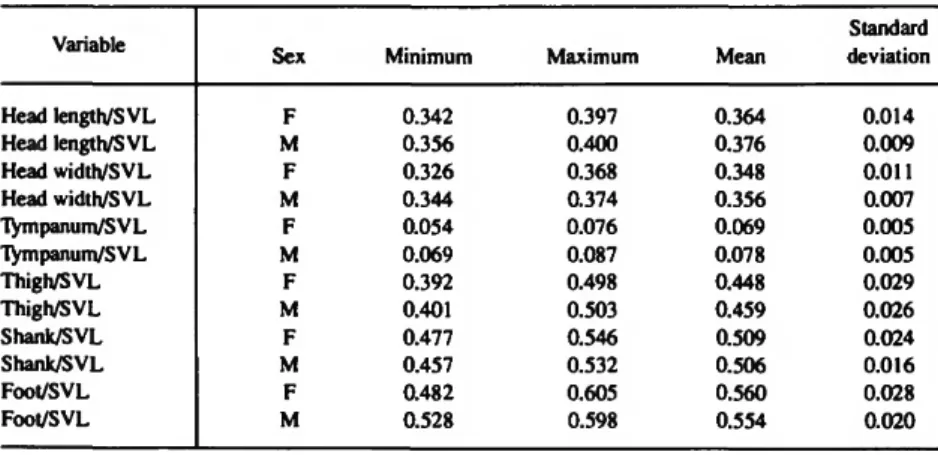
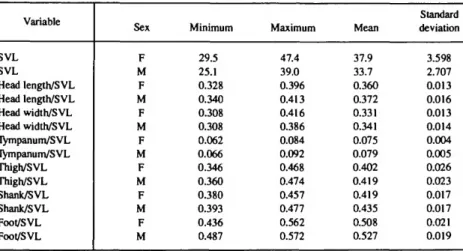
(3) melanophore distribution on the chin, throat, chest and stomach; and (4) degree of extension of the toe points. Most (87%) individuals have no indication of a light stripe on the back of the thigh. Slightly less than half of the individuals have no indication of light stripes on the back of the thigh.
None of the moderately large OTU individuals of the light posterior abdomen have this particular condition of dorsolateral folds. All small/moderate-sized OTU specimens with abdominal anastomosis have mottled patterns on the posterior thigh. The chin and throat of small-sized ventral anastomosing OTUs are dark (heavily impregnated with melanophores) and may or may not (most) have scattered light spots.
Only two thighs (out of 48 for a total of 24 adults and sub-adults) of moderate, light size. Hind thighs of medium-sized, light hind OTU adults have light or distinct or very distinct stripes.

AXIS
None of the Diauarum individuals have distinct light spots on the neck, chest or belly (about one third have light spots on the chin). The Dark Belly Region 3 OTU, consisting of the Xingu-Araguaia drainage samples (except for Aldeia dos Tapirap6s and other Mato Verde OTU samples) and the southern and eastern Region 3 OTUs, show geographic variation. There is a single recording available for the call from the Dark Belly Region 3 OTU from Botucatu, Edgardia, Sao Paulo, Brazil.
There is some variation along the second axis of the principal component with outliers at each end of the axis. The majority of specimens (68%) from the states of Amazonas and Para, Brazil, have slightly distinct posterior lip lines (14% have very distinct lines). The abdomen pattern is intermediate between the characteristic patterns of region 4 anastomotic OTUs and the dark abdomen.

I 1 llllllUMAAAyw——
A single male from Region 4 Anastomotic Belly OTU from Cachoeira do Espelho, Rio Xingu, Par£, Brazil, is distinctive within a series from the same locality. The light posterior lip stripe stops at the posterior angle of the eye and does not extend below the eye as is typical of Region 4 Anastomotic Belly OTU. MZUSP 69065 is considered a member of the Region 4 Anastomotic Belly OTU, although the belly pattern is unusual.
Examination of the specimen leads to the conclusion that it represents a single OTU with a variable belly pattern and is identical to the Region 4 Dark Belly OTU. USNM 202553 is considered a region 4 member of the Dark Belly OTU with a somewhat unusual belly pattern. The specimen is a member of region 4 of the Dark Belly OTU, with signs of a light posterior lip extending to below the eye.
Each of the specimens has indications of a light posterior lip stripe extending below the eye. However, all seven have fairly well-developed light stripes on the posterior thighs, which is characteristic of the Region 4 Light Posterior Belly OTU. Three individuals from the Region 4 Dark Belly OTU from Sao Carlos, Rondonia, Brazil, show extreme variation in belly pattern from dark with almost distinct light spots (MZUSP 51465) to a scattering of melanophores (USNM 202545).
The samples of the Region 4 Light Posterior Belly OTU from the state of Vaupes, Colombia, include several individuals with rather heavily spotted bellies, very similar to the belly pattern found in the Region 4 Anastomotic Belly OTU. In most Region 4 Light Posterior Belly OTU individuals, bellies are moderately to heavily mottled. Light stripes on the hind thighs are evident in almost all of the light posterior abdomen OTU specimens from this locality.
All but one individual of the specimens on hand from Ivon, Beni, Bolivia are easily placed with either the Region 4 Anastomose Belly OTU or the Region 4 Dark Belly OTU.

2 - cvl
All stripes extend from the rear corner of the eye and are as distinct above as below. The light stripes on the posterior surfaces of the thighs range from distinct (3), indistinct (5), to no indication of a light stripe (2). The light femoral stripes on the back of the thighs range from distinct (23%) to indistinct (43%) to no indication of a stripe (34%).
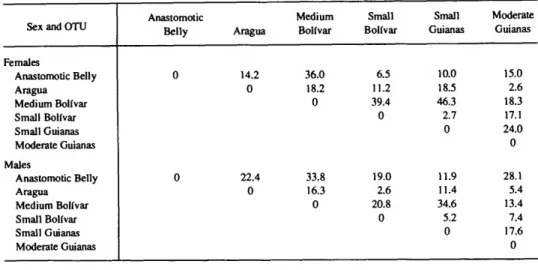
The medium-sized Bolivar OTU is also quite distinct based on the generalized squared distances of the discriminant function analysis using the measurement data (Table 26), with the consequence that there are few misclassifications by the posterior classification procedure (Table 27 ). Based on the interpretation of faint faint lines on the posterior lips in two of the specimens, they are considered to represent the Small-sized Guiana OTU, but this locality record needs to be confirmed with additional material. Most specimens were collected from higher elevations (850-1900 m), but specimens from lowland localities adjacent to the mountains appear to be the same (with the exception of the specimens discussed in the next paragraph).
All specimens have the tips of the toes only inflated or inflated; in all other characteristics they match at least some individuals of the small-sized Guianas OTU. First, reexamination of CAS 146925 from French Guiana, between Cayenne and Tonate, which was originally identified as a member of the Guiana small-sized OTU, is actually a member of the Anastomotic Belly Region 5 OTU as suggested. Re-examination of all three specimens indicates that they represent two OTUs, the other two specimens being members of the Small Size Guianas OTU.
The first call type was recorded from MZUSP 62430 from Ilha de Maraca\ Roraima, Brazil, a member of the Anastomotic Belly Region 5 OTU. An unproven call from BV-8, Roraima, Brazil, closely matches the second note of the unproven call described for the Small Size Guianas OTU, specimen USNM 302409. In none of the calls analyzed (6 ), is there any evidence of a lower frequency initial note (Figure 28).
Additional recordings for the Venezuela Andes OTU are needed to characterize the call and to determine how distinctive the call is from the Small Size Guianas OTU.
M -T * calls
Habitat data are only available for a few specimens of Region 7 Anastomotic Abdomen OTU and Region 7 Light Posterior Abdomen OTU. Moderate-sized Central Peru OTU Region 7 individuals are highly similar in size and shape to individuals of the Region 7 light posterior abdominal OTU (as shown by discriminant analysis of measurement data, Tables 38,39). Samples from the other localities are all considered members of the Midsize Andean OTU.
In both, the light posterior labial stripes are distinct and extend from just behind to the middle eye region in one and from the posterior corner of the eye in the other. It is unclear whether the Light Posterior Belly OTU is the same as either some or all of the Venezuelan Andes OTU. A single specimen from Araracuara, Amazonas, Colombia (ICNMNH 18093), was also previously identified as a member of the Light Posterior Belly OTU.
Platymantis petersii Steindachner, 1864.—The type originally in the Naturhistorisches Museum Wien is apparently lost (Heyer, 1970:21; Haupl and Tiedemann, 1978 did not include the specimen in their type list). The light posterior eye line is distinct (especially when viewed with a specimen immersed in alcohol) and does not extend below the center of the eye. The light posterior lip line is more pronounced on the left and reaches below the middle of the eye.
Eleutherodactylus leptodactyloides Andersson, 1945.—The holotype is a 44.0 mm SVL male (medium-large paired black spines on each thumb) from Rio Pastaza, Ecuador. The last light lines on the lips are pronounced and extend from the back corner of the eye. Two species of the podicipinus-wagneri complex occur in the Rfo Pastaza region of Ecuador, region 7 Large Size Mid-Andes OTU (= L. wagneri) and Light Posterior Belly OTU.
DISTRIBUTION.—Amazonian slopes of the Andes from central Peru to north-central Bolivia, from known elevations of 100-1800 m (Fig. 36; Appendix 2). DISTRIBUTION.—Guyana, north-central Roraima, Brazil, and Venezuela from known altitudes to 360 m (Fig. 39; Appendix 2). There are regional differences in the expression of light lines on the back of the thighs.

Specimens Examined and Locality Data
Literature Cited
A quasi-historical approach to the natural history of reptilian differentiation in tropical geographic isolates. Manuscripts intended for serial publication undergo a thorough review (conducted by their originating museums or Smithsonian offices) and are submitted to the Smithsonian Institution Press on Form SI-36, which must demonstrate approval by the appropriate authority designated by the sponsoring organizational unit. Requests for special treatment - use of colors, folds, bound covers, etc. - request additional approval from the sponsoring authority on the same form.
Review of manuscripts and art by the Press for requirements relating to the format and style of the series, the completeness and clarity of the copy and the arrangement of all material, as set forth below, is, within the discretion of the Press, determines the acceptance or rejection of manuscripts and art. On the first page of text, the title and author should appear at the top of the page; the second page should contain only the author's name and professional mailing address, to be used as an unnumbered footnote on the first page of printed text. Formal tables (numbered, with captions, boxheads, stubs, lines) should be submitted as carefully typed, double-spaced copy, separate from the text; they are set unless otherwise requested.
Synonymy in zoology should use the short form (taxon, author, annual page), with the full reference at the end of the paper under. Extensive notes should be collected together and placed at the end of the text in a notes section. For titles of books and articles, use capital letters in the style of sentences according to the rules of the language used (exception: write all main words in English).
Legends for illustrations should be submitted at the end of the manuscript, with as many legends typed, double-spaced, on the page as appropriate. They should be called figures and numbered as they will appear in the monograph. The use of the metric system of measurement is preferred; where the use of the English system is unavoidable, give the metric equivalents in brackets.
Index copy may be submitted at the page proof stage, but plans for an index should be indicated when the manuscript is submitted.