Over time, Housing First has become widely (although not universally) accepted in the homeless outreach field – fueled by a growing body of beneficial research material, inspiring examples, and government incentives and mandates. A local culture of homeless outreach helps define “the Nashville homeless outreach field”—the term I use to describe the social community that helps create Housing First and other homeless outreach agencies in Nashville. What are the most important aspects of OTN's homeless support culture, and how do they align (or not) with Housing First.
How OTN members' descriptions of Housing First compare to general conceptualizations of Housing First in helping the homeless. First, I examined OTN's involvement in the local institutionalization of Housing First (as recounted by key informants and supported as much as possible by archival evidence).
Institutional Mechanisms and Pillars
In his review text Institutions and Organizations, Scott offers an influential view of institutions that differs from theorists such as Zucker (1977) and Meyer and Rowan (1977), who characterize institutions as exclusively cultural-cognitive structures. For Scott (2014), institutions “constitute regulatory, normative, and cultural-cognitive elements that, together with related activities and resources, provide stability and meaning to social life” (p. 56). The regulatory pillar consists of formal rules that, through coercive mechanisms, force actors to act in accordance with the institution out of expediency.
The normative pillar consists of binding expectations that, through normative mechanisms, persuade actors to comply with an institution out of social obligation. Finally, the cultural-cognitive pillar consists of shared understandings of social reality that, through mimetic mechanisms, persuade actors to conform to an institution out of an acceptable belief.
The Issue-Based Organizational Field
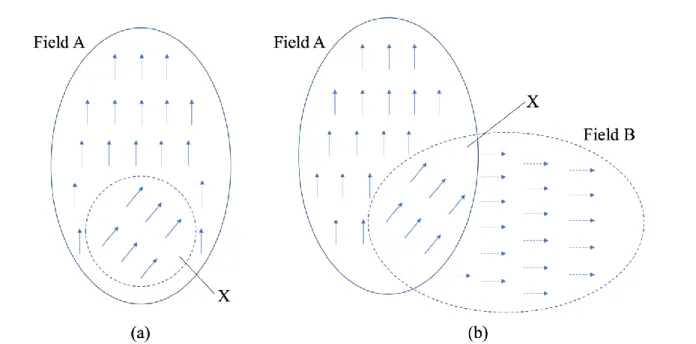
Thus, where an element is located in the field—its position—determines the direction and magnitude of the force that is activated. The boundaries of a field are determined empirically; the field ends where field effects stop (Martin, 2003; Martin, 2011). In the first sentence ("Only fields exist...") DiMaggio and Powell allude to the tautological principle of the field theorist: that a field is identified by its potential for force.
The authors' thesis is that certain configurations of the field4 and organizational attributes predict the extent to which organizations in this field succumb to coercive, normative and mimetic pressures, homogenize v. In light of this, DiMaggio and Powell's concept of the organizational field is consistent with other uses of field theory in social theory.
Community-Level Institutions
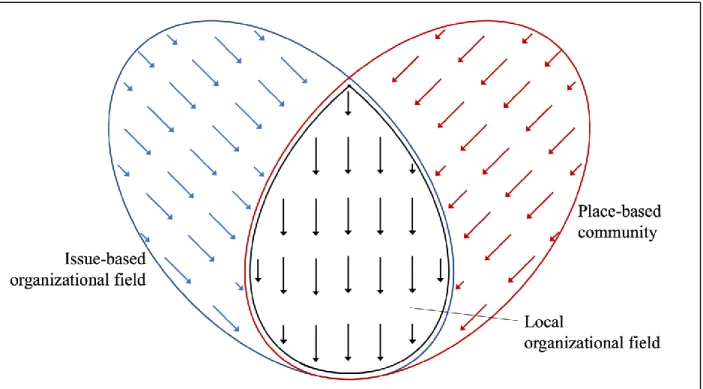
Summarizing the development of the organizational field construct in Organizational Institutionalism, Wooten and Hoffman (2017) argue that the dialogic conceptualization of fields – pioneered by Scott (1995) and Hoffman (1999) – changed the kinds of organizational connections that theorists saw. important for institutional processes. This reconceptualization of the organizational field as a context shaped around a common issue is in . institutional theory. In particular, this literature outlines a kind of place-bound institutional environment that is conceptually distinct from the issue-based and geographically independent organizational field.
Recall that Scott (1995) referred to the organizational field as a “community of organizations” (p. 56), which is consistent with this idea. It is therefore not surprising that the organizational domain dominates as the level of analysis preferred by institutional scholars.
Social Practices and Structuration Theory
The basic domain of study of the social sciences," he wrote, "is social practices ordered over space and time" (Giddens, 1984; p. 2). It should be noted that a geographic community, and the social templates and rules specific to it, can complicate social practices (Lawrence & Dover, 2015; Marquis & Battilana, 2009). For example, local stakeholders may be interested in what local data sources, in particular, reveal about an issue in their area (e.g., homeless assistance in Nashville), and thus the practice of analyzing data for actors attempting to appeal to local stakeholders complicated.
Similarly, local philanthropic foundations might be receptive to certain ways of organizing homeless services (for example, foundations in Nashville might be more receptive to religious frameworks than foundations in Seattle), thereby reducing the practice of writing grants for homeless service organizations that try to reach local people speaking becomes more difficult. foundations. Because a community organization is an organization that is centrally concerned with an issue or issues in its own community, its social practices—compared to those of other organizations (e.g., the National Alliance to End Homelessness)—are more likely to be influenced by community culture .
Institutional Work
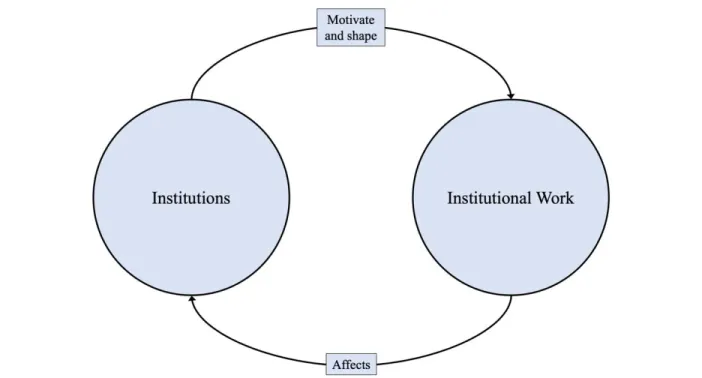
On the one hand, Housing First can refer to a general philosophy or paradigm of helping the homeless (Schiff & Schiff, 2014). Housing First's remarkable emergence as a macro-level institution in homelessness amid countervailing macro-level pressures provides the necessary background for. In other words, the institutional work of OTN at the local level is in a way part of the wider story of the institutionalization of Housing First in the whole area.
Answering these questions seemed necessary to determine the purpose behind OTN's institutional work and the relevance of this work to the Housing First paradigm. Housing First” was not an obvious choice, because homeless services are full of competing definitions and models. To what extent are OTN's idealized homeless outreach practices (including the members' own understanding of .. Housing First) consistent with the Housing First paradigm.
Taken together, these questions were a useful prerequisite for understanding the institutional work of OTN in the field of helping the homeless. Question 2(a) focuses on the activities that make up OTN's institutional work in assisting the homeless in Nashville. Finally, question 3(c) seeks to understand how OTN's efforts to influence wider community institutions might in turn influence the local Housing First institution.
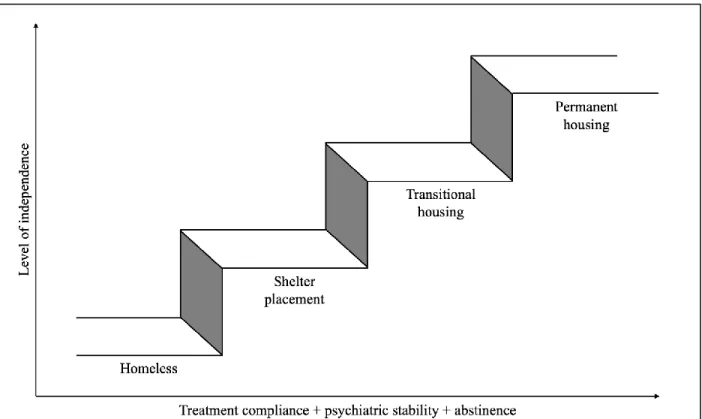
As mentioned earlier in this chapter, the meaning system of the field of homeless assistance facilitates the discussion of housing in the first place opposite. In the background above, I explained how the Housing First paradigm broke the dominance of the staircase model and became an institution in the field of helping the homeless. To this end, the chapter describes OTN's culture of homeless assistance and its alignment with the Housing First paradigm.
OTN's culture is also important to subsequent discussions about OTN's institutional work related to Housing First. It informs and motivates the organization's embrace of Housing First and its institutional work in the community.
We See Them as Friends”
The section concludes with comments on the tensions between service delivery and OTN's ideals. So I think it's both the fact that we have personal relationships with so many of our quote-unquote "customers." OTN's language of friendship and rejection of the service-client nomenclature also underscore the organization's conscious resistance to "transactional."
The emphasis on the word "friend" idealizes a relationship that is less based on service and more based on mutual love and trust.
We Meet People Where They Are”
Instead, OTN workers go to the camps, search the streets, drop by homes, visit hospital rooms, go to court hearings, and travel to other local places where OTN's "friends" are at any given time. As a result, the organization's field workers tend to work from their cars and spend much less time at OTN headquarters compared to administrative staff. In another sense, to meet someone where they are is to perceive and meet their immediate needs – that is, to engage in personalized daily assistance that experientially recognizes "where" the individual exists.
Meeting immediate needs may or may not be directly related to permanent housing; For example, this could include help securing “social security cards or birth certificates to get them into housing” or basic necessities such as “a pair of socks or sometimes. Instead, OTN connects people to other organizations in the community that can better meet needs. In an effort to meet immediate needs, OTN has also worked to fill gaps in Nashville's inventory of temporary shelter options.
The need for basic resources has expanded; due to the economic disruption some of OTN's "friends" were experiencing before. Meeting the immediate needs of people experiencing homelessness constitutes much of OTN's outreach activities. Meeting immediate needs is a way to parachute into where someone is at.
Finally, meeting someone where he/she is means suppressing the expectations he/she has, namely the expectations about how he/she should behave or what goals he/she should pursue. In the field of homeless services, policies and practices around alcohol and substance use are a common way for people experiencing homelessness to lose their autonomy; with still the staircase model. For OTN, meeting someone where he/she is means respecting the decisions he/she has made.
Developing That Relationship”
We certainly want – we fully advocate that a person has the freedom of choice over his life, to be an autonomous person who can choose for himself. I think that's part of the trust element of our work – of our relational model of meeting them where they are, without expectations, building trust and developing that relationship. And when you have that trust and that relationship, conversations about substance abuse can happen.
Indeed, it is difficult to separate the act of building a relationship from OTN's practice of helping the homeless.
Mobilizing Them in the Direction of Housing
OTN's practice of travel informs its affiliation with and advocates for the Housing First paradigm. In addition, OTN members sometimes cited the professional authorities in the homeless assistance field to justify Housing First. OTN informants spoke of the Housing First paradigm as not just a good idea, but imperative.
This is not surprising, given that this dimension is related to the literal meaning of "residential first" and given that v. However, informants often cited these beliefs as a motivation for aligning OTN with the Housing First paradigm. Overall, it's easy to see why OTN has adopted "Housing First" as a slogan and philosophy for helping the homeless.
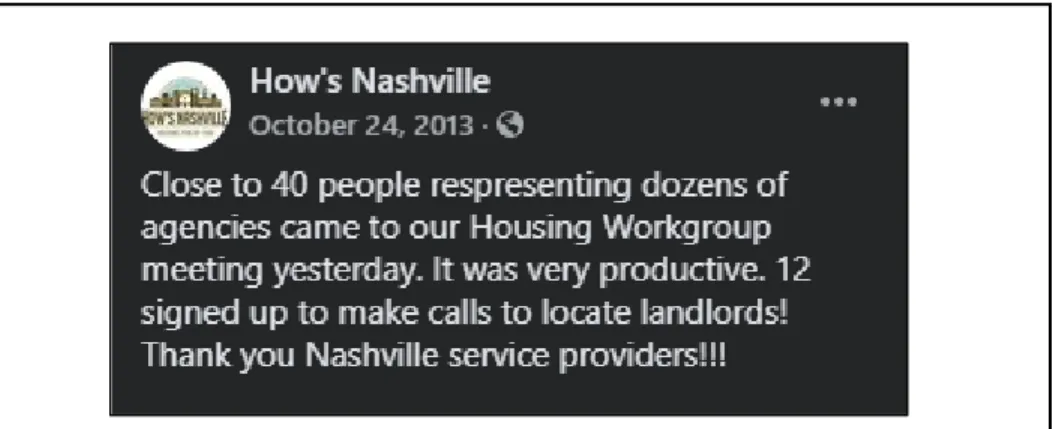
The first case study is about the How it is in Nashville campaign, which attempted to mobilize support for the Housing First paradigm in Nashville. Since Nashville's homeless organizations are fully involved in the field of homeless assistance, it is likely that some local awareness of Housing First existed earlier. Another tip about the Housing First concept of the How's Nashville campaign can be found in the instructions for participating landlords.
Thus, the How's Nashville campaign can be interpreted as an attempt to articulate a local version of the Housing First paradigm as it was widely conceived in the field of homeless assistance (alongside other practices associated with the 100,000 Homes campaign, such as the use of a vulnerability index to prioritize people for help). That's why, after the end of How's Nashville, OTN continues to advocate for Housing First and work to make it a stronger homelessness institution in Nashville. All of this institutional work—from the time of the How's Nashville campaign to the present day—centers on one institution on the ground: Housing First.
As part of the steering committee of How's Nashville, OTN tried to convince its colleagues in Nashville that Housing First was especially feasible in Nashville. This was not surprising given OTN's culture of homeless outreach and its alignment with the Housing First paradigm discussed in the previous chapter.