The macroeconomic impact of bank capital requirements in emerging economies:
Past evidence to assess the future
Maria Concetta Chiuri
a, Giovanni Ferri
a, Giovanni Majnoni
b,*aUniversitaadegli Studi di Bari, Department of Economics, Via Camillo Rosalba, 57-70124 Bari, Italy
bThe World Bank, 1818 H Street N.W., Washington, DC 20433, USA
Abstract
We test for emerging economies the hypothesis – previously verified for G-10 countries only – that the enforcement of bank capital asset requirements (CARs) curtails the supply of credit.
The econometric analysis on individual bank data suggests three main results. First, CAR en- forcement significantly trimmed credit supply, particularly at less-well capitalized banks. Sec- ond, the negative impact has been larger for countries enforcing CARs in the aftermath of a currency/financial crisis. Third, the adverse impact of CARs has been somewhat smaller for foreign-owned banks, suggesting that opening up to foreign investors may have partly shielded the domestic banking sector from negative shocks. Overall, CAR enforcement – inducing banks to reduce their lending – may have had both beneficial and detrimental effects. On one hand, it may have reduced ill-advised lending – possibly induced by banks’ exploitation of the public safety net – and this is desirable. On the other hand, CAR enforcement may have induced an aggregate credit slowdown or contraction in the examined emerging countries, thus exacerbating liquidity constraints and negatively affecting real activity. This paper is relevant to the ongoing debate on the impact of the revision of bank CARs, as contemplated by the new Basel proposal. Our results suggest that in several emerging economies the revision of bank CARs could well induce a credit supply retrenchment, which should not be underesti- mated. Ó 2002 Elsevier Science B.V. All rights reserved.
JEL classification:G18; G21; G28
Keywords:Bank capital requirements; Solvency regulations; Capital crunch
www.elsevier.com/locate/econbase
*Corresponding author. Fax: +1-202-522-2031.
E-mail address:[email protected] (G. Majnoni).
0378-4266/02/$ - see front matterÓ 2002 Elsevier Science B.V. All rights reserved.
PII: S 0 3 7 8 - 4 2 6 6 ( 0 1 ) 0 0 2 6 7 - 9
1. Introduction
During the last decade an increasing number of emerging countries adopted stiffer rules for bank minimum capital requirements following the spirit, if not the letter, of the 1988 Capital Accord proposed by the Basel Committee on Banking Supervision for ‘‘internationally active’’ banks of G-10 countries. As a result, the Accord, initially designed to provide a level playing field for internationally active banks, has become a model for capital regulation of national banking systems in both developed and emerging countries.
Following the early phases of implementation of the Accord in developed coun- tries, a widespread concern emerged about the possible negative impact that higher capital requirements could exert on the level of economic activity, especially during economic downturns. The intense debate led to a number of empirical analyses, which identified several cases in which binding capital requirements led to a sudden contraction of bank lending.1On the occasion, Mr. Richard Syron, president of the Federal Reserve Bank of Boston, coined the expression ‘‘capital crunch’’ to charac- terize the simultaneous shortage of capital and the limited banks’ ability to grant new loans that occurred during the 1990–1991 recession in the United States.2
More recently, following the widespread adoption of Basel-like minimum banks’
capital requirements, similar concerns have been expressed for emerging economies.
Several authors have claimed that the tightening of capital requirements – or their more stringent enforcement – contributed to the depth and length of the financial cri- sis of East Asian economies. Indeed, the issue seems even more relevant for emerging economies than it might have been for G-10 economies, given the larger role that banking systems usually play in the former countries.
This paper explores the effects of the introduction of Basel-like capital require- ments on bank lending policies in emerging countries and extends previous empirical analyses in several directions. In the first place, we expand earlier studies – focusing on single countries – to a larger set of emerging economies.3Secondly, rather than looking at individual countries in isolation, we group a relatively large number of emerging countries – which have adopted and enforced capital regulation in the last decade – and look at the statistical regularities arising from their joint analysis.
Thirdly, rather than relying on aggregate data, we analyze the behavior of individual banks active in each selected country, thus being better able to identify supply-driven credit restrictions. Finally, our framework encompasses both shocks to bank capital arising from external sources – such as business cycle related losses – and shocks originating from regulatory sources – such as in the case of an increase in capital ratios.
1For an exhaustive and updated survey of the literature on the impact of capital requirements on the level of economic activity, see Basel Committee on Banking Supervision (1999).
2Remark reported in Bernanke and Lown (1991, p. 221).
3Previous empirical work on the impact of capital requirements on bank lending in developing countries includes Ferri and Kang (1999).
The evidence gathered in the paper points to three major results. First, the en- forcement of capital adequacy requirements has had on average a negative effect on the supply of bank loans over a multiyear horizon and the effect tends to be stron- ger for initially less capitalized banks. Second, the impact of higher capital require- ments has been larger for those countries implementing enforcement practices in the aftermath of financial crises. Third, the adverse impact of more stringent minimum capital regulations on their deposit taking has been somewhat smaller for foreign- owned banks, suggesting that opening domestic banking to foreign ownership or to the entry of foreign institutions may be an effective way of partly shielding the do- mestic banking sector from negative shocks. Overall, higher capital requirements seem to exert a rather general and negative effect on bank lending in emerging econ- omies, whether affected by crises or not. While this may have beneficial effects – pos- sibly reducing ill-advised lending engaged in by banks exploiting the safety net provided by their governments – capital asset requirement (CAR) enforcement may also induce an aggregate credit slowdown or contraction in the examined emerging countries, thus exacerbating liquidity constraints and negatively affecting real activity.
Accordingly, in view of the potential damage of such evolution, our analysis sug- gests using caution in the process of raising minimum capital requirements in emerg- ing economies, where financing channels alternative to the banking system are generally weaker. Under these circumstances, a sudden reduction of bank loans could have negative long-lasting effects on these economies growth opportunities.
(Greenwald and Stiglitz, 1993). Adequate phasing in procedures should, therefore, be considered for those economies which are planning to introduce new and higher capital requirements as a result of the revised Capital Accord or as a result of local supervisory authorities’ decision of introducing higher than the Basel suggested min- imum capital ratios.
More generally, our analysis is consistent with the view that risk-based capital re- quirements has positive disciplining effects, but that such effects are likely to be lower for developing countries with a weak regulatory framework, e.g. where adequate ac- counting standards, a proper definition of regulatory capital, and sound provisioning practices are not in place. For these economies it is also likely that the macroeco- nomic effects of a sudden and generalized reduction of bank lending may be larger than in industrialized economies, given the central role of the banking system in most emerging financial systems.
In the following section we survey the considerable literature – mostly referred to developed countries – devoted to the analysis of the impact of the 1988 Basel CARs (Section 2). Section 3 outlines our methodological framework – building on the sem- inal contribution of Peek and Rosengren (1995) – to identify the impact of the en- forcement of the 1988 Basel CARs in emerging economies. Specifically, we single out crisis countries – in which the enforcement likely took place under external pres- sures – from the others. Section 4 describes the procedure adopted to select the sam- ple of emerging economies and Section 5 exposes our testing strategy. We present the econometric results in Section 6, while Section 7 concludes.
2. The impact of CARs on bank behavior: Previous contributions and open issues It is a well-known tenet that capital adequacy rules have an impact on bank be- havior. 4Specifically, the literature focuses on two aspects. First, it is believed that the introduction of capital adequacy rules will normally strengthen bank capital and, thus, improve the resilience of banks to negative shocks. A second order of ef- fects concerns banks’ risk taking behavior. If, as it happens, capital adequacy rules establish higher capital standards for loans to the private sector than for credits vis-aa-vis the public sector (e.g. Treasury securities), the introduction of these rules, might cause a shift in banks’ balance sheets from the former to the latter assets. It cannot be excluded, either, a perverse risk shifting pattern, by which banks in order to finance new and higher capital requirements may move along the efficiency fron- tier towards more profitable and riskier loans. 5
In general the question is whether banks fulfill the CARs mainly by reducing risk- weighted assets (the denominator) or by increasing capital (the numerator), the latter course being impaired by shallow domestic capital markets in emerging economies. 6 A second question concerns more specifically whether higher capital standards lead banks to contract their supply of loans – as an effective way of reducing risk- weighted assets – again with potentially larger effects in emerging economies where bank loans represent a larger share in the corporate sector’s external finance.
In the US the possible link between stiffening capital adequacy and contraction in bank loans has been debated at length in the effort of explaining the early 1990s re- cession. By historical standard such recession was rather mild and yet recovery was extremely slow. Various authors attributed such tardy recovery to the capital crunch, that is to a credit crunch7supposedly precipitated by the introduction in the US of the new Basel Committee capital adequacy standards. 8
Various authors, using different methodologies, contribute to this interpretation.
Some of the relevant papers have used cross-sectional bank-level data. Bernanke and Lown (1991) show that loan growth at individual banks between 1990:Q2 and 1991:Q1 was positively linked to initial capital ratios. Berger and Udell (1994) concur that the expansion of loans was lower in 1990–1992 for less-capitalized banks, but do not detect a sensitivity of loan expansion to capital ratios higher than the one ob-
4For general discussion, see Dewatripont and Tirole (1994) and Freixas and Rochet (1997).
5The substitution toward riskier loans can take place also in anticipation of future and higher capital requirement, as suggested by Anthony Saunders. Unfortunately, lack of data on future CAR enforcement anticipation makes it impossible to test this alternative interpretation.
6Some authors show that banks shift away from high risk-weighted assets when capital requirements are binding for them: e.g. Dahl and Shrieves (1990), Aggarwal and Jacques (1997), and Jacques and Nigro (1997). Others try to assess whether negative shocks to capital induced Japanese banks to restrict loans:
e.g. Kim and Moreno (1994), Ito and Sasaki (1998), Peek and Rosengren (1997).
7See Council of Economic Advisors (1991) for a definition of ‘‘credit crunch’’.
8Following the 1988 Basel Committee rules, loans to the private sector require the bank to post a minimum of 8% in qualifying capital equivalent, whereas credits on the State sector bear a zero requirement. In the US, Basel Committee capital standards were formally approved in 1989 and phased in at the end of 1990.
served during the recession of the early 1980s. Peek and Rosengren (1995) introduce an influential method to address the issue of identification of supply-induced effects.
Namely, they argue that capital-unconstrained banks should react to negative shocks to capital by intensifying deposit taking, thus, when banks are not capital con- strained, one should expect a negative relationship between shocks to capital and de- posit taking. On the contrary, they find a positive link between shocks to capital and the dynamics of deposits in 1990. They conclude that this evidence suggests that the capital constraints for banks were pervasive and that the impact of the new Basel Committee ratios was larger for banks having lower initial capital ratios. All in all, most contributions published on the issue9support the hypothesis that the cap- ital crunch adversely affected loan expansion in the US at the beginning of the 1990s.
A comprehensive paper by the Basel Committee on Banking Supervision (1999) surveys the evidence for G-10 countries on the response of banks to the enforcement of the 1988 CARs. The paper’s main findings are that ‘‘there is some evidence that bank capital pressures during cyclical downturns in the US and Japan may have lim- ited bank lending in those periods and contributed to the economic weakness in some macroeconomic sectors’’. However, the report argues that for G-10 countries these effects ‘‘may well have reflected both regulatory and market pressures on banks to maintain ratios at least as high as minimum’’ (Basel Committee on Banking Su- pervision, 1999, p. 2). In a recent analysis, the Basel Committee on Banking Supervi- sion (2000) has argued that – other things being equal – risk-sensitive capital requirements tend to increase the pro-cyclical nature of capital ratios and this, there- fore, may exert an impact on the macroeconomic cycle. The analysis goes on to note that although the empirical evidence for developed countries – as already mentioned – is mixed, the relevance of the impact is likely to be highly dependent on historical and institutional factors and, more specifically, on the presence of an important bank credit channel in the economy.
3. Testing hypotheses and methodology
In choosing our econometric approach we were aware of the well-known problem of identifying supply-driven contractions in intermediation. Such contractions may, in fact, also stem from demand determinants. Accordingly, our results would be hardly interpretable if our approach didn’t pay enough attention to the identification issue. In view of this, the methodology we follow in our econometric analysis is the one proposed by Peek and Rosengren (1995). The Peek and Rosengren framework can be easily generalized in order to model the effect that changes in capital regula- tion might cause on deposits and loans of banks operating in emerging economies. In particular, capital shortages in the banks included in our sample may have derived
9A notable exception is Sharpe (1995), who presents a survey of this literature and a critical review of its research findings. He argues that the evidence in favor of a capital crunch is far from conclusive, the only exception being the evidence for banking in New England where the support for the capital crunch is reasonably firm.
from two sources: the first stems from loan losses, forcing banks to write down cap- ital; the second is due to changes in regulation, raising banks’ capital ratio. 10
In order to derive the implications of the two sources of shocks it is useful to refer to the following simplified version of the banks’ balance sheet:
Dþ ðRKþEKÞ DþTK¼LþB ð1Þ
where D¼Deposits, RK¼Regulatory Capital, EK ¼Excess Capital, TK¼Total Capital, L¼Loans, andB¼Bonds.
We also assume that capital regulation is defined by the leverage ratio
k¼RK=L ð2Þ
and that supply determined loans can be expressed as
L¼RK=k: ð3Þ
From Eqs. (1) and (2) we obtain the following expression for deposits:
D¼LþB ðRKþEKÞ ¼RK=kRKEKþB which by total differentiation becomes
dD¼ ðð1=kÞ 1ÞdRKþ ðRKÞdð1=kÞ dEKþdB: ð4Þ As a matter of completeness, we further assume that banks do not wish to change their bond holdings (dB¼0). Then we can also totally differentiate the expression (3) for loans and have
dL¼ ð1=kÞdRKþRKdð1=kÞ: ð5Þ
Both expressions (4) and (5) are discussed within three distinct scenarios:
1. the crisis case, when a negative shock to total capital affects bank lending and li- abilities (i.e. dTK<0);
2. the regulatory restriction case, when a change in regulation raises the fixed mini- mum capital requirement (i.e. dk>0);
3. the case of crisis with regulatory restriction, when the regulatory restriction takes place during a financial crisis and the previous two impacts need to be considered simultaneously.
3.1. The crisis case
It is easy to see from Eq. (4) that if the bank is capital constrained ðdEK ¼0 and dTK¼dRKÞ, the impact of a decrease in capital (and in regulatory capital) determines an effect of equal sign (reduction) in deposits. Alternatively, if the bank is not capital constrained ðdRK ¼ dEK and dTK¼0Þ the impact will
10The Peek and Rosengren (1995) model describes the effects on bank deposits and loans of profit maximization under different level of banks capital and does not address the possible effects associated to risk shifting induced by new or prospective changes in the levels of bank capital. For a survey of the different risk shifting patterns induced by capital regulation see Freixas and Rochet (1997).
be of opposite sign. This is the case considered by Peek and Rosengren that we shall label as the ‘‘crisis case’’.
Following Peek and Rosengren we have that:
dTK<0)dD=dTK>0 if the bank is capital constrained: ð6aÞ dTK<0)dD=dTK<0 if the bank is not capital constrained: ð6bÞ dTK<0)dL=dTK>0 if the bank is capital constrained: ð6cÞ dTK<0)dL=dTK¼0 if the bank is not capital constrained: ð6dÞ A direct implementation of these results (see Peek and Rosengren, 1995) is testing whether there is a positive correlation between a change in capital (dTK) and in deposits (and/or loans).
3.2. The case of regulatory change
Let us now consider the ‘‘regulatory case’’. Capital shortages may derive from an increase in capital ratio (here the leverage ratio k). If effective, this exogenous in- crease will cause a reduction in deposits of the constrained banks (since dEK ¼0).
The impact on the unconstrained bank instead will be null, since there will only be a substitution of excess capital with regulatory capital dEK ¼ RK ðdk=kÞ.11
Therefore in this second case we have that an increase in the capital ratio ðk¼K=LÞhas a clear-cut impact on deposits and loans whenever the bank is capital constrained:
dk>0)dD<0 if the bank is capital constrained: ð7aÞ dk>0)dD¼0 if the bank is not capital constrained: ð7bÞ dk>0)dL<0 if the bank is capital constrained: ð7cÞ dk>0)dL¼0 if the bank is not capital constrained: ð7dÞ Note though that an increase in the capital ratioðdk>0Þdoes not imply a pre- defined variation of total capital TK. Still, where banks are capital constrained and have limited asset alternative to loans, the presence of an idiosyncratic negative shock to capital should lead to a positive correlation between changes in capital and deposits (loans). In addition, the correlation becomes stronger with the increase of the leverage ratio (k).12
11This expression can be derived substituting the relation, dRK¼ dEK, which holds for unconstrained banks, in Eq. (4).
12From Eq. (4) we can observe that for a capital constrained banks (i.e. when dTK¼dRK) dD=dTK>0 if dTK=TK<ð1=ð1kÞÞ ðdðkÞ=kÞ.
3.3. The case of crisis with regulatory restriction
We are now ready to consider the third case in which capital shortage may derive both from losses and from the introduction of a more restrictive capital regulation. If the bank is capital constrained ðdEK¼0Þwe shall have a cumulative effect driven by the capital reduction due to losses (lower deposits) and by a higher capital ratio (lower deposits). The impact on deposits of the negative shock on capital, foreseen by Peek and Rosengren, would therefore be reinforced. If the bank is not capital con- strained then the cumulative effect should be similar to that foreseen by Peek and Rosengren. In fact the increase in regulatory capital would be absorbed by a com- pensating reduction in excess capital ðdEK ¼dRKÞ with no effects on deposits (Eq. (7b)) while the negative shock to total capital would again be transmitted with a negative sign to deposits (Eq. (6b)).
Looking at the loan side we can easily see that the increase in capital ratio (k) (Eq.
(7c)) and the decrease in total capital (TK) (Eq. (6c)) will have a negative impact for capital constrained banks. The sum of the two effects in the ‘‘crisis’’ plus ‘‘regulatory tightening’’ is likely to have a magnified effect.
dTK<0 and dk>0)dD<0 if the bank is capital constrained: ð8aÞ dTK<0 and dk>0)dD>0 if the bank is notðenoughÞcapital constrained ðnote that dD>0 iff dEK>RK ðdk=kÞÞ: ð8bÞ dTK<0 and dk>0)dL<0 if the bank is capital constrained: ð8cÞ dTK <0 and dk>0)dL¼0 if the bank is notðenoughÞcapital constrained:
ð8dÞ Therefore, when a regulatory restriction is enforced during a financial crisis, it is less likely that we find a negative correlation between changes in capital and changes in deposits (loans). This would only materialize for banks not (enough) cap- ital constrained, either being well capitalized or undergoing smaller negative capital shocks.
4. The estimation sample
We have just shown that under the latter two scenarios the impact of a regulatory restriction may not only reinforce the effect of a crisis on deposits and lending but may also lower the supply of credit in a stable economy. The next step is to test those theoretical hypotheses on a sample of banks operating in emerging economies. Al- though in principle interesting, we disregard the first scenario, i.e. the crisis case, given the sufficient evidence already provided in the literature.
The definition of the estimation sample needs to address some specific issues. In fact the Basel 1988 Capital Accord was signed by G10 countries, while non-G10 adopted it on a voluntary basis and therefore without any pre-defined time schedule.
This requires a specific effort in the definition of the proper date of introduction of new capital regulation. A second relevant issue is that several non-G10 countries have relatively weak regulatory and supervisory structures and therefore the simple introduction of new capital requirements cannot be considered equivalent to their enforcement. It is a matter of fact that national regulators had a certain leeway in the effective enforcement of bank CARs. As a result, enforcement didn’t always fol- low the introduction of the 1988 Basel CARs. For this reason we need to identify those emerging economies in which capital requirements were not only increased but also enforced. The identification of the countries and of the dates where CARs were effectively enforced has been made possible by an extensive survey of the IMF Article IV Consultation documents for a very large selection of emerging economies over each year of the last decade. These documents offered us an independent and well-informed assessment of whether and when enforcement had followed the intro- duction of the Basel-like CARs.
In these documents we looked for a number of policy actions that can be consid- ered as a signal of a more rigorous stance of bank supervisory authorities and can be used as indicators of a more effective enforcement of bank capital discipline. Among them, we considered: (i) a more severe approach to provisioning practices (e.g. the introduction of more restrictive criteria in the definition of non-performing loans or more stringent provisioning requirements); (ii) changes in the bankruptcy regula- tion; (iii) the implementation of bank restructuring programs and/or reorganization of bank supervisory agencies.
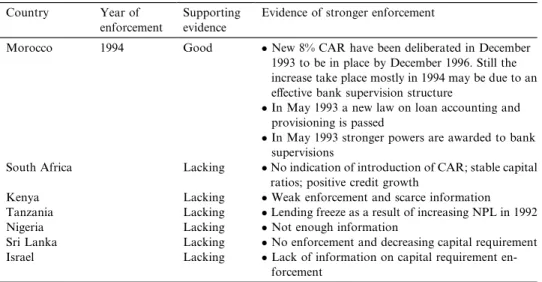
On the basis of these indicators we detected 16 countries in which the introduction or the revision of capital requirements was accompanied by measures of more effec- tive supervision. For each of them we have also identified the year in which these measures were taken. This group includes 10 countries in which the regulatory change happened in conjunction with an exchange rate and/or financial crisis (Argentina, Brazil, Hungary, Korea, Malaysia, Mexico, Paraguay, Thailand, Tur- key, and Venezuela)13and other five non-crisis countries (Chile, Costa Rica, India, Poland, and Slovenia). A sixth non-crisis country (Morocco) had to be eliminated due to the lack of data on bank loans and deposits associated to different accounting procedures of Islamic banking. We also contemplated the possibility of different de- grees of enforcement, identifying a subset of 10 countries for which the evidence of enforcement is more convincing. In this latter group the crisis countries were eight and the non-crisis two. A more detailed description of the change in legislation oc- curred in each country and the year of enforcement is contained in Table 1 (for crisis
13We identified crisis countries according to the two lists provided in Detragiache and Demirg€uucß-Kunt (1998) and Kaminsky and Reinhart (1999). Hungary was added to such a list, since it did undergo a crisis even though it was not highlighted by the two referred studies, which did not consider transition economies. Furthermore, we did not include India among crisis countries since its banking crisis occurred a few years before India enforced Basel CARs.
countries), in Table 2 (for non-crisis countries), and in Table 3 (for countries that were considered but not included due to lack of evidence).
On the basis of the 15 selected countries we then verified the number of banks for which we have (from Bankscope) the balance sheet/profit and loss accounts in the years which precede and follow the enforcement date, as required for the empirical
Table 1
Identifying CAR enforcement in crisis countries Country Year of en-
forcement
Supporting evidence
Evidence of stronger enforcement
Argentina 1994 Good CAR has been increased from 8.5% (December 93) to 11.5% (January 95) and regulatory capital has increased from $6.7 bn to $8.7 bn from December 93 to May 95 In June 1994, have been introduced stricter rules on loan loss provisioning
Brazil 1997 Good Capital requirements were increased from 8% to 10%
Introduction of consolidated supervision Hungary 1992 and
1994
Good 1992: stricter provisioning rules with a revised bankruptcy code made provisioning effective with negative effects on bank lending
1994
(a) In December 1994, 8% CAR (deliberated in 1991) became effective
(b) New provisioning rules
(c) But capital is supplied by the public sector Korea 1997 Good In December 1997 the issuance of stricter loan classifi-
cation and provisioning rules (which still fall behind international practices) was announced: it was planned to take place by July 1998
Malaysia 1997 Good In late 1997, after the crisis unfolded, new stricter loan classification and provisioning rules were announced.
The new rules should be substantially in line with best international practices. Their implementation was sup- posed to start in January 1998. The Malaysian authorities changed their mind later on, in September 1998 Mexico 1993 Weak Introduction of 8% CAR but weak accounting proce-
dures (massive deferred tax credit in Tier 2) may have reduced the impact
Paraguay 1994 Weak 15% CAR has been introduced but there is evidence of weak enforcement
Thailand 1997 Good In late 1997, after the crisis unfolded, the issuance of new stricter loan classification and provisioning rules was announced. The new rules should be in line with best international practices. Implementation was supposedly phased-in July 1998/end-2000
Turkey 1994 Good Introduction of 8% CAR
Venezuela 1994 Good Capital requirements were increased from 3% to 6% (to 8% in the first quarter 1996) at a rate of 2% per year NPL were reduced from 15% to 7% of total loans
analysis. In the 15 countries previously listed we were able to select 572 banks (426 for crisis countries and 146 for non-crisis countries).
We also selected among these banks those that are owned by Western banking in- stitutions, because the impact of regulatory restrictions could be smaller for these banks.14There are various reasons why we could ex ante expect this to be the case.
Table 2
Identifying CAR enforcement in non-crisis countries Country Year of
enforcement
Supporting evidence
Evidence of stronger enforcement
Chile 1997 Good Introduction of 8% CAR
Costa Rica 1998 Weak CAR is increased from 9% to 10% but is not binding No evidence of previous evolution of capital regulation India 1996 Good CAR of 8% (deliberated in 1991) become effective in
March 1996
More restrictive loan classification procedure introduced Strengthening of on-site supervision
Poland 1993 Weak A public recapitalization plan of the banking system is undertaken which will put the system on a right track from there on
Slovenia 1994 Weak There is an increase of CAR from 6.25% to 8% but the system appears overcapitalized
Table 3 Further evidence
Country Year of
enforcement
Supporting evidence
Evidence of stronger enforcement
Morocco 1994 Good New 8% CAR have been deliberated in December
1993 to be in place by December 1996. Still the increase take place mostly in 1994 may be due to an effective bank supervision structure
In May 1993 a new law on loan accounting and provisioning is passed
In May 1993 stronger powers are awarded to bank supervisions
South Africa Lacking No indication of introduction of CAR; stable capital ratios; positive credit growth
Kenya Lacking Weak enforcement and scarce information
Tanzania Lacking Lending freeze as a result of increasing NPL in 1992
Nigeria Lacking Not enough information
Sri Lanka Lacking No enforcement and decreasing capital requirement
Israel Lacking Lack of information on capital requirement en-
forcement
14We exclude Japanese ownership because the Japanese crisis largely coincided with the period of observation – the 1990s – thus making it a possible further source of instability rather than a stabilizing factor (Peek and Rosengren, 1997).
First, foreign banks may be more efficient and more resilient to negative shocks (Claessens et al., 1998; Clarke et al., 1999). Second, as the bulk of their business is elsewhere a local negative shock is less likely to affect their underlying strength. Ac- cordingly, we should control for whether the bank is domestic or foreign owned.
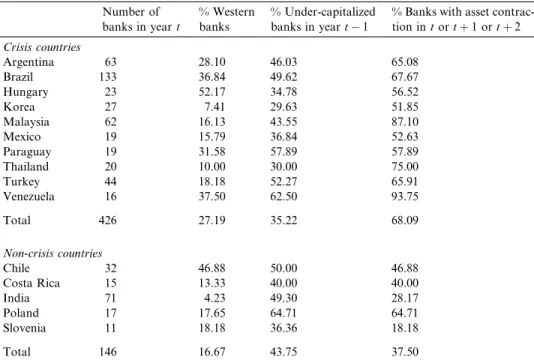
Table 4 contains the sample composition by country, including also additional in- formation on: (i) the percentage of banks with foreign ownership in Western coun- tries; (ii) the percentage of banks that were undercapitalized in the pre-enforcement year; and (iii) the percentage of banks suffering an asset reduction either at yeartor at yearðtþ1Þor at yearðtþ2Þ. The largest percentage of banks included in the sam- ple are Brazilian and Indian, the smallest those of Venezuela and Slovenia. India is also the country with the lowest foreign presence in the banking sector (only 4%).
Since Indian banks account for almost half of non-crisis countries’ banks, this helps explain why Western ownership is on average larger in crisis than in non-crisis coun- tries. Venezuela had the largest percentage both of undercapitalized banks and of banks suffering an asset reduction either in the year of enforcement or in the follow- ing two years. On average, the percentage of banks experiencing an asset reduction with the enforcement is almost twice as large in crisis than in non-crisis countries.
Table 4
The Bankscope sample Number of banks in yeart
% Western banks
% Under-capitalized banks in yeart1
% Banks with asset contrac- tion intortþ1 ortþ2 Crisis countries
Argentina 63 28.10 46.03 65.08
Brazil 133 36.84 49.62 67.67
Hungary 23 52.17 34.78 56.52
Korea 27 7.41 29.63 51.85
Malaysia 62 16.13 43.55 87.10
Mexico 19 15.79 36.84 52.63
Paraguay 19 31.58 57.89 57.89
Thailand 20 10.00 30.00 75.00
Turkey 44 18.18 52.27 65.91
Venezuela 16 37.50 62.50 93.75
Total 426 27.19 35.22 68.09
Non-crisis countries
Chile 32 46.88 50.00 46.88
Costa Rica 15 13.33 40.00 40.00
India 71 4.23 49.30 28.17
Poland 17 17.65 64.71 64.71
Slovenia 11 18.18 36.36 18.18
Total 146 16.67 43.75 37.50
The table reports the number of banks by country included in the sample. For each country the percentage of foreign-owned banks, excluding the ownership held by other crisis and developing countries, is given.
The percentage of under-capitalized banks is computed as the one of banks with CAR lower than the median level, by country, the year before the regulatory shock (i.e. att1). The last column includes by country, the percentage of banks with an asset contraction occurring in yeartorðtþ1Þorðtþ2Þ.
The specific international composition of our sample might well affect the empir- ical results, although we will control for this problem as accurately as possible. Still, it is not an easy task to disentangle the effect of the enforcement of CARs in emerg- ing economies, especially for those economies contemporaneously experiencing a fi- nancial crisis. In Section 3 we pointed out a transmission mechanism caused by a financial tightening and/or a regulatory shock, originating from a contraction in as- sets and especially affecting capital constrained banks. In Table 4, column 3, we make an attempt to evaluate the potentially capital constrained banks in our sample;
we do this by computing the percentage of banks with CARs lower than the sample median by country, at the year preceding the enforcement. This proxy is the best we could find, given the limited information available on CARs regulation by country, especially before the enforcement. On average capital constrained banks, so defined, represent nearly half of our sample. An alternative and indirect measure is provided in the last column of Table 4, reporting the percentage of banks with a drop in assets occurring the years immediately following the enforcement. As expected, such per- centage is higher in crisis countries, whereas the share of undercapitalized banks is analogous between non-crisis and crisis countries.
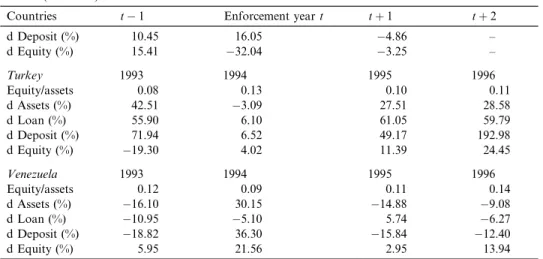
Table 5 (for crisis countries) and Table 6 (for non-crisis countries) provide an overview of the dynamics of relevant banking variables around the period of regu- latory change. They report by country the percentage change in assets, equities, loans and deposits occurring the year before the enforcement, the year of enforcement and over the two years after the enforcement. Furthermore, the two tables also show the evolution of the equity/asset ratio. Data in the tables were computed on a restricted sample excluding Western owned banks; however, the values presented in each col- umn are not strictly comparable, due to missing observations.
At a first glance, the capital asset ratio in all countries does not seem on average to have raised following the change in regulation, possibly reflecting mounting losses.15 There are a few exceptions, as Argentina, Paraguay or Turkey. Moreover, in coun- tries like Venezuela, Thailand, Malaysia, Korea or Brazil, where crises were deeper, we found on average a substantial drop in assets, loans and/or equity. In most of the countries, though, the data show that bank loans and deposits either decreased or reduced their growth rate in the two years following the introduction of new capital requirements.
Table 6, concerning non-crisis countries, shows a less clear trend. During the change in regulation two countries out of five, namely Poland and Slovenia, reported a drop in the average level of equity, or of deposits and loans.
It is apparent from these summary statistics that, although a credit contraction or slowdown has affected almost all of the considered countries in the wake of regula- tory changes, still rather diversified patterns have emerged in different countries.
Only a multinomial analysis conducted at the level of individual banks may properly
15This descriptive statistics could, thus, support Anthony Saunders’ view that banks respond to capital regulation substituting towards riskier loans.
Table 5
Crisis countries – bank balance sheet statistics
Countries t1 Enforcement yeart tþ1 tþ2
Argentina 1993 1994 1995 1996
Equity/assets 0.14 0.16 0.18 0.16
d Assets (%) 67.82 20.87 1.82 30.92
d Loan (%) 44.05 27.16 2.77 20.98
d Deposit (%) 87.84 20.50 1.76 26.63
d Equity (%) 11.87 12.04 1.01 1.51
Brazil 1996 1997 1998 1999
Equity/assets 0.19 0.17 0.21 0.17
d Assets (%) 38.95 9.05 17.71 9.05
d Loan (%) 26.39 9.37 65.29 9.37
d Deposit (%) 41.89 31.50 52.13 31.50
d Equity (%) 10.12 7.08 4.05 7.08
Hungary 1993 1994 1995 1996
Equity/assets 0.18 0.18 0.16 0.12
d Assets (%) 5.71 5.54 0.71 20.72
d Loan (%) 8.14 24.41 19.73 0.84
d Deposit (%) 13.76 9.96 5.48 24.40
d Equity (%) 22.40 1.88 15.53 1.10
Korea 1996 1997 1998 1999
Equity/assets 0.07 0.06 0.05 0.05
d Assets (%) 19.41 18.54 7.96 16.75
d Loan (%) 18.16 12.06 15.90 15.25
d Deposit (%) 19.31 13.90 33.24 24.04
d Equity (%) 6.63 7.33 13.32 4.99
Malaysia 1996 1997 1998 1999
Equity/assets 0.12 0.10 0.09 0.09
d Assets (%) 30.30 29.41 10.72 6.75
d Loan (%) 37.63 27.12 5.51 0.73
d Deposit (%) 30.31 31.35 11.23 11.65
d Equity (%) 37.66 26.05 14.18 3.98
Mexico 1992 1993 1994 1995
Equity/assets 0.08 0.07 0.05 0.05
d Assets (%) 3.21 32.52 48.64 3.04
d Loan (%) 22.02 30.35 40.86 6.00
d Deposit (%) 4.93 25.40 40.83 10.12
d Equity (%) 13.15 22.32 4.85 6.61
Paraguay 1993 1994 1995 1996
Equity/assets 0.09 0.12 0.12 0.13
d Assets (%) 19.97 13.16 17.73 2.30
d Loan (%) 23.49 11.82 31.86 0.53
d Deposit (%) 18.93 10.98 25.23 10.66
d Equity (%) 56.44 67.61 24.68 12.98
Thailand 1996 1997 1998 1999
Equity/assets 0.09 0.05 0.07 –
d Assets (%) 10.83 12.72 8.57 –
d Loan (%) 13.86 13.97 14.57 –
control for the different sources of possible heterogeneity and detect the existence of significant regularities.
5. The testing strategy
Our testing procedure is based on the construction of an international panel whose observations are centered on the year of enforcement. The panel we managed to assemble is an unbalanced one since: (i) there are some missing observations across time, and (ii) the available time length varies by country. The construction of a panel is justified by the fact that the announcement of the change in regulation might have occurred at any time during the year (for instance in Venezuela and Bra- zil it was in June, in Paraguay in December). In general, we expect not to be able to capture the enforcement effect in the same year. This might instead be spread also over the following years.16
In order to test for the effect on deposits and loans of a shock to CARs, we use the Peek and Rosengren (1995) approach, but with some adjustment specifically tailored to our case. We do take into account explicitly the international and inter-temporal dimensions of our sample, by means of panel analysis and by including control vari- ables for year and macroeconomic effects. We estimate the two following regressions:
Table 5 (continued)
Countries t1 Enforcement yeart tþ1 tþ2
d Deposit (%) 10.45 16.05 4.86 –
d Equity (%) 15.41 32.04 3.25 –
Turkey 1993 1994 1995 1996
Equity/assets 0.08 0.13 0.10 0.11
d Assets (%) 42.51 3.09 27.51 28.58
d Loan (%) 55.90 6.10 61.05 59.79
d Deposit (%) 71.94 6.52 49.17 192.98
d Equity (%) 19.30 4.02 11.39 24.45
Venezuela 1993 1994 1995 1996
Equity/assets 0.12 0.09 0.11 0.14
d Assets (%) 16.10 30.15 14.88 9.08
d Loan (%) 10.95 5.10 5.74 6.27
d Deposit (%) 18.82 36.30 15.84 12.40
d Equity (%) 5.95 21.56 2.95 13.94
The table contains the percentage change in assets, capital, loans and deposits by country computed at the enforcement year, the year before and the two following years. The average capital asset ratio is also reported. Values are deflated by the annual consumer-price index. The sample excludes foreign-owned (more than 30% foreign shareholding) banks. Values in each column are not strictly comparable due to missing observations.
16Because of this and also of possible errors in detecting enforcement dates, in our econometrics below we perform some sensitivity analyses.
dDs=As1¼a0þa1TKs1=As1þða2þa3TKs1=As1ÞdTKs=As1 þa4logðAsÞ þa0iDysþa0jXþlbþeD
withs¼ð t 1;t;tþ1Þ; ð9Þ
dLs=As1¼b0þb1TKs1=As1þðb2þb3TKs1=As1ÞdTKs=As1 þb4logðAsÞ þb0iDysþb0jXþlbþeL
withs¼ð t 1;t;tþ1Þ; ð10Þ
Table 6
Non-crisis countries – bank balance sheet statistics
Countries t1 Enforcement yeart tþ1 tþ2
Chile 1996 1997 1998 1999
Equity/assets 0.08 0.07 0.08 –
d Assets (%) 12.77 9.52 5.53 –
d Loans (%) 15.18 17.70 2.87 –
d Deposit (%) 11.57 7.48 7.68 –
d Equity (%) 5.74 4.57 12.23 –
Costa Rica 1996 1997 1998 1999
Equity/assets 0.15 0.12 0.10 0.12
d Assets (%) 4.83 14.76 22.93 7.61
d Loan (%) 1.90 13.22 37.20 17.88
d Deposit (%) 40.34 60.34 28.37 8.19
d Equity (%) 1.19 6.45 8.17 13.48
India 1995 1996 1997 1998
Equity/assets 0.06 0.06 0.06 0.06
d Assets (%) 9.05 13.50 15.83 9.53
d Loan (%) 22.23 9.11 12.73 6.24
d Deposit (%) 7.97 18.59 15.88 8.30
d Equity (%) 34.76 29.35 26.03 0.21
Poland 1992 1993 1994 1995
Equity/assets 0.12 0.07 0.10 0.10
d Assets (%) 8.84 0.19 5.91 12.62
d Loan (%) 3.07 2.87 3.46 34.27
d Deposit (%) 7.68 0.20 10.34 8.08
d Equity (%) 3.13 10.53 18.87 6.69
Slovenia 1993 1994 1995 1996
Equity/assets 0.19 0.19 0.16 0.15
d Assets (%) 33.04 26.19 24.58 11.88
d Loan (%) 30.57 32.18 39.04 5.11
d Deposit (%) 54.33 119.31 27.78 13.73
d Equity (%) 31.83 13.25 12.45 2.59
The table contains the percentage change in assets, capital, loans and deposits by country computed at the enforcement year, the year before and the two following years. The average capital asset ratio is also reported. Values are deflated by the annual consumer-price index. The sample excludes foreign-owned (more than 30% foreign shareholding) banks. Values in each column are not strictly comparable due to missing observations.
where the first line of Eq. (9) is a replica of the specification adopted by Peek and Rosengren (1995) and the variables dTK, dD, dLare normalized by the beginning of period assets. The effect of a change in total capital on dDis captured by the esti- mates of thea2parameter. As shown in Section 3.3, such an impact should decrease with the level of banks’ initial leverage ratio (capital over total assets), since we expect it to be higher for those banks initially undercapitalized. The latter effect will be identified by a3 parameter, provided that potential demand side shocks are controlled for by the logarithm of total assets (logðAÞ), and country/time varying effects are captured by the vector of macrovariablesX. VectorXincludes real GDP growth, the local exchange rate as currency units per US dollar and the local nominal interest rate.17The vectorDysincludes year dummies, having as reference category the year preceding the enforcement. The regression includes a full set of bank fixed effectslband normal i.i.d. random errors,eD;eL respectively. The peculiarity of Eq.
(9) is that it describes a two-way fixed effect error component model where time periods across observations are artificially piled taking the enforcement date as the reference year, instead of listing the calendar years in the usual way.
This methodology can be applied straightforwardly to banks in crisis countries.
Indeed, in crisis countries banks normally suffer macronegative shocks to their cap- ital. Our expectation is that dD=Awill be positively related to the change in banks’
capital endowment. The dynamic of bank deposit and bank capital is in fact crucial for detecting signs of capital crunch in the Peek and Rosengren approach. Should we obtain this result, we will be able to claim that the capital constraints associated with the enforcement of the CARs did shrink bank intermediation, thus further reducing the supply of credit. Such a result should be reinforced where the negative impact of the crisis on bank capital has been strengthened by a more severe enforcement dis- cipline. Typically, we would anticipate the effect of the change in capital to be smaller for banks which have higher initial leverage ratios (i.e. capital/total assets). Corre- spondingly, we expect the estimates of thea3coefficient to be negative, proving that the effect of the change in capital decreases when the ratio of capital over total assets increases.
We run also a similar regression for bank loans (Eq. (10)) to provide a richer per- spective on the evolution of bank loans around the period of regulatory change. We cannot, though, base our empirical estimation of capital crunches on the behavior of the loan equation alone due to a serious statistical shortcoming related to the treat- ment of loan write-offs that we are not able to control for. In fact, the experience of banking crises in developing countries has shown that often simultaneous changes of bank loans and capital do not represent a change of banks’ lending policies but re- flects the impact on both variables of loan write-offs due to the surfacing of hidden losses as a result of banking crises.
Due to the fixed effect panel structure of regressions (9) and (10), we cannot intro- duce additional dummy variables in order to catch the effect of regulatory changes on banks owned by foreign Western investors (controlled here with the dummy
17Source: International Financial Statistics by the IMF.
Dfb¼1, which is the case for one out of four banks; Table 4). For the reasons out- lined above, these banks may be better fit to cope with the regulatory restriction.
However, we can still test for this effect by means of cross-section analysis, where banks’ fixed effects can be substituted by the control variableDfb. We will thus com- plement our panel analysis with the appropriate cross-section regressions.18
The shortcoming of our methodology is that it does not deliver easily interpret- able results for non-crisis countries. There is, in fact, no guarantee that negative capital shocks will prevail for banks in countries that are enforcing CARs during a non-crisis period. In this case, however, any attempt to select banks suffering from an idiosyncratic negative capital shock runs into a small sample problem, since the non- crisis sample only includes 146 banks and 37.5% of them had asset contraction at the time of the regulatory change. 19 We chose therefore to evaluate the effect of the change in capital on deposits and loans – i.e. estimating the following Eqs. (11) and (12) – for the sample of initially undercapitalized banks. Indeed, the sub-sample of low capitalized banks selects banks supposedly forced to reducing their assets to meet their CAR obligations. Therefore, in Eqs. (11) and (12) some of the regressors included in the crisis and regulatory case have been left aside:
dDs=As1¼a0þa1TKs1=As1þa2dTKs=As1þa3logðAsÞ þa0iDysþa0jX þlbþeD withs¼ðt;tþ1Þ; ð11Þ dLs=As1¼b0þb1TKs1=As1þb2dTKs=As1þb3logðAsÞ þb0iDys
þb0jXþlbþeL with s¼ðt;tþ1Þ: ð12Þ Finally, it is worth stating that both sets of Eqs. (9) and (10) and Eqs. (11) and (12) are reduced forms of the systems exposed in Section 3.3 and Section 3.2 respectively.
In our reduced forms, the impact on deposits and loans of a change in CAR regula- tions will be indirectly estimated only through the effect of the change in total capital.
6. The empiricalanalysis: Main results
6.1. Testing the crisis with regulatory change hypothesis
The empirical estimates of Eqs. (9) and (10) for banks in crisis countries are re- ported in Table 7. The results are obtained by means of panel analysis, controlling for bank fixed effects and for country trends in both the financial and the real sector.
18In order to avoid such an identification problem, we could also estimate a random effect model, however in Section 5 we will report results obtained in testing for fixed vs. random effect hypotheses that provide enough evidence against the latter specification.
19Were it feasible to regress Eqs. (9) and (10) above separately for the two classes of banks, we would expect that a2 and b2 be insignificant for unconstrained banks but significant – and positive – for constrained banks. Alternatively, we would expect thata2andb2be significant for both classes but their size be smaller for unconstrained than for constrained banks.
The effects of changes in capital on both the change in deposits and the change in loans are strong and consistent with the theory. Still, we prefer to concentrate on the evidence supplied by the deposit equation which is not affected by the presence of rel- evant loan write-offs during periods of crisis. As predicted by the theoretical analysis of the crisis case with regulatory enforcement, changes in deposits and in loans are positively affected by changes in capital. Thea3parameter in the deposit regression is negative and strongly significant.20Both deposits and loans grow at a higher pace for larger banks [the positive and significant effect of logðAÞ]. This seems consistent with the Too Big To Fail hypothesis, according to which, conscious that the risk of closure during the crisis is lower for larger institutions, depositors move their deposits to larger banks.21Note that in both regressions the time dummies, having as reference category the year prior to the enforcement, are all negative but insignificant. This re- sult suggests that the negative impact of the regulatory change is most virulent at first and then decays. However, to the extent that its impact continues (and the cross-sec- tion results below support this), it spans also to the year following the enforcement and
Table 7
Crisis countries: Panel regression
Variables Dependent variable: dD=A Dependent variable: dL=A Coefficient (standard error) Coefficient (standard error)
Constant 4.9276 (0.3871) 5.7099 (0.5797)
dK=A 1.8516 (0.3941) 1.1223 (0.5721)
K=A 2.9954 (0.2572) 2.7231 (0.3680)
K=AdK=A 2.7270 (0.9391) 1.1489 (1.2409)
logðAÞ 0.5263 (0.0450) 0.6155 (0.0670)
DyðtÞ 0.0178 (0.0343) 0.0749 (0.0483)
Dyðtþ1Þ 0.0363 (0.0361) 0.0473 (0.0514)
Growth in GDP 0.5019 (0.2799) 0.4028 (0.3841)
Interest rate 0.0003 (0.0021) 0.0015 (0.0030)
Loc. Cur./(US$10 000) 0.0002 (0.0003) 0.0003 (0.0003)
N 1072 11052
T 2.6 2.5
R2 0.36 0.24
Fð418;644Þ ¼1:49 Fð413;629Þ ¼1:29
The table reports panel regressions of Eqs. (9) and (10) for the change in deposits and loans occurred in crisis countries the year before, the year of enforcement and the year after (i.e. att1,t,tþ1).
Note:significant at the 10% confidence level,significant at the 5% confidence level,significant at the 1% confidence level.
20For robustness, we also considered two sub-samples. First, the sub-sample of the (some 700) crisis countries’ banks experiencing a drop in total asset either in the year of enforcement or within the following two years. Second, banks in crisis countries where we found strong supporting evidence of the enforcement taking place. In both cases, results were very similar to those in Table 7 (results are not reported but are available from the authors on request).
21Bongini et al. (2000) find evidence of Too Big To Fail policies pursued by national authorities in the East Asian crisis countries included in the crisis countries sample.
it seems to have a systemic nature. 22As regards our economic fundamental controls, only the growth in GDP shows significant positive effects in the deposit equation.
Estimates included in Table 7 have been tested also for autocorrelation; the Balt- agi and Wu (1999) locally best invariant (LBI) test for unbalanced panel and fixed effects and the modified Bhargava et al. Durbin–Watson test for fixed effects pro- vided enough evidence in support of the null hypotheses of zero serial correlation in the disturbances.23 In principle, we could estimate (9) and (10) assuming that the individual bank specific effects were randomly drawn. However, on the basis of results obtained implementing the Breusch–Pagan LM test, we had to conclude that estimates found were not significantly different from the classical pooled regres- sion model. The same conclusion doesn’t hold for the fixed effect hypothesis, as shown by theF-statistics in Table 7. 24
To check for the robustness of our results, in addition to the panel, we report in Tables 8 and 9 the cross-section OLS estimates of Eqs. (9) and (10) restricted to the year of the enforcement and the year thereafter. In addition, as already mentioned, the cross-section regressions allow us to identify, the differential impact for banks under foreign (Western) ownership – that could not have been addressed in the panel with bank level fixed effects. The evidence found is weaker, though still generally consistent with previous results. In the deposit equation, the effect of the slow down in capital accumulation due to the joint effect of the crisis and the rise in CAR is not significant at timetbut is significant at the 10% level in yeartþ1. This result might be driven by the regulation enforcement becoming effective only intþ1 in countries – such as Malaysia, Korea, Thailand and Paraguay – where the CAR enforcement happened towards the end of the year. In the loan regression, instead, the coefficient of the change in capital is positive but significant only in the first year, suggesting the presence of a credit crunch immediately upon the regulatory enforcement. As regards foreign-owned banks, their deposits and loans generally grow above average and the difference is significant at the 1% level at timetþ1. Thus, we detect some evidence of no capital crunch for foreign-owned banks.
6.2. Testing the regulatory change hypothesis
The theoretical analysis exposed in Section 3 found that even when exerted in a stable economy, the enforcement of CARs can curtail credit supply, particularly if less-well capitalized banks are the main source of financial intermediation. Thus, in spite of the small sample problems we faced, we restricted our tests to undercap- italized banks only, for which identification of the CAR impact is possible. By so doing, our sample drops from the original 146 to 63 non-crisis countries’ banks. Fur-
22We need however to state a caveat. We cannot exclude that our result is driven by simultaneous business cycle effects – possibly not adequately controlled by the macrovariables included – or simply by differences in the sample composition – due to the unbalanced nature of our panel.
23Baltagi and Wu statistic is 3 and the modified Bharagava et al. Durbin–Watson value is 2.
24Due to the estimated zero variance of the individual error term, the Hausman test for fixed vs.
random error was not implemented because inappropriate.