COLORISM IN FOUR SELECTED BEAUTY PRODUCT ADVERTISEMENTS : A SYSTEMIC FUNCTIONAL
MULTIMODAL DISCOURSE ANALYSIS
THESIS
written by Maharani Murpratiwi
140110101024
ENGLISH DEPARTMENT FACULTY OF HUMANITIES
UNIVERSITAS JEMBER 2018
COLORISM IN FOUR SELECTED BEAUTY PRODUCT ADVERTISEMENTS : A SYSTEMIC FUNCTIONAL
MULTIMODAL DISCOURSE ANALYSIS
THESIS
This thesis is presented to the English Department, Faculty of Humanities, Jember University as one of the Requirements to Achieve Sarjana Sastra
Degree in English Studies
written by Maharani Murpratiwi
140110101024
ENGLISH DEPARTMENT FACULTY OF HUMANITIES
UNIVERSITAS JEMBER 2018
DEDICATION
This thesis is dedicated to:
1. my beloved parents, Harjono, and Herni Suprapti for their uncountable loves, prayers, and supports;
2. my beloved aunties, Mistuniah and Sri Yuliatin;
3. my big family;
4. my Alma Mater.
MOTTO
What you think, you become.
(Buddha)
The difference between a successful person and others is not a lack of strength, not a lack of knowledge, but rather a lack of will.
(Vince Lombardi)
DECLARATION
I hereby state that the thesis entitled “Colorism in Four Selected Beauty Product Advertisements: A Systemic Functional Multimodal Discourse Analysis” is an original piece of writing. I certify that the analysis and the research explained in this thesis have never been submitted for any other degree or publication. I certainly certify to the best of my knowledge that all sources used and any help received during the composition of this thesis have been acknowledged.
Jember, 27 December 2018 The Candidate
Maharani Murpratiwi 14011010101024
APPROVAL SHEET
Approved and received by the examination committee of the English Department, Faculty of Humanities, Universitas Jember.
Name : Maharani Murpratiwi Student Number : 140110101024
Title :Colorism in Four Selected Beauty Product
Advertisements: A Systemic Functional Multimodal Discourse Analysis
Day, Date : Thursday, 27th December 2018
Place : Faculty of Humanities, Universitas Jember
Chairman,
Drs. Albert Tallapessy, M.A., Ph.D NIP. 196304111988021001
Jember, 27th December 2018 Secretary,
Sabta Diana, S.S.,M.A NIP. 1975019200642001
The Members:
1. Prof.Dr.Samudji, M.A NIP. 194808161976031002
(………..)
2. Prof. Dr. Sukarno, M.Litt NIP. 196211081989021001
(………..)
Approved by the Dean,
Prof. Dr. Akhmad Sofyan, M.Hum.
NIP. 196805161992011001
ACKNOWLEDGEMENT
My deepest gratitude belongs to Allah SWT, the Almighty. Because of His blessings, I can finish my thesis and enter my position right now. There are several people who give big contributions during my education in university and my personal journey. I give my special gratitude into several people mentioned above:
1. Prof. Dr. Akhmad Sofyan, M.Hum., the Dean of the Faculty of Humanities, Jember University;
2. Dra. Supiastutik, M.Pd, the Head of English Department;
3. Drs. Albert Tallapessy, M.A.,Ph.D and Sabta Diana, S.S.M.A., my advisors, thank you for your kindness in giving me guidance, help, advice, suggestion and enlighment during the process of writing my thesis;
4. Reni Kusumaningputri, S.S., M.Pd., my academic advisor, who has supported and guided me during my study;
5. all of English Department lectures who have taught me precious knowledge and experience during my journey of learning English;
6. my unforgetable friends, Sella Nursafitri, Ratih Rahmi Nurnisa, Habibatur Roviqoh, Ninik Wijiyanti, and Novi Putri Andyana, thank you for the limitless memories, countless laughs, and endless friendship. Thank you for accepting me as I am;
7. my MDA mates, Elia Anggraeni, Erwin Candra Purnama, Nur Meyra and Budi Santoso, for discussing similar topic of thesis;
8. my friends, Harris Budiman, Basofi Hardiyanto, Hilda Ima Maulani, Clarissa Cantika and Ilma Makrifah for listening me and giving me the endless supports.
9. all of my friends in English Department academic year 2014.
Jember, 27 December 2018 Maharani Murpratiwi
SUMMARY
Colorism in Four Selected Beauty Product Advertisements: A Systemic Functional Multimodal Discourse Analysis; Maharani Murpratiwi, 140110101024; 2018; 54 pages; English Department, Faculty of Humanities, Jember University
The aim of this research is to reveal the colorism presented through linguistic and visual elements on the advertisement. The analysis is based on SF- MDA theory by O’Halloran (2008), enhanced by Generic Structure Potential (GSP) of printed advertisement proposed by Cheong (2004) that is rooted from Halliday and Hasan (1989) to categorize the linguistic and visual elements.
Systemic Functional Linguistics especially transitivity and mood analysis are applied to analyze the linguistic elements. Theory of colour and structure composition by Kress and van Leeuwen (2006) are used to analyze the visual elements. Finally, Intersemiotic Ideation by O’Halloran is used to relate the visual and linguistic elements in order to find the concept of colorism in printed advertisement through interpretation.
The Qualitative research is applied because the data are in the form of images and text in printed advertisement. Moreover, the documentary research strategy which focuses on internet data based collection is also used. The data are four selected printed advertisements focusing on face products. These data were taken from official Facebook account of different brands on 2017. To analyze the data, Generic Structure Potential (GSP) theory by Cheong is applied to label the linguistic and visual elements. Then, the linguistic elements are analyzed by using the SFL theory from Halliday especially mood and transitivity analysis. In the end, the analysis is completed by elaborating overall theories.
Most clauses use material and declarative mood to show the ability of the products and allows the customers to do certain actions. There are several vocabularies used to enter the concept of colorism such as white, bright, clean, light, radiant, and fair. Visually, several pictures, vizualisation, background and colours are used. White, green, blue, yellow, pink and black are colours which
found on the advertisement that have meaning. The picture of star, light, snow, water, lemon are the examples of the use of visual elements that relate to the message of linguistic elements on the advertisement. The employment of female models is supporting the ideation of beauty that the advertising campaigns are trying to introduce.
TABLE OF CONTENTS
FRONTISPIECE... ii
DEDICATION... iii
MOTTO ...iv
DECLARATION... v
APPROVAL SHEET ...vi
ACKNOWLEDGEMENT ... vii
SUMMARY ... viii
LIST OF TABLES ... xii
LIST OF FIGURES ... xiii
CHAPTER 1. INTRODUCTION ... 1
1.1 Background of study ... 1
1.2 Research Topic ... 3
1.3 Research Problem ... 3
1.4 Research Questions ... 3
1.5 Purposes of the Study ... 4
1.6 Scope of Study ... 4
1.7 The Organization of the Thesis ... 4
CHAPTER 2. LITERATURE REVIEW ... 5
2.1 Previous Studies ... 5
2.2 Theoretical Frameworks ... 6
2.2.1 Multimodal Discourse Analysis ... 6
2.2.2 Generic Structure Potential ... 8
2.2.3 Systemic Functional Linguistics ... 11
2.2.4 Intersemiotic for Meaning-Making: Theory of Color ... 16
2.2.5 Intersemiotic for Meaning-Making: Theory of Structure of Composition18 2.2.6 Concept of Colorism ... 19
CHAPTER 3. RESEARCH DESIGN AND METHODOLOGY ... 22
3.1 Type of the Research ... 22
3.2 Data Collection ... 22
3.3 Data Processing ... 23
3.4 Data Analysis ... 23
CHAPTER 4. RESULTS AND DISCUSSION ... 26
4.1 Result of the Analysis Based on the Generic Structure Potential (GSP) of the Advertisements ... 26
4.2 Discussion of Visual and Linguistic Elements in the Advertising Campaign .. 28
4.3 Result of Discussion ... 42
CHAPTER 5. CONCLUSION ... 44
Suggestion ... 47
REFERENCES ... 49
APPENDICES ... 52
Appendix 1. Clause Boundary ... 52
Appendix 2. Transitivity and Mood Analysis of Linguistic Elements ... 50
Appendix 3. Analysis of the Linguistic Elements in the Advertising Campaign ... 54
LIST OF TABLES
Table 2.1 Material Process with Goal ... 12
Table 2.2 Material Process with Recipients ... 13
Table 2.3 Material Process with Client ... 13
Table 2.4 Material Process with Scope ... 13
Table 2.5 Material Process in Passive ... 13
Table 2.6 Transitive Material Clause (Process of Doing) ... 13
Table 2.7 Intransitive Material Clause (Process of Happening) ... 14
Table 2.8 Relational Attributive Process ... 14
Table 2.9 Mental Process …... 14
Table 2.10 Verbal Process …... . 15
Table 2.11 Behavioral Process with Circumstance ... 15
Table 2.12 Existential Process ... 15
Table 2.13 Interpersonal Metafunction ... 16
Table 2.14 Textual Metafunction...16
Table 4.1 Visual and Linguistic Elements in the Printed Advertisements …...25
LIST OF FIGURES
Figure 1.1 The General Structure of Print Advertisement Cheong…... 8
Figure 2.2 The Generic Structure of Print Advertisement... 11
Figure 3.1 Research Design... 25
Figure 4.1 Fair and Lovely cream (2017)... 28
Figure 4.2 Garnier Light cream (2017)... 32
Figure 4.3 Olay White Radiance cream (2017)... 35
Figure 4.4 Pond's White Beauty cream (2017)... 38
CHAPTER 1. INTRODUCTION
This part provides the background of the study that explains the reasons in conducting this research, research problem, research questions, and purposes of the research. Furthermore, it is expected that this part will give a global depiction of this research by giving as brief as possible about the information needed.
1.1 Background of study
It is a fact that there are a lot of different skin colors in this world.
Somehow, this diversity leads people to classify which one is better and which one is not. This classification is termed colorism. The simplest definition of colorism is a discrimination based on the skin color. Hunter (2005) stated that colorism is system that gives better opportunities and great advantages for those who have lighter complexions within the African-American community. This statement means colorism signifies that lighter skins are favored and more desirable than darker skins. This discrimination based on skin color came from the enslavement of Africans by Americans. It is related to White Supremacy ideology, where “White people have consistently belonged to higher social classes, both in the colonial era and now as expatriates” (Leong, 2006: 172).
Although the colonial era has ended, the legacy of that era still exists in today society. For example, in the way people define the concept of beauty. The societies and nations which were commanded by White European colonizers introduced and developed the concept of “white beauty” into the non-white inhabitants cultures in their defeated territories (Hunter, 2011, pp. 143-144). This statement is quite clear. From then to now, white skin represents beauty.
Therefore, a lot of treatments have been introduced to achieve a desirable skin color. It can make the skin a way lighter by using certain treatments.
Consequently, in recent decades, skin lightening products are blooming into fame (Johnson, 2007). According to the Harper’s Magazine, “The number of new skin- whitening products that have been introduced to Asian and Pacific markets exceeds one-hundred and eighty-nine since 2002. The annual growth rate of
fairness products market is estimated on 10 to 15 % just in Asia” (Challapalli, 2002).
Several studies from Hunter (2011) and Frosh (2013) have revealed that the notion of white beauty has also been influenced by skin whitening products advertising (Dlova et al, 2014). The advertisement inspires people in defining the concept of beauty. It also has the capability to affect and simulate the way people see themselves. The way people define themselves into what they are and what they wish to be is called the self-image (Hong & Zinkhan, 1995). The way advertisement conveys the message can persuade and inspire people to believe it.
For example, these beauty advertisements have the same familiar pattern. There must be a dark-skinned actress which is feeling rejected and hopeless. Then her friend gives the secret to a better life that is a product of skin whitening. Then she gets several shades lighter by using the product. Soon, she is transformed to an attractive and stunning version of her former self. It signifies that whitening cream is a solution to be a better person. However, there are some evidences that skin whitening products have serious physical health effects. “These products cause itching, burning, blistering and darker skin patches, skin irritation or even skin cancer” (Dussault, 2006). Furthermore, many products also “contain mercury and hydroquinone, the damaging substances” (Jenkins, 2001). It is quite miserable while people will do anything to make them look lighter and whiter but the fact is they are poisoning themselves.
Accordingly, the researcher aimed to analyze colorism in beauty product advertisements. Four beauty product advertisements are used as the data of the research. These advertisements come from different well-known brands such as Pond’s, Garnier, Olay, and Fair and Lovely. Those brands are in the top list of Top Brand Award Indonesia 2017 (Irawan, 2017). In this research, the concept of colorism in four selected beauty product advertisements was analyzed by using Systemic Functional Multimodal Discourse Analysis (SF-MDA) approach to interpret the meaning which is constructed by the visual and linguistic elements in the advertisements. In revealing colorism in four selected beauty product advertisements, this study also employed some theories including Generic
Structure Potential in print advertisement by Cheong (2004) to identify the visual elements in the data, Systemic Functional Linguistics by Halliday (2004) to analyze the linguistic elements of the data, and concept of colorism, and theory of color and composition structure by Kress and van Leeuwen (2006) as the supporting theory in this research.
This research in a logical way wants to show how skin whitening advertisements encourage the concept of colorism. The researcher’s interest is to study how colorism is dealt with in the whitening cream advertisements. Last but not least, the researcher also wants this study to be a provocative point for the readers to stop consuming and producing colorism especially in Indonesia, as we know that the implication of colorism is quite dangerous.
1.2 Research Topic
The research topic is about the existence of colorism in four selected beauty product advertisements.
1.3 Research Problem
The beauty product advertisement seems to instill the concept of colorism.
Colorism overestimates the white skin and underestimates the dark skin. Colorism also believes that white skins are favored and more desirable than darker skins.
Advertisments in this case persuade people to whiten their own skin using lightening product in order to achieve the white beauty standart. Therefore, the beauty product advertisements are identified to prove the existence of colorism.
1.4 Research Questions
Based on the background of the study, the questions needed to be answered through this research are:
1. What visual and linguistic elements are used in selected advertisements?
2. How do visual and linguistic elements reveal colorism in selected advertisements?
1.5 Purposes of the Study This present research aims:
1. To identify visual and linguistic elements in selected advertisements.
2. To identify how colorism revealed through visual and linguistic elements in selected advertisements.
1.6 Scope of Study
This study is conducted under Discourse Analysis study, especially Systemic Functional Multimodal Discourse Analysis, because the data are containing more than one mode of meaning making that work in one context.
1.7 The Organization of the Thesis
This thesis is organized into five main chapters. The first chapter contains the background of the study, research topic, research problems, research questions, purposes of the study, the scope of the study and the organization of the thesis. Chapter two consists of previous studies and supporting theories. Chapter three delivers the type of research, data collection, data processing and data analysis. Chapter four presents analysis and discussion. On the other hand, the last chapter is dealing with the conclusion.
CHAPTER 2. LITERATURE REVIEW
This chapter delivers the theories which deal to the aim in achieving the goal of the study. The previous studies is needed in order to give contribution toward this research. The main theory used to investigate the problems is Systemic Functional-Multimodal Discourse Analysis by O‘Halloran (2008), with the help of Halliday‘s (1994) Transitivity and Mood Analysis. The theory is supported by other theories like Kress and van Leeuwen‘s (2006) theory of colour and also structure of composition in accordance to the meaning-making processes.
2.1 Previous Studies
There are several previous studies that are used to compose this research.
The first previous study is taken from jornal by Iqbal (2014). He tries to analyze the exploitation of women in beauty products of Fair and Lovely. He also explores how advertisers present specific identities, visuals, texts and ideologies for the promotion of their products and manipulation of women's beliefs. Hence, Fairclough's three dimensional model of Discourse analysis is used in his research, which explores the discursive relationship of text with society and culture. He finds that the advertisements of Fair and lovely use of nouns instead of verbs and scientific evidences, emotive words, code switching, celebrity endorsement, disjunctive tone pattern and other so many features. This journal gives the general information about the standard of beauty of woman in Fair and Lovely products. In addition, this journal also gives the idea to the researcher conduct this study using the similar approach, revealing ideology constructed in advertisements through Multimodal Discourse Analysis.
The second previous study is taken from journal by Dworek (2010). He reveals the role of the media text in Peru in the reproduction of racism and colorism. The journal also says that a lot of studies in a lot of countries have proved that the media has a significant role in producing and distributing the discrimination. In his analysis, “the discourse conveys a velvet symbolic notion of power” (Dworek, 2010: 75). It means that the discourse can create certain impression which is reproduced by the image. The advertiser uses certain
sophisticated technique in expressing and spreading the message. In this case, the function of celebrity and super model and also the use of special settings like lights, angles, and colors are connected to encourage the reproduction of racism and colorism. This journal conducts Multimodal Discourse Analysis to analyze problem and in addition the data is criticized using socio-cultural context. This journal gives the idea to the researcher conduct this study using the similar approach, revealing colorism through Multimodal Discourse Analysis.
The next previous study used in this study is a thesis by Ningsih (2014).
She employs Halliday‘s Systemic Functional Linguistics (2004) and Cheong‘s Generic Structure Potential of a print advertisement (2004) to investigate the ideational meaning of ten electronic devices advertisement. According to her research, she revealed that visual elements used in the printed advertisements that she analysis are Lead, Emblem and Display, with the most used linguistic elements are Announcement and Emblem (Brand name). She also revealed the relationship between visual and linguistic elements of printed advertisement that they are interconnected to construe the intended messages of the advertisers. Her analysis shows how semiotic metaphors, occur in both visual and linguistic elements. Her study gives the idea to conduct this study using the similar approach, Systemic Functional-Multimodal Discourse.
2.2 Theoretical Frameworks
2.2.1 Multimodal Discourse Analysis
The advertisement is made not without a purpose. Of course there is an idea that advertiser tries to convey. Goddard (1998: 3) stated that “in the process of marketing ideas or materials a cumulative effect will be produced in the long term”. The effect in this case is creating reality by using certain techniques. For example, in advertisement the existence of image is intentional. “Certain attributes and signs are consciously used in order to transmit a certain, set a priori message, which meaning was chosen in advance” (Barthes, 1964:270). The term multimodality appeared then to help investigation deeply about advertisement in language study. Multimodality or multimodal discourse analysis provides the
tools and techniques to analyze texts which employ more than one mode of discourse. Kress (2010) states that multimodality as the normal state of human communication in the form of writing, image and color. It is interesting to see how the advertiser develops the different modes in the meaning making process in order to influence the readers, in this case, the potential buyers.
Multimodal Discourse Analysis is the study of language in the combination between the language itself with another semiotic resources (e.g.
spoken and written language, gesture, mathematical symbolism, picture, etc) which becomes an emerging paradigm in discourse studies (O’Halloran in press 2011:1). It is a theory which concerns on how more than one modes are connected each other to create the meaning making. The modes are relating each other to construct one concept that arises through the use of linguistic and visual modes (O’Halloran in press 2011:2).
In making-meaning process through advertisement, there must be many considerations so that the readers can understand the advertisements. The way advertiser presents its advertisements help the whole modes of the advertisement create the context. Therefore, to analyze it, it is important to see in the other modes, not only the language used. The theories of multimodality are based on the theory of Kay L. O‘Halloran (2008).
In this research, the focus of investigation is concerned to the issue of colorism which is conducted by several beauty product advertisements such as Pond’s, Garnier, Olay, and Fair and Lovely. This investigation will be conducted under Systemic Functional Multimodal Discourse Analysis as the toolkit.
In spite of all reasons, to reveal colorism in the discourse, the form of the discourse may have to be considered as the choice of the discourse maker. Where in this case, the advertisements, Pond’s, Olay, Garnier, and Fair and Lovely advertisements to be the objects of the analysis. It is also important to analyze the object through the wider consideration such as the visualization. In which the advertisement is the size, the place, and the color of the pictures. The visualization also involves the expressions of the models, setting of places, setting of times, lighting, contrast, etc. Those modes construct meaning of interpretation. In MDA,
they look at how semiotic choices used by the advertisers are able to signify the broader discourses. These aspects are analyzed to find colorism in Pond’s, Garnier, Olay, and Fair and Lovely advertisements, where the colorism is revealed through the analysis of the language used as well as the visualization in the advertisements which may have sign of skin issues.
2.2.2 Generic Structure Potential
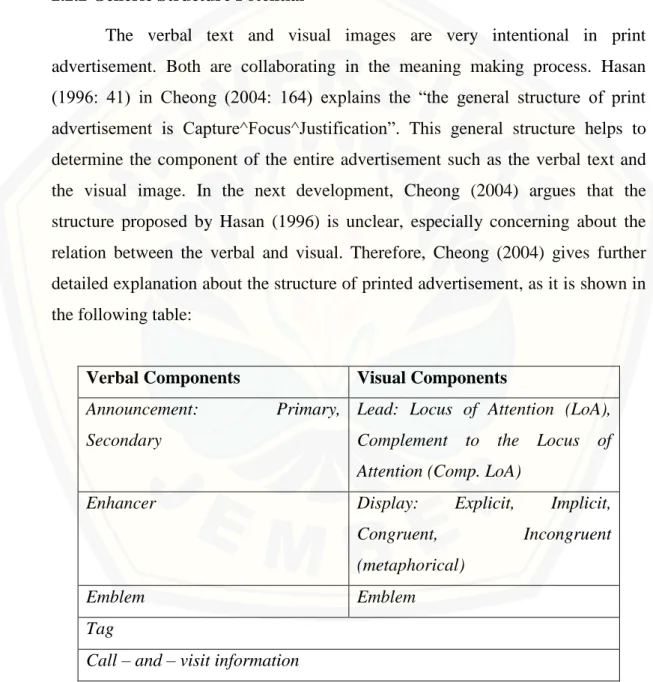
The verbal text and visual images are very intentional in print advertisement. Both are collaborating in the meaning making process. Hasan (1996: 41) in Cheong (2004: 164) explains the “the general structure of print advertisement is Capture^Focus^Justification”. This general structure helps to determine the component of the entire advertisement such as the verbal text and the visual image. In the next development, Cheong (2004) argues that the structure proposed by Hasan (1996) is unclear, especially concerning about the relation between the verbal and visual. Therefore, Cheong (2004) gives further detailed explanation about the structure of printed advertisement, as it is shown in the following table:
Verbal Components Visual Components Announcement: Primary,
Secondary
Lead: Locus of Attention (LoA), Complement to the Locus of Attention (Comp. LoA)
Enhancer Display: Explicit, Implicit,
Congruent, Incongruent (metaphorical)
Emblem Emblem
Tag
Call – and – visit information
Figure 2.1 The General Structure of Print Advertisement Cheong (2004: 165 – 174)
The structure of advertisement is divided into two components: the Visual and the Linguistic. The visual component consists of the Lead, the Display and the Emblem.
1. The Lead
The Lead is the visual element of print advertisement. This is the most remarkable item in the advertisement. This component has a significant role in print advertisement that becomes the main focus of attention that attracts the readers. Cheong (2004: 165) classifies “the components of Lead into the Locus of Attention (LoA) and Complement to the Locus of Attention (Comp.
LoA)”. LoA is the most noticeable item in the Lead. It “encapsulates the central ideal” (Cheong in O‘Halloran, 2004: 167) of the Print advertisement.
LoA also has function as the enhancer for “the meaning of the linguistic elements and make it obvious to the reader” (Ningsih, 2014: 20).
On the other hand, Complementary Locus of Attention (Comp.LoA) is other vsual elemets usually the background which are less noticeable than the LoA. It only complements the LoA.
2. The Display
The visual component Display describes the product in a real and explicit way. As shown in figure, there are four types of Display: Explicit, Implicit, Congruent, and Incongruent or Metaphorical. The Display is explicit if the product which is being advertised is in a tangible object (Nugroho, 2009). On the other hand, the Display is “implicit if the intangible product or service is given tangible form through another medium” (Nugroho, 2009: 74).
Furthermore, the Display is congruent “if the product is not realized through symbolism”. Thus, the Display is incongruent “if the product is realized through symbolism” (Nugroho, 2009: 74).
3.
The EmblemThe Emblem is usually the logo of the company. It also can be the brand name of the product (Cheong in O‘Halloran, 2004: 171). Emblem has function to “give or status for the product where its position can be everywhere in the advertisement text” (Cheong, 2004: 171 – 173). According
to Cheong‘s conclusion upon her research, Emblem is one of the obligatory elements in print advertisement. It is functioning as the identity of the product which is advertised.
The second component of print advertisement is the Linguistics. It is collaborated by some elements such as Emblem, Announcement, Enhancer, Tag, and Call-and- Visit Information.
1. The Emblem
The visual component emblem is accomplished through the logo of product. It belongs to both linguistic and visual element of print advertisement.
Cheong (2004) in her conclusion says that Emblem is one of the obligatory elements in print advertisement. It is functioning as the identity for the product which is being advertised. It also gives a status to the product, to which the product is belonging to.
2. The Announcement
Announcement is the most significant linguistic element in the advertisement. According to the level of prominence, Announcement consists of the Primary announcement and Secondary Announcement. Primary Announcement acts as the eye-catching phrases of the advertisement, while
“Secondary announcement has a meaning interpersonally that is not really important in an advertisement text” (Cheong, 2004: 173). However, all these announcements are used to grab the attention of the readers of the advertised product.
3. The Enhancer
Enhancer only exists in linguistics component. According to Cheong (in O‘Halloran, 2004: 173), “the Enhancer builds on or modifies the meaning emanating from the interaction between the Lead and the Announcement”.
Enhancer is usually typed in smaller font size and in the form of a paragraph.
The function is to persuade the reader to buy with the reasonable argument.
4. Tag
This part consists of “information contact where the public can buy or gain the product advertised” (Cheong, 2004: 174). The Tag is the additional phrase or clause which is printed in brief that explains further about advertisement. The Tag represents certain information about the product that is being advertised, which is not informed in the Enhancer.
5. The Call-and-Visit
The linguistic component Call – and – Visit Information is needed to be enclosed in the advertisement especially for the readers to contact the company if they interest and wish to obtain the products. Usually Call – and – Visit Information is usually printed in small font size in certain parts of the advertisement product.
In this way, The Generic Sructure Potential of print advertisement which is formulated by Cheong is as in this following pattern:
The symbol “^”‖ means “followed by”, and the brackets “()”‖ mean that the element inside them is optional. According to Cheong in her analyzis, Lead and Emblem are the elements that mainly present in the advertisements.
Therefore, that becomes the consideration that there are some elements inside the brackets “()” which do not have to occur in print advertisements, because they are optional and not all of print advertisements have those elements.
2.2.3 Systemic Functional Linguistics
Systemic Functional Linguistics (SFL) is formerly proposed by Halliday.
Systemic Functional Linguistics (SFL) is a theory of language that analyse how the struncture of the text are organized and how the message are conveyed.
Halliday (2004) stated that language construes human experience. He also believes that language is built by two kinds of “context, which are context of culture and context of situation. Context concerns the Field that is what is going
Lead^(Display)^Emblem^(Announcement)^(Enhancer)^(Tag)^(C all-and-Visit Information)
Figure 2.2 The Generic Structure of Print Advertisement
on, Tenor which is the social roles and relationships among the participants, and Mode which is the aspects of the channel of communication” (Halliday, 2004).
The main focus in this analyzis is clause. Therefore, whenever the data is served as a long sentence, it must be broken down in to clauses. Relating to this theoretical framework, SFL has its tool to analyze a text which is called metafunction. Later, it is developed by Butt (2007):
a) A representational function (ideational or experiential & logical): the researcher uses it to encode our experience of the world and it conveys a picture of reality
b) An interpersonal function: the researcher uses it to encode interaction, and show how defensible the researcher finds the proposition.
c) A textual function: the researcher uses it to organize our experiential, logical and interpersonal meaning into linear and coherent whole.
2.2.3.1 Ideational Metafunction
Ideational or Experiential metafunction is the representation of the human experiences. In describing the experiential function, there are three functional constituents: Participant, Process, and Circumstance. Halliday and Matthiessen (2014: 213) agree that the center of those three elements is the process.
1. Material Process
Material process focuses on what is happening or doing. In this process the Actor or the Agent as the main participant. Butt, et. al. (2007: 46) Material process are about doing – they could answer the question “What did X do?” or
“What happened to X?” Material process expresses the idea of something does to some other thing. The participant is called as actor. The thing that is affected by the actor is called as goal.
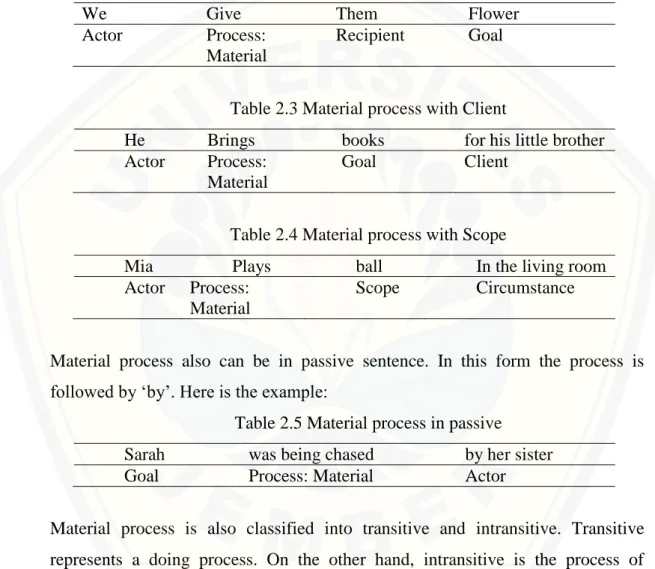
Table 2.1 Material process with goal
Sarah Makes a cake
Actor Process: Material Goal
Besides an actor, there are several additional participants in material process. They are recipients, client, and scope. Recipient is the participant which is not affected by the process but it get beneficial from the performance of the process. Client is the one for whom the process is done. Moreover, Scope is participant that is not affected by the performance of the process.
Table 2.2 Material process with Recipients
We Give Them Flower
Actor Process:
Material
Recipient Goal
Table 2.3 Material process with Client
He Brings books for his little brother
Actor Process:
Material
Goal Client
Table 2.4 Material process with Scope
Mia Plays ball In the living room
Actor Process:
Material
Scope Circumstance
Material process also can be in passive sentence. In this form the process is followed by ‘by’. Here is the example:
Table 2.5 Material process in passive
Sarah was being chased by her sister
Goal Process: Material Actor
Material process is also classified into transitive and intransitive. Transitive represents a doing process. On the other hand, intransitive is the process of happening.
Table 2.6 Transitive material clause (process of doing)
The lion is roaring the dog
Actor Process: Material Goal
Table 2.7 Intransitive material clause (process of happening)
The lion Roars
Actor Process: Material
2. Relational Process
Relational process relates to the identity or description of its participant.
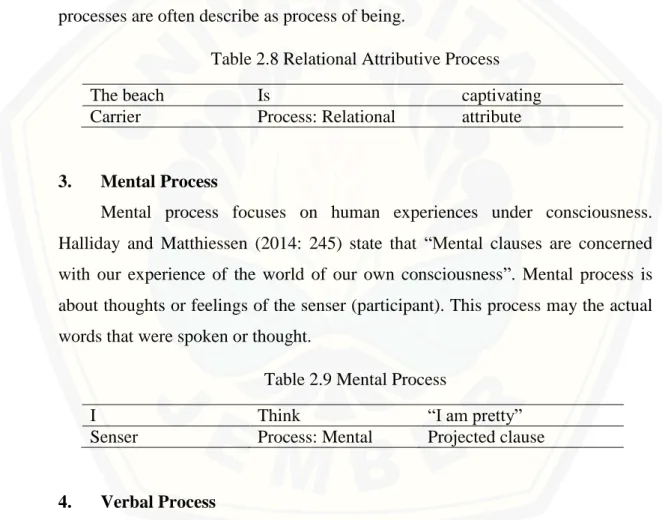
This function is to know the identity or the description of the participant. It can be said that the participant is being or having something. Butt, et. al. (2007: 47) states that Relational process states that something is/was/will be, and hence relational processes are often describe as process of being.
Table 2.8 Relational Attributive Process
The beach Is captivating
Carrier Process: Relational attribute
3. Mental Process
Mental process focuses on human experiences under consciousness.
Halliday and Matthiessen (2014: 245) state that “Mental clauses are concerned with our experience of the world of our own consciousness”. Mental process is about thoughts or feelings of the senser (participant). This process may the actual words that were spoken or thought.
Table 2.9 Mental Process
I Think “I am pretty”
Senser Process: Mental Projected clause
4. Verbal Process
Verbal process is process of saying. Butt, et. al. (2000: 59) Verbal process construe saying. The participant in this process is a Sayer. Reciever is the addressee of the speech. It may project a summarized report of words that were spoken or thought.
Table 2.10 Verbal Process
He Asks her a difficult question
Sayer Process:
Verbal
Reciever Verbiage
5. Behavioral Process
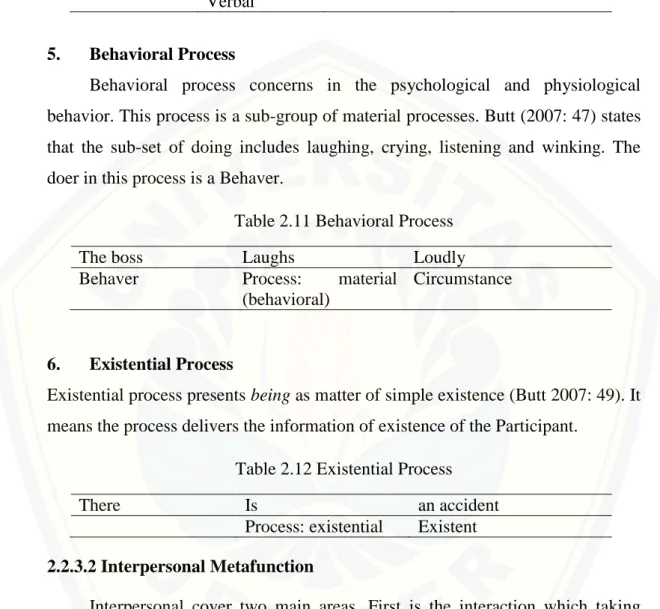
Behavioral process concerns in the psychological and physiological behavior. This process is a sub-group of material processes. Butt (2007: 47) states that the sub-set of doing includes laughing, crying, listening and winking. The doer in this process is a Behaver.
Table 2.11 Behavioral Process
The boss Laughs Loudly
Behaver Process: material
(behavioral)
Circumstance
6. Existential Process
Existential process presents being as matter of simple existence (Butt 2007: 49). It means the process delivers the information of existence of the Participant.
Table 2.12 Existential Process
There Is an accident
Process: existential Existent 2.2.3.2 Interpersonal Metafunction
Interpersonal cover two main areas. First is the interaction which taking place and commodity that is being exchanged. And second is how the speaker takes the position in their messages. This is one of the example of the analysis of interpersonal function. The basic interaction using language between exchanging information and demanding or giving goods and services. This example is the demanding information.
Table 2.13 Interpersonal Metafunctioon
Does He know The truth?
Finite Subject Predicator complement
Mood: Interrogative Residue
Therefore, in revealing meaning, interpersonal function is one of the way to examine them. In this case the advertiser is doing question tag. Thus interpersonal function becomes one of a tool to analyze the concept of colorism in beauty product advertisements.
2.2.3.3 Textual Metafunction
Butt et, al. (2007: 88) Textual metafunction is to organize text into coherent whole. It is the connection of ideational metafunction and interpersonal metafunction. The function is to encode meanings of texts and find the coherency of the context. The main elements of textual metafuntion is Theme and Rheme.
The example is provided below:
Table 2.14 Textual Metafunction
The police arrested the burglar
Theme Rheme
Toward to those three types of metafunction, this study uses two of them, which is ideational and interpersonal metafunction. These two types are considered to help to do the analysis in the linguistics element in advertisements.
This system plays a role in meaning making which is determined based on language choice system. Therefore, SFL is selected to examine the meaning behind linguistic option used in beauty product advertisements to show concept of colorism using transitivity and modality analysis.
2.2.4 Intersemiotic for Meaning-Making: Theory of Color
The theory of color will be employed in this study because color can be used as a tool “to create meanings: to convey messages, engage the reader and consolidate” (Zammit in Whittaker et. al., 2007: 65). Since this study tries to
reveal the colorism in print advertisements, it will need the use of color in generating meaning in the selected beauty product advertisement. In helping the analysis to support meaning- making, there are distinctive features of color in several scales as follows:
a) Value
Kress and van Leeuwen (2006: 233) state that “the scale of value is grey scale”. It ranges from maximally light (white) to the maximally dark (black).
According to (Kress and van Leeuwen, 2006: 106), gold is the color that would confer the values of things associated with softness. It shows a strong sense of unity and cohesion.
b) Saturation
Saturation, according to Kress and van Leeuwen (2006: 233)Saturation has the ability to express emotive feeling such as positive, exuberant, adventurous, which are expressed through high saturation color, and subtle, tender, cold, repressed, brooding and moody, which are expressed through low saturation color.
c) Purity
Purity, according to Kress and van Leeuwen (2006: 234), ranges from the most pure to the most mixture of color. It relates to the pureness or primary and the mixture of color. Color like red, green, blue, which has one single name are considered as pure color. On the other hand, color like cyan is considered as mixed color since it composes from blue and green.
d) Modulation
Modulation, as stated by Kress and van Leeuwen (2006: 234), runs from the fully modulated to the flat color. Flat color expresses color essential quality of things, while modulated color rather attempts to show the color of people, places and things as it is actually seen, under certain condition.
e) Differentiation
Differentiation is related to the monochromic of color to maximally varied palette of color. It relates to the adventurousness or timidities of a thing (Kress and van Leeuwen, 2006: 235).
f) Hue
Hue runs from blue to red in scale (Kress and van Leeuwen, 2006: 235).
Red is associated with warmth “may be very warm, medium dark, highly saturated, pure and modulated”, energy, salience and foregrounding, while blue is associated with cold, calm, and distance. According to Goethe (1840: 311), blue represents cold, gloomy and calmness.
2.2.5 Intersemiotic for Meaning-Making: Theory of Structure of Composition The structure of composition is also employed this study in terms of meaning-making process. According to Kress and van Leeuwen (2006: 177), the representational and interactive meaning can be analyzed through the compositional structure of the image. It concerns with the disposition of elements within the visual space. There are three interrelated systems of composition:
1) Information Value
It refers to the way elements from the picture are placed between left and right, top and bottom, centre and margin. As Kress and van Leeuwen state “the right seems to be the side of the key information, of what the reader must pay particular attention to” (2006: 180). In short, something places on the right must be the new information that the advertisement try to introduce, while something places on the left is assumed to be known by the readers already.
2) Salience
Salience can create a hierarchy of importance among the elements, selecting some as more important, more worthy of attention than others. Salience is not objectively measurable, but results from complex interaction. As Kress and van Leeuwen (2006: 202) explain, salience as “a complex trading-off relationship between a number of factors: size, sharpness of focus, tonal contrast, color contrasts, placement in the visual field, perspective, and also quite specific cultural factors, such as the appearance of a human figure or a potent cultural symbol”.
3) Framing
Framing determines whether the elements in the layout may be strongly or weakly framed or connected each other. Kress and van Leeuwen (2006: 204) state
that “the more the elements of the spatial composition are connected, the more they are presented as belonging together, as a single unit of information”. It means that framing controls whether the elements in the advertising are interconnected or not and whether the advertisement itself shown a harmony in information sharing.
The theory of color and structure of composition are applied in Multimodal Discourse Analysis to analyze the intersemiotic of the verbal, visual, symbolic and other semiotic resources in the meaning-making processes. By using these theory, the relationship between the reasons of employing certain type of processes in linguistic elements, utilizing certain colors and choosing certain position to placing objects are hoped to be able to reveal colorism systematically and scientifically.
2.2.6 Concept of Colorism
For many people, color is not just color. For example, in advertisements, it is very common for dark-skinned women to be portrayed as unhappy and jealous of the attention, especially from men. Later they finally receive favorable attention by those men after their skin is lightened (Parameswaran & Cardoza, 2009, p. 243). In this context, skin color plays an important role. Some people might relate this phenomena with racism, which is the discrimination to the entire race including various characteristics, both pheneotype and latent, like beliefs. On the other hand, colorism is more specific than racism, which focuses only on the skin color. Colorism, in its simplest definition, is a discrimination based on the skin tone. It is defined as “discriminatory treatment of individuals falling within the same ‘racial’ group on the basis of skin color” (Herring & Keith, 2004).
Colorism indicates that lighter skins are favorable and more desirable than darker skins. The term colorism refers to the event of non-white people who are discriminated by those who have lighter complexion within their own ethnic groups (The Free Dictionary, 2018).
As it was mentioned in the background, the idea of a white skin complexion has dealt to the colonial mentality and racial supremacy. White skin complexion is related and associated with prosperity and desirability, which
accord with holy and aristocracy (Leong, 2006). Acquiring white skin complexion is regarded as the way to improve an economic and social level (Luce &
Merchant, 2003). The desire toward whitening affects all social classes in almost all region. White skin is a sign of the status of person (Parameswara & Cardoza, 2009). These discriminations lead people to ideology of colorism.
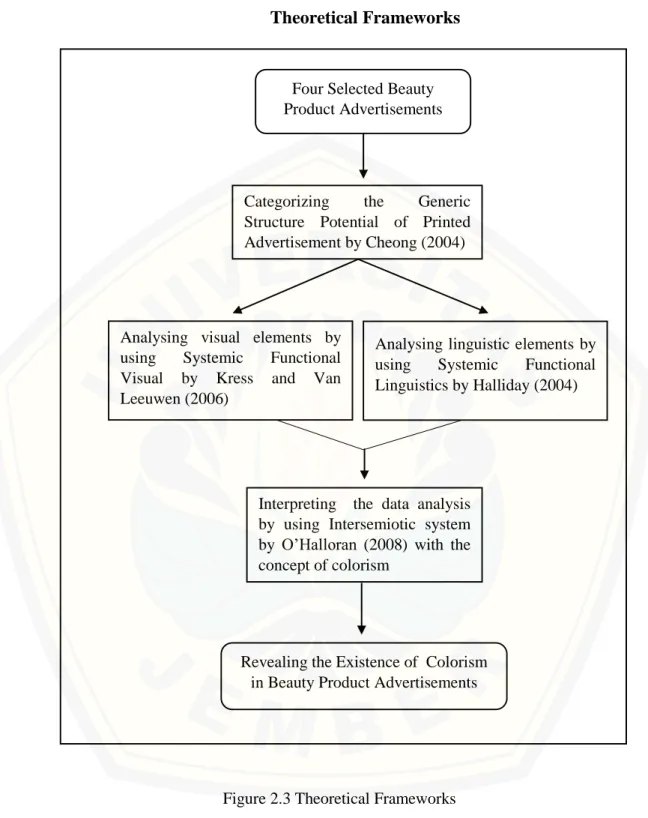
Theoretical Frameworks
Analysing visual elements by using Systemic Functional Visual by Kress and Van Leeuwen (2006)
Interpreting the data analysis by using Intersemiotic system by O’Halloran (2008) with the concept of colorism
Four Selected Beauty Product Advertisements
Categorizing the Generic Structure Potential of Printed Advertisement by Cheong (2004)
Figure 2.3 Theoretical Frameworks
Analysing linguistic elements by using Systemic Functional Linguistics by Halliday (2004)
Revealing the Existence of Colorism in Beauty Product Advertisements
CHAPTER 3. RESEARCH DESIGN AND METHODOLOGY
This chapter deals with the design and methodology of this research. It contains type of research, data collection, data processing and data analysis. It is explained as follows:
3.1 Type of the Research
To describe and to analyze the data, qualitative method is used in this research. “Qualitative method is non-experiment method and the data do not relate to statistic, and this does an interpretative analysis” (Mackey and Gass, 2005: 2).
It focuses on meaning and the data is not in the form of number. There are two bases of this research, those are descriptive and interpretative. In descriptive method, the researcher does not only describe the data, but also, he or she has to elaborate them (Gray, 2004). Meanwhile, the interpretative method is the process of making sense the data which have been collected and analyzed in order to determine the conclusion (Blaxter et. al., 2006). The qualitative method is taken by collecting the data, analyzing the data, collecting information, and the last is interpreting the data. The data in this research is words and visuals. Hence, this qualitative data is suitable in analysing colorism in selected whitening cream advertisments.
3.2 Data Collection
Regarding to the data collection, documentary technique is applied.
Internet is chosen as the tool to collect the data because the advertisements containing the data must be in English. Hence, searching for it on the internet is the most possible alternative. The source of data of this research is beauty product advertisements published on internet, while the data are visual and linguistic elements from four whitening product advertisements used as a case study, as read online in official Facebook account of each brand. Four print advertisements with different brand will be used in this research. Those products are:
1. Fair and Lovely cream;
2. Garnier Fair Miracle cream;
3. Olay White Radiance;
4. Pond’s White Beauty day cream.
They are choosen because the products are best selling in Indonesia (Irawan, 2017). Those four brands comes from two different giant companis in Europe and America. Fair and Lovely, Ganier, and Pond’s are from Unilever meanwhile Olay is from Johnson&Johnson.
3.3 Data Processing
After collecting the data, the next step is processing the data. The process would be explained as follow:
1. first, print the advertisements regarding to the face beauty product;
2. then, the beauty product advertisements are categorized based on the type of elements in advertising campaign. It includes categorizing the elements to visual and linguistic elements based on Cheong‘s framework of Generic Structure Potential of print advertisement (2004);
3. the visual elements of beauty product advertisements are grouped into Lead, Display, and Emblem. While the linguistic elements are grouped into Announcement, Enhancer, Emblem, Tag, and Call-and-Visit elements;
4. the linguistic elements of beauty product advertisements are processed using Transitivity and Mood analysis in order to find the metalanguage of interpersonal meaning of the clause;
5. last, discussion with elaboration of interpretation of the data analysis is made in order to find the concept of colorism in beauty product advertisements.
3.4 Data Analysis
The next step after processing the data is analyzing the data. In this data analysis, descriptive and interpretative methods are used in this research. The collected data were then processed by using the following steps :
1. labelling and categorizing the elements based on Cheong’s GSP;
2. analysing the linguistic elements by using the theory from Halliday’s transitivity and mood analysis. It is used to analyze the type of process and the type of mood to know how the interaction between the advertiser and customers through the clauses;
3. analysing the position of every element and its meaning by using the theory of Structure of Composition (Kress and van Leeuwen);
4. analysing the meaning of using picture and colour in the advertisement by using the theory of colour (Kress and van Leeuwen);
5. relating the results of linguistic elements with the visual elements. It uses the theory of Intersemiotic Ideation (O’Halloran). By having this, the concept of colorism is captured through the linguistic and visual elements and it shows how each element relates each other.
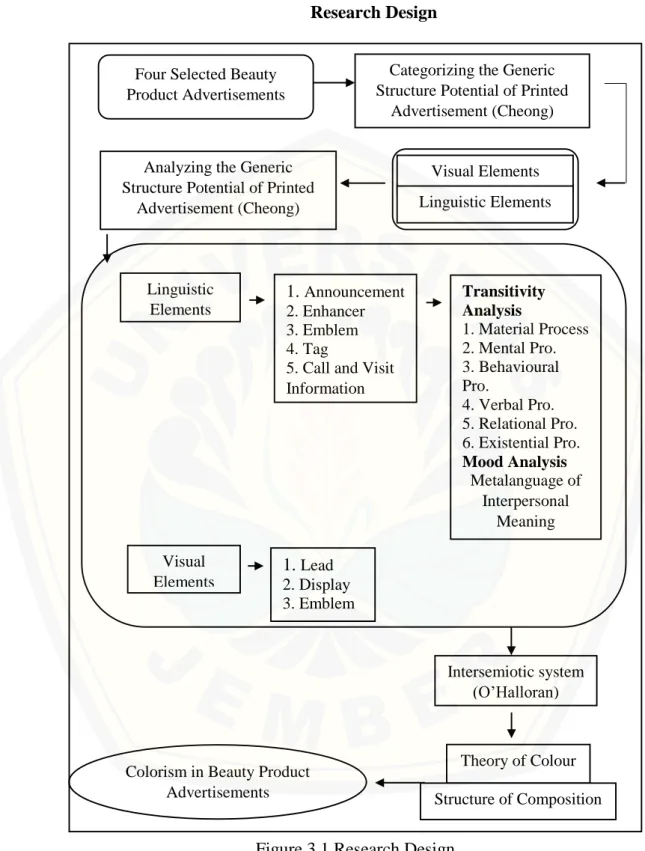
The illustration of those explanation is delivered below.
Research Design
Visual Elements Analyzing the Generic
Structure Potential of Printed Advertisement (Cheong)
Linguistic Elements
1. Announcement 2. Enhancer 3. Emblem 4. Tag
5. Call and Visit Information
Transitivity Analysis
1. Material Process 2. Mental Pro.
3. Behavioural Pro.
4. Verbal Pro.
5. Relational Pro.
6. Existential Pro.
Mood Analysis Metalanguage of
Interpersonal Meaning Visual
Elements
1. Lead 2. Display 3. Emblem
Intersemiotic system (O’Halloran)
Theory of Colour Structure of Composition Colorism in Beauty Product
Advertisements Four Selected Beauty Product Advertisements
Linguistic Elements Categorizing the Generic Structure Potential of Printed
Advertisement (Cheong)
Figure 3.1 Research Design
CHAPTER 5. CONCLUSION
This chapter comprises the conclusion of the thesis concerning to the topic of exploring colorism in four selected beauty product advertisements. The analysis done and discussed in the previous chapter using several theories, such as Systemic Functional Multimodal Discourse Analysis (SF-MDA) by O’Halloran (2008) supported by Generic Structure Potential (GSP) of Printed Advertisement by Cheong (2004), Systemic Functional Linguistic especially Transitivity and Mood Analysis by Halliday (1994), theory of colour and Structure of Composition by Kress and van Leeuwen (2006). Answering the research questions in chapter one is suitable to conduct and conclude the last discussion of the thesis.
The first question concerns with what the linguistic and visual elements used in the printed advertisements are. Based on the result of analysis in Chapter Four, the linguistic elements attached in the printed advertisement are Announcement, Enhancer, Emblem, Tag, Call and Visit Information. Three out of four printed advertisements do not have Enhancer and Call and visit. Moreover, paying attention to the analysis of text as linguistic elements in the printed advertisement, it can be found that there are several type of processes used. They are Material and Relational Identifying processes. The highly used process is Material process with the representation 75%. It reveals that the advertiser has power to assert certain power and opinion in order to let the customers to purchase the product and to do certain actions. The next is Relational Identifying showing 25%. These kinds of process expresses the attribute towards the customers and also to represent the character of the product. From the visual elements, it is clearly answered that Lead, Display and Emblem are used in the printed advertisement. Only one out of four printed advertisements do not have Visual Emblem. The Display of the printed advertisements all are Explicit yet Congruent.
Thus, the customers or targeted market do not need to imagine the representation of the product because it is clearly displayed on the advertisement. Through the use of complete elements in the printed advertisement, it means that it shows the
completeness and it makes clear understanding for the customers or targeted market providing in the printed advertisements.
The second question, which is related to how the relationship between linguistic and visual elements in revealing colorism is answered through the analysis of linguistic and visual elements. In this study, there are several adjectives used to increase and enhance the readers interest to use the product.
The main function of adjective is to desrcribe the product and the results that people will get after using the product. The advertisements frequently use adjective such as fair, beautiful, whitening, radiant, bright, light and glow to promote the product. Furthermore, it is argued that in describing the concept of colorism through the discourse of advertisement, the advertisers tend to use the adjective.
The reason why white skin models are always used in the selected advertisements is to make the targeted believe that the customers can get and feel like what are being represented on the advertisement which is having white skin and persuade the customers attention to use the product. The use of certain factors such as colour contrast, the appearance of human figure and placement in the visual elements construct ‘salient’ of the printed advertisement. From the framing side, it shows that the linguistic and visual elements are connected each other. The explained informations describe the fact about the product, the way of product works, and the impact of using the product to the customers. Moreover, the use of colours become the interesting part of the advertisement since it brings certain meaning that relates to concept of colorism.
The construction of colorism can be seen through the linguistic and visual elements on the advertisement. Announcements, the linguistic realization of Emblem (brand name), Enhancer, Tag, Call and Visit Information are the linguistic elements. Meanwhile, the visual elements are displayed through Lead:LoA, Comp.LoA, and the visualization of Emblem. Linguistically, the messages are depicted through certain words, phrase, material processes in Ideational metafunction and declarative mood in Interpersonal metafunction.
Furthermore, the representation of visual elements can be seen through the use of
certain colours (white, green, pink and yellow) the models who act as Comp.LoA, the use of several pictures and visualization that relate to the linguistic messages on the advertisement (star, lemon, pearl, etc.). Both visual and linguistic elements elaborate each other in constructing colorism in beauty advertisement.
Suggestion
This research investigated the discourse analysis of the fairness product advertisements. This research also explains how such advertisements are used to influence and manipulate the consumers. This study also shows the impacts on the consumers. In a consumer oriented society, Discourse Analysis can help the consumers who are influenced and manipulated by the implicit message of the fairness product ads, which in this case is colorism, DA’s aim is to empower people by making them conscious of hidden structures which exist in societies. As a result of this research, people will become aware of the manipulative strategies used in the language of fairness advertisements. Furthermore they will learn not to believe or accept everything which is seen in the print advertisements.
Furthermore, there is an evidence that skin whitening products have serious mental, physical and emotional health implications (Malik, 2007:3).
Bleaching products are costly and in many cases, cause pain and harm and may even lead to irreversible health hazards (Baxter, 2000; Dussault, 2006). These cosmetics cause itching, burning, blistering and darker skin patches, skin irritation or even skin cancer (Dussault, 2006). The problem complicates the fact that poorest people are the most at risk, because the less expensive the product, the more perilous it is (Baxter, 2000). Some of these products, which are available on the market, contain mercury and hydroquinone, the damaging substances (Jenkins, 2001), some whitening products contain steroids (Dussant, 2006).
There is no scientific backing of the claims and no evidence or medical study which confirm that these fairness cosmetics really work. “No externally applied cream can change your skin colour” (Sinha, 2000). There is no documented benefit of skin whitening creams nor medical studies which interchangeably substantiate its effects (Karnani, 2007:7 ).
This research in a logical way wants to show how skin whitening advertisements encourage the concept of colorism. The researcher’s interest is to study how colorism is dealt with in the whitening cream advertisements. Last but
not least, the researcher also wants this study to be a provocative point for the readers to stop consuming and producing colorism especially in Indonesia, as we know that the implication of colorism is quite dangerous
REFERENCES
Barthes, & Roland. (1964). Elements of Semiology. London: Cape.
Blaxter, L., Hughes, C. and Tight, M. (2006). How to Research. Philadelphia: Open University Press.
Butt, D. (2007). Using Functional Grammar. Sydney: Macquirie University.
Challapalli, S. (2002). All’s Fair in this Market. The Hindu Business Line.
Cheong. Y. Y. (2004). The Construed of Ideational Meaning in Print Advertisement. . Denscombe, M. (2010). The Good Research Guide: For Small-Scale Social Research
fourth edition. Open University Press.
Dijk, T. A. (1993). Elite discourse and racism. Sage, Newbury Park, CA.
Dlova, E., Hamed, S. H., Tsoka-Gwegweni, J., Grobler, A., & Hift, R. (2014). Women’s perceptions of the benefits and risks of skin-lightening creams in two South African communities. Journal of Cosmetic Dermatology, vol. 13(3), pp. 236-241.
Dussault, A. M. (2006). Light Headed. The Hindu Business Line.
Dworek, J. (2010). Discursive reproduction of racial attitudes, whitening and whiteness dominance in media texts in Peru.
Frosh, S. (2013). Psychoanalysis, colonialism, racism. Journal of Theoretical and Philosophical Psychology, vol. 13(1), pp. 141-154.
Gary, D. (2004). Doing Research in the Real World. London.
Goddard, A. (1998). The Language of Advertising. London and New York: Routledge.
Halliday, M. A. (2004). Halliday's Introduction to Functional Grammar fourth edition.
London: Routledge.
Halliday, M. A., & Matthiesen, C. (2004). An Introduction to Functional Grammar. 3rd Edition. London: Arnold.
Hasan, R. (1996). What’s going on: a dynamic view of content in language. In Yuen, Cheong Yin. 2004. Open Linguistics Series: The Construal of Ideational.
Herring, C., & Keith, V. (2004). Teaching and Learning Color Consciousness in Black Families: Exploring Family Processes and Women’s Experiences With Colorism.
Hong, J. W. (1995). Self-concept and advertising effectiveness: The influence of
congruency, conspicuousness, and response mode. Psychology & Marketing, 53- 77.
Hunter, M. (2002). The Persistent Problem of Colorism: Skin Tone, Status, and Inequality.
Hunter, M. (2005). Race, Gender, and the Politic of skin tone. New York: Routledge.
Hunter, M. (2011). Buying racial capital: Skin-bleaching and cosmetic surgery in a globalized world. Journal of Pan African Studies, vol.4, pp 142-164.
Iqbal, A. (2014). Exploitation of Women in Beauty Products of “Fair and Lovely”
Jha, M. R. (2016). The Global Beauty Industry. London and New York: Routledge Johnson, J. (2007). Bollywood star’s skin-cream ad irritates. New Delhi: Financial
Times.
Kress, G. (2010). Multimodality: A social approach to contemporary communication.
Britain: Routledge.
Kress, G., & Leeuwen, T. v. (2006). Reading Images: The Grammar of Visual Design.
Canada: Routledge.
Leong, S. (2006). Who’s the Fairest of Them All? Television Ads for Skin-whitening Cosmetics in Hong Kong. Asian Ethnicity, 167-181.
Luce, E., & Merchant, K. (2003). India Orders Ban on Advert Saying Fairer Equals Better for Women. Financial Times.
Mackey, A. a. (2005). Secondary Language Research Methodology and Design. United Stated: Lawrence Erlbaum Associates.
Mayr, A. (2008). Language and Power: An Introduction ro institution Discourse.
London: Continuum.
Ningsih, E. F. (2014). Construing Ideational Meaning in Ten Electronic Devices Advertisement in Jawa Pos: A Systemic Functional Linguistic Multimodal Discourse Analysis. .
Nugroho, A. D. (2009). The Generic Structure of Print Advertisement of Elizabeth Arden‘s INTERVENE: A Multimodal Discourse Analysis.
O’Halloran, K.L. 2005. Mathematical Discourse: Language, Symbolism and Visual Images. London and New York: Continuum.
O‘Halloran, K. L. 2008. Systemic Functional-Multimodal Discourse Analysis (SF-MDA):
Construing ideational meaning using language and visual imageri. Visual Communication
O‘Halloran, K. L. Multimodal Discourse Analysis. In K. Hayland & B. Paltridge (Ed.).
The Continuum Companion to Discourse Analysis. London and New York:
Continuum. 2011. pp. 120-137.
Parameswaran, & Cardoza. (2009). Melanin on the Margins: Advertising and the Cultural Politics of Fair/Light/White Beauty in India. Journalism and Communication Monographs. vol.11(9), pp. 213-271.
Zammit, K. (2007). Popular Culture in the Classroom: Interpreting and Creating Multimodal Texts. In Whittaker, R., O‘Donnel, M., McCabe, A. Advances in Language and Education. London and New York: Continuum.
Intenets :
Irawan, H. (2017). Top Brand Award Indonesia. http://www.topbrand-award.com/top- brand-survey/survey result/top_brand_index_2017_fase_1 accessed on Saturday 3rd March 2018.
https://www.facebook.com/takecaregarnier accessed on Friday 25th May 2018.
https://web.facebook.com/PondsPhilippines accessed on Friday 25th May 2018.
https://web.facebook.com/OlayIndonesia accessed on Friday 25th May 2018.
https://web.facebook.com/fairandlovelyindia accessed on Friday 25th May 2018.