11
Managing Organizational Change, Resistance, and Conflict
CHAPTER OVERVIEW
This chapter will focus on preparing the organization for change. After studying this chapter, you should understand and be able to:
• Describe the discipline of organizational change management and its role in assessing the organization's readiness and capability to support and assimilate a change initiative.
• Describe how change can be viewed a process and identify the emotional responses people might have when faced with change.
• Describe the framework for managing change that will be introduced in this chapter.
• Apply the concepts and ideas in this chapter in order to develop a change manage ment plan. This plan should focus on assessing the organization's willingness and ability to change, developing a change strategy, implementing and tracking the progress toward achieving the change and then evaluating whether the change was successful, and documenting the lessons learned from those experiences.
• Discuss the nature of resistance and conflict and apply several techniques for dealing with conflict and resistance in an efficient and effective way.
GLOBAL TECHNOLOGY SOLUTIONS
Tim Williams could hear the drone of a single engine airplane as it flew overhead. He was sitting in the office of L.T. Scully, president and CEO of Husky Air. No one was really sure what the initials "L.T." represented; everyone just referred to Husky Air's top manager as "L.T." Tim could see by the pictures on the office walls that L.T. had begun his flying career in the military and then worked his way up to captain of a major airline. Five years ago L.T. left the airline and, along with several other investors, purchased Husky Air. Behind L.T.'s desk was a large window overlooking
254
GLOBAL TECHNOLOGY SOLUTIONS 255 the ramp area and hangers where Husky Air's planes were kept. Tim watched as one of the service people towed a business charter jet from its hanger.
L.T. folded his hands on his tidy desk. "Tim, thanks for coming in on such short notice, but I think we might have a little problem."
Tim was a bit perplexed. The testing of the system was going forward as planned.
Tim began, "L.T., testing is going as expected. Sure we found a few problems, but the team is confident that the bugs will be fixed and implementation will go according to plan."
"No, no," L.T. responded. "I'm very happy with the work you all have done so far. In fact, I have every bit of confidence in you and your team. My degree was in engineering, so I understand that finding problems and fixing them is all part of the process. Heck, I'm just glad that you're finding them instead of us! No, it seems that the problem is one that I may have created."
Tim was intrigued, but confused, and urged L.T. to explain.
"I may have underestimated how the change of introducing a new system will affect my employees," L.T. said. "My vice president of operations, Richard Woodjack, told me that several of our employees are not happy about the new system. A few of them have even threatened to quit. I almost told those employees that they have a choice — they can like it or leave — even if it would mean a large disruption to our business. But then I calmed down and recalled how I grumbled along with my coworkers at the airline when management would try to get us to do something new. It became sort of a joke because management would make a big deal of some new way of doing things and then expect everyone to just jump on board. Things would change for awhile but then people would revert to the old way of doing things. Soon, nobody took these announcements very seriously. It seemed that the more things changed, the more things stayed the same. I guess I thought my employees would see this new system as a positive change and that they would be open and welcome to it. I guess I was wrong."
Tim was impressed by L.T.'s candor. "I know what you mean. In fact, I've been on projects where the system ended up being a technical success, but an organiza- tional failure. The system worked fine, but the people in the organization didn't accept it. It means missed opportunities because the system is never fully used as intended."
L.T. let out a deep sigh. "Ok, you're my consultant. How should we handle this?
We really need the new system, but it's important that we have everyone on board."
Tim thought for a moment. "The reason the employees are resistant to the new system is because they may be feeling that they have no control over the situation," he said. "Also, they may not understand the benefits of the new system or how they will fit into the new picture. We need to come up with a plan and strategy that com- municates the benefits of the new system and why the company has to replace the old system."
"That's a good idea, Tim," reflected L.T. "However, I think it's important that we not only tell the employees, but listen to them and engage them in the process so that they become part of the change." L.T. sat back in his executive chair. "Would you be willing to work with Richard Woodjack on this, but keep me informed about your progress?" he asked. Before Tim could respond, L.T. smiled and said "I know what you're going to say. This is definitely scope creep. Why don't you get back to me as soon as you can with the schedule and budget increases so I know what my little mis- take is going to cost?"
Tim laughed and said, "L.T, if you ever get tired of flying planes and running a company, you should get a job as a mind reader."
L.T. picked up his phone. "I'll let Richard know that you'll stop by and see him and explain to him what's going on. I know he'll be relieved."
Tim and L.T. shook hands, and Tim headed out the door and down the hallway to Richard Woodjack's office.
Things to Think About:
1. Why shouldn't managers expect people to just accept a new information system?
2. What impacts can implementing a new information system have on the people in an organization?
3. Why might people be resistant to a new information system?
4. How might people demonstrate this resistance?
5. What can the project team and organization do to help people adjust and accept the new information system?
INTRODUCTION
Most technical people tend to enjoy the challenges of setting up a network, writing snazzy code using the latest and hottest technology, or designing a solution to solve some organizational problem. After all, that is what they're trained to do, and most people who enter the IT profession enjoy new challenges and learning new things.
Indeed, many IT professionals believe that given enough time, training, and resources just about any technical problem can be solved. Being stuck in a boring job with obso- lete skills is not a condition for career longevity—people will either leave to find new challenges or find themselves looking for new jobs. It is important to keep pace with technological changes, and many of these changes are welcome.
As you may recall from Chapter 1, IT projects are planned organizational change.
And, an IT project has an impact on the organization, and the organization has an impact on the IT project. Organizations are made up of people, and the implementa- tion of the IT project's product can change the way people work, affect the way they share information, and alter their relationships. Whether you are an outside consultant or work for an internal IS department within the organization, your mere presence will often be met with suspicion and hostility because you will be viewed as a person who has the potential to disrupt their stability. You are an agent of change. As an old saying goes, the only people who like change are wet babies!
It is easy to concentrate on the hard side of IT project management. Dealing with the people issues, or soft side of technology, is an area that most technical people do not enjoy. It is human nature to focus on what we can accomplish with minimal conflict or on what we can control. Implementing a network of computers that communicate with each other or getting a program to work properly may be much easier and less stressful than dealing with resistance and conflict during systems development.
In addition, many technical people and managers naively believe that the users within the organization will gladly embrace a new system if it is built properly. Although a system may include the required features and functionality and perform as intended, this
"build a better mousetrap and the world will beat a path to your door" mentality can still lead to a system that is a technical success but an organizational failure.
Implementation of the new system is a technical challenge. The system must be moved from the development environment to a production environment and prop- erly tested before going live. The people within the organization, however, must be
INTRODUCTION 257
MANAGING CHANGE
According to Leslie Jaye Goff, change management really boils down to getting users to accept a new business process and the technology that enables it. Although the topic of change management may seem abstract for many people, it is an important area that project leaders, business analysts, applications developers, help desk staffers, train- ers, managers, and executives should know about and understand. Gabriel Cooper, a consultant in Santa Rosa, California, believes, "It is human beings that make compa- nies work, not technology. Technology is just a tool, and users have to be excited about it, believe in it, (be) trained in it, and supported in it. And change management is about making sure all of those things are included from the begin- ning as part of a project." In fact, International Data Corp., a research firm in Framingham, Massachusetts, estimates that services for change management in the U.S. will exceed $6 billion by 2003.
Not every IT project requires a formal change manage- ment approach. For example, upgrading an operating sys- tem or installing a new voice mail system would probably not create a great deal of stress among users. On the other hand, new applications that fundamentally change the way people work and their relationships with others may create
a great deal of anxiety. For example, implementing a new ERP or e-commerce site will drastically alter a person's job. While some people are invigorated by new technol- ogy, others may be frightened by such changes. Often peo- ple become frustrated, feel powerless, or rebel against rapid change.
Change management is about helping people deal with their emotions. IT professionals should be willing to put themselves in their users' shoes in order to understand how change will affect them. To reduce anxiety and help people accept change, consultants suggest finding a business champion for the project, including line workers in the design and development activities, communicating con- stantly about the project's progress, reiterating the business reasons for taking on the project, and providing adequate education and training. In addition, it is important to remember that you cannot separate people, processes, and technology. Many projects have failed because of some- one's inattention to the abstract, touchy-feely things.
SOURCE: Adapted from Leslie Jaye Goff, Change Management, Computenvorld, February 14, 2000, http://www.computerworld.com /news/2000/story/0,11280,41308.00.html.
prepared for the impact that the new system will have on them. It is easy to under- estimate this impact and, given human nature, downplay the response people will have. Managers and technical people may be given to false beliefs:
• "People want this change."
• "Monday morning we'll turn on the new system and they'll use it."
• "A good training program will answer all of their questions and then they'll love it."
• "Our people have been through a lot of change—what's one more change going to matter?"
• "We see the need for helping our people adjust, but we had to cut some thing..."
• "They have two choices: they can change or they can leave."
The above statements reflect the view that it is easier to gain compliance than it is to gain acceptance. This supposition is faulty because it assumes that everyone will comply and that compliance will be long-lasting. The results may be quite different:
• The change may not occur.
• People will comply for a time and then do things to get around the change.
• Users will accept only a portion of the change.
The full benefits of the project are never realized or are realized only after a great deal of time and resources have been expended.
The central theme of this text has been the concept of measurable organization value. The MOV is not only the overall goal of the project, but is also a measure of the project's success. It is how we define the value our project will bring to the organization after the project is implemented as originally envisioned. It provides a means for determining which projects should be funded and drives many of the decisions associated with the project throughout its life cycle. If the project's MOV is not realized in its entirety, then only a portion of the project's value to the organization is realized.
Organizations today cannot afford to mismanage change initiatives. Competitive pressures provide little room for error. There is also the potential for lawsuits arising from stress-related disabilities and wrongful discharge (Bridges 1991). Therefore, while it is important that we manage the development of our project well, we also need to ensure that the project's product is transferred successfully and accepted by the organization with minimal adverse impact.
Acceptance by the users of the system is much more powerful and longer-lasting than compliance, which means we need to ensure that the people within the organiza- tion are prepared properly before the system is implemented. The discipline called change management is the area of IT project management that helps smooth the transition and implementation of the new IT solution. The Gartner Group defines change management as:
The transforming of the organization so it is aligned with the execu- tion of a chosen corporate business strategy. It is the management of the human element in a large-scale change project.
The remainder of this chapter will focus on how change may be viewed as a process and on the emotional aspects normally associated with change. A framework for developing a change management plan and several techniques for dealing with the resistance and conflict that are a natural part of the change initiative will be intro- duced. Although this chapter deals will the soft side of IT project management, it is an important foundation for planning the implementation of the IT solution that will be discussed in the next chapter.
THE NATURE OF CHANGE
In this section, we will focus on how change affects both individuals and organiza- tions. Change tends to unfold in fairly predictable patterns (Conner 1995). In order to effectively plan and manage organizational change, it is important to understand the impact of change, how change may be viewed as a process, and the emotional behav- ioral patterns of change.
The Impact of Change
At any given time we must deal with changes that affect us. These changes may result from world or local events, the organizations we are part of, or personal decisions and relationships (Conner, 1995). Think about the changes that are going on in your life right now. You may be graduating soon, seeking employment, moving to a new residence, or scheduling root canal work with your dentist the day after tomorrow. The point is that there are a number of changes going on in our lives at any given moment. We may view these changes as being either positive or negative. As Jeanie Duck (2001) observes, nearly all change in our lives entails some amount of anxiety. Anxiety combined with hope is anticipation, while anxiety combined with apprehension is dread.
THE NATURE OF CHANGE 259
Whether we view change as positive (anticipation) or negative (dread), there is a cer- tain amount of stress that accompanies each change. For example, let's say that you will graduate this semester and start a new job that requires you to move to a distant city.
Although you may be looking forward to leaving school and earning some real money, you may still feel some apprehension. After all, you will have to leave your circle of family and/or friends and the familiarity of your present environment. Once you arrive in your new city, you will need to find a new place to live, make new friends, and become familiar with your new job, the company, and its people. Moving to a new city is relatively easy compared to the other transitions. The move itself is a change that will occur fairly quickly; the transition required to adjust to the change takes longer.
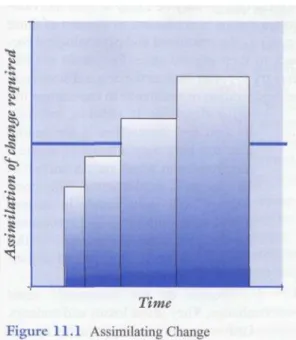
In Managing at the Speed of Change, Daryl Conner (1995) points out that an individual must deal with a variety of changes in his or her life and that we must assimilate these changes over time. Assimilation is the process of adapting to change and determines our ability to handle current and future change (Davidson 2002). For example, you may be dreading that root canal work next Wednesday, but once it's over you won't have the same level of anxiety that you are feeling right now. Or, you may be in the midst of planning a wedding. Most people view weddings as happy occasions, but anyone who has planned and gone through a wedding knows it can be a stressful. The stress and anxiety felt before the ceremony, however, become a distant memory once the happy couple celebrates their first anniversary. It simply takes time to assimilate change because we must adjust to the transition. Major changes, whether positive or negative, will require more time to assimilate than small ones. But once change is assimilated, it no longer creates the same level of anxiety or stress.
According to Conner, the problem occurs when we cannot assimilate change fast enough. Unfortunately, change tends to have a cumulative effect, and we can only assimilate change at a given pace. Different people will assimilate change at a different pace, and this ability to assimilate change becomes our resiliency to handle change.
Figure 11.1 illustrates the cumulative effect of assimilating change over time. Problems occur when we have to deal with too many changes or when we cannot assimilate change fast enough. When an individual passes a certain threshold, he
or she may become stressed out and exhibit dys functional behaviors. The behaviors depend largely on the person and may range from mild irritability to depression or dependence on alco hol or drugs. Therefore, it is important to man age the assimilation of change to keep things below the change threshold. In order to do this, Change an individual may try various tactics, such as
threshold exercising more regularly or postponing major life changes so as to deal more effectively with the present changes.
Conner (1995) points out that organizations are made up of people and these people have any number of personal changes going on in their lives. Changes proposed by an organization (e.g., reorganization, downsizing, implementing a new information system) will certainly affect the way people work and the relationships that have become established. Although these organizational changes will have to be assimilated by
each person, the organization must assimilate
SOURCE: D. Conner, Managing at the Change of Speed (New York:
Villard Books, 1995).
change similar to an individual. After all, organizations are made up of people!
Therefore, each change adopted by an organization must be assimilated and managed within the change threshold. Just like people, organizations can exhibit dysfunctional behaviors. These behaviors may include an inability to take advantage of new oppor- tunities or solve current problems. Eventually, an organization's inability to assimi- late change will be reflected in the organization's ability to make a profit. Like an individual who cannot effectively deal with change and the associated stress, the long-term health and sustainability of the organization becomes questionable.
Change as a Process
Although a great deal has been written about change management, one of the most useful models for understanding change was developed by Kurt Lewin. Lewin devel- oped the concept of Force Field Analysis or change theory to help analyze and under- stand the forces for and against a particular plan or change initiative (Lewin 1951). A Force Field Analysis is a technique for developing a big picture that involves all the forces in favor of or against a particular change. Forces that are viewed as facilitating the change are viewed as driving forces, while the forces that act as barriers or that work against the change are called restraining forces. By understanding all of the forces that act as aids or barriers to the change, one may enact strategies or decisions that take into account all of the various interests.
Lewin's basic model includes three concepts: unfreezing, changing, and refreez-ing as illustrated in Figure 11.2. The present state represents an equilibrium or status quo. To change from the current state, there must be driving forces both to initiate and to motivate the change. This requires an unfreezing, or an altering of the current state's habits, perceptions, and stability.
Figure 11.2 also depicts a transition from the present state to the desired state. This state is sometimes referred to as the neutral zone and can be a limbo or emotional wilderness for many individuals (Bridges 1991). Problems arise when managers do not understand, expect, or acknowledge the neutral zone. Those in the organization who act and support the driving forces for the change may be likely to rush individuals through the transition. This rushing often results in confusion on the part of those in the neutral zone, and the resisting forces (i.e., the emotional and psychological barriers) tend to push those individuals back to their present state. People do not like being caught in the neutral zone. They may try to revert back to the original status quo or escape. Escape may mean leaving the organization or resistance to the change initiative altogether. In addition, individu-
als who find themselves in the neutral zone too long may attempt to create a compromise in which only a portion of the change is implemented. This compromise will only result in missed opportunities and sets a bad precedence for the next change initiative—if this one did not work, why should anyone believe the next one will?
People do not necessarily resist change.
They resist losses and endings. Unfreezing, or moving from the current state, means letting go of something. Therefore, viewing change from
Figure 11.2 Change Process
SOURCE: Based on K. Lewin, Field Theory in Social Science (New York: Harper and Row, 1951).
THE NATURE OF CHANGE 261 Lewin's model suggests that beginning a change starts with an ending of the present state. Transition through the neutral zone also means a loss of equilibrium until an individual or organization moves to the desired state. Once there, it is important that the attitudes, behaviors, and perceptions be refrozen so that the desired state becomes the new status quo and equilibrium for the individuals involved.
Emotional Responses to Change
Until now, we have looked at change as a process and how change affects different areas of the organization. Change can also bring out emotional responses. An individ- ual may have an emotional response to a change when the change is perceived as a significant loss or upsets a familiar or well-established equilibrium. In her book On Death and Dying, Elizabeth Kubler-Ross (Kubler-Ross 1969) provides insight into the range of emotions one may experience from the loss of a loved one. These same emotional responses can be applied to managing change whenever people experience the loss of something that matters to them.
The original model included five stages that we go through as part of a grieving process that leads to eventual healing. If people are not allowed to grieve and go through the first four stages, it becomes difficult to reach the last stage—acceptance.
A person may have a number of emotions, such as sorrow, loneliness, guilt, and so forth, but the inability to work through these five stages can create more stress and difficulties than working through the stages. Although Kubler-Ross's model has been widely accepted, it has also been criticized as being oversimplified. However, it still provides some valuable insight for understanding how people may react to significant changes that affect their lives. The five stages include:
• Denial—The first stage is characterized by shock and denial. It is a com mon reaction when a person is given first notice of a change that will have significant impact. For example, when a person is informed that he or she is being fired by an organization, the initial response may be, Are you seri ous? This can't be true! The reality may be too overwhelming. Disbelief may be the immediate defense mechanism. The initial news, however, pro vides a beginning for understanding the full impact of the change that is about to take place.
• Anger—Once a person gets over the initial shock of the announcement, he or she may become angry toward others, or even the messenger. The reac tion is to blame whoever is responsible for creating the change. Although anger is a more active emotional response, it can be a cathartic expression when people are allowed to vent their emotions. Keep in mind that there is a difference between feeling anger and acting out in anger. While having feelings is always acceptable, the latter never is.
• Bargaining—In the third stage, the person is no longer angry. In fact, he or she may be quite cooperative and may try to make deals in order to avoid the change. For example, the person who lost her job may begin making promises that she will "double my productivity" or "take a cut in pay" in order to avoid being let go. A person may look for ways to extend the status quo, or the present equilibrium, by trying to "work things out."
• Depression—Once a person admits that the change is inevitable, he or she may understand the full impact of the change and may enter the fourth stage—depression. This stage generally occurs when there is an over whelming sense of the loss of the status quo. Although losing a job
involves losing income, most people become depressed because they also lose the identity associated with their job.
• Acceptance—The last stage is when a person comes to grips with the change. A person does not have to like the change in order to accept it. This fifth stage has more to do with one's resolve that the change is inevitable and must be dealt with. Acceptance is an important part of ending the status quo and getting on with a new state.
These emotional responses can help us understand why people react the way they do when faced with organizational change. Because of these emotions, people may be drained and productivity in the organization will suffer. It is also important to under- stand that people will have different perceptions of change. But, to them, their percep- tion is their reality. Often management and the project team will have known about and have had the time to prepare for an upcoming change. While they may be impatient for the change to occur, others in the organization will lag behind. Management and the project team may want to "get on with it," while the others are still dealing with their emotions during the transition. Instead of trying to suppress these individuals and their emotions, the leaders of change should accept them as a normal part of the change process and address them in the change management plan (Duck 2001).
THE CHANGE MANAGEMENT PLAN
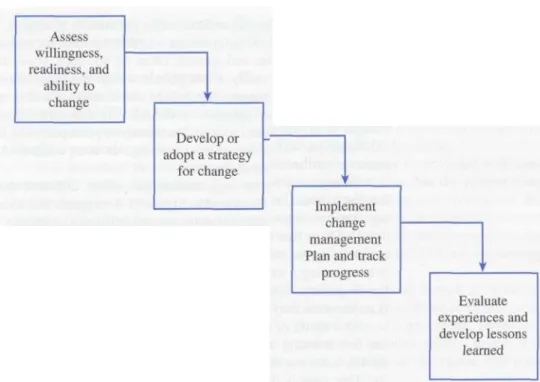
The key to any organizational change is to plan for and manage the change and the associated transition effectively. This entails developing a change management plan that addresses the human side of change. The mere existence of such a plan can send an important message throughout the organization that management cares about the people in the organization and will listen and take their needs and issues seriously (Bridges 1991). Depending on the size and impact of the change initiative, the change management plan can be an informal or formal document; however, the project team and sponsor should address and be clear on several important areas. These areas are summarized in Figure 11.3, and provide a framework for the developing a change management plan discussed in this section.
Assess Willingness, Readiness, and Ability to Change
The first step to developing a change management plan is to assess the organization's willingness, readiness, and ability to change. This assessment entails defining who the players or stakeholders involved in the change will be, their roles, and how they will interact with each other (Davidson 2002). Conner (1995) defines several roles or players involved in a change initiative: the sponsor, change agents, and targets.
Sponsor The sponsor can be an individual or group that has the willingness and power, in terms of authority and making resources available, to support the project.
Although this person or group is often the project sponsor, an initiating sponsor may hand off the project to a sustaining sponsor. More specifically, after making the deci- sion to fund and support the project, the initiating sponsor may become completely removed from the project. Without the support of a sustaining sponsor, the project will eventually lose steam and direction. Therefore, the sustaining sponsor must become the primary sponsor for the project. A major portion of the organization's ability and will- ingness to support the change rests with the sponsor's commitment to the project and
THE CHANGE MANAGEMENT PLAN 263
Figure 11.3 Change Management Plan
the associated change that will impact the organization. This commitment may be in terms of how they communicate with the rest of the organization, how they deal with challenges and issues, and the amount and quality of resources made available. In addi- tion, sponsors must be effective leaders. If the project fails because the organization cannot adapt to the change, the project's envisioned value to the organization is lost and the sponsor's credibility is diminished. As Conner points out, "they lose twice."
Change Agents In the most basic terms, the change agents will be the project manager and team; however, others from inside or outside the organization may be involved as well. An agent may be an individual or group responsible for making the change happen in order to achieve the project's goal and objectives. Change agents report directly to the sponsor and must be able to diagnose problems, plan to deal with these issues and challenges effectively, and act as a conduit of communication between the sponsor and the targets of change. The ability to sustain the change associated with the IT project rests largely with the change agents. They must be ready and properly prepared to meet the challenges they face.
Targets The target is the individual or group that must change. In general, these may be the users of the new system or those who will use or be directly involved with final product of the project. Conner uses the term "target" because these are the people who are the focus of the change effort and who play a critical role in the ultimate success of the project.
Although the project sponsors and change agents play important roles in supporting and carrying out the change effort, the dynamics associated with the targets of change become the most critical. Therefore, the willingness, ability, and readiness to change also rest largely with the change targets. This may require: (1) clarifying the real
impacts of the change, (2) understanding the breadth of change, (3) defining what's over and what's not, and (4) determining whether the rules for success have changed.
The project team and sponsor often do not think about how the planned change and transition will really affect people within the organization. As described in the previous section, change often brings about endings and a sense of loss of control.
The project team and sponsor should take the time to think about what various indi- viduals or groups stand to lose. For example, perceptions of loss may include power, relationships with other people, stability, or even control. As a result, people may become confused and disoriented.
Change within an organization can affect different things in different ways.
Leavitt's model, as illustrated in Figure 11.4, suggests that changes in people, technol- ogy, task, or organizational structure can influence or impact the other areas (Leavitt 1964). These four components are interdependent where a change in one can result in a change in the others For example, a change in the organization's technology (e.g., implementing a new information system) can impact the people within the organization (e.g., new roles, responsibilities, etc.) as well as the tasks the individual's perform (i.e., the work they perform), and the organization's structure (i.e., formal or informal).
As a result of the planned change, people will go through a variety of emotions.
On first learning of the impending change, people may feel shock, anger, and even denial. Later on, they may try to bargain or negotiate as a way of maintaining stability.
This time is difficult because compromise, or appeasement, may seem to be a good alternative for avoiding conflict and resistance. Unfortunately, this tactic will only undermine the effectiveness of the change initiative. Therefore, it is important that a boundary be defined in a way that allows the change to happen as planned, but also allows individuals to "take something with them" by giving them something familiar to hold on to so as to ease the transition. This allows the past to be remembered with reverence and can also mark the end and the new beginning.
People become confused and disoriented when the rules for success change or are no longer clearly defined. Let's say that you have been working at a company for several years. Over that time, you have come to understand and become part of that culture. You know from your own experience and from those around you that pro- motion is based solely on seniority. As long as you meet the minimum performance requirements of your job, you know that promotions and the pay raises that follow
will come arter working a specific amount ot time m a particular job. If the company ever has to layoff employees, you know that layoffs will begin with the employees with the least seniority. But what if the company you work for has been acquired by a larger organization? The acquiring company has decided to
"make a few changes" and starts by downsizing the workforce in your company. But now each employee's performance will be reviewed and only the top performers will be invited to stay. You can only begin to imagine peoples' reactions. The rules for success have changed.
Develop or Adopt a Strategy for Change Once the organization's capability to change is assessed, the next step involves developing or Figure 11.4 Leavitt's Model of Organizational Change
THE CHANGE MANAGEMENT PLAN 265
adopting a strategy for change. Davidson (2002) provides four approaches to change management.
Rational-Empirical Approach The rational-empirical approach to change man- agement is based on the idea that people follow predictable patterns of behavior and that people will follow their own self-interests. Therefore, a change agent must be persuasive in convincing, explaining, and demonstrating how a particular change will benefit a particular person or group identified as a target of the change.
It is important that the individuals affected by the change be provided with con- sistent and timely information. Consistent information means that the project team and sponsor send the same message to all individuals and groups throughout the organization. Mixed messages can lead to confusion and suspicion. Credibility should not become suspect. In addition, each message must be accurate and timely. Often the excuse is, "It may be better to wait until we have all the details." But, saying nothing at all can send the wrong message.
When people are not given enough information, they tend to seek information from other sources. Often these sources rely on innuendos, misinformation, and opin- ions, which become gossip that spreads through the informal organization. Stress levels rise until a point is reached where the organization becomes dysfunctional. It is better to be honest and tell people that there is no news before the rumor mill goes into warp drive.
Many managers believe that it is better to spare people bad news until the very last moment. However, it may be better to give people enough advanced warning to allow them to prepare for any upcoming changes. Then they can deal effectively with the gamut of emotions that will be brought on by the change.
The change management plan based on this strategy should provide each individ- ual with the purpose, a picture, and a part to play. Purpose is the reason for the change.
Often individuals within the organization have a narrow view of their job and its rela- tionship to the rest of the organization. It may be useful to provide people with a chance to see or experience the problem or opportunity first-hand. For example, a person may be given the chance to witness how the current level of poor service is affecting the organization's customers. Then, it should be clear to that person that unless the organization does something (i.e., implement a new information system), it will con- tinue losing customers to its competition. In time, the company will have to reduce its workforce or inevitably face bankruptcy.
A picture, on the other hand, provides a vision or a picture in the individual's mind as to how the organization will look or operate like in the future. If done effec- tively, this procedure can help the individual buy into the proposed change.
A part to play can be very effective in helping the individual become involved in the proposed change. Although purpose and a picture of the proposed change are important, it is also important for the individual to understand and visualize the part he or she will play once the change is instituted. Having a part may provide the needed WIIFM (or what's in it for me?) to help them through the transition.
Normative-Reeducation Approach The normative-reeducation strategy for change management is based on the work of Kurt Lewin. This approach takes the basic view that people are social beings and that human behavior can be changed by changing the social norms of a group. Instead of trying to change an individual, one must focus on the core values, beliefs, and established relationships that make up the culture of the group. For example, you may hear, "That's the way things are done
HOW NOT TO MANAGE CHANGE
Sheila Smith and Mary Silva Doctor offer some sure-fire ways to disrupt a change initiative:
• Communicate by Vulcan Mind Meld—Although being able to learn another person's thoughts and feeling like Mr. Spock in the old Star Trek TV series has its advantages, many managers seem to believe that as soon as they think something is a good idea, everyone else in the organization will know it, too.
Unfortunately, this type of communication does not work very well.
• The Rational Person View of Change—Often orga nizational leaders and managers believe that people will support an idea if it makes sense.
Unfortunately, change can be emotional and unset tling for many people, and, therefore, people may not always act rationally.
• Cuckoo Clock Leadership—Ineffective change lead ers tend to isolate themselves from the rest of the organization and communicate through their staff. A
company whose leaders only pop out of their offices occasionally to champion a particular cause soon became known as cuckoo clock sponsors.
• Sponsoring the Concept, Not the Implementation—
Sponsoring the recommended solution for a change initiative is an important, but not sole, ingredient for success. An effective change leader must also sponsor the implementation as well. Championing a concept is relatively easy compared to its actual implementation.
• The Best-Laid Plans—Although a transition plan is important, it cannot be the only plan to make the change successful. Moreover, a carefully constructed, detailed plan may not be all that useful when much of the real change is opportunity-driven, and the oppor tunities can occur in the day-to-day, informal interac tions among the people in the organization.
SOURCE: Adapted from Sheila Smith and Mary Silva Doctor, Sure-Fire Ways to Derail Change Efforts, CIO.COM, September 1, 1997, http://www.cio.com/archive/090197/change.html.
around here." The targets of change in this case may be highly resistant to new ideas or new ways of doing things.
This approach can be very difficult and time-consuming because the change agents and sponsor must study the existing values and beliefs of a group. It requires unfreezing the current norms so that the change can take place and so that a new set of norms can be refrozen in order to solidify the acceptance of the new way of doing things by the group. As a result, change becomes more effective when each person adopts the beliefs and values of the group. The focus for managing change under this strategy becomes helping people redefine their existing social norms into a new set that supports the change effort. Some key principles include:
• Capacity for change is directly related to a person's participation in a group. When we become part of a group, our views and beliefs and those of the group become interwoven with each other.
• Effective change requires changing something not only about the individ ual's values and beliefs, but also the values and beliefs that make up the existing group's culture.
• Bias and prejudice toward guarding one's closely held beliefs and values diminishes one's ability to think rationally. Even when presented with the facts, many people may not act upon them in a rational way.
Power-Coercive Approach The power-coercive approach to change management attempts to gain compliance from the change targets through the exercise of power, authority, rewards, or threat of punishment for non-conformance. Many managers may be lured into using this deceptively easy and straightforward approach, but there is a real risk when used in the wrong situation. People may comply (or at least go through the motions of compliance), but an approach based solely on rewards or punishment
THE CHANGE MANAGEMENT PLAN 267
may have only short-term effect. For example, a person may comply for the time being, until they can find new employment. On the other hand, a person may view the change as temporary and just "wait out the storm" until it is convenient or safe to go back to the old way of doing things.
There are, however, situations where the power-coercive approach is useful and effective. In such cases, the targets of change recognize the legitimate power or expertise of the change agent. For example, a person may not change his indolent lifestyle until the doctor cautions him that certain health problems will get worse unless he changes his diet and begins an exercise program. Similarly, an organization may be faced with a situation that requires immediate attention — i.e., any inaction or time lost trying to get
"everyone onboard" would spell disaster for the company. In this case, the use of rewards and threats would be a rational approach. As Davidson observes,
People's dependency on an organization largely dictates how effec- tive the power-coercive approach and the use of sanctions can be. If people are highly dependent on the organization; live paycheck to paycheck; have few job alternatives; and are not financially, men- tally, or emotionally prepared to walk, you are on relatively safe ground using the power-coercive approach judiciously. (90-91)
The objective is to change the behaviors of the targets so that their new behavior supports the change effort. Davidson points out that sanctions should be imposed on an individual level and should focus on what an individual values and what they dread losing — perhaps a bonus, a paycheck, or a position within the organization. Sanctions can be imposed in ascending order to demonstrate a point in the beginning and to keep any target's losses at a minimum. A change agent or sponsor can lose credibility, how- ever, if they issue a warning or sanction that they do not fully intend to carry out.
Finally, the change agent or sponsor should never be abrasive or disrespectful and should not impose sanctions in a cruel or vindictive manner.
Environmental-Adaptive Approach Like a pair of old, comfortable shoes, people often become attached to and comfortable with a certain way of doing things, perhaps an older system or established processes that have become part of the group's culture and norms. The premise of the environmental-adaptive approach is that although people avoid disruption and loss, they can still adapt to change.
Following this approach, the change agent attempts to make the change perma- nent by abolishing the old ways and instituting the new structure as soon as possible.
Cortez, the explorer, probably displayed the most drastic form of this approach. After landing in the New World, many of his men began to grumble about the conditions and what lay ahead. In response, Cortez burned the boats so that there was no option other than pressing on. A much less drastic example would be upgrading everyone's word processing software over the weekend so that when everyone returned to work on Monday morning, they would have no choice but using the new software package.
In both examples, the targets of change were given no choice but to change.
Although this approach may be effective in certain situations, it is still important that the targets of change assimilate the change as quickly as possible in order to adapt to the change as soon as possible. Some ways may include helping the targets of change see the benefits and showing them how the new way is similar to their old, familiar way of doing things.
The change management strategies introduced here are typical for many change initiatives. A single strategy or approach, however, may not be effective in every sit- uation. A more useful approach may be to combine the different strategies, depending on the impact of the change and the organization.
Implement the Change Management Plan and Track Progress
Once the players and the strategy for the change management plan have been defined, the next step entails implementing the change management plan and tracking its progress. Although tracking progress should be integrated into the overall project plan and monitored using the various project tools, such as the Gantt chart, PERT chart, and so forth, introduced in an earlier chapter, milestones and other significant events should be identified and used to gauge how well the organization is adapting to the change.
In addition, one of the most critical issues for ensuring that the change takes place as planned is the establishment of effective lines of communication. At the very outset of any change initiative, gossip, rumors, and people's perceptions will find their way in both the formal and informal organizations. It is important that the project team and project sponsor create and open channels of communication.
The communication media can be important, especially when delivering certain types of news. For example, a richer media, such as face-to-face communication, is generally preferable when delivering important or bad news. There are a number of stories about people who realized that they were being let go when they found their phone line and network connections disconnected and security guards standing by their desk waiting to escort them out of the building. Delivering bad news is something that no one really enjoys, but must be done nonetheless. The point is that management can handle difficult situations with class or with very little class.
Finally, open channels of communication should be both ways. The project team and sponsor must communicate effectively with the various groups within the organ- ization affected by the change, and these groups, in turn, must be able to communicate effectively with the project team and sponsor. In addition, Web sites, e-mails, memos, and newsletters can all be mediums for effective communication.
Evaluate Experience and Develop Lessons Learned
As the project team carries out the change management plan, they will, no doubt, learn from their experiences. These experiences should be documented and made available to other team members and other projects so that experiences can be shared and best prac- tices can be identified. At the end of the project, it is important that the overall success of the change management plan be evaluated. This evaluation may help determine the effec- tiveness of the different players or a particular change management strategy. The impor- tant thing is to learn from experience and to share those experiences with others while adding new form and functionality to the project organization's IT project methodology.
DEALING WITH RESISTANCE AND CONFLICT
Resistance and conflict are a natural part of change (Davidson 2002). In this section, we will look at the nature of resistance and conflict and several approaches for dealing with these two issues. Keep in mind that the concept of conflict presented in this section can be applied to conflicts within the project team as well as external conflicts brought about by the change effort.
Resistance
Resistance should be anticipated from the outset of the project. Rumors and gossip will add fuel to the fire, and the change effort can easily run out of steam if those affected by the change begin to resist. Resistance can be either overt, in the form of
Conflict
DEALING WITH RESISTANCE AND CONFLICT 269
memos, meetings, etc., or covert, in the form of sabotage, foot dragging, politicking, etc. Once the change is compromised, management and the project team will lose credibility, and the organization may become resistant to all future changes.
Resistance can arise for many valid reasons. For example, someone may resist an information system because the response time is too slow or because it does not provide the features or functionality that were originally specified as part of the requirements.
On the other hand, resistance due to cultural or behavioral reasons is harder to rationalize, but still can keep a project from reaching its intended goal. People may resist change even though they understand that the change will be beneficial (Davidson 2002). For example:
• Some people perceive the change as requiring more time and energy than they are willing to invest.
• Sometimes people feel that that a change will mean giving up something that is familiar, comfortable, and predictable.
• People may be annoyed with the disruption caused by the change, even if they know that it will be beneficial in the long run.
• People may believe that the change is being imposed on them externally, and their egos will not tolerate being told what to do.
• In addition, people may resist because of the way the decision to change was announced or because it was forced upon them.
Resistance is human nature and a natural part of any change process.
Understanding what an individual or group perceives as a loss is the first step to dealing with resistance effectively. Because the project team and sponsor are the agents of change, it is easy to see those who resist as overreacting or not being logical. As the proponents of change, the project team and sponsor have had the luxury of knowing about the change early and, therefore, have had the time to become used to it. The rest of the organization, however, may learn about the change much later and, therefore, may not be at the same place for digesting the change. Subsequently, it is important that the project team and sponsor listen to what the rest of the organization is saying. Instead of arguing and trying to reason, it is better to allow people to vent their anger and frustration. Again, having defined a boundary of what is and what is not part of the change can help deal with stressful conflict situations. Keep in mind that empathizing or sympathizing with an individual is not the same as agreeing with them.
Closely associated with resistance is the concept of conflict. Conflicts arise when people perceive that their interests and values are challenged or not being met. Conflict management focuses on preventing, managing, or resolving conflicts. Therefore, it is important to identify potential conflicts as early as possible so that the conflict can be addressed. Although conflict can be positive and help form new ideas and establish commitment, negative conflict left unresolved can lead to damaged relationships, mistrust, unresolved issues, continued stress, dysfunctional behavior, and low produc- tivity and morale (Davidson 2002). As Verma (1998) suggests:
Although conflict is one of the things most of us dislike intensely, it is inevitable. Most often when we try to avoid conflict, it will nev- ertheless seek us out. Some people wrongly hope that conflict will go away if it is ignored. In fact, conflict ignored is more likely to get worse, which can significantly reduce project performance. The best way to reduce conflict is to confront it. (367)
RESISTANCE (TO CHANGE) IS FUTILE
According to David Foote, resistance to change can be one of the "nastiest, most debilitating workplace cancers." It is difficult to understand why even successful companies fail to carry out well-conceived solutions to problems, discour- age innovative and creative ideas, lose valued employees, or watch their successes from the past evaporate. Often the reason is resistance to change. Foote provides several suc- cess factors based on the experiences of companies that have managed resistance well.
• Manage the transition, not the change—Resistance is more deeply rooted in the transition rather than the change itself. Transition is more psychological in nature, whereas change is more situational.
Transitions are more internally felt and focus on end ings. Therefore, it is important to think through who will have to let go of what.
• Fear is real when pursuing change—When fear fuels resistance, it is important to determine who is losing what, anticipate overreaction, acknowledge the losses, and give something back. It is important to look for signs of grieving and allow people to vent their emotions. In addition, treat the past with respect (symbolically and literally), and let people take a piece of the past with them.
• Keep change teams small—Empirical evidence sug gests that small, empowered teams comprised of six to eight people have the greatest impact on change initiatives. Smaller teams are better at following the rules and improvising creative solutions when faced with obstacles.
Anticipate and embrace failure—Progress toward the project goal counts. But, learning can be difficult, and relapses are a normal part of the change process.
Use metrics—Metrics are important for measuring progress and for rewarding performance being made toward the change objective. Be in agreement—An organization's leaders must be in agreement so that a clear, consistent message is being sent throughout the organization. This message should focus on the compelling reasons for the change. Dissension can fuel resistance. Invite broad participation—For a change initiative to succeed, at least 15 percent of the people who are affected by the change must be actively engaged and committed to the change.
Over-educate—Management and the change agents should manage expectations and resistance through effective and timely communication. Communica- tion should focus on the mission, vision, philoso- phy, process, choices, and details about the impending change.
It takes time—Change does not happen overnight.
Often organizations take years to prepare, practice, and build their capabilities to manage change.
SOURCE: Adapted from David Foote, The Futility of Resistance (to Change), Computer-world, January 15, 2001, http://www .computerworld.com/managementtopics/management/story/0,10801 ,56246,00.html.
There are three different views of conflict that have evolved from the late nine- teenth century to today (Verma 1998). These views are (1) the traditional view (mid-nineteenth century to mid-1940s), (2) the contemporary view (mid-1940s to 1970s), and (3) the interactionist view (1970s to present).
• Traditional View—The traditional view considers conflict in a negative light and feels conflict should be avoided. Conflict, according to this view, leads to poor performance, aggression, and devastation if left to escalate.
Therefore, it is important to manage conflict by suppressing it before it occurs or eliminating it as soon as possible. Harmony can be achieved through authoritarian means, but the root causes of the conflict may not be adequately addressed.
• Contemporary View—The contemporary view, on the other hand, suggests that conflict is inevitable and natural. Depending on how conflict is han dled, conflict can be either positive or negative. Positive conflict among people can stimulate ideas and creativity; however, negative conflict can
DEALING WITH RESISTANCE AND CONFLICT 271 have damaging effects if left unresolved. Therefore, positive conflict should be encouraged, while keeping negative conflict in check.
• Interactionist View—Today, the interactionist view holds that conflict is an important and necessary ingredient for performance. Although the contem porary view accepts conflict, the interactionist view embraces it because teams can become stagnant and complacent if too harmonious or tranquil (Verma 1998). Subsequently, the project manager should occasionally stir the pot in order to encourage conflict to an appropriate level so that people engage in positive conflict. This may, however, be a fine line to walk for many project managers. Although someone who plays the role of the devil's advocate can be effective in many situations, people may become annoyed when it is used in every situation or used ineffectively.
To better understand the nature of conflict, Verma (1998) points out that conflict within projects can fit one, or a combination, of three categories:
1. Conflicts associated with the goals, objectives, or specifications of the project.
2. Conflicts associated with the administration, management structures, or underlying philosophies of the project.
3. Conflicts associated with the interpersonal relationships among people based on work ethics, styles, egos, or personalities.
According to a study conducted by Thomas and Schmidt (Thomas and Schmidt 1976), a typical middle or top-level manager spends about 20 percent of her or his time dealing with conflict! For the project manager and project team, the seeds of resistance can easily lead to negative conflicts. Subsequently, it is important to under- stand how to deal with conflict. Blake and Mouton (Blake and Mouton 1964) and Verma (1998) describe five approaches for dealing with conflict. A project team mem- ber or project manager should choose an appropriate approach for managing conflict based on the situation.
• Avoidance—Avoiding conflict focuses on retreating, withdrawing or ignor ing conflict. Sometimes, a cooling-off period may be a wise choice, espe cially when emotions and tempers are high. Avoidance may be appropriate when you can't win, the stakes are low, or gaining time is important.
However, it may not be useful when the immediate, successful resolution of an issue is required.
• Accommodation—Accommodation, or smoothing, is an approach for appeasing the various parties in conflict. This approach may be useful when trying to reach an overall goal when the goal is more important than the personal interests of the parties involved. Smoothing may also be effective when dealing with an issue that has low risk and low return or when in a no-win situation. Because accommodation tends to work only in the short run, conflict may reappear in another form later on.
• Forcing—When using this approach, a person uses his or her dominant authority to resolve the conflict. This approach often results in a one-sided or win-lose situation in which one party gains at the other's expense. This approach may be effective when no common ground exists, when you are sure you are right, when an emergency situation exists, or when time is of the essence. Forcing resolution may, however, cause the conflict to rede velop later because people dislike having a decision or someone else's views imposed upon them.
• Compromise—Compromise includes aspects of both forcing and accommo dation; it gives up more than forcing and less than accommodation.
Compromise is essentially bargaining—one person or group gives up some thing in exchange for gaining something else. In this case, no party actually wins and none actually loses, so that some satisfaction is gained from reso lution of the conflict. This approach may be useful when attempting to resolve complex problems that must be settled in a short time and when the risks and rewards are moderately high. Unfortunately, important aspects of a project may be compromised as a means of achieving short-term results—for example, quality standards may be compromised in order to meet the project's schedule.
• Collaboration—When the risks and benefits are high, collaboration may be the best approach for dealing with conflict. This approach requires con fronting and attempting to solve the problem by incorporating different ideas, viewpoints, and perspectives. The focus of collaboration is learning from others and gaining commitment, trust, respect, and confidence from the various parties involved (Verma 1998). Collaboration takes time and requires a sincere desire to work out a mutually acceptable solution. In addition, it requires a willingness to engage in a good-faith problem-solving process that facilitates open and honest communication.
According to Verma (1998), each conflict situation is unique and the choice of an approach to resolve conflict depends on:
• Type of conflict and its relative importance to the project.
• Time pressure to resolve the conflict.
• Position of power or authority of the parties involved.
• Whether the emphasis is on maintaining the goals or objectives of the proj ect or maintaining relationships.
Polarity Management
Often the project manager or project team is faced with a conflict situation that appears to have no solution. For example, the agents of change (i.e., the project team) may be faced with conflict and resistance from the targets of change (i.e., the users).
Often one side finds itself advocating a change (e.g., a new system), while the other side is trying to maintain the status quo. The problem is that both sides end up in a polarity where each side can only see the upsides or advantages of their pole and the downsides or disadvantages of the other. For many, this is a difficult dilemma that can create even more resistance and conflict.
In his book, Polarity Management: Identifying and Managing Unsolvable Problems, Barry Johnson (Johnson 1996), advocates a technique that can help people see the whole picture and then structure the process of change to bring about an effec- tive method for collaboration.
According to Johnson, the problem is that we often frame a problem or dilemma as something that can be solved by choosing one side over another. Crusaders are those who want to change the status quo and are the supporters of change. Tradition Bearers are those at the opposite end of the pole and wish to preserve the best of the past and present. Using a tool called polarity mapping, we can see the upsides and
DEALING WITH RESISTANCE AND CONFLICT 273
HOW TO HANDLE CONFLICT Kenneth Cloke is the director of the Center for Dispute
Resolution, and Joan Goldsmith is an organizational con- sultant and educator. Together they provide a number of ideas to help make the most of conflict. The following steps can help you to think about yourself, your opponent, and your conflict:
1. Look inward—The first thing to do is to focus on yourself by making a decision to approach and engage in conflict constructively. Being open to learning during the process and being committed to resolving the conflict constructively are required.
2. Set the stage for dialog—The next step is to find a neutral environment, perhaps by inviting your opponent to lunch or some other locale away from the office. It is important to be open, honest, and friendly rather than hostile or suspicious.
3. Listen carefully—Now is the time to disengage from your fight-or-flight response and be open to listening empathically to your opponent. Conflict is fundamentally a communication problem, and to be an effective listener you need to control your emo tions. Control your anger and refuse to take com ments personally.
4. Speak carefully—Your needs and self-interests should be stated clearly and without emotion.
Becoming angry yourself can escalate the conflict and diminish your integrity and credibility.
5. Dig deeper—Look beyond the words spoken to the real meaning of what is being said. This can help you to understand the underlying reasons for the conflict. Often the conflict is not about the issue you are arguing about, but about issues that lie beneath the surface.
6. Don't get personal—People often think that they are right and that the other person is reason for the conflict. Conflict can present opportunities when you separate the person from the problem, focus on the future and not the past, and stop arguing about what you want and instead talk about why you want something. Positions that focus on what you want limit thinking, percep tions, and imagination, while interests that focus on why you want something can broaden choices and focus on the future.
7. Think creatively—It helps to work with the other person to brainstorm potential solutions. When in
conflict, it is easy to spend a great deal of time trying to get the other person to accept your solu- tion while poking holes in theirs. Brainstorming allows for expanding the range of solutions and seeing the big picture.
8. Collaborate—It is better to negotiate collabora- tively than aggressively. Negotiating can help both parties to shift from anger to problem solving.
9. Use the right tools—Appropriate problem-solving techniques, mediation, and so forth can help over come an impasse, find common ground, and reach a resolution to the conflict.
10. Be forgiving—Letting go of your judgments and perceptions about the other party can help you to improve your own skills at handing his or her diffi cult behaviors. Sometimes you have to admit to yourself that you do not know how to respond effectively to his or her behaviors. You may have to learn to let go of your conflicts so that your future is not overshadowed by what has happened in the past. Your lessons learned from your experiences should help you to "remember and forgive" rather than "forgive and forget."
11. Don't surrender—You cannot always avoid con flict, but you can turn conflicts into collaboration and opportunity. Resolving a conflict does not mean losing or giving in because both parties cheat them selves out of the chance to learn from what the con flict has to teach.
12. Look outward—It is important to recognize that larger organizational and social issues are expressed as a result of conflict. Conflict can lead to change that offers the promise of a better world. Your role in this change can allow you to grow and feel con nected with others.
13. Search for completion—Conflicts will continue if you do not feel that you have been heard or have communicated completely what you think. You can help the other party by summarizing what the other person has said, asking them to summarize what you have said, and ensuring that the person (or you) has not held anything back. Only then can you feel as though something has changed.
SOURCE: Adapted from Kenneth Cloke and Joan Goldsmith, Making the Most of Conflict, CIO.COM, http://www.cio.com/leadership/edit /020100 conflict.html.
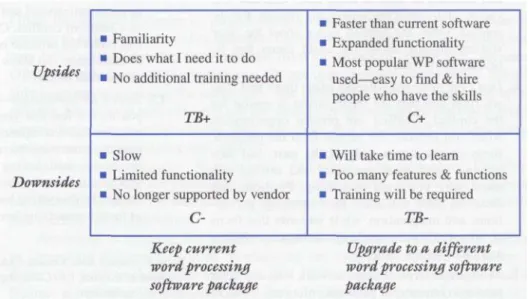
downsides that each side is advocating. Figure 11.5 provides an example of a polarity map for implementing a new word processing application.
The polarity map illustrated in Figure 11.5 shows how the two polarities can be mapped. In the upper left quadrant, the Tradition Bearers' (TB+) view of the upsides for keeping the current word processing software package are listed, while the Crusaders' (C+) view of the upsides for upgrading to a new word processing package are listed in the upper right quadrant. Often the conflicts occur in the lower two quadrants or on the diag- onals. For example, people who advocate upgrading to a new word processing package may focus on the upsides of the upper right quadrant (C+) and the downsides of the lower left quadrant (C-). Similarly, those in favor of maintaining the status quo will focus on the quadrants TB+ and TB-. Often the upside of one quadrant (e.g. "familiarity" in TB+) becomes a downside in the opposite quadrant (e.g., "will take time to learn" in TB-).
Subsequently, resistance and conflict only escalate unless both sides see the entire picture.
Brainstorming is a useful technique for having both the Tradition Bearers and the Crusaders list the upside and downsides for both polarities. Starting in any quadrant is fine, and either side can add to the upsides or downsides of any quadrant. It is important to see the big picture and for both sides to communicate a particular per- ception. Johnson suggests that before using polarity management, both sides should:
1. Clarify what you value and what you do not want to lose.
2. Let the other side know that you are aware of the downsides of the pole you favor.
3. Assure the other side that you want to maintain the upsides of their pole.
The effective use of polarity mapping helps people get away from seeing their ini- tiative as the only solution to the problem and from believing a decision must choose one pole over the other. In fact, both Crusaders and Tradition Bearers make important contributions to the process. For example, Crusaders contribute by identifying the downsides of the current pole and provide the energy to move away from the current pole. Similarly, Tradition Bearers, by identifying the upsides of the current pole, help identify things that should be preserved. Tradition Bearers also identify downsides of the opposite pole. Everyone's concerns are valid and important in coming up with a
Figure 11.5 Polarity Mapping
SOURCE: From Polarity Management: Identifying and Managing Unsolvable Problems, copyright © 1996, Barry Johnson. Amherst, MA: HRD Press, Inc. Used with permission.