• • • •
9
Marketing research
Where is research going? I think right now it’s heading nowhere slowly. Many clients use research as a crutch ���research is used for analysis and information ���it’s not used for insight. It’s operating at about 30% of its potency.
Kevin Roberts, CEO Saatchi & Saatchi
Aims
The aim of this chapter is to enhance understanding of:
• the marketing research process
• exploratory, descriptive, and causal research
• limitations of marketing research.
Perspective
DMOsplaytwo keyroles inmarketingresearch.Firstly, amarketing orientationdictates a focuson understandingconsumerneeds, and so the DMO must collect information to enable effective decision
makingrelating to the destination marketingprocess. Secondly, the DMO acts as an information clearing house to assist stakeholders with their own marketing decisionmaking. The chapter focuses on the sixstep marketing research process, beginning with identification of themanagement decision problem(MDP) and culminatingin the reporting of information to enable effectivedecisionmaking. DMOs, particularly at the RTO level, rarely have the time and/or financial resourcesto undertakenecessary marketingresearchinallmarkets of interest to stakeholders. So, tradeoffs must bemade. Decisions mustoftenbemadeatspeed,withoutthebenefitoffullinformation.No marketingresearchdesignisperfecttherefore.Eachprojectwillhave limitations,andsoitisimportantfordestinationmarketerstodevelop skillstobeabletocritiquethevalidityoftheresearchapproachused.
Why conduct marketing research?
Marketing research has been defined as (Malhotra et al., 2006, p. 5):
The systematic and objective collection, analysis and dissemination of information for the purpose of assisting management in decision
making related to the identification and solutions (and opportunities) in marketing.
Clearly, any destination marketer with a market orientation (see Chapter 1) requires a process for staying in tune with consumertravellers in target markets and gaining insights into the why of buy, to generate information that will aid future decisionmaking, both for the DMO and for stake
holders. Information reduces uncertainty and so is necessary at each stage of the marketing process from the environmental analysis and planning (see Chapter 8) through to implementation and ultimately performance evaluation (see Chapter 19). Access to the right information enables more effective marketing decisionmaking.
Times have certainly changed in terms of marketing research adoption by DMOs. Someone involved in the early days of regional destination promotion confided to me during an indepth interview that many of her resort destination’s promotions in the 1960s and 1970s were developed
‘over a bottle of gin at two in the morning’. From my own experience in New Zealand I know that most RTOs there only became serious about developing a marketing research programme around the late1990s. But even then the function was rated secondary to other marketing activities, with one RTO marketing manager admitting to me: ‘As you know Steve,
research is always the first to get cut in the budget planning.’ Around the same time in the USA, Hawes et al. (1991) found that only 10 out of 37 USA STOs commissioned market research on a regular basis. In the UK, Bramwell and Rawding (1996, pp. 213–214) noted the lack of research used by destination marketers there. They cited the following comment by the CEO of a Convention and Visitor Bureau on the development of a city image during the 1990s:
The image was chosen because it is the facts, it is the reality. We did no market research to create an image ���We promote the facts, we don’t go in for gimmicks.
In examining the priority of research for CVBs in the USA, Masberg (1999) found that the activity was regarded as essential for improving pro
ductivity, and yet the bureaus were devoting little time or funding. For example, the person responsible for research was more likely to hold a management position rather than hold the title of research manager, and almost 80% of respondents indicated spending less than 10% of their time on research. Masberg (p. 38) summarised the research findings as ‘grim and bleak’. Similarly, in an investigation of the perceived importance of research in Austria by the NTO and RTOs, Dolnicar and Schoesser (2003) found:
• an underestimation of the importance of market research
• minimal research budgets relative to promotional spend
• a lack of formal criteria for evaluating market research needs
• a lack of coordination between research and marketing staff.
Increased competition and greater access to information have contributed to increased marketing research activity by DMOs at all levels. Case Study 9.1 provides an example of a sizable CVB marketing research project, where much was at stake in terms of decisionmaking based on informa
tion generated.
Case study 9.1 Gateway Calgary: Research-driven strategies
TraceyGrindal,MarketResearchManager,TourismCalgary
Gateway Calgary was a research study initiated and project managed by Tourism Cal
gary on behalf of seven industry partners. The goal of the study was to identify lucrative productmarket linkageswithintheCalgaryregion’s tourismindustryfromwhich todevelop, package, and promote product clusters. The results are guiding Tourism Calgary’s market
ing and strategic planning through to 2008. The study began in 2004 and concluded in summer 2005.
Gateway Calgary wasa fourphasedproject. Phase one,information collection, included athoroughscanofCalgary’stourismindustryinventoryto identifyareasofcriticalmassand
gaps in tourism product offerings and an analysis, using demographic as well as psycho
graphic and behavioral tools, of Calgary’s currentgeographic and productbased markets.
Inphasetwo, 10developing andemergingproducts onwhichto focusmarketingeffectsin thenear andlongterm were identified. Phase two identified10 potential marketsegments forCalgary andarea. Ofthe10,threewere identifiedashavingimmediatepotential,which were (1) Western Heritage, (2) Information, and (3) Sport/Major Event Tourism. In phase three, industry wasconsultedto gather their input,feedback andsupport of thethree seg
ments.Phase four, sustainableimplementation, continues to bethe most important phase of theproject. It involves the focused, strategic marketingof theright products to the right demographics.
Todate, several initiatives relating to the three segments have been completed or are underway.UnderWesternHeritage,mediamarketinghas beenincreasedonWesternher
itage and culture. The ‘West’ messaging and the brand, Experience Calgary Heart of the NewWest,areused throughoutTourismCalgary’smarketingandsalesinitiatives.Fourdif
ferent Western Heritage experiences – the Old West, the Real West, the Wild West, and the New West – were developed based on the research.
UnderInformation, Tourism Calgary partnered withthe City of Calgary and the Calgary TowertoopenanewVisitorInformationCentrethatservicesbothvisitorstoCalgaryandCal
garyresidents.Otherinitiativesinclude provincialaccreditationofvisitorinformationcentres andimprovedvisitorfriendlyhighwaysignage.
Amajor component of the Sportand Major Event segment was thedevelopment of the CalgarySportTourismAuthority(CSTA).TheCSTAisavolunteercommitteeofseniorlevel Calgary executives whose purpose is to review and ultimately decide whether to support sportandmajoreventopportunitiesforCalgarybytakingalookattheeconomic,social,and environmentalimpacts and meritsand its‘fit’ withCalgary.In just two short yearsTourism Calgary and its partners have made great strides in this area, confirming the 2006 World FigureSkatingChampionships,2007NorthAmericanOutGames,andthe2008JUNOS.
Discussion question
How does the Gateway Calgary project relate to the definition of marketing as described in Chapter 1?
Furtherinformation www.tourismcalgary.com
Information clearing house
A key function for DMOs is acting as an information clearing house for local stakeholders, potential investors and developers. The majority of tourism service providers are small familyowned businesses with min
imal marketing budgets. DMOs can enhance decisionmaking of small businesses by providing links to market intelligence and other useful infor
mation. Table 9.1 lists the key elements in Ritchie and Crouch’s (2003) model of DMO information management.
Table9.1 InwardandoutwardflowsofDMOinformation
Inwardflowofinformation Outwardflowofinformation
• Evolving research methods • To investors and developers
• Impacts on tourism policy • To members
• Environment scanning • To visitors
• Monitoring competitors • To community stakeholders
• Monitoringperformance
• Monitoringmarkets
• Destination image
• Monitoring sector performance
• Monitoring visitor impacts
• Visitor feedback
• Internal destination information
• Internal DMO information
In practice
For an example of a comprehensive research clearing house see TourismQueensland’scorporatesite(http://www.tq.com.au/research/
index.cfm).Thesiteprovidessummaryfactsheetsaboutkeymarkets andtrends,aswellasmoredetailedreportsandlinkstoothertourism researchproviders.Informationonthesiteisfreelyavailable.Alsoin Australia,TourismResearchAustralia(www.tra.australia.com)made themovein2006to providingfactsheetresearchsummaries, inan efforttoappealtoabroaderrangeofstakeholders.
The marketing research process
As future managers, it is important for students of destination market
ing to develop a good understanding of the marketing research process, even though many might view the topic as being as scary as management accounting due to an aversion towards anything involving numbers or statistics. My question to any student aspiring to a marketing or manage
ment position who tries avoid these topics is this: When you are responsible for business decisionmaking, how can you trust what the accountant and mar
keting researcher are advising you if you don’t have an understanding of the basic concepts? After all, you will be making decisions that involve their input.
What will be particularly valuable is an understanding of the advantages and disadvantages of the various research techniques in relation to the decision problem. Marketing research is increasingly being criticised about its effectiveness, for (1) techniques being selected on the basis of economic
efficiency rather that tailored to address a specific problem, and (2) using metrics designed for previous generations that are no longer effective in the Internet age.
In addition to general marketing research texts (see, for example, Aaker et al., 2007; Churchill & Iacobucci, 2005; Malhotra et al., 2006; Zikmund &
Babin, 2007) and tourism research texts (see, for example, Jennings, 2001;
Veal, 2006), a useful resource is Ritchie, Burns and Palmer (2005), who edited a 17chapter text on the applicability of various research approaches to tourism. Each chapter has been written by a researcher who has applied the approach in a tourism setting, including for example: Delphi forecast
ing, depth interviews, mystery shoppers, action ethnography, case studies, focus groups, and content analysis. The text by no means addresses all available research techniques, but it is hoped that the concept will be expanded in the future.
Some types of information required by managers will be informal or indirect in nature, such as the feedback from suppliers dealing directly with visitors and nonvisitors. Other aspects will be generated by more formal and direct means, such as intercept surveys of visitor at information centres. There is a place for both types of information in decisionmaking.
Gut feelings or intuition from those on the frontline of tourism services is valuable for some decisionmaking. For example, the ANZCRO case in Chapter 15 discusses the development of a marketing joint venture based on both research and practitioner experience.
Generally, the more complex the decision the more detailed the informa
tion required and this requires a systematic approach. What is important is that the information generated for decisionmaking purposes has the following qualities (Malhotra et al., 2006): relevance, accuracy, reliability, validity, timeliness, and efficiency.
Marketing research is a sixstep process, as highlighted in Figure 9.1. It is important to note that this is not a linear process that stops at step 6. Rather the process is ongoing in a circular manner. In this way, the conclusions in step 6 lead to the identification of new problems and/or opportunities.
Step 1 – Identification of the management decision problem (MDP)
Step 2 – Statement of the marketing research problem (MRP)
Step 3 – Research design
Step 4 – Data collection
Step 5 – Data analysis
Step 6 – Interpretation and presentation Figure 9.1
Marketingresearch process
Management decision problem (MDP) and marketing research problem (MRP)
The first stage in marketing research involves identifying and articulat
ing the management decision problem (MDP). The MDP is a short state
ment summarising the problem or opportunity facing management. In this section, the terms opportunity and problem are used interchangeably.
An example is whether to use the destination’s general brand positioning theme when entering a new market such as China. This is a potential marketing opportunity, but represents a decision problem requiring infor
mation to design a course of action such as retaining or modifying the theme for the new markets or in markets with English as a second lan
guage such as in the case of Tourism Australia’s controversial Where the bloody hell are you campaign in 2006.
While all steps are important, it is essential that the MDP and MRP are clear, because it is these that lay the foundation for the remaining steps. The MDP is typically expressed as actionoriented, focusing on a practical mar
keting decision. The type of information required for the decision is then guided by a marketing research problem (MRP) statement. The aim is to focus the researcher’s attention on the information required to address the MDP.
The MRP usually features a broad statement about the construct of interest, which is then broken down into more manageable research objectives.
The brief • • •
Usually a brief would be provided by management for the marketing researcher, much in the way a client’s brief would guide an advertising agency. For example, Appendix 9.1 is a real world ‘Request for propos
als’ (RFP) distributed by Tourism New Zealand in 2005. The RFP invited marketing research firms to submit research design proposals. The MDP and MRP are not necessarily explicit in these documents. In this case, the MDP could read: Is the brand positioning theme still relevant/appropriate in our major markets? Or, does the brand positioning theme need to be changed? This clearly identifies the action/decision faced by management.
The MRP to address the MDP could then feature the following broad state
ment: How is New Zealand positioned as a holiday destination in each major market? The key construct of interest here is market position. This would then be supported by a series of questions to guide the collection of information that would measure this construct, and therefore enable management’s decision.
Research design
The research design is sets out the procedures for collecting the required information. Important considerations include (Malhotra et al., 2006, p. 21):
• definition of the target population
• methods of collecting qualitative and quantitative data
• sampling process and sample size
• measurement and scaling procedures
• questionnaire design
• data analysis approach.
The valueofmixedmethods • • •
Clearly, the level of available resources will dictate the scope and lim
itations of the research design. Importantly, the focus must remain on designing the collection of information to address the MRP and therefore the MDP. In many cases, the most effective research designs will employ mixed methods, which combine both qualitative and quantitative tech
niques. Figure 9.2 helps to demonstrate the value of mixed methods. In short, quantitative techniques offer the potential to provide a broad scope of data from a large and representative sample of the population. How
ever, the data is quite shallow given that it is only in the form of numbers.
Qualitative techniques on the other hand are not designed to provide a breadth of data, and so the scope is quite narrow with only a small unrep
resentative sample of the population. However, qualitative data, in the form of a transcript of the participant’s conversation, for example, provides a greater richness and depth of insights.
Qualitative research uses an inductive approach, where the phenom
ena of interest are observed and then a conclusion or theory is subjec
tively interpreted. Quantitative research uses a deductive approach, in which hypotheses previously developed from theory are objectively tested through data collection. Qualitative techniques are useful in exploratory research, while quantitative techniques are used in descriptive and causal research designs.
Exploratory research design • • •
Exploratory research is useful when the nature of the problem/opportunity is not fully understood. This is common at the situation analysis stage of marketing planning. Exploratory research approaches might be used
Quantitative
Q u a l i t a t i v Figure 9.2 e
The breadth and depth ofmixedmethods
to diagnose a situation, to screen alternatives, or to discover new opportunities.
Information generated in exploratory research may be in the form of either primary or secondary data. Primary data is originated for the pur
pose of addressing the MRP. Secondary data on the other hand is that which has been previously collated for purposes other than the current MRP. For example, primary data collected by the DMO and placed on a website for general viewing will become secondary data for those third party organisations accessing it. The first port of call in any research project should be to check secondary data sources in an effort to see if information already exists to address the MRP. The wide range of external secondary data sources of interest to DMOs include:
• government statistics, such as the national/regional census
• tourism industry association reports, such as by the WTTC, WTO, PATA, and IACVB
• specialist industry reports, such as those by Euromonitor
• the academic literature
• the news media
• syndicated marketing research services.
Construct/concept • • •
Effectively defining the construct (also referred to as concept) of interest helps the research team to develop a research design that will effectively measure the construct. Common marketing research constructs of interest to DMOs include brand image, brand awareness, market position, con
sumer attitudes, and visitor satisfaction. The academic literature review at this stage is particularly useful as it enables the researcher to identify how others have conceptualised (defined) and then operationalised (measured) the construct. In other words, what is the current extent of knowledge?
Verbal, graphical, or mathematical models provide a guide to otherwise complex concepts. For example, a common DMO research objective is to identify whether a marketing initiative has resulted in increased aware
ness of the destination and intent to visit. From a review of the consumer behaviour literature, Fishbein and Ajzen (1975) proposed that any question exploring the relationship between attitude and behaviour must include the following characteristics:
• the behaviour (in this case a holiday)
• the target object at which the behaviour is directed (destinations)
• the situation in which the behaviour is to be performed (type of holiday)
• the time at which the behaviour is to be performed (e.g. in the next 12 months)
These are then incorporated in the following question designed to measure unaided awareness: Of all the destinations available to you for your next family holiday, which one first comes to mind? The response to this question can be regarded as qualitative as it will be elicited unaided by the participant.
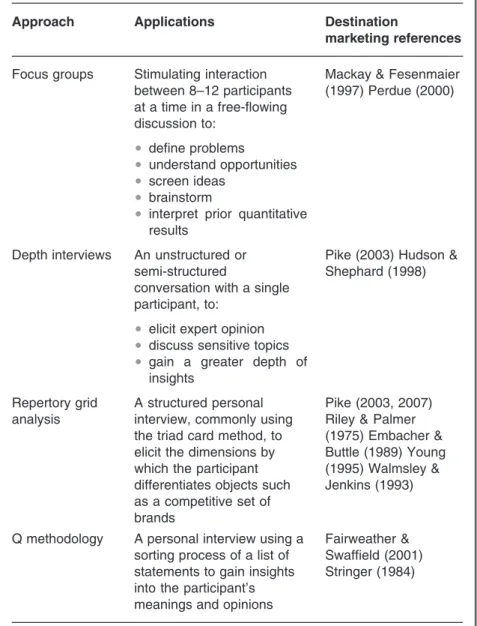
Although quantitative techniques can be engaged in exploratory research, such as in a pilot study, it is more common for qualitative techniques to be employed. A summary of some qualitative techniques, potential applications, and destination marketing references is provided in Table 9.2.
Qualitative techniques are particularly effective at the questionnaire design stage, in that they aid the researcher in constructing questions and scale items that are relevant to the target group. Following a questionnaire, qualitative techniques can again be useful in helping to clarify any emer
gent issues and gain indepth feedback relating to the findings.
Table9.2 Qualitativeapproaches
Approach Applications Destination
marketingreferences Focus groups Stimulating interaction
between 8–12 participants atatimeinafreeflowing discussion to:
Mackay&Fesenmaier (1997) Perdue (2000)
• defineproblems
• understand opportunities
• screen ideas
• brainstorm
• interpret prior quantitative results
Depth interviews An unstructured or semistructured
conversation with a single participant, to:
Pike (2003) Hudson &
Shephard (1998)
• elicit expert opinion
• discuss sensitive topics
• gain a greater depth of insights
Repertory grid
analysis A structured personal interview, commonly using the triad card method, to elicit the dimensions by which the participant differentiatesobjectssuch as a competitive set of brands
Pike (2003, 2007) Riley & Palmer (1975) Embacher &
Buttle (1989) Young (1995) Walmsley &
Jenkins(1993)
Q methodology A personal interview using a sorting process of a list of statements to gain insights into the participant’s meanings and opinions
Fairweather &
Swaffield (2001) Stringer (1984)
Descriptive research design • • •
The aim of descriptive research is to describe the characteristics of the phenomena or population of interest. This approach, which takes place after the problem/opportunity has been clearly identified, has been the most popular in the destination marketing literature (see, for example, Research Snapshot 9.1). Descriptive research designs generally employ the use of questionnaires, where numbers are assigned to responses. Observa
tion methods can also be used but are rarely reported in the destination marketing literature. Quantitative techniques are employed to generate findings from a representative sample that can be generalised to the wider population of interest.
Research snapshot 9.1 Destination image by the numbers
Thefirststudiesofdestinationimagewerereportedintheliteratureintheearly1970s.Inthe timesince,thefieldhasgrownintooneofthemostpopulartopicsfortourismresearchers.In a review of 142 destination image papers published in the literature between 1973 and 2000, it was found that the vast majority of papers (114) used quantitative methods to measure the construct.Lessthanhalfof thepapersreportedtheuseofqualitative methodsatanystage intheresearch. Thepaper isa usefulguidefor destination imageresearchers, asit tables theapproachesusedineachofthe142studies.
Source:Pike,S.(2002).Destinationimageanalysis–Areviewof142studiesbetween1973and2000.Tourism Management.23(5):541–549.
Key attractions of questionnaires to destination researchers include:
• a standardised instrument can be used by multiple interviewers
• ease of administration of large samples
• relatively low cost, particularly using internetbased applications
• large geographic flexibility
• availability of data analysis techniques
• the ability to generalise results to the wider population of interest.
Essentially there are three aims of a questionnaire. The first is to translate the information required in the MRP into a set of questions. A ques
tionnaire is only as good as the questions asked. The second aim is to encourage participants to participate and to complete the questions.
A wellconstructed questionnaire appears simple and focused, and yet will have been developed through careful preparation and pretesting. Word
ing of questions should be jargonfree and designed in the language of the participant. Other key issues relate to: the use of incentives; order of questions; selection of response scales; placement of sensitive questions;
cover letter; ethics; and avoiding leading questions, ambiguity and double
barrelled items. The third aim is to minimise response error. Response bias
occurs when participants answer questions in a way that either deliber
ately or unconsciously misrepresents the truth. Deliberate falsification can manifest through: acquiescence bias, extremity bias, interviewer bias, aus
pices bias, and social desirability bias. Unconscious misrepresentation can occur when participants are unable to recall information, such as travel motivation (see, for example, Crompton, 1979), or simply don’t know (see Research Snapshot 9.2).
Research snapshot 9.2 Avoiding uninformed responses
Even though destination image has been one of the most popular research topics in the tourism literature, there is no commonly agreed conceptualisation of the construct. As shown in Research Snapshot 9.1, the majority of studies have used structured questionnaires for measurement.Therehasbeencriticismthatthewayinwhichsomeresearchershaveselected the questionnaire scale items means a greater likelihood of some questions being irrele
vant to participants (see, for example,Dann, 1996; Pearce, 1982). This then runs the risk of stimulating uninformed responses. This paper suggests that the use of a ‘Don’t know’
(DK) option for scale questions provides participants with an alternative to skipping the question, using the scale midpoint to denote neutrality, or guessing. Of the 114 studies of destination image studies, using questionnaires, tabled by Pike (2002), none explicitly reported theuseof a DK option.This paperreported thatinthetrial of a DKoptionintwo destination imagequestionnaires. In both studies, there wasa very hightakeup by partic
ipants for someattributes. These results provided practical implications for the DMOs, as they highlighted information thatwould not have been identified without theuse of theDK option.
Source:Pike,S.(2008).Destinationimagequestionnaires:Avoidinguninformedresponses. Journalof Travel&
TourismResearch.(Inpress).
Causal research design • • •
Experiments can be used to analyse causal relationships between variables.
Independent variables (e.g. price) are manipulated to test the effect on a dependent variable (e.g. sales). While this research approach provides the greatest degree of certainty for marketers, the complex and expensive nature of experimental designs has meant that it is the least common in the tourism marketing literature. Causal relationships are extremely difficult to prove because of the difficulty in isolating and controlling the wide range of extraneous variables in the real world, which could also impact on the dependent variable at the time of the experiment. For example, in an experiment involving the manipulation of DMO advertising spend (inde
pendent variable) to test the effect on intent to visit (dependent variable) in a target market, it would be impossible to control for extraneous vari
ables such as competitors’ advertising, terrorist acts, currency exchange rate fluctuations and so on. So at best, the research is only able to infer a causal relationship between the variables.
Sampling
The purpose of sampling is to invite participation from a portion of the population of interest. To survey the entire population requires a census, which is neither practical in most cases, nor required. Through a prob
ability sample, where every member of the sample frame has an equal and known chance of selection, the goal of a quantitative approach is to draw a sample of participants whose characteristics closely match those of the census population. There will always be a degree of sampling error, because the data generated from a sample will by chance vary in some way from that of a census. An effective sampling plan results in data that can be generalised to the wider population of interest. Destination marketing studies commonly draw a sample from consumers in the market of interest or from visitors at the destination. The question of sample size is impor
tant, and will be dictated by issues such as: the budget, the importance of the information, statistical analyses requirements, and level of confidence.
Readers will find a useful discussion on sample size determination by Baker et al. (1994).
In qualitative studies there is no rule regarding sample size (Patton, 1990). One approach is to sample until a point of data redundancy is reached. That is, the addition of any new participants will not yield any new insights. However, the research will always be interested in ensuring participants are selected purposefully, on the basis of being knowledgeable about the phenomena, having the ability to articulate, and representing a diversity of opinions.
Data collection and analysis
The data collection stage must be carefully managed to minimise potential systematic error, particularly when a team of interviewers is employed to undertake field or telephone interviews. Decisions must be made about when to collect data, as well as how to communicate with participants.
The data analysis techniques selected will depend on the nature of the information required to address the MRP and therefore the MDP. There are commonly two main aims of data analysis. The first is to identify any significant differences between groups within the sample. For example, ttests can be used to identify differences in perceptions held by two groups such as males and females, and analysis of variance (ANOVA) can be used in the same manner for more than two groups, such as by education levels. The second is to investigate relationships between variables. For example, exploratory factor analysis might be used to reduce a long list of attribute scales into a small subset of core themes, while regression can be used to identify relationships between a dependent variable and a set of independent variables.
Interpretation and presentation
Interpretation is the ‘so what’ stage. ‘So ���what does this information mean in relation to the decisionmaker’s problem?’ This involves the use
of both critical and creative thinking skills, regardless of whether the data is of a qualitative or quantitative nature. Findings need to be presented in a way that not only demonstrates the validity of the approach, but most importantly focuses on addressing the MDP and MRP.
In Chapter 1, the divide between tourism academics and practitioners was discussed, along with the call for marketing researchers to better market themselves and their work. The same challenge exists in the mar
keting research world in general. Marketing researchers are often left wondering why their findings are not always incorporated into marketing actions. In a 2007 Australian Market & Social Research Society seminar to address this issue, guest speaker Tiina Raikko, Consumer Insight Director for Unilever Australasia, offered these views:
• Why do we assume others will find our data as intrinsically interesting as we do?
• To engage marketers requires bringing the research to life
• Delivery is worth as much as the content
• As a marketing researcher you are useful when you know the business as well as the client, but know the customer better.
Limitations of marketing research
The opening quote in this chapter made by the worldwide CEO of Saatchi
& Saatchi advertising, Kevin Roberts (see www.saatchikevin.com), pro
vides an insight from someone in the ideas business of the difficulty in gaining an understanding of consumer thinking. Roberts is not alone in his criticism of the failure of marketing research to deliver effective consumer insights, and so it is appropriate to introduce some of the limitations of research. IMC pioneer Professor Don Schultz (2005, p. 7) offered these strong words:
Marketing is in trouble because marketing research is in trouble. No, make that, today marketing research is in a death spiral and its taking marketing down with it ���. Research is supposed to present the voice of the customer. Today, it doesn’t.
Critics of current marketing research practice argue that there is an over
reliance on certain techniques that are selected on the basis of cost and familiarity rather than to gain a deeper understanding of how consumers really think. So much research is based on attitudinal data. That is, ques
tionnaires and focus groups that provide data in the form of participants stating what they say they do and what they might do in the future.
Comparatively little research generates behavioural information, analysing what people do rather than what they say they will do. The high failure rate of new products has been blamed in many cases on the reliance on flawed focus group research with a strong acquiescence bias. Such bias occurs, for example, when it is easy for participants to say they like the proposed product. This is because they are in a research situation and not a real buying situation. The failure of New Coke and Crystal Pepsi highlight
how even the largest of research projects can get it wrong. Research Snap
shot 9.3 heeded the call of Schultz and Schultz’ (2004) call for researchers to link attitudinal and behavioural data through longitudinal studies. This research investigated the relationship between stated destination prefer
ences and actual travel.
Research snapshot 9.3 Combining attitudinal and behavioural data
There have only been a small number of applications of consumer decision set theory to holidaydestinationchoice,andthesestudieshavetendedtorelyonasinglecrosssectional snapshot of research participants’ stated preferences. Very little has been reported on the relationship between stated destination preferences and actual travel. To what degree then can marketers rely on consumers’ stated attitudes if there is no comparative measure of actualbehaviour? This studypresented ararelongitudinalexaminationof destination deci
sionsets,andthefirstinthecontextofshortbreakholidaysbycarinQueensland,Australia.
Two questionnaires were administered, three months apart. The first identified destination preferenceswhilethesecondexaminedactualtravel.Thefindingsindicatedageneralconsis
tencybetweenattitudeandbehaviourintheshortterm,andsupportPike’s(2002)proposition that the positioning of a destination into a consumer’s decision set representsa source of competitiveadvantage:
• In terms of unaided topof mind awareness (ToMA),participants elicitedover 100short
breakdestinationswithindrivingdistanceofBrisbane.Brisbaneresidentsareliterallyspoilt bychoiceofcontiguousdestinations.
• Participantsindicatedameanofonlyfourdestinationsintheirshortbreakdecisionset.This has implications for those destinations not included, particularly in light of the competition mentioned in the previous point.
• Therewasastronglink betweenstateddestinationpreferencesandactualtravel.Almost 75%ofparticipantswhotookashortbreakduringthestudyvisitedatleastonedestination fromtheirstateddecisionset.
• Familiarity with preferred destinations was apparent, with 92% of participants indicated havingpreviouslyvisitedtheirToMAdestination.
• Intenttovisitthedestinationofinterestwassignificantlyhigherfrompreviousvisitors than nonvisitors.
A key implicationfor destination marketers is the recommendation to monitor decision set composition,whichrepresentsanimportantandpracticalindicatoroffutureperformance.
Source:Pike,S.(2006).Destinationdecisionsets:Alongitudinalcomparisonofstateddestinationpreferencesand actualtravel.JournalofVacationMarketing.12(4):319–328.
Rarely would any marketing research design be regarded as perfect. Usu
ally, due to resource constraints such as insufficient time and/or money, every project will have limitations. It is important that such limitations are acknowledged in the final report. Case Study 9.2 describes exploratory research, which also helps to demonstrate the value of surveying nonusers
of a service, in addition to users. In this case, surveying nonusers iden
tified significant barriers by travellers to wine tourism in New Zealand.
However, as with every exploratory research project, the research does have limitations.
Case study 9.2 Wine tourism: investigating differences between users and non-users
AbelD.Alonso,EdithCowanUniversity,WesternAustralia
Theworldwide wine tourism phenomenon hasgained inpopularity inNew Zealand asan additionalactivityforthosetravellingtoruralareas,whichiswheremostwineriesarelocated.
Winetourismincludesvisitingwineries(O’Neill,Palmer, Charters&Fitz,2001),cellardoors (Cambourne, 1998), or tasting the wine product (O’Neill, Palmer & Charters, 2002), often in combination with food offered at the winery. Some studies suggest that wine tourism provides anadditionaltravelmotivation(Macionis&Cambourne,1998),whileothersseeitasacritical aspectof thetravelexperience(Jago,Issaverdis&Graham,2000).
Today,NewZealandhasover500wineries(WineInstituteNewZealand,2006),whichare locatedintenmain wineregions.Effortsthat includeorganisingwinefestivals andcreating internetwebsiteshavebeenundertakenbothnationallyandregionallytoenhanceandmarket the appeal of the wine regions (see, for example, www.winemarlborough.co.nz/). Recent internationalsuccessofseveralNewZealandwines(Foodworks,2006a,2006b)hashelped boostthereputationofthenation’swineindustry.
Whilemanystudiesfocusonwineryvisitors,theircharacteristicsandconsumptionpatterns, littleisknownabouttheinvolvementwithwineryvisitationamongtravellersinNewZealand.
Recent figuresabout wine trail andvineyard visitation indicate modest involvementamong domestictravellers,whichwaslessthan1%in2005(Ministryof Tourism,2006a),andinter
national travellers. However, the percentage of international wine trail and vineyard visitors has increased from 1.5% in 1998 to 10% in 2006 (Ministry of Tourism, 2006b). Another area of limited knowledge is how people travelling in New Zealand view winery visitation. This dimensionisparticularly important toenhance theappeal ofwine tourismasanalternative attractiontoindividualstravellinginthecountry.
Duringlate2006, exploratoryresearchwasundertakento analysedifferencesinattitudes towardswine tourismbyusersand nonusers.Atotal of 998individuals travellingfromthe North Island to the South Island of New Zealand were invited to participate. In all, 500 responseswereobtained.
Justover half(56%) of participantsadvised they hadvisited a NewZealand winery.The sample therefore provided a balance between users and nonusers. The most important reasonsfor visitingwineriesare‘todrink wines,’‘tosocialise’,and‘toeat.’For international nonusers,‘Idon’t knowmuchaboutNew Zealandwineries,’and ‘Idon’t knowmuchabout New Zealand wines’ were clearly their main motives for not visiting wineries. In contrast, the domestic travellers’ main reason was ‘becauseI can easily buy wine/food elsewhere,’
followed by ‘I am not interested in winery visitation.’ Interestingly, ‘because I don’t drink wine’
was the least important reason among respondents not to visit wineries. The results show clearly that more work is required to raise the profile of wine tourism regions among both internationalanddomesticvisitors.Theaspectofsocialising,indicatedbyparticipantsasone oftheirmainreasonsfor visitation,andthepeaceful/ruralsettingofthewineriesidentifiedin
several studies (see, for example, McRaeWilliams, 2004), suggest that there is much more towineryvisitationthanthewine/foodproduct.Destinationmarketingstrategiescouldalsobe implementedtoeducatedomestictravellersandchangethecurrentviews amongmembers ofthisgroupofwineryvisitationassimplybeinganactivitytobuywinesorfood.
Discussionquestion
What questions would you ask the researcher to determine possible limitations of the findings?
Furtherreading
Alonso, A.D., Fraser, R.A.& Cohen, D.(2007). Does agematter? Howage influences the winery experience.International Journalof Culture TourismandHospitalityResearch. 1(2), forthcoming.
Alonso,A.D., Fraser, R.A.& Cohen,D.(2007). Investigatingdifferences between domestic and international winery visitors in New Zealand. International Journal of Wine Business Research,19(2),forthcoming.
The future of marketing research
The year: 2050. A baby is born. A small blood sample is taken with parental consent ���and sent through to DNA screening. There the sample is tested for congenital abnormalities, future disease possibili
ties, criminal potential, and consumer segmentation. The results of the consumer segmentation are sent to subscriber companies around the world to be added automatically to their databases, which will predict behaviour for that person in terms of their combined demographics and DNA profile (Walkley, 2005).
The Managing Director of a leading Australian market research firm, Walkley (2005) believed current research into relationships between genet
ics and antisocial behaviour will lead to marketing research applications in the future. For example, identification of those with a higher propensity for being ‘born loyal’ will enable targeted segmentation in pursuit of brand loyalty.
While DNA based marketing research might or might not eventuate in the future, mind reading by neuroscience to test the effectiveness of adver
tising campaigns is already in practice. The potential of magnetic resonance imaging (MRI) technology, used by medical specialists to scan the body for diseases, to scan brainwave responses to advertising has been realised by the USAbased ideation consultancy Brighthouse. While the organi
sation’s website (see www.thoughtsciences.com) carries endorsements by Fortune 500 companies such as CocaCola and in the travel sector from Delta.
Analysis of the brainwaves identifies at what points in a commercial such engagement occurs. The idea is to ensure brand imagery appears during the limited period of engagement. Clearly any technique that can achieve this will be welcomed by marketing researchers, who in the main
are relying on what consumers tell them through interviews and question
naires. Alarcon (2006, p. 1) cited GAP Research’s John Grono’s view that researchers tend to ask consumers questions they can’t answer: ‘The limbic part of the brain that registers engagement and memory is nonverbal, you can’t put it into words.’ Neuroscience is already here and affordable for larger DMOs.
Key points
1. The marketing research process
The marketing research process involves six steps, beginning with the design of a manage
ment decision problem (MDP) and culminating in the presentation of information that will enable effective decisionmaking. It is important to remember that the process is cyclical ratherthanlinear,sothatthesixthstepleadstotheidentificationofanew MDPandsothe processcontinues.
2.Exploratory,descriptive,andcausalresearch
DependingofcourseontheMDPandmarketingresearchproblem(MRP),marketingresearch designwillideallyincorporatebothinductiveanddeductivereasoning,andthereforerequire a combination of qualitative and quantitative methods. The different strengths of the two approaches can provide much deeper insights into the why of buy when combined in a meaningfulway.
3. Limitations of marketing research
No marketing research design will be perfect, and so it is important to develop an under
standing of limitations interms of validityand reliability. It isimportant thatsuch limitations arestatedexplicitlyinthereport.
Review questions
• Examine the extent to which your DMO is acting as an information clearing house for stakeholders.
• For the TNZCFP, produce aresearch design asif you were a consultantbidding to get thecontract. Due to thelarge scaleof this project,perhaps consider aresearch strategy foroneofthemarketsofinterest.
• Whyisitoftenadvantageoustosamplenonvisitors?
Appendix 9.1 Tourism New Zealand CFP
Tourism New Zealand Consumer Perception Research 2005 REQUEST FOR PROPOSALS (RFP)
Tourism New Zealand invites proposals to undertake consumer research in the UK, USA, Australia and Japan to further refine and enhance the positioning of the 100% Pure New Zealand global marketing campaign.
In 1998 Tourism New Zealand embarked on indepth consumer research in Australia, USA, UK, and Japan to:
• understand the motivations of long haul travelers, and
• identify the most relevant, motivating, unique, and appropriate posi
tioning for New Zealand as a holiday destination.
The results from this ‘Foundation’ research were pivotal in the initial and ongoing development of the 100% Pure New Zealand global marketing campaign launched by Tourism New Zealand in August 1999.
Framework for understanding the long-haul travel market
A key outcome of the Foundation research was the development of a framework for understanding the needs and motivations of the long haul travel market.
Actual Visitors
New Zealand’s Positioning
Active, lively, natural environment
Potential Visitors Peaceful relaxing
natural scenery Engaging with
the world Exploring
the world Nature
Inward Focus Outward
Focus
This framework aims to position long haul travellers in relation to the following questions:
• What are travellers looking for in long haul travel?
• What basic needs does the experience satisfy?
• How does New Zealand meet these needs?
• How can we use this knowledge to position New Zealand as a com
pelling holiday destination?
Research showed that, across all markets, potential visitors believed that a holiday in New Zealand delivered predominately to those seeking a quiet, relaxing holiday. In contrast, past visitors saw New Zealand as deliv
ering exceedingly well to those with an energising need. Thus Tourism New Zealand needs to position New Zealand as a destination that offers an energising experience1.
It is now six years since the Foundation research was commissioned.
It is timely therefore to reassess inmarket travel dynamics and percep
tions of New Zealand as a holiday destination to ensure that the 100%
Pure New Zealand campaign continues to evolve, building an increasingly strong brand for New Zealand offshore.
To assess the most appropriate positioning for New Zealand in the USA, UK, Australia and Japan the research will need to:
• explore consumers’ general perceptions of New Zealand, New Zealan
ders, and products and services of New Zealand origin
• determine how consumers perceive the personality of New Zealand
• identify icons that consumers associate with New Zealand and under
stand which have positive strengths that New Zealand could leverage
• identify which key messages and/or qualities would inspire consumers to think more positively about New Zealand
• examine the effect these perceptions have on New Zealand’s competitive position as a tourism destination
• identify and understand the motivations of long haul travellers and Interactive Travellers®
• explore perceptions/attitudes towards travel to New Zealand
• understand the strengths and weaknesses of New Zealand’s image as a destination
• identify the barriers to travel to New Zealand
• explore destination decisionmaking processes and opportunities for converting interest or intentions to visit New Zealand into actual travel
• identify the most relevant, motivating, unique, and appropriate posi
tioning for New Zealand as a destination
• assess and enhance the current framework for understanding the needs and motivations of longhaul travellers.
Tourism New Zealand invites the proposer to put forward the best methodological solution for meeting the research objectives within the
1 See Appendix 1 for a more comprehensive description of this framework. Individual research reports for each of the four markets included in this study can be viewed at:
http://www.tourisminfo.govt.nz/cir_randd/index.cfm?fuseaction = 36
available budget. The proposed methodology will need to consider the following:
• The target audience for this research is LongHaul Travellers or Intenders – those who have travelled longhaul in the previous twelve months OR are likely or very likely to travel to long haul destinations in the next 3 years, and who are aged 18 or over (see Appendix 2 for details).
• The 100% Pure New Zealand campaign focuses its marketing activ
ity on a selected target group of travellers that has been identified as New Zealand’s ideal visitor; namely the Interactive Traveller2. At least 50% of research participants will need to be Interactive Trav
ellers®. The Interactive Traveller definition will need to match the defi
nition used for other commissioned TNZ research. (See Appendix 2 for details.)
• Research in Japan will need to be translated and undertaken in Japanese.
• At the survey stage, certain questions such as demographics will need to be consistent with the format used in previous TNZ sur
veys. The successful proposer will be provided with all relevant docu
ments and survey questions used previously in Tourism New Zealand research.
• Research design phases will require input and feedback from key Tourism New Zealand personnel. This will need to be considered when planning the project timeline.
• The proposer will need to consider inmarket events such as public holidays that might effect fieldwork timetabling.
A key output of this research is the development of a ‘conceptual device’
or analytical framework that Tourism New Zealand can assess perfor
mance of specific campaign elements in terms of positioning, appeal, and motivational response.
Reporting:
• One full research report including an executive summary and recommendations
• Four short reports focusing on research outcomes for each of the four markets – Japan, USA, UK, Australia .
• Presentation of research highlights to key Tourism New Zealand person
nel (including power point or equivalent). This will involve a minimum of two presentations, one a presentation of results and workshop on findings and the other a final presentation.
• Provision of presentation material on Tourism New Zealand templates.
Up to $400,000 NZD + GST
Proposals are due at Tourism New Zealand by 5 pm 28 January 2005.
2 More detailed information about the Interactive Traveller is included in Appendix 2.
This contract must be completed by May 31st 2005 with a draft report submitted that date.
When tendering for this project we ask that you provide us with the following details:
Preferred research methodology
How the fieldwork and analysis will be undertaken detailing preferred sampling framework for qualitative and quantitative phases within the available budget.
Project plan/Timetable • • •
When research milestones will be met
Costs • • •
Costs itemised for each research phase and estimates of disbursements where applicable.
Key personnel • • •
Who will be involved in the project including references to skill base, relevant experience and qualifications.
References • • •
Evidence or examples of relevant work
Key contact • • •
Every proposal must include the name of the person to whom Tourism New Zealand may address any questions relating to the proposal.
Tourism New Zealand will be assessing proposals for this contract on the following basis:
• Evidence of an in-depth understanding of our requirements.
• Quality of the research design to provide a comprehensive solution to meeting the research objectives.
• Evidence of understanding of the framework for understanding the needs and motivations of long-haul travellers.
• Prior experience of conducting evaluation/communications research particularly in offshore markets.
• Quality of staff put forward to conduct the assignment.
• Ability to supply specialists with relevant experience.
• Price and value for money.
Following preliminary consideration of the written proposals, Tourism New Zealand may invite one or more of the potential providers to meet
with the evaluation panel to present and discuss their proposal. Proposers must provide TWO complete copies of their proposals.
For supplementary information relating to this RFP, please contact the project manager:
Vaughan Schwass
Manager – Channel Marketing and Marketing Research Tourism New Zealand
147 Victoria street west, Auckland PO Box 91 893, Auckland Mail Centre Email: [email protected]
Please make no contact in relation to this RFP with any other Tourism New Zealand employee without the authorisation of the project manager.
The lowest priced or any proposal will not necessarily be accepted.
Tourism New Zealand will not be under any obligation to discuss reasons why a proposal is accepted or rejected. No proposal is deemed to have been accepted or rejected until the fact of such acceptance or rejection has been notified in writing to the proposer by Tourism New Zealand.
The requirements specified in this RFP reflect those presently known.
Tourism New Zealand reserves the right to vary, in detail, the final requirements.
Proposers must ensure that the person or persons nominated to negotiate a contract have the authority to finalise details without reference to others, either in New Zealand or overseas.
In relation to this RFP and consequential negotiations, only communica
tions from the project manager and any person authorised by the project manager will be considered as an expression of Tourism New Zealand’s position.
Preference will be given to proposals that meet all the conditions of the RFP. However, in the event that no proposal can comply with this, then consideration will be given to proposers answering part of the RFP.
If, in the opinion of Tourism New Zealand, none of the proposals are acceptable, Tourism New Zealand reserves the right to enter into negoti
ation with one or more proposers for a satisfactory offer, or with none of the proposers.
Tourism New Zealand will not be responsible for, or pay, any expense incurred by a proposer in the preparation of their proposal or in Tourism New Zealand’s evaluation of it.
The acceptance of a proposal does not create any contractual relation
ship between Tourism New Zealand and the proposer but represents a commitment to enter into negotiations in good faith.
All prices must be in New Zealand dollars at the time of the response and be exclusive of GST.
All submitted proposals become the property of Tourism New Zealand and will not be returned to the proposer.
General information which is not specifically requested but which pro
posers wish to provide is to be attached separately and clearly labelled
‘Supporting Material’. Any reference in the proposal relating to this mate
rial must be specified.
All information contained in this RFP and all other information supplied by or on behalf of Tourism New Zealand to proposers will be treated as confidential, and may only be used for the purpose of preparing a proposal.
This document and any copies produced with or without approval will remain the property of Tourism New Zealand and must be returned to it upon request.
Tourism New Zealand shall be entitled to rely on all statements and representations made by the proposer in response to the RFP or subsequent enquiries or correspondence whether such statements or representations are given in writing or orally.
All information submitted by proposers in their proposals that are regarded as confidential in nature, must be clearly marked ‘Commercial:
In Confidence’.
Tourism New Zealand would like to remind proposers that under the provisions of the Official Information Act Tourism New Zealand may be obliged to disclose certain information if a request for information is made pursuant to the Act. Tourism New Zealand will endeavour to refuse requests to release information which is commercially sensitive, but no guarantee is given that refusal to release such information will not be successfully challenged.
All proposers are required to acknowledge in their proposals that they accept the terms and conditions set forth in this Section 11. Proposals which fail to give such acknowledgement may be rejected by Tourism New Zealand.
Appendix 1 A framework of needs and motivations for understanding the long-haul travel market
Introduction
Ask a traveller about their longhaul travel experience (that is, when they’ve travelled more than six hours by air to reach their destination), and they’ll often say this type of travel provides some of their most enjoyable and significant life experiences.
New Zealand’s place in the world means we are a longhaul destination for thousands of people every year. So how can we find out whether we’re providing the experience these travellers are looking for? How can we put New Zealand at the top of their list of longhaul destinations?
First, we need to define just what they’re looking for – and then establish whether we can offer the experience that meets those needs.
That’s what this framework aims to do. It asks questions such as:
• What are travellers looking for in longhaul travel?
• What basic needs does the experience satisfy?
• How does New Zealand meet these needs?
• How can we use this knowledge to position New Zealand as a great vacation destination?
The framework is a useful tool for New Zealand’s tourism industry. Pro
duced as part of a project for the Tourism New Zealand, it provides some valuable insights into the ‘inner workings’ of this unique travelling market.
Seeking discovery
All longhaul travellers describe a sense of discovery as a key part of their travel experience – a desire to discover and expand their world.
Individual travellers vary widely in how they do this, and choose des
tinations and experiences that meet their individual needs. Their choice may also be affected by the things they like to do at home:
• A weekend ‘trail walker’ may choose to backpack when they travel.
• An avid reader may travel to book fairs around the world.
However, some underlying dynamics in the market shape all travel prefer
ences. These dynamics provide a framework for understanding the needs in the market overall.
The travel dynamics
Two key emotive forces shape longhaul travellers’ decisionmaking in longhaul travel:
1. ‘Exploration’ vs ‘engagement’
2. An ‘outward’ vs an ‘inward’ personal focus.
L/H Vacation Travel Market Dynamics
Engaging with the world Exploring
the world
Inward Focus Outward
Focus
Discovery
The horizontal axis deals with the person’s relationship with the envi
ronment. It ranges from seeking to explore the world (for people who
investigate or challenge their world), to seeking to engage their environ
ment (for people who seek connection with people and/or with their natural surroundings).
The vertical axis deals with the traveller’s personal focus on their journey.
Inwardly focused people seek a mental or emotional retreat that centres largely on their internal world. Outwardly focused people seek to con
nect and interact with the outside world, either physically with nature or socially with other people.
Together these two dynamics create a range of distinct needs in the longhaul market.
Travel needs and motivations
Motivations for L/H Vacation Travel
Inward Focus Outward
Focus
Energising
“Take on the world”
Learning
“Broaden the mind”
Relaxation
“Restore the spirit”
Sociability
“Join in - have fun”
Engaging with the world Exploring
the world
Status
“Distinguish yourself from the pack”
Connection
“Getting together”
Energising–What isit? • • •
‘Energising’ is about the need to experience a feeling of excitement and interaction through physical activity, experiencing oneself as a physical being. A sense of being reenergised, challenged and even exhilarated through physical activity.
It’s the feeling I get, getting to the top of a mountain I’ve just climbed and just standing there. A sense of accomplishment ���it’s a challenge. Climbing adds to the whole experience ���a physical rush ���incredible.
Who are ‘energising’ travellers?
Typical travellers with an energising need:
• are younger (under 40) and more physically fit than the average traveller
• are interested in outdoors activities in daily life, and may be ram
pers/hikers, backpackers
• use a large variety of specialist guides (Lonely Planet, Rough Guide etc.) as well as Internet sources such as travel sites
• like to rely on word of mouth where possible. Wordofmouth informa
tion gives them the feeling of being insiders who discover places and experiences that are ‘off the beaten track’
• see themselves as confident, energetic, adventurous and outdoorsy
Wants to get into nature, into the challenge ���physical exhilaration.
Profile of an ‘energising’ traveller
‘Steven’isa27yearoldcoastguard,livinginNewYork.
Previoustravel:Aruba,Barbados,Europe
TraveltoNewZealand:wouldliketobackpackNewZealandwithhisgirlfriend.
Motivation:‘LikeChristopherColumbus discoveringtheNewWorld � � �Just you,thinking youarethefirst.Ofcoursetherehave beenotherpeopleliketherewaswithChristopher Columbusthen,butinyourmind,inyourownheartit’sjustyou–andit’ssonewandreal’.
Personal ideal: ‘Notonly accomplishment butit’s a feeling like a new world conquered.
Wouldlovetobungy � � �sowild� � �incrediblefeelingoffreedom,excitement’.
Energising – What is the ideal vacation?
Environment
A natural environment that provides the potential for release through a range of physical activities.
A place to be explored and interacted with physically.
Tracks for walking, beaches for swimming, and mountains for climbing.
Activities
Walking, tramping/hiking, climbing, river rafting, kayaking, and bicycling.
Novel activities like such as sailing and bungy jumping – but note these are not for everyone; they may be too extreme and risky for some.
The individual’s physical fitness plays a part in which activities appeal.
Planning and preferred mode of travel
Travel planning can be either very involved, with plenty of research on journey detail, or more spur of the moment and allowing for a sense of freedom and excitement.
Travellers may prefer to travel independently or use a package deal, but generally find tours too restrictive.
Ideal destinations
Countries with distinctive natural environments (e.g. Nepal, South America, Australia, New Zealand) which offer the promise of the ability to interact physically with the environment.
Images that appeal to energising needs
• Images that show vibrant, exhilarating, outdoor images of physical inter
action with nature.
• Walking, bicycling, tramping/hiking, kayaking.
• Show one or two people getting into the outdoors.
• Natural images that are exhilarating and invigorating to view (e.g. majes
tic waterfalls, surf, mountains).
• Overall feeling of communications should be bold refreshing and lively (not lifethreatening!).
Avoid images that are too extreme (e.g. bungy jumping) and that have relatively niche appeal. (Note: while pictures of ‘icon’ activities like ‘bungy’
fit well here they have the potential to alienate travellers with a less extreme approach to satisfying their energising need. Ensure eyecatching pictures of extreme adventure activities are used only in conjunction with other, less extreme activity images.)
Sociability– Whatisit? • • •
‘Sociability’ is about participating with others and having fun in a lively, outgoing and sociable environment.
Travellers with this need:
• love to share their travel experiences with others along the way
• enjoy a feeling of camaraderie or togetherness
• typically travel with a companion or group
• choose destinations that provide the potential for meeting others.
She just wants to have fun – not see every ruin in the world – somewhere where there is a lot of people and a lot happening ���a feeling of excitement, energy ���something is about to happen.
Who are ‘sociability’ travellers?
Typical travellers with a sociability need:
• are younger (aged 20 to 30)
• are interested in socialising with their peers
• are not extensively travelled
• use standard sources for travel information (such as travel agent news
paper travel sections)
• see themselves as outgoing, energetic and sociable.
He’s not married so he’s out to have a good time with people his own age ���it’s all about meeting people.
Profile of a ‘sociability’ traveller
‘Michael’is22yearsold,alawstudent,andcurrentlylivinginLosAngeles.
Previoustravel:toEuropewithfamilyandAustralia/NewZealandwithagroupoffriends TraveltoNewZealand:a threedaypackage,which wasaside tripfromAustralia.Took
daytourstoseelocalsights,andwentclubbingandpubbingatnight.
Motivation:‘Iwantedtogoonthattrip� � �toparty� � �somesightseeing � � �butI’membar
rassedtosayit,wegoouttomeetgirls.Thatwaswhatthewholetripwasabout.’
Personal ideal: ‘Somewhere by thebeach � � �meeting people � � �the city life� � �whereI couldpartyandmeetpeople.’
Sociability – What is the ideal vacation?
Environment
A lively, urban environment that provides the potential for socialising with locals and other travellers (ideally with people from a similar culture and age group).
Activities
Seeing the nightlife (dining out, pubs, clubbing).
Day activities such as visiting a popular beach, recreational shopping, visiting museums, and cafés.
Tours or cruises with other travellers of similar ages or interests.
Planning and preferred mode of travel
A more openplan, ‘free and easy’ schedule, or cruises and resorts provid
ing a ‘noplanning’ alternative that leaves travellers free to socialise.
Ideal destinations
Island resorts such as Greek Islands, Caribbean Islands – anywhere that offers a lively social life (Australia’s cities are an excellent fit).
Images that appeal to sociability needs
• Lively images that depict social interaction against an appealing vibrant backdrop. A range of day and night, ageappropriate images (e.g.
beaches and shopping during the day, dining out, pubbing or clubbing at night). People interacting in urban as well as rural settings.
• Convey lively, social and fun feelings.
Avoid images that are solitary or too rural.
Connection – What is it? • • •
‘Connection’ is the need to feel connected to others and at one with the environment. Travel is the opportunity to reconnect with the world – either with people (especially friends and family) or symbolically with nature.