Introduction: Synthetic biology from single cellular to multicellular 1
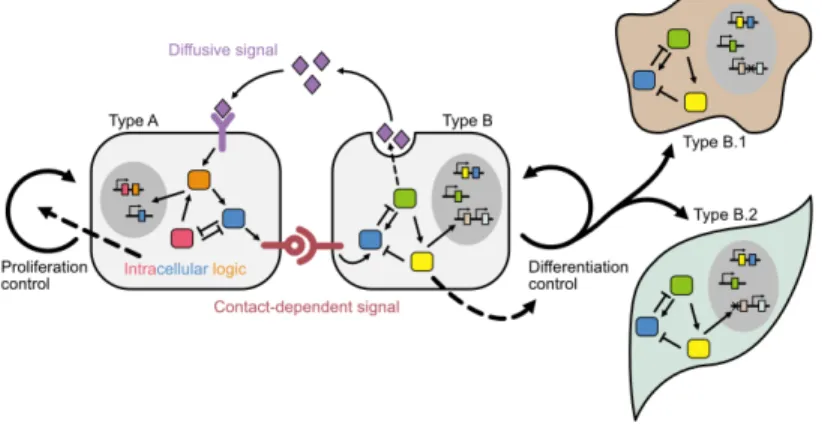
Modules for ideal multicellular circuit
Additionally, synthetic systems produce and sense metabolites from either plant (M.-T. Chen and Weiss, 2005) or bacteria (Bacchus et al., 2012) have been developed for cell-cell communication in mammalian system. On the other hand, driving differentiation has been accomplished by either rewiring the endogenous differentiation circuit (Kitada et al., 2018), or creating fully synthetic bi-stable gene switch to lock cells into a certain desired state (cell type) . (R. Zhu et al., 2022).
Content of this thesis
In addition, we examined the effect of the 2-3 day time delay required for blasticin to kill sensitive cells (Sato et al., 2012) (Figure 2.10F). At the same time, we implanted a recipient-only tumor on the other flank of the same mouse (the distal side) (Figure 4.5A).
Synthetic auxin-based mammalian signaling circuits for robust
Introduction
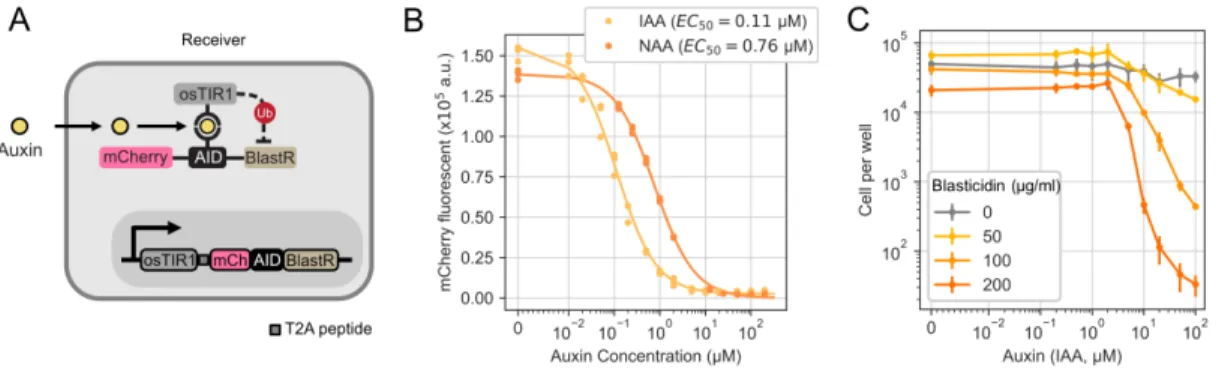
Synthetic intercellular communication systems may enable the engineering of inherently multicellular behaviors that are not possible with cell-autonomous circuits (Toda, Blauch, et al., 2018). However, ectopic expression of TIR1 from rice (osTIR1) is sufficient to confer auxin-dependent degradation of proteins engineered to contain a minimal auxin-inducible degron (mAID, or AID for simplicity in this article) (Nishimura et al., 2009 ; Natsume et al., 2016).
Engineered mammalian cells sense population with auxin-based
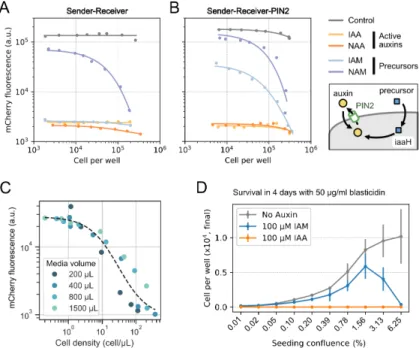
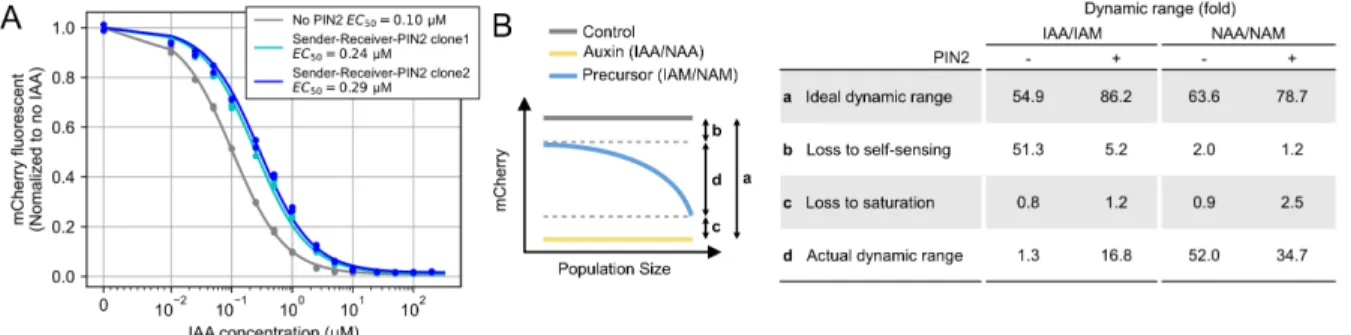
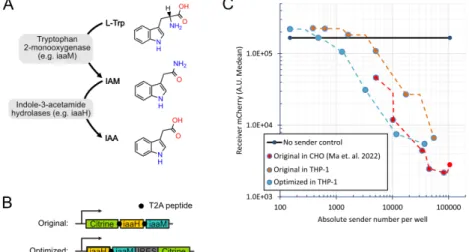
Bacterial auxin (IAA) synthesis pathways use a tryptophan 2-monooxygenase, iaaM (also known as aux1 or TMO), to synthesize IAM from L-tryptophan (Figure 2.3A). To overcome this problem, we stably expressed the auxin exporter PIN2 from Arabidopsis thaliana (Petrásek et al., 2006) in sender-receiver cells (sender-receiver PIN2 cells) (Figure 2.5B, right).

Multicellular paradoxical circuit achieve robust population control
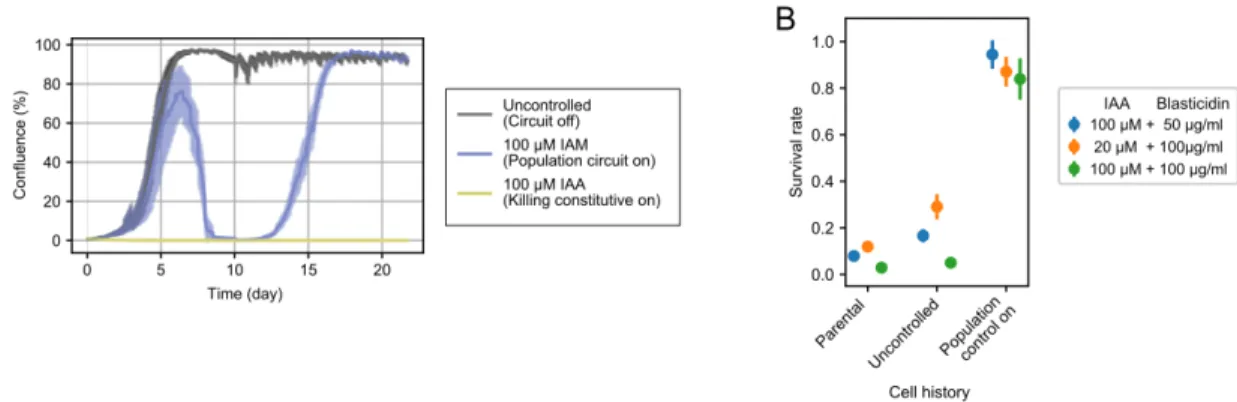
Data are from the first 120 hours of the uncontrolled growth sample in movie set 1 (Figure 2.11B). In the uncontrolled regime, cells grew and remained in complete confluence throughout the duration of the film (Figure 2.11A, Movie S3³).
Conclusions and discussions
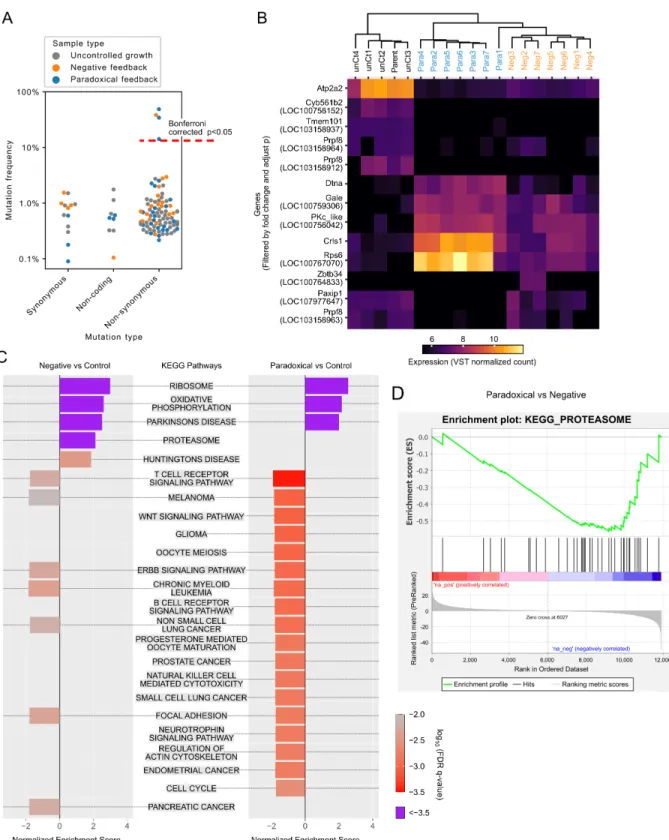
Mutations were detected by comparing reads of isolates with those from the parental line (chi-square test, Bonforroni corrected p<0.05, Methods, Section A.6). Direct comparison of the KEGG proteasome pathway between the paradoxical and negative group was analyzed by GSEA, as shown with a standard GSEA plot. Three of these (one in a negative feedback cheater isolate, the other two from non-cheating paradoxical isolates) harbored mutations in the AID domain of the AID-BlastR fusion protein.
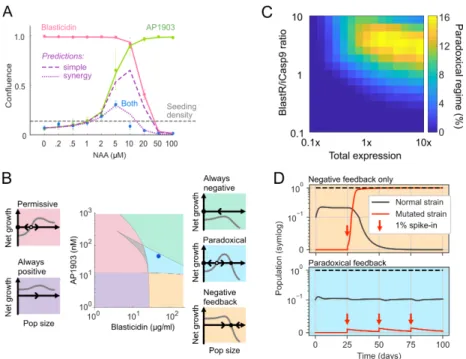
The Paradaux cell line requires addition of the auxin precursors IAM or NAM for auxin synthesis.
Supplementary text
The genetic design of signaling cascades to register receptor activation.” In: Proceedings of the National Academy of Sciences105.1, pp. The role of interleukin-2 during homeostasis and activation of the immune system.” In: Nature Reviews Immunology 12.3, pp. Acetylated histones are associated with FMR1 in normal but not vulnerable X syndrome cells.” In: Natural genetics 22.1, pp.
Therapeutic applications of macrophage colony-stimulating factor-1 (CSF-1) and antagonists of CSF-1 receptor (CSF-1R) signaling." In: Blood, The Journal of the American Society of Hematology119.8, pp.
Epigenetic-based synthetic gene regulation
Introduction
The field of synthetic epigenetics seeks to harness epigenetic regulatory mechanisms to control gene expression on different time scales (Kungulovski and Jeltsch, 2016; . Nakamura et al., 2021). Conversely, the insertion of several hundred base pairs of CpG-free DNA can disrupt these patterns, allowing de novo methylation of the surrounding CpG island ( Takahashi et al., 2017 ). Nuñez et al., 2021; Van, Fujimori and Bintu, 2021), and even create fully synthetic DNA methylation-based systems for synthetic epigenetic memory (Park et al., 2019).
In this chapter, we adapted a previously established DNMT recruitment system to analyze DNA sequence effects on methylation-dependent silencing (Bintu et al., 2016).
Promoter CpG content regulates DNMT-dependent silencing dynamics 45
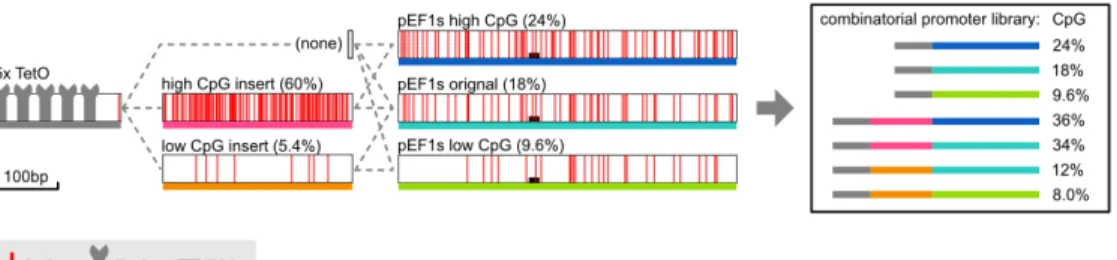
Despite their difference in CpG density, all 7 promoters induced strong expression of the fluorescent protein reporter (Figure 3.3A and B). Further, the logarithm of the silencing rate was linearly related to CpG density over this interval (Figure 3.4C). However, it failed to capture an initial delay in the silencing of slower promoters (lower CpG density) (Figure 3.5A).
Taken together, these results provide a phenomenological parameterization of the dependence of tacit dynamics on CpG density.
Conclusion and discussion
To test for a functional role of CpG793, we mutated it to CpC in pEF1s(orig) and in pEF1s(high). Together, these constructs provided a set of controlled comparisons where position 793 was either CC or CG in pEF1s(high), pEF1s(orig), and pEF1s(low) (Figure 3.6D, top). These rates,𝐾𝑙, were significantly (p<0.01) decreased in all three "CC" variants of promoters compared to the CG variants (Figure 3.6D lower and Figure 3.7B).
In addition, the sequencing results obtained here indicate that methylation accumulation is remarkably independent of CpG density (Figure 3.6B).
Supplementary text
Coordinate the transgenesis of two genes by lentiviral vectors carrying synthetic bidirectional promoters.” In: Nature biotechnology23.1, pp. A high-throughput method for characterizing novel chimeric antigen receptors in Jurkat cells.” In: Molecular Therapy-Methods &. Comparison of Gene Transfer Efficiency in Human Embryonic Stem Cells.” In:Molecular imaging and biology12, pp.
Synthetic introns enable splicing factor mutation-dependent targeting of cancer cells.” In: Nature Biotechnology 40.7, p.
Multicellular circuit for immunotherapies
Introduction
Currently, even the most successful cell therapies (Ramos, Heslop and Brenner, 2016) focus on the engineering of a single modified cell type. More generally, this should demonstrate the potential of multi-cell type strategies for cell therapy. More specifically, we will prototype our circuit based on the regimen where the macrophage seekers will “seek” EGFRvIII and produce auxin to locally activate CAR-bearing T cells for the killing of Her2-positive cells (Figure 4.1).
Next, auxin will activate killer cells (CAR-bearing T cells) to eliminate Her2 positive cells without EGFRvIII expression.
Auxin is produced and sensed by immune cells
The EGFRvIII-recognizing SNIPR receptor will release the Gal4-VP16 fusion transcriptional factor into the nucleus, inducing the expression of genes driven by a UAS-fused minimal promoter (Figure 4.3A). THP-1 seeking cells successfully detected the EGFRvIII target and expressed the auxin cassette when cultured with target cells (Figure 4.3B and C). More importantly, the searcher cells produce a significant amount of auxin with the target cells (Figure 4.3D).
We integrated these components together with the auxin receptor osTIR1 into Jurkat cells via lentiviral transduction, co-incubated the engineered cells with SKOV3 cells, and stained for the early T-cell activation marker CD69 (Figure 4.4B).
Auxin labels tumor locally in vivo
With this modification, CAR must be rendered nonfunctional in the presence of TEV protease (TEVp). TEVp is then tagged with AID, making it degradable in the presence of auxin. We demonstrated that CAR activity is nearly suppressed to the basal level by the TEV strategy and can be recovered when auxin is added.
Auxin-regulated CAR is rendered non-functional by the presence of the protease TEV (TEVp), which is degraded by auxin. B) A Jurkat cell carrying an auxin-TEV regulated CAR can be cultured with auxin.

Conclusion and future directions
Lentiviral vectors can be used for gene therapy with full-length dystrophins.” In: Scientific reports 7.1, p. Non-immune cells equipped with T-cell receptor-like signaling to eliminate cancer cells. In: Chemical biology of nature 14.1, p. Engineering principles for synthetic biology circuits in cancer immunotherapy. In: Cancer Immunology Research 10.1, p.
Mammalian synthetic circuits with RNA-binding proteins for RNA-only delivery.” In:Nature biotechnology33.8, pp.

Conclusions and discussions
Potential applications of the auxin communication module in syn-
In addition to applications in immunotherapies (demonstrated in Chapter 4), the auxin communication system opens the possibility of designing other, more complex multicellular circuits for developmental biology. More complex circuits for synthetic development could be achieved by combining the auxin with additional diffusible or contact-dependent, orthogonal signals, as well as other synthetic gene circuits. This approach could enable synthetic bidirectional signaling (X. Zhou et al., 2018) or even Turing-like spatial patterning (Turing, 1990).
With the auxin cell-cell communication module presented here, we now have a synthetic version.
Other molecules potentially serve as additional communication
Remaining questions about how CpG density regulate silencing rate . 67
Interplay of epigenetic marks during stem cell differentiation and development.” In: Nature Reviews Genetics 18.11, p. In: Nature Communications10.1, p. Quorum sensing: cell-to-cell communication in bacteria." In: Annual Review of Cell and Developmental Biology21.1, pp.
Dual functions of Tet1 in transcriptional regulation in mouse embryonic stem cells.” In: Nature473.7347, p.
Cell line handling and plasmid construction
To establish each stable cell line for CHO cells, the following steps were used: 1) Cells were first transfected with 800–1000 ng of plasmid DNA using Lipofectamine 2000 or Lipofectamine LTX according to the manufacturer's instructions. 2) 24-48 hours later, cells were transferred to selection media containing antibiotics (see below) as needed for 1-2 weeks. To establish stable cell lines via lentiviral transduction, 50k cells are seeded in a 24-well plate, along with 400 μL of fresh media, 400 μL of virus-containing media (see above), and polybrene (0.8 μg/ml final concentration , Sigma, Cat # TR-1003).
Cells were first seeded at approx. 20% confluence with fresh media for conditioning and cultured for 2 days.
Flowcytometry and FACS
Imaging setup and analysis
Time-lapse images were acquired on an inverted Olympus IX81 fluorescent microscope with Zero Drift Control (ZDC), an ASI 2000XY automated stage, iKon-M CCD camera (Andor, Belfast, NIR) and a 20x Olympus objective (0. 70 NA). An image of each position is acquired every hour for movie set 1, and every four hours for movie sets 2 and 3. Transmitter-receiver cells were placed in the inserts and allowed to settle for 2 hours.
Receptor cells were then seeded into the dish at approximately 20% confluence and allowed to settle for a further 6 h.
Animal experiment
The classifier was then applied to the entire set of images and displayed as a probability mask.
NGS and analysis
Babraham Institute) and then aligned with Bowtie2 (Langmead and Salzberg, 2012) according to the template set. We then compared the frequencies of such isolates to other isolates against the expected distribution above to identify any significant deviations (the Chi-square test was used here as a good approximation for a multinomial test. p<0.05 with Bonferroni correction). Libraries were sequenced on Illumina HiSeq2500 in single read mode with a read length of 50 nt to a depth of 15 million reads per sample, according to the manufacturer's instructions.
Total DNA is then converted with NEBNext Enzymatic Methyl-seq Conversion Module (NEB) according to the manufacturer's instructions, and further amplified (EpiMark Hot Start Taq DNA Polymerase, NEB) with primers targeting the promoter region and gene body (nucleotide 1943 -4438). on the non-pEF1s(orig) plasmid).
Miscellaneous data processing and statistical testing
For expression ratios (Figure 2.12C) and survival rates (Figure 2.12D and E), means and standard deviations were calculated by normalizing treatment replicates to check replicates with bootstrapping. To generate the standard deviation of the estimated silencing rate in Figure 3.6D, we restarted the data points in Figure 3.6D. Specifically, in each round, 10 of the 64 data points (9 points for each of the 7 time points and plus one at (0, 0)) are randomly selected and fitted to the model.
The Matlab code for the mathematical modeling of the paradox circuit (Section 2.3) is available on Github (github.com/labowitz/auxin_paradox_matlab_. code).