Full Terms & Conditions of access and use can be found at
http://www.tandfonline.com/action/journalInformation?journalCode=tsed20
Download by: [University of Calgary] Date: 06 November 2017, At: 05:42
International Journal of Science Education
ISSN: 0950-0693 (Print) 1464-5289 (Online) Journal homepage: http://www.tandfonline.com/loi/tsed20
Native plant naming by high-school students of different socioeconomic status: implications for botany education
Gonzalo M. A. Bermudez, Sandra Díaz & Ana L. De Longhi
To cite this article: Gonzalo M. A. Bermudez, Sandra Díaz & Ana L. De Longhi (2017): Native plant naming by high-school students of different socioeconomic status: implications for botany education, International Journal of Science Education, DOI: 10.1080/09500693.2017.1397297 To link to this article: http://dx.doi.org/10.1080/09500693.2017.1397297
Published online: 03 Nov 2017.
Submit your article to this journal
Article views: 34
View related articles
View Crossmark data
Native plant naming by high-school students of different socioeconomic status: implications for botany education
Gonzalo M. A. Bermudez a,b, Sandra Díazcand Ana L. De Longhia
aDepartamento de Enseñanza de la Ciencia y la Tecnología, Universidad Nacional de Córdoba, Facultad de Ciencias Exactas, Físicas y Naturales, Córdoba, Argentina;bCONICET (National Scientific and Technical Research Council of Argentina), Buenos Aires, Argentina;cDepartamento de Diversidad Biológica y Ecología, Instituto Multidisciplinario de Biología Vegetal (IMBIV-CONICET) and Universidad Nacional de Córdoba, Facultad de Ciencias Exactas, Físicas y Naturales, Córdoba, Argentina
ABSTRACT
People’s diminished awareness of plants, affected by anthropogenic environmental deterioration, has challenged science education to overcome the obstacles impeding a better understanding of their meaning and value. The aim of this study was to investigate the influence of the socioeconomic status of high-school students, as indicated by their attendance at private or state schools, on their knowledge of native plants. In total, 321 students aged 15–18 were asked to write down 10 plants native to Córdoba, Argentina, in a freelist questionnaire. Students listed a mean of 6.8 species of a total of 165 different categories of plant names. The majority of the species named were exotic to Córdoba (63%) or Argentina (50.6%, of which 33.8% were adventitious), indicating an ‘adventitious-to- native’effect by which all spontaneously reproducing plants were presumed to be native species. However, the 20 most frequently named plants were mainly native, with ‘Algarrobo’ (Prosopisspp.) and ‘Espinillo’ (Vachellia caven) being the most mentioned.
Students’ socioeconomic status had a significant effect on the number of species named, with the students of state schools (where the less well-off sectors of the society attend) mentioning more species and, among these, more native ones than the students from private schools. Furthermore, we defined size, colour and scent as being conspicuous traits of plant flowers that are relevant for human perception, and found that the most frequently named adventitious species, unlike the native ones, were those exhibiting big brightly-coloured flowers which ranged from being inodorous to having medium intensity scents.
ARTICLE HISTORY Received 24 May 2016 Accepted 23 October 2017 KEYWORDS
Botany teaching; plant blindness; floral traits; school sector; biological diversity
Introduction
Botany is an integral component of ecology, and the impact of current global environ- mental issues, such as climate change and the rapid loss of biodiversity, emphasise the need for a more significant role of botany in science education (Galbraith,2003; Kassas,
© 2017 Informa UK Limited, trading as Taylor & Francis Group
CONTACT Gonzalo M. A. Bermudez [email protected] Departamento de Enseñanza de la Ciencia y la Tecnología, Universidad Nacional de Córdoba, Facultad de Ciencias Exactas, Físicas y Naturales, Cátedra de Didáctica Especial. Av. Vélez Sársfield 1611 (X5016GCA), Córdoba
Supplemental data for this article can be accessedhttps://doi.org/10.1080/09500693.2017.1397297.
https://doi.org/10.1080/09500693.2017.1397297
Downloaded by [University of Calgary] at 05:42 06 November 2017
2002; Randler, 2008; Sanders, 2007). With regard to this, Navarro-Perez and Tidball (2012) have pointed out that an effective action to address plant conservation and environ- mental sustainability relies on education which ensures that everyone understands the value of biodiversity. Therefore, a basic knowledge of plant species, including recognition and an understanding of their life cycles, origins and growth forms, has been targeted as being a fundamental issue linking the components of biodiversity with every day contexts (Fischer & van der Wal, 2007; Lindemann-Matthies, 2005, 2016; Link-Pérez, Dollo, Weber, & Schussler,2010; Menzel & Bögeholz,2009; Randler,2008).
Knowledge of species identity, the expression of functional traits (e.g. growth-form) and the origin of a plant may help in the understanding of ecosystem processes that sustain life, such as primary and secondary production and carbon and nutrient cycling (Millennium Ecosystem Assessment [MEA], 2005). Nevertheless, the study of plants has long been disregarded in the teaching of biology and in textbooks of university and secondary school levels (Link-Pérez et al.,2010; Stagg & Donkin,2013).
Science education research has revealed that when teachers give classes on botany they find obstacles interfering in students’learning due to children’s general disinterest and the students’ poor abilities in recognising plants (Bebbington, 2005; Patrick & Tunnicliffe, 2011; Prokop, Prokop, & Tunnicliffe, 2007; Sanders, 2007; Strgar, 2007; Wandersee &
Schussler, 2001). Also, teachers tend to spend more time focusing on the animal kingdom than on other life forms, which might accentuate plant misconceptions such as thinking that plants are not living organisms, or that they are the least important to pre- serve (Lindemann-Matthies,2005; Patrick & Tunnicliffe,2011; Schussler & Olzak,2008;
Wandersee & Schussler,2001).
What is more, the biology curriculum itself might tend to make the teaching of botany
‘dull, lifeless and boring’(Tranter,2004, p. 104). In Argentina, the National Standards for
the Basic Cycle of Secondary Education (years 1st to 3rd, common to all schools, students aged from 11–12 to 13–14) include the studying of life diversity and conservation, as well as the changes in ecosystem dynamics caused by the disappearance and introduction of species. In the Natural-Sciences-oriented curriculum (students aged from 15–16 to 17–
18) the changes in ecosystem dynamics due to deforestation, the introduction of crops and the invasion of exotic species are also studied.
From the environmental science perspective, invasive alien species are often considered a major threat to world biodiversity (Convention on Biological Diversity [CBD],2009;
MEA,2005; Simberloff et al.,2013). A range of studies have revealed that exotic species are not only often considered more attractive than native ones (e.g. Ballouard, Brischoux,
& Bonnet,2011; Fischer & van der Wal,2007), but also, as part of the native flora (Lin- demann-Matthies, 2016). In fact, biological invasions are not perceived as a significant threat to biodiversity (European Commission [EC],2013; Vilches, Legarralde, Darrigran,
& Ramírez,2015).
Theoretical background
Research on the students’knowledge of plants
Cross-cultural research reveals that the observations of children are influenced by cul- tural contexts (Eberbach & Crowley, 2009). Also, children engage in everyday
Downloaded by [University of Calgary] at 05:42 06 November 2017
observations with little or no knowledge of the constraints and practices of scientific disciplines. For instance, students are able to generate lists of differences noticed in colour and shape, but miss making connections between them (Eberbach & Crowley, 2009). Also, novices’representations of complex systems focus on perceptually available components, whereas experts easily integrate structural and functional elements (Hmelo-Silver & Pfeffer, 2004).
Because plants are typically static objects in the observer’s field of view, noticing them may pose much greater problems of visual detection than dynamic objects do (Gopnik, Meltzoff, & Kuhl, 1999). Moreover, Mack and Rock (1998) pointed out that for plants with inconspicuous flowers, the overlap of their green leaves with the surroundings could make edge-detection difficult. Taking this into consideration, Wan- dersee and Schussler (2001) coined the general inability of humans to notice plants in their environment as the ‘plant blindness’ phenomenon. This syndrome mainly refers to (a) failing to see or focus attention on common plants; (b) thinking that plants are merely the backdrop for animal life; (c) overlooking the importance of plants in one’s daily affairs; (d) lacking hands-on experience in growing, observing or identifying plants in specific geographic regions; (e) being insensitive to the aesthetic qualities of plants and their structures (colours, diversity, scents, etc.); and (f) the misunderstand- ing of what kinds of matter and energy plants require to stay alive (Wandersee &
Schussler, 2001).
As a consequence of plant blindness, people may ignore plants, show a general disin- terest towards them and may have misconceptions (Barman, Stein, McNair, & Barman, 2006; Schussler & Olzak,2008; Schussler & Winslow,2007). For instance, Barman et al.
(2006) found that sunlight was seen as being ‘helpful’ to plant warmth rather than being ‘essential’ for food production. Moreover, students that were not able to identify several native plants indicated that they did not see the purpose in learning their names (Schussler & Winslow,2007).
In this framework, a range of educational studies has focused on people’s knowledge of plant species (e.g. Campos et al.,2012; Lindemann-Matthies,2005; Patrick & Tunnicliffe, 2011; Tunnicliffe,2001). To date, research on this topic has been mainly focused on the familiarity of children with species, by asking them to name a specific number of plants. In a study from Argentina, Campos et al. (2012) found that only 3 of the 10 most frequently named plants were native species and that girls mentioned more orna- mental plants. In Switzerland, about 50% of sampled children appreciated garden or dec- orative plants the most (Lindemann-Matthies,2005).
Categorising a plant according to its status involves cognitive demands that require more complex processes than direct observation (Eberbach & Crowley,2009 ; Lupyan, Rakison, & McClelland,2007). Although some attention has been paid to students’taxo- nomical classification of organisms (Randler,2008; Sanders,2007; Schreck Reis, March- ante, Freitas, & Marchante, 2013), there is little evidence concerning students’
categorisation of plants according to their origins. For instance, in the studies of Campos et al. (2012), Lindemann-Matthies (2005) and Patrick and Tunnicliffe (2011), the identification of the species that are native was determined by the researchers, rather than from a student classification, and as such, may be an analytical artefact. In con- trast, in the current study, we specifically asked a sample of high-school students about the local native status of plants.
Downloaded by [University of Calgary] at 05:42 06 November 2017
Social factors influencing students’construction of meaning
Sociocultural perspectives on learning and development analyse thinking, knowledge and action as mediated by cultural activities. Hence, for ‘meaning making’ we refer to a constructivist-related view on learning that considers the mental and social influ- ences on constructing an understanding of new information (Zimmerman, Reeve, &
Bell, 2010).
In Argentina, a school’s economic resources and family incomes influence the stu- dents’ performance because of a complex social stratification (social heterogeneity), as well as the considerable difference in practices and institutional resource distribution (school heterogeneity) (Cervini,2002). The public and private management sectors can be distinguished by the socioeconomic background of the attending students and by the quality of material and human resources (Formichella & Krüger,2013; Gamallo, 2011;
Krüger & Formichella, 2012). In addition, the socioeconomic status of a student’s family is a principal determinant of their performance in science at school (Cervini, 2005; Duarte, Bos, & Moreno, 2009; Organization for Economic Cooperation and Development [OECD], 2013).
Outside school, a family influences a youth’s science learning experiences by providing conceptual and physical resources (Zimmerman et al.,2010), i.e. by expressing knowledge from movies or family trips, and by talking about absent people and other shared experi- ences (Zimmerman, McClain, & Crowl,2013). Mass media also contribute to meaning- making, by drawing children’s interest towards a few charismatic, often exotic and dom- estic plants (Balmford, Clegg, Coulson, & Taylor, 2002; Lindemann-Matthies & Bose, 2008; Lindemann-Matthies, 2005). This may favour a widespread disconnection between people and their immediate biological environment (Campos et al., 2012;
Fischer & van der Wal,2007; Palmberg et al., 2015).
Finally, in the field of botany education (Bebbington, 2005; Fančovičová & Prokop, 2011; Randler,2008; Sanders,2007; Strgar,2007) there is a paucity in knowledge about the socioeconomic factors that influence a pupil’s understanding of the native flora. There- fore, the present study is one of the first to investigate the influence of the socioeconomic background of the schools where students attend on the knowledge of the native flora at the end of the compulsory educational cycle (17–18 years old).
Plant invasions in Argentina
In recent decades, the Córdoba province in Argentina has experienced extremely high rates of deforestation (Zak, Cabido, Cáceres, & Díaz,2008) and the spread of exotic vas- cular plant species over the landscape (Furey, Tecco, Perez-Harguindeguy, Giorgis, &
Grossi, 2014; Giorgis, Cingolani, et al.,2011; Giorgis, Tecco, et al., 2011; Hoyos et al., 2010,2013; Tecco, Gurvich, Díaz, Pérez-Harguindeguy, & Cabido,2006).
The accelerated deforestation rate is supported by social narratives that associate crops with progress and societal benefits, and native vegetation with backwardness and poverty (Cáceres, Silvetti, & Díaz, 2016). In fact, some of the most detrimental exotic species were not introduced accidentally; rather, they were actively and repeatedly introduced as forestry (Furey et al.,2014; Giorgis, Cingolani, et al.,2011; Hoyos et al., 2010). As a result, children and their families may construct ideas of nativeness when interacting with the plants and other people in their everyday contexts. This may
Downloaded by [University of Calgary] at 05:42 06 November 2017
apportion knowledge to the origin of a plant, since Bebbington (2005) argues that the ability to name plants is related more to the background experiences of pupils than to their education.
Study aims
The main objectives of the present study were (a) to describe the knowledge of native plant species of high-school students of the province of Córdoba, Argentina; (b) to determine which exotic species are considered to be native; and (c) to analyse the influence of the socioeconomic status of the students, as indicated by their attendance at private or state schools, on students’knowledge of the native flora.
Methodology Data collection
An opportunity-sample technique was used to recruit high-school teachers who had taught biodiversity in the year of the study. Educational institutions were contacted through ADBIA (http://adbia.org.ar/), which is a teacher non-profit organisation, and through the contact list of the M.Sc. course Maestría en Educación en Ciencias Experi- mentales y Tecnología (National University of Córdoba,http://www.mae.educacion.efn.
uncor.edu/). The upper secondary level was chosen, as topics such as biodiversity and nature conservation are included in the respective natural science curricula (Bermudez, Battistón, García Capocasa, & De Longhi, 2017; Education Ministry of Córdoba,2011).
In addition, the Natural Science oriented cycle aims to expand the botanical knowledge that students have received in the basic cycle. The students’ science performance was examined in the private and state school sectors (Gamallo,2011; OECD,2010a,2010b), and perceptions of animal species had been previously found to be better in private than in state schools (Bermudez et al.,2017).
In June/July 2011, data were collected with the help of a written questionnaire.
Overall, 321 students (between 15 and 18 years old) from 8 state and 6 private schools (always 1 class per school and a participating teacher) filled-in the question- naires. For these classes sampled, teachers expressed their focus on the definition of bio- diversity as stated in the CBD (United Nations Conference on Environment and Development [UNCED], 1992), and on the study of biological diversity (including genetic, species and ecosystem diversity) as a consequence of evolution. Species inter- actions were also taught, mainly as food chains, food guilds (herbivores, carnivores, etc.) and competition, as well as species adaptations to diverse environmental conditions (saltiness, heat, draught, etc.).
Teachers who were responsible for the surveyed classes highlighted the fact that the biology curriculum throughout secondary school put great emphasis on biodiversity as a consequence of evolution, with taxonomy and life kingdoms being the most representa- tive contents. The fossil record was then used as an evidence of the evolution and extinc- tion of biodiversity. Regarding the plant kingdom, curriculum standards include the studying of not only life cycles, plant nutrition and responses to stimuli, but also, main plant groups such as green algae, mosses, ferns and seed plants (mainly confers and flow- ering plants).
Downloaded by [University of Calgary] at 05:42 06 November 2017
In addition, international and national legislation about ecosystem and species protec- tion (such as national parks, Ramsar sites and red lists) was also taught, with the study of the biomes of Córdoba and Argentina providing information about the native plant species present and their adaptations to the environment. More background information on the teaching content and methods is provided in the Supplementary material.
With respect to the geographic situation of the schools in which the data were col- lected, four out of the eight state schools were located in the city of Córdoba, while the remaining four were situated in small towns in mountainous and agricultural productive regions. In the case of the private schools, four were located in the city of Córdoba and two were from small nearby towns. The questionnaires were personally administered by Bermudez in a natural setting (classroom), and students were given 25 min to complete the task.
The questionnaire
A freelist written questionnaire was provided to the students, where they were asked to write down the names of 10 plants native to Córdoba province (Argentina). Freelisted data allow the researcher to discover the‘relative salience’of items across all respondents within a given domain (Campos et al.,2012; Lindemann-Matthies,2005; Quinlan,2005).
When students list plants it should not be taken for granted that they have a deep understanding of them, but it should only be assumed that the students ‘know’ the plants they list.
Data analysis
Names and status of the species
For each given plant name, the vernacular names and their scientific matches were searched for on the Internet (Wikipedia, among other sources), and in books (e.g. de la Peña & Pensiero,2004; Demaio, Karlin, & Medina,2002) and research papers (Martínez
& Luján,2011; Toledo, Trillo, & Grilli,2010; Trillo, Toledo, Galetto, & Colantonio,2010).
Then, the scientific names were standardised according to Zuloaga, Morrone, and Bel- grano (2009), and taxonomical data were examined in Tropicos.org (Missouri Botanical Garden, www.mobot.org), with the distribution and origin being searched for in Zuloaga et al. (2009). The number of spaces the students left uncompleted in the question- naire was also counted and was considered‘blank-answers’; i.e. an indication of a student’s inability to name native plants.
The names given by the students were placed into categories according to the origin of the species at two geographical levels: province (analysis type 1) and country level (analy- sis type 2). These were recorded as: (a) native, (b) exoticsensu lato (s.l.) and (c) mixed, with the latter being plant names corresponding to both native and exotic species (‘Willow’, for instance). It was also determined if the given exotics.l.species were spon- taneously propagating in Argentina (at country level). Therefore, the exotic s.l. subcate- gory from analysis type 2 was further divided into (a) ‘adventitious’ species, for those exotic ones that have naturalised in Argentina, i.e. have established in plant communities without being planted or sown, and have sometimes become invasive; and (b) ‘exotic sensu stricto’ (s.s.) species, for those that have not (analysis type 3).
Downloaded by [University of Calgary] at 05:42 06 November 2017
It is worth noting that the adventitious category in analysis type 3 is justified by the importance of the differences between typical invasive species exotic to Argentina (e.g.
‘Privet’) and iconic non-invasive exotic species, whether they are used in the Argentine domestic sphere (e.g.‘Rose’) or not (e.g.‘Baobab’ –Adansoniaspp.). However, we were not able to discriminate the adventitious quality of a species to the province of Córdoba according to the classification system of Flora Argentina (Zuloaga et al.,2009), which con- siders a species to be adventitious when it spontaneously reproduces in Argentina, but is native to another country.
The processes of assigning scientific names to the vernacular ones listed by the students and of categorising the plants according to their origin as native, mixed, exotic and adven- titious was performed by Bermudez and, then discussed species by species with Díaz.
When discrepancies were found, an independent plant ecologist with an ample expertise in the flora of Córdoba was consulted. This process resulted in negotiated categories that were agreed to by two/three researchers.
Conspicuous floral traits
Colour, size and scent of the plant flowers or inflorescences were selected as indicators of the students’awareness of plant species and in order to investigate whether they might help in overcoming plant blindness symptoms (Bringslimark, Hartig, & Patil,2009; Franklin, Bevis, Ling, & Hurlbert,2010; Guéguen,2011; Haviland-Jones, Rosario, Wilson, & McGuire,2005;
Prokop & Fančovičová,2014; Tunnicliffe,2001; Wandersee & Schussler,2001).
In order to categorise plant flowers and inflorescences of the students’freelists, we devel- oped a coding scheme that was devised inductively by viewing the photographs in biblio- graphic sources and by our experience in fieldwork. Bermudez and De Longhi drafted the initial coding structure, and later, after consultation with Díaz, the scheme was revised. This enabled the authors to reach a consensual agreement about the coding process of the colour, size and scent of the plant flowers or inflorescences. This scheme con- sisted of assigning every species named by the students a value of 1, 2 or 3 for each floral trait examined, namely, size, colour and scent. For example, for‘size’ we evaluated a species according to the presence of small (or absent)-, medium- or large-sized flowers or inflores- cences, and assigned the species a value of 1, 2 or 3, respectively.
Regarding colour, it is recognised that humans have trichromatic vision, which comprise the three basic dimensions of colour, i.e. hue, saturation (the difference between a given colour and grey) and brightness (a colour value ranging from black to white) (Kelber &
Osorio, 2010). Then, this framework was used to classify flower colours in three ordinal categories: number‘1’was used to code species with cryptic foliage colours (green, brown- ish-green, and greenish-white) or species not having flowers; number‘2’was given to species with colours of medium brightness and saturation, such as yellow and pink; and number‘3’
was used to code species exhibiting very brightly-coloured flowers (golden yellow, red, purple, etc.). In this study, for instance, the species‘Algarrobo’(Prospisspp.),‘Eucaliptus’
(Eucaliptusspp.) and‘Palo borracho’(Ceiba speciosa) were given the numbers 1, 2 and 3 for the colour ordinal category, respectively.
Concerning the sense of smell, humans are not only good at detecting odorants, but are also good at discriminating one odorant from another (Sela & Sobel,2010). Taking this into account, we coded scent intensity as the perceived strength of odour sensation (Distel et al.,1999). Consequently, a species with highly aromatic floral pieces was rated
Downloaded by [University of Calgary] at 05:42 06 November 2017
with number‘3’(e.g.‘Paraíso’ –Melia azedarach), while those with a lower intensity odour were given the number‘2’(e.g.‘Espinillo’ –Vachellia caven) or‘1’(e.g.‘Piquillín’ –Con- dalia microphyllaandC. buxifolia), with the latter also being used for inodorous or absent flowers (e.g.‘Fern’).
The resulting coding scheme generated three ordinal categories for each freelisted species. However, although this system was agreed to by the authors as a measure of inter-rater reliability, it has a subjective character, and it is only relevant to the pool of species freelisted by the students. Finally, a new integrated categorical variable was created (Infostat®, http://www.infostat.com.ar, 2015 version), which included a combi- nation of the size (x.-.-), colour (-.x.-) and scent (-.-.x) variables (e.g. ‘1.1.1’, ‘1.1.2’, etc.). In this way, the categories ranged from‘1.1.1’to‘3.3.2’.
Statistical procedures
Names and status of the species
The response variables (type 1, 2 and 3 analyses) were proportional data, since they rep- resented the number of native plants named with respect to the total number of plants freelisted by each student. Generalised linear mixed models (GLMM) were derived by backward selection and were used with a binomial error structure (Campos et al., 2012). The models were fitted by a Laplace approximation and with a log-link function that was applied using the lmer function of the R lme4 package (R Development Core Team, 2010;http://www.r-project.org/) for Infostat®.
The socioeconomic status of the students (as indicated by their attendance in private and state schools (‘school sector’)), ‘gender’ (male or female) and their interactions were considered to be the fixed factors, and the classes the students attended the random factor. The significance of fixed factors was tested (p< .05) and thepost hoccom- parison tests were applied following Campos et al.’s (2012) procedures.
Floral traits
The integrated conspicuous floral traits were treated as a categorical variable. Frequencies were calculated and analysed by a Chi-square test (Infostat®), bothwithandwithoutcon- sidering the species origin at level 3.pwas considered significant when <.05.
Results Summary
On average, students were able to list 6.8 species of plants, corresponding to 165 different categories of plant names. The most salient species was‘Algarrobo’(Prospisspp.), which is also a native plant. However, the majority of plants named were exotic to Córdoba (analy- sis type 1) and Argentina (analysis type 2). The most frequently named species had low to medium values of floral conspicuous traits, with the exception of the most prominent adventitious plants. Finally, we found that the students’socioeconomic status had a sig- nificant effect on the number of species named, with the students of state schools having mentioned more species and, among these, more native ones than students from private schools.
Downloaded by [University of Calgary] at 05:42 06 November 2017
Familiarity with species Salient species
Students listed a mean of 6.8 plants (standard error = 2.7, range = 1–10), corresponding to 165 different categories of plant names. We depict the frequency distribution of the most mentioned (salient) plants and their origin inTable 1, with‘Algarrobo’(Prosopisspp.) and
‘Willow’ (Salix spp.) being the most prominent. The fifth most named plant (‘Privet’,
(Ligustrum lucidum and L. sinense) is considered to be adventitious and invasive to Córdoba. ‘Pines’ appeared in seventh place, and represented the first exotic group of species that is not yet considered to be adventitious to Córdoba (Zuloaga et al.,2009).
Species origin
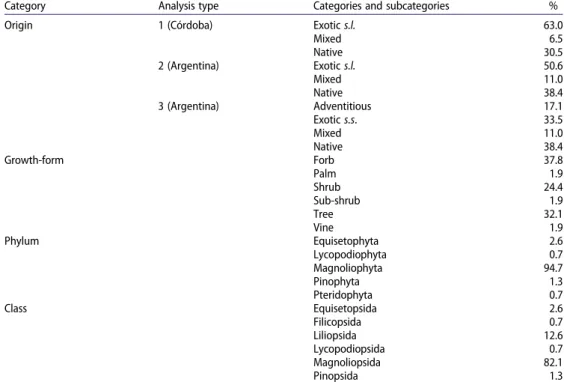
For analyses of types 1 and 2, the majority of the students named exotic s.l. species (Table 2). However, for analysis type 3 of species categorisation, the highest percentage of students named native species, closely followed by exotics.s.species.
Table 1.Absolute (n) and relative (%) frequencies and origin categorisation (analysis type 1–3) for the most frequently named plant species by high-school students attending state or private schools in Córdoba, Argentina.
Order
Spanish vernacular and scientificanames
English common name
Growth-
form n %
Analysis type 1
(Córdoba) 2 (Argentina)
3 (Argentina) 1 ‘Algarrobo’(Prosopisspp.) ‘Mezquite’ Tree 208 9.3 Native Native Native
2 ‘Sauce’(Salixspp.) ‘Willow’ Tree 133 5.9 Mixed Mixed Mixed
3 ‘Espinillo’(Vachellia caven) ‘Roman cassie’ Shrub 110 4.9 Native Native Native 4 ‘Palo borracho’(Ceiba
speciosa)
‘Silk floss tree’ Tree 101 4.5 Exotics.l. Native Native 5 ‘Siempre verde’(Ligustrum
spp.)
‘Privet’ Tree, shrub
97 4.3 Exotics.l. Exotics.l. Adventitious
6 ‘Quebracho’b,c Tree 96 4.3 Native Native Native
7 ‘Pino’(Pinusspp.) ‘Pine’ Tree 81 3.6 Exotics.l. Exotics.l. Exotics.s.
8 ‘Peperina’(Minthostachys verticillata)
Forb 80 3.6 Native Native Native
9 ‘Ceibo’(Erythrinaspp.) ‘Cockspur coral
tree’ Tree 70 3.1 Exotics.l. Native Native
10 ‘Piquillín’c,d Shrub 70 3.1 Native Native Native
11 ‘Cactus’c ‘Cactus’ N/A 56 2.5 Native Native Native
12 ‘Quebracho colorado’c,e Tree 44 2.0 Native Native Native
13 ‘Nogal’(Junglansspp.) ‘Walnut’ Tree 38 1.7 Exotics.l. Mixed Mixed
14 ‘Tala’(Celtisspp.) Shrub 37 1.7 Native Native Native
15 ‘Quebracho blanco’ (Aspidosperma quebracho-blanco)
Tree 36 1.6 Native Native Native
16 ‘Molle’(Lithraea molleoides)
Tree 33 1.5 Native Native Native
17 ‘Tuna’(Opuntiaspp.) ‘Indian fig
tuna’ Sub-
shrub
33 1.5 Mixed Mixed Mixed
18 ‘Eucalipto’(Eucalyptus spp.)
‘Eucalyptus’ Tree 32 1.4 Exotics.l. Exotics.l. Exotics.s.
19 ‘Rosa’(Rosaspp.) ‘Rose’ Shrub 32 1.4 Exotics.l. Exotics.l. Exotics.s.
20 ‘Helecho’c ‘Fern’ N/A 27 1.2 Mixed Mixed Mixed
Note: spp.: the species of‘x’genus; Cba: Córdoba. Arg.: Argentina; N/A: not applicable.
aBetween parenthesis.
b(Schinopsisspp.,Schinusspp.,Aspidosperma quebracho-blanco).
cDenotes taxa that were not further specified.
d(Condalia microphyllaandC. buxifolia).
e(Schinopsisspp.,Schinusspp.).
Downloaded by [University of Calgary] at 05:42 06 November 2017
Species growth-form and taxonomy
The most commonly named plants were trees and shrubs (Table 1), whereas the majority of the 165 different categories of plant names were forbs and trees (Table 2). Regarding the taxonomic status, the majority of the species freelisted corresponded to the Magnoliophyta phylum and the Magnoliopsida class (Table 2).
Floral traits
We found that the majority of the species named by the students exhibited floral traits of low to medium value for size (x.-.-), colour (-.x.-) and scent (-.-.x) (χ2= 2121; degrees of freedom -d.f.- = 18; p< .001; Figure 1). Regarding analysis type 3, most of the salient native (χ2= 1411; d.f. = 14;p< .001) and exotic species named (χ2= 350; d.f. = 12;p< .001) were those portraying small, pale to medium intensity-coloured and inodorous. However, the most salient adventitious species were those exhibiting big brightly-coloured flowers with inodor- ous to medium intensity scents (χ2= 458; d.f. = 14;p< .001;Figure 1). A set of 3D plots of the size (x), colour (y) and scent (z) of the flowers or inflorescences for the native, exotics.s.
and adventitious named plants is available in the Supplementary material.
Influence of sociocultural variables on students’knowledge of native plants The students’socioeconomic status had a significant influence on plant naming, with stu- dents from the less well-off sectors of the society (state schools) naming more species
Table 2.Relative frequency (%) of the origin, growth-form, Phylum and Class of the list of plant species named by high-school students attending state or private schools in Córdoba, Argentina.
Category Analysis type Categories and subcategories %
Origin 1 (Córdoba) Exotics.l. 63.0
Mixed 6.5
Native 30.5
2 (Argentina) Exotics.l. 50.6
Mixed 11.0
Native 38.4
3 (Argentina) Adventitious 17.1
Exotics.s. 33.5
Mixed 11.0
Native 38.4
Growth-form Forb 37.8
Palm 1.9
Shrub 24.4
Sub-shrub 1.9
Tree 32.1
Vine 1.9
Phylum Equisetophyta 2.6
Lycopodiophyta 0.7
Magnoliophyta 94.7
Pinophyta 1.3
Pteridophyta 0.7
Class Equisetopsida 2.6
Filicopsida 0.7
Liliopsida 12.6
Lycopodiopsida 0.7
Magnoliopsida 82.1
Pinopsida 1.3
Downloaded by [University of Calgary] at 05:42 06 November 2017
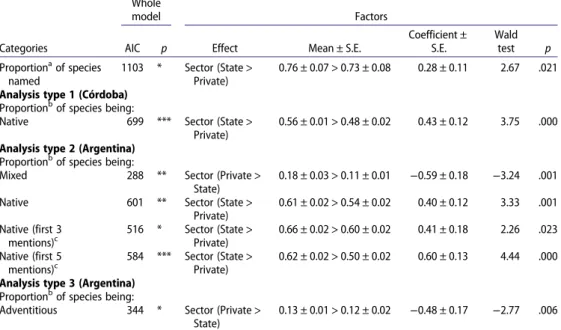
native to Córdoba province than those of the most privileged sectors (private schools) (GLMM:χ2= 17.38; df = 1;p< .000;Table 3). Likewise, students attending state schools named more species (GLMM:χ2= 5.33; df = 1;p< .021) and more species native to Argen- tina than their private peers (GLMM:χ2= 9.70; df = 1;p< .002). In contrast, pupils from private schools mentioned more adventitious species than those from state schools (GLMM:χ2= 4.16; df = 1;p< .050). No differences were found with respect to gender.
Discussion
Familiarity with species
Biological, ecological and cultural relevance of salient species
In the current investigation, the number of plants named were similar to the 154 and 126 names of plants given by students from England and the USA, respectively (Patrick &
Tunnicliffe, 2011), but lower than the 257 plant taxa listed by pupils from Mendoza (Argentina) (Campos et al.,2012). Moreover, as the number of freelisted plants in our Figure 1. Number of species named by high-school students from different socioeconomic back- grounds for the integrated floral trait variable, according to their origin (Argentina, analysis type 3).
Floral traits include (in order): size (x.-.-), colour (-.x.-) and scent (-.-.x). Footnote: s.s.=strict senso.
Adventitious + exotics.s.species = exoticsensu lato(s.l.) species from analysis type 2.
Downloaded by [University of Calgary] at 05:42 06 November 2017
study was lower than the 216 categories of animals named by the same students in another study performed in Córdoba (Bermudez et al., 2017), these findings may also reveal a poorer knowledge of the flora than that of the fauna (Patrick & Tunnicliffe, 2011;
Schwarz, André, & Sevegnani,2012).
The salience of‘Mezquite’registered in our investigation could be due to its traditional relevance to people as a major source of food, medicines, dyes, fuel and building materials (Toledo, Galetto, & Colantonio,2009), while that of‘Willow’may be explained by its orna- mental use and invasive character (Giorgis, Cingolani, et al.,2011). In contrast, the pro- minence of‘Roman cassie’may be related to the abundance of this native species in the Chaco phytogeographical region (Giorgis, Cingolani, et al.,2011).
The prominence of‘Privet’,‘Palo borracho’,‘Jacarandá’and‘Ceibo’might be explained by the their ornamental use and because of‘Privet’is one of the most common exotic trees in Córdoba (Furey et al.,2014; Giorgis, Cingolani, et al.,2011; Hoyos et al.,2010; Tecco et al.,2006). Similarly, the high incidence of‘Pines’ may be related to their promotion by European immigrants in an attempt to recreate their homeland environments (Giorgis, Cingolani, et al.,2011).
The prominence of‘Peperina’may be explained by its traditional use as an infusion and especially as an added component of the iconic‘mate’infusion (Trillo et al.,2010). Finally,
‘Roses’had a much lower salience than that recorded in previous studies (Campos et al.,
Table 3.Significant effect of school sector and student gender on proportion of species named at two geographical contexts: province (Córdoba) and country (Argentina).
Categories
Whole
model Factors
AIC p Effect Mean ± S.E.
Coefficient ± S.E.
Wald
test p
Proportionaof species named
1103 * Sector (State >
Private)
0.76 ± 0.07 > 0.73 ± 0.08 0.28 ± 0.11 2.67 .021 Analysis type 1 (Córdoba)
Proportionbof species being:
Native 699 *** Sector (State >
Private)
0.56 ± 0.01 > 0.48 ± 0.02 0.43 ± 0.12 3.75 .000 Analysis type 2 (Argentina)
Proportionbof species being:
Mixed 288 ** Sector (Private >
State)
0.18 ± 0.03 > 0.11 ± 0.01 −0.59 ± 0.18 −3.24 .001
Native 601 ** Sector (State >
Private)
0.61 ± 0.02 > 0.54 ± 0.02 0.40 ± 0.12 3.33 .001 Native (first 3
mentions)c
516 * Sector (State >
Private)
0.66 ± 0.02 > 0.60 ± 0.02 0.41 ± 0.18 2.26 .023 Native (first 5
mentions)c
584 *** Sector (State >
Private)
0.62 ± 0.02 > 0.50 ± 0.02 0.60 ± 0.13 4.44 .000 Analysis type 3 (Argentina)
Proportionbof species being:
Adventitious 344 * Sector (Private >
State)
0.13 ± 0.01 > 0.12 ± 0.02 −0.48 ± 0.17 −2.77 .006 Note: Akaike’s Information Criterion (AIC) values and significance for the overall models; value, S.E. and significance (p< .05;
Wald test) for effect coefficients are shown.
aCalculated in relation to the 10-blank freelist questionnaire.
bCalculated in relation to the sum of species named by each student.
cCalculated for the first three and first five species named by each student.
*Significant at .05 probability level.
**Significant at .01 probability level.
***Significant at .001 probability level.
Downloaded by [University of Calgary] at 05:42 06 November 2017
2012; Lindemann-Matthies, 2005). However, these studies omitted the nativeness con- dition in the questionnaire, and hence their findings might possibly have confused native plant knowledge with plant preference.
Species origin
The cultural contexts which children are subject to can also influence both their relation- ship with plants and their acquirement of plant knowledge (Bell, Lewenstein, Shouse, &
Feder,2009; Sanders,2007). With regard to this, biological observation and interpretation is influenced by families through several interactional ways in home yards, museums and nature centres (Zimmerman et al.,2010, 2013).
In the current investigation, we found a prominence of exotic plants at both local and country levels, which is in agreement with Campos et al.’s (2012) study. This finding could be interpreted in the light of students’ everyday observations of home yards and fields, which are often enriched in exotic species (Bebbington,2005; Patrick & Tunnicliffe,2011).
The difference between analyses types 2 and 3 revealed that 33.8% of the exotics.l.free- listed plants were adventitious species (17.1% in total). Thus, we propose the existence of
an‘adventitious-to-native effect’, which leads to spontaneously reproducing plants being
named as native species. As a consequence, species such as‘Willow’, ‘Privet’ and‘Pine’ were considered to be native in the context of a fuzzy notion of the nativeness concept (Re et al.,2011) that also favoured the naming of species native to Argentina, but exotic to Córdoba.
Moreover, we consider that a‘natural equilibrium’notion might have influenced stu- dents’perception of the flora with respect to nativeness, which can promote plant blind- ness (Wandersee & Schussler,2001), by (a) failing to identify species origin and the related consequences in ecosystem functioning and (b) taking for granted that every plant species
is‘positive’for the environment for the mere reason of being considered to be‘natural’(as
opposed to artifactual) (Fischer & van der Wal,2007; Siipi,2004).
Species growth-form and taxonomic position
Biological taxonomies allow the grouping of organisms that share a common descent (Eberbach & Crowley,2009), which could represent a critical juncture in school (Link- Pérez et al.,2010).
Our finding that the most frequently named species were trees and that the majority of the plant names given (among 165) were either forbs or trees, possibly highlights the presence of a‘tree-centrism phenomenon’. Related to this, trees are usually introduced in textbooks as the principal organisms that provide ecosystem goods and services (Hadzigeorgiou, Prevezanou, Kabouropoulou, & Konsolas,2011). In addition, the promi- nence of flowering plants (as for the forb growth-form) may be explained by the fact that
‘angiosperms represent the majority of vascular plants on Earth’(Raven, Evert, & Eichhorn,
1986, p. 584) and that they are more conspicuous to people (Wandersee & Schussler, 2001). This is consistent with herbaceous plants with a grass-like morphology (grami- noids) being markedly underestimated by the students, which may constitute a particular case of the plant blindness phenomenon (Wandersee & Schussler,2001). With regard to this, Barman et al. (2006) found that US children thought that a grass was not a plant because‘it doesn’t make flowers, does it?’(p. 78).
Downloaded by [University of Calgary] at 05:42 06 November 2017
Our findings on the salience of trees (growth-form), forbs (growth-form) and flowering trees might indicate that the size of the plant and the bearing flower feature were impor- tant factors when recalling native species.
Floral traits
Family mediation in children’s science experiences includes directing their observations towards the most noticeable features of the organisms (McClain & Zimmerman,2014;
Zimmerman et al.,2010). At school, Tunnicliffe (2001) also found that pupils talked spon- taneously about easily noticeable features of plants, indicating that colour, shape and scent of the flowers effectively attracted children’s attention.
In the current investigation, the higher values for floral traits were the least salient irre- spective of the plant origin, with the exception of adventitious plants. These findings, however, contradict similar studies in which ornamental species such as Roses, Jasmines and Daisies were highly salient (Campos et al.,2012; Lindemann-Matthies,2005). In our study, the recall of the most salient exotic species may be explained by the students think- ing that‘Privet’,‘Mulberry’,‘White cedar’and‘Pine’are native to Argentina. In addition, the students’knowledge of plant nativeness seems to have prevailed over the plant blind- ness phenomenon (Wandersee & Schussler,2001), as if not, students would have listed a limited number of species exhibiting only big colourful and odorous flowers.
Influence of sociocultural variables on students’knowledge of native plants This study has revealed the influence of the socioeconomic status of students on their knowledge of native plants, with pupils from the less well-off sectors of society (attending state schools) mentioning more species than their private school peers. Our findings diverge from a previous study on the sociocultural variables that influenced the percep- tions of the native fauna using the same sample of students (Bermudez et al., 2017), and might indicate a differential knowledge of animal versus plant species (Patrick & Tun- nicliffe,2011; Schwarz et al.,2012). Moreover, our findings may be explained by two non- mutually exclusive reasons: (a) the studied state schools were more effective than the private schools at promoting knowledge of the flora native to Córdoba and Argentina or (b) that the students from the least privileged sectors, who attend state schools (Gamallo, 2011), may possess a stronger tie to the native natural environment than their private peers due to their lifestyles, as well as to personal and family experiences (Campos et al., 2012; McClain & Zimmerman, 2014; Patrick & Tunnicliffe, 2011;
Schroeder,2007; Zimmerman et al.,2010,2013).
Concerning the school sector, Duarte et al. (2009) found that privately run schools in Argentina did not offer a better education nor better organisation as a result of the private management itself, but instead because the students’socioeconomic background favoured the well-off pupils that generally attend private schools (Cervini,2005; Krüger,2013). In addition, the clustering process of pupils in educational institutions indicates that those who are ‘culturally equal’ tend to be together institutionally (Benzem, 2012;
Gamallo,2011).
Research on lifestyles, socioeconomic topics and out-of-school experiences is important for learning about organisms (Prokop et al.,2007; Prokop, Prokop, & Tunnicliffe,2008).
Downloaded by [University of Calgary] at 05:42 06 November 2017
The concept of humans as being part of or as being separate from nature suggests various possibilities regarding the ways people experience the life of plants (Schroeder,2007), i.e.
from a sense of being‘separate’from the native flora as it grows‘naturally’in the forest, to a feeling of‘comfort’and‘coziness’if the environment is enriched in ornamental, mainly
‘domestic’ plants. As children develop their knowledge of the natural world through
nature-based encounters, they cultivate attitudes and concerns towards nature (Patrick
& Tunnicliffe,2011).
It has been suggested that parents adapt their facilitation strategies and shared prior experiences with nature according to perceived traits or the gender of their child (Crowley, Callanan, Tenenbaum, & Allen, 2001; Soori & Bhopal,2002; Tenenbaum &
Leaper, 2003). In the current study, however, no significant difference was found in student’s freelists with respect to gender, which is in agreement with previous studies performed in Switzerland (Lindemann-Matthies,2005) and Brazil (Schwarz et al.,2012) regarding the perception biodiversity.
Educational implications and perspectives
The findings of the current study have implications for scientists engaged in public out- reach, environmental education researchers, and teachers. Concerning scientists, the awareness and consensus in the scientific community of the negative impact of biologi- cal invasions on biodiversity (Simberloff et al.,2013) should motivate those interested in the popularisation of science to design campaigns specifically oriented toward the rec- ognition of native species in the local contexts and in the field, in order to be able to differentiate between native and exotic species, and to make them aware of the impli- cations of exotic invasive species (Schreck Reis et al.,2013). Related to this, the‘adven- titious-to-native’ figure serves to point out the importance of the construction of collective ideas nurtured in the presence of the flora in the local contexts (home and school yards, etc.) (Campos et al., 2012; Palmberg et al., 2015; Patrick & Tunnicliffe, 2011).
Based on the present investigation, we suggest the following recommendations for the enhancement of botany education:
(a) examine the concept of nativeness, which may require reconstructing the students’
pre-existing plant categorisation systems, including a ‘natural equilibrium’ notion that could take for granted the positive effect of the existing species on local ecosys- tems as being‘natural’;
(b) avoid the grouping of species with mixed origin (e.g.‘Willows’), by referring to those with a native and exotic origin separately. For instance,‘the Willow native to Córdoba isS. humboldtiana, whereas the Willows which are exotic and invasive to Córdoba are S. viminalis,S. babylonica, etc.’,
(c) consider a wide range of plant growth forms in order to include graminoids and other underestimated forms, as well as connecting growth forms to ecosystem processes and services. To carry this out, students need a diversity of examples within a single group to understand a category appropriately (Lupyan et al.,2007);
(d) favour knowledge of the local flora as an action to increase people’s connectivity to the local environment and to ameliorate the plant blindness phenomenon;
Downloaded by [University of Calgary] at 05:42 06 November 2017
(e) to bear in mind, when taking these actions, of the differences in the perception of plants according to the socioeconomic background of the students, as indicated by their attendance at private or state schools.
Approaches that emphasise the native status of a species and can recognise exotic and invaders in data analysis might play a critical role in future botany teaching and science education research. Future studies should now be undertaken that take into account cur- riculum issues, environmental and socioeconomic contexts, traditional ecological knowl- edge and students’attitudes to species conservation.
Acknowledgements
We wish to thank all students and teachers for their collaboration. Special thanks to CONICET, Universidad Nacional de Córdoba (SECYT) and FONCYT (ANPYCT: PICT-2011-13799, PICT- 2015-1903) for financial support.
Disclosure statement
No potential conflict of interest was reported by the authors.
Funding
This work was supported by Consejo Nacional de Investigaciones Científicas y Técnicas; Fondo para la Investigación Científica y Tecnológica [grant number PICT-2011-13799, PICT-2015- 1903]; Universidad Nacional de Córdoba.
ORCID
Gonzalo M. A. Bermudez http://orcid.org/0000-0001-9734-0965
References
Ballouard, J. M., Brischoux, F., & Bonnet, X. (2011). Children prioritize virtual exotic biodiversity over local biodiversity.PLoS One,6(8), e23152.
Balmford, A., Clegg, L., Coulson, T., & Taylor, J. (2002). Why conservationists should heed Pokémon.Science,295(5564), 2367.
Barman, C. R., Stein, M., McNair, S., & Barman, N. S. (2006). Students’ideas about plants & plant growth.The American Biology Teacher,68(2), 73–79.
Bebbington, A. (2005). The ability of A-level students to name plants. Journal of Biological Education,39(2), 63–67.
Bell, P., Lewenstein, B., Shouse, A. W., & Feder, M. A. (2009).Learning science in informal environ- ments: People, places, and pursuits. Washington, DC: National Academies Press.
Bermudez, G. M. A., Battistón, L. V., García Capocasa, M. C., & De Longhi, A. L. (2017).
Sociocultural variables that impact high school students’perceptions of native fauna: a study on the species component of the biodiversity concept. Research in Science Education, 47(1), 203–235.http://dx.doi.org/10.1007/s11165-015-9496-4
Bezem, P. (2012). Equidad en la distribución de la oferta de educación pública en la Argentina [Equity in the distribution of the offer of public education in Argentina]. Documento de Trabajo 91.Buenos Aires, Argentina: Centro de Implementación de Políticas Públicas para la Equidad y el Crecimiento.
Downloaded by [University of Calgary] at 05:42 06 November 2017
Bringslimark, T., Hartig, T., & Patil, G. G. (2009). The psychological benefits of indoor plants: A criti- cal review of the experimental literature.Journal of Environmental Psychology,29(4), 422–433.
Cáceres, D. M., Silvetti, F., & Díaz, S. (2016). The rocky path from policy-relevant science to policy implementation — a case study from the South American Chaco. Current Opinion in Environmental Sustainability,19, 57–66.http://dx.doi.org/10.1016/j.cosust.2015.12.003 Campos, C. M., Greco, S., Ciarlante, J. J., Balangione, M., Bender, J. B., Nates, J., & Lindemann-
Matthies, P. (2012). Students’familiarity and initial contact with species in the Monte desert (Mendoza, Argentina).Journal of Arid Environments,82, 98–105.
Cervini, R. (2002). Desigualdades socioculturales en el aprendizaje de matemática y lengua de la educación secundaria en Argentina [Sociocultural inequalities in the learning of language and Mathematics in Secondary Education in Argentina: A model of three levels]. Revista Electrónica de Investigación y Evaluación Educativa,8(2), 126–148.
Cervini, R. A. I. (2005). The relationship between school composition, school process and math- ematics achievement in secondary education in Argentina.International Review of Education, 51(2-3), 173–200.
Convention on Biological Diversity. (2009). What are invasive alien species? Retrieved fromhttps://
www.cbd.int/idb/2009/about/what/
Crowley, K., Callanan, M. A., Tenenbaum, H. R., & Allen, E. (2001). Parents explain more often to boys than to girls during shared scientific thinking.Psychological Science,12(3), 258–261.http://
dx.doi.org/10.1111/1467-9280.00347
de la Peña, M. R., & Pensiero, J. (2004). Plantas argentinas. Catálogo de nombres comunes [Argentine plants. Catalog of common names]. Buenos Aires: L.O.L.A.
Demaio, P., Karlin, U. O., & Medina, M. (2002).Árboles nativos del centro de la Argentina[Native trees from central Argentina]. Buenos Aires: L.O.L.A.
Distel, H., Ayabe-Kanamura, S., Martínez-Gómez, M., Schicker, I., Kobayakawa, T., Saito, S., &
Hudson, R. (1999). Perception of everyday odors—correlation between intensity, familiarity and strength of hedonic judgement.Chemical Senses,24(2), 191–199.
Duarte, J., Bos, M. S., & Moreno, M. (2009).Inequidad en los aprendizajes escolares en América Latina [Inequity in school learning in Latin America]. (IDB Technical Note No. 4).
Washington, DC: Inter-American Development Bank.
Eberbach, C., & Crowley, K. (2009). From Everyday to Scientific Observation: How Children Learn to Observe the Biologist’s World.Review of Educational Research,79(1), 39–68.http://dx.doi.org/
10.3102/0034654308325899
Education Ministry of Córdoba. (2011).Diseño curricular de Educación Secundaria: Orientación Ciencias Naturales. Volumen 4 [Secondary Education Curriculum Standard. Orientation natural sciences. Volume 4]. Córdoba: Ministerio de Educación.
European Commission. (2013).Attitudes of Europeans toward the issue of biodiversity(Analytical report –Wave 3. Flash Eurobarometer 379). European Commission, TNS Political & Social.
Retrieved fromhttp://ec.europa.eu/public_opinion/flash/fl_379_en.pdf
Fančovičová, J., & Prokop, P. (2011). Children’s ability to recognise toxic and non-toxic fruits: A preliminary study. Eurasia Journal of Mathematics, Science & Technology Education, 7(2), 115–120.
Fischer, A., & van der Wal, R. (2007). Invasive plant suppresses charismatic seabird–The construc- tion of attitudes towards biodiversity management options.Biological Conservation,135, 256– 267.
Formichella, M., & Krüger, N. (2013). El fracaso escolar en el nivel medio argentino: Es menos fre- cuente en las escuelas de gestión privada debido a su administración? [School failure in the middle Argentine level: It is less common in privately run schools because of their adminis- tration?].Regional and Sectoral Economic Studies,13(3), 127–144.
Franklin, A., Bevis, L., Ling, Y., & Hurlbert, A. (2010). Biological components of colour preference in infancy.Developmental Science,13(2), 346–354.
Furey, C., Tecco, P. A., Perez-Harguindeguy, N., Giorgis, M. A., & Grossi, M. (2014). The impor- tance of native and exotic plant identity and dominance on decomposition patterns in mountain woodlands of central Argentina.Acta Oecologica,54, 13–20.
Downloaded by [University of Calgary] at 05:42 06 November 2017
Galbraith, J. (2003). Connecting with plants: Lessons for life.Curriculum Journal,14(2), 279–286.
Gamallo, G. (2011). Mercantilización del bienestar. Hogares pobres y escuelas privadas [Commodification of welfare. Poor homes and private schools].Revista de Instituciones, Ideas y Mercados, 55, 189–233. Retrieved from http://www.fundacioncepp.org.ar/wp-content/
uploads/2011/12/riim55_gamallo.pdf
Giorgis, M. A., Cingolani, A. M., Chiarini, F., Chiapella, J., Barboza, G., Ariza Espinar, L.,…Cabido, M. (2011). Composición florística del Bosque Chaqueño Serrano de la provincia de Córdoba, Argentina [Floristic composition of the Chaco Serrano Woodland in Córdoba province, Argentina].Kurtziana,36(1), 9–43. Retrieved fromhttp://ref.scielo.org/kdhvjv
Giorgis, M. A., Tecco, P. A., Cingolani, A. M., Renison, D., Marcora, P., & Paiaro, V. (2011). Factors associated with woody alien species distribution in a newly invaded mountain system of central Argentina.Biological Invasions,13(6), 1423–1434.
Gopnik, A., Meltzoff, A. N., & Kuhl, P. K. (1999).The scientist in the crib: What early learning tells us about the mind. New York, NY: HarperCollins.
Guéguen, N. (2011).“Say it with flowers”: The effect of flowers on mating attractiveness and behav- ior.Social Influence,6(2), 105–112.
Hadzigeorgiou, Y., Prevezanou, B., Kabouropoulou, M., & Konsolas, M. (2011). Teaching about the importance of trees: A study with young children.Environmental Education Research, 17(4), 519–536.
Haviland-Jones, J., Rosario, H. H., Wilson, P., & McGuire, T. R. (2005). An environmental approach to positive emotion: Flowers. Evolutionary Psychology, 3, 104–132. Retrieved from http://epjournal.net/388
Hmelo-Silver, C. E., & Pfeffer, M. G. (2004). Comparing expert and novice understanding of a complex system from the perspective of structures, behaviors, and functions. Cognitive Science,28(1), 127–138.
Hoyos, L. E., Cingolani, A. M., Zak, M. R., Vaieretti, M. V., Gorla, D. E., & Cabido, M. R. (2013).
Deforestation and precipitation patterns in the arid Chaco forests of central Argentina.Applied Vegetation Science,16(2), 260–271.
Hoyos, L. E., Gavier-Pizarro, G. I., Kuemmerle, T., Bucher, E. H., Radeloff, V. C., & Tecco, P. A.
(2010). Invasion of glossy privet (Ligustrum lucidum) and native forest loss in the Sierras Chicas of Córdoba, Argentina.Biological Invasions,12(9), 3261–3275.
Kassas, M. (2002). Environmental education: Biodiversity.The Environmentalist,22(4), 345–351.
Kelber, A., & Osorio, D. (2010). From spectral information to animal colour vision: experiments and concepts. Proceedings of the Royal Society B: Biological Sciences, 277(1688), 1617–1625.
http://dx.doi.org/10.1098/rspb.2009.2118
Krüger, N. (2013). Segregación social y desigualdad de logros educativos en Argentina [Social seg- regation and educational attainment inequality in Argentina]. Education Policy Analysis Archives/Archivos Analíticos de Políticas Educativas,21, 1–26.
Krüger, N., & Formichella, M. M. (2012). Escuela pública y privada en Argentina: Una comparación de las condiciones de escolarización en el nivel medio [State and private schools in Argentina: A comparison of the school conditions in the secondary educational system].Perspectivas,6(1), 113–144.
Lindemann-Matthies, P. (2005).‘Loveable’mammals and‘lifeless’plants: How children’s interest in common local organisms can be enhanced through observation of nature.International Journal of Science Education,27(6), 655–677.
Lindemann-Matthies, P. (2016). Beasts or beauties? Laypersons’perception of invasive alien plant species in Switzerland and attitudes towards their management.NeoBiota,29, 15–33. Retrieved fromhttp://neobiota.pensoft.net/articles.php?id=5786
Lindemann-Matthies, P., & Bose, E. (2008). How many species are there? Public understanding and awareness of biodiversity in Switzerland.Human Ecology,36(5), 731–742.
Link-Pérez, M. A., Dollo, V. H., Weber, K. M., & Schussler, E. E. (2010). What’s in a name:
Differential labelling of plant and animal photographs in two nationally syndicated elementary science textbook series.International Journal of Science Education,32(9), 1227–1242.
Downloaded by [University of Calgary] at 05:42 06 November 2017