The emphasis on publications as a means of disseminating knowledge was expressed by the first Secretary of the Smithsonian Institution. The meeting of the conference was stimulated by the increasing emphasis and need for investigations of the systematics and ecology of meiofauna and for a means of providing an exchange of ideas between systematists and ecologists. One of the most pressing problems is the need for more attention to the sampling problem.
Statistical evaluation of various techniques of sampling and statistical treatment of the sampling efforts are essential. This emphasizes the need to take into account the local environmental conditions of the organism. Funding for the conference was made possible by the Office of International Activities of the Smithsonian Institution.
Ray Manning and his staff of the Department of Invertebrate Zoology, Smithsonian Institution, is gratefully acknowledged. And finally, sincere appreciation is expressed to the authors of the papers in this volume for their patience and cooperation.
SYSTEMATICS AND ECOLOGY OF MEIOFAUNA TAXA
Monniot Les Ascidies littorales et profondes des
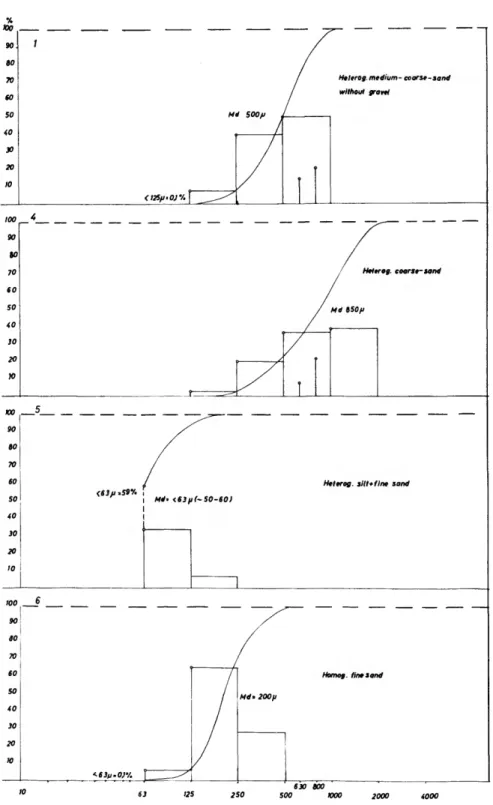
The summation and intensities of the different parameters will determine the field distribution of interstitial fauna. Limitation of water flow through the interstitial network is determined by the permeability of the sediment (Brafield, 1964; Emery and Foster, 1948).
D.Mcintyre Observations on the
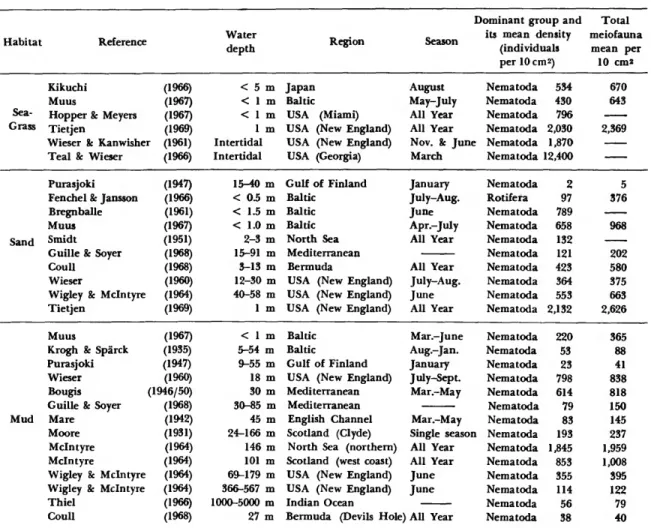
Channel, Moore (1931) in the Clyde, and Mclntyre (1964) in the marine lochs of the Scottish west coast as well as in the North Sea off the east coast. A high proportion of the samples were taken in north-west European waters and there is clearly great scope for extending comparable work to other regions. Similar limitations apply to our knowledge of the vertical distribution of organisms in sediment due to the difficulty of obtaining long undisturbed cores from the subtidal base.
In most of the studies referenced in Table 1, sampling was limited to the top 4 to 6 cm of the deposit. Mclntyre (unpublished) examined 23 cm long cores collected in Scotland by divers from a sandy soil (median grain size 200 ju,) at 1 to 8 m depth where he found mainly nematodes, but he also found several other groups down to the deepest part of the cores. Hopper and Meyers (1967), for example, showed how gradual deterioration of the plants in a seagrass bed could complicate the interpretation of seasonal changes.
Because of the ecological diversification that exists within such groups, greater taxonomic discrimination would undoubtedly aid in the interpretation of seasonal patterns. It is clear from the studies in the table that nematodes are numerically overwhelmingly the dominant group, often accounting for more than 90 percent of the metazoan fauna. As suggested above, the sorting and processing techniques used can influence the relative quantitative picture of the meiofauna.
Of the three methods, there is no doubt that the diver-collected core is the most satisfactory. Furthermore, the diver is usually able to collect a core of the desired length and bring it to the surface more or less intact - a useful feat on sandy ground. Even a tube of more than 4 cm diameter caused some washing away of the flocculent material, despite the most gentle insertion into the deposit.
An ecological study on animal communities of the Zostera marina belt in Tomioka Bay, Amakusa, Kyushu. On a new bottom sample for investigation of the microfauna of the seabed with comments on the amount and significance of the bottom microfauna. Distribution and Ecology of Dominant Species in the Shallow Range of the Mesohaline Zone.
T. Gomoiu Ecology of
On the rocky shores of the Romanian Black Sea, almost 100 zoobenthonic species have been identified, of which 73 belong to meiobenthos. A new coenosis has been established in the Black Sea perizoic zone based on the presence of certain meiobenthonic taxa dominated by the foraminiferan Lagena, the hydrozoan Bougainvillea Forbes, and the nematode Spirina parasitifera. An analysis by groups of the most important meiobenthic organisms from the Romanian Black Sea coast shows the following.
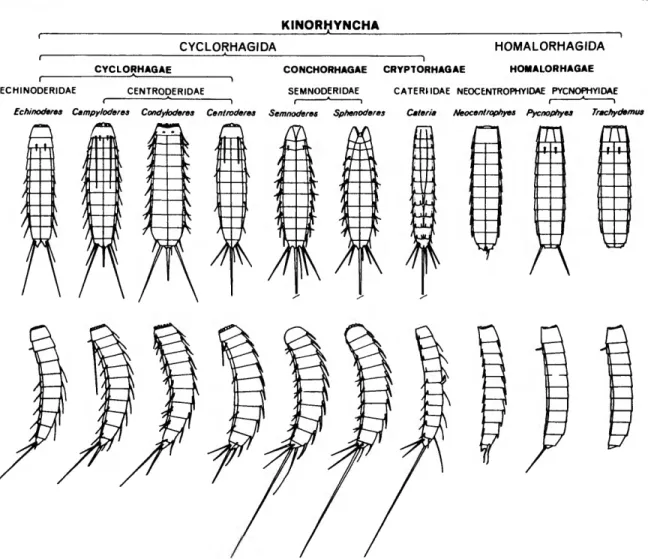
Of the nearly 200 polychaete species in the Black Sea, the vast majority are microbenthic, while the others have meiobenthic juvenile stages. From more than 600 quantitative meiobenthos samples of the Romanian coast, the highest density of Kinorhynchus was 7,980 samples/m2. Over 210 microbenthic diatom species have been identified in the fine quartz sand zone of the Romanian coast.
The importance of microphytobenthos in mollusc nutrition has been demonstrated (Bodeanu and Gomoiu, 1964). Thus we see the great importance of meiobenthos for the economy of the sea. On the effects of water movement on marine organisms in the mesolittoral and infralittoral zones of the Romanian coast of the Black Sea.
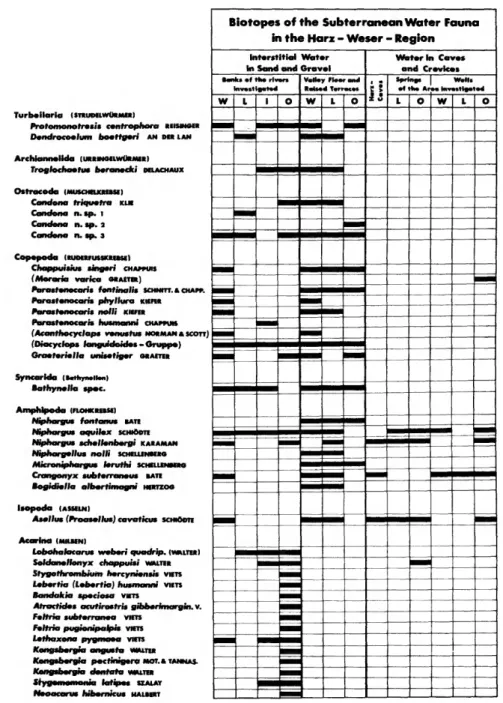
The biotopes of such intermediate benthal fauna must be considered as biozones of the ecosystem "groundwater" (stygocoen). As mentioned, the biotopes of these benthal-mixed biocoenoses of stygobiont, stygophilous and stygoxene interstitial freshwater organisms are to be considered part of the "groundwater" ecosystem. Investigations of the subterranean freshwater fauna in sandy and gravelly river beds as well as in wells, springs and caves in a geomorphologically heterogeneous region of the Weser system (Germany) provided the first information on the ecological relationships between interstitial benthal and other groundwater biotopes (Husmann, 1956).
The clearly demonstrated dependence of the groundwater organisms of stygobionts on the structure of underground biotopes indicates that interstitial waters in sand and gravel were the main biotopes of almost all captured stygobionts. Due to such underground conditions, it is understandable that most stygobionts living in the interstitial groundwater of terraces and valleys can also be trapped in the interstitial waters of sandy and gravelly riverbeds. The ecological ambiguity mentioned in such intermediate biozones is characterized by a decrease in stygophilic freshwater organisms in proportion to the distance from benthic biotopes of interstitial mixed biocenoses.
THALASSON|
Kiihl On Changes of the Interstitial Water
In aquarium 1, the meat was placed on the surface of the sediment; the pulp was placed in aquarium 2. In aquarium 3, these compounds were detected at the beginning of the experiment and disappeared later. Ammonification in aquarium 4, with coarse sandy sediment, started within 4 days of the start of the experiment.
Within the next eight days, the reduction zone extended downward to the bottom of the tube, but not to the top at outlet 2. The decomposition products can appear on the surface of the sediment and in the water column. The results of the experiments show that the decomposition products can reach the surface of the sediment after a certain time.
Liineburg of the Hydrographische Abteilung, Institut fur Meeresforschung, Bremerhaven, for grain size determination. It might be better to dig down to the bottom of the pipe and lift it out of the ground with your body. If the sample is to be used to provide information on the vertical faunal zone, it must be removed.
Pushing the core out with the plunger disturbs the surface and is likely to cause compression of the sample. In the sublittoral, shorter cores are usually sufficient and simple hand coring of the type described can be carried out using SCUBA to a depth of about 50 m. It is possible to use most of the quantitative gear designed for macrobenthos studies for the meiobenthos (Holme, 1964; Hopkins, 1964).
In the Willimoes sampler, the ball is pulled up to close the bottom of the tube by a string running through the tube. Qualitative samples of these animals and of the larger, more mobile meiobenthic species can be taken with Mortensen (1925) and Ockelmann (1964) sledge samplers. This problem can be remedied by fitting a gauze cover on top of the scoop, as in the Smith-Mclntyre grip (Smith and Mclntyre, 1954).