To the northeast of the ruins are several acres of mangrove swamp containing a few isolated huts. It is from this point that confusion begins about the actual details of the city. Cristopher's Hill and this account would place Malambo on the opposite side of the Portobelo route and out.
THE SITE
This is used here, with permission, as map 1, because it gives a good view of the entire site. It places Malambo on the other side of the path and marks the current survey area as 'dense tropical jungle, swamps and marshes'. Unfortunately, the name of the map's creator is unclear and no further references are available. At least one researcher of this site (Smith, 1960) suggests that the remains belong to the Indians who were present at the site before the first.
DESCRIPTION
The area north of the site also contains scattered sherds for another 500 meters on the opposite side of the Rio Abajo. The southern part of the site has less topsoil and in some places the underlying sandy clay is exposed. Pertinent material is included from the large collection of the Museo Nacional de Panama.
BURIAL PRACTICES
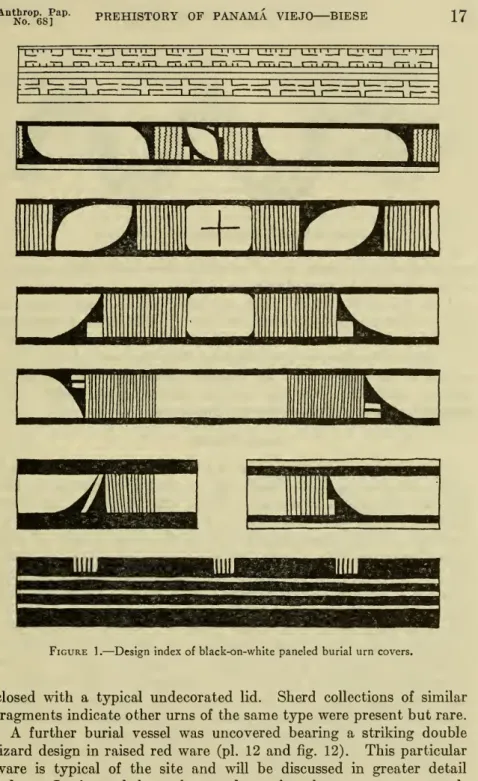
As there were no distinctive ground markings, there was no indication of the exact size or shape of the original graves. Both had their mouths wide open and their heads in hyperextension with the occiput touching the cervical spine (Fig. 1).
BURIAL URNS
There was insufficient evidence to support previous burning of the bones, but the size of the vessel basin would favor a secondary burial. At first they may appear to be utilitarian sinks, but their close fit, precise size and absence of other parts of the site make it so. In no case did the design extend onto the sliding surface of the vessel.
DECORATED URNS
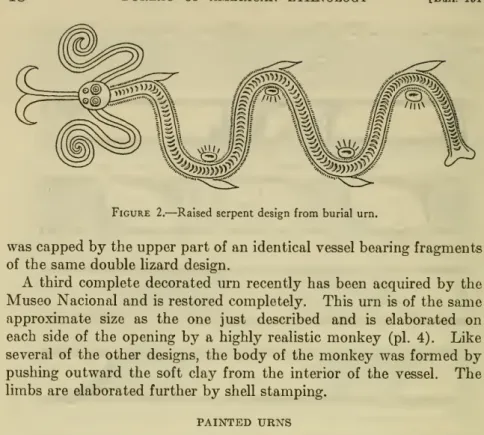
This urn has approximately the same dimensions as the urn just described and is elaborated on either side of the opening by a very realistic monkey (fig. 4). As with several other designs, the monkey's body was formed by pushing the soft clay outward from the inside of the vessel. There was no associated skeletal material, so the use of the vessel is inferred only from its location and size.
BURIAL OFFERINGS
FUNERARY VOTIVE WARE
The base and the lower part of the bowls are processed with geometric patterns in cut and pierced lines. In plate 6, a, a slightly different type of bird's head, apparently from the same class of vessel, is shown to illustrate the variation in featherwork. The lower bowl was dusty and is shown rebuilt in the photo.
STONEWORK
POINTS
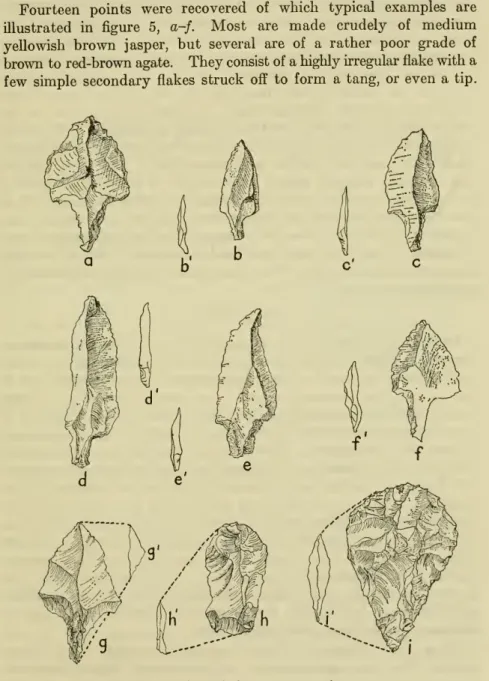
PRE-HISTORY OF PANAMA VIEJO—BIESE. the surface or immediate subsurface. exposed on the surface after heavy rain. 191 There is no secondary machining of the blade edges. fig. 5, a-j) have a well-defined tongs on a short blade which they give. As in the Code area, there is no evidence that any of these points were attached to arrows, nor does their clumsy appearance suggest so.
SCRAPERS
These points are identical to those described by Lothrop from Sitio Conte and also represent typical blades found at Venado Beach and Madden Lake. It is more likely that they were used as points for small throwing spears or with wooden "throwing sticks", for which there is no archaeological evidence. This differs from the first only in that it consists of a very fine grade of the light brown chert peculiar to Missouri.
CELTS
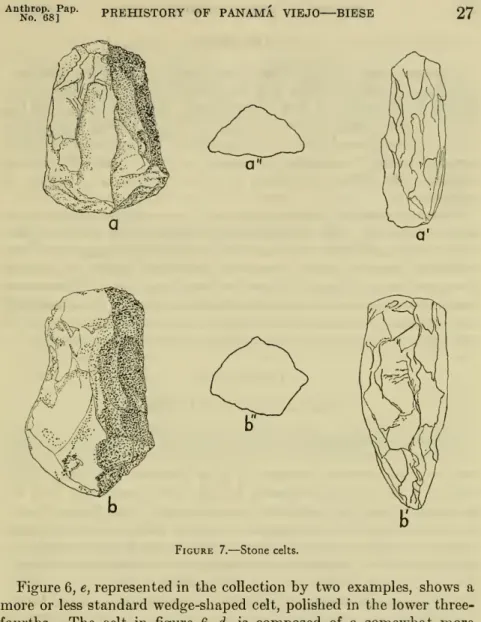
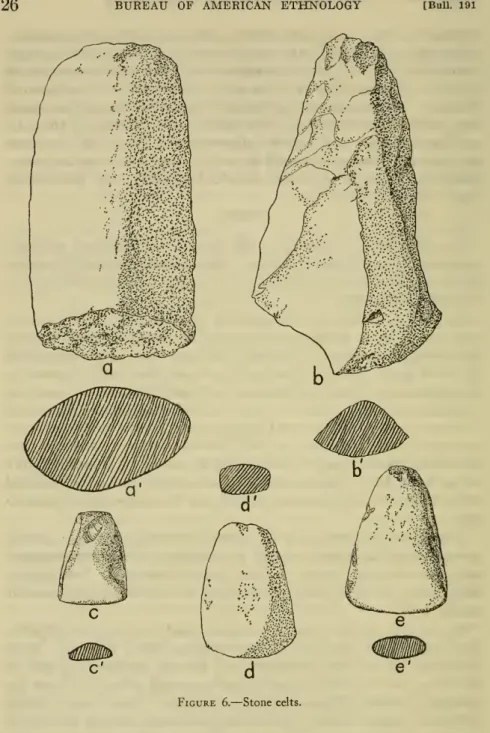
Figure 6, e, shown in the collection with two examples, shows a more or less standard wedge-shaped celt, smooth on the lower triplets. It has a diagonal cut edge like some of those also found at Sitio Conte, and is smoothly polished throughout. The two remaining celts, one of which is illustrated (fig. 6, c), are small, dense, dark black basaltic material, wedge-shaped and of a high polish throughout.
METATES
CERAMICS
NATURE OF THE SAMPLE
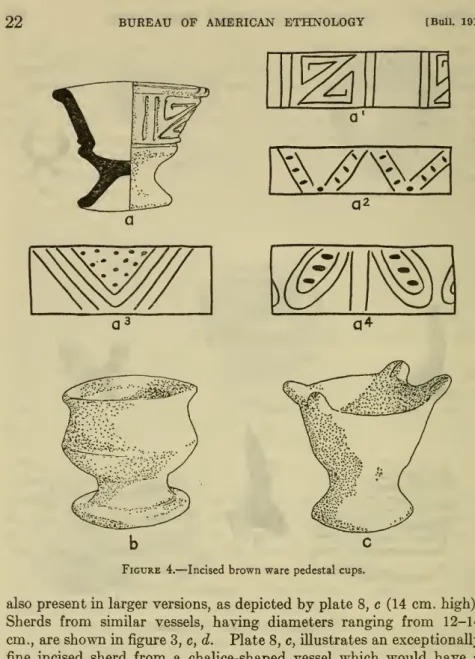
Modern undecorated examples can be seen in almost every hut in the mountains across Panama, where they are used for water and grain storage or to prepare the alcoholic "chicha". Of the smaller sherds, the majority have so little curvature that they must have come from at least moderately sized vessels of unknown shape; the contours are shown with the shard figures. The size is also attested by identifiable portions of incised images that must have covered an area at least as large as our intact example.
RED WARE
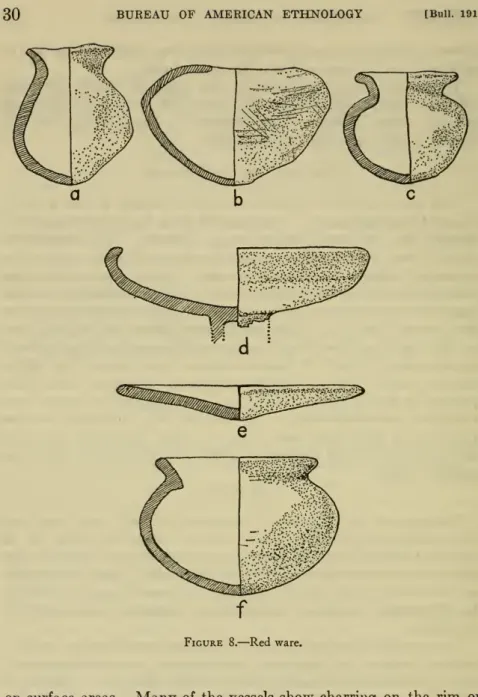
Several of the larger shards appear to belong to a ship of approximately the same size. Of the smaller herd pieces, the majority have so little curvature that they must certainly have come from at least medium-sized vessels of unknown shape; the contours are shown with the shard figures. It would be very interesting to know that. the variety of shapes and uses of these pottery types and why only they received the distinctive stylistic treatment not found on smaller pots.
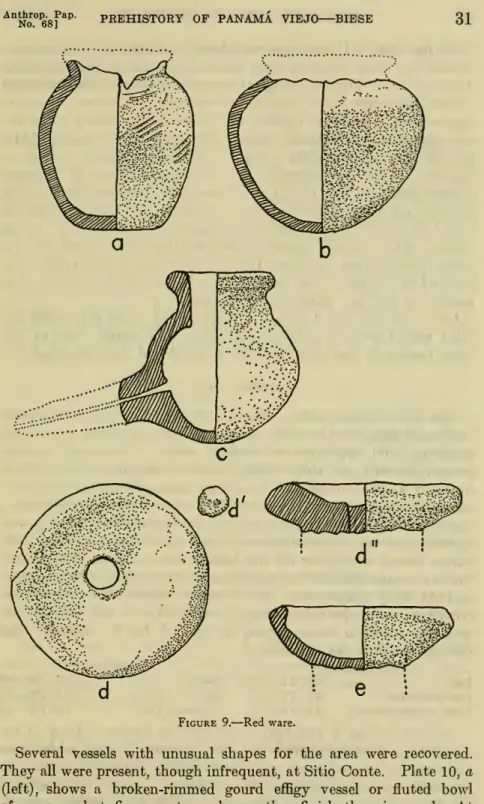
Many vessels show charring of the rim or interior, indicating their contact with fire during use. illustrated intact examples were found in the burial ground and several from the interior spaces. Kedware containers have been obtained in both average utility sizes of 1-2 quarts and miniature sizes of the same shape but less than 2-4 ounces in capacity. All were present, albeit rarely, in Sitio Conte. left), shows a gourd image of a dish with a broken rim or a fluted bowl.
BROWN WARE
PAINTED WARES
RIMSHERDS
ORANGE
DECORATIVE TECHNIQUES
Plate 12 and figure 12 depict a very realistic lizard or iguana, the finest example of incised relief. The backward-facing position of the head seems quite unusual for Panama and gives the entire design an appearance reminiscent of Quetzalcoatl motifs in Mexico, such as those on the facades of Xochicalco. This is an example of the modeled relief technique where the body is formed by pushing the clay outwards from the inside of the vessel, leaving the actual wall thickness unchanged.
Again, we are reminded more of the Mexican motifs than the polychrome phases of Panama. In some cases, the same pattern was present on both sides of the upper half to one-third of the vessel. On some, the glass was divided into four vertical panels with appliquéd ridges in four alternating blank and decorated vertical panels similar to these parts of an orange.
The rims are further elaborated at the top or side, but the edge and body decorations are not connected.

ANTHROPOMORPHIC EFFIGIES
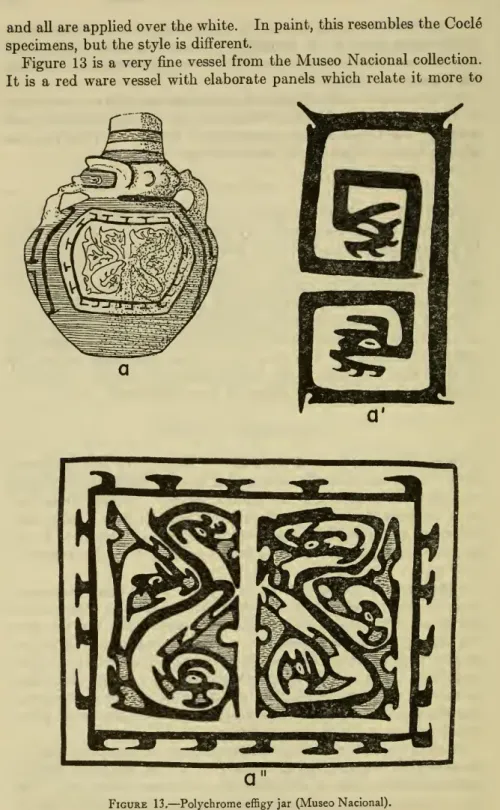
The head is skidded white with a border to indicate the hairline and a tall conical hat decorated with alternating red and purple stripes. The front panel (a') is repeated on the back and consists of scrolls in black on the natural background. The side panels {a") are placed over a white background and consist of intricate scrollwork ending in alligator god heads and have.
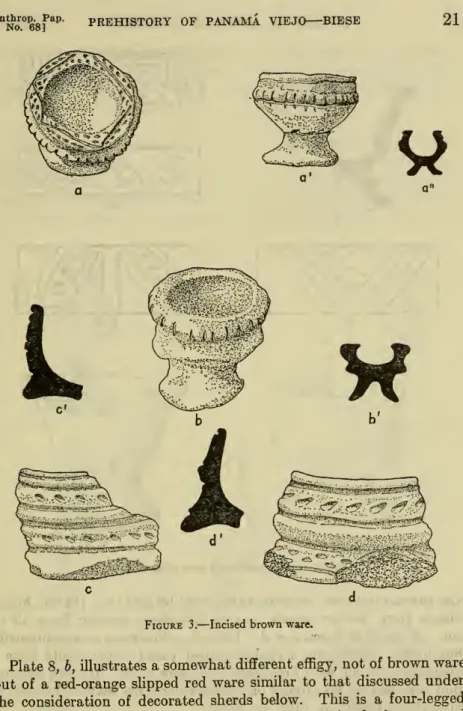
The way the hair is indicated is similar to the above and the legs are like those on many veragua tools. The main design technique consists of cutting with a miniature or a pointed tool in an inline fashion to form various animal designs. These are then processed by cutting or drilling with various mechanical tools in order to complete the design or to further process it.
Raised ridges along the incised lines are present in some cases, but most designs are clean and would indicate incising into "leather hard" rather than wet clay, causing uneven furrows from later polishing.
SURFACE DESIGNS
No^esf^^ PREHISTORY OF PANAMA VIEJO—BIESE 41 were made in a wet state, leaving a well-defined ridge which can be seen in the photograph.
RELIEF MODELING AND APPLIQUE
TRADE WARE
The patterns occur everywhere on the external surface, excluding the underside, and do not appear to be organized into zones. Code vessels, at least they appear to be imitations or copies thereof; animation perhaps only obtained by dealing with the two sides.
SECONDARY USE OF ARTIFACTS
SPINDLE WHORLS
The broken tail of another whistle, probably representing a bird, is illustrated in plate 23 with other miscellaneous objects found at the site.
CLASSIFICATION
Panama Viejo Red Ware
Panama Viejo Decorated Brown Ware
Panama Viejo Urn Wares
DISCUSSION
GEOGRAPHICAL DISTRIBUTION
191 Raised brownware sherds with animal motifs are illustrated from Punta Patiiio, near the Gulf of San Miguel, deep in the Darien (Linne, 1929, p. 154). Recent work at Cupica, Colombia (Reichel-Dolmatoff, 1961) has revealed identical fragments of our modeled brown pottery, as well as polychrome coded humpback whale images and other late period merchandise at Sitio Conte. This gives us a known, active range of over 400 kilometers to the southeast, into the Darien jungle overland.
Similarly, the same potterj^ is found over most of the Madden Lake region in a broad zone up to 15 miles east of the Canal. From the distribution of similar pottery, points and bm'ials, it is seen that related cultures covered a wide band over the whole. Isthmus from the Atlantic to the Pacific, covering the area occupied by the present Channel Zone and slightly to the east of it.
It extends to the Pearl Islands in the south and into an unknown area of the Darien.
CONTACTS AND MIGRATIONS
Until further details are available, we can only state with certainty that the Panama Viejo culture had limited trade contacts with her classically polychrome neighbors to the west. There is no evidence to suggest contact with the more western Chiriqui or Costa Rica. Parallel shell rim stamping around vessel rims is known in Panama from the Gir6n site in Azuero (Willey and Stoddard, 1954), where it was found in the possibly contemporaneous levels of the Santa Maria phase, and from both the Santa Maria and early Code -levels at Sitio Conte (Ladd, 1957).
Shell stamping is also known from the Sarigua phase at Parita Bay (Willey and McGimsey, 1954), although in this case the pottery paste is quite different and there is a considerable time lag between the estimated dates for Sarigua and Code. These have been discussed in more detail above, and we are now beginning to believe that urn burial may represent a direct migration of much more ancient origin and distribution throughout Mesoamerica than previously thought.
CHRONOLOGY
Even more recently (Lothrop, 1958 and 1959) an urn burial at Venado Beach yielded a radiocarbon date of AD that was cross-dated with early Code polychromes. Lothrop suggested that this was premature and could represent sampling or technical error; the reader is referred to the two papers cited above for a thorough discussion of these and other dates from Panama. Once the date is accepted, we still need to decide on the relationship of this site to Venado Beach and the lake area.
INTERPRETIVE SUMMARY
Likewise, the absence of both jewelry and merchandise suggests an economically poor or dependent tribe associated with Venado Beach at the same time when the latter was the ceremonial or ruling center.
BIBLIOGRAPHY