JOHN F. EISENBE
and MELVYN LOCKHA An Ecological
Reconnaissance of Wilpattu National Park, Ceylon
SMITHSONIAN CONTRIBUTIONS TO ZOOLOGY NUMBER 101
SERIAL P U B L I C A T I O N S OF THE SMITHSONIAN INSTITUTION The emphasis upon publications as a means of diffusing knowledge was expressed by the first Secretary of the Smithsonian Institution. In his formal plan for the Insti- tution, Joseph Henry articulated a program that included the following statement:
"It is proposed to publish a series of reports, giving an account of the new discoveries in science, and of the changes made from year to year in all branches of knowledge."
This keynote of basic research has been adhered to over the years in the issuance of thousands of titles in serial publications under the Smithsonian imprint, com- mencing with Smithsonian Contributions to Knowledge in 1848 and continuing with the following active series:
Smithsonian Annals of Flight Smithsonian Contributions to Anthropology
Smithsonian Contributions to Astrophysics Smithsonian Contributions to Botany Smithsonian Contributions to the Earth Sciences
Smithsonian Contributions to Paleobiology Smithsonian Contributions to Zoology Smithsonian Studies in History and Technology
In these series, the Institution publishes original articles and monographs dealing with the research and collections of its several museums and offices and of profes- sional colleagues at other institutions of learning. These papers report newly acquired facts, synoptic interpretations of data, or original theory in specialized fields. These publications are distributed by mailing lists to libraries, laboratories, and other in- terested institutions and specialists throughout the world. Individual copies may be obtained from the Smithsonian Institution Press as long as stocks are available.
S. DILLON RIPLEY
Secretary
Smithsonian Institution
INTERNATIONAL BOOK YEAR • 1972
111
SMITHSONIAN CONTRIBUTIONS TO ZOOLOGY
NUMBER 101
JohnF.Eisenberg A n E c o l o g i c a l
I -KM J J 1 1 . m
Jvcconnaissance 01
Wilpattu National Park, Ceylon
SMITHSONIAN INSTITUTION PRESS
CITY OF WASHINGTON
1972
Eisenberg, John F., and Melvyn Lockhart. An Ecological Reconnaissance of Wil- pattu National Park, Ceylon. Smithsonian Contributions to Zoology, number 101.
118 pages 76 figures, 16 tables. 1972.—The results of this study are based on a 14- month survey in Wilpattu National Park, Ceylon, covering an area of some 580 square kilometers in the lowland dry zone scrub jungle. Special attention was paid to the major ungulate species and data concerning abundance, seasons of reproduction, and feeding patterns are discussed. Although the elephant {Elephas maximus) exhibits the lowest numerical density, it accounts for the second highest biomass, exceeded in biomass only by the axis deer, which is also the most numerically abundant ungulate in the lowland dry zone of Ceylon. Special attention was paid to the role of the elephant in the dry zone ecosystem. Composition of social groupings, seasonal habitat utilization trends, general behavior patterns, and population structure are discussed for the elephant (Elephas maximus), water buffalo (Bubalus bubalis), axis deer (Axis axis), sambar (Cervus unicolor), muntjac (Muntiacus muntjac), wild swine (Sus scrofa), and mouse deer (Tragulus meminna). Certain aspects of the behavior of the major predators are also discussed, including the general biology of the golden jackal (Canis aureus) and the Ceylon leopard (Panthera pardus). Social organizations of the un- gulate species are compared with special attention given to the mode of antipredator behavior exhibited by ungulates. Habitat utilization trends and comments on com- petition and ecological separation are included together with an estimate of numeri- cal abundance and biomass for the major ungulate species. Recommendations for management of the park system are discussed.
Official publication date is handstamped in a limited number of initial copies and is recorded in the Institution's annual report, Smithsonian Year.
UNITED STATES GOVERNMENT PRINTING OFFICE WASHINGTON : 1972
For sale by the Superintendent of Document*, U.S. Government Printing Office Washington, D.C. 20402 • Price $1.60 (paper cover)
Contents
Page Introduction 1 Acknowledgments 2 The Environment 4 Physical Description of the Park 4 Climate 4 Flora 7 The Mammalian Fauna 10 The Elephant (Elephas maximus) 10 Description and Aging Criteria 10 Criteria for Age Classes 11 Criteria for Distinguishing the Sexes 12 Social Groupings 13 Distribution in the Park 17 Habitat Utilization 18 The Use of Tall Grass Villus 18 Short Grass Feeding 19 Trail Utilization During a Long March 20 Tree-Pushing Behavior 21 Description of River-Crossings 21 Elephant Sign in the Habitat 21 Concluding Remarks on Habitat Utilization 22 Summary of Elephant Behavior Patterns 23 Activity 23 Patterns of Social Interaction 23 Behavior During Agonistic Encounters 24 Antipredator Behavior 25 Female-Young Relationships 26 Sexual Behavior 26 Behavior Patterns of Different Age and Sex Classes 28 Interspecific Social Relations 28 Population Structure 29 The Water Buffalo (Bubalus bubalis) 30 Description and Aging Criteria 30 Social Groupings and Habitat Utilization 30 Distribution in the Park 30 Movements 32 Habitat Utilization 32 General Observations on Behavior 33 Population Structure and Dynamics 36 The Spotted Deer (Axis axis) 37 Social Groupings 37 Distribution in the Park 38 Habitat Utilization 39 Behavior Patterns 40 Activity Rhythms and Group Behavior 40 Communication Mechanisms 41 Patterns of Social Interaction 42 Male-Male Interactions 42
in
Male-Female Behavior 42 Female-Female Behavior 43 Female with Young 43 Antipredator Behavior 44 Interspecific Relationships 45 Population Trends 45 Seasons of Birth and Mating 45 Mortality and Biomass 47 The Sambar (Cervus unicolor) 47 Description and Age Classes 47 Grouping Tendencies 48 Habitat Utilization 49 Social Behavior 49 Antipredator Behavior 50 Population Trends 50 The Muntjac or Barking Deer (Muntiacus muntjac) 51 The Mouse Deer (Tragulus meminna) 52 Summary Statement on the Small Forest Ungulates 54 The Wild Swine (Sus scrofa) 55 Description and Definition of Age and Sex Classes 55 Social Groupings 55 Reproduction 55 Distribution in the Park 57 Feeding 57 Habitat Utilization 57 Summary of Swine Behavior 57 Activity 58 Patterns of Social Interactions 58 Male-Male Interaction 59 Male-Female Behavior 59 Female-Female Behavior 59 Adult-Young Relationships 59 Interrelationships of Young Pigs 60 Antipredator Behavior 60 Interspecific Relationships 60 Population Trends 60 The Jackal (Cants aureus) 61 Description and Social Organization 61 Distribution in the Park 62 Behavior Patterns 62 Predation Behavior 63 Population Structure and Dynamics 63 The Sloth Bear (Melursus ursinus) 63 The Leopard (Panthera pardus) 65 Home Range 66 Activity 69 Stalking and Predation 69 Reproduction 70 Social Behavior 70 General Comments on Sociability 70 Communication Mechanisms 71 Scratching Trees 71 Urine Marking 71 Scrapes 71 Calling 71 Review of Social Roles 73 Biomass of Prey and Home Range Occupancy 74
Page The Smaller Carnivores 75 The Mongooses {Herpestes) 75 The Civets (Viverricula and Paradoxurus) 75 The Smaller Cats 75 The Primates and Other Mammals 75 The Primates 75 Comments on Other Mammals 77 Comments on the Nonmammalian Fauna of Wilpattu 78 The Avian Fauna 78 The Reptile Fauna 79 A Consideration of the Termites 79 Synthesis and Comparisons 81 Trends in the Evolution of Social Behavior as Exemplified by Ungulates 81 Review of Ungulate Evolution 81 Adaptation to Open Country 82 The Social Organizations of Ungulates 82 Ungulate Social Systems and Antipredator Behavior 83 The Muntjac or Barking Deer 83 The Wild Swine 84 The Axis Deer 84 The Water Buffalo 85 The Asiatic Elephant 86 Relationship of Social Organization to Antipredator Behavior 87 Communication Mechanisms and the Evolution of Social Organizations ... 88 Summary of Other Social Mechanisms Manifest in Ungulate Groupings 89 Trends in Habitat Utilization 90 Competition and Ecological Separation 98 Numerical Abundance and Biomass 101 Recommendations for Management 104 Literature Cited 107 Appendix A: Methods Employed in Censusing 110 Appendix B: List of Some Dominant Plants of the Lowland Dry Zone 115 Index 117
John F. Eisenberg and Melvyn Lockhart
An Ecological
Reconnaissance of Wilpattu National
Park, Ceylon
Introduction
Although the study here reported was addressed pri- marily to the problem of conserving Ceylon's elephant population, it has been necessary to survey all the ma- jor ungulate populations in the National Park in order to assess such subtle effects as competition and cooper- ation among the various populations of large mam- mals. Special attention was directed towards censusing the populations of large ungulates resident in the parks and to gather data concerning the seasonal movement patterns with respect to the distribution of food and water. Methodology was carried out in a classic pat- tern. Two types of censusing operations were con- ducted, including a jeep survey of the major water holes and river areas where actual counts of the ani- mals could be made, or indirect counts based on tracks.
Certain parts of the park were subjected to a walking survey, especially in the West Sanctuary area where jeep trails have not been constructed. Indirect esti- mates of animal activity were routinely conducted in certain areas of the park; plots were set up and pellet counts were carried out on these plots for a period of some six months (see Eisenberg, Santiapillai, and Lockhart 1970). In addition, transect walking permit- ted an estimate of habitat utilization employing a check sheet designed by Dieter Mueller-Dombois. For / . F. Eisenberg, National Zoological Park, Smithso- nian Institution, Washington, D.C. 20009. Melvyn Lockhart, Taronga Park Zoological Gardens, Moss- man, New South Wales, Australia.
actual discussion of the methods employed, see Appen- dix A.
A map of Wilpattu National Park and the surround- ing sanctuary and intermediate zones is portrayed in Figure 1. In our survey, we intensively studied the West Sanctuary, parts of the North Sanctuary, and the major park area including the old south interme- diate zone which last year was included in the park itself. Two camps were established: a temporary camp on the banks of the Moderagam Am, which forms the north boundary of the park, and a permanent camp at Marai Villu on the border between the West Sanc- tuary and the park proper. The park and northern portion of the West Sanctuary were surveyed in their entirety on a quarterly basis employing the major jeep trails and walking trails as indicated on the maps in Figures 75 and 76. This also included portions of the river systems: the banks of the Kala Oya, the banks of the Moderagam Aru, portions of the Pan Ella, and the Eerige Ella. The total area which was surveyed quarterly included some 745 square kilometers.
Monthly surveys were executed in the northern por- tion of the West Sanctuary and the central or villu area of the park up to the Moderagam Aru; this included an area of approximately 320 square kilome- ters. Intensive surveys of ten to fourteen days duration were carried out monthly in an area from the Modera- gam Aru to the seacoast including the north portion of the West Sanctuary and the western villu area; this area included some 266 square kilometers. Surveys in
the park began in July 1968 with a preliminary check for campsites. In August 1968 the intensive surveys were begun and continued until October 1969. The study thus covers fourteen months and includes two drought periods.
ACKNOWLEDGMENTS
The study reported in the following pages was part of a team effort to investigate the behavior and ecology of the Ceylon elephant. The team surveying the Na- tional Parks of Ceylon was organized and coordinated by the Smithsonian Institution.
In 1966, The Wild Life Protection Society of Ceylon and the Ceylon Department of Wildlife sent a request to the Smithsonian Institution for advice and/or help in the organization of an elephant study pro- gram. Dr. Helmut K. Buechner, then Head of the Office of Ecology, invited Dr. John A. King from Michigan State University to survey the possibilities for a research project. Dr. King filed a report with several recommendations but was unable to follow up as a principal investigator on the project. On the basis of King's report, Dr. Buechner and Dr. John F. Eisen- berg, Resident Scientist at the National Zoological Park, wrote a grant request and formed a team for elephant research. The study was projected to extend from 1967 to 1969, concentrating in three dry zone national parks: Ruhunu, Gal Oya, and Wilpattu. At the same time, Dr. Raymond Fosberg of the Smith- sonian Institution formed an Ecology Project built around a botanical reconnaissance which was under the field direction of Dr. Dieter Mueller-Dombois of the University of Hawaii.
Throughout the course of this three-year investiga- tion there was continual cooperation and exchange of information among the team members. The primary responsibility for the survey of Ruhunu National Park fell to Dr. Fred Kurt of Switzerland, who conducted his studies from 1967 through 1969. Dr. Eisenberg initiated and directed the survey of Wilpattu National Park from 1968 through 1969 and Mr. George McKay of the University of Maryland conducted extensive studies in Gal Oya National Park from 1967 through 1969. The authors are indebted to McKay, Kurt, and Mueller-Dombois for their assistance and for ex- change of information.
The Smithsonian teams were aided by many indi- viduals in Ceylon. In particular we may mention the efforts of Mr. Th. Hoffman, Secretary of the Wild-
life Protection Society of Ceylon; Mr. Max Hemple, former editor of "The Loris"; and Mr. Lynn de Alwis, Director of the Zoological Gardens at Dehiwala and Warden of the Wild Life Department of Ceylon—
without the aid, assistance, and encouragement of Mr.
de Alwis, the project could not have achieved success.
Throughout the survey, we were aided by members of the faculty of the University of Ceylon, Perideniya. In particular we wish to thank Professor Hilary Crusz of the Department of Zoology, and Professor P. Senivar- atne, Drs. J. B. Jayasinghe, and M. R. Jainudeen, of the Faculty of Veterinary Medicine at the University of Ceylon, Perideniya. Helpful assistance in the initial phases was provided by the former President of the Wildlife Protection Society of Ceylon, Mr. T. E.
Norris. The cooperation of Mr. Percy de Alwis, Di- visional Game Ranger, who is responsible for the supervision of Wilpattu National Park, is deeply ap- preciated. Able assistance in the survey operations came from Mr. Desmond Lockhart, Mr. Anil Jaya- suria, Mr. A. P. W. Nettasinghe, and Mr. Charles Santiapillai.
Assistance in data collection was also supplied by members of the Smithsonian Primatological Survey;
in particular we are indebted to Miss Nancy Mucken- hirn for making her observations on leopards available to us and for undertaking a primate survey in the western part of Wilpattu Park. Helpful comments were also forthcoming from Dr. Suzanne Ripley, Dr.
Gilbert Manley, and Mr. Wolfgang Dittus.
Useful discussions concerning vegetation and pro- ductivity came about through frequent interchange of information with Dr. Marcel Hladik and his wife, Annette, who jointly carried out a survey of produc- tivity in the western part of Wilpattu. Identification of plants and discussions concerning the physiognomic classification of the flora were forthcoming with Dr.
Dieter Mueller-Dombois and his assistant, Mr. Ranjit Cooray. To all of these people we are indebted for comradeship, inspiration, guidance, and cooperation;
and, although at times there may have been certain points of stress, the results which we are about to jointly present could not have been achieved without the interaction of trained observers.
The research was supported by Grants No. SFC-7- 0059 and No. 7428 from the Smithsonian Foreign Currency Program, and Grant No. 258 from the World Wildlife Fund to Drs. Buechner and Eisenberg.
Two landrovers were donated by the World Wildlife
N U M B E R 1 0 1
Fund and Fauna Preservation Society through the Wildlife Protection Society of Ceylon.
Logistic support while in the field, as well as tech- nical support during the preparation of the manu- script, was provided by the National Zoological Park- Smithsonian Institution. The authors are indebted to the enthusiasm, support, and encouragement provided by Drs. T. H. Reed and H. K. Buechner.
Assistance in the reduction of the primary data to tabular form was performed by Miss J. Block. Prepa-
ration of the figures was carried out by G. McKay.
McKay also read the entire text and offered useful criticism. The text was prepared by the senior author who spent one hundred twenty-one days in the field engaged in the survey operations. The junior author spent some two hundred and sixty days in Wilpattu and was responsible for the continuing census opera- tions aided by several trackers from the staff of the Ceylon Wildlife Department. The manuscript was typed and edited by Mrs. W. Holden.
The Environment
Physical Description of the Park
Ceylon is located in the northern tropics off the south- ern tip of India, lying in the main between 5° and 9°
N latitude. It is approximately 430 kilometers long and 221 kilometers wide, with an area of some 67,400 square kilometers. Although Ceylon is divisible into a highland, a midland, and a lowland area, the highland area has a peneplane of some 1830 meters elevation, and the major land mass is below 762 meters. Wilpattu Park itself is located in the lowlands. All of the land contained within the park is below 152 meters elevation and the majority of park land is less than 91 meters above sea level. The park and sanctuary are located in the northwest corner of Ceylon. The west boundary of the sanctuary area includes Portugal Bay. The north boundary of the park is set by the Moderagam Aru and the southern boundary by the Kala Oya (see Figure 1).
Several geological considerations are pertinent to an understanding of Wilpattu's ecosystems. The West Sanctuary area is characterized at its western margin
by littoral sands with some dune formation which overlays sandstone. The western portion of the park itself is dominated by the so-called Jaffna limestone formations which extend up to the northwestern por- tion of the island into the Jaffna Peninsula; this exten- sive limestone bed permits the capillary uptake of water from underground streams and results in exten- sive depressions formed by a gradual sinking of the land. At such places the soil surface is thin over the limestone and water can percolate to the surface through capillary action, thus forming a small pond or lake with no visible source or external drainage. Such water is often of a permanent nature and such bodies are referred to as "villus." The central portion of the park is dominated by a series of such lakes or ponds which form the major water reservoir through the drought period for the game species. Approximately 24 kilometers from the coast, the rocks change in character from the Jaffna limestones to the so-called Vijayan series which is a complex conglomerate of supercrustal rocks, including crystalline limestone and granitic gneiss. These same rock formations are gen-
FIGURE 1.—Map of Wilpattu National Park showing the major river systems and villus discussed in the text (See also Figures 74, 75, and 76.)
1. Mail 2. Marai 3. Periya Naga 4. Periya 5. Madura Odai 6. Sinna Uppu 7. Periya Uppu 8. Atha 9. Marikaram 10. Kali 11. Kanjuran 12. Eranapola 13. Allam
Major villus and water holes 14. Pannikar
15. Kombonsanchi Pooval 16. Tala
17. Uduppu 18. Sengapadu 19. Katakandal Kulam 20. Namada
21. Herathamy Wala 22. Katarampu 23. Kara 24. Kaya Motai 25. Mana 26. Kumuttu
27. Manikepola 28. Illande Motai 29. Kuruttu Pandi 30. Kokarre 31. Nelun 32. Kudapatessa 33. Mahapatessa 34. Demata 35. Luna 36. Timpiri 37. Borupan 38. Kumbuk 39. Peddiveli Wewa 40. Maradan Maduwa
I Moderagam Aru II Kala Oya
Rivers and tributaries III Denigaha Ella IV Eerige Ella
V Pan Ella
N U M B E R 1 0 1
erally overlain with reddish brown earth (Cooray 1967).
The soils of Wilpattu Park may be considered in a series from west to east. At the extreme edge of the
West Sanctuary, the soils are littoral as a result of sand deposition from wave action. After passing the dune barrier and into the first depression, the soils are typically of a saline nature and some of the water
sources here are strongly saline, hence the name Sinna Uppu and Periya Uppu1 for two of the southern, low villus. The rest of the West Sanctuary is characterized by red-yellow latosols which are slightly acid, low in organic material, and also low in phosphate, calcium, potassium, and magnesium. These are in general very poor soils and support a scrub-type jungle. These soils are intermittently characteristic of the western portion of the park until approximately the level of Mana Villu. From Mana Villu to the east, the soils are more frequently characterized as reddish brown earths.
These soils have a rather good fertility being high in phosphorous, calcium, and magnesium. Along the banks of the major river systems and their tributaries, the soil types are characteristically alluvial deposits re- sulting from upstream erosion.
In areas of former cultivation within the park, es- pecially Mail Villu and Periya Naga, and the series of abandoned tanks along the Moderagam Aru and the Eerige Ella down to Maradan Maduwa, the soils are characteristically clay-type. These clay soils show a rapid uptake of water but very soon dry out in the drought period forming a cracked hexagonal pattern on drying. These former tank areas support mostly
1 Sinna=rlittle; Uppu=salt; Periya=large.
scrub vegetation and are prime feeding areas for ele- phants and other game. For more detailed considera- tions of soils and their characteristics, the reader is referred to Panabokke 1967.
Climate
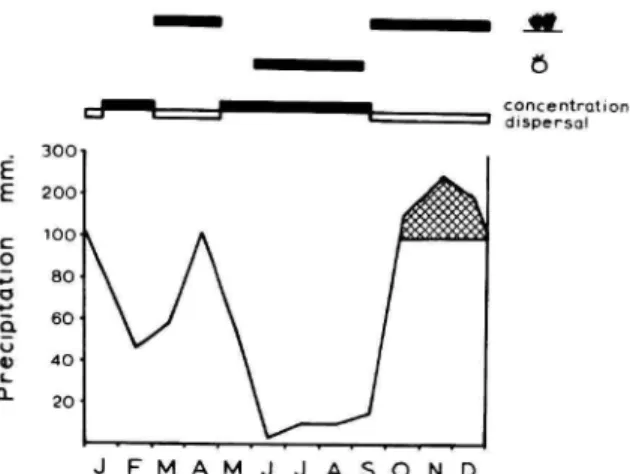
The reconstruction of Wilpattu's climate is based upon the long-term records taken at the station at Pomparippu. The average annual temperature is 27.2°C and the average precipitation is approximately 1,000 millimeters. According to the climate analysis published by Mueller-Dombois and Sirisena (1968) and Mueller-Dombois (1968), the Wilpattu area is generally characterized by two drought periods. There is a brief drought period of variable duration in Janu- ary and February, followed by moderately heavy rains in March and April with an average peak of 100 mil- limeters rainfall in March. An extensive drought pe- riod then begins in May, lasting through August to the beginning of September. During the height of the drought, rainfall is less than 10 millimeters per month.
The major rainy season commences in September, ris- ing to a peak in October, November, and December.
During October and November rainfall typically ex-
6
concentration dispersal
J F M A M J J A S O N D
FIGURE 2.—Interrelationship of ungulate habitat utilization, rainfall, and grass growth.
Precipitation for 1968-1969 taken from the station at Pomparipu. Dispersal refers to the time when ungulates utilize the grassland in the vicinity of permanent water to the least extent.
Concentration refers to increasing utilization of grassland in the vicinity of permanent water by ungulates. Black bars above the concentration dispersion indicator line refer to times of maximal fruit production and new grass growth. The shaded area within the rainfall curve defines the autumnal monsoon period.
N U M B E R 1 0 1
ceeds 100 millimeters per month. There is a slight difference between the West Sanctuary area, which is characterized as hot arid lowland tropical, and the easterly portion of the park, which is characterized as hot dry lowland tropical (Fernando 1968).
Figure 2 portrays the average annual flux in rainfall and correlates the appearance of new grass growth with the behavior of the resident ungulate populations.
In general, there is a renewal of moderate grass growth during the rains of March and April. During the pe- riod of June-July-August, fleshy fruits which fall from the trees are abundant but very little new vegetation growth can be observed. New grass growth commences again in September and persists well into January.
During the months of June, July, August, and into September, there is a concentration of the mobile spe- cies of game near permanent water sources, either in the villus or on the two major river systems. With the onset of rains in the two periods, October-November- December and March-April, the mobile game species generally disperse into the forest or into seasonal graz- ing areas, such as those provided by parts of the West Sanctuary. These two factors then, the growth of grass and its control by the onset of rain and the abundance and distribution of permanent water, are the deter- minants of distribution patterns for the larger ungulate species within the park system.
Flora
The flora of Wilpattu Park may be divided into three categories: (1) the littoral vegetation, including salt grass and low scrub immediately adjacent to the beach sand, rapidly grading into (2) monsoon scrub of a very low stature, which imperceptibly grades into (3) monsoon forest including tall emergents, such as Man- ilkara and Chloroxylon. This monsoon forest and mon- soon scrub division is discussed in detail by Fernando (1968). The monsoon scrub classification of Fernando roughly corresponds to the vegetation zone A of Gaus- sen, et al. (1964). Fernando's monsoon forest vegeta- tion type roughly corresponds to Gaussen's vegetation zone B, characterized by Chloroxylon, Berrya, Vitex, and Schleichera.
For the purposes of our animal census surveys and in an attempt to correlate animal activity with differ- ent vegetational types, we adopted the plan of dis- cussing the vegetation in terms of physiognomic or structural types as proposed by Mueller-Dombois. In his published vegetation map of Wilpattu National
Park, Mueller-Dombois and Fernando (1970) have divided the park into three ecological zones which are in general in agreement with our own observations.
The first zone, or villu zone, has two subtypes: subtype A with perfect vertical drainage and characterized by the underlying Jaffna limestone and the small perma- nent lakes, and subtype B with locally impeded vertical drainage characterized by low lying masses of water which do not persist throughout the drought period.
In general, villu zone subtype B corresponds to the major portion of the West Sanctuary. The third eco- logical zone is the Ara zone which shows lateral surface drainage and restricted vertical drainage; this includes the borders of the Moderagam Aru and its tributaries, including the Eerige Ella, thus encompassing the east- ern portion of the park and the northern boundary.
FIOURE 3.—Typical alluvial forest on the banks of the Mod- eragam Aru. The prominent Kumbuk (Terminalia arjuna) characterizes this vegetation form.
SMITHSONIAN CONTRIBUTIONS TO ZOOLOGY
We have employed the same classification of vegeta- tion as proposed by Mueller-Dombois with three major cover types: forest cover, scrub cover, and herbaceous cover types. The forest cover type includes low to medium stature forest and forest scrub islands. The scrub cover type includes vegetation less than two me- ters in height which may be either discontinuous or clumped. Herbaceous cover types include grasslands, herbs, and forbs, divisible into short grass or tall grass.
Although Mueller-Dombois' vegetation map does not cover the total area of the park which we sur- veyed, it covers sufficient area to be representative and to characterize the habitat. The sheets include some 54,429 hectares. The Ara zone, including the river sys- tems and their tributaries, comprises 17,894 hectares;
the West Sanctuary (villu zone B) 13,005 hectares;
and the villu zone A 23,532 hectares. Villu zone A has 96 percent of its area in the forest cover type clas-
sification, only .3 percent in scrub cover, 3.1 percent in herbaceous cover, and .6 percent includes open water. Villu zone B, lying in the main in the West Sanctuary includes 89 percent forest cover type, .7 percent scrub cover type, and approximately 10 per- cent herbaceous cover type, with only .2 percent open water. The Ara zone is 87 percent forested, 9 percent scrub cover, and 3 percent herbaceous cover. Most of the scrub and herbaceous cover types lie in areas of former cultivation or in the flood channel areas pe- riodically scoured when the Moderagam Aru or Kala Oya overflow their banks (Figures 3, 4, and 5).
Although the three major physiognomic categories are useful, it should not be concluded that less than 10 percent of the park supports grasses and forbs.
The latter plant forms persist in open forest and open scrub. When one calculates the areas of the park which exhibit discontinuous forest or scrub cover, then 27
FIGURE 4.—Typical short grass and forb carpet surrounding a villu in Wilpattu. The isolated trees are Palu (Manilkara hexandra). Low stature forest with emergent trees can be seen in the background. Such a grazing area can be heavily utilized during the drought.
N U M B E R 1 0 1
FIGURE 5.—Flood channel area near the Moderagam Aru. Such an area may be flooded during the autumnal rains at irregular intervals. Scrub and scattered herbaceous undergrowth charac- terize the high ground.
percent of the park supports adequate grasses and forbs for sustained ungulate grazing and only 73 per- cent of the park is characterized by dense scrub or forest with a minimum of herbaceous undergrowth.
A species list for the dominant plants within each of the physiognomic vegetational classes is included in Appendix B. According to the Holistic analyses done by Koelmeyer (1959), the period of maximum fruiting for the low altitude dry zone forests lies between May and August. January to May are poor fruiting months which follow on the autumnal rains; however, at this
time flowering is maximal and may provide a food resource for arboreal species. Of course, some tree spe- cies may fruit almost throughout the year; a notable example being Vitex pinnata which will fruit in Jan- uary, February, and March, as well as in August through December. Dominant fruit plants that pro- vide a feeding substrate for terrestrial forms at the time of fruit fall include Chloroxylon swietenia, Schleichera oleosa, Manilkara hexandra, Vitex pinnata, and Dry- petes sepiaria.
The Mammalian Fauna
The terrestrial mammalian fauna of Ceylon consists of 109 forms (including subspecies). These 109 forms are distributed in the seven major vegetational zones of Ceylon as defined by Gaussen, et al. (1964). Gaus- sen's zone A or the lowland dry zone does not exhibit the same level of faunal diversity as that displayed by zone D-l or the lowland wet zone. Exclusive of the Chiroptera, thirty-two forms are found in the lowland dry zone compared with forty-eight forms for the low- land wet zone. If the Chiroptera are included, there are forty-five recorded forms on the lowland dry zone and seventy for the lowland wet zone. Faunal diversity is also low in the highland wet zone where some twenty-four mammalian forms are recorded exclusive of the Chiroptera and only thirty if the Chiroptera are included.
The mammalian faunal diversity parallels the floral diversity and both are highest in the lowland wet zone;
but diversity is inversely related to the numerical den- sity of any one species. Diversity of the Chiroptera and nonvolent forms when considered separately show the same trends. When individual Orders are considered, the following trends are noted. The Insectivora are re- duced in diversity to almost virtual absence in drought areas such as the lowland dry zone. The Chiroptera are least favored at high elevations but seasonal aridity has little overall effect except to induce seasonal move- ment patterns in the bats which utilize the lowland dry zone. The present Artiodactylan diversity is maximum in the more open vegetation zones of the lowland dry areas. Trends in carnivore diversity parallel those of the Artiodactyla. Rodent diversity is favored in the highland wet zone and they make their maximum contribution to faunal diversity there. For other com- ments, see Eisenberg and McKay 1970.
Table 1 provides a species list of the mammalian fauna noted for Wilpattu National Park. Since collect- ing was not carried out on any large scale within the park, the species of bats and rodents are imperfectly known for that area, although collection in adjacent areas would indicate that at least a dozen or so species are present in the park itself but not recorded during our reconnaissance (Eisenberg and McKay 1970).
In general, the alluvial forest habitat with its asso- ciated dry washes carrying scrub and herbaceous cover are favorable to most of the dominant species within the park. The forest itself can be utilized by the ele- plants and to some extent by sambar (Cervus unicolor), but the forested habitat over great tracts of Wilpattu Park is certainly not favorable to high numerical den- sity of any one species. Rather the forest margins grad- ing into scrub and open grassland in the West Sanctu- ary and in the areas bordering the villus and drainage systems within the center of the park are most favor- able to faunal diversity and intensive ecological den- sities. Further discussion of these problems will be taken up in the section titled "Numerical Abundance and Biomass," pages 101-103.
THE ELEPHANT (Elephas maximus) Description and Aging Criteria
The Asiatic elephant, Elephas maximus, is the largest terrestrial mammal in Asia. The Ceylon subspecies is the forma typica, E. maximus maximus L. (for a discussion of synonomy see Deraniyagala 1955). Adult weights range from 3,950 to approximately 4,000 kilo- grams and the average height of cows is approximately 2.0 to 2.46 meters. The height of adult bulls ranges between 2.46 to 3.00 meters (Kurt and Nettasinghe 1968). Height increments as a function of age have been treated in the literature by a variety of authors, including Hundley (1934), Rzasnicky (1939), and summarized in Frade (1955). Recently Reuther (1969) has summarized the early growth increments for captive elephants and has suggested that aging cri- teria for many published accounts could well be in error. Table 2 summarizes our field criteria for average growth increments based in part on the data from the literature cited previously and the data from Kurt and Nettasinghe (1968).
CRITERIA FOR AGE CLASSES
The animals are approximately 90 to 95 centimeters in height at birth and increase their height to approxi- mately 130 centimeters by two years of age. At three
10
N U M B E R 1 0 1 11 TABLE 1.—Mammalian fauna of Wilpattu*
Species Comments
CHIROPTERA
Pteropus giganteus Seasonally abundant
Loris tardigradus Presbytis entellus Presbytis senex Macaca sinica
PHOL1DOTA
Manis crassicaudata
Not abundant
Abundant in vicinity of permanent water Moderately abundant in riverine habitat Moderately abundant in riverine habitat
Rare
Funambulus palmarum Ratufa macroura Hystrix indica Tatera indica Rattus rattus Golunda ellioti
LAOOMORPHA
Lepus nigricollis
CARNIVORA
Canis aureus Melursus ursinus Viverricula indica
Paradoxurus hermaphroditus Paradoxurus zeylonensis Herpestes edwardsii Herpestes fuscus Herpestes smithii Felis rubiginosa Felis chaus Panther a pardus
PROBOSCIDEA
Elephas maximus
ARTIODACTYLA
Sus scrofa Tragulus meminna Muntiacus muntjac Axis axis
Cervus unicolor Bubalus bubalis
Abundant in vicinity of permanent water Abundant in vicinity of permanent water Thinly distributed
Extremely abundant Abundant in tall forest
In eastern portion of park especially near cultivation
Moderately abundant in scrub and grassland
Thinly distributed Thinly distributed
Locally abundant near permanent water Locally abundant near permanent water Near permanent water; rare
Thinly distributed
Locally abundant in northwest Abundant
Rare Rare
The dominant carnivore in the park; estimate less than 20 resident animals
Estimated 75 to 80 resident animals
Locally abundant Thinly distributed Locally abundant Extremely abundant Moderate distribution Moderate distribution
* Species seen or collected. Many species of Rodentia or Chiroptera are undoubtedly present but intensive collecting was not carried out in the park. For comments on distribution and nomenclature, see Eisenberg and McKay, 1970.
12
TABLE 2.—Field age criteria for Elephas maximus
Adult Subadult Juvenile Calf
HALE
Height (shoulder) Track (circumference)
FEMALE
Height (shoulder) Track (circumference)
9+yrs
>2.1 m
> 119 cm 7+yrs
>1.83 m
>91 cm
40 mos-9 yrs
>1.5 m<2.1 m
>76 cm<119 cm 40 mos-7 yrs
>1.5 m<1.8 m
>76 cm<91 cm
14-40 mos <14 mos
>1.2 m<1.5 m .91 m<1.2 m
>61 cm<76 cm >45 cm<61 cm 14-40 mos < 14 mos
> 1.2 m< 1.5 m .91m<1.2m
>61 cm<76 cm >45 cm<61 cm
years of age, the animal may be from 150 to 160 centi- meters at the shoulder; at four years of age, most males are between 175 to 190 centimeters at the shoulder. At six years of age, shoulder height may vary between 180 and 200 centimeters; hence, the growth rate is much more rapid than had been previously supposed.
We consider males to be in the subadult category from approximately four to nine years. They are ca- pable of reproduction from six to seven years on but, from the age of approximately eighteen to twenty-four years, they show an increased spurt of growth in shoul- der height and begin to consistently show the phenom- enon of musth, which first manifests itself at fourteen to fifteen years. This is a transition phase to full adult- hood in a sociological sense which extends from ap- proximately fifteen to twenty years of age. We refer to adulthood in terms of sociological age because, al- though males can reproduce at an earlier age, within a normal herd structure males under eighteen years of age are probably prevented from mating due to their lower dominance position with respect to older cows, as well as being dominated by the fully adult males living in the population. With the preceding discussion in mind, we wish to point out that in cen- susing we considered males greater than 2.1 meters at the shoulder as "adults"; thus we do not separate males older than nine years into sociologically func- tional categories.
Females may under the best nutritional conditions come into their first estrus as early as seven years of age (Evans 1910, Seth-Smith 1932). This is in reas-
onable agreement with age at onset of first reproduc- tion cited by Buss and Smith (1966) for the African genus, Loxodonta. Since the gestation is twenty-two months, the age at first parturition for many cows will be approximately nine years. Much variation exists in the literature concerning the age at first estrus in cows and this has been summarized by Dittrich (1967) and reviewed by Kurt (1971).
With these criteria in mind, we established a field age criteria for Elephas maximus and employed it in our censusing. Since we included both track data and actually observed data in our tabulations, we include our track criteria as well. According to Kurt and Net- tasinghe (1968), a reasonably close relationship exists between the circumference of the track and shoulder height. Table 2 includes the field age criteria for Elephas maximus as employed throughout this study.
CRITERIA FOR DISTINGUISHING THE SEXES
After some experience with adult elephants, it is not too difficult to distinguish the sex of the animal even without seeing the external genitalia. The male in gen- eral has a broader face and a more bulging nasal bump. Less than 10 percent of the males on Ceylon bear tusks, so the possession of tusks is not an adequate criterion. The male frequently releases his penis from the sheath especially when moving into new areas or crossing from one habitat type into another. The exact significance of this will be speculated on in the section on behavior. Suffice to say that absolute determination of sex can generally be made when the full animal is
N U M B E R 1 0 1 13 in view and moving from, for example, the scrub into
the open. Without the protrusion of the penis, the sex of the animal can still be determined since the position of the penis in the male can be noted even when re- tracted into the body as a distinct bulge from the sheath opening to the anus. Sex determination in ani- mals younger than five years is difficult but not impos- sible by employing the same genital criteria as for adults. The only problem is that the frequency of penis protrusion in the younger animals, as well as its visi- bility, is somewhat reduced.
Q.
D
o
O)
o
n
E
6 0 .
5 0 -
40-
3 0
2 0
10
10 15
G r o u p s i z e
FIGURE 6.—Frequency of sightings for elephant groupings of various sizes. Over 90 percent of all solitary sightings were of adult males. The usual grouping of four or five is a subunit of a larger herd consisting of some eleven to seventeen individuals.
Social Groupings
Some 233 sightings and track determinations were made of elephants in the twelve-month survey at Wil- pattu; seventy of these records were of solitary indi- viduals. Almost invariably the solitary individuals are subadult or adult males. The remaining sightings were for the most part groups of females with their young or partially grown young. The most frequent grouping was four individuals recorded thirty-six times. Nota- tions of three and five individuals were recorded twenty-four and twenty-six times, respectively (Fig- ure 6 ) .
In general one can say that the adult males are semi- solitary, utilizing a given home range for prolonged periods of time. Shifts in home range utilization by males generally accompany shifts in the availability of water and are determined by the length and severity of the drought period. Figure 7 illustrates the positions of solitary males in the park with home ranges for individuals which were known.
Females and young, including males up to the age of approximately eight to ten years, comprise the majority of the social groupings exceeding two in num- ber. One herd which we consistently observed in this area included eight adult females, three subadults, four juveniles, and two calves. Frequently this herd was split into two subgroups consisting respectively of four adult females, two subadults, one juvenile, and one calf; and four adult females, one subadult, two juve- niles, and one calf. A second herd utilizing this same area consisted of seven adult females, three subadults, two juveniles, and one calf. Within this same study area were four adult males and four subadult males;
thus giving a total population of thirty-eight animals, three of which were calves less than one year old. It is not uncommon for the individuals comprising a given herd to split up in order to feed in groups of three to five. In general the female with a small calf will be accompanied by at least one other female; hence, the groups of females having the smallest calf in it will generally be the larger groups.
Subadult animals are prone to be more individual- istic, to wander in pairs or, in the case of young males, in a solitary fashion. The total herd will assemble in order to drink or graze at choice sites, coming together in the early part of the evening and perhaps remaining together for several hours before once again dividing into subgroups. The maximum extended herd size counted in Wilpattu Park consisted of seventeen ani-
14
FIGURE 7.—Locations where adult male elephants were sighted throughout the annual cycle.
Black dots=individual males; shading = home ranges for three known males; dashed lines=
movements for known males during dry seasons; solid lines indicate movements during the rains.
Dotted lines=movements of males whose ranges were imperfectly known. Except for the excur- sions, the ranges of adult males remained remarkably constant for the better part of the year.
N U M B E R 1 0 1 15
FIOURE 8.—Distribution of cow herd activity in Wilpattu Park during the rainy season. Heaviness of shading indicates relative intensity of habitat utilization; lines and arrows indicate movements of individual herds at the onset of rains. The solid black lines indicate the movement cycle of the
"villu herd" (see Figure 9) during a two-month period (November-December 1968).
16
FIGURE 9.—Distribution, intensity of activity, and movement patterns of cow herds during the drought season. Compare with Figure 8. Movements at the onset of the drought to areas of per- manent water are indicated and the ranges of three separate cow herds are delineated with dashed and dotted lines for the duration of the June-August drought. In general the cow herds maintained a separate habitat utilization pattern in contrast to the more extensive range overlap illustrated in Figure 8 during the rainy season. Question mark designates total extent of range undetermined.
N U M B E R 1 0 1 17 mals; however, at least four adult and two subadult
males were associated off and on with this herd, thus raising the total count for the extended "villu herd" to twenty-three animals. Other large groupings composed of the smaller subunits included sizes of eleven animals nine times and one sighting each for herds of twelve, thirteen, fourteen, fifteen, and seventeen. The latter series really represents sightings of the same maximum group of seventeen broken into various fractions with the absence of from two to five animals. In March of 1970 two herds (the west herd and the villu herd) as- sembled jointly at Mail Villu, but such an aggregation of over thirty animals is only temporary.
Essentially the most permanent social grouping ap- pears to be related to cows and their offspring. This social structure is virtually identical to the herds de- scribed for the African elephant by Laws and Parker
(1968).
Distribution in the Park
Figures 8 and 9 indicate the distribution of elephants within the park for the two rainy periods and the dry season. As can be seen, as the drought proceeds, the animals aggregate either in the center of the park in- cluding the freshwater villus or near the banks of the two permanent rivers, i.e., the Moderagam Aru and Kala Oya. There is a pronounced shift at the onset of rains to feeding activity in the West Sanctuary. This includes movements of herds from the Kala Oya as well as movements from herds that have been utilizing the central villus to the West Sanctuary. The bulls move widely at the onset of rains, dispersing from areas of concentration, and returning to more stable home ranges (Figure 7).
Movements within the park may be considered from two standpoints. The extent of movement is dependent on the available forage and the location and size of the water hole. When small water holes are visited with very little grassland in the near surroundings, the herd may spend only one evening, or at the most two, mov- ing on to a neighboring water hole at a distance of approximately 4.8 kilometers. Thus, there is a shifting or rotation from one small water hole to the next. This is a characteristic movement pattern during the drought period; however, at the onset of rains, when the vast expanses of low lying areas are inundated in the West Sanctuary and grass growth is encouraged, herds may remain in the vicinity of these water holes for a week at a time before shifting. Nevertheless, the
pattern is for utilization at one locus and re-utilization at a new locus after a period of several days. The dura- tion of the stay at any one given water hole is deter- mined in part by availability of water, grasses, and the amount of disturbance to the elephants.
Seasonal movements in die western part of Wil- pattu involve major shifts in the intensity of utilization from the villu area to the large temporary villus which support a luxuriant grass growth during October through January. Figure 10 illustrates the frequency of movement across the Mannar Road during the shift from the drought period to the rainy season and back during the short drought from January through March. As can be seen there is a pronounced seasonal shift in frequency of movement by individual elephants across the Mannar Road.
2 0 "
LLJ
FIGURE 10.—Movement across the Manar Road for the drought and rainy seasons. At the onset of the rains, move- ment to the west increases; movement to the east, or villu area, increases at the onset of the drought, through both periods of rainfall and drought in the annual cycle of Wil- pattu. Stretch of road surveyed was from Moderagam Aru to Maduru Odai. Black areas in bar above graph indicate periods of rainfall. Ordinate indicates number of animals crossing for each fortnight.
There are no long-range migrations on the part of the park elephants, at least with respect to the cow herds. The longest movement by any single bull re- corded was slightly in excess of 24 kilometers. The longest single linear movement by any cow herd was slightly under 6 kilometers. Rather, with respect to the cow herds, one can see from Figure 9 that there is a constant shift in the intensity of habitat utilization and even during the drought period the western feeding areas are sometimes visited by the cow herds, but they do not remain for long at one locus. The onset of rain and sustained rain seems to synchronize the assembling of the cow herds in the West Sanctuary area.
Habitat Utilization
The animals appear to drink at least once a day. Gen- erally clear, nonsaline water is taken. Those villus that exhibit a pronounced salinity, such as Kokarre Villu, Luna Villu, Sinna Uppu, and Periya Uppu, do not show evidence of being utilized by elephants for drink- ing, although the animals may graze in the vicinity of these villus. Drinking behavior during daylight hours is generally brief. If the animals are quite calm, they may engage in bathing but, if they are in any way disturbed, the drinking will be furtive and swift. Sport- ing in the water, spraying, and bathing generally take place in the latter part of the evening or during the hours of darkness. Example from field notes:
11 September 1968, 1810 hours. Three elephants emerged on the west side of Kali Villu, two females and one juvenile.
After remaining in the fringing forest, they moved down to drink at 1814; they drank for four minutes without interrup- tion and then stood until 1825. The juvenile sprayed the smaller of the two females. We departed before the elephants.
When river beds are dry, it is not uncommon for the elephants to dig by kicking forward and backward with their forefeet and subsequently removing sand from the riverbed with their trunk thus creating a small depression into which the groundwater will seep.
Example from field notes taken in Ruhunu Park:
The Menik Ganga is dry. We went into the river bed and observed where an elephant had dug a hole and water had seeped up. Later that same afternoon, we observed an ele- phant come to the pool to drink [see Figure 11].
Feeding is typically carried out throughout the day and night. Exact rhythm of feeding activity is treated in analyses by McKay (1971) and Kurt (1971).
In utilizing trees as a food resource, the animals can
reach a height of approximately 3l/2 to 4 meters. The animal will approach a tree, orientate toward a branch overhead, and then extend his trunk to reach directly overhead toward the branch. It can grasp the branch tip and exert a twist and pull to snap merely the tip of the branch off without breaking the whole branch.
The animal can snap the branch by exerting two different stresses on it with its trunk. Curling its trunk around the branch and pushing down with its trunk tip the branch is braced against the rest of its trunk which exerts an upward pressure. In this manner, the elephant can effectively break off the terminal portion of branches. Leaves may be stripped off the branches themselves. Stripping involves holding the branch sta- tionary with the foot while sliding the trunk and exert- ing slight pressure along the length of the branch. The leaves can be retained in the trunk and, by rolling the trunk up and down, a small bolus can be formed. The coiling and uncoiling movement results in pressing the leaves into a ball, which is then inserted into the mouth. Bark can be removed from branches by in- serting the branch into the mouth and rolling it against the molars. Larger branches may be broken off and split into thinner lengths for mastication and then be discarded. Splitting of larger branches is generally ac- complished by employing the forefoot or, if the animal has tushes or tusks, the branch may be brought into close proximity with the tush or tusk tip. Utilizing the trunk musculature and exerting pressure against the tusk tip, splitting can be effected.
T H E USE OF TALL GRASS VILLUS
Here follows a description of elephant use at Atha Villu made on 21 December 1968:
Elephants have fed here about three days ago for an ex- tended period of three to four days. There is an area of free water where drinking takes place and there are at least three different points on the tall grass villu that show where the ele- phants have fed on three different occasions, probably on successive nights. About 10 to 30 percent of the new grass is cropped in the first of these areas. Wherever the elephants have gone into the water, the villu grass is stomped down and disturbed. I estimate one area of feeding is 48 hours old, one 36 hours old, and the other greater than 72 hours. There is a calf track associated with the herd that is less than 15.3 cm in diameter. Grazing activity is spotty and not necessarily consistent. In the vicinity of this water hole there are several trees with permanent leans from animals rubbing against them, showing that these trees have been habitually used for rubbing for many years. I note that some of the tall grass is
NUMBER 10 1 19 torn up by the elephants and dropped, being not eaten. This
all appears to be of the same species. The Cymbopogon is fed on heavily. There are at least two types of grasses, with the Cymbopogon and the tall grass growing on higher ground.
Perhaps one-fifth of the prime grasses have been already fed upon and suffered some physical damage from the elephants' feet.
SHORT G R A S S FEEDING
Where the herbaceous cover is extremely short, in- cluding not only short grasses but also a variety of forbs, the animals employ the forefeet to scrape or scuff the grass from the substrate. Here follows a de- scription of a cow herd made on 31 January 1969:
All animals feeding are scraping grass with the forefeet.
Clouds of dust are raised on the plains by the sustained effort of several elephants. The grass scraping includes scuffing with
the forelegs. The motion is slightly idiosyncratic, that is, the stroke may be forward and backward, or to one side. This appears to vary from individual to individual. As grass is scuffed up, the trunk is employed to gather it into a pile which gradually increases in size in front of the animal. The temporal patterning of this activity is (given 40 seconds total time) : scuffing for approximately 10 seconds, gathering 3 seconds, scuffing 5 seconds, gathering 3 seconds, scuffing 15 seconds. The complex gathering movement includes not only bringing the grass together into a pile but seizing it in the trunk and then stroking it on the leg to remove the earth.
When the pile is of sufficient size, it is seized in the trunk and rolled up and down the outer face of the leg. The earth is thus thoroughly scraped before it is inserted in the mouth.
Only after this earth removal is the grass inserted into the mouth. When adults feed in this fashion, they are spaced out at anywhere from 9.1 to 91 meters. Young calves may take food from an adult's pile but juveniles may be kicked if they approach too near an older animal's food pile. [Figure 12.]
*«
- -
%
•*. -
FIGURE 11.—Hole dug in dry river bed by elephant seeking water.
20
FIGURE 12.—Elephant scuffing short grass, creating bare areas of earth during the height of the drought.
TRAIL UTILIZATION D U R I N G A LONG M A R C H
Here follows an account of an elephant herd's activi- ties on a march from the night of 19 to 20 October 1968:
We noted where an elephant march had begun from Kali Villu in the general direction of Mannar Road. After passing down the road from Kali Villu for about 2 kilometers, we noted that twelve elephants had crossed since 1700 hours yesterday. We began back-tracking on the herd of twelve toward Kali Villu. The following comments are noteworthy.
The dung passed by the animals on the march has already been destroyed in part by the scarab beetles. The whole trail length exceeded 4 kilometers; thirty-three dung piles had been deposited during that time which would mean two defe- cations per animal during the march. On the trail itself, after 35 meters, we came to a digging spot where the whole herd had apparently gathered and engaged in dust-bathing before proceeding to cross the Mannar Road itself. The total num-
ber of branches broken along the trail included eight. The number of scuffiings with feeding areas included only one.
One rubbing tree showed recent use and only one sandy spot showed recent use. The group had moved in a direct fashion with adults leading and subadults following. There was very little indication of feeding other than noted above. The ani- mals stopped to defecate and mill about three times on the trail, always at forks in the trail.
Returning to the Mannar Road junction, we then pro- ceeded to follow the elephants toward their ultimate destina- tion which was Periya Naga Villu. The total length of this portion of the trail was slightly in excess of 1.6 kilometers.
There was one trampled spot where perhaps the calf had rested while the herd milled around. Immediately adjacent to the open area of grass surrounding Periya Naga Villu, three rubbing trees had been used during the march and there was hardly any evidence of feeding. The elephant trail itself may be only 41 to 46 centimeters wide in spots. They step one foot in the other track so that a 61 centimeter wide area of bare earth is the only indication of the trail; but the
NUMBER 10 1 21
trees are set back far enough so that the animals can slide through easily, although the hanging creepers give an impres- sion that the trail is almost impenetrable.
T R E E - P U S H I N G BEHAVIOR
Trees may be pushed down or broken off at the base by employing the forehead, shoulder, or one forefoot and the trunk, depending on the diameter of the tree itself. Tree breaking was noticeable during the height of the drought and may be related to obtaining access to branches which for the young juveniles are out of reach. In addition to pushing over trees for obtaining branches for feeding or to expose roots for chewing on, the males engage in tree-pushing behavior that seems to be unrelated to feeding at all. At Marai Villu we had a tuskless male elephant visiting us on a regular
5 m.
FIGURE 13.—Trees pushed over by adult male in the vicinity of Marai Villu (see text for discussion). Inset shows study plot location at the edge of Mannar Road and outline of Marai Villu.
basis. In October he pushed down a 7-meter tree about 92 meters south of Marai Villu on the Mannar Road.
Thereafter we kept a record of his tree-pushing be- havior. On 13 February 1969, the sketch reproduced in Figure 13 was made. This indicates that the male tended to push trees down at interfaces between trees and grassland or in what looks to be a new rest