Consumer advocates often argue for strict regulation or an outright ban on the industry based on the idea that payday lending rates are usurious. For policymakers, understanding the lending market and the effects of regulation is necessary to create a welfare-enhancing regulatory environment. Finally, the payday lending market offers a number of interesting questions for economists and those studying finance.
Those who argue for a complete ban or strict regulation of payday loans usually argue that payday loans are predatory and that lenders profit from the poor. In the absence of clear definitions, the argument for limiting quick lending rests on two principles. The final argument of payday loan opponents is that consumers who use payday loans are systematically acting irrationally (Francis, 2010).
Those who support the deregulation of payday loans argue that the high annual interest rates associated with their loans are due to the small loan size, short term and high risk.
History
As non-bank institutions, payday lenders assumed they were not restricted by state usury laws. One of the early investors in payday lending was William Webster IV, CEO of Advance America, who had previously worked in the Clinton Administration. Attitudes toward moneylending were summed up by Benjamin Franklin in Poor Richard's Almanac, "the second vice lies, the first is in debt (Peterson, 2008). In general, the view during the colonial period was one of disdain for usury and reproach of the poor for the use of any debt.
Despite this early foundation, the early twentieth century saw a shift in views on short-term debt. Arthur Ham's movement eventually led to the creation of the Uniform Small Loan Act of 1916, upon which many state small loan laws were based (Peterson, 2008). The new legal environment quickly led to the development of a regulated small loan industry that reached $255 million by 1930 (Keest, 2000).
In his book Broke USA, Gary Rivlin sums up the position of many critics of payday lenders when he questions "the morality of making a much higher profit on the working poor than on wealthier citizens" (Rivlin, 2010). Returning to the history of small loan loans, the small loan laws of the early 1900s led to the creation of a relatively fair and transparent market for short-term consumer loans. First of Omaha led to the de facto end of usury laws in the United States as far as banks were concerned.
Most notable were the Reagan-era banking reforms, which allowed more competition among banks. The resulting marginalization of the working class from the financial sector was one of the causes of the development of the "fringe banking sector" of which payday lenders are a major player (McGray, 2008). In this void, an industry re-emerged that the first decades of the century were spent trying to eradicate."
Literature Review
Stango (2012) examines borrower decision making and argues that borrowers prefer personal loans over comparable products from traditional lenders due to non-price attributes, the most important of which are speed, business hours, location and simplicity. Francis (2010) develops a behavioral model of demand where borrowers prefer personal loans due to cognitive biases and hyperbolic discounting. In another recent article, Morgan and Strain (2008) test the claim that payday lending is a “predatory debt trap.” The authors track bounced check rates, Federal Trade Commission complaints, and Chapter 7 bankruptcies in Georgia and North Carolina, both before and after the states banned payday lending.
The authors argue that these results support the thesis that consumers may trade payday loans for less desirable alternatives, such as bounced check fees. The antithesis of this research culminates in a paper by Paige Marta Skib and Jeremy Tobacman (2009), in which the authors find that access to payday loans leads to more Chapter 13 bankruptcy filings. The authors exploit a discontinuity in the lender's loan approval rule to show that for first-time applicants at or near the 20th percentile of the credit score distribution, access to payday loans results in a doubling of Chapter 13 bankruptcy.
On a final note, Morse (2009) finds that access to payday loans can mitigate the negative effects of emergencies. Data on borrower demand is sparse due to the difficulty of surveying consumers, but two recent studies, conducted by the Pew Foundation and the CFPB, shed light on payday loan consumers and their habits. What both of these studies indicate is that a large proportion of payday loan users may not be using the products in the manner prescribed and marketed by payday lenders; as a response to a short-term income gap or to emergency expenses.
If borrowers are actually using payday loans in an unsustainable way, then these loans can lead to spiraling debt. To understand why borrowers use payday loans, it is necessary to examine the alternatives available to payday loan users. Second, this paper adds to the payday loan demand literature and demonstrates the need to consider all aspects of the decision-making process (such as opportunity costs and substitutable products) when defining a payday loan demand model.
Supply Side Analysis: Advance America
Due to its size, Advance America offers a useful subsection of payday loan industry data. However, a potential weakness of the data set is that it does not provide insight into the operations of single-store lenders, also known as “mom and pop” stores. Previous research (DeYoung and Phillips 2009) has shown that the pricing strategies of single-store and multi-store companies can differ, with franchises charging higher rates on average.
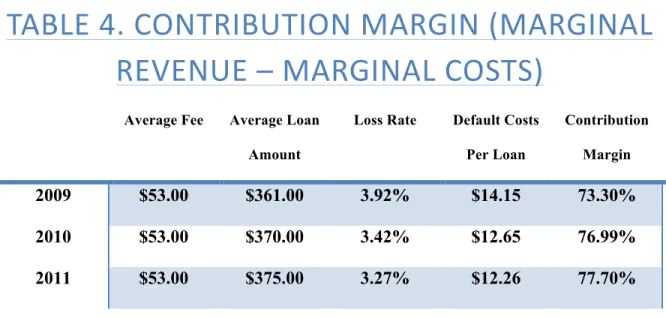
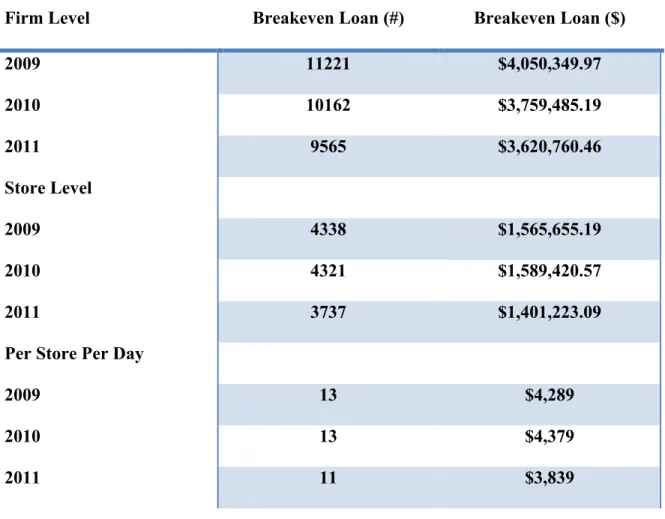
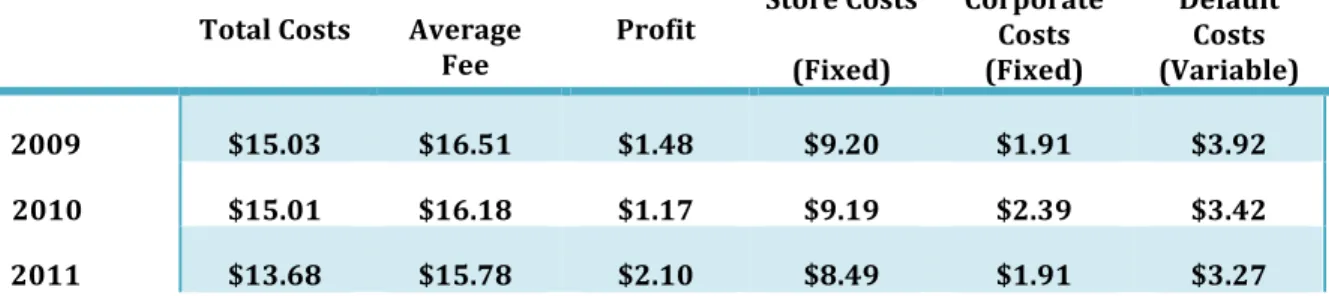
Furthermore, I show that the industry's claim that high default rates are a major contributor to corporate costs is untenable, as loss rates for payday lenders are equal to or below the financial industry average for consumer loans. Finally, I calculate the coverage contribution per loans and the breakeven point in terms of loan volume for a typical Advance America business. To analyze the costs per payday loans I define three categories for Advance America's costs: company-level costs, store-level costs, and standard costs.
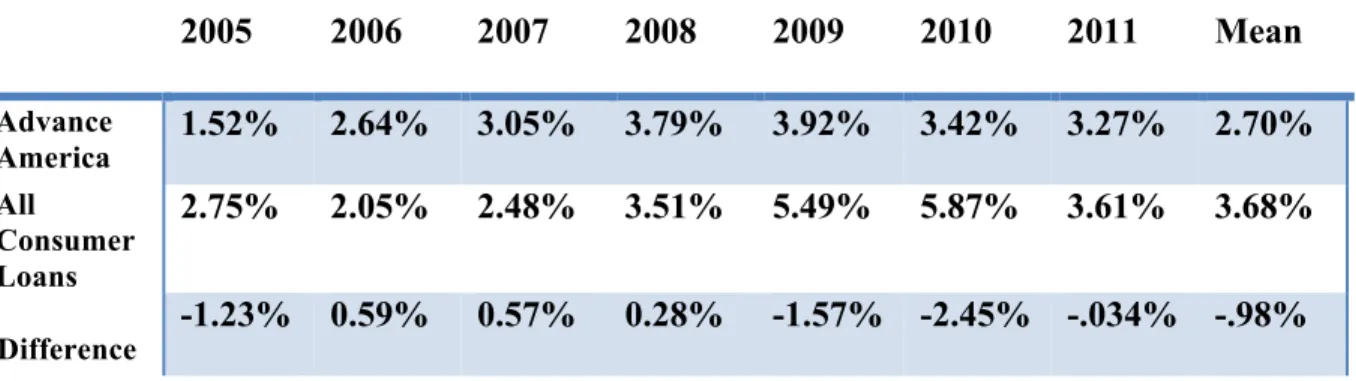
Average fees are not significantly higher than total costs, and even in their most profitable year (2011), the company's profit is only $2.10 per hundred dollars lent. To determine whether loss rates for payday lenders are particularly high compared to other lenders, I compare Advance America's loss rates (defined as charge-off principle/total principle of loans originated over time) to the average loss rates for all consumers. loans as reported by the Federal Reserve (Federal Reserve, 2014). As shown in Table 2, loss rates for Advance America were lower than the market average for four of the seven years in the data set, with the average loss rate for Advance America being nearly a percentage point lower than other consumer loans.
A paired t-test has a p-value of 0.23 indicating that the two means are not statistically different from each other. My analysis shows that, contrary to industry claims, loss rates on payday loans are similar to the market average for consumer loans. The break-even APR indicates the price the firm must charge to recover its costs.
COMPARED TO ALL OTHER CONSUMER LOANS
Empirical Analysis
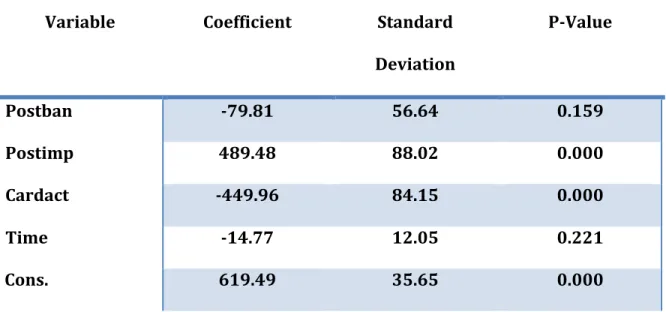
Measuring changes in revenue from service charges provides an indirect measure of the ban's impact on consumer welfare. As previously stated, supporters of the payday loan industry argue that borrowers can use payday loans to avoid check fees, NSF charges, and overdraft fees. Although the original case considered the collection process, by the time the case reached the Arkansas Supreme Court, the court was determining the legality of the Arkansas Check Casher's Act.
In an excerpt of the ruling, the justices state, “It was argued before this court both in brief and in oral argument by those in favor of the law that the check cashers provide a service to Arkansas citizens that would not otherwise be available. The consolidated report of condition and income, colloquially called call reports, provides information about the financial health of the bank.Because the Supreme Court's announcement of the ban did not lead to an immediate end to payday lending in the state, two marginal effects are measured.
The post-ban time period measures the effect of a de jure ban on payday lending in a country, while the post-implementation time period measures the effect of the actual end of payday lending. The interest coefficients here are 𝛽!. amp; 𝛽! which capture the marginal effects of 1) the effects of the ban announcement and 2) the effects of all payday lenders leaving the country. The immediate effect of the ban was a drop in service charge income of about $79,000.
I would argue that there was a time in American financial history when the legitimate need of the poor for access to credit was recognized and an attempt was made to create a market to serve that need. If loss rates are indeed at or below the market average for consumer loans, banks may need to rethink the services they currently offer to this subset of the population. The results of an analysis of banks in Arkansas show an economically and statistically significant increase in service charge income after the payday loan ban in Arkansas.
One example of successful collaboration between those on both sides of the payday loan debate is the merger between Kinecta Federal Credit Union and Nix Check Cashing. Founded in Los Angeles, Nix Check Cashing was one of the first check cashers and payday lenders on the West Coast.