The purpose of this paper is to determine the appropriateness of the Deepwater Horizon Economic Settlement payments to achieve full recovery and recovery of the Gulf Coast economy. The Deepwater Horizon Economic Settlement reparations have been sufficient for the economic recovery of Texas and Florida. The Deepwater Horizon Economic Settlement reparations have been sufficient for economic growth in Louisiana.
The Deepwater Horizon Economic Settlement reparation payments have been insufficient for the economic recovery of Mississippi and Alabama. The Deepwater Horizon oil spill had a profound impact on the livelihoods of people located along the Gulf Coast. The purpose of this paper is to determine whether these Deepwater Horizon Economic Settlement payments to individuals and businesses have been adequate to achieve full recovery and restoration of the Gulf Coast economy.
The findings are that the Deepwater Horizon Economic Settlement compensation payments were adequate for the economic recovery of Texas and Florida. Finally, the findings are that the Deepwater Horizon Economic Settlement compensation payments were inadequate for.
Literature Review a. Social Milieu and Context
The 2010 BP oil spill resulted in the contamination of the second most productive fishery in the United States by oil and chemical dispersants. Despite the uncertainty, many consumers simply weren't willing to risk eating Gulf seafood. Known as one of the worst natural disasters to hit the southeastern United States, it devastated the economy, ecology, and population of the Gulf Coast.
He uses public government labor market statistics regarding employment, average weekly wages, and labor force participation rates to provide evidence of the impact of Katrina in the greater New Orleans area. Cohen (1995) concludes that the ex-vessel value of the region's fisheries was approximately $393 million in 1989. Given these studies of past disasters, the article next discusses the composition of the Gulf Coast economy.
Composition of the Gulf Coast Economy
In the Gulf States alone, there was 98 million in lost tax revenue.7 Moreover, when the ban was lifted, a precedent was set for stricter safety and containment standards.7 Mason, The Economic Cost of a Moratorium on Offshore Oil and Gas Exploration into the Gulf Region, Louisiana State University, July 2010. Alabama has many vibrant beach destinations along the Gulf Coast, including Gulf Shores, Orange Beach, Perdido Key, Dauphin Island, Fort Morgan, Fairhope, Daphne and Mobile.
While Florida gains the most among the Gulf states from tourism, it also stands to lose the most from the BP oil spill. 20 Nadeau et al., Assessing the Impacts of the Deepwater Horizon Oil Spill on Tourism in the Gulf of Mexico Region, September 2014, p. However, many other “..sections of coastline that never saw oil spill ashore were nevertheless affected by public perceptions of the Gulf states.
Recreational and subsistence fishing also saw a significant increase in 2011: more than 3 million recreational fishermen made 23 million fishing trips in the Gulf of Mexico. The Bureau of Ocean Energy Management estimates that the commercial fishing industry may have lost a total of $952.9 million in revenue and up to 9,315 jobs in the first eight months after the oil spill.25 This is a huge, damaging loss, not just for fishermen, but also for the Gulf Coast economy as a whole. Although this section will focus primarily on aviation, it should be noted that the Gulf Coast is the location of many sizable military and industrial manufacturing operations.
The southeastern I-10 corridor (excluding Texas), also known as the Gulf Coast Aerospace Corridor, claims significant aerospace activity. For a national industry that had sales of $219 billion in 2011, this is a lucrative market for the Gulf Coast; in 2010 alone, contractors in 12 provinces/parishes were awarded 6,225 contracts totaling $3.97 billion.27 Somewhat surprisingly, there is no research on the impact of the BP oil spill on these industrial contractors. Because the area has a strong tourism industry, many people fly to the Gulf Coast region for vacation, creating a relationship between tourism and aviation revenue.
The man-made disaster brought a slew of specialists to the Gulf Coast to assist in the recovery and protection of the Gulf States. Keeping in mind that the Gulf Coast economy is also made up of other non-maritime industries, it is significant that any natural disaster that affects the functioning of the ocean economy would have substantial impacts on other industries. This section provided insight into how the BP oil spill affected the Gulf Coast economy.

Model Design a. Methodology
Restitution payment information is provided by the Deepwater Horizon Economic Settlement Program in court-requested document reports. Law firms that litigate on behalf of individuals and businesses also take a significant share of the claims won, typically ranging from 15% to 30% of the total settlement depending on the case.28 In addition, the court-required reports are provided by Deepwater Horizon Claims Center , reporting periods are irregular and data is missing. The 2005 hurricane caused a major economic downturn in the Gulf of Mexico region, which would have skewed the results of the regressions.
28 This is from the author's personal experience working with a law firm on Deepwater Horizon Economic Settlement claims and from personal conversations with actual claim recipients. Although every state suffered damage from the storm, the effect of Hurricane Katrina on employment in the coastal counties of Texas and Florida studied in this project turns out to be negligible; thus, the Katrina dummy variable is not included for these two states. To account for the national macroeconomic trend and its effect on the Gulf of Mexico region, the national gross domestic product (GDP) is included as an explanatory variable.
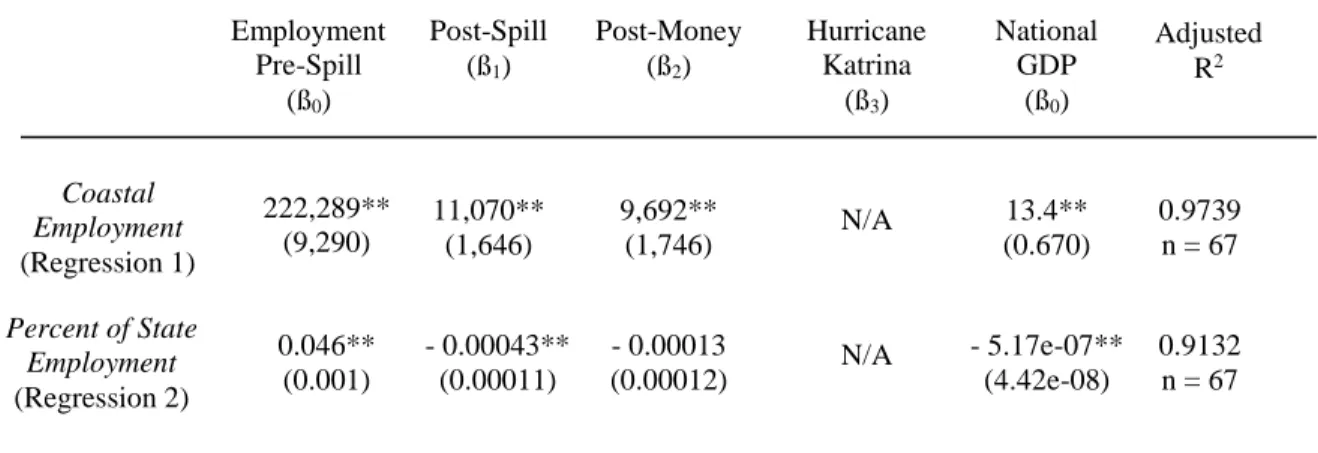
The Post-Money dummy variable is marked for effect (1=effect) beginning with the third quarter of 2012, per the start of the Deepwater Horizon Claims Center's administrator status reports showing first payments made for economic loss.29 The most important indicators are the post-spill and post-money explanatory dummy variables. Their coefficients, measured in coastal county employment or as a ratio of coastal county-to-state employment, show the impact of the oil spill and the impact of compensation payments on employment in Gulf Coast counties. 9_5_12_Status_Report_No__1_of_the_Claims_Administrator_of_the_Deepwater_Horizon_Economic_an d_Property_Damage_Settlement_Agre.pdf.
The Gulf of Mexico region, which stretches from the Florida Keys to the southern tip of Texas and includes barrier islands, includes over 47,000 miles of coastline.30 This study will only look at the regions directly affected by the Deepwater Horizon oil spill and exclude thus certain Texas coastal counties. The affected region is determined by British Petroleum's Deepwater Horizon Economic Settlement Claims Center affected zone map, which indicates the areas eligible to file economic injury claims.31 The economic settlement is federally mandated. To more accurately describe the impact on affected Gulf Coast counties, only counties in direct contact with the Gulf of Mexico will be examined.
Accordingly, it is assumed that coastal counties took the greatest economic loss from the oil spill.

Regressions and Findings a. Texas
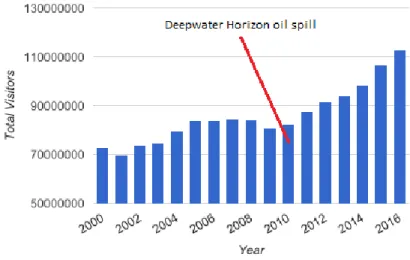
Although there is evidence that the oil spill actually increased tourism activity in the area, as tourists sought clean, oil-free beaches.32 Visitor numbers to Galveston reached a record high in 2012, with consistent increases since 2010.33. Texas showed a slightly negative, insignificant decline in coastal employment as a percentage of state employment since reparations began (-0.013 percentage points). Although the loss of employment is less than in the immediate aftermath of the oil spill (-0.043 percentage points), the economy of the coastal provinces may be.
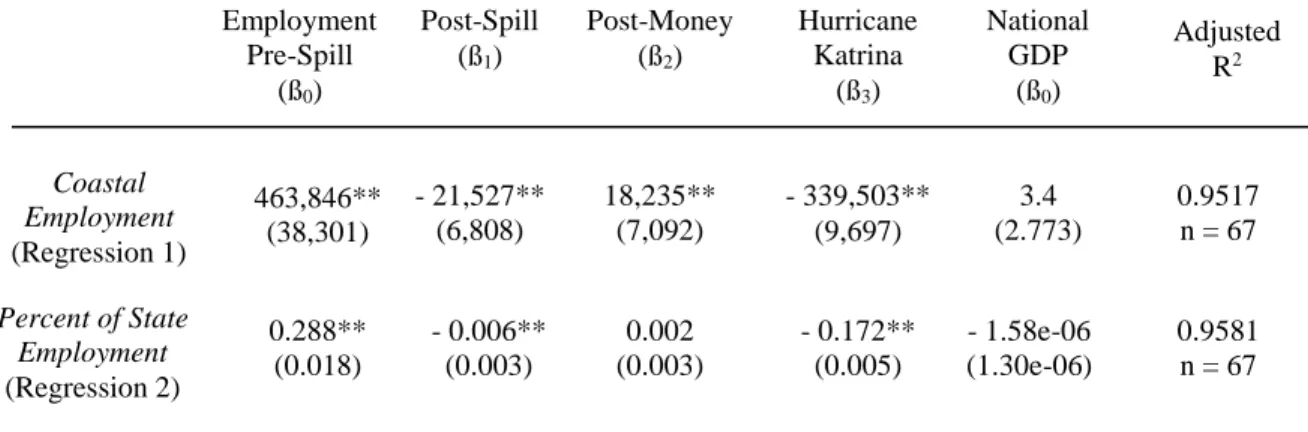
Post-recovery payments, coastal service (18,235) and percentage of government employment (0.2 percentage points) both increased. Although the Post-Money coefficient in the percentage of civil service regression is insignificant at the 10% level or less, the Post-Money. The increase in coastal employment post-recovery payments (18,235) almost offset the decline in post-spill employment (-21,527).
Stagnant economic growth in the state as a whole may have mitigated the impact of the oil spill on coastal employment. Population growth per county supports this claim, as the population grew along the Gulf Coast, in the aforementioned provinces and in central. However, this influx had already occurred before the spill.38 Therefore, population and employment growth in the Mississippi Gulf Coast mitigated the impact of the spill on both measures of employment after the onset of reparations.
If this increase in travel was due to disaster response specialists, employment would have temporarily increased in the aftermath of the spill. According to Johnson, "Of the 25,000 people responding to the largest environmental catastrophe in the nation's history, 21,000 are under contract to the offshore oil giant BP."39 An increase of. However, the increasing population and employment in the Gulf Coast countries along with reparations have mitigated that economic downturn.
Post-recovery payments, coastal employment (-3,371) and percentage of public employment (-0.3 percentage points) had greater declines in employment than Mississippi, which shows slow economic recovery. In the aftermath of the spill, although percentage of state employment increased (0.3% percentage points), approximately 80,000 people lost their jobs. 43 Nadeau, Kaplan, Sands, Moore and Goodhue, Assessing the Impact of the Deepwater Horizon Oil Spill on Tourism in the Gulf of Mexico Region, September 2014, p.
Conclusion
It would take into account related problems with statistical analysis, such as autocorrelation – a problem to which time series data is sensitive. 34;Science in Support of the Deepwater Horizon Response.' Proceedings of the National Academy of Sciences of the United States of America 109, no. 34; FDA Risk Assessment of Seafood Contamination after the BP Oil Spill: Rotkin-Ellman and Solomon.