The relations between the lower Paleozoic and the post-Paleozoic Tubuliporina therefore become as interesting a question as those of the Hederelloidea to the Tubuliporina in general. THE HEDERELLOIDEA — BASSLER 27 The distinction between the Reptariidae is thighBicult because a single species shows so many variations in growth. Then, after a certain distance characteristic of the species, one of the tubes, branching at a certain angle, continues to extend in that direction, forming a new one.
Thus, it is possible to separate the branching angle of the zoarium from the angle at which individual tubes bud, and branching and budding must be distinguished, even though they are based on the same phenomenon. Zooecia of individual tubes arising from the lateral wall of the preceding zooecia, the ends of each separated by a disc, probably perforated; apertures transversely elliptical and finally equal to the diameter of the zooecial tubes. Zoarium consisting of a single narrow tubular axis formed by the initial parts of successive zooecia branching at fairly regular angles and distances, the zooecial tubes arising one after the other alternately right and left from about the middle of the side of the preceding one.
The type and only known example of this, the oldest known species of Hederelloidea, is an incrustation of the brachiopod, Protothyris didyma (Dalman), from the Silurian of Gotland, and at first sight it appears to represent a well-developed stomatopore.
THE HEDERELLOIDEA — BASSLER 35 This graceful species incrusts crinoid stems, cup corals, and other
36 PKOCEEDINGS OF THE NATIONAL MUSEUM VOL.87
THE HEDEEELLOIDEA BASSLER 37 been undisturbed by surface rugosities show that a small bulblike
This very subtle but abundant species can be easily recognized. with its thread-like zoarium, which, with sufficient magnification, resolves into a main axis creating, often at right angles and. intervals of about 1.5 to 6 mm, on equally narrow branches from which, as well as from the main axis, short zooecia arise on alternate faces at angles of about 45°. This, the most delicate member of the genus, is in marked contrast to such forms as H. reimanni, but the zooecial characters of all three are essentially the same except for size. Middle Devonian: 18 Mile Creek, etc., Erie County. cotype) (Wanakah shale), 3 miles W of East Bethany and York.
Centerfield shale), Iji miles south of East Bethany (cotype) and Pavilion (TichenorHmestone), Moscow, Leicester and Kashong Creek (Moscow shale taste), all in New York; Thedford (cotip) and Arkona, Ontario (Shalle Widder); 2}^ miles southwest of Sylvania, Ohio (silica taste); Lebanon, Ky. cotype) (Sellersburg Limestone); Milwaukee, Wis. cotype) (Milwaukee Limestone);. Falls of Ohio (Upper Jeffersonville Limestone) (cotype); Petoskey Cement Co., Petoskey (Gravel Point limestone), Phelps Quarry (Upper Alpena limestone) and Rockportquarry, Alpena County (Upper Ferron Pointformation),. Partridge Point, 3 miles south of Alpena (PartridgePoint formation), 1}^ miles northeast of Bay View, and 1.6 miles north of.
Norwood, Charlevoix County (Petoskey formation), miles northwest of Bolton, Alpena County and Thunder Bay quarry, Alpena (Alpenahmestone.DockStreetclay),allinTraversegroupofMichigan.
THE HEDERELLOIDEA — BASSLER 39
THE HEDERELLOIDBA — BASSLER 41
42 PROCEEDINGS OF THE NATIONAL MUSEUM VOL.87
THE HEDERELLOIDEA — BASSLEB 43
The basal part of an old zoarium consists of an almost solid mass of radiating tubes inside. An interesting feature of the branching is that at intervals of about 4 mm, groups of 4 or 5 short and wide tubes develop on alternate sides. Ontario (Arkona and Widder shales); Livingston County, Kashong Creek (Ludlowville); 3 miles west of East Bethany (Centerfield shale), Averys Creek and Hamburg (Wanakah shale), and VA miles southeast of East Bethany (cotype) (Kashong shale), all in New.
Occurrence.— Middle Devonian: 18 Mile Creek (holo type), Wanakah, Athol Springs, Elma, and Bay View (Wanakah shale), 3 mUes west of East Bethany (Centerfield shale), all in New York; Rockport Quarry, Alpena County, Mich. Traverse-Upper Bell shale (pre-type).
THE HEDERELLOIDEA — BASSLER 45
From the primary branch with a tube, a gently curved zooecium emerges at about 45° and within a short distance of successive flowering forms a cluster of 4 or 5 zooecium usually curved from the branch, then after a short interval a cluster of similarly presented on the other side. . Occurrence.— Onondaga (Upper Jeffersonville limestone-*S'^myer acuminatus bed): Falls of the Ohio at Louisville, Ky. A gutta-percha squeeze of the type seems to show that the zooecia bud from the middle side of the precursor tube as in that genus.
THE HEDERELLOIDEA BASSLER 47
Although originally referred to Hernodiain, where the zooecia arise quite regularly from the middle part of the preceding tube, this is.
THE HEDERELLOIDEA — BASSLER 49
THE HEDERELLOIDEA — BASSLER 51
Creek (Moscow shale), all in New York; Arkona (Arkona shale) and Thedford (Widder shale), Ontario; 2)^ miles southwest of
THE HEDERELLOIDEA — BASSLER 53 emerging from one side, quite swollen at the base, and with romid,
The various zoaria on which this species is based are clearly related to the other members of the H. The surface details are very similar to those of the other members of the group. River (Norway Point Formation), Rockport Quarry, Alpena Coimty. cotype) (Upper Ferron Point Formation), 1.6 miles north of Norwood, Charlevoix County (Petoskey Formation), ji miles northwest of Bolton, Alpena County (Alpena Limestone), all in the Traverse Group.
Therobuste colony in this species is caused by any frequent markings of zooecial tubes, which in their general shape and size are similar to those of other species of the group. Zooecia after emerging from the mother tube vary in length according to age, but the mature average is at least 3 mm. Occurrence.—Middle Devonian: Norway Point Dam (holotype) (Norway Point formation) and other localities in Alpena County (Genshaw and Ferron Point formations), Iji miles northeast of Bay View and 1.6 miles north of Norwood, Charlevoix Coimty (Petoskey formation) , y, miles northwest of Bolton, Alpena County (Alpena limestone), all in the Traverse group of Michigan;.
Ik Miles southeast of last Bethany (Kashong Shale) (paratype). and 3 miles west of East Bethany, N. paratype) (Centerfield Shale); Thedford, Ontario (further shale). Occurrence.— Middle Devonian: Bay View (Holotype) and 18-Mile Creek (Wanakah Shale) and Pavilion (Tichenor Limestone), N. The zoarium of this species occurs as a thick mat of large, broad zooecial tubes in close contact, which reach analyzed shows the characteristic branching of this section that differs from such species as H.
Surface of pipes transversely rough; openings transversely oval and as wide as the tubes; 2K to 3 zooecia in 5 mm. Prevent. -llamilton group: Moscow (cotype) (Moscow shale - Windom member), 3 miles west of East Bethany (Centerfield shale).
THE HEDERELLOIDEA — BASSLER 57
The fragmentary zoarium forming the holotype of this species forms a Fenesirellina and apparently belongs to the H. The initial branches are only about 1 mm wide and divide at considerable intervals, often 9 mm; later division occurs at short intervals (3 mm.) and at such a low angle as to result in a fan-shaped expansion of close intercalation. The purpose of the septum and compartments is unknown, but since they occur in at least six species that have other characters in common, they have been assigned, they form a good generic character.
THE HEDERELLOIDEA — ^BASSLER 59
The zooecia bud alternately from the main axis at such a low angle that they remain in contact for part of their length and then sharply diverge. As usual, the main axis continues for some distance before terminating as a zooecium and giving rise to another tube, which continues as the axis. In this genus the sihnric annulated zooecia are all equal in shape and length and arise alternately from the basal part of the preceding one at a low angle and with such regularity that they remain in contact for nearly their whole length, further dividing the branches so uniform that the zoarium completely has a feather-like aspect.
Reptaria may therefore be regarded as a Hederella, the zooecia occurring so nearly opposite each other as to give the branch the appearance of two straight parallel rows arising from a median line. Zooecia strongly annulated, sometimes the rings look rather knotty, sprouting from near the base of the opposite preceding at an angle of less than 45° and increasing in width and gently curving outwards, reaching a length of 3 mm.
THE HEDERELLOIDEA BASSLER 63
This genus can be distinguished from Hederella by its elongate, club-shaped, annulated zooecia, which sprout regularly from the center of the lateral wall of the preceding zooecia, each of which thus gives rise to one or more daughter cells.
THE HEDERELLOIDEA — BASSLEB 65 HERNODIA CORNUCOPIA, new species
With a rather sharp angle and slightly bent outwards, remaining free, but close together throughout their course, by 3 to 4 to 5 mm. Each arises at an angle of 25° on alternate sides of the elongated central tube composed of narrow proximal portions of successive zooecia. Our figured specimen corresponds exactly to Davis's illustration, but a new name is necessary as his name Nicholsonia canadensis apparently referred to Hederella canadensis Nicholson.
Occurrence. - Middle Devonian: Falls of the Ohio (Silver Creek dolomite); 2 miles north of Arkona, Ontario (Widder shale). This well-marked species exhibits all the generic features of Hernodia, except that the tubes are thick-walled and nearly smooth. With continued growth, only a small opening is left between the branches, which disappears in old species. men leave all the tubes in contact.
Rockport quarry, Alpena County (Traverse-Upper Ferron Point formation), 2.6 miles north of Norwood, Charlevoix County (Petoskey formation). This occurs as an excavation in the surface of a cephalopod (Mitroceras) preserved in the Museum of the Buffalo Society of Natural Sciences, as no gutta-percha expressions of this mold indicate a well-marked species of either Hederella or Hernodia, which is of interest. further into it.
As the illustration in plate 15 shows, the zooecia bloom very regularly and alternately from a median axis, but the preservation is not so good as to enable it to be determined whether this axis is formed from the caudal extremities of the tubes as in Hernodiaorans Long tubes that arise from side to side. Zooecia are small, cornucopia-shaped, bent outwards in a curve, at an angle of 45 °, on average 1.3 mm in length, 0.4 mm in width and 4 to 5 mm. measuring along one side of the shaft. The brachiopod shells in the Columbus Limestone species are probably Hederella, characterized by the very compact arrangement of the zooecia.
The few specimens available for examination are a frequently branched Hernodia (angle of 60°-90°), in which the zooecial tubes bud off from each other so frequently and at such a low angle that they practically remain in contact throughout their length.
FAUNAL LISTS SHOWING GEOLOGICAL AND GEOGRAPHICAL DISTRIBUTION
THE HEDEKELLOIDEA — BASSLER 69 Devonian (Gasp6 sandstone): Portage Road (P), Haldemand (H), and Gasp^
Middle Devonian (Traverse-Upper Ferron Point Formation): Abandoned shale pit of Alpena Portland Cement Co., SE^ Sec.
THE HEDERELLOIDEA BASSLER 71
THE HEDERELLOIDEA — BASSLER 73 Table 1
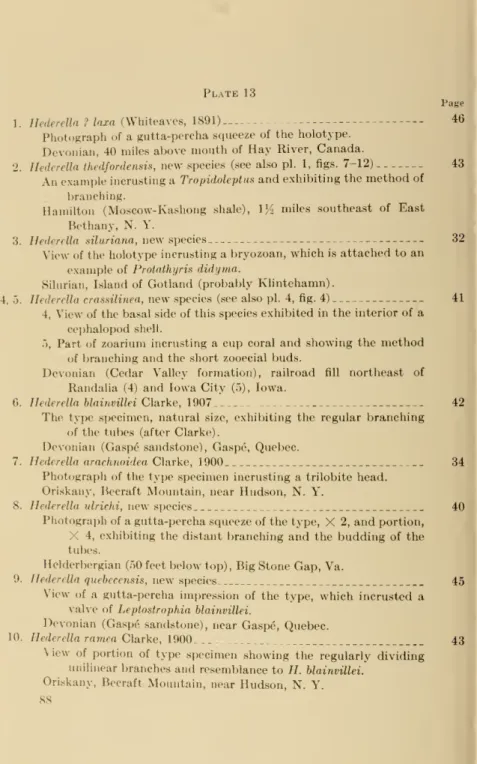
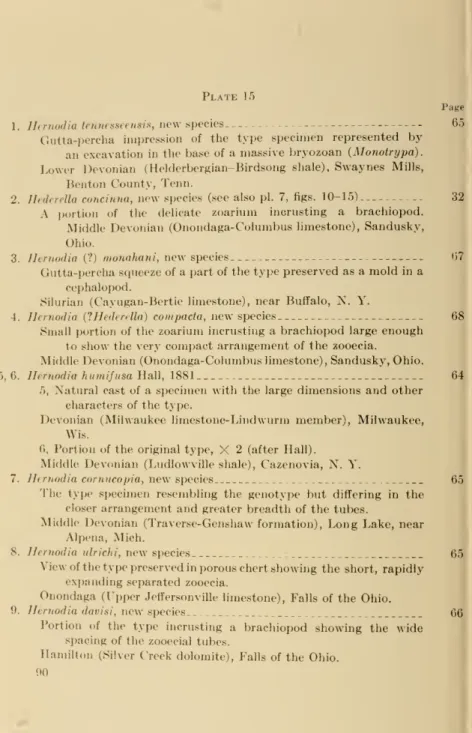
PLATES
The type of zoarium encrusting a Stropheodonta shows a section of parallel branches with zoocia in contact and wider than in the related H. Middle Devonian (Silver Creekdolomite), Charlestown, Ind. 9, One of the types, illustrating the main axis that gives rise to branches of separate zoos that form and grow into characteristic groups. 1, The type specimen, a large zoarium in which a Cystiphyllum is encrusted, the background in the lower half being blackened to bring out the regular branching and budding of the zooecia.