LAPORAN PENELITIAN FUNDAMENTAL
DETERMINAN PERINGKAT SUKUK KORPORASI
PENGUSUL:
Sartini, SE, MSACC, PhD, Ak, CA Moch Imron, SE, MS1
PROGRAM STUDI AKUNTANSI FAKULTAS EKONOMI DAN BISNIS UNIVERSITAS AHMAD DAHLAN
JANUARI 2022
Dibiayai oleh:
Lembaga Penelitian dan Pengabdian kepada Masyarakat Universitas Ahmad Dahlan Sesuai dengan Surat Perjanjian Pelaksanaan Penelitian
Nomor: PD-046/SP3/LPPM-UAD/VI/2021
HALAMAN PENGESAHAN
LAPORAN AKHIR PENELITIAN DANA INTERNAL UAD TAHUN AKADEMIK 2021/2022
Judul Penelitian : Determinan Peringkat Sukuk Korporasi Butir Renstra Prodi/Pusat : Program Studi
TSE Penelitian : 11.04-Finance, property and business services
Jenis Riset : Dasar
Skala TKT : 3
Ketua Peneliti
a. Nama Lengkap dan Gelar : SARTINI SE, MSAcc, Ph.D., Ak, CA.
b. NIY/NIP : 60010369
c. Fakultas/Program Studi : Ekonomi dan Bisnis / Akuntansi d. Pendidikan Terakhir : S2
e. Jabatan Akademik : Asisten Ahli
Anggota Peneliti
Nama Lengkap dan Gelar : 1. MOCH. IMRON, SE., M.Si. Ak. (Akuntansi) Anggota Peneliti Eksternal
Nama Lengkap dan Gelar :
Jumlah mahasiswa terlibat : 1 orang Lama Penelitian : 7 bulan
Biaya Total Penelitian : Rp. 11.000.000,00 - Dana Disetujui : Rp. 11.000.000,00 - Sumber Dana Lain : Rp. 0,00
Menyetujui,
Kepala LPPM Universitas Ahmad Dahlan,
Anton Yudhana, S.T., M.T., Ph.D.
NIP/NIY. 60010383
Yogyakarta, 05 Januari 2022 Ketua Pengusul,
SARTINI SE, MSAcc, Ph.D., Ak, CA.
NIP/NIY. 60010369
LAPORAN AKHIR PENELITIAN
RINGKASAN
Seiring dengan dinamisnya perkembangan pasar modal syariah, sukuk berkembang pesat menjadi instrumen keuangan syariah yang semakin diminati oleh masyarakat baik di tingkat nasional maupun internasional. Namun demikian, karena setiap investasi mengandung risiko, investor tetap harus berhati-hati dalam membeli sukuk. Salah satu informasi yang bisa menjadi pertimbangan para investor dalam membeli sukuk adalah peringkat sukuk yang dikeluarkan oleh lembaga pemeringkat sukuk. Namun demikian karena lembaga pemeringkat sukuk yang jumlanya lebih dari satu menggunakan metode yang berbeda-beda dalam melakukan pemeringkatan, investor perlu memahami faktor apa saja yang menjadi determinan dari peringkat sukuk.
Penelitian ini bertujuan untuk menganalisis faktor-faktor yang mempengaruhi peringkat sukuk korporasi pada perusahaan-perusahaan penerbit sukuk di Indonesia.
Terdapat tiga masalah penelitian yang berusaha dijawab dalam penelitian ini yaitu: 1).
Apakah kinerja keuangan berpengaruh terhadap peringkat sukuk?; 2). Apakah maturitas sukuk berpengaruh terhadap peringkat sukuk?; 3). Apakah struktur sukuk berpengaruh terhadap peringkat sukuk?
Pelaksanaan penelitian dimulai dengan kajian teoritis dan kajian empiris.
Berdasarkan kajian teoritis dan kajian empiris, Peneliti mengajukan enam hipotesis yang menduga bahwa informasi keuangan perusahaan yang meliputi profitabilitas, leverage, likuiditas dan ukuran perusahaan serta informasi non keuangan yang berkaitan dengan sukuk yang meliputi maturitas dan struktur sukuk masing-masing memiliki pengaruh secara parsial terhadap peringkat sukuk. Selanjutnya, Peneliti melakukan pengambilan sampel penelitian dari populasi seluruh sukuk korporasi yang diterbitkan sejak tahun 2014-2020 berdasarkan metode purposive sampling. Sampel akhir dari penelitian ini adalah 67 sukuk korporasi non-keuangan. Data keuangan perusahaan didokumentasikan dari laporan tahunan masing-masing perusahaan penerbit sukuk, sedangkan data non keuangan yang berkaitan dengan informasi sukuk diperoleh dari publikasi newletter PT Pefindo yang dipublikasikan dalam website resmi perusahaan tersebut. Hasil analisis dengan menggunakan regresi ordinal menunjukkan bahwa hipotesis yang berkaitan dengan maturitas dan ukuran perusahaan memiliki nilai signifikansi uji Wald masing- masing 0,019 dan 0,002 dan arah nilai B yang positif. Hal tersebut menunjukkan bahwa maturitas dan ukuran perusahaan masing-masing memiliki pengaruh positif terhadap peringkat sukuk.
Luaran wajib dari penelitian ini adalah artikel ilmiah yang dipublikasikan di journal nasional terakreditasi. Luaran tambahan diharapkan berupa Hak Kekayaan Intelektual. selanjutnya, TKT penelitian ini ada di level 3.
Kata Kunci: Peringkat Sukuk, rasio keuangan, ukuran emiten, struktur sukuk, maturity
HASIL PELAKSANAAN PENELITIAN
Untuk kemudahan referensi, berikut ini ditampilkan tahap-tahap penelitian yang direncanakan oleh Peneliti dan disetujui dalam proposal.
Gambar 1 Tahap Pelaksanaan Penelitian
Merujuk pada gambar tahapan penelitian di atas, Peneliti telah melakukan tahap kajian teoritis, kajian empiris, pemilihan sampel, pengumpulan data, analisis data dan interpretasi. Pada saat ini, Peneliti sedang mempersiapkan pembuatan artikel ilmiah.
Seperti telah disebutkan sebelumnya, populasi penelitian ini adalah seluruh sukuk korporasi yang diterbitkan oleh perusahaan-perusahaan di Indonesia dan terdaftar di Otoritas Jasa Keuangan. Setiap akhir bulan, OJK mempublikasikan jumlah sukuk secara akumulasi dan sukuk yang masih beredar. Untuk tujuan penelitian ini, Peneliti menggunakan jumlah sukuk yang beredar setiap akhir tahun. Setiap perusahaan penerbit sukuk tidak hanya menerbitkan satu jenis sukuk saja setiap periode, sehingga pada akhir tahun, satu perusahaan dapat memiliki beberapa jenis sukuk. Sebagai contoh, pada akhir tahun 2020, PT Indosat memiliki 12 jenis sukuk yang masih beredar. Tapi ada juga yang satu atau dua jenis sukuk saja seperti PT Tiga Pilar Sejahtera dan PT Elnusa yang masing- masing hanya memiliki dua dan satu jenis sukuk yang beredar di akhir tahun 2020.
Karena data keuangan yang dipakai dalam penelitian ini merupakan perusahaan, maka pada setiap periode satu perusahaan hanya diwakili oleh satu jenis sukuk untuk menjadi sampel penelitian.
Berdasarkan hal tersebut sebelumnya, kriteria yang dipakai untuk memilih sampel dengan menggunakan metode purposive sampling adalah sebagai berikut:1). Sukuk yang dipilih adalah yang terdaftar dalam daftar produk obligasi syariah OJK; 2). Perusahaan penerbit sukuk harus terdaftar di BEI dan sukuknya diperingkat oleh PT Pefindo; 3).
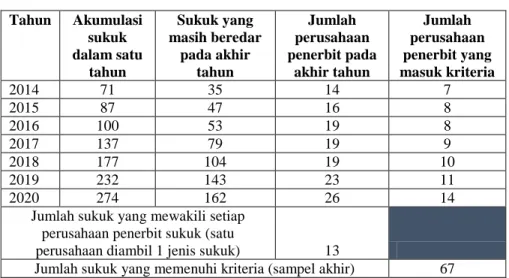
Perusahaan penerbit sukuk bukan termasuk perusahaan di sektor keuangan. Proses pemilihan sampel dengan menggunakan purposive sampling disajikan dalam Tabel 1 berikut ini.
Tabel 1 Proses Pemilihan Sampel Penelitian
Tahun Akumulasi sukuk dalam satu
tahun
Sukuk yang masih beredar
pada akhir tahun
Jumlah perusahaan penerbit pada
akhir tahun
Jumlah perusahaan penerbit yang masuk kriteria
2014 71 35 14 7
2015 87 47 16 8
2016 100 53 19 8
2017 137 79 19 9
2018 177 104 19 10
2019 232 143 23 11
2020 274 162 26 14
Jumlah sukuk yang mewakili setiap perusahaan penerbit sukuk (satu
perusahaan diambil 1 jenis sukuk) 13
Jumlah sukuk yang memenuhi kriteria (sampel akhir) 67
Tabel 1 menunjukkan bahwa sampai akhir periode pengamatan terdapat 162 sukuk yang masih beredar dan diterbitkan oleh 26 perusahaan. Karena Peneliti hanya mengambil satu jenis sukuk untuk setiap perusahaan, total sukuk yang potensial untuk dijadikan sampel penelitian selama sepuluh tahun pengamatan adalah 136 sukuk. Dari 136 sukuk tersebut 69 sukuk tidak dapat dijadikan sebagai sampel penelitian karena sukuk tersebut tidak terdaftar di BEI atau merupakan perusahaan sektor keuangan. Oleh karena itu, jumlah sukuk yang memenuhi kriteria dan bisa dijadikan sampel akhir penelitian berjumlah 67 sukuk.
Seluruh data dari 67 sukuk tersebut kemudian dianalisis dengan statistik deskriptif dan regresi logistik ordinal. Statistik deskriptif digunakan untuk meringkas data penelitian sehingga diperoleh gambaran tentang sukuk korporasi yang menjadi sampel penelitian.
Regresi logistik ordinal dipakai untuk menguji keenam hipotesis penelitian dan pada akhirnya dipakai untuk menjawab rumusan penelitian.
Tabel 2 dan Tabel 3 berikut ini meringkas hasil analisis deskriptif dari data yang berkaitan dengan masing-masing sukuk.
Tabel 2 Statistik Deskriptif Variabel Penelitian
Min Maks Rata-rata
Deviasi standar
ROA (%) -10,00 250,00 16,33 45,60
DER (kali) -38,66 483,55 7,92 59,32
CR (kali) -0,65 4,72 1,17 ,89
Ukuran (triliun Rp) 1,814 31.608,916 1.389,058 5.604,43
Maturity (tahun) 2 12 5,27 1,96
Peringkat 0 7 5,3 1,78
Tabel 3 Tabel Frekuensi Peringkat dan Struktur Sukuk
Peringkat Frekuensi Persentase Struktur Frekuensi Persentase
D 4 6,0 wakalah 2 3,0
BB 4 6,0 ijarah 54 80,6
BBB 4 6,0 mudh/musy 11 16,4
A 25 37,3 Total 67 100,0
AA 8 11,9
AAA 22 32,8
Total 67 100,0
Tabel 2 menunjukkan bahwa rata-rata kemampuan perusahaan penerbit sukuk dalam menghasilkan laba (profitabilitas) yang diukur dengan ROA adalah 16,3%. angka tersebut menunjukkan bahwa secara rata-rata perusahaan penerbit sukuk berada dalam kategori sehat. Nilai ROA tertinggi (250%) dicapai oleh PT Indosat pada tahun 2019. PT Indosat merupakan perusahaan penerbit sukuk pertama dan terbanyak sampai saat ini.
Nilai ROA terendah dialami oleh PT Sumberdaya Sewatama pada tahun 2018.
Selanjutnya, nilai rata-rata leverage perusahaan yang diukur dengan DER adalah 7,92. Angka ini menunjukkan tingkat leverage yang tidak sehat karena secara rata-rata hutang perusahaan penerbit sukuk hampir delapan kali dari total modalnya. Nilai DER terendah (-38,6 kali) dialami oleh PT Sumberdaya Sewatama pada tahun 2017 dimana nilai modal perusahaan mengalami angka minus 78,9 milyar. Sedangkan untuk nilai DER tertinggi (48,3 kali) dicapai oleh PT MORA Telematika pada tahun 2019.
Untuk kemampuan perusahaan dalam memenuhi kewajiban jangka pendeknya (likuiditas) yang diukur dengan current rasio, nilai rata-rata CR sebesar 1,17 kali menunjukkan bahwa perusahaan penerbit sukuk berada dalam kondisi kurang sehat karena nilai tersebut berada di bawah 1,5. Nilai CR tertinggi diraih oleh PT Tigal Pilar Sejahtera Food pada tahun 2017, sedangkan nilai terendah dicapai oleh PT Angkasa Pura pada tahun 2020.
Tabel 2 juga menunjukkan ukuran perusahaan penerbit sukuk yang diukur dengan total asset. Rata-rata nilai total asset adalah sebesar 1.358 triliun. Perusahaan penerbit sukuk terbesar adalah PT Angkasa Pura I pada tahun 2020, sedangkan perusahaan terkecil adalah PT Sumberdaya Sewatama tahun 2019.
Tabel 2 dan Tabel 3 juga memberikan informasi tentang maturitas (jatuh tempo) sukuk, struktur sukuk dan peringkat sukuk. Untuk maturitas, rata-rata jatuh tempo sukuk yang menjadi sampel penelitian ini adalah 5,27 tahun dengan jatuh tempo terlama 12 tahun dan tercepat 2 tahun. Untuk struktur sukuk, terdapat tiga jenis akad yang digunakan dalam sukuk yang menjadi sampel penelitian ini yaitu sukuk ijarah (80,6%), sukuk berbasis bagi hasil seperti mudharabah dan musyarakah (16,4%) dan sukuk wakalah (3%). Terakhir, peringkat sukuk yang paling sering didapatkan oleh perusahaan penerbit sukuk adalah A (37%) dan disusul oleh AAA (13%), AA (12%) dan selanjutnya BBB, BB dan D (masing-masing 6%). Tidak ada sukuk dalam sampel ini yang memperoleh peringkat CCC.
Berkaitan dengan hasil analisis regresi logistik ordinal, sebelumnya Peneliti menyampaikan proses pengambilan keputusan hipotesis penelitian, Peneliti akan menyampaikan hasil uji kelayakan model terlebih dahulu. Tabel 4 menyajikan hasil uji kelayakan model regresi logistik ordinal yang dipakai untuk menguji hipotesis penelitian ini.
Tabel 4 Hasil Uji Kelayakan Model
Model Fitting -2 Log Likelihood Chi-square Sig
Intercept Only 195,571
Final 140,025 55,546 0,000
Goodness of Fit Chi-Square df SIg
Pearson 649,587 314 0,000
Deviance 140,025 314 1,000
Nagelkerke R2 0,600
Berdasarkan hasil uji kelayakan, model regresi logistik ordinal yang digunakan dalam penelitian ini telah memenuhi kelayakan. Hal tersebut ditunjukkan dengan nilai signifikansi Chi-square dalam proses model fitting yang berada dibawah alpha (5%). Hasil tersebut juga didukung hasil pada uji goodness of fit. Terakhir, nilai nagelkerke yang kuat sebesar 0,600 menunjukkan bahwa 60% variasi peringkat sukuk dipengaruhi variabel- variabel terkait keuangan perusahaan yaitu ROE, DER, CR dan ukuran perusahaan serta variabel-variabel terkait sukuk (struktur sukuk dan maturitas). Sisanya sebesar 40%
dipengaruhi oleh faktor lain yang tidak dimasukkan dalam penelitian ini.
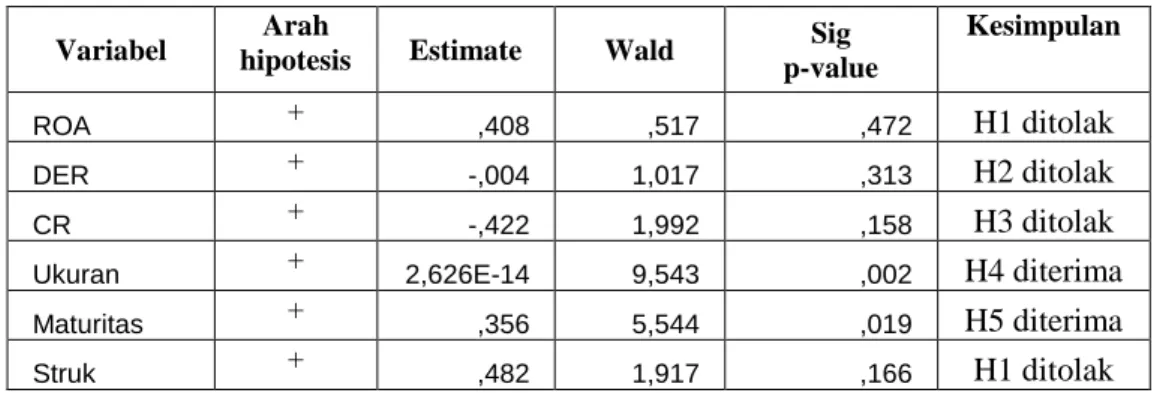
Tahap pengujian regresi logistik ordinal yang kedua adalah pendugaan (estimasi) parameter yang digunakan sebagai dasar dalam pengujian hipotesis penelitian. Tabel 5 menampilkan ringkasan hasil uji parameter dengan menggunakan uji Wald.
Tabel 5 Hasil Pendugaan Parameter
Tabel 5 menunjukkan ada dua variabel independen yang bisa menjadi determinan peringkat sukuk perusahaan yang terdaftar di BEI, yaitu variabel ukuran perusahaan dan maturitas sukuk. Kedua variabel tersebut memiliki nilai signifikansi uji Wald 0,002 dan 0,019 dengan nilai dugaan (estimate) bertanda positif. Artinya ukuran perusahaan berpengaruh positif terhadap peringkat sukuk pada taraf signifikansi 1% dan maturitas sukuk berpengaruh terhadap peringkat sukuk pada tara signifikansi 5%. Variabel lainnya, tidak ditemukan berpengaruh.
Berdasarkan hasil pendugaan parameter uji regresi logistik ordinal tersebut, maka pengujian hipotesis dalam penelitian ini disampaikan sebagai berikut. Hipotesis kesatu yang berbunyi profitabilitas berpengaruh positif terhadap peringkat sukuk tidak dapat diterima. Hal tersebut karena nilai signifikansi p-value variabel ROA lebih dari 5%
(0,472). Artinya, rasio ROA yang mengalami peningkatan atau penurunan tidak akan menyebabkan perubahan pada peringkat sukuk. Temuan ini tidak mampu mendukung penelitian terdahulu yang dilakukan oleh Astuti (2017), Pebruari (2017), Haraqi &
Ningsih (2018) serta Kesuma (2018) yang menemukan bahwa profitabilitas berpengaruh positif terhadap peringkat sukuk. Namun demikian terdapat pula beberapa penelitian terdahulu yang tidak berhasil membuktikan pengaruh profitabilitas terhadap peringkat sukuk seperti Intani (2018), Azizah (2018) dan Yandi (2019).
Hipotesis penelitian kedua yang berbunyi leverage berpengaruh positif terhadap peringkat sukuk juga tidak diterima. Nilai signifikansi p-value uji Wald sebesar 0, 313 berada di atas alpha (5%). Artinya, leverage yang diukur dengan rasio hutang terhadap modal (DER) tidak mempengaruhi peringkat sukuk selama periode pengamatan. Hasil penelitian ini bertentangan dengan Pebruary (2017) dan Intani (2017) yang menemukan bahwa leverage berpengaruh negatif terhadap peringkat sukuk.
Hipotesis penelitian yang ketiga dalam penelitian ini juga tidak diterima. Nilai signifikansi p value uji Wald variabel current ratio yang merupakan proksi dari likuiditas sebesar 0,158 menunjukkan bahwa likuiditas tidak berpengaruh terhadap peringkat sukuk.
Variabel Arah
hipotesis Estimate Wald Sig p-value
Kesimpulan
ROA +
,408 ,517 ,472 H1 ditolak
DER +
-,004 1,017 ,313 H2 ditolak
CR +
-,422 1,992 ,158 H3 ditolak
Ukuran +
2,626E-14 9,543 ,002 H4 diterima
Maturitas +
,356 5,544 ,019 H5 diterima
Struk +
,482 1,917 ,166 H1 ditolak
Temuan tersebut tidak mendukung hasil kajian empiris terdahulu yag ditemukan oleh Pebruary (2016), Astuti (2017) dan Kesuma (2018).
Berbeda dengan hipotesis pertama sampai ketiga yang tidak terdukung, hipotesis keempat yang berbunyi ukuran perusahaan berpengaruh positif terhadap peringkat sukuk.
Nilai signifikansi p-value uji Wald sebesar 0,002 dengan nilai setimasi bertanda positif menunjukkan bahwa ukuran perusahaan berpengaruh positif terhadap peringkat sukuk.
Artinya, apabila ukuran perusahaan yang diukur dengan jumlah aset meningkat maka peringkat sukuk akan meningkat juga. Menurut teori sinyal, semakin besar total aset perusahaan penerbit sukuk menunjukkan bahwa perusahaan tersebut sumber daya yang besar untuk mengelola operasi perusahaan maupun untuk memenuhi kewajiban kepada stakeholder. Lebih lanjut, risiko gagal bayar atas sukuk perusahaan dengan aset yang besar akan menurun. Menurunnya risiko gagal bayar atas sukuk yang diterbitkan akan meningkatkan peringkat atas sukuk yang diterbitkannya. Selain itu, dari perspektif agensi teori, perusahaan yang besar juga cenderung memiliki sistem pengelolaan perusahaan yang baik (good corporate governance). Dengan GCG, perusahaan akan mampu meningkatkan efisiensi dalam operasi perusahaannya dan menurunkan risiko gagal bayar.
Hal tersebut akan meningkatkan peringkat sukuk. Hasil analisis ini didukung oleh penelitian terdahulu yang dilakukan oleh Pramesti (2017), Azizah (2018) dan Yandi (2019) yang menemukan bahwa ukuran perusahaan berpengaruh positif terhadap peringkat sukuk.
Hipotesis kelima yang menyatakan bahwa maturitas berpengaruh terhadap peringkat sukuk juga diterima. Hasil uji Wald menghasilkan nilai signifikansi p-value sebesar 0,019 dengan nilai estimasi bertanda positif. Artinya, maturitas berpengaruh positif terhadap peringkat sukuk pada taraf 5%. Semakin lama jatuh tempo sukuk yang diterbitkan akan meningkatkan peringkat sukuk tersebut. Sukuk yang memiliki jatuh tempo yang lama biasanya menjanjikan tingkat kembalian baik yang berupa biaya sewa atau fee atau bagi hasil yang tinggi. Tingkat kembalian yang tinggi dapat menaikkan peringkat dari sukuk tersebut.
Terakhir hipotesis keenam yang berbunyi struktur sukuk berpengaruh positif terhadap peringkat sukuk tidak diterima. Sukuk yang didasarkan pada akad-akad yang memberikan peluang/imbalan yang lebih besar seharusnya memiliki peringkat yang lebih tinggi. Namun demikian, penelitian ini tidak berhasil mendukung pernyataan tersebut.
Secara umum, ketidakberhasilan penelitian ini untuk mendukung hipotesis kesatu, kedua, ketiga dan keenam menunjukkan bahwa aplikasi teori sinyal dalam sampel penelitian ini tidak dapat dibuktikan. Menurut teori sinyal, semakin tinggi kemampuan perusahaan dalam meningkatkan laba, semakin rendah leverage, dan semakin tinggi kemampuan likuiditas perusahaan seharusnya memberikan sinyal bahwa risiko gagal bayar perusahaan penerbit sukuk akan menurun. Hal tersebut seharusnya akan meningkatkan peringkat sukuk.
STATUS LUARAN Luaran Wajib
Jenis luaran: Publikasi di jurnal nasional terakhreditas (Sinta 2) Nama jurnal: Share Jurnal Ekonomi dan Keuangan Islam Status luaran: Submitted
Luaran Tambahan
Jenis luaran:Hak Kekayaan Intelektual (HAKI) Bentuk luaran: Poster penelitian
Status luaran: Poster selesai dibuat
PERAN MITRA Tidak ada mitra
KENDALA PELAKSANAAN PENELITIAN
Pada dasarnya penelitian ini tidak memiliki kendala yang berarti. Namun demikian, karena proses penyampelan yang harus dilakukan dengan melakukan sinkronisasi antara data dari OJK, BEI dan PT Pefindo, proses penyampelannya memerlukan waktu yang lebih lama dengan yang direncanakan. Selain itu, karena Peneliti tidak memiliki basis data keuangan perusahaan penerbit sukuk, Peneliti harus melakukan dokumentasi manual data keuangan melalui proses analisis isi terhadap laporan keuangan masing-masing perusahaan. Oleh karena itu, pelaksanaan dokumentasi dan tabulasi data juga memerlukan waktu yang lebih lama dari yang direncanakan.
RENCANA TAHAPAN SELANJUTNYA
Penelitian ini sudah selesai dikerjakan. Semua luaran penelitian sudah dibuat. Untuk rencana selanjutnya, Peneliti akan melanjutkan proses artikel yang sudah disubmit dengan mengikuti prosedur yang ditetapkan oleh penerbit jurnal. Khusus untuk luaran tambahan, Penelitian akan segera mengajukan HKI melalui Pusat HKI UAD.
DAFTAR PUSTAKA
1. Iqbal,Z., Mirakhor, A. (2008). An Introduction to Islamic Finance: Theory and Practice. John Wiley and Son: New Jersey.
2. Midgley K., Burns R. (1977) The Role of the Capital Market and the Purposes which it Serves. In: The Capital Market: its Nature and Significance. Studies in Finance and Accounting. Palgrave, London. https://doi.org/10.1007/978-1-349-15755-6_1
3. Mcmillen, M. J. T. (2006). Islamic capital markets: developments and issues. Capital Markets Law Journal, 1(2), 136. doi: doi:10.1093/cmlj/kml015
4. Ni’mah, A., Laila. N., Rusmita, S., dan Cahyono, E. (2020) The Determinant of Sukuk and Bond Rating in Indonesia. Journal of Islamic Monetary Economics and Finance, Vol. 6, No.3 (2020), pp. 689-712. htts://doi.org/10.21098/jimf.v6i3.1106 5. Borhan, N. A., Ahmad, N. (2018) Identifying the determinants of Malaysian corporate
Sukuk rating. International Journal of Islamic and Middle Eastern Finance and Management. https://doi.org/10.1108/IMEFM-02-2017-0045
6. OJK. (2018). Peraturan Otoritas Jasa Keuangan tentang Penerbitan Sukuk.
Sekretariat Negara: Jakarta.
7. Chapra, M.U. (2000). The Future of Economics: An Islamic Perspective: Leicester:
Islamic Foundation
8. Pebruary, S. (2016). Pengaruh Rasio Profiabilitas, Rasio Likuiditas, Rasio Leverage Dan Pendapatan Bunga Terhadap Rating Sukuk Korporasi Periode 2010-2013. Jurnal Dinamika Ekonomi & Bisnis 13, no. 1: 94–112.
9. Bapepam. (2012). Keputusan Ketua Badan Pengawas Pasar Modal dan Lembaga Keuangan No.712/BL/2012 tentang Pemeringkatan Efek Bersifat Utang dan atau Sukuk. Kementerian Keuangan Republik Indonesia: Jakarta. Diakses dari https://www.ojk.go.id/Files/regulasi/pasar-modal/bapepam-pm/emiten-pp/peraturan- lain/9.IX.C.11.pdf pada tanggal 10 Februari 2021.
10. Hamida, L. (2017). Pengaruh Likuiditas dan Leverage terhadap Yield Sukuk dengan Peringkat Sukuk sebagai Variabel Intervening (Study Pada Perusahaan Non Keuangan di Bursa Efek Indonesia). Jurnal Ekonomi dan Bisnis. 18(1): hal 71- 86. http://dx.doi.org/10.30659/ekobis.18.1.71-86
11. Alam, N., Hassan, M. K., & Haque, M. A. (2013). Are Islamic Bonds Diffrent from Conventional Bonds? International Evidence from Capital Market Tests. Borsa Istanbul Review, 13(3), 22-29.
12. Ayturk, Y. and Asutay, M. and Aksak, E. (2017) 'What explains corp orate sukuk primary market spreads?' Research in international busine ss and nance., 4 0 . pp. 141- 14 9.
13. Elhaj, M.A., Muhamed, N.A. and Ramli, N.M. (2015), “The influence of corporate governance, financial ratios, and Sukuk structure on Sukuk rating”, Procedia Economics and Finance, Vol. 31, pp. 62-74.
14. Rofi, A.T. (2020). Pengaruh Total Aset dan Aset Turnover terhadap Peringkat Sukuk dengan Retuns on Assets sebagai Variabel Intervening.
15. Suratmi, Rahmawati I.Y., (2020). The Effect of Profitability, , Liquidity Ratio, Leverage Ratio and Firm Size on Sukuk Rating Corporation 2013-2017 Periode. SHS Web of Conferences 86, 01027 (2020)
Lampiran-Lampiran 1. Bukti luaran wajib
a. Bukti penerimaan submission dari penerbit b. Artikel yang disubmit
2. Bukti luaran tambahan a. Poster Penelitian
SARTINI Wardiwiyono <[email protected]>
[SHARE] Submission Acknowledgement
1 message
Editorial SHARE <[email protected]> Fri, Jan 7, 2022 at 1:27 PM To: "Dr. Sartini Wardiwiyono" <[email protected]>
Dear Dr. Sartini Wardiwiyono:
Thank you for submitting the manuscript, "The Determinants of Sukuk Rating
in Indonesia" to Share: Jurnal Ekonomi dan Keuangan Islam. With the online
journal management system that we are using, you will be able to track its progress through the editorial process by logging in to the journal website:
Manuscript URL:
https://jurnal.ar-raniry.ac.id/index.php/Share/author/submission/12085 Username: sartini
If you have any questions, please contact us. Thank you for considering this journal as a venue for your work.
Editorial SHARE
Share: Jurnal Ekonomi dan Keuangan Islam
____________________________________________________________
______________________________________________
Share: Jurnal Ekonomi dan Keuangan Islam
http://jurnal.ar-raniry.ac.id/index.php/Share
Wardiwiyono & Imron | Determinants of Sukuk Rating 1
SHARE | Volume 00 | Number 0 | Month - Month 20XX
THE DETERMINANTS OF CORPORATE SUKUK RATING IN INDONESIA
ABSTRACT - Along with the dynamic development of the Islamic capital market, sukuk is rapidly developing into an Islamic financial instrument that is increasingly in demand. However, because every investment contains risks, investors still have to be careful when buying sukuk. One information that investors can consider in purchasing sukuk is sukuk rating. However, because there are more than one sukuk rating agency with different rating methods, investors need to understand what factors are determining sukuk rating. This study aims to analyze the factors influencing corporate sukuk rating in Indonesia. It is specifically designed to answer three research questions on whether or not: 1) financial performance; 2) sukuk maturity; and 3) sukuk structure; have impact on sukuk rating. 67 sukuk representing 14 different non-financial sukuk issuers from 2014 to 2020 were selected to achieve the objectives. Secondary data related to profitability, leverage, liquidity, firm size, sukuk maturity, sukuk structure and sukuk rating issued by PT PEFINDO were analyzed using ordinal logistic regression to test six research hypotheses. The analysis results show that firm size and sukuk maturity positively impact corporate sukuk rating in non-financial sukuk issuers in Indonesia. The finding support signalling theory and agency theory.
Keywords: Sukuk rating, financial performance, sukuk maturity, sukuk structure, Islamic finance ABSTRAK - Seiring dengan dinamisnya perkembangan pasar modal syariah, sukuk berkembang pesat menjadi instrumen keuangan syariah yang semakin diminati oleh masyarakat baik di tingkat nasional maupun internasional. Namun demikian, karena setiap investasi mengandung risiko, investor tetap harus berhati-hati dalam membeli sukuk. Salah satu informasi yang bisa menjadi pertimbangan para investor dalam membeli sukuk adalah peringkat sukuk yang dikeluarkan oleh lembaga pemeringkat sukuk. Namun demikian karena lembaga pemeringkat sukuk yang jumlanya lebih dari satu menggunakan metode yang berbeda-beda dalam melakukan pemeringkatan, investor perlu memahami faktor apa saja yang menjadi determinan dari peringkat sukuk. Penelitian ini ditujukan untuk menganalisis faktor-faktor yang mempengaruhi peringkat sukuk. Secara lebih khusus, penelitian ini didesain untuk menjawab tiga pertanyaan penelitian tentang apakah: 1) kinerja keuangan, 2) maturitas sukuk, dan 3) struktur sukuk berpengaruh terhadap peringkat sukuk. Untuk menjawab rumusan masalah tersebut, penelitian ini menggunakan data sekunder dari 67 sukuk korporasi yang diterbitkan oleh 14 perusahaan non keuangan dari tahun 2014-2020. Data berkaitan dengan profitabilitas, leverage, likuiditas, ukuran perusahaan, maturitas sukuk, struktur sukuk dan peringkat sukuk yang diterbitkan oleh PT PEFINDO dianalisis dengan menggunakan analisis regresi logistik ordinal untuk menguji enam hipotesis penelitian. Hasil analisis menunjukkan bahwa ukuran perusahaan dan maturitas masing-masing memiliki pengaruh positif terhadap peringkat sukuk. Temuan ini mendukung teori sinyal dan teori agensi.
Kata Kunci: Peringkat sukuk, kinerja keuangan, maturitas, struktur sukuk, keuangan syariah Received: 00 Month 20xx; Revised: 00 Month 20xx; Accepted: 00 Month 20xx
© SHARE Jurnal Ekonomi dan Keuangan Islam ISSN: 2089-6239 (P); 2549-0648 (E)
Vol. XX, No. X, 20XX; pp. 1-19 DOI: 10.22373/share.v6i1.XXXX
2 Wardiwiyono & Imron |Determinants of Sukuk Rating
SHARE | Volume 00 | Number 0 | Month - Month 20XX
INTRODUCTION
Islamic finance is one of the fastest-growing financial sectors today. Along with the development of the Islamic economy and finance, the innovation of Islamic financial products has become diverse. One of the most demanding Islamic financial products is sukuk, often known as Islamic bonds. Sukuk provides an alternative solution for investors who want to invest through bonds but do not want to deal with usury as Islam prohibits usury.
Similar to bonds, sukuk are relatively safe securities for investors. However, they still have some risks. The most considerable risk of corporate sukuk is default risk. This risk may happen when the sukuk issuer fails to repay the principal of their outstanding sukuk and its promised return. To anticipate default risk, investors must be careful when choosing sukuk for their investment. In this regard, sukuk rating can be taken into consideration as it provides an indication whether a sukuk is at investment grade or not. Sukuk that are at investment grade indicate that it is feasible for investment.
There are many sukuk rating agencies with different rating methods. To optimize the use of sukuk rating information for decision-making, investors need to understand the factors influencing sukuk ratings. By understanding the determinants of sukuk rating, investors will be able to choose sukuk with good ratings so that their investments will be safe and provide high returns.
Understanding the determinants of sukuk rating will also help potential sukuk issuers manage the company to obtain a good sukuk rating. A good sukuk rating will ensure investors so that it will be easier for companies to get funds from them.
Information about the determinants of sukuk rating can be obtained from several sources. One of the sources is the results of empirical studies. The studies could provide the actual pictures of sukuk in the capital market.
However, previous studies on sukuk determination still give a mixed picture.
Additionally, the data used in the researches are not the latest ones. Therefore, further research on the determinants of sukuk ratings needs to be carried out to obtain an updated and more comprehensive picture.
In general, this study aims to identify factors influencing sukuk rating in Indonesia, especially corporate sukuk. As stated earlier, understanding the factors that affect sukuk ratings will be beneficial for investors and issuers alike. This research will also be helpful for the development of Islamic
Wardiwiyono & Imron | Determinants of Sukuk Rating 3
SHARE | Volume 00 | Number 0 | Month - Month 20XX
finance literature. As the relatively new Islamic financial system, the innovation process in developing sharia securities, including sukuk, continues.
Furthermore, research updates on sukuk ratings must always be carried out to highlight the latest findings.
In line with signaling theory and the mixed findings of the previous studies, sukuk rating may be affected by issuer companies' financial performance and the characteristics of the sukuk. Therefore, this study was designed to answer three research questions with a more specific objective. Firstly, do financial performances affect sukuk rating? Secondly, does sukuk maturity affect sukuk rating? And lastly, does sukuk structure affect sukuk rating?
Parallel to the specific objectives of this study, six research hypotheses were developed based on signaling theory and the findings of prior researches.
Those hypotheses are stated as follow: 1). Profitability positively effect sukuk rating; 2). Leverage negatively effect sukuk rating; 3). Liquidity positvely effect sukuk rating; 4). Firm size positively effect sukuk rating, 5). Sukuk maturity positively effect sukuk rating, 6). Sukuk structure has a significant impact on sukuk rating.
LITERATURE REVIEW Theoretical Review
Capital Market, Sukuk and Sukuk Rating
The capital market is indispensable in the modern financial system so that there is an efficient allocation of financial and non-financial resources for various purposes (Iqbal and Mirakhor, 2011). It plays an essential role in bringing together two different needs parties (Midgle & Burn, 1977). The first parties need funds to carry out value-added activities, whereas the second ones need additional income from their excess resources. The capital market allows business companies to obtain external funding for their business development. Along with the increasing awareness of Muslims to run the economic transaction under sharia, the need for an Islamic capital market is undeniable. An Islamic capital market provides companies with usury-free funding (McMillen, 2006). In line with that, it also provides opportunities for potential investors to obtain a halal return from their invested funds.
4 Wardiwiyono & Imron |Determinants of Sukuk Rating
SHARE | Volume 00 | Number 0 | Month - Month 20XX
One of securities in the Islamic capital market that can be used to mobilize financial resources and become a key instrument in developing an Islamic economy is sukuk (Ni'mah, Laila, Rusmita, and Cahyono, 2020). The term sukuk comes from the Arabic word sakk, which means certificate or proof of ownership (Borhan and Ahmad, 2018). Sukuk are certificates issued by issuers to investors/potential investors as proof of ownership of assets, projects, or other assets supporting sukuk. To obtain sukuk, investors must submit funds/net assets in the amount stated in the certificate. Meanwhile, the sukuk issuer should provide return/yield to sukuk holders in the form of profit-sharing, margin or fees, and repay the principal funds at its maturity date. For the public, sukuk are often referred to as Islamic bonds or certificates/debt securities free from any elements prohibited by Islam, such as usury, gharar, maysir, and falsehood.
Sukuk can be used as a funding source for the government in carrying out infrastructure development. Additionally, sukuk can also be used by business companies to expand their business as a source of funds. Therefore, sukuk in Indonesia can be divided into two types: state sukuk and corporate sukuk.
Apart from being a source of funding, sukuk may enhance investor diversification. Suppose Muslims who were previously obedient to Islamic law were unwilling to invest through the capital market. In that case, the existence of sukuk provides an opportunity for them to invest in the capital market in a peaceful mind.
In contrast to ordinary bonds, which are only in the form of certificates as proof of debt from the bond issuer, sukuk requires an underlying asset as the basis for issuing sukuk (OJK, 2018). OJK Regulation No. 18 of 2015 concerning Issuance of Sukuk states that the underlying assets or assets supporting the issuance of sukuk can be in the form of tangible assets, the value of asset benefits, services, projects or investment activities that have been determined. Underlying assets are needed in the issuance of sukuk because in Islam, all financial transactions must be related to the real sector (Chapra, 2000).
Although sukuk are relatively safe compared to other securities, they still carry risks. The most significant risk that may occur in corporate sukuk is default risk. Sukuk default risk is the risk that arises when the sukuk issuer is unable to pay off the sukuk obligations and the promised sukuk return.
Wardiwiyono & Imron | Determinants of Sukuk Rating 5
SHARE | Volume 00 | Number 0 | Month - Month 20XX
To anticipate default risk, investors can rely on the sukuk issuing company's financial information to assess its accountability in managing funds from investors (Pebruary, 2016). Based on signaling theory, a company with a healthy financial condition indicates that it will be able to carry out its obligations, including the obligation to pay off sukuk. From the perspective of agency theory, companies with good governance tend to have good performance and try to maintain investors' trust, including sukuk holders.
In addition to using financial performance information as a basis for investors' consideration in buying sukuk, investors can also use the ratings issued by sukuk rating agency. According to Bapepam (2012), sukuk rating is an opinion on the issuer's ability to promptly pay obligations related to sukuk.
Furthermore, Hamida (2017) states that sukuk rating indicates the timeliness of repayment of principal funds and sukuk returns that reflect the scale of risk of all traded sukuk. By referring to sukuk rating, investors can measure the level of risk and return on their investment.
There are three international securities rating agencies and two domestic securities rating agencies recognized by the OJK to rate securities, including sukuk in Indonesia. The three international institutions are Fitch Rating, Moody's Investor Service, and Standard and Poor's, while the two domestic institutions are PT. Fitch Indonesia and PT Pemeringkat Efek Indonesia (PEFINDO). Each of these institutions uses a different method of ranking.
However, the ultimate goal of all rating agencies is the same, namely to determine whether the sukuk is at investment grade or non-investment grade.
Sukuk that is in investment-grade indicates that investment through the sukuk is feasible because the issuer can pay off its obligations on time. On the other hand, sukuk that are in non-investment grade is not suitable as an investment option because the issuer of the sukuk may not be ablle promptly pay obligations related to sukuk. PT Pefindo is the rating agency of the five institutions most often used by previous empirical research on sukuk ratings.
Sukuk and bonds are securities with many similarities, and both market reaction is relatively similar. It is proven by Alam et al. (2013), who found that bonds and sukuk experienced similar market reactions during the global financial crisis. In addition, Ayturk, Asutay, and Aksak (2017) also find that the determinants of sukuk and bond ratings can be compared. Therefore, research on sukuk also uses a lot of theory and findings from studies on bonds as a reference.
6 Wardiwiyono & Imron |Determinants of Sukuk Rating
SHARE | Volume 00 | Number 0 | Month - Month 20XX
Signaling Theory and The Determinants of Sukuk Rating
Signaling theory that is often used for research in the capital market is also applicable for explaining the determinants of sukuk rating. This theory is based upon the assumption that information is not available for all parties at a similar time, resulting in asymmetric information. Therefore, every company listed in the capital market is obligated to publish its annual report to minimize the problem of asymmetric information. As proxied by a healthy level of profitability, leverage, liquidity, and other financial ratios, sound financial performance can be considered a signal from the manager to investors that the company is of good quality. Thus, investment in the company could be favourable. In the case of sukuk rating, sound financial performance indicates that the company will fulfill its obligation, including the obligation to distribute sukuk yield and pay off sukuk principal. Thus, a sukuk issued by a healthy company will be more likely to have a better rating.
Determinants of sukuk rating may also be associated with sukuk characteristics such as maturity dan sukuk structure. Based on the signaling theory maturity model proposed by Flannery (1989), managers will choose to issue sukuk with maturity that the market appears to overvalue most. In response to that, an investor will rely on insider information produced by managers through financial information that signal the firm's quality. Sukuk with longer maturity usually offers a better return for the sukuk holders.
Therefore, it may signal good news, increasing the probality to earn a better rating.
Concerning sukuk structure, Ghozali (2020) opined that, with the assumption of asymmetric information existence, a good quality company tends to use its capital structure to differentiate itself from a less quality one. Though the signal may be costly, it may attract investors. Only managers who understand how to prevent financial distress resulting from a risky capital structure will choose this approach. From an investor's perspective, such a manager is worth being supported as they may lead the company into a better quality company.
In terms of sukuk structure, fixed return-based sukuk such as ijarah, murabahah, or profit-sharing based sukuk such as mudharabah or musyarakah will influence the sukuk issuer's capital structure. Again, the way the manager chooses sukuk structure may signal the company's quality. In turn, it may affect the sukuk rating agencies in rating the sukuk issued by the company.
Wardiwiyono & Imron | Determinants of Sukuk Rating 7
SHARE | Volume 00 | Number 0 | Month - Month 20XX
Empirical Review on the Determinants of Sukuk Rating
In general, previous researches on the determinants of sukuk ratings found that sukuk ratings were influenced by financial and non-financial factors. The most frequently found financial factors influencing sukuk ratings are profitability, leverage, liquidity, and firm size.
Elhaj et al. (2015), Astuti (2017), Pebruari (2017), Haraqi & Ningsih (2018), Borhan and Ahmad (2018), and Rofi (2020) reported that profitability has a positive impact on sukuk rating. Only a few previous studies found that profitability has no effect on sukuk rating such asSihombing and Rachmawati (2015), Kustiyaningrum, Nurani & Wijaya (2017), and Suratmi & Rahmawati (2020).
In addition to profitability, Elhaj et al. (2015) also reported that financial leverage negatively impacts sukuk rating. This finding was supported by Ni'mah et al. (2020) and Pebruary (2017), confirming that as the financial leverage of sukuk issuer company gets higher, the probability of attaining a high rating is decreasing.
The following financial performance that was found to impact sukuk rating was liquidity. Ni'mah et al. (2020), Pebruary (2016), Astuti (2017) dan found that the current ratio as a proxy of liquidity has a positive impact on sukuk rating. However, Elhaj et al. (2015) did not find such a relationship.
With regard to the effect of firm size on sukuk rating, several previous studies report that firm size had a positive impact on sukuk rating (Ni'mah et al, 2020; Rofi, 2020; Suratmi and Rahmawati, 2020; Sihombing and Rachmawati, 2015). However, studies like Borhan and Ahmad (2018) did not find any significant impact of firm size on sukuk rating in Malaysia.
For non-financial factors, sukuk ratings' determinants include the maturity and the sukuk's structure. Several prior studies reported that sukuk with long maturity had higher probability of getting good rating (Ni'mah et al, 2020;
Haraqi & Ningsih, 2017).
In relation with sukuk structure, studies on sukuk in Indonesia found that ijarah sukuk has positive impact on sukuk rating (Ni'mah et al, 2020). Earlier studies on sukuk in Malaysia provided more diverse findings on sukuk structure. Sukuk based on murabahah, ijarah, mudharabah, musyarakah and
8 Wardiwiyono & Imron |Determinants of Sukuk Rating
SHARE | Volume 00 | Number 0 | Month - Month 20XX
istihmar contract were found to be positively significant in influencing sukuk rating ini Malaysia (Elhaj et al., 2015; Borhan and Ahmad, 2018).
Theoretical Framework and Hypotheses
Based on signaling theory and the results of prior empirical studies as discussed earlier, this study's conceptual framework and hypotheses are illustrated in Figure 1.
Figure1. Theoretical Framework and Hypotheses METHODOLOGY
This study was classified as an experimental study through hypotheses testing.
It involved all outstanding corporate sukuk registered in the Financial Services Authority (Otoritas Jasa Keuangan/OJK) as the population of the study. At the end of every month, OJK publishes the accumulation number of sukuk and the number of outstanding sukuk. Each sukuk issuing company did not only issue one type of sukuk each period. At the end of each year, one company could have various sukuk. For example, at the end of 2020, PT Indosat had 12 types of outstanding sukuk. But, there were also only one or two types of sukuk, such as PT Tiga Pilar Sejahtera and PT Elnusa, which only had two and one outstanding kind of sukuk at the end of 2020. Because some of the data used in the study were company-related, one type of sukuk was only selected to represent each company. As a result, the sample of this study was selected based on the purposive sampling method. The criteria used
Financial Information
Non-Financial Information
Profitability
Leverage Liquidity Firm Size Sukuk Maturity
Sukuk Structure
Sukuk Rating H1 (+)
H2 (-) H3 (+)
H4 (+) H5 (+)
H6
Wardiwiyono & Imron | Determinants of Sukuk Rating 9
SHARE | Volume 00 | Number 0 | Month - Month 20XX
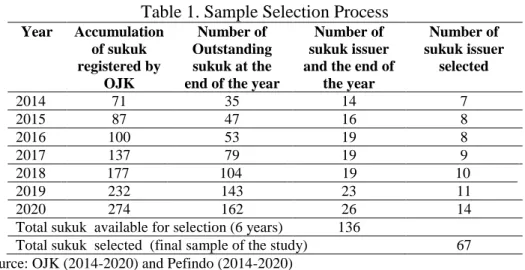
for choosing the sample were as follows: 1). The sukuk had to be registered by OJK; 2). One sukuk represented one company; 3).The issuer company was nonfinancial companies listed on the IDX; 3). The sukuk was rated by PT Pefindo. Based on the criteria, the final sample selected for this study was 60 sukuk. The sample selection process is presented in Table 1.
Table 1. Sample Selection Process
Year Accumulation of sukuk registered by
OJK
Number of Outstanding sukuk at the end of the year
Number of sukuk issuer and the end of
the year
Number of sukuk issuer
selected
2014 71 35 14 7
2015 87 47 16 8
2016 100 53 19 8
2017 137 79 19 9
2018 177 104 19 10
2019 232 143 23 11
2020 274 162 26 14
Total sukuk available for selection (6 years) 136
Total sukuk selected (final sample of the study) 67 Source: OJK (2014-2020) and Pefindo (2014-2020)
Table 1 indicates that at the end observation period (the year 2020), there were 274 sukuk registered on OJK in the last seven years and 162 of them were still in circulation. The 162 outstanding sukuk were issued by 26 companies. Because the researcher only took one type of sukuk for each company, the total sukuk available for being selected as the study sample during seven years of observation was 136 sukuk. Of the 136 sukuk, 69 sukuk could not be used as research samples because these sukuk issuers were not listed in the IDX or issued by financial companies. Therefore, the number of sukuk met the criteria as the study's final sample was 67 sukuk.
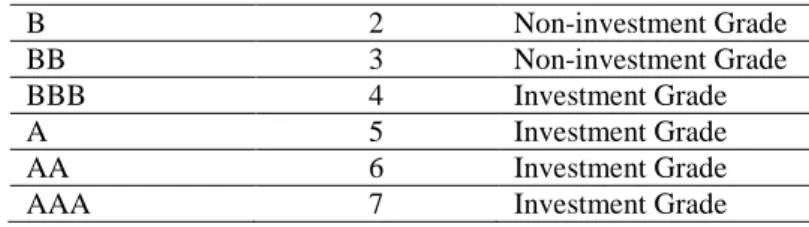
Secondary data related to financial performance were documented from the financial statements of each sample company and data on sukuk information were documented form Pefindo's end-year newsletter. The dependent variable of this study is sukuk rating issued by PT PEFINDO. The sukuk rating issued by this institution, measured by ordinal scale from zero to seven, was the rating used by most previous studies. Table 1 below shows the measurement of the sukuk rating variable.
Tabel 2. The Measurement of Sukuk Rating
Rating Given by PEFINDO
Measurement (Ordinal Scale)
Category
D 0 Non-investment Grade
CCC 1 Non-investment Grade
10 Wardiwiyono & Imron |Determinants of Sukuk Rating
SHARE | Volume 00 | Number 0 | Month - Month 20XX
B 2 Non-investment Grade
BB 3 Non-investment Grade
BBB 4 Investment Grade
A 5 Investment Grade
AA 6 Investment Grade
AAA 7 Investment Grade
With regard to the independent variables, there were six variables in this study. Those variables were profitability, leverage, liquidity, firm size, sukuk maturity, and sukuk structure. The measurements of each independent variables are presented in Table 2.
Tabel 3. The independent Variables and their Measurement
No. Independent Variables
Measurements Symbol
1 Profitability Return on assets ratio ROA
2 Leverage Debt to equity ratio DER
3 Liquidity Current ratio CR
4 Firm Size Total asset TA
5 Sukuk Maturity Sukuk maturity in years MAT 6 Sukuk Structure Variable one if the sukuk was
based on ijarah contract and 0 otherwise.
IJR
All data from the final sample were then analyzed using descriptive statistics and ordinal logistic regression. The current researchers summarised the data using descriptive statistics to overview the sample companies’ financial performances and the sample sukuk’s information in seven years of observation. Ordinal regression was used to test the six research hypotheses and, in the end, to answer the research questions. Based on the research hypotheses, the ordinal logistic regression model was formulated as follows.
( ) ( )
where:
Logit(i): Probability of corporate sukuk for rating i α(i): Constant for rating category i
i: rating category AAA, AA, A, BBB,BB, B, CCC, D β : Coefficient
RESULT AND DISCUSSION
As stated in the introduction part, the specific objective of this study was to analyze the impact of financial performances as proxied by profitability (ROA), leverage (DER), liquidity (CR), and firm size, as well as sukuk
Wardiwiyono & Imron | Determinants of Sukuk Rating 11
SHARE | Volume 00 | Number 0 | Month - Month 20XX
maturity and sukuk structure on corporate sukuk rating in Indonesia. The current study utilised descriptive statistics and ordinal logistic regression for data analysis. The results of the analysis are presented and discussed as follow.
Descriptive Statistic Results
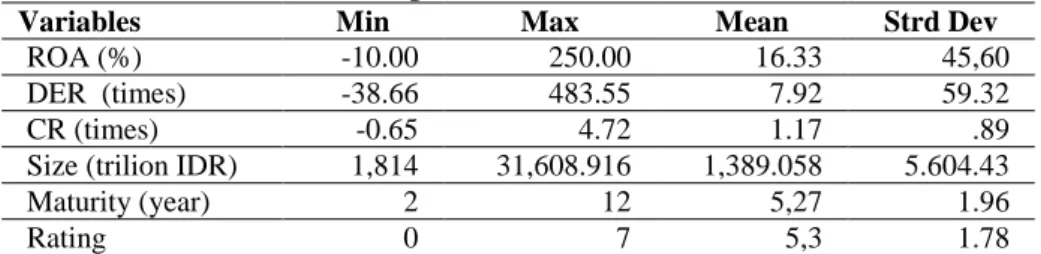
Table 4 summarizes the descriptive analysis results of the variables. It shows that the average ability of sukuk issuing companies to generate profit (profitability) as measured by ROA was 16.3%. This figure shows a healthy level of profitability for the sample companies. PT Indosat, the first and largest sukuk issuer to date, achieved the highest ROA (250%) in 2019. PT Indosat was. PT Sumberdaya Sewatama experienced the lowest ROA value in 2018.
Tabel 4. Descriptive Statistic of the Variables
Variables Min Max Mean Strd Dev
ROA (%) -10.00 250.00 16.33 45,60
DER (times) -38.66 483.55 7.92 59.32
CR (times) -0.65 4.72 1.17 .89
Size (trilion IDR) 1,814 31,608.916 1,389.058 5.604.43
Maturity (year) 2 12 5,27 1.96
Rating 0 7 5,3 1.78
Source: Secondary data processed (2021)
Furthermore, the average leverage value as measured by DER is 7.92 times.
This figure shows an unhealthy level of leverage as the debt of the sukuk issuing company is almost eight times its total capital, on average. A company is classified as having a healthy level of leverage when it has DER of less than one. The lower DER is, the better for the company. PT Sumberdaya Sewatama experienced the lowest DER (-38.6 times) in 2017, where the company was experiencing a capital deficiency of 156,587 billion rupiahs.
For the companies’ ability to meet their short-term obligations (liquidity) as measured by the current ratio, the average CR value of the sample companies was 1.17 times. It indicated that, on average, the sample companies were in an unhealthy level of liquidity as the value was below 1.5. PT Tiga Pilar Sejahtera Food achieved the highest CR value in 2017, while PT Angkasa Pura experienced the lowest in 2020.
Table 4 also shows the size of the sukuk issuing company as measured by total assets. The average value of total assets is 1.358 trillion. The largest
12 Wardiwiyono & Imron |Determinants of Sukuk Rating
SHARE | Volume 00 | Number 0 | Month - Month 20XX
sukuk issuing company was PT Angkasa Pura I in 2020, while the smallest company was PT Sumberdaya Sewatama in 2019.
In relation to sukuk maturity, Table 4 indicates that the average maturity of sample sukuk was 5.27 years. The maturity ranged from 2 years to 12 years.
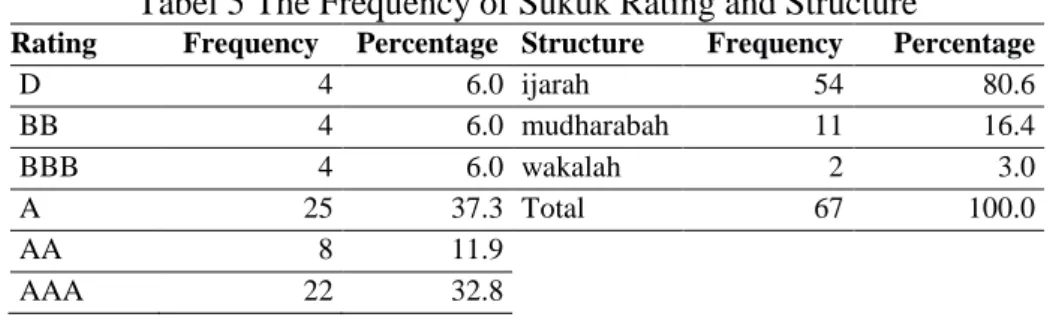
In addition to Table 4, the descriptive statistic also summarized the frequency distribution of sukuk structure and sukuk rating variables. The summary is presented in Table 5.
Tabel 5 The Frequency of Sukuk Rating and Structure
Rating Frequency Percentage Structure Frequency Percentage
D 4 6.0 ijarah 54 80.6
BB 4 6.0 mudharabah 11 16.4
BBB 4 6.0 wakalah 2 3.0
A 25 37.3 Total 67 100.0
AA 8 11.9
AAA 22 32.8
Source: Secondary data processed (2021)
Tables 5 indicates that most of the sample sukuk were structured with ijarah contract (80.6%). There were only two other contracts in the sukuk sample:
mudharabah (16.4%) and wakalah (3%). The table also indicates that most of the sample sukuk (88%) were in investment grade with the rating of AAA, AA, A, and BBB. There were four companies rated the highest rating (AAA):
PT Indosat, PT PLN, PT Angkasa Pura 1 and PT Telkom. The remainders (12%) were in non-investment grade with the rating of BB and D experienced by PT Sumberdaya Sewatama and PT Tiga Pilar Sejahtera in 2014 to 2018, respectively. None of the sukuk in this sample earned a CCC rating.
Ordinal Logistic Regression Results
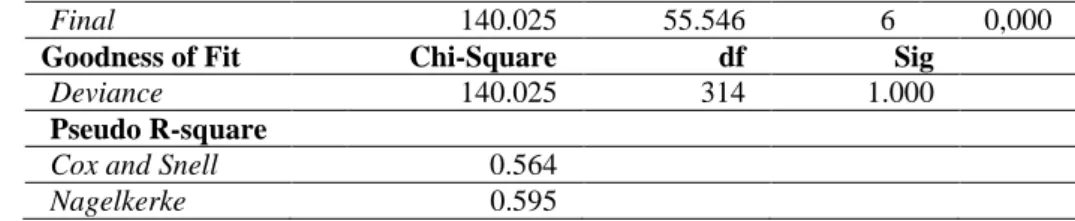
As stated earlier, ordinal logistic regression was used to test the six research hypotheses and, in turn, was used to answer the research questions. However, before discussing the hypotheses testing using Wald test, the researchers conducted model fitting test, goodness of fit test, and pseudo R-Square test to ensure that the regression model fit for hypotheses testing. Those tests were run using SPSS for Windows version 23. Table 6 summarizes the results of the tests.
Tabel 6 Model Fitting, Goodness of Fit, and Pseudo R-square
Model Fitting -2 Log Likelihood Chi-square df Sig
Intercept Only 195.571
Wardiwiyono & Imron | Determinants of Sukuk Rating 13
SHARE | Volume 00 | Number 0 | Month - Month 20XX
Final 140.025 55.546 6 0,000
Goodness of Fit Chi-Square df Sig
Deviance 140.025 314 1.000
Pseudo R-square
Cox and Snell 0.564
Nagelkerke 0.595 Source: Secondary data processed (2021)
Model Fitting
The model fitting was used to compare the regression model with an intercept only and the regression model with the variables independents by calculating each model's -2 Log Likelihood value. The value of -2 Log Likelihood was used to measure the model fitting. The higher the value of -2 Log Likelihood, the better the model fits a dataset.
Table 6 indicates that the -2 Log Likelihood value of the model with an intercept only was 195.571. However, when the independent variables were put into the model, the -2 Log Likelihood decreased to 140.025. The 55.546 decreasing value was counted as Chi-square. The significance value of the Chi-square reported in Table 6 is 0.000, indicating that the regression model resulted from the analysis was a perfectly fitting model.
The Goodness of Fit Test
The goodness of fit test was conducted to ensure that the model resulted from the data analysis process fit for hypotheses testing. Based on the Deviance method, a model is considered appropriate to use when the significant value of the Chi-square is more than the 5% value of α.
Table 6 reports that the Chi-square value based on the Deviance method was 140.025 with a significance value of 1.000. The result indicated that the model fitted with the empirical/observed data. Thus, the model fitted for the hypotheses testing.
Pseudo R-square
Pseudo R-square in logistic regression is acted like a coefficient determination in ordinary least squares. It reflects the model's predictive power and indicates the amount of variation in the dependent variable as explained by the independent variables. The value of coefficient determination ranges from 0 to approximately 1. As this study utilized ordinal logistic regression,
14 Wardiwiyono & Imron |Determinants of Sukuk Rating
SHARE | Volume 00 | Number 0 | Month - Month 20XX
coefficient determination can be checked on pseudo R-square representing by the value of Cox and Snell R2 or Nagelkerke R2.
Table 6 shows that the value of Cox and Snell R2 and Nagelkerke R2 of the resulted model is 0.564 and 0.595, respectively. According to Nagelkerke, it indicates that 59.5% variation of the corporate sukuk rating was explained by financial performance as proxied by ROA, DER, current ratio dan firm size, and sukuk maturity and sukuk structure. The remaining (40.5%) variation was explained by any other factor not included as the independent variables. This finding suggests the model resulting from the analysis had good predictive power.
Wald Test
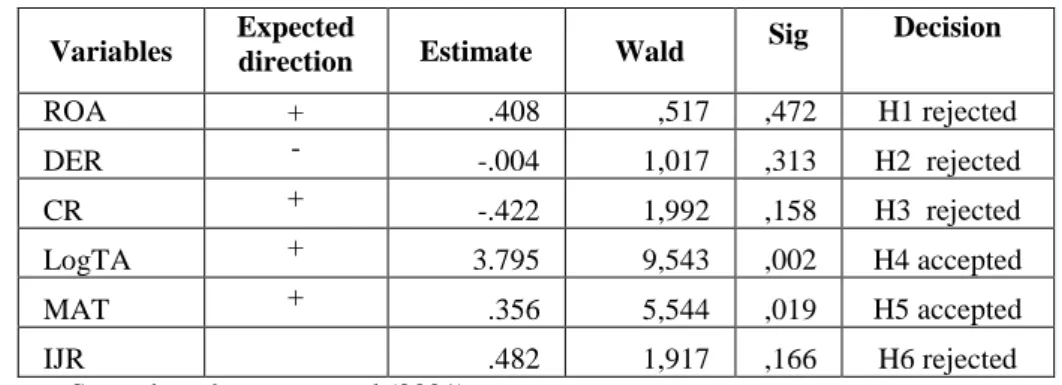
The model fitting, the goodness of fit, and the pseudo R-square indicated that the model fitted for hypotheses testing and had a moderately good predictive value. The hypotheses testing could be carried out using the Wald test. A hypothesis will be accepted if the significance value of the Wald test is less than the 5% value of α. Table 7 summarizes the results of parameter estimates that was run using SPSS for Windows 23 version.
Tabel 7 Summary of Parameter Estimates
Source: Secondary data processed (2021)
Table 7 shows two independent variables with Wald test significance values less than 5%. Those variables are firm size and maturity with a significance value of Wald 0.002 and 0.019, respectively. Both variables had a positive estimated value (B) as expected in the hypotheses. The results of the analysis suggested that as the size of sukuk issuer companies gets bigger, the company's probability of earning a high sukuk rating increases. Similarly, as the maturity of sukuk gets longer, the company's probability of achieving a
Variables Expected
direction Estimate Wald Sig Decision
ROA + .408 ,517 ,472 H1 rejected
DER - -.004 1,017 ,313 H2 rejected
CR + -.422 1,992 ,158 H3 rejected
LogTA + 3.795 9,543 ,002 H4 accepted
MAT + .356 5,544 ,019 H5 accepted
IJR .482 1,917 ,166 H6 rejected
Wardiwiyono & Imron | Determinants of Sukuk Rating 15
SHARE | Volume 00 | Number 0 | Month - Month 20XX
high sukuk rating increases. Thus, the fourth and fifth hypotheses were supported/accepted.
Referring to Table 7, the wald test produced a significance value of more than α (5%) for the remaining variables: ROA, DER, current ratio, and sukuk structure. The results indicate that ROA, DER, current ratio, and sukuk structure have no significant impact on sukuk rating of companies listed in IDX. Thus, the first, second, third, and sixth research hypotheses could not be accepted.
Discussion of the Findings
As stated earlier, the current study has three research questions. For ease of reference, the three research question is presented as follow:
1. Do financial performances affect sukuk rating?