Description. — Female: Forebody region elliptical except at posterior end, where posterior margin of fused fourth-fifth thoracic segments expands into wing-like process with a sensory hair on tubercle at distal end. Endopodite consisting of a single piece, equal to two-thirds of the length and one-third of the diameter of the first. Types.— The type series consists of the female holotype, the male allotype, and the six male and female paratypes, U.S.N.M.
Kiefer reported in 1929, and in 1934 alone, a sensory hair observable on the left side of the expanded anterior half of the genital segment. COPEPODS FROM LAKE ERH HAI, CHINA —^HSIAO 167 Kiefer gave two different descriptions of the structure of the fifth pair of legs in T. The strong spine on the distal outer edge of the first basal segment, the fine sensory hair on the second basal segment, and the claw on the second exopodite segment are the same as in T.
Of the male fifth pair of legs no description was given by Kiefer in 1929, only figures, but in 1934 they were described in detail.

COPEPODS FROM LAKE ERH HAI, CHINA — HSIAO 171
Of the two subgenera erected by Kiefer, Arctodiaptomus from Erh Haican can be distinguished by an excessively long spine on the thirteenth joint of the right first antenna of the male, by the absence of a second spine form on the second exopodite of the heel of the right leg in the male in addition to the lateral spine and terminal claw, and by the presence of hyaline height on mesial aspect proximal exopodite of same ramus instead of one on the other. Following the precedent established by Kiefer (1939) in connection with the establishment of the subgenus Ha'plodia'ptonms^ta. the new subgenus can be diagnosed by a combination of the following characters. a) The fourth and fifth thoracic segments are not fused together in males and females. a) Spinous process of the thirteenth joint of the right first antenna of the male very long, longer than the total length of the thirteenth and fourteenth joint together, and s. It is true that in fixed material the degree of telescoping of the segments varies according to the degree of contraction of the abdominal muscles at the time of killing and fixation, but by examining the length of the chitinous shell in transparent or semi-transparent specimens it is different.
In the third and fourth pairs of swimming legs, the skeletal plate connecting the right leg to the left is armed with long hairs on the ventral surface of the right and left sides and extends well beyond the caudal margin, but in the North Indian and Tibetan specimens of E. Genital segment as long as the total length of the next two segments, the anterior end of the genital segment extended to about the same width as the last thoracic segment, the posterior portion greatly reduced; anal segment slightly longer than preanal (9:7-8), anal plate semilunar in outline with smooth margin, anal fissure lined with spiniform teeth increasing in length posteriorly; posterior margin with 10 to 12 strong, spiny notches on the dorsal and ventral sides.
COPEPODS FROM LAKE ERH HAI, CHINA — HSIAO 175
176 PROCEEDINGS OF THE NATIONAL MUSEUM
COPEPODS FROM LAKE ERH HAI, CHINA — HSIAO 177
178 PROCEEDINGS OF THE NATIONAL MUSEUM
COPEPODS FROM LAKE ERH HAI, CHINA — HSIAO 179
Furcal rami 2.25 times as long as wide, both lateral and mesial margins hairless, no oblique row of spines from base of lateraleta running mesially across dorsal surface. Lateral set a large one, about half the length of the outer angular spine, inserted approximately in the middle of the ramus on the dorsal surface. Dorsal setae long and slender, about as long as the seta of the inner angle, inserted near the caudal end on the dorsal surface between the origins of the inner and outer apical setae.
Outer corner spines outward, with fine plumage on mesial surface, shorter than the inner corner seta, which is about 1.6 times as long. Leg 2 longer than leg 1; outer edge of second joint of fedopodite lined with fine hairs. Fig. 23, k); third joint of exopodite with four spines and five hairs; Third joint of endopodite of leg 4, more than three times (3.7) as long as wide, two terminal setae unequal, innermost twice as long as outer, slightly curved, unifying lamella with convex trailing edge covered with a row of spines.
Sixth leg on posterior margin of genital somite instead of being on anterior half of this somite as in female. Specimens collected in December are mature; the females either carry a fish or just go through spawning, as evidenced by the remains of the outer shell of the ovisacs. Ladak — is, as pointed out by previous workers, due to the difference in contraction of the preserved specimens.
But this does not apply to measuring the length and width of the furca, a single segment enclosed in a chitinous shell. Column 4 compares the length to width ratio with Kiefer's observation in Indian and Tibetan specimens. Columns 5 and 6 show that Kiefer's material has an inner corner seta of 58 percent and an outer corner seta of 57-60 percent, just as long as our specimens.
182 PROCEEDINGS OF THE NATIONAL MUSEUM
COPEPODS FROM LAKE ERH HAI, CHINA — HSIAO 183 The subspecies M.mridis acutulus was named for the subspecies by Kiefer (1930). ustus—according to Klie (1928) they are in three groups in G. Later Kiefer (1934) added some measurements made on two females and stated that the spine on the mesial surface of the distal joint of the fifth bone was very conspicuous, separated from the joint by a suture and armed with feathery spinules. The specimens of Erh Hai are like this subspecies in that the hairs on the inner surface of the bontrami are not evenly distributed but in groups of four (fig. 24, d)^ not three.
However, the spine of the fifth leg is not separated by a suture from the distal joint which bears it, and which has no hair or spiny armor. From the measurements given by Kiefer, which are attached to the table8, it will be noted that the length of the inner and outer setae of the caudal ends of the furcal rami is similar to the Erh Hai specimen. As it also differs in many quantitative aspects of its character, a summary of the measurements often used for taxonomic purposes is presented in Table 4, so that material from China and other parts of the Orient can be compared with this in the future.
Among the plankton collected on November 28, 1945, in one of the trawls made across Erh Hai Lake, Yunnan, China, was a large. First, descriptions of these species by various authors vary widely, and the question of how much variation within a species should be accepted and whether reclassification should be attempted needs to be worked out. It may serve a useful purpose, especially for students of copepoda and fish culture, to summarize in one place the main points of the confused situation in the literature as part of this study of argulids from the Erh Hai Lake and the main characters of the specimens that in this part of the world, so that future workers can use it for comparison.
COPEPODS FROM ERH HAI LAKE, CHINA — HSIAO 185 in outline of carapace and abdomen and rehitive length.
COPEPODS FROM LAKE ERH HAI, CHINA — HSIAO 185 on the outline of the carapace and abdomen and the rehitive lengths
Pearse in Japan and the specimens sent to him from that country were found to be identical to those of A. To begin with, as 'more recent specimens, including both sexes, were taken from goldfish in Tokyo and sent to the National Museum sent' and 'since they differ from Thiele described and calculated in a few details the specimens from Tokyo, reporting separately for each genus, in much more detail, and therefore more. In the case of the female, he described for the first time the relative size of the thoracic segments: the second and third segments are much wider than long, the fourth narrowest with a constriction in the middle of each segment.
COPEPODS FROM LAKE ERH HAI, CHINA — HSIAO 187
34;The sum total of these differences is more than sufficient to overcome any similarity to be found in the pattern of the respiratory area and would prevent this form from being placed under A.
COPEPODS FROM LAKE ERH HAI, CHINA — HSIAO 189
190 PROCEEDINGS OF THE NATIONAL MUSEUM
ABDOMEN
COPEPODS FROM LAKE ERH HAI, CHINA — ^HSIAO 191
CURVES
LENGTH IN MM
192 PROCEEDINGS OF THE NATIONAL MUSEUM
COPEPODS FROM LAKE ERH HAI, CHINA — HSIAO 193
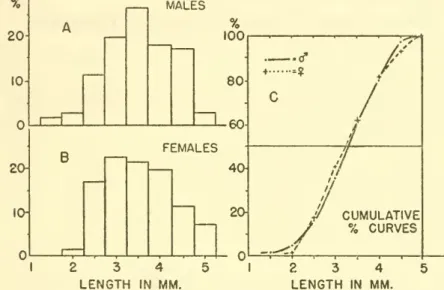
It will be seen from table 6 that these two structures in the female are slightly more variable than those in the male, as shown by them.
COPEPODS FROM LAKE ERH HAI, CHINA — ^HSIAO 195
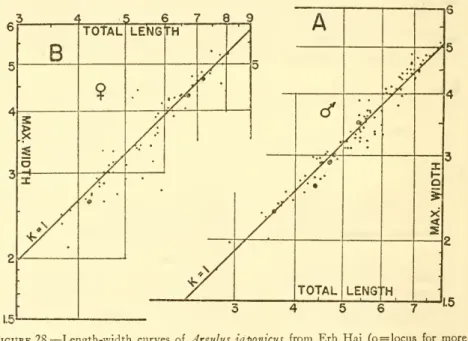
It also shows that the two suction discs from the same animal do not have the same number of ribs. But when the young and old are examined together, or when the young are compared separately, it is found that the carapace does not grow uniformly in length in relation to the total length of the animal. Since carapace length has been used to describe argulids - how far its posterior edge reaches, to.
The line with slope = 1 shows very well the trend of all points for men and women. In all the young specimens in this collection the posterior border of the carapace extends only to the anterior margin of the second leg, while in the larger ones it extends to the base of the fourth. In the case of the abdomen, as shown in Fig. 30, A, the points relating to the abdomen and total length in animals are less than 3.5 mm.
Adult female: Carapace almost circular, width 92 ± 1.05 percent of the carapace length, carapace length 64.92 ± 0.23 percent of the total length, reaching almost to the anterior edge of the fourth web leg, parts of.
COPEPODS FROM LAKE ERH HAI, CHINA — ^HSIAO 197 rami of first three pairs of legs and all of the fourth visible from the
T()TA_ LENGTH
COPEPODS FROM ERH HAI LAKE, CHINA —^HSIAO 197ramioff first three pairs of legs and all the fourth visible from. Distance from anterior end of median eye to anterior tip of carapace as a percentage of total length. Abdomen oval in outline, anterior end wider, maximum width as a percentage of abdomen length, considerably wider than in female.
But apart from the slight spinous lobe on the lateral edge of the thorax, between the second and third leg, directed from the base of the third appendage of the anterior thorax (see fig. Meehean . 32
SUMMARY
Statistical analysis indicates that during growth the width of the carapace increases proportionally with the total length, but its length shows brachyauxesis with reference to the whole body. The abdomen of growing young, on the other hand, shows tachyauxesis in relation to the rest of the body.
LITERATURE CITED