The rock of the Reindeer Hills consists of coarse crystalline, striped, red-brown and light gray marble. The marble is sleek. There is no evidence of glaciation in or near the Reindeer Hills during any part of the Quaternary. Evidence of habitation is found on the surface and slopes of the terrace remains on either side of the valley.
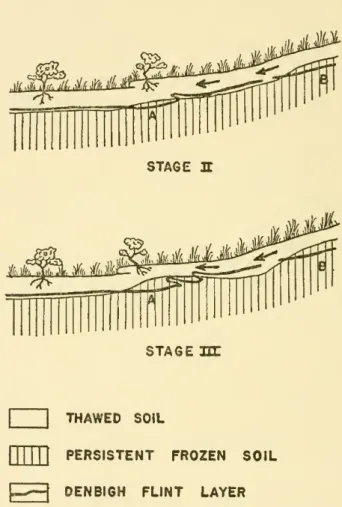
Near the inner edge of the terrace there are gaps in the layer caused by ground movements. The cultural material of the Denbigh flint complex consists of sparsely dispersed flint flakes and artifacts (cherry, obsidian, and chalcedony, according to their abundance) pressed against buried podzol. The distribution of cultural material in the Denbigh culture layer, pressed into the surface of the buried earth, is open to two.
Burins, or "gravers" in the European sense, and their spatters thrown away during grinding, occupy about a quarter of the Denbigh flint. Assemblages of artifacts in the Denbigh Fire Complex tradition have been found in the Kugurorok River Valley (fig. i) in the eastern part of the Brooks Range (Solecki, 1951), in the Anaktuvuk Pass in the central part of the range (Irving, 1951), and before the north end of the Anaktuvi Range (Solecki, 1951). and Hackman, 1951). These relationships indicate that no part of the Trail Creek Series currently known is as old as the Denbigh.
3A coal sample from the Denbigh Flint seam was submitted for age analysis at the end of the 1951 field season.

FOLDS IN THE DENBIGH CULTURE LAYER
THAWED SOIL
PERSISTENT FROZEN SOIL
I^ DENBIGH FLINT LAYER
THE PALEO-ESKIMO LAYER
This shortening was compensated by the formation of gaps in the slope of the seam from the folds. Cord marks appear on several sherds, and two or three vessels featured in the collection were treated on the outer surface only with smoothing. In general, the handling methods of this pottery are consistent with Upper Neolithic practices in Asia and with Woodland and other earlier pottery-making traditions in the eastern United States.
The flint materials chosen by the Paleo-Eskimos were mainly basalts and silicified shales—materials that are almost entirely in short supply. However, they were skillfully handled and formed the basis for most weapon points and other blades. Some chert and obsidian were used, but it is often difficult to determine which of the objects of these materials belong to the middle levels and which were moved from the underlying disturbed sections of the Denbigh quartzite.
The few objects of organic material taken from these levels are, in almost all cases, associated with sherds from the nearby houses of Ipiutak^ and middens at Point Hope. In general, the materials obtained from Paleo-Eskimo levels at Lyatayet show close identity with those from Near Ipiutak at Point Hope, and much less similarity with those from true Ipiutak. No part of Paleo-Eskimo is always frozen, and the poor preservation of organic material indicates that it has not been permanently frozen for most of the time since the Paleo-Eskimo period of occupation.
Small plications in the charcoal lenses are characteristic of the deeper parts of the Paleo-Eskimo layer, below the old soil. Some of these are due to the formation and destruction of clear ice lenses during annual cycles of freezing and thawing; others were formed by local collapse when wood and other organic materials in the soil rotted away. Still others were probably the result of the pressure of trampling feet when the ground was wet and soft each spring.
The subarctic brown Eorest soil appears to have developed beneath Paleo-Eskimo soils, indicating that the soil was relatively stable and immobile. Some silt may have been introduced during brief cold spells when soil pockets formed higher upslope, but most of the added sediment likely came from trails, dog holes, and other artificial bare surfaces. Carbon-14 analysis of the charcoal sample indicates that it is an older part of the Paleo-Eskimo area at lyatayet.
THE NEC-ESKIMO LAYER
Doubtless the Paleo-Eskimos were as interested in the microlithic work of the earliest inhabitants of these lands, are the Neo-Eskimos of to-day in all curious early works. Several thousand artifacts from the Nukleet site outline a sequence of stylistic changes that provides a fairly complete picture of Neo-Eskimos in the Cape Denbigh region during their period of occupation. The lack of rounding and the unsorted character of the debris indicate, in this region, that the fill.
The lack of wave-handled material in the terrace fill and the absence of raised wave-cut rock terraces elsewhere along the rugged coast between Cape Denbigh and Point Riley indicate that the sea level did not stand higher during the deposition of the congeliturbate than it does today . Small streams within the hills in the Koyuk-Kwik area meander over flat, debris-choked valley floors (p. 4). A small rise in sea level in the Koyuk-Kwik area would subject the unconsolidated fans to erosion by waves and longshore currents, and the fans would be rapidly removed to the edges of the rock hills.
Stream gradients at the mouths of the valleys would steepen, and the streams would then excavate the valleys again, filling remnants of the valley as terraces like those in lyatayet valley. It seems certain that the climate of the interval during which podzol formed at lyatayet was at least as warm as, and. The buried podzol, the Denbigh culture layer and part of the sandy silt were tightly folded as ground movement.
Because this buried profile occurs in only one of the many good exposures of the full thickness of the sandy silt layer, it can be considered to have formed at some point in a local area of stable soil. It is extremely unlikely that any part of the sandy silt on the old valley floor of lyatayet creek would have remained sufficiently stable until the formation of a well-developed SubarcticBrownForest. The profile probably developed in the sandy silt through the valley, but was obscured by frost that moved during the subsequent cold period, except in areas where it was later buried by an unusually large thickness of sandy silt.
The deposition of the sandy silt was eventually terminated by the period of warmer climate which has continued with only minor fluctuations to the present day. Well-developed soil profiles below Paleo-Eskimo ground levels indicate that soil movements had ceased. A small climatic fluctuation over the past 2000 years is suggested by the difference in the preservation of organic matter in Paleo-Eskimo and Neo-Eskimo soils.
LATE QUATERNARY CLIMATIC FLUCTUATIONS ON SEWARD PENINSULA AND IN THE FAIRBANKS DISTRICT
4 above Discovery on Cofifee Creek, a tributary of the Kougarok River 60 miles north-northeast of Nome, by way of Black Gulch, a tributary of the Noxapaga River 80 miles north-northeast of Nome and in Mud Valley. Wood collected at Coffee Creek in the Aldermuck Unit is 8,350±200 years old; wood collected at Black Gulchin the older muck is years old; and wood collected at Mud Creek in the younger muck is 3,600±200 years old. Cut grass peat, willow or elm liver, and birch stump 6 inches in diameter were rooted near the beaver dam.
The bars in the beaver dam were carved by beavers whose incisors were comparable in size to those of Castorcanadensis. Rare willow bushes grow today in Coffee Creek, Black Gulch, and Mud Creek valleys, but poplar and birch do not. The dated muds from the Seward Peninsula and the youngest muds in the Fairbanks area may have accumulated during a single, long period after.
The distribution of the buried soil and the culture layer suggests that the surface of the 40-meter terrace still formed the floor of the lyatayet med valley. This incomplete dissection of the terrace suggests that the sea level has not yet risen to its present position. Comparison of the Denbigh flint complex with flints in the oldest culture layer identified at Trail Creek Caves indicates that the Denbigh culture layer is more than 6,000 years old.
The buried podzol may have formed and the Denbighculture layer may have been deposited about 12,000 years ago, during part of the warm interval recorded by Middlemuck in the Fairbanks area. The cultural layer would then have been covered and folded during the Mankato Substage at the same time that some of the upper wood of the Fairbanks area was deposited. It is also possible that some or all of the stony congeliturbate was deposited during the Mankato Substage while the upper wood was being deposited in the Fairbanks area (correlation A, Table 2).
The authors favor correlating the podzo and the Denbigh culture layer with the older sediments of Seward Peninsula, deposited 8,000 to 9,000 years ago, because the thinness of the podzol at lyatayet suggests that the warm period during which it formed was very short. The middle mocklayer in the Fairbanks area, with which the podzol and culture layer may be rather correlative, represents a warm period lasting at least 4,000 years. The thickness of the upper loess of the Fairbanks area suggests that the Mankato Substage was a major cold interval in Alaska.
HOPKINS AND GIDDINGS 3I
ACKNOWLEDGMENTS