Some Tertiary Brachiopods
j of the ^ East Coast o f t h e United States
^^ .^.^
G. ARTHUR COOPER
SMITHSONIAN CONTRIBUTIONS TO PALEOBIOLOGY • NUMBER 6 4
SERIES PUBLICATIONS OF THE SMITHSONIAN INSTITUTION
Emphasis upon publication as a means of "diffusing knowledge" was expressed by the first Secretary of the Smithsonian. In his formal plan for the Institution, Joseph Henry outlined a program that included the following statement: "It is proposed to publish a senes of reports, giving an account of the new discoveries in science, and of the changes made from year to year in all branches of knowledge." This theme of basic research has been adhered to through the years by thousands of titles issued in series publications under the Smithsonian imprint, commencing with Smithsonian Contributions to Knowledge in 1848 and continuing with the following active series:
Smithsonian Contributions to Anthropology Smithsonian Contributions to Astrophysics
Smithsonian Contributions to Botany Smithsonian Contributions to the Earth Sciences Smithsonian Contributions to the Marine Sciences
Smithsonian Contributions to Paleobiology Smithsonian Contributions to Zoology
Smithsonian Folklife Studies Smithsonian Studies in Air and Space Smithsonian Studies in History and Technology
In these series, the Institution publishes small papers and full-scale monographs that report the research and collections of its various museums and bureaux or of professional colleagues in the world of science and scholarship. The publications are distributed by mailing lists to libraries, universities, and similar institutions throughout the world.
Papers or monographs submitted for series publication are received by the Smithsonian Institution Press, subject to its own review for format and style, only through departments of the various Smithsonian museums or bureaux, where the manuscnpts are given substantive review.
Press requirements for manuscript and art preparation are outlined on the inside back cover.
Robert McC. Adams Secretary
Smithsonian Institution
S M I T H S O N I A N C O N T R I B U T I O N S T O P A L E O B I O L O G Y • N U M B E R 6 4
Some Tertiary Brachiopods ofthe
East Coast of the United States
G. Arthur Cooper
SMITHSONIAN INSTITUTION PRESS Washington, D.C.
1988
A B S T R A C T
Cooper, G. Arthur. Some Tertiary Brachiopods of the East Coast of the United States.
Smithsonian Contributions to Paleobiology, number 64, 45 pages, 11 figures, 9 plates, 2 tables, 1988.—^The Tertiary brachiopod fauna of the United States is discussed and reference is made to the composition of the World Tertiary fauna. The brachiopod fauna of the East Coast of the United States at present numbers 17 genera (4 inarticulates and 13 articulates), of which 11 are discussed herein (asterisk): 2 linguilidids: Glottldia,* Discradisca; 2 craniidinids: Isocranial*
and Crania?*; 2 rhynchonellids: Probolarina* and Cryptopora, the former extinct; 2 cancellothyrids: Eucalathis* and Terebratulina*; 5 extinct terebratulids: Embolosia, Oleneothy- ris, Plicatoria,* Rhytisoria,* and Tanyoscapha; 2 terebratelUds: Argyrotheca* and Platidia;
and 2 thecideids: Lacazella* and ThecidelUna.* PHocene Glottidia inexpectans Olsson in adult form is described. New species of Probolarina, Terebratulina, Argyrotheca, Lacazella, and ThecidelUna are described and illustrated. Specimens not identified as to species are described:
Crania?, Isocrania?, Eucalathis?, and Terebratulina. The remarkable variation of Plicatoria wilmingtonensis (Lyell and Sowerby) is described and illustrated.
OFFICIAL PUBLICATION DATE is handstamped in a limiled number of initial copies and is recorded in the Institution's annual report, Smithsonian Year. SERES COVER DESIGN: The trilobite Phacops rana Green.
Library of Congress Cataloging-in-Publication Data Cooper, G. Arthur (Gustav Arthur), 1902-
Some Tertiary brachiopods of the East Coast of the United States (Smithsonian contributions to paleobiology ; no. 64)
Bibliography: p.
Supt. of Docs.: SI 1.30:64
1. Brachiopoda, Fossil. 2. Paleontology—^Tertiary. 3. Paleontology—United States. I. Title. II. Scries.
QE70LS56 no. 64 564'.8'0974 87-600205 [QE796]
Contents
Page
Introduction 1 Acknowledgments 3
Systematic Hierarchy of Species Described 3
Class INARTICULATA Huxley, 1869 4 Genus Glottidia Dall, 1870 4
Glottidia inexpectans Olsson, 1914 4
Genus Crania Retzius, 1781 4 Crania? species 1 5 Crania? species 2 5 Genus Isocrania Jaekel, 1902 5
Isocrania? species 1 5 Isocrania? species 2 5 Isocrania? species 3 5 Class ARTICULATA Huxley, 1869 6
Superfamily RHYNCHONELLACEA Gray, 1848 6 Genus Probolarina Cooper, 1959 6
Probolarina brevirostris, new species 6 Probolarina holmesi santeensis, new subspecies 6
Probolarina transversa, new species 7 Superfamily CANCELLOTHYRIDACEA Thomson, 1926 7
Genus Terebratulina d'Orbigny, 1847 7 Terebratulina alabamensis, new species 7 Terebratulina brundidgensis Aldrich, 1907 8 Terebratulina capillata. new species 8 Terebratulina lachryma (Morton, 1833) 9 Terebratulina wilsoni, new species 10
Terebratulina species 11 Genus £Mca/ar/iw Fischer and Oehlert, 1890 11
Eucalathis? species 1 12 Eucalathis? species 2 12 Superfamily TEREBRATLTLACEA Gray, 1840 12
Genus Plicatoria Cooper, 1983 12 Plicatoria wilmingtonensis (Lyell and Sowerby, 1845) 12
Plicatoria parva, new species 18 Plicatoria ventricosa, new species 18 Genus Rhytisoria Cooper, 1983 19
Rhytisoria alabamensis Cooper, 1983 19 Superfamily TEREBRATELLACEA King, 1850 19
Genus Argyrotheca Dall, 1900 19 Argyrotheca beecheri (Clark, 1895) 19 Argyrotheca laevis, new species 19 Argyrotheca macneili, new species 20 Argyrotheca quadrata, new species 20 Argyrotheca quadrata transversa, new subspecies 21
Argyrotheca semicostata, new species 21
lU
NUMBER 64 IV
Superfamily THECIDEACEA Gray, 1840 22
Genus Lacazella Munier-Chalmas, 1881 22
Lacazella nana, new species 22 Genus ThecidelUna Thomson, 1915 22
ThecidelUna alabamensis, new species 22
Localities 23 Literature Cited 25
Plates 27
Some Tertiary Brachiopods ofthe
East Coast of the United States
G. Arthur Cooper
Introduction
Tertiary deposits of the United States are endowed with a variety and abundance of brachiopods only rarely and locally.
Few brachiopods were noted and described by early workers in the United States. Schuchert (1897:68) Usts only six species of Tertiary brachiopods from the eastern United States: one rhynchonellid that Lyell and Sowerby mistakenly identified as Terebratula wilmingtonensis, 3 "Terebratula,'^ one Terebra- tulina, and one inarticulate. In the many years since Schuchert's summary, only a few species have been described, mostly from Paleocene and Eocene strata. The present work is designed to make known some new and old species from these Tertiary deposits of the East Coast (including Alabama). Statistical information was obtained from the literature to February 1986;
therefore, numbers of genera recorded for the Tertiary and other geological times are suggestive rather than definitive.
Thirty genera of brachiopods have been described from Tertiary sediments of the East, Gulf, and West coasts of the United States. Of these, 18 are now living in the waters of the Atlantic, Gulf of Mexico, and Pacific. Three living genera are known from the Paleocene, 8 from the Eocene, 7 from the Oligocene, 8 from the Miocene, 10 from the Pliocene, and 5 from the Pleistocene. Terebratulina. Argyrotheca, Discinisca, and Discradisca occur in all of the Tertiary epochs and extend into the Recent. Terebratalia and Dallinella extend from Oligocene to Recent on the West CoasL Only four genera of the East and Gulf Coast Tertiary are known on the West Coast:
Glottidia, Discradisca, Terebratulina, and Platidia. Four West Coast genera are extinct: Eogryphus. Miogryphus, Kingenal and Terebratulal. Of East Coast genera, 7 are extinct:
Isocrania?, Probolarina, Embolosia, Plicatoria, Oleneothyris,
G. Arthur Cooper, Department of Paleobiology, National Museum of Natural History, Smithsonian Institution, Washington, D.C. 20560.
Tanyoscapha, and Rhytisoria. Identification of Gryphus in the Eocene and the Oligocene of the West Coast is doubtful and no typical Gryphus occurs in the Pacific today, although the genus has been doubtfully identified there. Although Gryphus is known in the Eocene of the Caribbean region (Cooper, 1979), where it is a likely invader from the Mediterranean, it has not been found in the Eocene or later sediments of the Atlantic Coast.
Of the 17 genera of the East Coast Tertiary, 4 are inarticulates: Isocranial, Cranial, Glottidia. and Discradisca;
2 are rhynchonellids: Cryptopora and Probolarina; 5 are terebratulids: Embolosia. Plicatoria, Tanyoscapha. Oleneothy- ris and Rhytisoria; 2 belong to the cancellothyrids: Eucalathisl and Terebratulina; 2 to the terebratellids: Argyrotheca and Platidia; and 2 to the thecideids: Lacazella and ThecidelUna.
The great development of the Terebratulacea and Terebratel- lacea in the Tertiary took place outside of the United States, chiefly in Austraha, New Zealand, Japan, and the Mediterra- nean borders. The Tertiary rhynchonellids are moderately represented generically in the Southern Hemisphere and the Mediterranean. Hemithiris appears in the Pleistocene of New England and Quebec. It is not known from East Coast Tertiary sediments. It has been recorded from the Tertiary of the West Coast, but the generic identity of some of the species is suspect (//. dibbleei Hertlein and Grant, and H. regani Hertlein and Grant). Cooper (1959:54) placed Hemithiris astoriana Dall in Frieleia.
Terebratula [now Plicatoria] wilmingtonensis Lyell and Sowerby, from the Eocene of North Carolina, is of special interest because of the variation shown in its development of costae. It and some of its aberrations, were illustrated by Dall (1903). A species (now Rhytisoria alabamensis Cooper, 1983) from the Paleocene of Alabama was mistakenly referred to T.
wilmingtonensis and led to erroneous dating of the formation in which it occurred (Aldrich, 1907:9). Based on exteriors
SMITHSONL\N CONTRIBUTIONS TO PALEOBIOLOGY
TABLE 1.—^Numbers of brachiopod genera in existing superfamUies from Triassic lo Recent (from fUes of the National Museum of Natural History, Smithsonian Institution, February 1986).
Class and/or Superfamily Inarticulata Articulata
Rhynchonellacea Cancellothyridacea Terebratulacea Terebratellacea Thecideacea
Total
Triassic
3 61 0 11 13 2
90
Jurassic
4 113 4 136 10 9
276
Cretaceous
7 30 13 67 40 11
168
Tertiary
8 ' 18
6 27 62 4
125
Recent
10 17 10 19 54 2
112
Extinct in Tertiary
2 8 2 18 28 2
60
Cooper (1983) split the variable T. wilmingtonensis into three genera, Embolosia, Plicatoria, and Tanyoscapha, all with similar loops.
Most marine Tertiary deposits are marginal to the continents and islands. Brachiopods found as fossils in these marginal deposits are often genera and species living offshore today.
Along the Atlantic and Gulf coasts fossil and living genera are: Glottidia, Discradisca, Crania, Hemithiris, Terebratulina, ThecidelUna, Lacazella, Platidia, Argyrotheca, and Crypto- pora. Off the Pacific Coast of the United States, fossil and living genera are: Glottidia, Discinisca, Discradisca, Hemi- thiris, Terebratulina, Platidia, Terebratalia, Dallinella and Laqueus. Eohemithiris, recorded by Hertlein and Grant (1944) lives today in the southern Pacific. Brachiopods hving today off Japan, Australia, New Zealand, South Africa and the Mediterranean shores occur in the marginal Tertiary and Pleistocene deposits. In addition (Cooper, 1982:4) recorded Cryptopora from off the Oregon coast.
The brachiopod fauna of the West Coast of the United States, like that of the American Cretaceous brachiopod fauna, is a limited one. Hertlein and Grant (1944:7) list 14 (15, with Dallinella separated from Terebratalia) genera from the West Coast Tertiary, a fauna shghtly less diverse than that of the East Coast. The end of the Cretaceous wimessed a decline in the brachiopods, as well as in other marine phyla. Only 9 genera (10 with doubtful Isocrania) definitely crossed the Cretaceous-Tertiary boundary: Lingula, Discinisca, Discra- disca, Crania, Terebratulina. Argyrotheca. Megathiris, Bifo- lium, and Glazewskia. All but the last two, and Isocrania, are living today. The Cretaceous brachiopod fauna (both extinct and extant) contains 173 genera; that of the Tertiary-Recent numbers 180 (Table 1).
The Jurassic brachiopod fauna of 314 genera declined to 173 in the Cretaceous. The rhynchonellids dropped from 113 genera in the Jurassic, their heyday, to 30 genera in the Cretaceous. The Terebratulacea declined from 136 genera in the Jurassic lo 67 in the Cretaceous. The Cancellothyridacea appeared in the Jurassic and increased to 13 genera in the Cretaceous. The zeilleriids declined from 36 genera in the
Jurassic to 5 in the Cretaceous and became extinct thereafter (not in Table 1). Unlike the Terebratulacea, the Terebratellacea increased from 10 genera in the Jurassic to 40 in the Cretaceous.
Significant changes occurred after the Cretaceous. The rhynchonelhds declined from 30 genera in the Cretaceous to 18 in die Tertiary; the terebratulaceans declined to 27 genera in the Tertiary from 67 in the Cretaceous; the cancellothyri- daceans from 13 in the Cretaceous to 6 genera in the Tertiary.
The terebratellids increased from 40 genera in the Cretaceous to 62 in the Tertiary. The Thecideacea dropped from their maximum of 11 in the Cretaceous to 4 in the Tertiary. The inarticulates ntimbered 7 genera in the Cretaceous, increasing to 8 in the Tertiary.
Although the Recent brachiopod fauna is thought by some to be a mere remnant of the Tertiary fauna, in reality it numbers 112 genera, nearly as many as the 125 genera of the Tertiary.
There is a slight increase (total of 10 genera) of the Inarticulata in the Recent and a slight decrease to 17 genera of the Rhynchonellacea. The Terebratulacea decreased from 27 genera to 19 in the Recent and the Cancellothyridacea increased from 6 Tertiary genera to 10 genera in the Recent fauna. There is a small decline in the number of Recent Terebratellacea to 54 genera in the Recent fauna, in which they are now the most numerous brachiopod element. The Thecideacea declined to 2 genera in the Recent from the 4 present in the Tertiary.
Several Recent genera of the Atlantic and Pacific are not found in Tertiary deposits adjacent to those coasts. Macan- drevia. occurs off New England but has not yet been found in the Caribbean or East Coast Tertiary. Dallina is fairly common in the Caribbean, rare in the Gulf of Mexico, but has not yet been found as fossil in die Caribbean, East Coast and Gulf Coast Tertiary. It and Macandrevia occur in the Japanese Tertiary.
Ecnomiosa Cooper (1977) from Gulf and Caribbean waters, and also from the Indian Ocean, has not been found as a fossil.
Chlidonophora, rare in the Caribbean, common in the Gulf of Mexico, has also been found in the Indian Ocean. Its report as a fossil is probably erroneous. Rare Caribbean forms such as
NUMBER 64
Erymnia (Cooper, 1977), Notozyga (Cooper, 1977) and Megerlia are not known from the Caribbean, East Coast, or Gulf Coast Tertiary, Abyssothyris is rare in the North Atlantic, a possible deviant stock, and unknown in the American Tertiary. It occurs with its homeomorphs Notorygmia and Neorhynchia on the Baja Abyssal Plain off San Diego, California. Abyssothyris has been identified from Miocene Globigerina-hoai'mg deposits on Fiji (Cooper 1978). Crania, rare in the Pacific, has not been found in the West Coast Tertiary.
In spite of the changes since the Tertiary, the modern brachiopod fauna is not in serious decline. Widespread modern dredging operations are fmding .brachiopods at many new locations, with new species and occasional new genera as rewards. Continued exploration for fossil and Recent brachi- opods is certain to add many new taxa to the literature.
ACKNOWLEDGMENTS.—Dr. Druid Wilson, retired from the U.S. Geological Survey and well informed in Tertiary stratigraphy and paleontology .advised in connection with recent advances in Tertiary stratigraphy. Dr. J. Thomas Dutro, Jr., U.S. Geological Survey, made valuable suggestions for the improvement of the manuscript. I am most grateful to both of these authorities.
I am grateful to Mr. Rex Doescher, Museum Specialist, for his help with brachiopod ranges. His compilations of genera have been most helpful. Dr. P.M. Kier, formerly curator in the National Museum of Natural History collected many of die brachiopods from South Carolina; Mr. P.J. Harmatuck, Bridgeton, North Carohna, collected most of the specimens from the Ideal Cement Company, northeast of Castle Hayne, Nordi Carolina.
Systematic Hierarchy of Species Described
(frcHn Class through Species)
Class Inarticulata Huxley, 1869 Order LinguUda Waagen, 1885
Superfamily Lingulacea Menke, 1828 Family Linguhdae Menke, 1828
Genus Glottidia Dall, 1870
Glottidia inexpectans Olsson, 1914 Order Acrotretida Kuhn, 1949
Suborder Craniidina Waagen, 1885 Superfamily Craniacea Menke, 1828
Family Craniidae Menke, 1828 Genus Crania Retzius, 1781
Crania? species 1 Crania? species 2
Genus/.socrama Jaekel, 1902 Isocrania? species 1 Isocrania? species 2 Isocrania? species 3 Class Articulata Huxley, 1869
Order Rhynchonellida Kuhn, 1949
Superfamily Rhynchonellacea Gray, 1848 Family Basiliolidae Cooper, 1959
Subfamily BasiUohnae Cooper, 1959 Genus Probolarina Cooper, 1959
Probolarina brevirostris, new species
Probolarina holmesi santeensis. new subspecies Probolarina transversa, new species
Order Terebratulida Waagen, 1883
Suborder Terebratulidina Muir-Wood, 1955 Superfamily Cancellothyridacea Thomson, 1926
Family Cancellothyrididae Thomson, 1926 Subfamily Cancellodiyridinae Thomson, 1926
Genus Terebratulina d'Orbigny, 1847 Terebratulina alabamensis, new species Terebratulina brundidgensis Aldrich, 1907 Terebratulina capillata, new species Terebratulina lachryma (Morton, 1833) Terebratulina wilsoni, new species Terebratulina species
Genus Eucalathis Fischer and Oehlert, 1890 Eucalathis? species 1
Eucalathis? species 2
Superfamily Terebratulacea Gray, 1840 Family Terebratulidae Gray, 1840
Subfamily TerebratuUnae Gray, 1840 Genns Rhytisoria Cooper, 1983
Rhytisoria alabamensis Cooper, 1983 Subfamily PUcatoriinae Cooper, 1983
Genus Plicatoria Cooper, 1983
Plicatoria wilmingtonensis (Lyell and Sowerby, 1845)
Plicatoria parva, new species Plicatoria ventricosa, new species Suborder Terebratellidina Muir-Wood, 1955
Superfamily Terebratellacea King, 1850 Family MegaUiyrididae Dall, 1870
Genus Argyrotheca Dall, 1900 Argyrotheca beecheri (Clark, 1895) Argyrotheca laevis, new species Argyrotheca macneili. new species Argyrotheca quadrata. new species
Argyrotheca quadrata transversa, new subspecies Argyrotheca semicostata, new species
Order Thecideida Pajaud, 1970 Suborder Thecideidina ElUott, 1958
Superfamily Thecideacea Gray, 1840 Family Thecideidae Gray, 1840
Subfamily Lacazellinae Backhaus, 1959 Genus Lacazd/a Munier-Chaknas, 1881
Lacazella nana, new species
Subfamily Thecidellininae Thomson, 1915 Genus ThecidelUna Thomson, 1915
ThecidelUna alabamensis, new species
S M I T H S 0 N L \ N CONTRIBUTIONS TO PALEOBIOLOGY
Class INARTICULATA Huxley, 1869
Genera of Inarticulata are generally scarce in the American Tertiary alUiough local occurrence of abundant specimens is known. Lingula, which is usually found in the Soudiern Hemisphere, has not been found in die Tertiary of the United States. However, its northern cousin, Glottidia is known from die Pliocene of the East Coast Tertiary and from die Miocene and Pliocene of the West Coast Tertiary,
Discradisca Stenzel (1964) is rare in die Paleocene of Texas where its type species, D. littigensis Stenzel occurs. Discra- disca lugubris (Conrad) is fairly common in the Miocene of Maryland and Virginia, less so in die PUocene. Discradisca aldrichi (Gardner) occurs in die Miocene (Alum Bluff Formation) of Horida. Discradisca occurs in the Adantic where it is rare; it is more common in the Pacific.
In the West Coast Tertiary Discradisca occurs in die Eocene, Oligocene, and PUocene. Discinisca, the smooth relative of Discradisca, occtu-s in die Miocene and Pliocene and is fairly common off the west coast of Soudi America.
Crania is rare off the Adantic coast of die United States.
The one specimen described from die Gulf of Mexico has now proved to be a Discradisca (Tunned, in Utt. 17 Sep 1984).
Typical, unornamented Crania is not known in the American Tertiary; those referred to Crania widi a query are radially ornamented, as is die species from die Paleocene Salt Mountain Formation described by Touhnin (1940).
Genus Glottidia Dall, 1870 Glottidia inexpectans Olsson, 1914
PLATE 1: HGURES 17-32
Glottidia inexpectans Olsson, 1914:21. pl. 12: figs. 17-21.
Large, equivalve, length 2.5 times width; sides subparallel;
anterior margin broadly rounded; posterior pointed. Surface marked by fine concentric growth varices. Dark brown widi a long median triangular area of lighter brown or grayish brown.
Ventral valve with a long triangular median, elevated, flattened area originating at beak, broadening anteriorly to disappear near anterior quarter. Flanks bounding elevated area gentiy concave, sloping laterally and marked by concentration of growth varices. Beak sharp, making an angle of about 50°.
Interior marked by two diverging ridges, separating posteriorly, each to form small flattened triangle. Ridges diverging anteriorly, extending for slighdy less than half shell length.
Anterior ends of ridges occupy median 7 mm of widdi in a specimen 15 mm wide. Posterior triangular patches are scars of umbonal muscle attachments. Midvalve marked by low median ridge widi scars of central muscles on each side.
Anterior quarter with low median ridge, continuation of preceding ridges at midvalve.
Dorsal valve with exterior like that of ventral valve widi raised median area and gendy concave flanks with crowded growth varices. Inside dorsal valve beak is solid, excavated
with umbonal chamber occupied by umbonal muscle scar.
Anterior of scar, short median septum extending for slighdy more than one-diird valve lengdi. Septum ends in splayed anterior from which extends low median ridge nearly to anterior margin. Muscle scars not resolved.
MEASUREMENTS.—Lengdi and width are in mdlimeters.
USNM ^"^'^ ^^'^
551520b 551520c 551520d 551520g 5515201 551520k 551520-2 551520m 551520U 551520y
32.0 37.0 23.5 47.0 47.0 32.0 18.0 34.0 45.0 40.0
12.5 13.5 9.0 17.0 15.0 12.5 7.0 15.0 17.0 17.0
GEOLOGICAL OccimRENCE.—^Pliocene (Yorktown Forma- tion).
LOCALITY.—Virginia 1.
TYPES.—Hypotypes: USNM 551531; 551520a-z.
DISCUSSION.—The original specimens on which this species is based are very small, 5-12 mm in length, undoubtedly juvendes. They were taken from the filling of a Pecten jeffersonius shell (Olsson, 1914).
Of described species, G. inexpectans is extremely similar externally to G. palmeri Dall (1871). The Pliocene species is shghtiy wider, averaging L/W = 2.62, while G. palmeri has LAV above 3.0. The posterior of G. palmeri is more pointed and its anterior margin straighter than in G. inexpectans. Inside both valves, the internal ridges of G. inexpectans are proportionately shorter, and those of the ventral valve are more widely divergent anteriorly than those of the modern species.
Glottidia is very rare in the fossil state. It is known in the Tertiary of California. The known occurrences of modern Glottidia are on the East and West coasts of North America, the Caribbean, Gulf of Mexico, and Central America.
Genus Crania Retzius, 1781
The Craniidae have persisted since Ordovician times in a variety of forms, some smooth, some spinose, some pustulose, or moderately costellate, die costellae continuous or discon- tinuous. Cranias are found in the Tertiary of eastern United States, especially in the Eocene, which, of all the Tertiary on the East Coast, is best endowed widi brachiopods. All specimens so far collected from die Eocene of the Coastal Plain have ornamented dorsal valves. Only three ventral valves are known, and these show signs of costellation in die form of small peripheral projections. The younger Tertiary and Pleistocene have not yet yielded Crania, although it may be expected. Crania is not known in the Recent fauna nordi of Florida. Modern Crania in the western Adantic usually is concentrically marked; no costellate forms are known.
NUMBER 64
Specimens from the Eocene are not common and are usually found in sample residues. They are often small, probably immature forms. Touhnin (1940:288, pl. 28: figs. 1-3) described specimens from the Eocene (Salt Mountain Forma- tion) as Crania species, a costellate form. Sufficient specimens for adequate specific characterization have not yet been found.
Crania? species 1
PLATE 5: HGURES 4 - 6
Small, widely and roundly elliptical, forming a low eccentric cone in lateral profde. Apex located about one-fifth length from posterior margin. Posterior slope slighdy concave; lateral and anterior slopes shghdy convex. Surface covered by scattered pits except for die marginal region which is marked by low radial costellae.
Interior marked on the posterior margin by small adductor scars. Posteromedian region bearing V-shaped diickening with short median ridge extending anteriorly to slightiy anterior of midvalve. Anterior muscle scars present in V-shaped thicken- ing. Inner anterior margin or Umbus minutely scalloped except posteriorly.
MEASLIREMENTS (mm).—^Length 5.5; width 7.1; cone height 1.8.
GEOLOGICAL OCCTJRRENCE.—^Eocene (Castie Hayne Forma- tion).
LOCALITY.—North Carolina 1.
SPECIMEN EXAMINED.—^USNM 549401.
Crania? species 2
PLATE 5: HGURES 1-3
Subcircular to subquadrangular in outline and conical in profde; apex one-sixth length from posterior margin. Posterior slope steep. Anterior and lateral slopes steep and flattened.
Surface marked by densely crowded, discontinuous costellae that form spines at lines of growth interruption and the margin.
Interior with posterior adductor scars well defined and median region not thickened by V-shaped mass. Species 1 and 2 of Cranial are unlike any living species.
MEAStJREMENTS (mm).—^Length 5.2; width 5.8; cone height 2.3.
GEOLOGICAL OCCURRENCE.—Eocene (Castle Hayne Forma- tion).
LOCALITY,—North Carolina 1.
SPECIMEN EXAMINED.—USNM 549410.
Genus Isocrania Jaekel 1902
This genus is characterized by having bodi valves conical, the ventral one attached by its apex and both valves costellate.
The costae radiate from die apex to die margins. The adductor scars are well impressed in both valves and diere is a short median ridge separating the anterior adductor scars in the ventral valve. There is a strong Umbus around the periphery.
The American shells referred to diis genus widi a query agree in die exterior ornament and in die interior of die dorsal valve.
The ventral valve differs from that of Isocrania in having its attachment surface occupying the entire exterior or a generous share of it. The anterior adductor scars of die dorsal valve of die American shells are strongly diickened.
Isocrania? species 1
PLATE 3: HGURE 8; PLATE 6: nGiWES 1, 4
Small, circular in outUne, forming shaUow cone in profile;
apex one-fourdi valve length anterior to posterior margin. All slopes gentiy concave. Surface marked by diin, elevated, thread-like radial costellae separated by wide spaces.
Ventral valve circular, attached by its entire surface;
posterior adductor scars large; anterior adductor scars smaU;
short ridge located one-diird valve lengdi from posterior margin. Limbus narrow.
MEASUREMENTS (mm).—Ventral valve: USNM 551512:
length 4.7; width 6.0; height 2.0?; dorsal valve: USNM 551509: length 4.8; width 4.8; height about 0.5.
GEOLOGICAL OCCURRENCE.—Eocene (Cross Member of
Santee Formation).
LOCALITY.—South Carolina 3.
SPECIMENS EXAMINED.—USNM 551509, 551510, 551512.
DISCUSSION.—This species is characterized by the low conical form of both valves, the elevated numerous costellae and the septum-like ridge in the ventral valve. Specimen USNM 551512 is regarded as a water worn example.
Isocrania? species 2
PLATE 3 : HGURES 9, 10; PLATE 6: HGURES 2, 3
Small, low cone, eUiptical with apex near midvalve. Apical region flattened, smoodi, surrounded by concave slopes marked by elevated thread-like costellae without definite pattern. Interior marked by swollen posterior; anterior adductor scars with short low ridge anterior to them.
MEASUREMENTS (mm).—^USNM 551528: lengdi 6.3; width 8.3?; height 0.75?.
GEOLOGICAL OCCURRENCE.—Oligocene (Ashley Member of
Cooper Formation).
LOCALITY.—South Carolina 5.
SPECIMENS EXAMIN'ED.—USNM 551509, 551528.
DISCUSSION.—The elliptical oudine and very flat cone distinguish this species from Isocranial species 1.
Isocrania? species 3
A fairly large dorsal valve, length 5 mm and width about 4.5 mm, and several immature specimens are from the Santee Formation, the former at South Carolina 1 and the immature forms from Soudi Carolina 2. The dorsal valve is irregularly costellate with apex at about one-third valve length. The interior is marked by only a slight diickening of the muscle scars.
SMTTHSONIAN CONTRIBUTIONS TO PALEOBIOLOGY
SPECIMENS EXAMINED.—USNM 549403; immature spec- imens unnumbered.
Class ARTICULATA Huxley, 1869
Superfamily RHYNCHONELLACEA Gray, 1848 Rhynchonellids are very rare in the East Coast Tertiary. The small smooth Cryptopora occurs in die Salt Mountain Formation of Alabama (Touhnin, 1940). A single dorsal valve in die USNM collections comes from die Pliocene, SWl/4 section 16, T. 1 S., R. 4 W, Jacksons Bluff, Ocklocknee River, Florida (USNM 551530). Cryptopora was recendy reported living off the Oregon coast (Cooper, 1982). It has not yet been found as a fossil in the West Coast Tertiary.
Hemithiris has been identified in the West Coast Tertiary and East Coast Pleistocene. The generic affinities of the West Coast species are questionable. Eohemithiris, another rhyn- chonellid of the West Coast Eocene, is Uving in the soudiern Pacific but is not known in die Tertiary of the East Coast.
Only new taxa of Probolarina are described here.
Genus Probolarina Cooper, 1959 Probolarina brevirostris, new species
PLATE 3: HGURES 5-7
DIAGNOSIS.—SmaU, rotund, with narrow uniplication, low fold and short tongue on ventral valve.
DESCRIPTION.—Small, compact, roundly triangular, lengdi and width nearly equal. Dorsal valve more convex than ventral one. Maximum width at about midvalve. Apical angle 90°.
Beak shorL Surface costate except for smoodi umbones. Costae numbering 16, 3 on fold, 2 in sulcus.
Ventral valve gently convex in lateral profile, flady convex in anterior view. Umbonal and median regions moderately swollen. Sulcus originating at midvalve, widening anteriorly to occupy one-third valve width. Tongue short. Hanks moderately steep, smooth posteriorly.
Dorsal valve strongly convex in lateral profile, strongly domed in anterior view. Umbonal and median regions swollen.
Fold low, originating at midvalve. Ranks swoUen and steep.
MEASUREMENTS (mm).—USNM 551527: lengdi 7.3; dorsal valve lengdi 6.8; widdi 7.2; diickness 4.9; apical angle 90°.
GEOLOGICAL OCCURRENCE.—Eocene (Castle Hayne Forma- tion),
LocALnY.—North Carolina 7, TYPE.—Holotype: USNM 551527.
DISCUSSION.—This species is similar to Probolarina holmesi (Dall, 1903), also from the CasUe Hayne Formation, but is smaller, more compact, with shorter beak, and more pro- nounced fold and sulcus.
Probolarina holmesi santeensis, new subspecies
PLATE 2: HGURES 9—17
DIAGNOSIS.—Probolarina with length and widdi of dorsal valve nearly equal and strongly convex dorsal valve.
DESCRIPTION.—Small, inequivalve, subtriangular, dorsal valve deeper and more convex dian ventral one; maximum widdi near midvalve; sides rounded, tapering slighdy ante- riorly; posterolateral margins forming angle of 85° to slightly over 90°. Lateral commissure nearly straight; anterior commis- sure uniplicate. Beak very narrow, tube-like; foramen small, hypodiyridid, surrounded by alar extensions of conjunct, wholly visible deltidial plates. Surface costate in anterior two-thirds; umbonal regions smooth.
Ventral valve gently convex in lateral profile, flady convex in anterior view. Umbonal regional narrow, gentiy convex.
Sulcus shallow, originating at midvalve, forming short, anteriorly serrate tongue. Sulcus occupied by 2 to 4 rounded costae; flanks occupied by 2 to 4 costae.
Dorsal valve strongly convex in lateral profile, narrowly and steeply domed in anterior view. Dorsal valve length almost equal to shell width. Umbonal and median regions strongly swollen. Fold beginning at midvalve, not well defined, occupied by 2 to 5 costae. Flanks rounded and steep widi 2 to 5 costae.
Ventral valve interior with short erect dental plates, small teedi and sessile pedicle collar. Adductor scar large, surrounded by elongate diductor scars.
Dorsal valve interior with long expanding falcifer crura, crescentic in section and convex laterally. Outer hinge plates narrow, concave. Socket ridges low, sockets long, narrow.
MEASUREMENTS.—All measurements are in mdUmeters, except apical angles, which are in degrees.
USNM 551518a 551518b 551518c 551518d 551518e
Length 13.4 12.5 13.0 11.2 11.0
Dorsal valve length 11.6 11.3 11.5 10.0 9.8
Width 11.5 11.0 11.3 9.8 9.7
Thick- ness 8.0 7.8 8.0 6.8 7.0
Apical angle 89 86 91 85 86
GEOLOGICAL OCCURRENCE.—Eocene (Santee Formation), LOCALITY.—South Carolina 2.
TYPES.—Holotype: USNM 551518a; paratypes: USNM 551518b-n.
DISCUSSION.—This subspecies has the same narrowly triangular form as Probolarina holmesi (Dall, 1903) from die Casde Hayne Formation at Wilmington but differs in its larger size, less development of a pedicle collar, the shell more strongly costate, and costae extending for two-thirds shell length. It is less wide and tiiicker than P. transversa, new species.
NUMBER 64
Probolarina transversa, new species
PLATE 2: HGURES 30-46
DIAGNOSIS.—^Widely triangular Probolarina.
DESCRIFOON.—Small, widely triangular in oudine; maxi- mum width anterior of midvalve; inequivalve, dorsal valve more convex dian ventral one. Sides somewhat narrowly rounded. Anterior margin gendy convex; posterolateral extre- mities forming angle of slightiy more or slightiy less dian 90°.
Beak narrow, foramen oval, small, hypodiyridid; deltidial plates conjunct, alate, forming short tube. Lateral commissure nearly straight; anterior commissure gentiy uniplicate. Surface semicostate, costae in anterior half, posterior half smoodi.
Number of costae variable, from 8 (0 12, widi 2-5 in die sulcus and 3-6 on the fold, 4-6 on flanks.
Ventral valve slightiy convex in lateral view, broadly and gentiy convex in anterior profile. Beak narrow, umbonal median regions gendy swollen; sulcus beginning abrupdy at about midvalve, shallow, forming short serrate tongue. Flanks with genUe slopes, occupied by 4 costae.
Dorsal valve fairly strongly convex in lateral view, broadly and moderately domed in anterior profile. Umbo smooth, swollen, sweUing continued anteriorly as low fold, slightiy elevated above steep, rounded flanks.
Ventral valve interior without pedicle coUar (?); dental plates short, erect; umbonal chambers separating dental plates from sheU wall narrow. Muscle scars not seen.
Dorsal valve interior widi broad falcifer cnira. Other details not seen.
MEASUREMENTS.—All measurements are in milUmeters, except apical angles, which are in degrees.
USNM 551517a 551517b 551517c 551517f
Length 10.7 10.8 12.3 10.9
Dorsal valve length 9.4 9.6 11.0 9.6
Width 11.4
9.8 12.0 10.0
Thick- ness 6.3 6.4 6.5 6.0
Apical angle 92 92 87 92
GEOLOGICAL OCCURRENCE.—Eocene (Santee Formation).
LocALFiY.—South Carolina 2.
TYPES.—Holotype: USNM 551517a; paratypes: USNNM 551517b-f
DISCUSSION.—This species differs from Probolarina holmesi santeensis, new subspecies, in the nearly equal dimensions of its length and width, whereas die subspecies is more narrowly triangular with length greater than width and with greater thickness. Probolarina transversa, new species, differs from P. salpinx (Dall, 1903) in having narrower costae in die fold and sulcus.
Superfamily CANCELLOTHYRIDACEA Thomson, 1926 As in modern seas, Terebratulina is common in the Tertiary of the world. It is present in the Eocene of New Jersey ( I
manasquani Stenzel, 1940), in Alabama (7: brundidgensis, Aldrich 1907, T. innovata de Gregorio, 1890), in Louisianna (T. louisianensis Stenzel, 1940), in Soudi CaroUna (T lachryma Morton, 1833) and in Nordi and Soudi Carolina (the new species described herein). Terebratulina occiu^s in all epochs of die West Coast Tertiary and is extant off die West Coast, where it is fairly common. It is common off the New England coast and in die Caribbean Sea, less common in the Gulf of Mexico. It is a long-Uved genus, from Jurassic to Recent and is worldwide in its distribution.
Eucalathis is known from the Caribbean and is widely distributed, usuaUy in deep water. It is rare and doubtfully identified in the East Coast Tertiary. It is not known in die West Coast Tertiary nor in die northern Pacific.
Genus Terebratulina d'Orbigny, 1847 Terebratulina alabamensis, new species
PLATE 6: HGLTIES 5-13
DIAGNOSIS.—SmaU Terebratulina with width about 80% or more of length, and with concentric growth varices.
DESCRIPTION.—Small, widely oval, longer than wide, subequivalve, greatest width anterior to midvalve; anterior truncate; posterolateral extremities forming an angle of 80°-90° in the adult. Lateral commissure straight; anterior commissure rectimarginate. Beak short, truncated; foramen fairly large; deltidial plates smaU. Surface costeUate with strong growth varices. Costellae increasing by bifurcation and intercalation in three generations; costellae strongest poste- riorly, fairly uniform anteriorly with about 4 in a milUmeter at the anterior of sheUs 10-12 mm long.
Ventral valve evenly and moderately convex in lateral view, broadly and moderately domed in anterior view. Umbonal and median regions swollen; anterior flattened.
Dorsal valve less convex in lateral profile than ventral valve, anterior profile moderately narrowly domed, more so than ventral valve. Anterior flattened; ears conspicuous.
Ventral valve interior with short, excavate pedicle collar, large teeth. Muscle scars lightiy impressed.
Dorsal valve interior with stout loop one-third valve length.
Socket ridges straight, obliquely directed crura and stout ring.
MEASUREMENTS.—All measurements are in millimeters, except apical angles, which are in degrees.
USNM 141028a 141028b 141028e 141028f 141028h
Length 11.6 12.2 10.3 12.5 11.0
Dorsal valve length 10.9 11.6 9.9 11.7 10.4
Width 10.4 10.5 9.4 10.1 9.6
Thick- ness 5.4 4.8 4.6 5.0 4.6
Apical angle 84 86 88 90 88
GEOLOGICAL OCCLIRRENCE.—Oligocene (Jackson Group,
Zeuglodon Bed; and Jackson Group).
8 SMITHSONIAN CONTRIBUTIONS TO PALEOBIOLOGY LocALFiiEs.—Alabama 2, 5, 7.
TYPES.—Holotype USNM 141028a; paratypes: USNM 141028b-h.
DISCUSSION.—This Jackson Group species has been called T. lachryma (Morton, 1833), but it differs markedly from that species in its greater width, greater frequency of occturence, and strength of its growth varices and shorter beak. Terebratu- lina brundidgensis Aldrich, 1907, is widest near midvalve, is more elongate, and more strongly costellate than T. alabamen- sis. The latter differs from T. wilsoni, new species, in its wider outline, flatter shells, and more prominent growdi varices.
Terebratulina brundidgensis Aldrich, 1907
PLATE 1: HGURES 9-14; PLATE 3: HGURES 1-4, 16-19
Terebratulina brundidgensis Aldrich, 1907:8, pl. 1: figs. 1-3.
About medium size, longer than wide, oval in outiine;
inequivalve, ventral valve deeper than dorsal valve; sides rounded; maximum widdi anterior to midvalve; anterior margin strongly rounded. Posterolateral margins forming angle of about 70°. Lateral commissure straight; anterior commissure rectimarginate. Beak narrow, moderately extended; deltidial plates small. Surface multicosteUate, early costellae narrowly rounded, coarse at umbones, increasing by intercalation. First intercalation just anterior to beaks, second at about 2 mm on ventral valve, third at or near midvalve, and fourth in anterior thu-d.
Ventral valve gently convex in lateral view; anterior profile broadly domed. Umbonal region narrowly convex; median region moderately swollen; anterior slope flattened.
Dorsal valve flatly convex in lateral profile; gentiy domed in anterior view. Umbonal region narrow; median region gentiy inflated.
Dorsal valve interior widi loop occupying nearly half valve length; crura stout; ring ribbons wide; ring diameter 1.3 mm, about one-fourth valve width.
MEASUREMENTS.—All measurements are in mdlimeters, except apical angles, which are in degrees.
USNM 551519a 551519b 551519c 551519d 551519e 639036*
639037**
639038**
*Lectotyj)e.
Length 15.3 14.3 14.2 13.4 11.0 9.5 15.2 12.8
** Paralectotype.
Dorsal valve length 13.6 12.7 13.0 12.1 10.0 8.3 13.8 11.3
Width 12.0 10.8 10.2 10.1 8.4 7.0 11.4 9.8
Thick- ness 5.3 5.5 5.0 5.3 4.3 3.2 7.3 5.3
Apical angle 71 71 67 69 72 69 71 81
GEOLOGICAL OcctmRENCE.—Paleocene (Wilcox Group, un- named limestone below the NanafaUa Formation).
LOCALITY.—Alabama 1.
TYPES.—Lectotype: USNM 639036; paralectotypes: USNM 639037, 639038; hypotypes: USNM 551519a-e.
DISCUSSION.—This species is based on diree syntypes (USNM 639036-639038); all three unlike in size and preservation, two of them deviating strongly from die average of a collection of 45 specimens from the type locality.
Specimen USNM 639036 is smaU, about half grown, but all its features are like diose of die lot of 45 specimens (USNM 551519). Specimen USNM 639037 is aberrant as regards thickness. Its ornament is badly worn so that die specimen appears finely costellate. Specimen USNM 639038 is unlike the other two and unlike any in the collection. It is widest at midvalve rather than anterior to it and its apical angle is greater than diat of any other specimen in the collection. In addition, the dorsal valve bears a narrow median furrow occupied by a single costeUa at its place of initiation near midvalve, becoming smaller and joined by implantation of a costella on each side just anterior to midvalve and extending to the anterior margin.
On the ventral valve the narrow sulcus is opposed by a primary costa and a second intercalated costa adjacent, both of diese become enlarged as two tight bundles of costellae. Aldrich (1907:8) described these as "a central raised rib doubled shows on the ventral valve, replaced by a depression between two ribs on dorsal valve ...." Nodiing like this is seen on any odier specimen in the coUection; it appears to be a unique aberration.
Aldrich faded to designate a type specimen. His mention of the raised double rib suggests that, in his opinion, this was the most important specimen in the lot. Because this specimen is unlike any other from die same locality and formation, it has not been selected as lectotype. Specimen USNM 639036, although a young one, agrees with specimens in the lot of 45 and is therefore here chosen as lectotype.
According to Stenzel (1943, card 133) this species is known only from the type locality. Terebratulina brundidgensis Aldrich 1907, differs from T. capillata. new species, and T.
lachryma in its stronger costellation and flattened valves. It differs from T. alabamensis, new species, in its larger size, more ovoid outiine, stronger costellation, and lack of strong growth varices.
Terebratulina capillata, new species
PLATE 3: HGURES 3 7 - 4 1 ; PLATE 5: HGURES 7 - 1 1 , 2 9 ^ 0
DIAGNOSIS.—Uniplicate, finely capillate Terebratulina with short beak and stout loop.
DESCRIPTION.—Medium size, oval, longer than wide, maxi- mum width at or slightiy anterior to midvalve; sides rounded;
anterior margin narrowly rounded; posterolateral margins forming angle of 80°-90° in adult. Lateral commissure moderately concave toward ventral side; anterior commissure uniplicate in large adults. Beak suberect, strongly truncated.
Foramen large; deltidial plates small. Surface marked by fine, elevated, thread-like crowded costellae, 4 to 5 in 1 mm at anterior. Costellae minutely beaded on posterolateral slopes.
NUMBER 64
Ventral valve gendy convex in lateral profile, broadly but gently convex in anterior profile. Umbonal region swollen to about midvalve, flattening or becoming gendy concave anteriorly to form a poorly defined sulcus. Ventral tongue short. Ranks bounding sulcus convex; posterolateral slopes short, concave.
Dorsal valve about equal in depdi to ventral valve; flatter in lateral profile than ventral valve but considerably more convex than that valve in anterior view. Ears very small.
Umbonal region narrowly swollen, swelling continued anteri- orly to form moderately strong fold. Lateral slopes long, fairly steep.
Dorsal valve interior with erect, slender socket ridges diat project slighdy beyond posterior margin. Crura stout, bowed outward, supporting strong ring consisting of moderately broad posterior band and ventrally projecting transverse band.
MEASUREMENTS.—All measurements are in mdUmeters, except apical angles, which are in degrees.
USNM 550814a 550814b 550814c 550814d
Length 17.3 14.0 11.5 9.1
Dorsal valve length
16.5 12.6 10.6 8.3
Width 14.3 11.2 9.1 7.5
Thick- ness 8.1 6.8 5.3 3.4
Apical angle 90 81 86 88
GEOLOGICAL OCCURRENCE.—Eocene (Castie Hayne Forma- tion).
LocALFTY.—North Carolina 1.
TYPES,—Holotype: USNM 550814b; paratypes: 550814a,c- i; 550872, 550882a-e, 551525a,
DISCUSSION.—This species has been known hitherto as Terebratulina lachryma (Morton, 1833), but it is wider, more strongly uniplicate, and has a stouter loop. It is also larger and more evenly and finely costellate than T brundidgensis Aldrich, 1907, from Alabama. Although its shape is simdar to that of T. manasquani Stenzel, 1940, it is much smaller, more finely costeUate and not so strongly folded as that species. It is suggestive of T. louisianae Stenzel, 1943, but that species has a larger foramen, more prominent ears, and appears not to be uniplicate. Terebratulina capillata differs from T. wilsoni, new species, in its larger size, wider outiine, and less umbonate dorsal valve.
Lot USNM 550882 from die Castie Hayne Formation at Wdmington, North Carolina, contains many small specimens of Terebratulina that I believe are the young of T. capillata.
These variable, small specimens have been regarded hitherto as belonging to Terbratulina lachryma (Morton) because of their small size. The shape of these smaU terebratulinas is variable, some well rounded but odiers more elongated. Many of diem have strongly beaded costellae (Plate 5: figures 7-11), a characteristic of most immature terebratulinas. The beaded nature of die costellae in many species of Terebratulina is not retained in the adult, probably due to abrasion. Some adults
do maintain traces of die beads in die region around the ears, which is usually protected. A few adults of T. capillata retain traces of the beaded costellae in die posterior regions.
Beading in die Wilmington specimens is variable as is die costellation in die earhest stages. Some young either did not form beaded costellae at die earliest stages of die shells, died early, and, being the prey of currents, had die beads abraded.
Terebratulina lachryma (Morton, 1833)
FIGURES 1,2; PLATE 1: FIGURE 16; PLATE 3 : FIGURES 11-15;
PLATE 5: FIGURES 2 6 - 2 8 ; PLATE 6: FIGURES 14-28
Terebratula lachryma Morton. 1833:130, pl. 10: fig. 11; 1834:17, pl. 16: fig. 6.
Terebratulina lachryma (Morton).—Whitfield 1885:12, pl. 1: fig. 14.—
Stenzel, 1943, card 135.
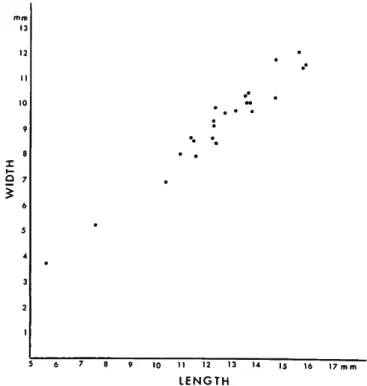
DESCRIPTION.—Medium size, longer than wide, narrowly oval; sides rounded; maximum width at midvalve. Anterior margin narrowly rounded; posterolateral margins forming angle of 58°-82°. Lateral commissiu-e gentiy curved toward the ventral side; anterior commissure rectimarginate to faindy uniplicate. Beak short, truncated; foramen large; deltidial plates small. Surface fmely costellate, costeUae strongest at posterior, increasing by bifurcation and implantation in 5 generations; 6 costellae in 1 mm at anterior margin; 4 in 1 mm at midvalve of a specimen 14 mm long.
Ventral valve moderately and gendy convex in lateral profile and anterior view, less convex than dorsal valve in same views.
Umbonal region weU rounded and swollen, swelling extending
8 X I—
Q 7
10 I I 12 i:
tENGTH
'4 15 16 17i
FIGURE 1.—Scattergram showing widthAength relationship of 24 specimens of Terebratulina lachryma (Morton) from South Carolina locality 2.
10 SMITHSONIAN CONTRIBUTIONS TO PALEOBIOLOGY
mm
to CO UJ
Z
^ U I 1—
12 11
10 9
8
7
6
5 • • • * •• •
•
•
• •
• •
• •
•
•
• • •
9 10 11
W I D T H
FIGURE 2.—Scattergram showing thickness/width relationship of 24 specimens of Terebratulina lachryma (Morton) from South Carolina locality 2.
to midvalve, dissipating anteriorly widi flattening of shell.
Posterolateral slopes rounded and steep. Interarea narrow.
Dorsal valve more convex than ventral valve in umbonal region in lateral view; anterior profile narrowly domed with long steep slopes. Umbonal and median regions swollen;
anterior half flattened.
Ventral valve interior with large teeth and short, excavate pedicle coUar.
Dorsal valve interior with fairly large elliptical cardinal process; socket ridges short, thin; crura slender, bowed; ring small, delicate, not complete in some fuUy grown specimens, complete in some only 9 mm long.
MEASUREMENTS.—^All measurements are in mdUmeters, except apical angles, which are in degrees; questionmark indicates angle could not be measured.
GEOLOGICAL OCCURRENCE.—^Eocene (Santee Formation).
LOCALITIES.—South Carolina 1, 2.
TYPES.—Hypotypes: USNM 550883a,b; 551514a-e; 551516a- d; 551516-1-28; 551526a.
DISCUSSION.—Terebratulina lachryma (Morton) differs from T. capillata, new species, chiefly in its narrow form, lesser
apical angle and more delicate loop. Occasional large specimens of T. lachryma, such as USNM 551516-25, approach adult T. capillata in size and general appearance, but the bulk of the specimens have a smaller apical angle and more slender form. (See discussion under T. wilsoni, new species, for distinction between the two species.)
Terebratulina wilsoni, new species
FIGURES 3, 4; PLATE 1: FIGURE 15; PLATE 6: FIGURES 29-36
DIAGNOSIS.—Medium size Terebratulina, widest at mid- valve and with ears obsolete.
DESCRIPTION.—Medium size, oval, longer than wide; maxi- mum widdi at midvalve; dorsal valve slighdy deeper than ventral one; sides rounded, anterior margin narrowly rounded;
posterolateral extremities forming angle of 67°-91°. Lateral commissure gentiy concave toward the ventral side; anterior commissure rectimarginate to gendy uniplicate. Beak short, truncated; foramen small, deltidial plates small. Surface variably multicosteUate, costellae intercalated in five genera- tions; strongest posteriorly, becoming flattened and often obscure anteriorly.
Ventral valve evenly and moderately convex in lateral profile, broadly and gentiy convex in anterior view. Umbonal region narrowly swollen, swelling continued to midvalve, flattened in anterior third to half to produce indistinct sulcus.
Flanks bounding posterolateral margins rounded.
Dorsal valve moderately convex in lateral view, slightiy more so than the ventral valve, narrowly humped in anterior view. Umbonal region swollen, sweUing continued to anterior margin forming narrow fold and somewhat nasute anterior.
Flanks steep; ears much reduced.
Ventral valve interior with short anteriorly excavate pedicle coUar, elongate teedi; muscle scars lightiy impressed.
USNM 551516-25 551516-24 551516-23 551516-18 551516-12 551516-22 551516-26 551516-27 551516-28
Length 16.2 16.0 15.9 14.8 13.7 11.6 10.2 7.6 5.6
Dorsal valve length
15.5 14.5 14.5 13.5 12.6 10.5 9.1 7.0 5.0
Width 12.5 11.5 11.4 10.2 10.4 7.9 7.3 5.2 3.7
Thick- ness 7.8 8.3 7.8 7.1 6.3 5.8 5.0 3.6 2.5
Apical angle 82 66 74 70 70 62 69 65
7
X 1—
D
i
• • *
*•*.* :
4 5 6 7 8 9 10 '1 12 13 14 15 16 17 18mm LENGTH
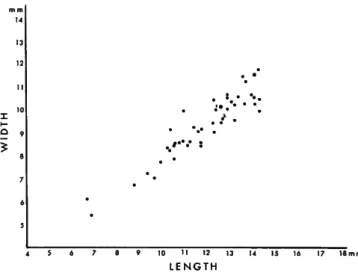
FIGURE 3.—Scattergram showing width/length relationship of 51 specimens of Terebratulina wilsoni, new species, from South Carolina locality 4. (The digit "2" over a dot indicates 2 specimens.)
NUMBER 64 11
mm 9 8 lO 7 lO UJ
Z 6
u E '
V / I D T H
FIGURE 4.—Scattergram showing thickness/width relationship of 51 specimens of Terebratulina wilsoni. new species, from South Carolina locality 4. (The digit "2" over a dot indicates 2 specimens.)
Dorsal valve with short, erect socket ridges extended posteriorly; cardinal process smaU; loop about one-difrd valve length, about one-foiuth its width; crura widely bowed; crural processes smaU, sharply pointed in some specimens, coalesced to form small ring in older specimens. Pedicle muscle scars narrow, elongate, separated by low ridge; adductor scars elongate, reaching midvalve.
MEASUREMENTS.—^All measurements are in mdUmeters, except apical angles, which are in degrees.
USNM 551515a 551515b 551515-1 551515-5 551515-7 551515-21 551515-24 551515^2 551515-26
Length 14.2 12.7 14.8 13.8 12.8 11.7 10.0 8.6 6.7
Dorsal valve length
12.5 11.3 13.3 12.2 11.0 10.5 8.6 7.6 5.7
Width 11.5 10.1 13.0 10.2 9.6 9.0 7.7 7.3 6.1
Thick- ness
7.7 6.4 7.4 7.7 7.4 6.2 4.7 4.2 3.3
Apical angle 84 83 91 76 75 75 77 83 83
GEOLOGICAL OCCURRENCE.—Eocene (Cross member of the
Santee Formation).
LocALTiTEs.—South Carolina 3,4.
TYPES.—Holotype: USNM 551515a; paratypes: USNM 551513; 551515b,c; 551515-(l-50).
DISCUSSION.—This is a variable species with a smaU percentage of specimens having a shallower, wider valve than the majority. Very young specimens often have beaded costellae, especiaUy in the posterolateral regions, and well- defined dorsal ears that are much reduced in the adult.
In the growth of the shell, there is intercalation of costeUae at a very early stage. On a specimen 1.5 mm long, all of the 10-12 costellae are direct A specimen 2.5 mm long has a fu-st
generation of intercalated costellae at about 2 mm. A specimen 4.5 mm long has bifurcation as well as intercalation of costeUae at about midvalve. In a specimen 5 mm long anodier set of costellae appears, and a specimen 7.5 mm long has 3 intercalations.
This species differs from T. lachryma (Morton) m its more convex valves when viewed from die anterior, its undefmed dorsal valve ears, narrower anterior, and finer ornament, especially on die anterior parts. It differs from T. capillata, new species, in its generaUy smaller size, more inflated dorsal valve and narrower oval outiine. It differs from T brundidgensis Aldrich and T. alabamensis, new species, in its quite different ornament from that of the other two.
Named in honor of Dr. Druid Wdson whose great knowledge of die Tertiary of eastern United States has helped me in preparation of diis manuscript.
Terebratulina species
PLATE 3: FIGURES 20-29
DESCRIPTION.—Small, oval, sides and anterior rounded, posterolateral margins forming angle of 80°-90°, Ventral valve deeper than dorsal one. Anterior commissure rectimarginate.
Surface costellate in 4 generations. Loop with stout, subparellel crura and narrow ring.
MEASUREMENTS.—All measurements are in mdUmeters, except apical angles, which are in degrees.
USNM 145613a 145613b 145613c
Length 10.4 11.6 8.9
Dorsal valve
length Width 8.2?
9.4
10.5 8.8 8.9 7.6
Thick-
4.6 5.4 3.5
Apical angle 81 84 90
GEOLOGICAL OCCURRENCE.—Ohgocene (Jackson Group).
LocAUTY.—Alabama 6.
SPECIMENS EXAMINED.—USNM 145613a-d.
DISCUSSION.—Most of the specimens of this species are distorted by crushing. An uncrushed specimen (USNM
145613b) indicates a less rotund species than T. alabamensis.
new species, large specimens of which tend toward a circular outUne. Terebratulina species does not tend to the elongate oval form of T. lachryma (Morton), although these specimens were originaUy placed in that species.
Genus Eucalathis Fischer and Oehlert, 1890 Specimens of Eucalathisl are uncommon and the generic identification is uncertain because die nature of the loop has not been determined. The relatively wide hinge of the specimens noted below is suggestive of Eucalathis rather than Terebratulina, and the specimens differ strongly in shape and ornamentation from the young of Terebratulina. Eucalathis is widespread in modern seas and can be expected in the Tertiary.