All rights reserved. The Southern Baptist Theological Seminary has permission to reproduce and disseminate this document in any form by any means for purposes chosen by the Seminary, including, without limitation, preservation or instruction.
FACTORS INFLUENCING LEADERSHIP DEVELOPMENT STRATEGIES
A Dissertation Presented to the Faculty of
The Southern Baptist Theological Seminary
In Partial Fulfillment
of the Requirements for the Degree Doctor of Philosophy
by Jong Keol Yoo
May 2005
Copyright 2005 by Yoo, Jong Keol (Jacob)
All rights reserved.
INFORMATION TO USERS
The quality of this reproduction is dependent upon the quality of the copy submitted. Broken or indistinct print, colored or poor quality illustrations and photographs, print bleed-through, substandard margins, and improper alignment can adversely affect reproduction.
In the unlikely event that the author did not send a complete manuscript and there are missing pages, these will be noted. Also, if unauthorized copyright material had to be removed, a note will indicate the deletion.
®
UMI
UMI Microform 3173119
Copyright 2005 by ProQuest Information and Learning Company.
All rights reserved. This microform edition is protected against unauthorized copying under Title 17, United States Code.
ProQuest Information and Learning Company 300 North Zeeb Road
P.O. Box 1346 Ann Arbor, MI 48106-1346
TRAINING CHINESE HOUSE CHURCH LEADERS:
FACTORS INFLUENCING LEADERSHIP DEVELOPMENT STRATEGIES
Read and Approved by:
George H. Martin
./ James D. Chancellor
Jong Keol (Jacob) Yoo
THESES Ph.D . . Y8t 0199701934952
my partner, my love, and to
my sons, Jae Gun and Jae Gil
Page
LIST OF TABLES . . . .. . . .. viii
LIST OF FIGURES ... IX PREFACE ... Xl Chapter 1. INTRODUCTION ... 1
Thesis ... 3
Background of the Proposal ... 14
Limitations ... 16
Research Methodology ... 16
2. THE HISTORY OF CHRISTIANITY IN CHINA. . .. . . .. . .. 18
The Early History of Christian Missions to China, 635-1784 . . . .. 19
Christian Missions during the Tang Dynasty (635-845) ... 20
Christian Missions during the Yuan Dynasty (1271-1368) ... 23
Christian Missions during the Late Ming through Mid-Qing Dynasties (1582-1784) ... 28
Imperialism and the Protestant Missions to China, 1807-1900 ... 34
Formation of the Chinese Church (1807-1842) ... 36
IV
Period of Coastal Missions (1842-1860) ... 40
Period ofInland Missions (1860-1900) ... 42
Nationalism and the Independent Church Movement, 1901-1949 ... 47
Sun Yat-sen and the Chinese Nationalist Party ... 48
The Church-Coalition Movement . . . .. 49
The Anti-Christian Movement ... . . . .. 51
The Indigenous Church Movement ... 53
The Revival Movement ... 58
Conclusion ... 63
3. COMMUNISM AND THE HOUSE CHURCH MOVEMENT ... 65
Formation of the House Church Movement, 1949-1965 ... 67
The Churches in 1949 . . . .. 67
The Communist Government's Religious Policy . . . .. 69
The Resistance of the House Churches . . . .. 72
Persecution and Survival of the House Church, 1966-1978 . . . .. 73
The Cultural Revolution (1966-1976) ... 73
Persecution against the Protestant Church ... 74
Survival of the House Church ... 74
New China and House Church Growth, 1979-Present ... 76
New Religious Policy . . . .. 77
The Revival of Christianity. . . .. 83 v
The House Church Movement in China . . . .. 84
Conclusion ... 98
4. THE URGENT NEED FOR LEADERSHIP TRAINING . . . .. 101
Problems the House Church Must Solve ... 102
The Current Leadership-Training Situation ... 116
Leadership Training for the TSPM Churches . . . .. 116
House Church Leadership Training ... 129
House Church Leadership Training Structure ... 135
Theology of the House Church ... 136
Conclusion ... 138
5. INFLUENTIAL FACTORS FOR DEVELOPING LEADERSHIP-TRAINING STRATEGIES ... 140
Survey Results. . . .. 141
Analysis of Grouping A (Comparison by Nationality) . . . .. 143
Analysis of Grouping B (Comparison by Province) ... 146
Analysis of Grouping C (Comparison between Rural and Urban Areas) ... 148
Analysis of Grouping D (Comparison by Gender) ... 150
Analysis of Grouping E (Comparison by Generation) ... 151
Ten Factors That Should Be Considered in Developing Chinese House Church Leadership-Training Strategies . . . .. 152
Economic and Geographic Factors ... 153
VI
Appendix
Relationship with the TSPM Church 164
Cultural and Historical Factors . . . .. 167
Chinese Intellectuals . . . .. 170
Political Factors ... 175
Influence of Four Leaders ... 179
Korean People's Role ... 185
Groups in the House Church. . . .. 191
Women in Church Leadership ... 196
Effect of the "One-Child Policy" ... 198
Suggested Models ... 200
Conclusion 203 1. SURVEY QUESTIONNAIRES. . . .. 206
2. SURVEY QUESTIONNAIRES (IN CHINESE) . . . .. 210
3. SURVEY QUESTIONNAIRES (IN KOREAN) ... 214
4. TABLES AND FIGURES FOR THE GROUPING A ANALYSIS ... 218
BIBLIOGRAPHY ... 226
VB
Table Page
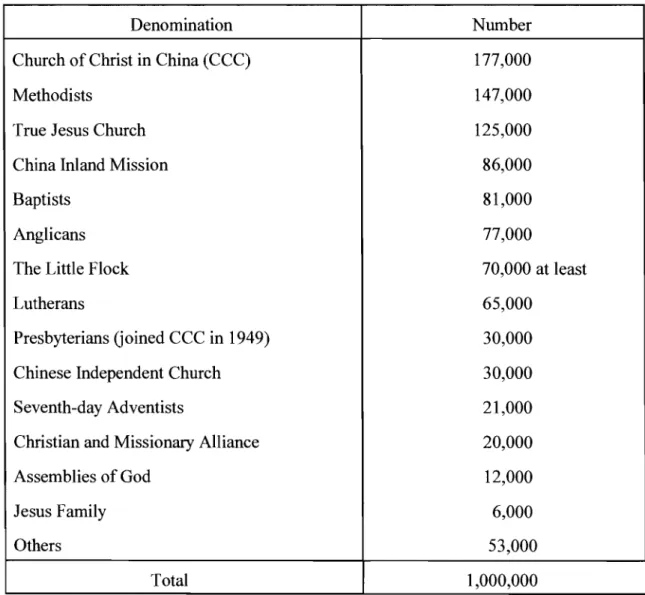
1. The number of Christians in China in 1949 ... 68
2. The List of the TSPMlCCC Seminaries ... 120
3. Jinling (Nanjing) Union Theological Seminary Curriculum (for freshmen) ... 123
4. Jinling (Nanjing) Union Theological Seminary Curriculum (for sophomore) ... 124
5. Jinling (Nanjing) Union Theological Seminary Curriculum (for juniors) ... 125
6. Jinling (Nanjing) Union Theological Seminary Curriculum (for seniors) ... 126
7. Profile of Respondent Grouping A-I ... 143
8. Profile of Respondent Grouping A-2 ... 144
9. Comparison of the Christian Presence by Province ... 157
10. The Christian Presence in Autonomous Regions ... 158
11. The Christian Presence in Special-Status Cities ... 158
12. Christian Presence in China ... 159
V111
Figure Page
1. The Composition of the Respondents 104
2. Most Urgent Need for the Chinese House Church ... 104
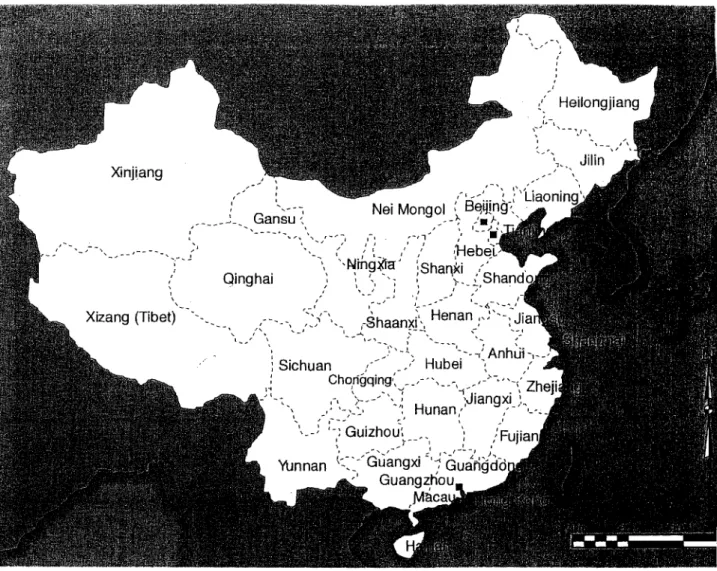
3. Provinces of China ... 119
4. Comparison between House Church Leaders and Missionaries ... 145
5. Comparison by Province ... 148
6. Comparison between Rural and Urban Areas . . . .. 149
7. Comparison by Gender ... 150
8. Comparison by Generation ... 151
9. Opinion concerning "Economic and Geographic Factors" ... 156
10. Opinions concerning "Relationship with the TSPM Church" . . . .. 166
11. Opinions concerning "Cultural and Historical Factors" ... 169
12. Opinions concerning "Chinese Intellectuals" ... 174
13. Opinions concerning "Political Factors" . . . .. 178
14. Opinions concerning "Influence of Four Leaders" ... 183
15. Opinions concerning "Korean People's Role" ... 190
16. Opinions concerning "Groups in the House Church" ... . . . .. 196
17. Opinions concerning "Women in Church Leadership" . . . .. 197
IX
18. Opinions concerning "Effect of the 'One-Child Policy" . . . .. 199
x
Many deserve credit for this work. Dr. 1. Mark Terry, my supervisor, has become an initiator and a facilitator of this project. He always has been available for any kind of help, and has been quick in responding. He and his wife, Barbara, are going to the mission field again. His passion for world missions and compassion for people have made him my life and ministry model. I wish that God would lead me to work with them someday. Drs. George H. Martin and James D. Chancellor have humbly offered me their kind encouragement and friendship.
This work could not have become a reality without survey participation by Chinese house church leaders and foreign missionaries who work for Chinese churches. I am sorry that their names cannot be published for their safety. I am impressed by their sacrificial work for the Lord, risking their lives. I hope that this work will benefit the Chinese churches they love. They deserve my loving heart and earnest prayer.
The True Light Korean Baptist Church and Bethany Baptist Church congregations-Louisville, Kentucky-have encouraged me through the research and writing process. Their support and prayers have given me the strength to continue and complete this enduring job. Marilyn Anderson deserves special thanks for her excellent proofreading and editing jobs.
My wife, Suk Hee, deserves my lifelong deep appreciation. She and our
Xl
Finally, God is the only one who is glorified through this work. He called me to do His job. He has been faithful to guide and provide for me during my journey to follow His Son. It was by His grace that I have completed this work. To Him be the praise forever.
Louisville, Kentucky May 2005
XII
long Keol Y 00
INTRODUCTION
The survival and dramatic growth of the church in China during Communist rule was one of the most decisive events of the Christian history in the twentieth century.
Patrick Johnstone writes, "The growth of the Church in China since 1977 has no parallels in history. The 1,266,000 Protestant members and 1.8 mill. affiliates in 1949 [the year of Communists ' takeover] had become seventeen million members and maybe twenty-six million affiliates in 2000 as well as a much larger uncounted, but estimated, forty-five million house church Christians. The Catholics grew from three million to twelve million over the same period."!
Various reports estimate the number of Christians in China. According to an article by Tony Lambert, Director of Research for Chinese Ministries for OMF
International, two former leaders of the Chinese house church movement now living in the United States of America report the number of Christians in China as more than one- hundred million. This is one of the highest estimations in circulation. "The official Chinese Three-Self Church says there are six million Christians (three million Protestants and three million Catholics), while some evangelical agencies take into account what
!Patrick Johnstone and Jason Mandryk, Operation World: When We Pray God Works (Carlisle, UK: Paternoster Lifestyle, 2001), 161.
1
they call 'secret believers' [house church members] and put the figure at between 25 and 50 million."2
Although the statistics are inconsistent, we notice that there has been a
dramatic multiplication of house churches during the past three decades of isolation from the Western Church due to the Communist regime's anti-Christianity policy. The house churches have survived and revived despite severe persecution during the Cultural Revolution (1966-76). Isolation led the church to indigenization, while persecution led to purification. Most evangelicals agree that "the unregistered house churches are the heart of the true Church in China."3
Intense persecution by the government has hindered leadership training for the church. Numerous leaders, many of whom are women, hail from rural areas. Lack of formal training and Bible teaching leads many house churches to legalistic and heretical extremes. Johnstone explains the multiplication of heretical sects and doctrinal extremist groups: "The lack of Bible knowledge and of mature leadership has opened the way for many exotic messianic, syncretistic and divisive groups, some of which have spread over much of China. In some areas they now constitute five percentage or more of the
unregistered church population.,,4
Many innovative leadership training methods have been developed to meet this urgent need. Numerous leaders of house church networks have been trained at
2Tony Lambert, "Counting Christians in China: A Cautionary Report,"
International Bulletin of Missionary Research (January 2003): 6.
3Johnstone and Mandryk, Operation World, 164.
4Ibid.
theological camps in secret places in the mountains or secure houses. Chinese Christian scholars from Hong Kong, Taiwan, and Singapore visit the training camps to teach.
Missionaries and Christians from the West or Korea support this kind of leadership training ministry. Christian literature, videos, Christian radio programs, and the Internet are being used to support the leadership training of house church leaders.5
Thesis
The need for effective leadership training for Chinese house church leaders is enormous, urgent, and crucial for the future of the Chinese church. The methods
mentioned above are just adaptations to emergency situations. Long-term base strategies should be developed. There is a concern that unthoughtful approaches might ruin the unity and independence of the Chinese church. Jonathan Chao says, "Many of us
Chinese Christians overseas, as well as Chinese believers on the mainland, share the fear that American and other foreign missions would reintroduce denominational or
organizational division, the corrupting influence of foreign funds, and enslavement of Chinese indigenous churches by Western missionaries who exercise control through funding.,,6 Many factors should be considered when outsiders, like Western
missionaries, develop the strategy.
The first factor is cultural and historical. The Chinese people take strong pride in their history and culture. China's recorded history (civilization) began more than four thousand years ago. Despite frequent political and social upheavals in its long history,
5Ibid., 165.
6Jonathan Chao, "A Response: Yes, But We Must Learn to Work with the Chinese Churches," Evangelical Missions Quarterly (January 1995): 18.
China was always one nation. Chinese culture has developed with relatively little outside influence. Even when the country was invaded by other peoples, such as the Manchurians and Mongolians, these groups were soon absorbed into Chinese culture.7 This tradition caused the Chinese people to have an unshakable pride in their nation and culture. The era of Protestant missions in China coincided with Western colonialism and imperialism in the nineteenth century. The Opium War (1839-1842), the most frequently cited example of ruthless colonialism,8 could be taken to mark the beginning of
nationalism in China.9 After this humiliating occasion, for most Chinese people
(especially Communists), the Christians were seen as advocates of Western imperialism.
Chinese Christians as well as foreign missionaries were always the enemies of those wishing to reconstruct China. There still are strong anti-foreign sentiments and pressure on the Chinese church to maintain independence from foreign influence.
The second factor is political. The appearance of the Chinese Communist regime in 1949 was the direct result of its unique nationalism. The Communist
government renounced all things foreign except Marxism. Christianity was considered a means of Western imperialism. The government made every effort to "break the
church's ties with the West and make them subservient to the State in the 1950s.")0 By 7Encyclopaedia Britannica, 15th ed., s.v. "China," 36.
8Wayne Dehoney, The Dragon and the Lamb (Nashville: Broadman, 1988), 16.
9Ming Ng Lee, "Christianity and Nationalism in China," East Asia Journal of Theology 1 (1983): 72.
)OThomas Wang and Sharon Chan, "Christian Witness to the Chinese People,"
Perspectives, 3rd ed., (Pasadena, CA: William Carey Library, 1999), 640.
1958, this goal to "liberate the church from the control of Western imperialism"l1 had been achieved through the Three-Self Patriotic Movement among Protestants and the Catholic Patriotic Association among Catholics. Although churches in the same area had different denominational backgrounds, they were merged by the government. During the Cultural Revolution (1966-1976), the most disastrous venture of Mao Zedong's regime, even these structures were criticized and destroyed by the Red Guards. During the Cultural Revolution, all religious activities went underground, and the house church movement started.12 After the death of Mao Zedong in 1976, China began to adopt more moderate policies under the leadership of Deng Xiaoping. He opened the bamboo curtain of China and welcomed the Westerners to help save and reconstruct China from its prolonged turmoil. Although his methodology for China's reformation was
completely contrary to Mao's policies, Deng's basic ideology was still Communist. His goal was to build a Communist society through China's modernization.13 Despite the death of Deng, the government's policy is still the same: maintaining the balance between autonomy of the church and loyalty to the nation through the Three-Self Patriotic Movement. Now the Chinese government is preparing for the 2008 Beijing Summer Olympics. Will there be any change of the policy toward religions (especially toward Christianity)? If there is a policy change, will it be in the open or strict direction?
The third factor is economic and geographic. China has become one of the IIPatrick Johnstone, Operation World: The Day-by-Day Guide to PrayingJor the World, 5th ed. (Grand Rapids: Zondervan Publishing House, 1993), 164.
12Dehoney, The Dragon and the Lamb, 22.
13David H. Adeney, China: The Church's Long March (Ventura, CA: Regal Books, 1985), 115.
fastest growing countries since late 1970 when the country opened its doors to foreign trade. China has already become a world-level trading nation. Its economic influence competes with that of Japan. This economic success has improved the people's living standards in general. The benefit of this growth, however, has not been even. Very wealthy individuals have emerged from several coastal economic cities, such as Shanghai, Hong Kong, and Shen Zhen. Western capitalism and secularism strongly influence the people living in these kinds of mega-cities. Now they are eagerly pursuing money and success for their family's happiness. They are too busy to pay attention to their spiritual fate. This materialism is also causing moral decline. 14 Individuals who reside in inland provinces are much poorer. People in urban areas are living in better conditions. People who live in rural areas are extremely poor. 15 College graduates are gathering more and more into the coastal cities to look for jobs that pay almost three times as much as do jobs in the inland provinces. They usually work in foreigner owned factories. This environment offers good opportunities for Christians to share the gospel with them.
The fourth factor is the influence of four Chinese indigenous leaders, namely John Sung, David Yang, Watchman Nee, and Wang Ming-dao. 16 They had great influence on the formation of the Chinese house church. During the first half the
14Johnstone and Mandryk, Operation World, 161.
15Daniel H. Bays, "Chinese Protestant Christianity Today," The China Quarterly (June 2003): 501.
16Samuel Mau-Cheng Lee, "A Comparative Study of Leadership Selection Processes among Four Chinese Leaders" (D. Miss. diss., Fuller Theological Seminary, 1985), xi.
twentieth century, the Chinese church "enjoyed a period of temporary but significant growth" with the support of Western missionaries. 17 As a growing number of intellectuals suspected Christianity "as the tool of foreign imperialism," the Anti- Christian Movement (1922-1927) quickly gained power. Because foreign missionaries were not successful in training much-needed indigenous leaders, Chinese Christians attempted to indigenize their church. The four leaders, who were all contemporaries in age, exercised their leadership during the first half of the twentieth century in the
formation of the Chinese indigenous church-the House Church Movement. All of them were powerful preachers and suffered for the Lord under the Japanese and Communist regimes.
John Sung (1901-1944) was "a highly effective evangelist. From 1932 to 1934 he joined the Bethel Evangelistic Band, traveled 54,823 miles, preached at 1,199 meetings, and spoke to over 400,000 people. Over 18,000 were converted. He began traveling in Southeast Asia in 1935. His preaching was centered on the need for
thorough repentance. Numerous Christians in China and Southeast Asia can trace their conversion or total consecration to the preaching of John Sung.,,18 David Yang (1898- 1966) was a prominent pastor and educator. His sphere of influence, through his ministry and his famous evangelistic team known as the Spiritual Action Team,
encompassed numerous churches scattered throughout China. Despite turmoil caused by a Communist-inspired anti-Christian movement in 1926 and the Japanese invasion in
17Ibid., x.
18Samuel Ling, "Sung, John (1901-44)," in Evangelical Dictionary o/World Missions, ed. A. Scott Moreau (Grand Rapids: Baker, 2000), 918.
1939, his influence was still strong through his followers. 19 "When the Communists took control of China in 1949, Yang was pastoring two churches, one in Nanking and the other in Shanghai, besides teaching at the China Bible Seminary. Soon persecution came ... he was accused of collaborating with 'foreign devils,' ... was made to assist in productive labour, and ultimately died of
a
heart attack.,,20Watchman Nee (1903-1972) was a preacher, theologian, and author. His worldwide influence was felt through his books such as The Spiritual Man and The Normal Christian Life. Samuel Ling said,
His theology is characterized by a heavy emphasis on man as body, soul, and spirit.
. .. He taught that there should be one church per location; denominational connections are anti-biblical. He was later imprisoned [and killed] by the communist government. He deeply influenced the life and witness of the house churches in mainland China, and numerous Christians outside China. One of his followers [known as Little Flock], Witness Lee, developed his thought further into the aberration known as the 'Local Church Movement,' based in the United States.21
Wang Mingdao (1900-1991) was a prominent preacher and contemporary model of suffering and triumph. He emphasized repentance, faith, and regeneration shown by a radical change in believers' lives. He suffered at the hands of the Japanese invaders and was imprisoned by the Communist regime later. "For the first fourteen months, Wang was subjected to continuous psychological pressures. He was released after signing and reading aloud a 'self-criticism,' which the Three-Self had written for him. His public confession caused many of his Church members to fall, and when he
19Samuel Lee, "A Comparative Study of Leadership," 31.
2°Ibid., 31-32.
21Samuel Ling, "Nee, Watchman (Ni Tuo-sheng) (1903-72)," in Evangelical Dictionary o/World Missions, ed. A. Scott Moreau (Grand Rapids: Baker, 2000), 672.
realized what he had done, he greatly regretted it and promptly went back to prison where he was to remain for the next twenty-one years. He was released in December
1979."22
These four leaders are heroes for Chinese Christians. They separated themselves from the Western church, even though all of them were strongly influenced by Western missionaries. Through their influence, the house churches have been rapidly indigenized and multiplied with the characteristics of being "largely evangelical in theological commitment and faithful in personal dedication.'m Christian mission leaders, like Ralph Covell and Jonathan Chao, are concerned about the future when the Chinese government opens the door to Christian missions. Their concern is preventing foreign missions from destroying "the spirit of independence.',24 It is crucial to find an effective strategy without destroying the Chinese church's independence and the legacies of the four Chinese indigenous leaders.
The fifth factor is understanding the different groups (sects) in the Chinese house churches. Under the influence of the four leaders mentioned previously, there are three major groups?5 One is the evangelicals. They are usually the people influenced by the revivals that numerous evangelists, like John Sung and Wang Ming Tao, led in the first half of the twentieth century. Another group is the Little Flock, the followers of Watchman Nee. This is the most influential group of the house churches. The Little
22Samuel Lee, "A Comparative Study of Leadership," 48-49.
23Ibid., 55.
24Chao, "A Response," 18.
25Lambert, "Counting Christians in China," 8.
Flock churches are somewhat exclusive and have a strong anti-denominational
sentiment. The last group is the Charismatics, who are influenced by the Pentecostal and Charismatic movement of the second half of the twentieth century. They emphasize the gifts of the Holy Spirit, such as speaking in tongues, prophecy, and divine healing. Each of these three major groups takes strong pride in its heritage and is somewhat exclusive.
Dealing with each group separately is necessary to plan an effective strategy for leadership development.
The sixth factor is the relationship between the house church and the Three- Self6 Patriotic Movement (TSPM) church. There are two kinds of Protestant churches in China. One is the house church, and the other is an officially registered TSPM church.
The majority of Protestant Christians belong to unofficial house churches.27 The word
"hatred" summarizes their relationship. The Chinese Communist government supports and supervises the TSPM churches. The government pays the salary of the pastors and controls every aspect of the ministry, including sermons and seminary training. The TSPM pastors cannot teach or preach on the resurrection, the Holy Spirit, and the Second Coming of Jesus. Although the TSPM members are usually nominal Christians, there are many true believers in the TSPM churches who want to practice their faith in the officially recognized setting. Some TSPM believers whose souls feel empty for this reason leave TSPM churches and join the house churches. TSPM believers thus blame the house church believers as "a thief of sheep;" they report their existence to the
26The three elements in the indigenous church formula: self-government, self- support, and self-propaganda.
27Daniel L. Overmyer, "Religion in China Today: Introduction," The China Quarterly (June 2003): 313.
government; and the house churches are persecuted. Therefore, the house church believers consider the TSPM church as "a synagogue of Satan." Understanding this relationship between the two Chinese Protestant Christian churches is crucial to developing an effective leadership-training strategy.
The seventh factor concerns women in the Chinese-Church leadership. A significant number of women hold house-church leadership positions unlike in other countries' Christian churches.28 Traditionally, women's status in Chinese society had been much lower than that of men because of Confucius's gender ideology. The Communist regime under the leadership of Mao Zedong, however, liberated women from housework to mobilize them in the development of the nation. Since then, Chinese women have often been found in the leadership of every field in society. The other reason for this phenomenon is that the house church meets in a home, where a woman's influence is strong. This situation can cause some problems when the Western Church approaches women with its own theology concerning them. A theological decision about women's leadership must be made before a leadership-training strategy is developed.
The eighth factor is the effect ofthe "One-Child Policy," which the
Communist government started to reduce population growth. Operation World reports,
"Family life has been deeply impacted, shown in: a higher divorce rate, ten million abortions a year (nearly all girls), suicide (40% of the world's suicides are in China), pampered children with poor interpersonal skills, and abandonment of baby girls and older people. The rising generation will pay a heavy cost-in 2000 there were ninety million marriageable unmarried men; in some areas young men outnumber young
28Johnstone and Mandryk, Operation World, 164.
women by 30-40o/o--rape, abduction, female slavery, incest, prostitution and rapid spread of AIDS could all be the result.,,29 These young people soon will be the leadership- training candidates for the Chinese Church. They will have these same problems despite their faith in Christ. A very careful strategy should be developed for effective leadership training.
The ninth factor concerns Chinese intellectuals on the mainland and overseas.
"Since the 1980s, about 100,000 Chinese students and scholars have come to North America. Most of those Chinese intellectuals' faith in Marxism has been virtually demolished after a series of political persecutions. Therefore, North America has become one of the most fruitful mission fields to those Chinese intellectuals.,,30 Among them, an increasing number of Chinese intellectuals are interested in Protestant
Christianity. Daniel H. Bays writes, "Some intellectuals have actively advocated China's adoption of some aspects of Christianity as part of its own modernization efforts, and a certain number of these intellectuals have themselves become Christians.,,3!
The 1989 Tiananmen Square incident opened the door for Chinese intellectuals to discredit their government and Communism.32 They experienced a spiritual vacuum in their hearts. As a result, significant numbers of them have turned their interest to Christianity. Since the "Open Door Policy" of Deng Xiaoping in the late
29Ibid., 162.
30Tsu-Kung Chuang, "The Factors Influencing the Conversion of Mainland Chinese Intellectuals toward Christianity in North America" (Ph.D. diss., Trinity Evangelical Divinity School, 1995), iii.
31Bays, "Chinese Protestant Christianity Today," 498.
32Johnstone and Mandryk, Operation World, 161.
1 970s, Chinese students have poured out into the Western world, including Christian countries, such as the United States, Canada, and the United Kingdom. Christians in those countries are struggling to evangelize them because they are elites who will have strong influence on their country. Now the vast missions field is on their doorstep. In Western countries, Chinese intellectuals have more freedom to experiment with Christianity, and many are accepting its truth. They can be excellent future candidates for Chinese-Church leadership. But they usually consider Christianity as a Western religion. Removing that idea of foreignness from Chinese intellectuals will be a crucial point in the process of making disciples. Now the Chinese house churches are suffering from a lack of well-educated leadership. These intellectuals can be the solution to this problem. Most house churches are located in rural areas though, while the intellectuals are usually urbanized. Having them serve as leaders in rural areas will be another crucial point in developing an effective strategy.
The tenth factor is the growing importance ofthe Korean people's role in the evangelization of China. The Chinese government still refuses visas for missionaries.
China fears the effect of Western influence on its people. The proselytization of China's people by foreigners is strongly forbidden by law, while Chinese people can share their beliefs with other Chinese people except for youth who are below eighteen years of age.33 If an individual meets Western people privately without reporting it, the governmental authorities of some provinces will scrutinize and persecute him or her. Thus, the
Chinese-Church leaders do not want to meet Western people even though they want their
33Jonathan Chao, ed., China Mission Handbook (Hong Kong: Chinese Church Research Center, 1989), 38.
support. Rather, they want to meet people who resemble themselves.
In fact, Chinese people from Hong Kong, Taiwan, Singapore, and Western countries have helped the Chinese church a great deal. But the number of Korean people-such as missionaries, Christian students, and Christian businessmen-is rapidly growing in the field of evangelism.34 They are usually well-trained Christians, who look like the Chinese. Because Chinese people cannot distinguish Korean people from themselves, Koreans can visit house churches and meet house church leaders secretly.
They understand Chinese culture and easily learn the Chinese language. Their supporting churches, which are close to China, have a strong missionary commitment. Strangely enough, there are more theological students in Korea than there are available positions.
There are about 280 theological institutions in South Korea, most of which are full of students. Many of them are ready to go to the mission field. Thousands more Korean students are pursuing higher degrees, such as doctorates, in North American seminaries.35 The Korean church has abundant human resources for missions to China. Cooperation with the Korean people for the evangelization of China is one of the essential factors for developing an effective strategy for leadership training in the Chinese Church.
Background of the Proposal
Since I confirmed my calling to become a missionary to China in 1997, I have studied missions to China. When I was admitted to the Ph.D. in Missiology program of the Billy Graham School of The Southern Baptist Theological Seminary, my
34Ibid., 389.
35Ibid., 388.
supervisor-Dr. John Mark Terry-suggested that I take "How to Train Chinese House Church Leaders" as my dissertation topic. I gladly accepted it because I already knew the urgency of Chinese-Church leadership development. The fact that I am in a doctorate program made me realize that I am called to the ministry of Chinese leadership training.
This topic is best for me, so I have been excited about research on the subject.
I visited China for three weeks during the summer of 2002. This was my first visit to China. I visited the central provinces of China, where one can see the real image of the country. I met several missionaries from the West and South Korea. They taught me about the situation of the Chinese Church, especially that of the house churches.
Some of them had experienced visits to secret places, where house church leaders were trained on a mountain. The missionaries agreed with me about the urgent need for an effective strategy for Chinese leadership training. They told me about unique factors that would affect strategy development. The information that they provided guides my dissertation research. After I complete the dissertation, these missionaries want to read it to help with their work.
The International Mission Board (1MB) ofthe Southern Baptist Convention is the largest and leading missionary agency in the world. It has deployed more than five thousand missionaries throughout the world. China has been one of the most important target areas for the 1MB. For missionary work in China, the 1MB has focused on the house church that Westerners cannot easily approach. I felt that this project would help 1MB's strategy development for China when Dr. Terry, an 1MB consultant, asked me to research this topic. It would be an honor for me, as an 1MB missionary candidate, if I can help to establish an effective strategy.
I could not find any books, dissertations, or articles that cover all my concerns for the dissertation. Some dissertations on the Chinese house church deal only with its formation and development. They do not include the leadership-training issue. Some dissertations cover leadership development for the Chinese Church. Their settings are not the Chinese Church in mainland China, however, but in Macau or Hong Kong.
Some dissertations and articles deal with just some of the abovementioned factors.
Limitations
The target people of this research are the Han Chinese of mainland China, who comprises 91.3 percent of the population. There are 456 ethnic minorities, but fifty-five ethnic groups are officially recognized for administrative convenience.36 The survey was mainly carried out among house church leaders from several provinces. The vastness of the regions and the variety of the situations hindered the generalization of the results.
The final research products can be used as models or suggestions for developing a useful leadership-training strategy for a specific targeted region or people group.
Research Methodology
The important parts of this research are (1) to review other scholars' literature on important factors in developing a Chinese house church leadership-training strategy, (2) to conduct participant observation and examine the situation on location, (3) to conduct formal and informal surveys through interviews and questionnaires on the subject, (4) to analyze all the information with validity and reliability, (5) to find some valuable insights from the analysis, and (6) to suggest some effective strategies based on
36Johnstone and Mandryk, Operation World, 159.
the findings.
For the literary research, I first used my personal library as well as the library of The Southern Baptist Theological Seminary. I already had most articles and
dissertations that relate to my subject. During the summer of 2004, I planed to visit other libraries in China (especially Hong Kong), Taiwan, and South Korea. I knew that a South Korean magazine on Chinese missions has been published for decades. It contains details of the current Chinese situation. I reviewed all the issues of the magazine as part of my literary research. A South Korean missions agency, which was founded by a Taiwanese Christian, has an excellent library for studying the Chinese house church. I visited there. I also used information from the Internet.
When I traveled to China and South Korea in the summer of 2004, I conducted participant observation on location and informal and formal surveys. I visited important places to examine the situation and to interview or survey (with questionnaires) some scholars, missionaries, missions-society leaders, and house church leaders in China. I also interviewed or surveyed some scholars, missionaries, and missions-society leaders in North America and South Korea. The major questions were as follows: (1) What do you think is the current leadership-training situation for the Chinese house church? (2) What do you think are the most important factors for outsiders (Westerners) in
developing an effective strategy for building or supporting Chinese house church leadership? This task involved a security concern. Some sources had to be protected.
THE HISTORY OF CHRISTIANITY IN CHINA
It is difficult to determine when Christianity was first introduced to China.
While the initial stage of the westward spread has been well-known, that of the eastward spread has not been well-known. The first missionary work eastward, including to China, traditionally has been attributed to the Apostle Thomas.' Scholars, however, agree that the history of Christianity in China began with the Nestorian missionaries' arrival in 635, based on a stele discovered in Xi'an, Shaanxi in 1625.2 The stele3 tells of the Nestorian missionaries' arrival through the Silk Road at Chang'an, the capital city of the Tang Dynasty (618-907) in 635. This was the first interchange between the Chinese people
'Kenneth Scott Latourette, A History o/Christian Missions in China (New York: The Macmillan Company, 1932), 48-49. Latourette suggests the breviary ofthe ancient Syrian Church in Malabar, India, that refers to Thomas twice as the man who converted the Chinese and Ethiopians to the truth. But this evidence is too weak to be the basis for the argument.
2Nicolas Standaert, ed., Handbook
0/
Christianity in China (Leiden: Brill, 2001), 15. The date of the discovery is uncertain. This book reads, "An impressivenumber of Western seventeenth-century sources take 1625 as the date of the discovery of the stele. Another plausible date, however, is 1623. It relies upon contemporary Chinese Christian sources, among others, an inscription which Xu Guangqi (1562-1633)
composed for the church at Jiangzhou (Shanxi) in ca. 1630, saying that the stele was found in 1623."
3It was erected in 781, but accidentally was unearthed after almost a thousand years.
18
and Christianity. Since that time, through the present-for almost fourteen hundred years-the Chinese people have been struggling with Christianity, marking a unique relationship mingled with love and hatred. Beginning with the last twenty-five years of the nineteenth century through the present, this contradictory mentality has produced major social, religious, and political movements. Their goal was saving the nation from the humiliation, such as the Unequal Treaties after the Opium Wars, caused by foreign imperialists (mostly the Westerners). Christianity has always been the target of the attack because its image was closely related to Western imperialism. The struggle is ongoing. Today's unique Chinese Christianity is the product of past struggles. It is essential to study the history of Chinese Christianity to understand the current situation and prepare for the future. I will divide the history into four major sections, focusing on a representative movement of each period-( 1) The Early History of Christian Missions to China, 635-1784; (2) Imperialism and the Protestant Missions to China, 1807-1900; (3) Nationalism and the Independent Church Movement, 1901-1949; and (4) Communism and the House Church Movement, 1949-Present. In this chapter, I did not include the history of the last section, Communism and the House Church Movement. I will deal with that section in the next chapter.
The Early History of Christian Missions to China, 635-1784
Christianity reached China more than thirteen hundred years ago, but the Chinese people have been very reluctant to accept it as their religion. There were three major missionary attempts before the Protestant Missionary Movement started in the
nineteenth century: (1) Christian Missions during the Tang dynasty (635-845),4 (2) Christian Missions during the Yuan (Mongol) dynasty (1271-1368), and (3) Christian Missions during the Late Ming - Mid-Qing dynasties (1582-1784).
Christian Missions during Tang Dynasty (635-845)
Nestorian missions. The first recorded encounter between China and Christianity involved the Nestorians. Nestorian Christianity took its name from Nestorius (382-451), who was appointed patriarch of Constantinople in 428, but
condemned as a heretic in 431 at the Council of Ephesus over the issue of Christology.5 He explained that Christ was, in fact, two persons-God and human. Nestorius described the Virgin Mary as the mother of the human son (Christ-bearer), but not of the divine nature (God-bearer). He criticized the worship of Mary and the use ofimages.6 His followers (Nestorians) were severely persecuted by Rome and Constantinople because of his heretical beliefs. They escaped to the Persian empire, and the Nestorian church flourished for several centuries in the east.7 The Persian court probably welcomed Nestorianism as an alternative to Roman Catholicism because of the rivalry relationship with the Roman Empire before the rise of Islam. 8 The Nestorians were zealous in
4This is the year-span that the evidence of Christianity is found during the Tang dynasty. The period ofthe Tang dynasty is 618-907.
5Paul E. Pierson, "Nestorian Mission," in Evangelical Dictionary of World Missions, ed. A. Scott Moreau (Grand Rapids: Baker, 2000), 675.
6Latourette, A History ojChristian Missions in China, 56.
7Standaert, Handbook ojChristianity in China, 1.
8Ibid., 22.
missionary outreach.9 Their missionary enterprises-by merchants and missionary monks- expanded along the Silk Road all over Central Asia, Arabia, and India,1O and finally reached China during the early years of the Tang dynasty. Their missionary work is well-explained in the stele that was discovered in Xi'an (the modern name of
Chang'an, the capital city ofthe Tang dynasty) in 1625.
The monument's inscription discloses information on the history of Christianity in Tang China. It explains the dogma of "Luminous Religion"
(Nestorianism) and gives an account of its story in China, from 635 to 781. According to the inscription, a Nestorian monk named Alopen came from "Ta Chin" (Persia) to
Chang'an in 635. He was accompanied by twenty-one fellow missionaries and brought the texts and images of "the great Religion ofTa Chin."11 The dynasty was friendly to the introduction of new foreign religions to China. 12 Emperor Tai Tsung welcomed the guests and sent the minister of state to escort them to the palace. The emperor himself studied the religion, ordered the translation of their Scriptures, and finally issued an
"edict of toleration" in 638. 13 Alopen built a monastery for the twenty-one monks in the 9Pierson, "Nestorian Mission," 675.
IOStandaert, Handbook of Christianity in China, 1.
IlIbid., 19.
12Ibid., 21. The book says, "Other sources indicate that the international context at the end of the seventh century was strongly influenced by the relations between the Persian and Chinese Empires. The Sassanian Empire had asked China for help after King Yazdergerd III's death in 651 following several defeats against the Arabs in 636-642. His son Peroz had entered the Chinese administration in 661 and sought refuge in Chang' an.
This situation created a climate of general tolerance toward Persians." Foreign religions were also generally accepted because of this mood at that time.
13Ibid., 31.
capital. The new religion gradually spread throughout ten provinces, and monasteries were constructed in several major cities,'4 such as Chang'an, Guangzhou, Luoyang, Zhouzhi, Chengdu, and Dunhuang. '5 The Nestorain monks honored the Chinese culture.
They tried to explain Christianity with the terms of Taoism and Buddhism, and appreciated Confucianism, which was the philosophical and ethical religion of the educated Chinese people.
In 845, Emperor Wu Zong, who was an ardent Taoist, issued an edict that ordered all monks of foreign religions to return to lay life. 16 By that time, Chinese society was struggling externally against the Arabs'7 and internally against the An
Lushan rebellion's in 755. These struggles evoked anti-foreign sentiment among Chinese intellectuals and caused nationalistic reactions. Nicolas Standaert, who is the chief editor of the Handbook o/Christianity in China, writes:
After the beginning of [the] ninth century, the guwen (antique culture) movement within artistic and literary circles clearly points to the tendency of Chinese society
141. Herbert Kane, A Global View o/Christian Missions: From Pentecost to the Present, rev. ed. (Grand Rapids: Baker, 1971), 14. Kane writes, " ... and monasteries were reported in a 'hundred cities,'" but recent research considers the figure as an
overstatement. Most scholars assume that the number ofNestorian settlements should be quite smaller than the report ofthe Xi'an stele.
15Standaert, Handbook o/Christianity in China, 25-30.
16Ibid., 32. The purpose of this edict was reforming the fiscal system that was under corruption. There were too many monks who were exempted from taxation because of their priestly status.
17Defeated by the Muslim Arabs at the Battle of Talas River in 751.
18An Lushan was a Chinese general who was not a native Chinese, but of Iranian and Turkish descendant. He became a leader of a rebellion in 755 that attempted to overthrow the Tang Dynasty. The rebellion by a foreigner caused the Chinese people to have anti-foreign sentiment.
to return to its original classic sources. This tendency, which mainly stemmed from the refusal of the 'exotic' culture prevailing during the early Tang, also had serious consequences on the spread of foreign religions. The main target of the edict was Buddhist monks, but "the persecution that ensued had drastic consequences for Christianity." Due to this persecution, while Buddhism rapidly recovered, Nestorian Christianity "totally disappeared from the empire until it was reintroduced during the Yuan dynasty."19
What was the reason for this sudden disappearance? Nestorian Christianity stood almost entirely on the emperor's favor. This dependence on the emperor's will weakened the adaptability of Nestor ian Christianity to Chinese society. The religion'S existence was short lived when the emperor's support was removed. There was no root in Chinese soi1.20 Nestorian Christianity had existed for more than two centuries.
Nevertheless, Christianity was considered to be a completely foreign religion without having considerable impact on the society.21 There is little evidence for the existence of Nestorian Christianity after 845 until the advent of the Yuan dynasty.
Christian Missions during the Yuan (Mongol) Dynasty (1271-1368)
The second encounter between Christianity and China happened during the Yuan dynasty (1271-1368). The Yuan emperors were not the Han Chinese people, but Mongol invaders of China. The Mongols, although fearsome warriors and cruel rulers,
19Standaert, Handbook ojChristianity in China, 32-33.
2°Buddhism was also a foreign religion that lost the emperor's favor. It was the main target of the persecution. It survived, however, because it was rooted in Chinese society. Although it could not recover its golden age, it could gradually indigenize itself to the Chinese culture. Buddhism was finally considered as one of the three major religions of China, along with Confucianism and Taoism.
21G. Thompson Brown, Christianity in the People's Republic ojChina, rev. ed.
(Atlanta: John Knox Press, 1986), 16.
had a custom of hospitality to foreigners. This culture made the empire tolerant of foreign religions. Encouraged by this welcoming mood, the Nestorian missionaries returned to China for the second time, and Roman Catholic missionaries from the Franciscan Order came for the first time.22
Nestorian missions. Nestorian Christianity during the Tang dynasty
disappeared from China after 845, when the emperor ordered the clergy of non-Chinese religions, such as Buddhism and Christianity, to return to laity status. A report of a Nestorian monk-who visited China at the end of the tenth century--confirmed that Christianity in China was extinct. Although there is a possibility that Nestorian Christians lived in Guangzhou and Northern China in the second half of the eleventh century, no strong evidence has been found to support their continuous existence between the Tang and the Yuan dynasties.23
The second introduction of Christianity to China was accomplished by Central Asian Nestorians, who moved into the northern parts of China. Many of them worked as administrators for the Liao (947-1125) and Jin dynasties (1115-1234). When the
Mongols conquered Northern China in the first half of the thirteenth century, they also hired the Nestorians as administrators because of their skills. By 1280, Genghis Khan established the Mongol Empire, reaching China. He and his followers favored Nestorian Christianity.24 During the rule of the Yuan (Mongol) dynasty, therefore, Nestorian
22Peter Julian Kelly, "Christianity and China" [on-line]; accessed 21 September 2004; available from http://www.columban.org.au/China/cac.98july.htm; Internet.
23Standaert, Handbook a/Christianity in China, 63.
24It has been said that Genghis Khan's wife was Christian.
Christianity flourished again in China. There were metropolitan provinces along the ancient Silk Road, with the bishops residing in Merv, Samarkand, Kasghar, Almaliq (Kulja), Ningxia, and Khanbaliq.25 Nestorian Christianity was strong in Central and East Asia during the thirteenth and fourteenth centuries. There were strong Nestorian
communities in the provinces of Xinjiang, Gansu, Qinghai, Shaanxi, Shanxi, and Inner Mongolia as well as in China's major commercial centers.26 Nestorian Christianity's prosperity was closely related to the Mongol rulers' favor. This dependency on the foreign conquerors caused Nestorian Christianity to disappear once again when the Chinese anti-foreign and nationalistic revolts occurred and finally expelled the Mongols from China.27 The newly-founded Ming Dynasty severely persecuted Nestorian
Christians because they had been friendly with the Mongol invaders.
Franciscan missions. There was a formal relationship between Christian Europe and Mongol China during the Yuan (Mongol) dynasty. For instance, Pope Innocent IV sent a legate to Genghis Kahn in the Mongol capital of Karakorm in 1245.
The purpose of this diplomatic visit was convincing the mighty ruler of China to ally with the Christian forces in Europe for fighting against the Arab Muslims. The Khan politely refused the proposal.28 There were also informal contacts by European merchants
25The present-day Beijing. Khanbaliq was the new capital of Khubilai Khan, who was the grandson of Genghis Khan.
26Standaert, Handbook
0/
Christianity in China, 80-82.27The Red Turban revolt, which lasted from 1355 to 1367, ended the Mongol dynasty. The revolt's leader, Zhu Yuang-zhang, established the Ming dynasty in 1368.
28Standaert, Handbook o/Christianity in China, 88-89.
and slaves caught by the Mongol invaders. In 1260, two Italian merchants-Maffeo and Nicolo Polo-reached China where they stayed for nine years. When they left China, Kubilai Khan sent the Pope a letter asking him to send one hundred science and religion teachers to China.29 In 1271, they returned (this time with their son, Marco Polo) to China, accompanied by two Dominicans with papal letters for Kubilai Khan. The Dominicans returned to Europe-frightened by a war on the way-but the Polos arrived in China.30 Marco Polo developed a good relationship with the rulers of Mongol China31 and promoted Roman Catholicism in the Mongol court.32
Two great Roman Catholic religious orders, the Franciscans and
Dominicans,33 were founded in Europe. Both of them had a strong passion for world missions. The Catholic Church appointed John of Monte Corvino as the first Catholic missionary to China. He arrived in Khanbaliq (modem Beijing) in 1294, shortly after the death ofKubilai Khan, and presented the pope's letter to the new emperor, Timur. He won the emperor's favor despite the Nestorian missionaries' interference. He had considerable success and baptized six thousand converts. He also converted "the Nestorian Prince George, ruler of the Ongut tribe in the great bend of the Yellow River, son-in-law of the Emperor" to Roman Catholicism. This incident provoked the
29Kelly, "Christianity and China."
30Latourette, A History a/Christian Missions in China, 67-68.
31He was even appointed as governor of one of the provinces.
32Kelly, "Christianity and China."
33The Franciscan Order was founded in 1209, and the Dominican Order was founded in 1215.
Nestorians' open hostility to Roman Catholic missionaries.34
Reports of his success prompted Pope Clement V appoint John as Archbishop ofKhanbaliq and Patriarch of the East in 1307 and also send seven Franciscan monks to China to assist him. Three of the seven monks finally arrived in China. John of Monte Corvino died in 1328. Although the Franciscan missions were maintained, their supporter-the Mongol dynasty-was in serious decline. After the Chinese patriots had established the Ming dynasty, all the Christians, Nestorians and Roman Catholics alike, were expelled from the capital Khanbaliq in 1369. Like the Nestorians, the Catholics' close relationship with the Mongol rulers caused the Chinese people to adopt an anti- Christian mentality and share the same fate with the Mongol dynasty.35 Another reason for the missions' decline is related to the Franciscan Order itself, "which had become internally divided and suffered heavily from the black plague in 1348, and to the papacy, whose incentives to sent missionaries to the east dissipated." Standaert writes:
With the overall decline of the Mongol khanates, there was no longer hope for recovering the Holy Land by means of a Western-Mongol alliance, and the idea of the reunion of the Eastern Churches with Rome was definitively abandoned with the Great Schism of 1378 (Avignon). No written sources confirm the arrival of any missionaries sent by Rome to China after the Marignolli mission.36
The Franciscans conducted missionary activities in Khanbaliq, Yangzhou, Hangzhou, and Quanzhou. Besides ministering to the foreign Roman Catholics at Khanbaliq and Quanzhou, the Franciscan monks tried to evangelize the Muslims and the
34Bob Whyte, Unfinished Encounter: China and Christianity (Harrisburg, P A:
Morehouse Publishing, 1988),44-45.
35Latourette, A History of Christian Missions in China, 70-75.
36Ibid., 97-98.
Jews, though no converts were made. Little is known about the Franciscan
missionaries' evangelistic activities among the native Chinese population.37 The first Jesuit mission and the second Franciscan mission to China later encountered such descendants who claimed that their connection with Christianity dated back to the Yuan.38
Christian Missions during the Late Ming through Mid-Qing Dynasties (1582-1784)
Roman Catholic missions in China were silent for almost two hundred years because of the nationalistic Ming dynasty's xenophobia. Ming China entirely closed its doors to foreigners. Jesuit missionaries came to China during the late-Ming dynasty.
Jesuit missions. The sixteenth century is known as the age of European exploration. It started when Columbus discovered America in 1492. The early
explorers' motive was "the creation of a universal Christian Empire whose advent would usher in the Millennial Kingdom.,,39 There was, however, excessive competition
between Portugal and Spain with regard to new possessions. To solve the problem, the pope developed the patronage system, by which he divided the world into two sectors for Spain and Portuguese colonization in 1493. He gave the two powers the exclusive rights of navigation, conquest, and commerce as well as the duty of evangelization in their assigned territories. According to the redefined treaty, China was finally assigned to
37While the official Yuan dynasty sources attest to the presence of Christians in Yuan China, the Ming sources are entirely silent.
38Standaert, Handbook o/Christianity in China, 89, and 97-98.
39Whyte, Unfinished Encounter, 55.
Portugal in 1494.40
The Ming emperors did not allow any foreigners to contact the Chinese people except when state business was involved. The Portuguese were able to establish their trading posts only in Macao. Francis Xavier, the founder ofthe Jesuit society,41 attempted to enter China in 1552. He died of disease that same year while he was waiting for his entrance approval of entrance on an island near Canton (Guangzhou).
After the death of Xavier, Jesuit missionaries who worked in and around Macao continued their efforts to enter inland China, although they were fruitless.42
An Italian Jesuit, Matteo Ricci, arrived in Macao in 1582. (The reins of control were loosened at that time due to the Ming dynasty's gradual decline.) His methodology was reaching the imperial court first because he believed that it would be the most effective way to evangelize China.43 Ricci slowly made his way to Peking for fifteen years and arrived there in 1598. Along the way, he studied the Chinese language, culture, and classic literature, establishing small mission stations, but his primary
concern was obtaining imperial recognition for Christianity. Ricci admired the Chinese 4°Standaert, Handbook of Christianity in China, 286-87.
4lThe order's formal name was the Society of Jesus. The Roman Catholic priests were mainly characterized by a monasticism (communal religious life). In the thirteenth century, however, a radical change occurred with the birth of the mendicant orders-the Franciscans, founded in 1209; the Dominicans, founded in 1215; and the Augustinians, founded in 1256. Another type of order was founded in 1540. Its name was the Society of Jesus, the so-called the Jesuits, who were more apostolic than monastic.
Due to their method of accommodation and wise approach toward the imperial court, the Jesuits played the most significant role in evangelizing China. The majority of
missionaries were Jesuits for almost two hundred years.
42Whyte, Unfinished Encounter, 58-60.
43Ibid., 60.
culture and tried to become acculturated. For instance, he and his Jesuit fellows dressed like Buddhist monks. They later changed to the dress of Confucian scholars, after realizing that Confucian scholars were far more respected than the Buddhist monks.
He wisely developed friendships with influential people in Peking. Ricci was finally able to meet the emperor in 1601 and received permission to stay in Peking.
Other Jesuit missionaries later joined him and followed his assimilation methodology for evangelism. They used the advanced scientific knowledge and instruments of
Europe-such as clocks and world maps-to maintain close relations with the imperial court. The emperor and the court officers, who were impressed with the scientific achievements that they introduced, allowed them to stay in Peking. Besides, the Jesuit missionaries tried to restate the Christian message in Confucian terminology and thought.
Although Chinese intellectuals remained suspicious of them, some were converted to Christianity. The Jesuit missionaries' integrity during a period of corruption impressed Chinese intellectuals. The gospel was gradually spread throughout the region because of the Jesuit missionaries' influence.44 Matteo Ricci laid a firm foundation for Catholic missions in China. Christianity continued to take root in China for the next two centuries despite frequent persecutions.
Matteo Ricci died in Peking in 1610. After his death, the Jesuits continued to evangelize the Chinese people, following Ricci's legacy. The Jesuit missions' success enticed other Roman-Catholic orders to come to China. The Dominicans-who came in 1631-were followed by the Franciscans and the Augustinians from Spain.45 These new
44Kelly, "Christianity and China."
45Standaert, Handbook of Christianity in China, 297.
missionary groups established their own ministries in China. Christianity was making remarkable progress by the beginning of the eighteenth century, although the missionary groups experienced conflicts among themselves.
The Rites Controversy (1645-1742). The so-called "Rites Controversy"
broke out in 1634-35 between the Roman-Catholic orders. The Jesuit strategy of the early period was accommodation to the Chinese culture, which determined missionary policy during the seventeenth and early eighteenth centuries. Standaert describes its four major characteristics:
1. A policy of accommodation or adaptation to Chinese culture. In
contradistinction to other missionary regions, the Jesuits learned the local language and, after an initial period of accommodation to a Buddhist life-style (till 1595), they adapted themselves to the life-style and etiquette of the Confucian elite of literati and officials.
2. Propagation and evangelization "from the top down." The Jesuits addressed themselves to the literate elite. The underlying idea was that if this elite, preferably the Emperor and his court, were converted, the whole country and even the whole Far East would be won for Christianity.
3. Indirect propagation by using European science and technology in order to attract the attention of the educated Chinese and convince them of the high level of European civilization. They offered clocks to the Emperor and the court officials, and taught mathematics, astronomy, and agriculture.
4. Openness to and tolerance of Chinese values. In China, Jesuits encountered a society with high moral values for which they expressed admiration. They were of the opinion that this excellent social doctrine should be complemented with the metaphysical ideas of Christianity. However, Jesuits rejected
Buddhism, Taoism and also Neo-Confucianism, which, in their eyes, had been corrupted by Buddhism and Taoism. They pleaded for a return to original Confucianism which they considered to be a philosophy based on natural law . In their opinion, it contained the idea of God. Finally, they adopted a tolerant attitude toward certain Confucian rites, like ancestral worship and the
veneration of Confucius, which they declared to be "civil rites.,,46 46Ibid., 310-11.
Matteo Ricci and his successors put the strategy into practice. This
accommodation strategy was seriously questioned when the Dominicans and Franciscans arrived after his death. The Dominicans openly criticized the methodology of the Jesuit missions. The more they criticized Ricci's way, the more the Jesuits identified with it.
One of two main issues47 pertained to the Chinese ancestor rites. It was a Chinese custom to honor their ancestors (their dead relatives). The rites involved offering meals before the dead relatives' tablets, burning incense, kneeling on the floor, and bowing. Matteo Ricci allowed this ritual understanding to be cultural, rather than religious, and most Jesuits followed. The Dominicans and Franciscans, however, disagreed with the Jesuits' view. As a result, the missionary groups were divided into two camps-the Jesuits and the others. Arguments ensued, and delegates of each camp were sent to Rome to seek condemnation of the other's position by the pope. In 1645, Pope Innocent VII condemned the rites, approving the Dominicans' view. In 1656, however, Pope Alexander VII allowed the rites, approving the Jesuit interpretation.
Conflicts continued until the end of the century. The Jesuits succeeded in securing their position from the Chinese emperor in 1700. He declared that the ancestor rites were of a purely civil and political character, having no religious meaning. This caused the other camp to blame them for asking a pagan emperor about a religious question.48
Pope Clement XI sent a special delegate to China in 1704 to seek a solution for the conflict. However, the meeting between the delegate and the emperor caused a
47The other concerned the Chinese terminology Shang Di (The Heavenly Emperor), which designated God in Chinese.
48Kelly, "Christianity and China."
big problem. During the conversation, the emperor became aware that the pope was attempting to control his own people and Chinese rites. He could not tolerate any
interference from foreigners regarding the affairs of his own empire. The emperor issued a decree ordering the delegate and some missionaries to leave the country and
commanded that all those who remain should follow Matteo Ricci's principles. Against this decree, the delegate proclaimed the decree of Pope Clement XI that condemned ancestor worship and threatened with excommunication those who disobeyed the decree.49
The pope ordered all missionaries who were working in China to take an oath that they would obey the decree. He also sent a new delegate to China in 1720 and alleviated the converts' burden due to the rites controversy. The new delegate allowed the ancestor rites, with a soft interpretation of the decree that emphasized the cultural aspect of the rites. However, Pope Benedict XIV, who was the successor of Clement XI, issued a decree that banned the rites again in 1742. Ironically, Rome issued revised instructions with regard to the ancestor rites, reversing the former decree again in 1939.50
The controversy between the Jesuits and the other missionaries caused conflict between the Qing Emperor Kangshi and the pope. During the course of the conflict, the furious emperor prohibited any Christian missionary activities throughout the empire in 1717. Hostility and persecutions against Christianity immediately broke out and continued in various forms for the next centuries. The proscription of Christianity followed in 1724 by the Yongzheng emperor. Finally, the emperor ordered the
49Ibid.
50Ibid.