By
Julian Ainsworth Ledford Dissertation
Submitted to the Faculty of the Graduate School of Vanderbilt University
in partial fulfillment of the requirements for the degree of
DOCTOR OF PHILOSOPHY in
French December, 2014 Nashville, Tennessee
Approved:
Robert F. Barsky, Ph.D.
Joy H. Calico, Ph.D.
Andrea Mirabile, Ph.D.
Lynn T. Ramey, Ph.D.
Virginia M. Scott, Ph.D.
ii
Copyright © 2014 by Julian Ainsworth Ledford All Rights Reserved
iii
To my parents, Derrick and Lillieth (June), and my brothers Derek and Paul,
For their unwavering love and support, and for always encouraging me to pursue the creative Impulses of my mind.
iv
ACKNOWLEDGEMENTS
It is unfair that my name should be the only one on the cover of this project because the company of people who worked to bring it to fruition is great. I therefore owe a huge debt of gratitude to all those whose contributions manifested themselves not only in the completion of this current work, but in the ones visible in the general disposition of a well-supported, well- cared-for, well-loved, and very fortunate young man.
Firstly, I’m fortunate to have had Dr. Robert Barsky as my thesis director. I thank him for taking what started as a frightfully-strange project and guiding me through the processes of making it into something I am now proud to share. Thank you, Dr. Barsky, for all the work you have done on this project. Thank you for your constant encouragement and positive outlook that have always reassured me. I’m grateful to you, too, for arranging to meet me to discuss my project at all times of the day, and in different countries, even during your busy schedule.
Also, to the members of my dissertation committee, Dr. Andrea Mirabile, Dr. Joy Calico, Dr. Lynn Ramey, and Dr. Virginia Scott: thank you so very much for discussing various areas of my project with me. I am indebted to you for all the time you spent reading through drafts, editing my writing, answering emails, meeting with me one-on-one, and writing me feedback on my work. You, along with Dr. Barsky, are easily the greatest mentors I could ask for. I look to you to find leading examples of inspiring teacher-scholars.
Within the Department of French and Italian at Vanderbilt University, I'd like to thank past and current members of the administrative staff, namely, Ms. Liz Shadbolt, Ms. Veronique Homer, and Ms. Tamra Hicks, for assisting me with navigating the sometimes complicated world
v
of graduate-school paperwork, thus making me free to work. Thank you, too, for being so kind and friendly to me.
Along with the Department of French and Italian at Vanderbilt, I’d like to thank the Graduate School at Vanderbilt for their financial support of my work, each awarding me a Dissertation Enhancement Grant during summer 2013 and winter 2014, respectively.
Next, I’d like to thank my colleagues and friends at Vanderbilt University, namely Dr.
April Stevens, Ms. Annette Quarcoopome, Ms. Raquelle Bostow, and Mr. Killian Quigley, who have not only advised me on different aspects of my work, but who have served as writing partners, copy editors, laughing buddies, and really wonderful friends to me. Your friendship is very dear to me and I look forward to many years of collaboration.
Very special thanks go to two people who have made my time at Vanderbilt very
memorable and manageable, Ms. Roxane Pajoul, and Dr. Eva Dessein. This project presented me with conflicting moments of solitude and collegiality, sadness and happiness, self-doubt and assertiveness, ignorance and knowledge, despair and hope, and countless permutations of these.
But throughout all these changes—and still today—I’m always able to confide in and rely on these two dear friends. Your friendship is more than I deserve and I’m so fortunate to have had you present for all the great events that took place while I was at Vanderbilt.
In Nashville, I give much thanks to the musicians at Christ Church Cathedral, who not only gave me the opportunity to sing with and learn from them, but also formed my little family in Nashville. Thank you for always surrounding me with your comforting and warm spirits.
Away from Nashville, special thanks go to Mr. Daniel Fortune, who read portions of my work and served as my writing coach. Thank you for holding me to writing deadlines, and being firm and kind at times when I lost motivation. Thank you, too, for always helping me to put
vi
things into perspective and for inspiring me with your extraordinary musicianship and your great spirit.
To my friends in Washington D.C, especially my “second family,” thank you for taking care of my psychological well-being, for feeding me, and for making me laugh. Thank you for allowing me to fall off the radar from time to time and for always welcoming me back into your hearts; your friendship is invaluable to me. I especially thank the soprano, Ms. Adriana Gonzalez Collins, for assisting me with aspects of this project that pertained to operatic performance. Your kindness and your great talent are very inspiring to me.
Lastly, I give the most thanks to my family, namely my parents Derrick and Lillieth (June), my brothers Derek, Jr. and Paul, my sisters-in-law Ashley and Meredith, my nephew Mason, and my nieces Mckenna, and Kennedy. I dedicate this work to all of you because, without your support—that you have sent in countless ways with phone calls, visits, cards, envelopes, gifts, hugs, kisses, smiles, and laughter—this project would not have been possible.
Thank you for spoiling me with your love and your patience. And for all the times that I’ve selfishly locked myself away at my desk and have been closed-off from you, you’ve never been bitter towards me. Thank you for that, and thank you for always being there for me.
vii
TABLE OF CONTENTS
Page
DEDICATION………..…….iii
ACKNOWLEDGEMENTS………...iv
LIST OF FIGURES………...….x
Chapter I. INTRODUCTION……….1
Cézanne and Renoir on Reading………2
Two Thousand Words ...4
Introducing Music and Opera……….6
II. A MATTER OF VOICE: DISCOVERING THE NINETEENTH-CENTURY NOVEL’S ORAL PAST ……….…...22
The Twelfth-Century Novel ...24
A Brief History of Writing...35
Writing and Speaking………...…..44
III. OPERATIC TERRITORY: CONSIDERING THE NOVEL, SPATIAL DYNAMICS OF LANGUAGE, MUSIC, AND ORALITY…………...51
Placing Opera ……….51
Opera as an Inheritor of the Oral Tradition……….53
Dialoguing Spaces to Create Meaning ………...…59
Perrin and Cambert’s Pomone as Doubly-Altered Discourse ………72
Considering the Novel………..81
IV. PERFORMING THE NOVEL: AN OPERATIC PERFORMANCE AND THE PARADOXICAL READER……….…83
Performance Revisited……….83
Performance in Fiction: Violet’s Story ………...87
Performance and Theory………..95
viii
V. VOCAL POETICS OF NOVELISTIC DISCOURSE………113
Discordant Derivatives………..…..113
Sound and Silence Signifying Much………..….…122
Vocal Poetics………..……….137
VI. PERFORMING THE NOVEL………...………..……...143
Performing a Novel………..………143
My Own Passions ………..……..147
I Hear Voices ………..……….159
VII. CONCLUSION………..…..173
BIBLIOGRAHY………..…...……181
ix
LIST OF FIGURES
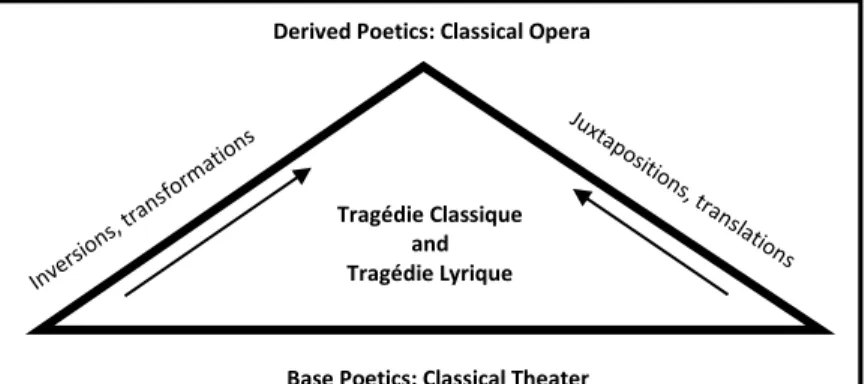
Figure Page 1. Young Girl Reading by Pierre-Auguste Renoir (1891) ………2 2. Paul Alexis Reading Manuscript to Émile Zola by Paul Cézanne (1871) …………2 3. Kintzler’s Approach to Deriving the Poetics of Classical Opera……….117 4. Proposed Approach to Deriving Vocal Poetics ………118 5. Diagram Showing Proposed Vocal Poetics ……….140
1 CHAPTER I
INTRODUCTION
It seems to me that a prominent thread that knits up the various philosophers and their budding philosophies is the fundamental act of creating a perfect object through which, and upon which, the philosophers’ ideologies may be developed and displayed. In the studies I’ve
undertaken thus far, I’ve been fortunate to meet some of these objects or tools. I think of, for example, Plato’s Ion, the hero Roland in La Chanson de Roland, Montaigne’s Bon Sauvage, Pascal’s dream, Rousseau’s Emile, Radet, and Barré’s Négresse, and Poulin’s, Grandes Marées, just to name a few. And these created objects that are used to propel the authors’ philosophy also provide windows into the vast reaches of an ever-changing mind, revealing the authors’ passions, fears, uncertainties, and even her/his unexpressed torment. How else would Plato, for example, explain his concept of whether a poet’s performance is based on skill and knowledge of content or on divine inspiration, without first creating the ignorant-other, Ion, by which his philosophy could be guided and to whom his questions could be addressed? In fact, by creating the ignorant Ion, Plato is able to construct a dialogue in which Socrates, who can be considered the
mouthpiece of Plato, is able to disperse his knowledge about divine inspiration and the talent of rhapsodizing. While I don’t pretend to be any such great philosopher, the writing that is
contained here begins with a brief study of two objects from where the source of my curiosity comes, and which will later lead me to the study of two genres: opera and the novel. At the onset of my work, the two perfected objects that serve as the impetus for the seedling of a philosophy I have, are two paintings that depict the act of reading.
2 Cézanne and Renoir on reading
It was some time ago that I came upon these two paintings. I was preparing to attend a lecture on obscenity in literature, when I discovered the Renoir painting. The Cézanne painting, however, I discovered while writing a paper on Émile Zola’s La Curée (1871). I find the two paintings very interesting as they depict two very different approaches to reading. In the first painting shown here (Figure 1), the young girl seems to be so engrossed in her reading that her mouth hangs slightly ajar. And as she blushes, her attention is scarce taken away from her reading, for she doesn’t seem to notice that her sleeve has fallen from her shoulder, nearly- exposing the crest of her breasts. While this painting may be viewed very differently through the eyes of queer studies, and gender studies, and may also be conceptualized within the framework of an, indeed, period-relevant obscenity discourse— the popular trial of which was not too far
Figure 1. Young Girl Reading - Oil Painting by French Artist Pierre-Auguste
Renoir (1891)
Figure 2. Paul Alexis Reading Manuscript to Émile Zola-Oil Painting by Paul Cézanne (1871)
3
gone with Flaubert’s Madame Bovary (1857)—when juxtaposed with the second painting (Figure 2), it is the very act of reading that is put into focus. For Cézanne, to my eyes, paints a performance. In his painting I do not see a blushing, young girl, but two men (Emile Zola being around thirty-one-years old, and Paul Alexis twenty-four), inhabiting a single space, where one man (Alexis) reads to the other (Zola). It is interesting to note that, though the men are in what seems to be a regular reading area, Alexis is seated higher than Zola, and Zola is shown to be very pensively meditating upon the text Alexis reads. It would be justifiable to say that Cézanne’s painting, based on these few remarks about the physical (dis)placement of the two men, is indicative of a sort of theatrical performance. Here, the performer is Alexis, sitting on a sort-of stage, and his audience is contained in the one man, Zola, who listens to the reading. It is interesting to note here that it is Alexis who is the biographer of Zola, and thus eventually performs—in writing—the text that Zola’s life has inspired.
Thinking of the two paintings again and also about my experience with reading, I wonder which painting better describes the approach to reading that I have encountered in my tertiary studies. In both paintings the text has demanded deep meditation, but between the
eroticized view of reading and the performed version of reading, which approach have I explored within the context of my literature studies? Furthermore, to continue with the notion of the performed, what notions of sound and silence do the paintings portray? That is to say, at the time of a silent reading, what role does sound play? How do I read?
Some may say, however, that the depictions of reading in the two paintings above are somewhat outdated, for reading looks and sounds differently today. These same persons may mention the advent of audio books and media-enhanced, interactive text that transform reading from a private and interiorized activity into something that is far more physically engaging.
4
While I do not disagree with these opinions, I do believe that these paintings represent a general understanding of reading that was popular in the nineteenth century and, for the most part, still holds true today. And while Renoir’s view of reading the novel may be more typical, Cézanne’s, to my eyes, is more unusual, especially based on my experiences with literature. My observation of these two paintings, added to these experiences, have inspired many words.
Two thousand words
The many nineteenth-century paintings that portray the (usually female) subject reading novels can be seen as a representation of the act of consuming the written text.1 While it can be argued that the figure of the reading female subject is more provocative than that of the reading male subject, who would, probably, be seen writing, the visual spectacle of reading novels fascinated the artists of the time. And it is the act of sitting (reclining!) in a private space, quietly gaining pleasure from the pages of a novel that seems to be showcased in these paintings.
Reading, as evidenced in the paintings of the nineteenth-century, is seen as solitary, private and interior. But if I return to the portrait of the reading woman, can I ask her if she hears nothing as she reads? In the private, muted, and interiorized act of her reading, is her mind not filled with a thousand sounds that accompany the passages she devours? She (the painted subject) says nothing in response, but she2 (the novelist) has written her own texts, and they sound like this:
1 A cursory search of this topic reveals portraits of the reading female subject by French painters Pierre-Auguste Renoir, Edward Manet, and Auguste Toulmouche. There are also many American painters, including Mary Cussatt, Edith Cusack, and Seymour Joseph Guy, whose depiction of reading in the nineteenth-century can be considered a main theme of his artistic output.
2 The following passage comes from the writings of Princesse Pauline de Metternich (1836-1921), and are found in
the collection Je ne suis pas jolie, je suis pire: Souvenirs 1859-1871, published in 2008. This passage comes from the entry entitled “Une promenade en mer.”
5
Siegneur! du danger! mais retournons! Arrêtez! C’est horrible!
Mon Dieu, ayez pitié de nous!—voilà les exclamations qui retentissent de tous côtés … mais il n’y a plus à reculer, le navire est engagé dans cette effroyable lutte des eaux du fleuve et de la mer !—
« Voici la barre! » crient les matelots, et à ce moment une vague énorme, gigantesque, une avalanche d’eau effrayante tombe par- derrière sur nous et couvre la Mouette…Puis, calme plat, on glisse sur les eaux de fleuve … nous étions irrévocablement perdus !!! (58- 59)
Sir! Danger! Let us go back! Stop! This is terrible! Have mercy on us, O Lord !—these are the cries that were heard all around us…but there was no turning back; our little bark entered a frightening battle with the rapids as they rushed us to the sea!—“There’s the sand bar!” cried the seamen, and then a gigantic, enormous wave, like an avalanche of frightening water, crashed down behind us and swallowed up the Mouette…then complete stillness, as we glided on the river…we had been surely doomed!!!
How paradoxical to see the silent reader, and then to see the noisy text! And more, if we explore the literary criticism that the noisy text inspires, am I not met there with more silence? The duplicity between the sound in the original text and the passive silence in the reception of the
6
same is the source of my ennui. While this project does not seek to discuss the idea of background noise, or a type of incidental music that could accompany a text, it does seek to problematize approaches to the reception of the novel that go counter to the ideas presented by the silent subject of the paintings I chose as the impetus of this writing. I am not alone in this concern pertaining to the critical reception of the novel. It is here, then, that I will introduce the second impetus for the current study, Mikhail Bakhtin’s work on dialogic approaches to reading the novel.
Introducing music and opera
In his work Esthétique et théorie du roman (1978), in an attempt to show the inability of popular stylistic approaches to fully analyze the novel, Mikhail Bakhtin states:
Elle [la stylistique du XXème siècle] ne sait pas aborder le dialogue social spécifique des langages du roman, aussi son analyse stylistique s’oriente-t-elle non sur l’ensemble du roman, mais sur telle ou telle unité subordonnée. Le chercheur passe à côté de la particularité initiale du genre, substitue l’objet de sa recherche, en somme il analyse quelque chose de très différent du style romanesque ! Il transcrit pour le piano un thème symphonique (orchestré) (89).
It [stylistic analysis of the 20th century] cannot handle dialogue specific to the langages of the novel, nor does its stylistic analysis
7
orient itself on the entire work, but on some lesser. The researcher brushes aside the initial singularity of the genre, substitutes the object of his research, and, simply put, s/he analyses something very different from the Romanesque style! S/he transcribes an orchestral piece for a solo piano.
Here Bakhtin argues that, instead of analyzing the language(s) of the text, the popular approaches to analyzing the novel3 only describe the style of the novelist, or place a mere secondary motif as the main theme of the entire work. Bakhtin argues against theoretical inquiries into the novel that seek to dissect the text as though it were some kind of a mechanical device, rather than
considering it to be the impetus for “reading,” a kind of catalyst to a process he deems
“dialogic.”
To clarify this point, Lane in the preface to his 2013 anthology on global literary theory explains what he considers “the rise of theory” or the “theoretical turn” (xxiv) that came about in the 1960s. He notes that, at that time, literary criticism was affected by three new
categories of enquiry into humanism: language, gender and sexuality, and history. To explain the difference between literary theory and literary criticism, Lane reveals Jonathan Culler’s (2000) work, in which he states that criticism focuses on the study of literary texts, while theory seeks to reorient literary texts by including theoretical frameworks from different fields, thus blurring the lines between literature and other academic disciplines. Additionally, in a presentation by Dilip Barad on Jul 20, 2013 entitled “Difference between Literary Theory and Criticism,” he notes that
3 It can be justifiably argued that Bakhtin is referring to the schools of Russian Formalism, (especially the work of
Victor Shklovsky, and Boris Eikhenbaum) and Structuralism.
8
literary criticism is the evaluation, study and interpretation of literary texts. Literary criticism, however, undertakes the philosophical arguments surrounding the methods of and purposes for literary criticism4. This rise in theory and literary criticism, with which Bakhtin was certainly involved, was, ironically, the source of his contention. It is not so much, as I will show later, that Bakhtin was against the criticism that was being developed during his lifetime (beginning with formalism) but it was that, for him, none of the historical or contemporary approaches seemed to sufficiently meditate upon the specificities of novelistic discourse before gauging their tools to handle this type of text.
It is, however, the final metaphor of the piano and the orchestra that is most provocative for me. With this notion, Bakhtin would seem to criticize the framework of contemporary approaches to discourse and the novel as being incapable of accounting for the many languages (registers and dialects, for example) within a text. And as such, these theories end up reducing the wealth of harmonic color, and sonic diversity of an orchestra to the
homogenous sound of a single instrument. Bakhtin, however, proposes an approach to analyzing the novel that accounts for all the many sounds within the text. In fact, to end his section on novelistic discourse, Bakhtin states:
Introduire dans le roman, le plurilinguisme y est soumis à une élaboration littéraire. Les voix sociales et historiques qui peuplent le langage (tous ses mots, toutes des formes), qui lui donnent des significations concrètes, précises, s’organisent dans le roman en un harmonieux système stylistique, traduisant la position socio-
4 This lecture may be accessed online here: http://www.slideshare.net/dilipbarad/difference-between-literary-theory-
and-criticism
9
idéologique différenciée de l’auteur au sein du plurilinguisme de son époque (121).
Once applied to the novel, plurilingualism leads to elaboration of the text. The voices of the society, and those of history that populate the language (all the words, in all forms), that add
concrete and precise meanings, make a harmonious stylistic system within the novel, bringing about a difference between a socio- ideological position and the plurilingualism of the author within his own era.
And it is here that I see the use of the word voice, which is both a propos and provocative. For where I once spoke of languages, and colors, and where I may have wanted to speak about registers (to be socio-linguistically correct), the word voices will henceforth be used.5 So, by way of resuming the two impetuses for this current study, I may now recall the portrait of the silent reader, who writes and reads a text that is loud with multiple voices.
Looking more closely, now, on the idea of multiple voices, and studying the works of Bakhtin, I cannot help but notice the many references to music (or music-related terms) that populate his work. I see, for example, the words rhythm, composition, counterpoint, tone, harmony, and voices. I am not alone is this realization, as prominent Bakhtin scholar (and concert pianist) M. Pierrette Malcuzynski (1999) not only reveals the great wealth of musical borrowings in Bakhtin’s work (with his use of terms such as voice, intonation, rhythm,
5 The term heteroglossia is used to describe the idea of multiple, diversified sounds. The term, however, means much more. Holquist (1992) says that heteroglossia refers to the notion that at any, given time there are many forces working to make meaning in a particular place. He mentions four planes: centrifugal and centripetal opposition, discourse and code, etymology and culture, and reader and author.
10
counterpoint, accentuation, and polyphony), but also argues that the musicologist’s work finds a resounding space within the context of Bakhtinian poetics.
Anthony Wall, too, sees music in Bakhtin’s discourse (perhaps not surprisingly given his musical interests and talents as a pianist). In fact, in a paper published online, Wall states:
“. . . very little has been said in international Bakhtin scholarship about the potential – and very real – relationship between Bakhtin’s theories of dialogic discourse and the philosophy of music.
In the following, I shall attempt to close – ever so slightly – a small part of this gap.” 6 Wall’s paper, which serves as a launching pad for studies on Bakhtin and music, dwells on the notions of tone, and repetition. He shows Bakhtin’s use of music as a basis for theorizing the dialectic (Wall’s term) between lesser sounds (those that are mere imitations, without thought), and those which are decorated (creative, artistic).7 As the perfected object through which to develop his philosophies, Wall chose the keyboard compositions of Johann Sebastian Bach, notably his famed work Das Wohltemperierte Klavier (1722). But where Wall turned to these, I will choose another genre of music, and one that is made up of a combination of voices—in the full sense of the word. To do so, I’ll look not only to the sound coming from the human throat, but rather to the understanding of the word that is explained in the first medical journals, and that which inspired Jean Starobinski’s (2005) idea that any study of civilization starts with a study of the voice.8 The musical genre I’m referring to, of course, is opera. I believe that by creating a framework for analyzing the novel based on that of analyzing all the voices within the opera, the reader stands to benefit as s/he appreciates the fullness of all the voices within a text. This
6 << http://fis.ucalgary.ca/awall/mikhailbakhtine.html>>
7 idem
8 Starobinski’s study of the human voice and civilization is inspired by, and builds upon the theories of Condillac.
Starobinski’s novel Enchantment: The Seductress in Opera (2008) is one that will shed much light on the notion of transferring words to music. .
11
notion, on first blush, sounds radical because, of course, the novel is (usually) read, while the opera is performed. And more, the novel may be read over the period of many hours, days, or even weeks, while the opera generally lasts for some part of one evening. In light of these differences, many may say that there is little value in treating the both art forms to similar processes; they are too different.
The opening of Carol Mossman’s (1996) work, however, says almost the exact opposite: “No one would dispute opera’s heavy debt to the novel” (387). She goes on to paraphrase Donald Grout and Susan McClary as saying, “the beginnings of opera as a form which tells stories with and through music can be situated at that point in history when the conventions of musical composition are shifting away from the “architectural” toward a linear and teleological unfolding not unlike the conventions governing narrative disclosure” (p. 387). In this citation, Grout and McClary reveal that opera arrived at the moment when there was a societal need for a more stable, and closed from of transmitting stories. From these two citations, I can surmise that the opera and the novel are not as absolutely different as we may have thought.
Mossman’s article continues to list the influence of opera within novels, the results of which I will show later. Her work is similar to those of more recent scholars, such as Leslie Baxter‘s Voicing Relationships: A Dialogic Perspective (2010) and Comrac Newark’s Opera in the Novel from Balzac to Proust. (2011), who both theorize the textual effect of including discourse about the opera within novels. But perhaps it is the work of Herbert Lindenberger, Situating Opera:
Period, Genre, Reception (2010) that best sets the stage for my discussion about opera and the novel.
In a chapter entitled Opera and the Novel: Antithetical or Complimentary?
Lindenberger, with a careful study of Plato’s triadic modes (lyric, the drama, and epic) shows
12
that, though seemingly antithetical in nature, the history, and compositional beginnings of the novel (which he calls “narrative”) and opera (which he calls “music drama”) reveal a oneness between the two (27-28). To Lindenberger’s study of historical genesis, I propose a study of historical purpose, and the history of performance. By that, I mean by studying the social impact and use of oral storytelling (orality), and studying the performance of these stories, I see yet another commonality between opera and the novel. And it suffices to mention the names of some of the storytellers who, like the painted portraits of my reading subject, have been the source of artistic inspiration. My references here are to the troubadour, the bard, the jongleur, the orator, and the comédien who all declared their tales in, or with, song and melodic voices. They do so even when speaking because the inflection and intonation of their voices were songlike, and even patterned on singers, as Patricia Ranum’s 2001 work states. This comparison is important
because it not only debunks the myth of the novel and opera being non-related genres, but also reveals the idea that even before the opera and the novel emerged as standardized genres, the categories of public or private, sung or read (or spoken), and performative or non-performative had little bearing. In fact, as I will now show, this blurring of the lines between opera and the novel may be rooted in the very origins of humankind.
Leading in this theory are early modern philosophers Etienne Bonnot de Condillac and Jean Jacques Rousseau. In his Essai sur l’origine des connaissances humaines (1746), Condillac states that the speech of early humans, because of its very harmonic nature, could be transcribed into music without much difficulty. Now to define the word harmony I would like to visit the writings of Rousseau in his Essai sur l’origine des langues : où il est parlé de la mélodie et de l’imitation musicale (1781). Here, Rousseau praises the progress of France as a nation, but laments that this progress has resulted in French becoming a flat language, devoid of harmony
13
and melody. Harmony, for Rousseau, refers to the inflection and cadence of the voice, while melody refers to the mixture of (consonant and vowel) sounds that are in the language. Rousseau argues that progress, which can be understood as a moving away from the instinctual gravity of nature, robbed language of its rich acoustic self. And perhaps it is further progress that made the separation of opera from the novel, and the emergence of the separate genres. Regardless of which theory or literary history is eventually chosen to explain this phenomenon (such as Lukacs, Bakhtin or Watt), I can say that opera and the novel share a history in terms of performance. But even in their present forms, the link between opera and the novel is fairly evident.
Firstly, the word opera, which I will take to mean “many works” hints at a genre that is inherently plural. It is important to note that the meaning of this word has often been the source of debate between music theorists, and historians. The confusion, as I understand it, stems from the uncertainty as to which origin to rely upon when ascertaining the definition of the term.
For starters, the word in the mouths of Latin-speakers is the plural of the word opus, meaning
“works.” For them, though, “opera” was also used for the singular (feminine) form to mean
“work.” In the mouths of Italian-speakers, however, the term refers to the word work, especially in the context of art. Now, does one follow the roots of Romance languages, or does one bow to the founders of the actual art form? While strong cases may be made for usage of either
definition, for my purpose I may choose to use both definitions. From this perspective, an opera is single, collective entity that is comprised of multiple works of art, namely vocal expression, ballet, musical accompaniment, and the stage.
In their turn, opera theorists (notably Catherine Kintzler and Downing Thomas) have studied the poetics elements that combine to make an opera: instrumental music, dance, text,
14
drama, spectacle, and vocal music.9 Similarly, from a compositional standpoint, the novel is also made up of many combined parts as in, for example, the difference between narration(s) and quoted spoken text. Additionally, the novel, similar to the opera, creates its own problematic;
revealing its own definition of unity (of time, place, and action). For example, in opera, speaking very generally, recitatives present the main theatrical action (l’action) while the arias reveal the interior emotions and thoughts of the character. Other notable operatic segments include the accompagnato and the arietta, both of which present different types of action and emotion. What is interesting here is the idea of time, since it moves very quickly during the recitatives, but slows down, stops, or even reverses itself during the arias. Using this framework of time—
checking how time moves—I can find various ways in which the novel is like the opera.
Another similarity is the plurality of hierarchized voices. At the opera, in order for the genre to be useful, the voices presented must be ordered, and assigned a certain rank or
importance at the opera: the heroes will have the robust arias; the leading lady will sing the highest notes but may sing with the voice of the flute when dying or when in love; the confidante will be a lower voice than the leading soprano; the chorus will be the loudest (by virtue of the number of people singing) but will always be in a supportive role, providing the harmonic fabric while the leading soprano and the hero sing above. Similarly in the novel, the representation of the types of voices—human, or not—follow a certain order, raising issues of politics, gender and society, and power relations. It may not be fair to say that since the novel is not performed that it has lost all ties with its ancestry. I believe that the novel is very noisy and that the many types of voices therein combine to create both pleasing harmonies and harsh discords. Even though the reader hears with her/his eyes, an understanding of the combination of these voices helps to
9 See Kintzler, C. (1991). Poétique de l’opéra français, de Corneille à Rousseau. Paris: Minerve, and Thomas, D. A.
(2002). Aesthetics of opera in the Ancien Régime 1647-1785. Cambridge; New York: Cambridge University Press.
15
deepen the analysis of the text. It is the effect of the existence of multiple voices that interact on multiple planes that constitutes the “dialogism” that Bakhtin describes in certain novels.
It is then not out of pure convenience that I employ Bakhtin’s approach to dialogism for this study on the novel and opera. The question I ask now is: Is dialogism for real? This, in fact, is the title of Ken Hirschkop’s (1992) work, and which gives me a starting point for defining dialogism. Hirschkop accepts the realness of dialogism, but argues that the familiarity with the banal word “dialogue,” and the misunderstanding of what dialogue actually is, brings about confusion as to what dialogism actually is. Hirschkop states “…the point I am most concerned to make is that the difference of dialogism from dialogue is what renders the former relevant to my social and political life, that in fact ‘dialogism’ as a distinctive kind of discourse calls attention to fundamental features of our social and political life too often obscured by our obsession with dialogue…” (108-109). He argues that the need to confine dialogue to the
exchange of speech acts makes it impossible for the greater purpose of dialogue to be revealed. It is the novel, then, that restores and reminds the reader of the wider purpose of dialogue: “The key to novelistic dialogism, then, is not an immersion in the authentic plebeian sociability of the public square, but the novelist's ability to endow so-called popular or everyday language with an historical or social significance it lacks in its everyday context” (109). The novelist, as Hirschkop would also seem to suggest, has done his/her part to situate language within the novel in a
network of speakers and events, thus rendering language pertinent to history and society.
For an even fuller understanding of dialogism, I turn to the work of Michel Holquist, who sheds the most light on the term. In his work Dialogism: Bakhtin and his World (1990), Holquist presents dialogism as the understanding that nothing said or written exists in a vacuum;
social, historical, personal, discursive and textual influences all conspire to affect the meaning of
16
any utterance. Dialogism also assumes that language and speech give order to an otherwise chaotic world. The literary novel, however, as Holquist states, gives the most possible order to the world. But this is not to say the novel, itself is not extremely complex. For this project, this understanding of an endowed, complex language (novelistic discourse) is very important because I believe that the reader of the novel must, in his/her turn, play an active part in re-enlivening and repurposing the language s/he reads. If not, the historical and social endowment of the language (to cite Hirschkop) would serve, in some cases, to render the language inaccessible and useless, especially readers within the realm of higher education. In my experience, for example, when first given Balzac’s Le Père Goriot (1835), I had no use for it. As an undergraduate student who loved French language, I could not understand why I was given a lengthy novel and told to read it. Why? Was I reading to answer the question: what happened? If so, I’m sure there were many summaries online I could have found. Was I reading to ascertain the social and historical contexts from which the novel was drawn? While that may or may not have been interesting to me at the time, I doubt spending two weeks to read a novel that I may find interesting was the most efficient use of my time. Furthermore, I believed that I should rely on history books to answer questions about history and society. My thinking has come a far way since then, but I still believe that novelistic discourse, though situated in history and society, should not be read in the same way that one reads a history textbook. The novel should do more then tell a story. The novel, for me, presents the reader with a complicated network of endowed language that is anchored to a certain time and place, and challenges her/him to fuse herself/himself with the network and change it, thus resulting in a unique reception of the novel and also a changed reader. The same, I add, holds for the reception of an operatic performance. And thus the notion of a similar treatment of the novel and the opera is revisited.
17
To continue my discussion on ways in which the novel and the opera have been conceptualized by other scholars, I recall the work of Mossman (1996), who considers the effect and the use of opera within the novel. Using the example of Le Père Goriot, Mossman visits the area in the novel where song is referenced, or executed by various characters. Mossman reveals that opera (she also considers various theatrical genres with music) creates three new spaces within the novel. They are “zones of trance and unknowing,” “privileged spaces of cognition and complicity,” and “intersecting spaces which create mis/understanding and malentendu” (390).
Mossman argues that the subjectivity of the human experience of performed sound, when placed within the context of the novel, enriches the text with the borrowed poetics of opera—the
operatic. In her discussion of what is lost when the novel becomes opera, Mossman lists the following criteria taken from Bakhtin “the narrative voice, the dialogue between present and past with the consequent relativization of traditional hierarchies, a temporality both subtle and
variegated, intersecting planes of language and, more pertinently…a certain capacity to import, naturalize, and domesticate discourses and genres alien to the novel itself” (388). But what is there to discover about the beginnings of the novel, especially the novel that defined the nineteenth-century in France? And what specific knowledge is there about the novel that may fuel my curiosity in the link between the opera and the novel?
In a whimsical book about French history, Catherine Dufour (2012) presents the
nineteenth-century in France as strange. In fact, she says that “strange” is probably the best and only term that fits to describe the century (285). The strangeness for her is, partly, seen in that the nineteenth-century was birthed from, and marred by the violence and blood of political and civil unrest, and the most frightening displays of human cruelty, but yet was fruited with the artistic output of these same people. The nineteenth-century novel is one of these fruits.
18
The French novel in the nineteenth century, as argued by Georges Saintsbury (1917), developed fairly slowly. Starting with Mme. de Stael, whom he credits for making the transition from eighteenth-century sentimentalism to nineteenth-century romanticism, Saintsbury states that the novel moved from sentimentalism to the aesthetic novel, then the novel of style, then short narratives (contes), followed by the great analytical texts (which are most studied today), and culminating in the Naturalist novel. The Naturalist novel, in the hands of its greatest
proponent, Emile Zola, becomes the “experimental novel.” Besides reasons of personal taste, and despite Bakhtin’s belief that the ultimate dialogic novel is contained in Dostoyevsky’s ouvrage, I would argue that Zola’s novels are more readily exploitable by Bakhtinian stylistic approaches than any other novel. The reasons for this statement bring me back to what has become the key word for this study: voices.
In defining the nature of the experimental novel, Zola (1881) states that the novel is the
“process-verbal de l’expérience que le romancier répète sous les yeux du public” ‘…the verbalization of human experience that the novelist recreates for the public to see’ (10). In this description, Zola explains his approach to being a novelist. For him, his work requires that he observe the human in his environment (society), and that he study his interactions with his peers.
Then, he (the experimental novelist) must experiment with placing the observed human in many different societies, scientifically noting how the human grows, changes, decays or evolves. The essential aspect of Zola’s approach is that he, like Bakhtin, dwelled on, and accounted for all the utterances of the common person. The two novel theorists therefore share in the sense that poetical discourse is limited by its formality, and that only the novel captures the full range of human experience. And though speech discourse is only one shade of dialogism, it does provide a launching pad from which to apply Bakhtinian approaches to analyzing Zola.
19
Besides this link between Zola’s desire to represent the plebian crowd within his novels, Zola shares a novel link to opera. In fact, Zola’s description of France during the Second Empire includes many pages describing opera balls, performances of operas, and even the reception of certain operas. I recall, for example, the description of the audience at the giving of Jacques Offenbach’s comic-opera La Belle Hélène (1864) in Zola’s La Curée (1872), and the general notion of comic-opera being petty, as opposed to the operas of Wagner. But besides this same notion of how the novel is represented within the novel, I discover in the work of Mosco Carner, for once, an idea of how the novels—of Zola— affect the reception of the opera.
In his 1985 work, Naturalism in opera: Verismo , Carner states that the reception of the opera Tosca (1900), by Italian composer, Giacomo Puccini, was made possible only because of the shift in “in European literature from romanticism to realism and its more extreme form, naturalism” (6). To put things very simply, verismo is a style of writing opera that sought to make the opera as true-to-life as possible. What this means is that the depiction of emotions, the plot, the characters, and the action were blatantly visible, and (more) believable. In terms of the music, the composer moved away from traditional delimitations of the opera into small, almost formulaic parts, but conceived of the art in its totality. Besides this, the palette of harmony used in the opera was at once new and diverse. According to Carner, Zola’s novel paved the way for the representation of this truth within opera. From these examples, I see ways in which the interaction between opera and the novel have been treated by theorists. It seems to me, though, that none of these theories unearth the fundamental similarities between opera and the novel.
From my perspective, the act of reading is greatly dependent on notions of voice and performance, and a comparative study of opera and the novel will reveal ways in which the reception of the novel can be likened to, and patterned on, the reception of the opera. This study
20
aims to focus on the role of the reader of novelistic discourse, paying special attention to the influence that the terms performance and voice has on reader-reception. To guide my research, I ask the following questions at the start of the project:
1) In what ways is the novel like opera?
2) In terms of my experiences with reading literature in higher education, what position do studies of voice and performance hold?
My project, sets out to answer these questions, but not by following well-trodden pathways.
Instead, by revisiting the origins of opera and the novel that I arrive at new definitions of,
otherwise, ancient institutions. In the first chapter, I trace the history of writing, seeking to reveal the processes that brought about the first novel. From there, I follow a similar trajectory as the one I’ll take in chapter 2, where I trace the history of opera. In both chapters my ultimate goal is to present the novel and the opera—both with long-established standings within many academic institutions—in a newly conceived way. Thus, a newer understanding of the fundamental
similarities between the two is ascertained and notions on the ways in which the reception of the one may affect the reception of the other are deduced. The general nature of these deductions concern the terms voice and performance.
The second half of the project focuses on these two terms, showing how they may be differently understood not only in the context of the opera and the novel, but also in the context of the literature studies in institutions of higher education. Next, I reveal the theoretical
underpinning and the various practical applications of my new understanding of voice and performance and textual analysis. Then, my last chapter sees us visiting a work of Zola’s and showing what I call “performing the novel: vocal poetics of novelistic discourse.”
21
It is my intent that this study be useful to anyone who reads novels, and, to a lesser extent, those interested in viewing opera from a unique perspective. Furthermore, since I believe that every academic endeavor should benefit the academician within the classroom, I cannot help but see a pedagogical goal to this study. That is to say, if my approach to reading the novel serves as a refreshing to the persons who work within higher education, and manages to inspire even a minute percentage of its scholars to meditate deeply upon and become better for having read literature—which is one of the great gifts of the academic process— then my work will have served its modest purpose.
22 CHAPTER II
A MATTER OF VOICE:
DISCOVERING THE NINETEENTH-CENTURY NOVEL’S ORAL PAST
The nineteenth century10 in France experienced the greatest explosion of literary
production in the entire history of French civilization. This is seen not only in the various literary schools that flourished (romanticism, realism, naturalism, symbolism, and the Parnassians), but in the rise of the century’s main literary genre: the nineteenth-century French novel. Seen as a genre whose defining characteristics are as changing and as untamed as the political and social conditions of the Romantic era, the novel is said to be representative of the new national identity of post-revolution France. In support of this notion, Hannoosh (2011) cites Victor Hugo’s famous declaration from the preface to his 1830 play Hernani, “While admiring the literature of the age of Louis XIV, so well adapted to monarchy, contemporary France will be able to have its own literature . . . the France of the nineteenth century to which Mirabeau gave liberty and Napoleon power” (452). Hugo’s declaration reveals the powerful correlation between
nationalistic, political ideologies, and literary output. There are, however, in these reflections pertaining to the nineteenth century and its literature, words that have become somewhat cliché in their usage. For example, what does one mean by the word “literature,” or “literary”? And what about the term “writing”? These terms have become so banal in their usage that they it wouldn’t be surprising if they figured among the list of least-searched words in the dictionary—
even if the definitions offered by scholars are as diverse and varied as the respondents
10 I will use the dates of the “long” nineteenth century provided by The Society of Dix-Neuviémistes (SDN): 1789-
1914.
23
themselves. Formal definitions of literature are equally problematic, with key terms so varied as the sources consulted. Things become even more complex when question of how I consume, enjoy, and participate in the reading process are posed. Indeed, what does it even mean to read?
How does one read writing? And how is this act represented?
According to the various nineteenth-century painters who depict the subject, (Caillebotte, Manet, Renoir, Soulacroix, and Toulmouche, to name but a few), reading is a solitary and mute activity. And it is the latter aspect that is more provocative for my topic, for scholarly approaches to the novel (and to reading) have traditionally excluded two very important concepts:
performance, and voice. This omission—attributable to the fragmentation of scholarly work into neatly defined departments, fields, and centuries—has resulted in the glorification of the novel as a phenomenon that was perfected, if not born, in the nineteenth century, the highest form of a single-authored written text, the highest form of literary writing, and a genre normally consumed in solitude, and in silence. On the contrary, I would suggest that the nineteenth-century novel is a descendant of, what I will call, the performed texts11, in which voice and the system of
performance played an integral role in aspects of composition, transmission, and reception, a phenomenon that arguably goes as far back as humankind’s ability to invent or recall stories. But in the arguments that follow, I will seek to trace particular historical processes that contributed to the silencing of the voices within the novel, and the consequent removal of the novel from the realm of performance in the nineteenth century.
11 A seemingly contradictory statement—seeing that a text usually necessitates writing—the word text has a meaning beyond that which is written down. Ong’s 1983 work will inform us of this later.
24 The Twelfth-Century Novel
The history of the novel, of writing, and the history of reading, for that matter, are essential to this project not only because they reveal various prejudices that affected the
explosion of the novel genre in the nineteenth century, but because such a study will assist me in understanding why, when, and how reading literature (and the novel in particular) came to be regarded as a solitary and interiorized act. Furthermore, the study will give some insight into the rise of the novel as a cherished thing within institutions of higher education. In what follows I will summarize study the etymology of the word literature, review the history of the novel, compare the history of the novel with the development of the French language, and reveal the influence of the ancient oral tradition on chirographic societies. To launch and guide this discussion in this chapter, I will rely heavily on the work of Paul Zumthor, a Swiss medievalist whose research in his later years focused on medieval oral poetry.
Zumthor’s three main texts on the subject of voice and performance in medieval poetry are Introduction à la poésie orale (1983); La Poésie et la Voix dans la Civilisation Médiévale (1984); and La Lettre et la Voix (1987). Zumthor focused much of his work on a topic he had been interested in for many years, oral poetry. His 1983 work called “Introduction à la poésie orale” is a declaration of his fascination with the study of voice and presents his main research question: “Y a-t-il une poéticité orale spécifique?” ‘Do oral-specific poetics exist’ (9). The rest of his work on the subject then seeks to discover and to conceptualize (theorize) the poetics of oral poetry— poetry transmitted by voice and memory only. As the impetuses for his work, he first cites the 1977 work of Irish linguist Ruth Finnegan Oral Poetry: Its Nature, Significance and Social Context. Elsewhere, he acknowledges French writer Paul Sébillot for creating in 1881 the term and the notion of littérature orale. Among American and British scholars, he mentions
25
Maurice Bowra (Primitive Song, 1962; Heroic Poetry, 1978), Albert Lord (Serbo-Croation Heroic Songs, 1954; The Poetics of Oral Creation, 1959; The Singer of Tales, 1971; The Perspectives on Recent Work on Oral Literature, 1975) and Nora Kershaw Chadwick (Poetry and Prophecy, 1942), and in the German Academy, he mentions Herman Bausinger (Formen der Volkspoesie, 1968). Zumthor’s publishing of a work on oral poetry is unsurprising because prior to his work on oral poetry, he theorized the notion of “mouvance.” This term, which can be translated as “mobility,” refers to the notion of ownership of medieval texts. Having argued in his prior work the notion of medieval texts—especially vernacular texts—have various authors, he uses the term “mouvance” to describe the notion of a text being altered and recreated by the various authors (including singers) who copy the text. Zumthor’s work is supported by the claim that a text is dynamic, and that the vernacular text, which was never static, is best understood as a composite of the input of the various influences on the text (singers, writers, copyists, for example). Already in this notion of “mouvance” I can begin to predict Zumthor’s arguments in his future work, especially in the ones that focus on voice, singers, and performance. After having developed the notion of a poetics of oral poetry, in his 1984 work, Zumthor goes on to ask, “Comment intégrer l’opération vocale dans l’étude des textes médiévaux?” ‘How does one integrate the poetics of voice into the study of medieval texts?’ Before addressing this question, though, I will begin with his 1987 work in which he enlightens us on the history of two of my key terms: novel and literature.
As the title for the conclusion to his 1987 work, Zumthor chooses “Et la ‘littérature’?”
‘And Literature?’ placing the word literature in quotation marks. The consequent usage of the word within his conclusion is either italicized or, once again, placed in quotations. By doing this, Zumthor flags the term as one whose meaning, by reasons of disassociation with its etymology,
26
privileges a certain discourse while silencing others. Suggesting that the term litérature has no precise definition, he blames the mass appeal of Romanticism for fueling the exclusion of the historical underpinnings of the term that would give it a more veritable meaning (312).
Zumthor’s main concern, in fact, is that when we approach literature without the understanding of the fundamental role of voice, we risk becoming trapped in a sort of elitist and ethnocentric imprisonment, and we become walled-in by limited historical experiences (322). To illustrate this notion, he uses the example of Todorov’s Les Genres du discours (1978) in which literature is treated as a scientifically quantifiable and classifiable object that is historicized using various brands (marques). For Zumthor, literature as treated by Todorov, “est partie de l’environnement culturel où nous pouvons la nommer; et s’interroger sur sa validité, c’est pour nous plus ou moins nous distancier de nous-mêmes” ‘is part of the cultural phenomenon that allows us to assign a name to something, and to pose questions about its validity; it is, more or less, a way for man to distance himself from himself.’ (312). That is to say, the definition of literature here is influenced by the historical experiences which saw humans separating herself/himself from what s/he himself had written, and from what his fellow writers had written; his text is assigned a name, or a code. Indeed, for Todorov (1990), the etymology and cultural significance of the word literature in societies across the world proved too massive an undertaking. He thus decided to focus his work on aspects of functionality and structure, leaving the challenge to another brave writer (1-9).While not taking up the task himself, Zumthor does give insight into the history of the usage of the word literature.
Zumthor (1987) reveals that the term literature evolved from the Greek word
grammaticê, and related either to the idea of stenography (tracing letters of the alphabet), or, as used by Roman rhetorician Quintilian, to grammar and philology (313). In religious circles, for
27
example, Zumthor notes that literature was used to refer to the scholarly writing of which the pious should be wary. To use a fitting religious analogy, I would say that the term literature was to the Church fathers as the apple was to the Eve in the Garden of Eden. That is, the term was used to refer to a sort of worldly knowledge that could prove detrimental to human’s relationship with God. Even in the twelfth century, Zumthor notes that the term was still mostly used to refer to the knowledge of writing, and the knowledge of the popular written texts, and was rarely used to refer to the material text itself (313). This definition of “literature” stayed fundamentally the same throughout the centuries leading up to the seventeenth century, though the actual word changed its lexical representation.
In the 1650’s, the term literature was wedded more to aesthetics and form and was used to reference an assembly of written texts that provided “lectures exquises” ‘exquisite readings’
(314). Zumthor goes on to state that the term literature, as we use it today, appeared in the seventeenth century to fill a void in society caused by the separation of once-united entities (politics, morality, and religion). There was a need for a stable, autotelic, and homogenous discourse, and literature was the answer (320). Consequently, in the background of the
convention-heavy seventeenth century, and the encyclopedic-minded eighteenth century, a sort of science of aesthetics was applied to the definition of literature, which Zumthor notes, excluded any other form of discourse (314). It is from this exclusion that is based on aesthetics that stemmed the creation of an elite set of privileged men who were seen as the creators and consumers of literature; the source of the creation of the hommes de lettres. This is the
understanding of literature that was en vogue at the birth of the nineteenth-century novel which, not surprisingly, coincides with the proliferation of various schools of literary thought. I see, thus, a time in which the materialized written object is subject to aesthetic approaches in aspects
28
of its composition. And for each literary school there is one aesthetic that is preferred over another, or is launched in reaction to another. From this perspective, Romanticism is a rejection of classicism, whereas symbolism (and other modernist approaches) come in response to realism.
To summarize, Zumthor’s work would seem to offer the following summary: the early seventeenth-century society necessitates homogeneity of discourse; both seventeenth and eighteenth- century societies subject written discourse to scientific (quantifiable and analytical) conventions in its composition; the nineteenth-century writers reject the conventions of the Classical period and replace conventions with art and Nature as the main sources of
compositional influence; and the reception of the written subject is once again subject to science (quantifiable and classifiable) by twentieth-century literary theorists. Lane’s (2013) discussion of the “theoretical turn” seems to support this fourth point, as he, like Zumthor, suggests that
literary criticism and theory became the obsession of literary scholars in the latter half of the twentieth century. Of these four general notions, it is the first that causes the most concern for both me and Zumthor, on account of the (deliberate) exclusion of certain discourses, most notably those that thrived within the oral tradition. What is more, the exclusion of these discourses came at a time when the nineteenth-century novel in France was about to make its entry onto the literary stage. Perhaps I should say re-entry, for past civilizations have seen the novel before.
Revealing that the novel was a direct descendant of the épopée—a heroic tale transmitted
in the ancient oral tradition—Zumthor (1987) states that the novel (roman) first emerged in the mid twelfth century. He adds that the novel appeared at the meeting place of orality—a system of communication based on memory and voice—and writing (300). For a fuller understanding of orality, scholars in the United States find the counterpart to Zumthor’s work on oral medieval
29
poetry in the work of Walter Ong. His 1982 work, Orality and Literacy: The Technologizing of the World, appeared one year before Zumthor’s work, and both Ong and Zumthor lament literary scholars who neglect any reflection on oral culture prior to the creation of writing. Ong, for example, argues that human communities that didn’t have a system of writing (pre-chirographic cultures), still composed texts (13). These texts were conceived for, and were only materialized by, the voice; there was no rapport with writing. That the word text, then, should primarily be considered as having to do with a written script, for Ong, is disconcerting (13). Ong, like Zumthor, argues that the development of writing systems in ancient societies did not hinder the influence of the verbalized texts on the written ones. In support of this claim, Zumthor (1983) reveals that the early novel found itself borrowing different aspects from both sets of texts: from the oral tradition of ancient societies, the novel keeps the aspects of transmission and reception, but relies on writing for its composition (except in cases of improvisation) and preservation (32).
Speaking specifically of the twelfth-century novel, Zumthor (1987) states,
Contrairement aux contes dont se nourrit le commun du peuple, [le roman]
requiert de vastes dimensions: longues durées de lecture et d’audition, où les enchaînements du récit, quelque embrouillés que parfois ils apparaissent, sont projetés vers un avant jamais clos, exclusive de toute circularité (300).
Contrary to the spoken tales on which common folk strived, [the
novel]called for vast dimensions: long durations of reading and listening where various tales, which were so carefully intertwined that they were scarcely distinguishable, were presented, like never before, with a definite end in mind, avoiding any circumlocution.
30
Here, I see the novel genre rejecting the open-ended nature of ancient poetry, which Zumthor considers circular (300), but preserves the idea of performance and voice as fundamental in the transmission of the novel. There is also the idea of a listening audience; a concept which, I will now show, is tied up with the definition of the word roman.
Focusing on the term roman, Zumthor reveals that the verbal phrase mettre en roman, literally meaning ‘to put into a novel form,’ refers to the idea of placing a text in a form that was best adapted to the people who would be receiving the said text (300). Ironically, both Bakhtin and Jakobson, believe that novelistic discourse, especially that of the nineteenth century, alters language in order for it to be included in the novelistic whole. For Bakhtin, this change in considered artistic. For Jakobson, language is made unfamiliar, and that language is
defamiliarized in order to serve the purpose of the novel. Yet, the naming of the genre (novel) suggests the very opposite. In fact, the original usage of the term, as Zumthor reveals, hinted at operations done in performance of the story to make the language familiar to the spectators. This would necessitate the use of the vernacular (as opposed to Latin), a register (langage), and cultural references that were best suited the listeners’ level of understanding, and their milieu.
An example of the notion of novelizing a story (mettre en roman) was recently demonstrated during a visit I made to the Chicago Lyric Opera. While there to see a performance of Johann Strauss’s Die Fledermaus, the principal actor, during an already-comical recitative in the third Act, made an allusion to infamous mayor of Toronto Rob Ford. While it was clear that Strauss knew nothing of Ford, the inclusion of him in this nineteenth-century opera resonated greatly with the audience, and the spectators’ response to the opera was heightened thereafter. It is not unjustifiable to think that similar processes took place at the performance of the twelfth-
31
century novel. And embedded in this notion is the concept that the twelfth-century novel relied on oral tradition in matters regarding performance—the rendering of the text before a group of listeners. Athough the idea of making texts appear before the eyes, and that of preserving it beyond the determined length of a performance was afforded by the genesis of writing, the text was still composed with listeners in mind.
Zumthor provides an example from the twelfth-century Lais of Marie de France. In her prologue, Marie de France insists that listening precede writing, so that the voice never ceases to sound within the written text (303). This is the heritage from which the novel of any age stems.
For reasons related to exclusion in the name of a progressing civilization, the nineteenth-century novel —in the general terms of its transmission, composition, and reception—was disconnected from this sonic discourse from which it was first inspired. But the novel isn’t alone in this exclusion of voice. A brief look at the history of the development of French civilization will show that another aspect of society experienced a loss in its reliance on voice and orality, namely the French language itself.
Jean-Jacques Rousseau in his Essai sur les origines des langues (1781) laments the impoverishment of the French language as it moved towards perfection. In fact, for Rousseau, the sign of a language’s progress is correlated to the degeneration of musicality within the language. He states :
Une langue qui n’a que des articulations et des voix n’a donc que la moitié de sa richesse; elle rend des idées, il est vrai, mais pour rendre des sentiments, des images, il lui faut encore un rythme et
32
des sons, c’est-à-dire une mélodie: voilà ce qu’avoit la langue grecque, et ce qui manque à la nôtre (411).
A language has only half of its richness when it is only made up of enunciation and spoken voice. Yes, it renders ideas, but in order to render feelings and images it must include a rhythm and sounds: a melody. This is the difference between our language and that of the Greeks.
Here I note the comparison of the French language in the eighteenth century with the language of the ancient Greeks, the suggestion being that the latter had more musicality than did the former. It is interesting to note, though, that at the time of the writing (or the publication) of Rousseau’s text, French writer Antoine Rivarol’s 1784 essay on the universality of French (De l’universalité de la langue française) was awarded top prize in The Berlin Academy’s12 essay competition. The proposed subject for the competition was “What has made French a universal language?”13 Rivarol’s essay, which sang of the glory of French men and the development of the French language, is seen as one of the major publications to prove the ultimate progression of French to a level of perfection. Christopher Coski, for example, in his 2011 work From
Barbarism to Universality: Language and Identity in Early Modern France juxtaposes Rivarol’s essay with Du Bellay’s 1549 work Défense et illustration de la langue française. Coski sees Du Bellay’s charge to his fellow poets as that which triggered the move towards perfection and
12 Also known as the Royal Prussian Academy of Sciences, the Berlin Academy was established in early July 1700.
13 The Berlin Academy posed three questions: Qu'est-ce qui a rendu la langue Française universelle ? (What has made French a universal language?) Pourquoi mérite-t-elle cette prérogative ? (Why does it deserve this status ?) and Est-il à présumer qu'elle la conserve ? (Should one expect the language to continue being universal?)