Phoca wymani and Other Tertiary Seals (Mammalia: Phocidae)
Described from the
Eastern Seaboard of North America
CLAYTON E. RAY
SMITHSONIAN CONTRIBUTIONS TO PALEOB
f r w mm^^mm *&
T h e emphasis upon publications as a means of diffusing knowledge was expressed by the first Secretary of the Smithsonian Institution. In his formal plan for the Insti- tution, Joseph Henry articulated a program that included the following statement:
"It is proposed to publish a series of reports, giving an account of the new discoveries in science, and of the changes made from year to year in all branches of knowledge."
This keynote of basic research has been adhered to over the years in the issuance of thousands of titles in serial publications under the Smithsonian imprint, com- mencing with Smithsonian ContrAutions to Knowledge in 1848 and continuing with the following active series:
Smithsonian Annals of Flight
Smithsonian Contributions to Anthropology Smithsonian Contributions to Astrophysics
Smithsonian Contributions to Botany Smithsonian Contributions to the Earth Sciences
Smithsonian Contributions to Paleobiology Smithsonian Contributions to Zoology Smithsonian Studies in History and Technology
In these series, the Institution publishes original articles and monographs dealing with the research and collections of its several museums and offices and of professional colleagues at other institutions of learning. These papers report newly acquired facts, synoptic interpretations of data, or original theory in specialized fields. These pub- lications are distributed by mailing lists to libraries, laboratories, and other interested institutions and specialists throughout the world. Individual copies may be obtained from the Smithsonian Institution Press as long as stocks are available.
S. D I L L O N R I P L E Y
Secretary
Smithsonian Institution
Phoca wymani and Other Tertiary Seals (Mammalia: Phocidae)
Described from the
Eastern Seaboard of North America
Clayton E. Ray
SMITHSONIAN I N S T I T U T I O N PRESS City of Washington
1976
Ray, Clayton E. Phoca wymani and Other Tertiary Seals (Mammalia: Phocidae) Described from the Eastern Seaboard of North America. Smithsonian Contribu-
tions to Paleobiology, number 28, 36 pages, 3 figures, 11 plates, 1976.—Fossil seal remains from Richmond, Virginia, first reported by Wyman in 1850, and named Phoca wymani by Leidy in 1853, have been neglected and unjustifiably regarded as cetacean by most subsequent authors. Recently recognized parts of the holotype and other material, in part recently collected in Richmond, show that the species is a monachine seal, here called Monotherium? wymani (Leidy, 1853a). It is derived from Miocene beds that are definitely older than the York town Forma- tion and probably correlative with the Calvert Formation of Maryland. Thus Monotherium? wymani is probably the oldest known monachine. Other evidence of fossil phocids in eastern North America is reviewed.
OFFICIAL PUBLICATION DATE is handstamped in a limited number of initial copies and is recorded in the Institution's annual report, Smithsonian Year. SI PRESS NUMBER 6139. SERIFS COVER DESIGN:
T h e trilobite Phacops rana Green.
Library of Congress Cataloging in Publication Data Ray, Clayton Edward
Phoca wymani and other Tertiary seals (Mammalia, Phocidae) described from the eastern sea- board of North America.
(Smithsonian contributions to paleobiology ; no. 28) Supt. of Docs. No.: SI 1.30:28
1. Phoca wymani. 2. Phocidae, Fossil. 3. Paleontology—Tertiary. 4. Paleontology—North America. I. Title: Phoca wymani and other Tertiary seals . . . II. Series: Smithsonian Institution. Smithsonian contributions to paleobiology ; no. 28.
QE701.S56 no. 28 [QE882.P5] 560'.8s [569'.74] 75-619303
Page
Introduction . . . . 1
Acknowledgments 1 Historical Review of Tertiary Phocidae in Eastern North America 2
Phoca wymani Leidy 4 Taxonomic History . . . 4
T h e Holotype 8 Fate of the Specimens 8 Additional Material . . . 10
Localities 10 Geology 12 Description 14 Diagnosis . . . . . . . . . . . . 19
Generic Allocation 19 Leptophoca lenis True 20
Addendum 21 Literature Cited . . . . 22
i n
Phoca wymani and Other Tertiary Seals (Mammalia: Phocidae)
Described from the
Eastern Seaboard of North America
Clayton E. Ray
Introduction
T h e evidence and literature of pre-Pleistocene fossil seals, family Phocidae, in North America have been extremely skimpy and unsatisfactory.
Barnes and Mitchell (in press) have now reviewed and clarified the meager evidence for the Pacific coast. With the exception of Leptophoca lenis True, 1906, the published record for the Atlantic seaboard may for the most part be characterized as at best obscure, confused, and without focus.
Presented here is a brief historical review of that record, followed by a detailed account of Phoca wymani and other remains of fossil seals from Richmond, Virginia, with notes on, and illustra- tions of, some other relevant specimens. Speci- mens deposited are in the Museum of Comparative Zoology (MCZ) and in the National Museum of Natural History, Smithsonian Institution, the latter under the catalog numbers of the United States National Museum (USNM).
ACKNOWLEDGMENTS.—I wish to thank Farish A.
Jenkins, Jr., for the loan of the temporal bones of Monotherium? wymani, MCZ 8741, and for per- mission to prepare them and extract the auditory ossicles of the left side. Elaine Anderson and Ralph Lutz provided the essential information
Clayton E. Ray, Department of Paleobiology, National Mu- seum of Natural History, Smithsonian Institution, Washing- ton, D.C. 20560.
from Jeffries Wyman's catalog that demonstrated conclusively the identity of the specimens. Barbara Lawrence, Antony J. Sutcliffe, Jane Knapp, Alta Copeland, and Robert W. Purdy supplied useful historical data, as did Robert Mayo, Elizabeth Childs, and Mrs. Stuart Gibson, all of the Valen- tine Museum, Richmond. Peter A. McCrery and associates of the Richmond Gem and Mineral So- ciety salvaged fossil vertebrates from the Ballard Street locality in 1968 and donated them to the Smithsonian Institution. Calvin F. Allison was the first to notice and bring to my attention seal re- mains among specimens from Ballard Street.
Franklin L. Pearce and Gladwyn B. Sullivan pre- pared all of the phocid fossils from Richmond.
James G. Mead granted free access to the modern pinniped collections and permission to extract auditory ossicles. Paul Sartenaer granted access to the collections of the Institut Royal des Sciences Naturelles de Belgique, and permitted my borrow- ing pertinent specimens. Q. Brett Hendey provided excellent casts of many elements of Prionodelphis capensis. Derek Siddons loaned and permitted casting a partial mandible of Leptophoca lenis.
Charles A. Repenning reawakened my interest in the problem, made available auditory ossicles of several species of phocids, and read a draft of the manuscript critically. Thomas G. Gibson, Lauck W. Ward, and Blake W. Blackwelder have been very generous in sharing their knowledge of the
stratigraphy and correlation of the Chesapeake series. In the Museum and in several rewarding field excursions, L. W. Ward has imparted in a short time an otherwise unobtainable understand- ing of Virginia coastal plain stratigraphy devel- o p e d by him through years of work, and not yet published. George W. Andrews processed several matrix samples from Richmond and reported up- on the diatoms. Frank C. Whitmore, Jr., provided previously unpublished data on cetaceans from Richmond and elsewhere, and reviewed the manu- script. Victor A. Krantz, assisted by Franklin L.
Pearce, made the photographs from which Law- rence B. Isham and Jeffrey Lund prepared the plates and the figures. The work on which this paper is based was supported by the Smithsonian Institution, in part through the Remington Kel- logg Memorial Fund, the Walcott Fund, and the Smithsonian Research Foundation.
Historical Review of Tertiary Phocidae in Eastern North America
FIGURE 1; PLATE 5: FIGURES 1-6; PLATES 8-11
The first notice of a fossil phocid in the western hemisphere seems to be that by Richard Harlan
(in Conrad, 1838:xi, footnote, Dall reprint, 1893:
[13]; Harlan, 1842:143), who mentioned "seal"
among fossils identified from excavations for marl on the plantation of Lucas Benners, near the north bank of the Neuse River 15-16 miles down- stream from New Bern, North Carolina. Although recent search has failed to identify with certainty any material on which this record was based, new collections from nearby localities and modern bio- stratigraphic interpretations suggest that Harlan's
"seal" might well have been derived from beds of late Tertiary age, possibly equivalent to the York- town Formation (Ray, in press).
The second report of a fossil phocid of possible Tertiary age in eastern North America is that of Lyell, apparently first recorded in Murchison
(1843:551), and subsequently in a series of publi- cations, mostly of similar content by Lyell (1843:
32, 1845:257). The specimen was identified by Owen as a canine tooth, with the crown fractured, of a seal thought to be allied to the modern hooded seal, Cystophora cristata. It was collected by Lyell, apparently from the greensand, at Gay
Head, Martha's Vineyard, Massachusetts (Lyell, 1845:257, fig. 6). These beds have been regarded as Miocene and/or Pliocene, possibly correlative with the Yorktown Formation (Dall, 1894:299;
Gibson, 1965:980), but are now regarded as older on the basis of the invertebrates (Gibson, personal communication, 1975) and the vertebrates, prin- cipally Squalodon, which is not known to occur in deposits younger than the Calvert Formation in the Atlantic Coastal Plain (Whitmore, personal communication, 1975). Intrusion of the seal tooth from the Pleistocene cannot be discounted. The specimen has been lost sight of and may have been destroyed. The only other pinniped fossil ob- tained by Lyell on Martha's Vineyard, a rolled rostrum of a probably Pleistocene walrus skull (Lyell, 1845:258, pl. 5: fig. 1), was compared, also by Owen, to modern walrus specimens in the Mu- seum of the Royal College of Surgeons, and was deposited there (Flower and Garson, 1884:203), where virtually the entire collection, excepting specimens out on loan, was destroyed during World War II (Sutcliffe, personal communication, 1972).
The seal canine may not have been in the Museum of the Royal College of Surgeons as neither Owen (1845) nor Flower and Garson (1884) listed it, but neither was it listed by Lydekker (1885) in the collections of the British Museum (Natural History), nor did I find it there in reviewing the collections of fossil pinnipeds in 1972. Although its affinities can scarcely be determined unless the specimen is found, it seems safe to say that a spe- cial relationship to hooded seal would be difficult to support solely on the basis of a broken canine, particularly if the tooth were as old as Miocene, and not Pleistocene. However, there is no particu- lar reason to doubt that the specimen was indeed the canine of some seal of late Tertiary age, espe- cially in view of the reliability of Owen and Lyell.
Confidence in the record is bolstered further by the recent discovery, in the greensand at Gay Head, by Clifford Kaye, U. S. Geological Survey, of a fragmentary, incomplete right humerus, now USNM 214625 (National Museum of Natural His- tory), tentatively assigned to Monotherium aber- ratum, and suggestive of an age greater than that of the Yorktown Formation (Plates 8-11: figures 1, 2). Monotherium was described from the Dies- tian deposits of the Antwerp Basin, Belgium. T h e major part of a large right humerus, USNM 25874,
and a few other elements, from the St. Marys For- mation of Maryland, are assigned tentatively to Monotherium affine. Monotherium has not been recognized among the abundant remains of phocids from the Yorktown Formation.
Third, from the Miocene of Richmond, Vir- ginia, Wyman (1850a, b, c) reported fossil seal material that included the basis for Phoca wymani named by Leidy in June 1853. This, with recently collected material from Richmond, is the principal subject of the present report, and is discussed at length below.
Fourth, at a meeting of the Academy of Natural Sciences of Philadelphia on 2 August 1853 (the proceedings of which, volume six, numbers 9-10, were published prior to 5 September 1853, the date on which the Smithsonian Institution acknowl- edged receipt of this issue, according to Nolan,
1913:xi), Leidy (1853b) reported upon a new species of fossil seal, the complete text of which follows:
Mr. Conrad has presented me with an outline drawing (of which the accompanying wood engraving is a copy,) of a tooth, discovered by Mr. Samuel A. Wetherill in the green sand, of the cretaceous series, near Burlington, New Jersey.
The specimen was given to Mr. Conrad, who made the drawing indicated, and afterwards loaned it to an acquaint- ance, from whom he has not been able to obtain it again.
T h e figure represents a double-fanged tooth, with a crown divided into five prominent lobes. It is, without doubt, the tooth of a mammal, and resembles very much one of the pos- terior molars of Stenorhynchus serridens, Owen [—Lobodon carcinophagus], an animal of the seal tribe. It may have belonged to a cetacean allied to Basilosaurus, but until further evidence is obtained, I propose to call the species indicated by the tooth Stenorhynchus vetus.
Although the incredible Cretaceous age (un- doubtedly antedating the origin of pinnipeds) has been carried into the later literature by some au- thors as a troublesome anomaly (Kellogg, 1922:68,
115; King, 1964:129), Leidy (1865:1-2, ftn; 1869:
416) had long ago expressed the opinion that the tooth was of Miocene age, and had pointed out as well (1865:1) that Pleistocene mammals were known from the same deposits. The geologic age of many fossils from the New Jersey coastal plain is subject to gross misinterpretation (Ray, 1975:
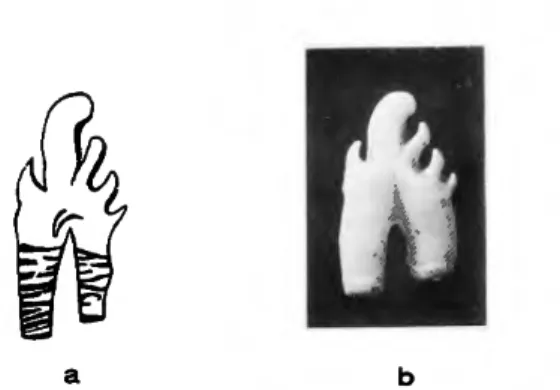
296-298). However, a crabeater seal in the North Atlantic of any geologic age is inexplicable. The drawing (Figure la) does indeed suggest a tooth essentially identical to a lower post-canine of the
FIGURE 1.—Lobodon species: a, the holotype of Lobodon vetus, after Leidy (1853b) (X 1), as confirmed by Leidy (1869:
416), though not indicated by Leidy (1853b); b, lower right fourth postcanine of modern Lobodon carcinophagus, USNM 270385, in lingual aspect (X 1).
living crabeater, Lobodon carcinophagus (Figure lb), and dissimilar to any tooth of any other seal.
The postcanines of some individuals of Phoca vitulina and of Pusa are rather comblike, but are much smaller, lower-crowned, fewer-cusped, and lack the posteriorly directed apical hook of the principal cusp seen in some teeth of modern Lobo- don and apparently in the fossil. Efforts to explain this tooth away, for example as an abraded shark tooth by Murray (1866:124), have not been suc- cessful (Allen, 1880:475^76). As the name has been validly proposed for a seemingly distinctive species, it would seem best, following the lead of Leidy (1869:415), to retain it as a species inquir- enda in the form of Lobodon vetus (Leidy, 1853), of Miocene or later age, pending recovery of the holotype or discovery of new material.
One does not work long with fossil marine mam- mals before becoming aware of the chronic con- fusion between remains of cetaceans and seals, from the earliest times at least through the nine- teenth century, if not to the present (see for ex- ample the synonymies of various squalodonts in Kellogg, 1923), particularly pernicious being the penchant of authors until recently to name taxa on the basis of isolated teeth. In some instances it has been possible to resolve the resultant problems, but there remain in limbo too many troublesome taxa, based originally upon nondescript teeth, and subsequently shuttled inconclusively about among various cetacean and pinniped assignments. Among these are Phoca debilis Leidy, 1857 (usually cited as 1856, but the publication not received at the Boston Society of Natural History earlier than 25
April 1857, according to Nolan, 1913:xi), and Phoca modesta Leidy, 1869, both named from small isolated teeth of unknown age in the collec- tions of the Academy of Natural Sciences of Phila- delphia, from the Ashley River deposits of South Carolina. Kellogg (1923) listed them as Delphino- don? debilis (p. 13) and Phoca? modesta (p. 26) respectively, and he (1922:127, 128; 1923) and Hay (1902:589) cited the earlier literature. In my opinion both taxa represent small porpoises, neither Delphinodon nor Squalodon, whose affini-
ties may or may not be determinable by thorough comparison with other taxa, including modern representatives, but which in any event are not pinnipeds and thus are outside the scope of this paper.
The fifth record is that of Leptophoca lenis True, 1906, from the Calvert Formation of Mary- land (and referred material from Virginia), thus far the only eastern North American Tertiary phocid adequately understood in the literature and based upon reasonably satisfactory material, though certainly not "the first authentic remains of American fossil seals" as claimed by True
(1905). Considerably more material has accumu- lated since True's description, reinforcing the pho- cine character of the species. This will be reported elsewhere, with the exception of two specimens from Richmond reported herein, one of which, a partial humerus, is illustrated alongside the holo- type (Plates 8-11: figures 3, 4) and a mandibular ramus illustrated for comparison with monachine mandibular fragments from Richmond and North Carolina (Plate 5: figures 1-6).
From 1906 onward has been a period of quies- cence for eastern North American Tertiary pinni- peds, completely so in terms of new, published information, and predominantly so in terms of additions to collections, until the past decade, during which collections have grown at an accel- erating rate. New material is known from the Cal- vert, Choptank, and St. Marys Formations, and elsewhere, and most abundantly from the York- town Formation (Ray, in press). Now, on the threshold of significant advancement of knowledge of the subject after more than half a century with- out progress, it seems particularly fortunate to be able to reinstate among the pinnipeds a species that was among the earliest named and most se- curely founded Tertiary phocids, but which has
languished, not forgotten, but misused, among the Cetacea virtually from its conception. Phoca wymani Leidy, 1853, had aroused my curiosity years ago, but so long as its holotype was unrec- ognized and presumed missing, and additional material was unknown, there seemed little pros- pect of clarifying its position. These handicaps have now been in part overcome by recovery of at least part of the original material and by discovery of a few additional specimens.
Phoca wymani Leidy
FIGURES 2, 3; PLATES 1-7
TAXONOMIC HISTORY.—Jeffries Wyman was a native and lifelong resident of Massachusetts, ex- cepting for travel and frequent wintering in the southern United States for reasons of health (see Gray, 1875, for this and most of the biographical information about Wyman). His specific associa- tion with Richmond, Virginia, stemmed largely from his occupying "the chair of anatomy and phy- siology in the medical department of Hampden- Sidney College, established at Richmond, Virginia,"
from 1843-1847, where he spent the winter and spring of each year in teaching. This was termi- nated in 1847 by his appointment to a position at Harvard, where his affiliation continued until his death on 4 September 1874. It was undoubtedly through acquaintances made while at Hampden- Sidney College (its medical department, since 1853, the Medical College of Virginia, Rucker, 1950:292) that he received the fossils collected by Dr. Martin Burton in Richmond, which in part form the primary subject of the present report.
In the Proceedings of the Boston Society of Natural History for 6 February 1850 (Wyman, 1850a:24l), it is recorded that "Prof. Wyman ex- hibited some fossil bones of Seals found in the Miocene deposit beneath the city of Richmond, Va., where they occur in company with the teeth of Sharks and Zeuglodonts [squalodonts?]." Again, in the meeting of 7 August 1850 (Wyman, 1850b:
323), "Prof. Wyman announced that he had re- ceived other fossil remains of seals from the Mio- cene deposit of Virginia, near Richmond . . . . He had a large portion of a cranium, of a well known genus, but of a species not yet ascertained. As these bones were found at some distance from each
other, farther discoveries would probably be made." In November of the same year he reported upon vertebrate remains from Richmond, mostly collected by Dr. Martin Burton of Richmond; the complete text on the seal remains (Wyman, 1850c:
229-230) is as follows:
Among the most interesting of the relics discovered by Dr. Burton were parts of the cranium of an animal belong- ing to the natural family of Phocidae, a family of which but few remains had been previously detected, and in so far as I have been able to find any record, only in one other locality in the United States. T h e bones were fragile, and had evidently been crushed previous to exhumation. T h e pieces in my possession consist of two temporal bones nearly entire, a fragment including a portion of the parietal and occipital bones; and in addition a part of the base of the skull. T h e reentering angle of the occiput, the well marked depressions corresponding with the cerebral convolutions on the parietal bones, the form of the cranial cavity, the deep fossa above the internal auditory foramen, the vascular canals opening on the occiput, and the inflated tympanic bones, all indicated an affinity to the Phocidae. T h e size varied but little from that of the common Harp seal, (P.
Groenlandica.) T h e presence of an interparietal crest indi- cating a large development of the temporal muscles, offers a diagnostic sign by which it may be distinguished from P. barbata, P. Groenlandica, P. hispida, P. mitrata, and P.
vitulina. From those species of seals which are provided with a crest the fossil presents a well marked difference in having the mastoid process much larger, more rounded, and promi- nent, nearly equalling the tympanic bone in size. T h e en- trance to the carotid canal is in full view when the base of the skull is turned upwards. T h e imperfectly divided canal which lodges the Eustachian tube and the tensor tympani muscle is of remarkable dimensions, especially when com- pared with that of P. Groenlandica. T h e interparietal crest extending from the occiput to the anterior edge of the frontals, is most narrow posteriorly where it is but slightly elevated above the surrounding bones.
T h e fragments of cranium above described were found in the Shockoe creek ravine near the base of Church Hill. In the ravine at the eastern extremity of the city and in the neighborhood of [end p. 229, begin p. 230] the penitentiary, Dr. Burton obtained several other portions of the skeleton of another seal. These consisted of an imperfect cervical vertebra, a lumbar vertebra nearly entire, a fragment of the sacrum, coccygeal vertebra, fragments of ribs and the lower extremity of a fibula. Their generic characters have been satisfactorily made out by comparisons with recent bones.
In figure 1, page 232, I have represented the coccygeal vertebra which corresponds in its general characters very accurately with recent bones of P. Groenlandica from the same region of the vertebral column. T h e small size of the vertebral canal and the imperfect transverse process, the wide spread articulating processes and the blunted spinous process indicate its affinity to the seals.
T h e fragment of a left fibula (figs. 2 and 3) presents at
its lower extremity (fig. 3), an oblique regularly concave articulating surface, on its inner face, and on its outer (figs.
2 and 3,) an elevated ridge or crest on either side of which is a groove for the passage of a tendon.
Leidy (1853a:8) lists among the Miocene mam- mals of North America:
Phoca Wymani, Leidy. Wyman: Am. Journ. Sc. 1850, X.
229.
In my opinion this constitutes valid publication of the species under the International Code of Zoo- logical Nomenclature (1961), in that it satisfies Articles 11, 12, and 16, the last of these by "indica- tion" of "a bibliographic reference to a previously published description, definition, or figure." The month and year of publication of Leidy's "The Ancient Fauna of Nebraska . . ." are June 1853 (see Rhees, 1882:8), the latter not 1854 as com- monly cited; the whole volume six of Smithsonian Contributions to Knowledge, of which Leidy
(1853a) is part seven, was completed in 1854, as indicated on its title page.
In 1857 Leidy (p. 265) published "Notice of remains of two species of Seals" (not two new species!), of which the part relevant here is as follows:
1. Phoca Wymani.
Remains of a Seal. Wyman, Am. Jour. Sci. X. 229.
Phoca Wymani, Leidy. Anc. Fauna of Nebraska, 8.
A tooth, apparently an inferior canine, from the miocene deposite [sic!] of Virginia, recently presented to the Academy by Prof. Tuomey, I suspect to belong to the same species as the remains of a seal from the same deposite, described by Prof. Wyman.
It is abundantly clear that Leidy did not regard this as the type description, but as the referral
(retracted in 1869) of a specimen to a previously established species. Certainly Prof. Tuomey's tooth from Virginia did not contribute to Leidy's concept of Phoca wymani when he named it in 1853, as the tooth was not donated to the Academy of Natural Sciences of Philadephia until 2 September 1856
(anonymous, 1857:xviii).
The proceedings of a meeting of the Academy of Natural Sciences of Philadelphia on 5 November 1867, record (Cope, 1868a: 132; see Nolan, 1913:
xiii, for year of publication) that "Squalodon mento Cope was characterized from four molar teeth, which were between two and three time[s]
as large as those belonging to the Squalodon wy-
manii (Phoca of Leidy) with similar incurved crowns, but much more rugose." Again, more formally, in a paper ordered to be published at a meeting of 31 December 1867, Cope (1868b: 152) stated as follows:
Squalodon wymanii m[ihi], Phoca wymanii Leidy. Pro- ceedings Academy N. Sci. 1856, 265.
Of this, the smallest species of the genus, three premolar teeth are in the collection, and the type specimen is in the Academy's Museum. . . .
These two publications by Cope in 1868 mark the first use of the name Squalodon wymanii (also listed by Cope, 1868b: 144), the first as a nomen nudum, but the second apparently validly pro- posed. In my opinion Cope did not intend to appropriate the species Phoca wymani to the Cetacea, as he did not refer to Leidy's (1853a) type description, but only to the paper in which he (Leidy, 1857) referred the tooth from Virginia, which Cope designated the holotype of Squalodon wymanii, indicating himself as the author of the species.
In 1869, Leidy explicitly separated the concepts of the original Phoca wymani and the interloping cetacean. He listed (p. 415) the former as follows:
Phoca Wymani.
Animal belonging to the Phocidae, Wyman: Am. Jour. Sc.
1850, X, 229, Figs. 1-3.
Phoca Wymani, Leidy: Anc. Faun. Neb. 1853, 8.
Remains found in a miocene formation at Richmond, Vir- ginia.
His account of the latter (pp. 425-426) is in part as follows:
Delphinodon Wymani.
Phoca Wymani, Leidy: Proc. Ac. Nat. Sc. 1856, 265.
Squalodon Wymani, Cope: Proc. Ac. Nat. Sc. 1867, 132, 151, 152.
Three teeth, from the miocene formation of Charles County, Maryland, ascribed by Prof. Cope to a species of Squalodon, appear to me, at least in part, to belong to a smaller species of Delphinodon.
One of the teeth . . bears a resemblance to that first described of the larger species . . . .
A tooth [ANSP 11225, the "type specimen" of Cope, 1868b, above] . . from the miocene formation of Virginia, orig- inally ascribed by me to the same species as the remains of a Seal described by Prof. Wyman, is very like the one above indicated . . .
T h e remaining two teeth from Charles County, ascribed by Prof. Cope to Squalodon Wymani, are different from the preceding, and it is uncertain whether they belong to the same animal . . . .
Thus Leidy and Cope scrupulously maintained the separate identity of the pinniped and the cetacean. Van Beneden (1877:28) merely men- tioned Phoca wymani as a form described early but not well characterized.
Allen (1880:470-473, 480) discussed Phoca wymani at length in a speculative manner, which, by weight of his authority, served largely to con- demn Phoca ivymani to nearly a century of neglect and misinterpretation. He stated first (p. 470) that:
some supposed Phocine remains were described by the late Professor Wyman from the Tertiary deposits underlying the city of Richmond, Virginia. They came from two localities, and consisted of quite different materials. T h e specimens are at present unknown, so that their reexamination is im- possible. A part of these remains were in all probability Squalodont, while others may have been Phocine.
Further (p. 470), under the heading "Squalo- dont Remains described as Phocine," he indicated:
No less than three species referred originally to "Phoca" are in all probability referable, in part or wholly, to Squalodon, as is more or less explicitly admitted by their original de- scriber. These are Phoca wymani, P. debilis, and P. modesta, of Leidy.
On page 471 he quoted Wyman's (1850c:229) description of the skull of Phoca wymani, followed by the assertion:
In the description above given there is nothing to prevent the supposition that these cranial fragments are referable to a small species of Squalodont. If, however, they are really Phocine, they represent a type very unlike anything at pres- ent known, either existing or extinct. But other remains are described by Professor Wyman, from the same locality, and in the same paper, which do not seem to admit of such an interpretation.
He then quoted Wyman's description of the post- cranial remains, followed (pp. 472-473) by the commentary that:
the specimens here described do not appear to have been preserved, or to have been seen by subsequent writers, but Professor Wyman was an osteologist of too well-known pro- ficiency to admit of the supposition that these remains did not present well-marked Phocine affinities. Indeed, his de- scription and rude figures of the fibula above mentioned show clearly that its affinities were rightly interpreted. T h e vertebra is not so evidently Phocine. Three years later the description of these remains became the basis of Dr. Leidy's
"Phoca wymanii," who, in proposing the name, merely cited Wyman's description. In 1856 [1857] he referred to it a tooth. . . . In 1867 [1868] Professor Cope referred Phoca wymani, Leidy, to Squalodon. . . . T h e Squalodon wymani
of Cope thus, inferentially at least, includes the remains described by Wyman, though direct reference seems to be made only to the tooth referred by Leidy to his Phoca wymani in 1856, and which is that of a squalodont. T h e Phoca wymani, if not originally a composite species, as was in all probability the case, certainly became so in 1856. In 1869 Dr. Leidy retained, under the name Phoca wymani, the specimens above mentioned as described by Wyman in 1850, separating the tooth referred by him to this species in 1856 under the name Delphinodon wymani.
I n c o n c l u d i n g h i s a c c o u n t of fossil p i n n i p e d s , A l l e n ( p . 4 8 0 ) s t a t e d t h a t :
in North America few remains of Pinnipeds have been found, and these, with two exceptions, are all from the Quaternary, and are referable to existing species. T h e excep- tions are the so-called Phoca wymani, based in part at least upon veritable Phocine remains from the Miocene of Rich- mond, Virginia, and the enigmatical Lobodon vetus . . . .
Judging from the foregoing statements, Allen vacillated radically in his thinking about Phoca wymani; much of what he said is contradictory or wrong. For example: Leidy never "admitted" that Phoca wymani was referable to Squalodon; Allen trusted Wyman's interpretation of the postcranial elements, but cast doubt on that of the skull; the Squalodon wymani of Cope did not, inferentially or otherwise, include the remains described by Wyman; erroneous subsequent (1857) referral of a specimen to a species in no way makes the species composite.
Roger listed "Ph. [Phoca] Wymanni," mis- spelled, in 1887 (p. 145), and "Ph. Wymani,"
correctly in 1896 (p. 74). Toula (1897:49, 53, 55) reviewed the history of Phoca wymani, noting Cope's and Allen's (1880) conclusions in large part correctly, while retaining the species among the fossil seals. Trouessart (1897:388, footnote) indicated under Pinnipedia, "Phoca Wymani, Ph.
debilis, Ph. modesta, Leidy (1853-1869) sunt dentes Squalodontium (Cetacea); vide infra:
Squalodon Wymani," but when the Cetacea were published (1898:1023) listed it as Delphinodon
Wymanii Leidy, 1856.
Hay (1902:591) indicated that "the name Del- phinodon leidyi is intended to replace D. wymani Leidy . . . . T h e type of D. leidyi is Leidy, J. 1869 A, pl. XXX, fig. 12 [ANSP 11225]." The new name must have been proposed under the erro- neous belief that Phoca wymani and Delphinodon wymanii were specific homonyms, which they were not and are not. In my opinion Delphinbdon
leidyi was an unnecessary replacement name and should be relegated to the junior synonymy of Delphinodon wymanii (Cope, 1868b). Hay's biblio- graphic citations under D. leidyi (p. 591) and Phoca wymani (p. 785) do not reflect the distinc- tion between the two—for example, none of the references to teeth (Cope, 1868a, b; Leidy, 1857) has anything to do with Phoca wymani, and no reference to Wyman's 1850 material has anything to do with Delphinodon wymanii. Hay did appar- ently understand the real separation of the two taxa, as evidenced by his listing them separately and in part distinguishing their respective litera- ture, and by listing Phoca wymani again in 1930
(p. 564). Trouessart (1905:762) followed Hay, and made no mention of the species under Phoci- dae (1904:282-288).
True (1912:185-186; confirmed by his unpub- lished notes) obviously accepted Allen's (1880) interpretations, implying that Leidy (1856 [ = 1857]) was a validation of Leidy (1854 [ = 1853a]), not the mere referral of a specimen as in fact it was. He also accepted Hay's replacement name, Delphinodon leidyi, for the cetacean, but he did recognize that the seal material of Wyman
(1850) was a separate entity.
Kellogg (1922:74, 75, 120, 130) perpetuated the unfounded notion that Wyman's original material described as seal was at best composite, and in part cetacean (squalodont).
Wilson (1935:126), without reference to Phoca wymani as such, accepted Wyman's (1850c) re- port as a valid record of fossil phocid remains, although erroneously supposing it to be the first for the United States.
The taxonomic history of Phoca wymani cannot be concluded without reference to the work of William Palmer, a taxidermist and naturalist in the United States National Museum, and an active collector of Miocene vertebrates along Chesapeake Bay approximately from 1907 until his death in 1921 (Gilmore, 1941:337). His prowess as collector has been adequately noted in published acknowl- edgments (as in True, 1912:166) and in one case by specific epithet (Parietobalaena palmeri Kel- logg, 1924), but his taxonomic insights have gone unremarked. In one of those rare occurrences that occasionally rewards antiquarian research, I found, long after reaching my own conclusions on the literature of Phoca wymani, in perusing notebooks
found among the late Remington Kellogg's papers, that William Palmer had covered essentially the same ground more than 50 years earlier, from the viewpoint of his interest in Delphinodon, and had written up his results in a formal manner under the title "Fauna Calvertensis, no. 2. The Fossil Cetacean Genus, Delphinodon." This projected series of publications never materialized, not even the first, which was to have been the description, under almost the same generic name, of the mate- rial ultimately described as Parietobalaena palmeri Kellogg, 1924. In a note written in May 1920 and placed with the holotype tooth of Delphinodon wymani in the collections of the Academy of Nat- ural Sciences of Philadelphia, Palmer recorded the synonymy of that species. T h e remarkable con- gruence of our conclusions would make it a pleas- ure to enter his name as coauthor of the present notes were he not so many years removed from the option of declining. However, it seems no dis- service to quote the following excerpt from his notes, which will reveal how perceptively he analyzed the main problems and how succinctly he stated them:
Delphinodon wymanii
Owing largely to careless citations the naming of this species has been remarkably confused. It was described [in the morphological, not taxonomic, sense] but not named by Leidy in 1856 in conjunction with a reference to remains of a seal described though not named by Prof. Wyman in 1850, but named and not described by Prof. Leidy in 1853 as Phoca wymani. It is clear that the porpoise tooth collected by Prof. Tuomey was without a name in 1856. We next find it named by Prof. Cope in 1867 as Squalodon wymanii.
On page 132 occurs, "Squalodon wymanii (Phoca of Leidy)." This is a nomen nudum here.
On page 144 occurs, "Squalodon wymanii. Cope, miocene."
Again a nomen nudum.
On page 152 he writes, "Squalodon wymanii m[ihi]. Phoca wymanii Leidy." He mentions the type, compares it with other specimens, and states that it is the smallest of the genus and distinctly uses a new valid name, the first for this type. Leidy had never used wymanii but had incidently discussed this porpoise tooth under the name of Phoca Wymani which of course rightfully belonged to the "seal remains" described by Wyman and named by Leidy in 1853, the first fossil seal named in North America. It is clear that Cope correctly identified this specimen as a cetacean tooth and his language clearly shows that he had written a new name.
T H E HOLOTYPE.—Leidy (1853a:8) seems clearly to have had in mind the cranial material as the
basis for his name Phoca wymani, as he cited the page reference as 229, on which only the cranium is described, not 230, on which the postcranial remains are described, nor the figures, on page 232, in which the latter are in part illustrated. Further, Toula (1897:53) wrote that "Phoca Wymani Leidy ist auf zwei Paukenbeine begrundet; eines der Stticke weist auch noch ein Stuck des Parietale und Occipitale auf. (Wyman: Amer. Journ. 1850, 229.)." If Leidy's intent were not regarded as suffi- ciently definite, then Toula's statement should qualify as subsequent designation of a lectotype, or, if not, then certainly True's (1912:186) state- ment that "in 1902, Dr. O. P. Hay pointed out the fact that the name Phoca wymani really belonged to the seal skull originally described by Wyman in 1850, and could not properly be applied to the teeth from Virginia and Maryland" would so qualify, even if he drew more than was warranted from Hay's bibliographic annotations. In any case, the prerogative of lectotype selection was not avail- able to Kellogg (1922:74) when he asserted, "The form Phoca wymani is here restricted to the fibula and vertebra from the ravine outside of the city limits of Richmond, Virginia." Thus, I feel that a conclusive case exists for the cranial remains as holotype by original indication (Leidy) or as lecto- type by subsequent designation (Toula, Hay, or True), and that Kellogg's later attempt is without force.
FATE OF THE SPECIMENS.—Apparently no one
has knowingly restudied Wyman's phocid speci- mens since his original reports of 1850. Although Leidy borrowed other specimens from Wyman, in- cluding some of cetaceans from Richmond (see, for example, Leidy, 1869:426, 432, 439; much or all of this material, in part still bearing Wyman's catalog numbers, is now in the collections of the Academy of Natural Sciences of Philadelphia, under the numbers, ANSP 11227, 11257, 11263, and 11268), there is no indication that he ever saw the material on which he based the name Phoca wymani, nor apparently did any other au-
thor who wrote about it until more than 100 years later, when I (1958:441) unwittingly reported upon the two temporal bones, cataloged in the collections of the mammal department of the Mu- seum of Comparative Zoology under the number MCZ 8741, labeled "Monachus?, S.C.?, R. W.
Gibbes coll. ?." At that time I tentatively accepted
the questioned data, and suggested that it provided a northerly (Pleistocene?) record for the monk seal.
There the matter rested until 1971, when, in connection with comprehensive studies of Tertiary pinnipeds of the Atlantic Coastal Plain, and at the urging of Charles A. Repenning, my interest in Phoca wymani was reactivated. Restudy of the literature suggested that MCZ 8741 might con- ceivably be part of the material. Borrowing and reexamining these temporal bones showed that they did in fact differ somewhat from those of modern Monachus, and showed as well the pres- ence of the faint but legible old numbers 825 on both specimens. At my request, Elaine Anderson, with the aid of Ralph Lutz, then of the Boston Museum of Science (successor to the Boston Soci- ety of Natural History) found in the library of that institution the Catalog of Jeffries Wyman's Collection of Comparative Anatomy in Boylston Hall (at Harvard University). The entries for fossil seal remains in the catalog are as follows:
824. A mass of clay presenting a cast of the interior of the cranium of a seal, from the Tertiary at Richmond, Va.
[illegible word].
825. Right and left temporal bones, with a portion of the parietal bones fitting the preceding specimen. From Dr. Martin Burton of Richmond.
826. Lumbar vertebrae of a fossil seal found at Richmond.
From Dr. Martin Burton.
827. Fragment of the sacrum of a seal. Fossil. From Dr.
Martin Burton.
828. Cervical vertebra of a seal. Fossil. From Dr. Martin Burton.
829. Dorsal vertebra of a seal. Dr. Burton.
830. Caudal vertebra of a seal. Dr. Burton.
831. Lumbar vertebra of a seal. Dr. Burton.
833. Ribs of a seal from Dr. Burton.
834. Metatarsal bone of a seal from Dr. Burton.
844. Extremity of the fibula of a seal, from Richmond.
Presented by Dr. Burton.
[This last entry lined out and replaced by an unrelated specimen.]
During recent curation of the collections of fossil marine mammals in the National Museum of Natural History there were found two casts of the distal part of a single left fibula of a seal, one with the number 929 and the other 930, from the old catalog of vertebrates, now in the Division of Mammals, NMNH, entered in 1852 as follows:
Fossil seal cast; Richmond, Va.; bone of hand; Dr.
J. Wyman. These are noted as item 36 in the "List
of Additions to the Museum of the Smithsonian Institution during the year 1851" (Baird, 1852:62).
They are now cataloged in the collections of the Department of Paleobiology under the single num- ber USNM 214650. Possibly representing the same bone may be the cast "of the inferior extremity of the radius of a fossil mammal obtained near Richmond, Va. From Dr. J. Wyman." listed among
"Donations to Museum" at the stated meeting of 5 January 1847 of the Academy of Natural Sciences of Philadelphia (Anonymous, 1847:141). The cast has not been found in recent examinations of the collections of the Academy.
Thus far then, of the seal remains in Wyman's catalog, only the temporal bones, no. 825, now MCZ 8741, and the casts of the distal part of the fibula, no. 844 (stricken), now USNM 214650, have been relocated. We know by Wyman's own assertion (Gray, 1875:105) that, during the sum- mer of 1874, "he had gone through his own museum of comparative anatomy, which had some- what suffered in consequence of the alterations in Boylston Hall, and had put the whole into perfect order," just prior to his death on 4 Sep- tember 1874, and that "The collections . . . forming a part of the late Prof. Wyman's Anatomical Mu- seum in Boylston Hall, have been deposited in the Museum [of Comparative Zoology] by the corpo- ration of the College [Harvard]" in 1875 (Agassiz,
1876:8). The entry for the temporal bones in the catalog of the mammal department of the MCZ is in the handwriting of G. M. Allen (Barbara Lawrence, prrsonal communication, 1975), and was made probably in 1907-1909, during his first, part-time employment at MCZ, when his chief activity was curation of the mammalian osteologi- cal collections, including fossils, which he com- pleted by mid-1909 (Henshaw, 1908:7; 1909:8), obviously after the deterioration of the "perfect order" of Wyman's collection of comparative anatomy, else he would undoubtedly have salvaged Phoca wymani. G. M. Allen was Wyman's younger cousin and said to resemble him in personal man- ner, including meticulous scholarship (Barbour, et al., 1943:299, 303, 304). Not so readily under- stood is the role of J. A. Allen, who surely was in a better position to have saved Phoca wymani for posterity than anyone could ever be again. On arriving at the MCZ in 1862 he was "to attend the course by Jeffries Wyman on comparative anatomy"
(Allen, 1916:8), a n d he mentions W y m a n as "a frequent caller" in Agassiz's laboratory where he worked (p. 9). W y m a n a n d Allen overlapped at H a r v a r d from 1862 u n t i l W y m a n ' s death in 1874.
Both were active a n d held various responsible positions in the Boston Society of N a t u r a l History d u r i n g the period (Gray, 1875:106; Allen, 1916:
44). Allen was curator of birds a n d mammals in- cluding fossils) b o t h in the MCZ a n d the Boston Society at W y m a n ' s death a n d at the time of trans- fer of his collections to the MCZ. Allen h a d published major papers on pinnipeds prior to 1874 a n d began work for his "History of N o r t h American P i n n i p e d s " no more than three years thereafter. All of these factors notwithstanding, he stated in 1880 that "the specimens are at pres- ent u n k n o w n , so that their reexamination is impossible" (p. 470) a n d "the [postcranial]
specimens here described do not a p p e a r to have been preserved, or to have been seen by subse- q u e n t writers" (p. 472). It is difficult to imagine how he could have failed to see a n d preserve the specimens.
ADDITIONAL M A T E R I A L . — O n 18 J a n u a r y 1968, vertebrate remains were salvaged from excavations
in downtown R i c h m o n d (Figure 2, locality 5) by Peter A. McCrery a n d other members of the Rich- m o n d Gem a n d MineralrSociety, including Rich- ard May, William Packard, a n d D o n a l d Woolford, a n d were donated to the Smithsonian Institution by the Society. Some m o n t h s later in the vertebrate paleontological laboratory of the Smithsonian Institution, Peter McCrery, working as a volunteer, prepared out the most promising specimen that turned out to be the major part of the skull of the small porpoise, Kentriodon pernix, now U S N M
171077. N o t h i n g further was done with the collec- tion u n t i l the fall of 1973 when Calvin Allison, another volunteer in the Smithsonian laboratory, discovered the distal part of a phocine humerus, now U S N M 187409, loose in a box of miscella- neous material from the site. T h i s led to close examination of all r e m a i n i n g material, which yielded a large cetacean l u m b a r vertebra, a few fragments of fishes, and most importantly, from a single block of matrix, several parts, poorly pre- served, probably from a single individual of a m o n a c h i n e seal, all now U S N M 187410, including a very incomplete right m a n d i b u l a r ramus, a left ulna lacking the distal epiphysis, a left tibia a n d
most of the shaft of a left fibula, each lacking the distal epiphysis, a left ectocuneiform, a n d several fragments of ribs, all carefully salvaged a n d skill- fully restored by F. L. Pearce. A right lower canine tooth from the same block seems not to belong with this material.
LOCALITIES.—Various sources for Phoca wymani have been cited in error, for example, "Carolina merid." by Trouessart (1898:1023) a n d "Mary- l a n d " by Trouessart (1905:591) a n d by H a y
(1930:564). In 1958 (p. 441) I erroneously re- corded the source of the temporal bones as "South Carolina?" on the basis of q u e r i e d entries i n the MCZ catalog—to be ignored now that the true identify of the specimens has been recognized.
W y m a n (1850c: 229) recorded the locality for the partial cranium as "Shockoe creek ravine near the base of C h u r c h Hill." A p l a n of R i c h m o n d made by Charles S. Morgan in 1848, showing the principal topography of the area by hachures, places the base of C h u r c h H i l l on the Shockoe Creek (northwest) side approximately at Twenty- first Street, a n d the southwest side, paralleling the James River, near F r a n k l i n Street, essentially similar to the present situation. Broad Street, paralleling F r a n k l i n Street, a n d t r e n d i n g approxi- mately S 53.5° E, traverses the center of C h u r c h Hill as labeled on the m a p of 1848. T h e inter- section of Broad Street a n d Twenty-first Street is central to the Shockoe Creek side of the base of Church Hill. T h u s the type locality of Phoca wy- mani may be fixed as "Shockoe Creek ravine near the base of Church Hill," at or near the inter- section of Broad Street a n d Twenty-first Street
(Figure 2, locality 1).
According to W y m a n (1850c:229-230), " I n the ravine at the eastern extremity of the city a n d in the neighborhood of the penitentiary, Dr. B u r t o n obtained several other portions of the skeleton of another seal." T h e s e included all the postcranial remains listed in W y m a n ' s catalog (above), of which only the casts of the fibula in the U S N M have been relocated at this time. His reference to
"portions of the skeleton of another seal" suggests a single individual, b u t reference to "the ravine at the eastern extremity of the city" a n d "the neigh- borhood of the penitentiary" entails two widely separated localities. T h e ravine in question can only be that of Bloody R u n , b o r d e r i n g Chimbor- azo Hill on the west (Figure 2, locality 2), as the
1 0 0 0 0 i—i i—< r = r
| v w CONTOUR INTERVAL 10 FEET
FIGURE 2.—Map of a part of the city of Richmond, Virginia, based on the Richmond Quad- rangle, 7.5 minute series (topographic) map, 1968, of the U. S. Geological Survey. (Segments of the city limits as of 1848 according to Morgan are indicated by a heavy broken line. T h e line A-A' indicates the line of section along the Church Hill Tunnel, shown in Figure 3. T h e line of section beyond the ends of the tunnel (broken) is imprecisely known. Localities for fossil pinnipeds and other vertebrates are as follow: 1, the type locality of Phoca wymani; 2, the ravine (of Bloody Run) at the (1848) eastern extremity of the city; 3, the neighborhood of the penitentiary; 4, downtown expressway excavations, Byrd Street between T h i r d and Fourth streets; 5, Ballard Street, now Fourteenth Street, between Grace and Broad streets.)
easternmost boundary of the city at that time fol- lowed the middle of Bloody Run ravine (Morgan, 1848). T h e penitentiary in question could not have been the Libby Prison of Civil War infamy, which stood on the south corner of Twenty-first and Cary Streets, but which was in 1850 a ship chandlery and tobacco warehouse, having been commandeered as a prison only after the first battle of Bull Run (21 July 1861), and dismantled and moved to Chicago shortly after the War. Instead the "penitentiary" in question undoubtedly was
the state penitentiary which then (Morgan, 1848) as now occupied an irregular area bounded ap- proximately by Belvidere, Byrd (now the down- town expressway), Second, and Spring Streets,
(Figure 2, locality 3), and at that time directly on the western boundary of the city, approximately 1.5 miles slightly north of west of the type locality.
In February 1975, vertebrate remains, representing Squalodon, were again encountered in this area, less than 0.25 mile east of the penitentiary, at 113 feet above sea level in excavations for the down-
town expressway (Whitmore, personal communi- cation), immediately north of Byrd Street between Third and Fourth Streets (Figure 2, locality 4).
Thus, Wyman's "several other portions of the skel- eton of another seal" probably came in part from Bloody Run ravine (locality 2) and in part from near the penitentiary (Locality 3), at the then eastern and western limits of the city.
The material salvaged in 1968 by the Richmond Gem and Mineral Society was obtained from a road cut made in widening the former Ballard Street, now Fourteenth Street, from two to four lanes, in the block between Broad and Grace streets, on the west side of Shockoe Creek ravine, directly opposite, and approximately 0.5 mile northwest of, the type locality, on the east side of Shockoe Creek ravine (Figure 2, locality 5). A por- tion of this roadcut remains exposed along the west side of Fourteenth Street.
GEOLOGY.—Hay (1930:564) listed Phoca wymani as "upper Miocene (Calvert); Maryland," and Clark and Miller (1912:167) listed Phoca wymani from the Calvert Formation of Richmond, but the presence of other Neogene beds in Richmond was not understood at that time. The exact horizon from which any of the fossil pinnipeds of Rich- mond was derived is unknown, but only Paleocene, Miocene, and Quaternary deposits are present.
However, as no phocid is known otherwise before the Miocene, that may be taken as the lower limit stratigraphically in Richmond, and the Paleocene beds of Richmond, including those known in and near the valley of Shockoe Creek (Aquia Forma- tion of Darton, 1911:16-17, pl. 1; Nanjemoy For- mation of Daniels and Onuschak, 1974:21, pl. 3;
definitely Aquia Formation, and largely if not entirely Paleocene, Hazel, 1969:C64, and Ward and Blackwelder, personal communication, 1975), may be eliminated from serious consideration. There is no evidence of Oligocene deposits in Richmond.
The latest Tertiary or Quaternary sands and gravels capping Church Hill and other uplands and the Quaternary alluvium flooring the lower end of Shockoe Creek Valley, the James River Val- ley, and other lowlands, are virtually nonfossili- ferous and largely nonmarine (Daniels and Onus- chak, 1974:28-36, pl. 3; Lafayette Formation and Columbia Group of Darton, 1911:27-31, pl. 1), and are thus exceedingly improbable sources for the fossil phocid material.
Here and there in the older literature the indi- cation "Yorktown" age or epoch occurs in con- nection with the Miocene of Virginia (Cope, 1868a: 131; 1868b: 138, 150) and in a few instances explicitly with Phoca wymani (for example, Dana, 1863:521; Guiscardi, 1871:8). The "Yorktown Epoch" was a regional time-term proposed and used by Dana but not widely adopted, essentially coextensive with the Miocene as then understood, and applied to the time of deposition of rocks of the Chesapeake group (Calvert, Choptank, St.
Marys, and Yorktown formations). Most of the evolution of the stratigraphic nomenclature of the Chesapeake group in Virginia was noted by Mans- field (1948:3-4); the Yorktown Formation of modern usage was named formally by Clark and Miller only in 1906 (p. 19) and is now regarded in whole or in large part as Pliocene in age. The westernmost known occurrence of the Yorktown Formation in the Richmond area is at Quinton, New Kent County, approximately 18 miles due east of Richmond (Ward and Blackwelder, per- sonal communication, 1975). Thus the Yorktown Formation is not a possible source of Phoca wymani.
The probable source beds for fossil pinnipeds in Richmond are limited to the strata of Miocene age, younger than the time of deposition of the Aquia Formation and older than that of the York- town Formation. They have been assigned tradi- tionally to the Calvert Formation (Darton, 1911:
18) or Calvert and questioned St. Marys Forma- tions (Daniels and Onuschak, 1974:21). These Miocene beds overlying the largely diatomaceous layers correlated with the Calvert Formation of Maryland are well represented in sections in and near Richmond, are under regional biostrati- graphic study at present, and are assignable neither to the Calvert nor to the St. Marys Formation
(Ward and Blackwelder, personal communication, 1975).
The beds in Richmond universally assigned to the Calvert Formation include a conspicuous dia- tomaceous layer, visible at distance on both flanks of Shockoe Creek ravine because of its light color on weathered outcrops and its sparse vegetation.
This bed was made known by W. B. Rogers in 1841, and has been written about extensively since (see Roberts, 1942, for citations to the many pub- lications and reprintings). It has been correlated
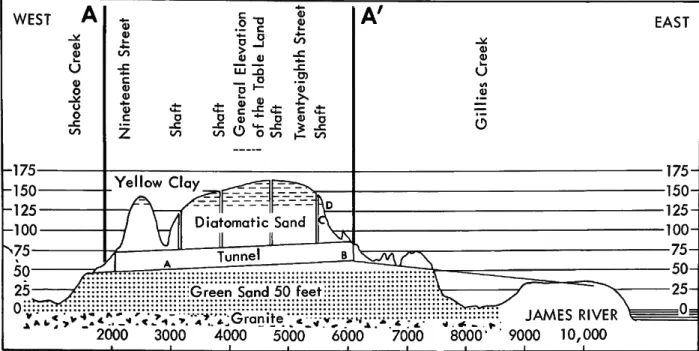
FIGURE 3.—Vertical section from northwest to southeast along the line A-A', extended, of Figure 2 along the course of the Church Hill Tunnel of the Chesapeake and Ohio Railway. (Modified from Coryell, 1876, pl. 5, and Darton, 1911, fig. 1. T h e letters A D indicate the sources of Coryell's samples analyzed for diatoms, of which only C was rich in diatoms. T h e stratum labeled "Yellow Clay" corresponds to Darton's Lafayette Formation; the "Diatomatic Sand" to the Calvert Formation, and possibly in part younger Miocene beds; the "Green Sand" to the Aquia and (below) the Patuxent Formations.)
with the Fairhaven member of the Calvert Forma- tion in Maryland, on the basis of the abundant diatoms.
Among the areas noted especially for the diato- maceous bed are the slopes of Church Hill. Rogers
(1841; reprinted 1881:59; 1884:452) refers espe- cially to the area "at the foot of the abrupt bare bank which has been cut into north of Main street, on Church hill, and thence south nearly to the next street—Indeed, along the slope of Church hill, as on the other side of the valley, this stratum may be found in all the ravines and cuttings, at the proper level." He refers also to the overlying sands and clays with plant remains and molds of scallops and other Miocene shells. His most exten- sive account of the diatomaceous deposits of Shoc- koe Creek Valley is that of 1859.
Along with Rogers' publications, perhaps the most useful in connection with Phoca wymani is that of Coryell (1876; reprinted 1881), particu- larly his geologic profile (his pl. 5; here modified in Figure 3) through Church Hill from northwest
to southeast along the course of the Church Hill Tunnel of the Chesapeake and Ohio Railway. This tunnel, which was begun in February 1872, opened in 1874, and largely disused from 1901 to 1925, collapsed in part during repairs on 2 October 1925, burying a work train and several workmen, after which it was mostly filled with sand and the ends sealed with concrete in 1926 (cf. Teal and Armit- age, 1950:775, and Blackford, 1973, Bower, 1975, and Heite, 1964). Its portals are still preserved, located immediately north of the intersection of Nineteenth and Marshall streets on the northwest (visible at surface), and near the head of Bloody Run ravine on the southeast (roofed, by a concrete extension of the tunnel some 241 feet in length), and indicated on the map (Figure 2) by the points A and A'. Coryell's section was reproduced with modifications by Darton (1911: fig. 1), who assigned all beds between his Aquia and Lafayette Formations to the Calvert Formation.
Coryell (1876:231-232) described the section in Church Hill very well, in part as follows:
Upon this granite bed is a sandy clay some fifty feet thick, of various colors and composition, then a ferruginous sand [Aquia Formation of Darton], so compact in places as to resist the pick and crowbar, and which, when struck, pro- duces sparks of fire, and is classed with the rocks. Upon this stratum is the blue deposit [Calvert Formation] through which the tunnel was made. T h e thickness of the stratum in the tunnel was found to be eighty feet; and the color;
when first exposed, a dark blue, but on long exposure be- coming nearly white. Upon this is a yellow clay [Lafayette Formation of Darton], very distinct in color, and filled with water-worn silicious boulders, nearly the size of hens' eggs.
This stratum is thirty feet in thickness, and upon it are various strata of clays which make the soil of the upland country, and under present cultivation do not indicate much fertility. In excavating the tunnel, large quantities of bones and teeth were found, not interspersed through the material, but generally in pockets. . . .
Mr. Peticolas, recognizing the importance and value of the true position and thickness of the strata from a known base-line, very kindly devoted his time to establish these facts for this paper, and, with the knowledge and assistance of Major Channing M. Bolton, he was furnished with material from well-established points in the tunnel and the railroad excavations, marked on the profile A, B, C, D.
To the eye, there is a uniform stratum eighty-five feet in thickness, blue in color when first exposed, and becoming nearly white after long exposure; this was generally denomi- nated the diatomaceous stratum. Material from the bottom of the tunnel and lower portion of the blue stratum (A and B), was nearly barren, and the remains of an inferior type;
at the point C diatoms were found in great abundance, and at D, near the top, the clay was quite barren.
Most important is the probable 80-85 feet of Calvert Formation, extending on the east side of Shockoe Creek ravine (Figure 2, locality 1), from an altitude of approximately 50 feet to 135 feet, which is to say from below the base of Church Hill well up its slopes. The cranium of Phoca wy- mani inevitably came from the lower part of this stratum (through which the tunnel was later ex- cavated, yielding numerous vertebrate remains) if it was collected in place, as seems probable in view of the improbability of such a delicate object surviving a tumble from high up the slope. Matrix recovered from the auditory bullae was insuffi- cient for analysis, but rediscovery and study of the associated endocranial cast would almost certainly yield significant results.
Darton (1911:24) described the extensive devel- opment of the diatomaceous Calvert Formation on the southeast side of Church Hill, on the nose of the slope bordering Libby Hill Terrace (Figure 2, locality 2) and extending along the west side of
Bloody Run ravine to the old tunnel entrance.
These beds constitute a likely source for the seal remains found by Dr. Burton "in the ravine at the eastern extremity of the city" (Wyman, 1850c:
229).
Darton (1911:25), in discussing the western margin of the Calvert Formation in Richmond, noted several exposures "in the neighborhood of the penitentiary" (Figure 2, locality 3). These include the "east side of Hollywood Cemetery,"
"railroad cuts on the north bank of the river at the foot of Pine and Laurel streets," "Bank near the foot of First Street," "formerly exposed in the steep slopes of the park just opposite [Gambles or Gimbles Hill Park]," and "penetrated by the railroad tunnel under Byrd Street between Third and Fourth streets." This last locality (Figure 2, locality 4) is exactly that of the present roadcut for the downtown expressway, from which Squalo- don remains were recovered recently.
The cut bank exposed still at the Ballard (Four- teenth) Street locality (Figure 1, locality 5) con- sists of up to 12 feet of diatomaceous, Calvert?, clay, overlain by a six-inch bed of bone and other rubble, grading upward into a bed of sandy clay up to 10 feet in thickness. Matrix associated with the phocid remains (described below) from this locality indicates that the partial humerus of Lep- tophoca came from the lower clay, with abundant well preserved diatoms; and the monachine re- mains, from the upper, sandy clay with sparse, generally fragmentary diatoms. The diatoms in the upper bed may be reworked and not strati- graphically significant, those in the lower are sug- gestive of zone 15 or 16 of the uppermost Calvert or lowermost Choptank Formation (Andrews, pers. comm., 1975). The upper bed is probably equivalent to the horizon from which the Squalo- don material was recovered at locality 4 to the west (Ward, pers. comm., 1975), and therefore is probably assignable to the Calvert Formation.
Thus, all specimens of fossil seals from Rich- mond probably came from the Calvert Formation, rather than from the overlying Miocene beds under study by Ward and Blackwelder.
DESCRIPTION.—Wyman's identification and de- scription (1850c, quoted in full above) of his fossil seal remains have been taken unjustifiably lightly, especially by his associate, J. A. Allen. Besides being a professional comparative anatomist, Wy-