ASSESSMENT (EWPA) AT THE SECOND GRADE OF SMA PGRI 2 TAMALATE MAKASSAR
(Pre-experiment Research)
A THESIS
Submitted to the Faculty of Teacher Training and Education
Makassar Muhammadiyah University in Partial Fulfillment of the Requirement for the Degree of Education in English Department
MUSDALIFAH RAHMA 10535 5375 12
ENGLISH EDUCATION DEPARTMENT
FACULTY OF TEACHER TRAINING AND EDUCATION MAKASSAR MUHAMMADIYAH UNIVERSITY
2017
SURAT PERJANJIAN
Saya yang bertanda tangan di bawah ini:
Nama : MUSDALIFAH RAHMA
NIM : 10535 5375 12
Jurusan : Pendidikan Bahasa Inggris
Judul Skripsi : Enhancing students’ ability in writing descriptive text through Extended Writing Project Assessment (EWPA) at SMA PGRI 2 Tamalate Makassar.
Dengan ini menyatakan perjanjian sebagai berikut:
1. Mulai dari penyusunan proposal sampai dengan selesaianya skripsi saya, saya akan menyusun sendiri skripsi saya, tidak dibuatkan oleh siapapun.
2. Dalam penyusunan skripsi, saya akan selalu melakukan konsultasi dengan pembimbing.
3. Saya tidak akan melakukan penjiplakan (plagiat) dalam menyusun skripsi ini.
4. Apabila saya melanggar perjanjian saya seperti yang tertera pada butir 1, 2 dan 3 maka saya bersedia menerima sanksi sesuai dengan aturan yang berlaku.
Demikian perjanjian ini saya buat dengan penuh kesadaran.
Makassar, November 2016 Yang membuat perjanjian
MUSDALIFAH RAHMA
SURAT PERNYATAAN
Saya yang bertanda tangan di bawah ini:
Nama : MUSDALIFAH RAHMA
NIM : 10535 5375 12
Jurusan : Pendidikan Bahasa Inggris
Judul Skripsi : Enhancing students’ ability in writing descriptive text through Extended Writing Project Assessment (EWPA) at SMA PGRI 2 Tamalate Makassar.
Dengan ini menyatakan bahwa :
Skripsi yang saya ajukan di depan tim penguji adalah hasil karya saya sendiri bukan hasil ciplakan dan tidak dibuatkan oleh siapapun.
Demikian pernyataan ini saya buat dengan sebenar-benarnya dengn penuh kesadaran.
Makassar, November 2016 Yang membuat perjanjian
MUSDALIFAH RAHMA
MOTTO AND DEDICATION
“Education is the best equipment for the old days”.
“Always do your best, and let God do next”
I presented this simple creation by the beautify expressions to my lovely mother and father was always accompanied by prayer and gives everything for my
success and others who saw a lot of me in my days.
Kupersembahkan karya sederhana ini dengan ungkapan yang lebih indah sebagai perwujudan cinta dan baktiku kepada ayahanda dan ibunda tercinta yang telah merajut benang kasih lewat doa dan tetesan keringat demi kesuksesan ananda
serta orang-orang yang tercinta yang tak pernah lelah
menemani hari-hariku
ABSTRACT
MUSDALIFAH RAHMA, 2016. English Department, Faculty of Teacher Training and Education Makassar Muhammadiyah University. Thesis. Enhancing students’ ability in writing descriptive text through Extended Writing Project Assessment (EWPA) at SMA PGRI 2 Tamalate Makassar. Guided by Erwin Akib and Ilmiah.
Many research applied Extended Writing Project Assessment (EWPA) in junior high school and the researcher interest to used this method at senior high school, because most of the result indicate that the students have low ability and can not express and organize their ideas in writing especially descriptive text at SMA PGRI 2 Tamalate Makassar. Based on the observation at the school, the researcher got that the students still have much difficulties when they were asked to write.
Sometimes, when the students want to write, they could not express and organize their idea.
The objective of the research was to examine the Extended Writing Project Assessment (EWPA) in enhancing the students‟ writing ability at SMA PGRI 2 Tamalate Makassar in descriptive text. This research used pre-experimental research design. The research had conducted with treatment, where each all consist of six meetings. A pre-experimental design was employed with one group pre-test and post-test design. The population of this research was the second grade at SMA PGRI 2 Tamalate Makassar. The sample of this research was only one class consisted 20 students that was selected by purposive sampling. The data were instrument of the research was writing test which consisted of one topic.
The result of data analysis indicates that there is a significant difference between pre-test and pos-test, the value of t-test was (13.26) with (df) = 19, and the mean score of pre-test was 9.65 with standard deviation 1.86, and the mean score of post-test was 16.275 with deviation 3.21. This indicates that alternative hypothesis (H1) was accepted and (H0) was rejected. Then, it is concluded that use of Extended Writing Project Assessment (EWPA) enhances the students‟ writing ability in descriptive text.
Keywords: Extended Writing Project Assessment (EWPA):, Writing, descriptive text
ACKNOWLEDGEMENT
AlhamdulillahiRabbilAlamin, the writer would like to express His praise and thankfulness to Allah SWT for blessing, love, mercy, guidance and most of all, to finish this thesis. Shalawat and Salam are addressed to beloved chosen messenger Muhammad SAW.
In writing this thesis the writer found many difficulties, so the writer realized that the thesis has a lot of mistakes and weakness. In order to become perfect, the writer needs correction and suggestion. The writer would like to say thank you very much for the people who give pray, spirit, advice, suggestion, and helping to the write as follows:
1. Rector of Muhammadiyah University of Makassar, Dr. H. Rahman Rahim, SE., MM.
2. Dean and vices dean of Faculty of Teacher Training and Education (FKIP), Dr. A. Sukri, M.Hum, Dra. Hj. Syahribulan, K. M.Pd (PD I), Khairuddin, S.Pd.,M.Pd (PD II), and Drs. Nurdin, M.Pd (PD III), H.Hambali, M.Pd (PD IV)
3. Head of English Department, Erwin Akib,M.Pd.,Ph.D and his secretary UmmiKhaeratiSyam, S.Pd., M.Pd
4. Supervisor who help very much from the beginning to the end of this work Erwin Akib,M.Pd.,Ph.D&Hj. Ilmiah, S.Pd., M.Pd
5. The headmaster of SMA PGRI 2 Tamalate Makassar Drs. H. Muhammad Ramli, M.si.,the teachers and the students at class XI IPA for helping to accomplish this thesis.
6. My highest appreciation goes tomy beloved parents Aliong and Nursiah, for their love, sacrifices, affections, advices and prays during her study.
And also thanks to my sister MulfaRahma and MarsyaAmaliafor their love and supports.
7. All her friends in EDSA 012, especially her lovely classmates in class H for their love, togetherness fully with joy and joke, you would never be forgotten and would be pleasant memories till the end.
Finally, the writer realized that this thesis still have not been prefect yet and still need more suggestions and critics, thus more improvements for this thesis are strongly needed. Hopefully, this thesis would be useful for many people who need it.May almighty, Allah SWT bless us all now and forever, Amen.
BillahiFiiSabililHaqFastabiqulKhaerat
Makassar, Oktober 2016
The Researcher
TABLE OF CONTENTS
TITLE... i
APPROVAL SHEET. ... ii
COUNSELLING SHEET ... iii
TABLE OF CONTENTS. ... v
LIST OF TABLE... vi
CHAPTER 1 INTRODUCTION A. Background ... 1
B. Problem Statement ... 3
C. Objective of the Research ... 3
D. Significance of the Research ... 4
E. Scope of the Research ... 4
CHAPTER II REVIEW OF RELATED LITERATURE A. Previous related studies………5
B. Some Pertinent Ideas………....6
1. The concept of Extended Writing Project Assessment ………...6
2. The concept of writing ………11
3. The concept of Descriptive Text ……….20
C. Conceptual Framework………...…….24
CHAPTER III RESEARCH METHOD A. Research Design ... 25
B. Population and Sample ………..25
C. The variable and indicartor ... 26
D. Instrument of the research ... 27
E. Instrument of collecting data ... 27
F. Procedure of collecting data ... 28
G. Technique of Data Analysis ... 28
BIBLIOGRAPHY………. 29
APPENDICES ………..…….……….
1. Instrument (pre-test) 2. Rpp
3. Instrument (Post-test)
INTRODUCTION
A. Background
Language is very important to communicate to each other. With language, people can deliver what in their mind. However, there is a different language which is used in every country, region, or district. That is why; national language is need to communicate between one people to another in one country, while international language is needed to be used to communicate between some people which come from different countries.
Teaching English at junior school in KTSP focuses on four skills of language. The standard competence of teaching English is based on language skills. Those are listening, speaking, reading, and writing. The skills are the ways to express thinking idea, concept, and opinion orally and written that are suitable with the correct context of communication. Writing activity is the last skill that is controlled by the students after listening, speaking, and reading skill. Comparing with the other skill, writing skill is more difficult to hold even the language speaker. This is because writing ability needs the mastery of some language elements and external of the language itself that will be a content of text. The language and content element must have a relation to arrange a good text.
Teaching writing is one of language skills that is important for the students, especially an idea, thinking, and feeling in written form or paragraph. To reach it every student has to receive a training and guidance about writing ability well, because writing ability is not an inheritance, but it is a result of study
process and stick of training.The reality now shows that in learning writing the teacher always gives speech and then an assignment about what the students have known. The score focuses on the product or result, and there is not attention about the ways of students in writing. For example Walker and Carmen (2008: 18) explain that the one of the unsuccessful in teaching writing because the unhappy with the contradiction of teaching writing skill through process genre approach and testing them by means of timed essay, and Extended Writing Project Assessment comes as an alternative evaluation mechanism.
Further more in the research report of SQA(2010 :9) stated that the Extended Writing Project allows the students some freedom of choice-in selecting and structuring and sequencing what they consider to be relevant features of content. the students are also given opportunity for demonstration of discrete and related higher order cognitive skills (applying knowledge, analyzing, synthesize, evaluating, and thinking critically).
Many Research applied Extended Writing Project Assessment (EWPA) in junior high school and the researcher interest to use this method at senior high school, because most of the result indicate that the students have low ability in writing especially descriptive text at SMA PGRI 2 Tamalate Makassar. Based on the observation at the school, The researcher got that the students still have much difficulties when they were asked to write. Sometimes, when the students want to write, they could not express and organize their idea.
B. Problem Statement
Based on the background above, the researcher formulates the research question ask follow: “How does the Extended Writing Project Assessment (EWPA)enhance the students‟ writing ability at SMA PGRI 2Tamalate Makassar in descriptive test?”
C. Object of the research
In relation to the problem statement above, the objective of the research was to examine the Extended Writing Project Assessment (EWPA) in enhancing the students‟ writing ability at SMA PGRI 2 Tamalate Makassar in descriptive text.
D. Significance of the research
The significant of the research was expected to be very useful and helpful information for teacher of English and learners to know the Extended Writing Project Assessment (EWPA) and also its contribution for teaching and learning process in increasing the students‟ writing ability especially in descriptive text.
E. Scope of the research
The scope of this research is viewed from three aspects: discipline, content, and activity. By discipline, this research is discipline of Language Learning (applied linguistic); by content, it is limited to focus on improving the students‟ writing ability in descriptive text using Extended Writing Project Assessment (EWPA) at SMA PGRI2 Tamalate Makassar and by activity. The mode of the research, the students‟ writing ability in descriptive text is considerably defined as the student‟s understanding in using writing component
such as content, organizing, vocabulary, structures and mechanics. In the studying activity, the students will be treated using Extended writing Project Assessment (EWPA) as the teaching technique.
REVIEW OF RELATED LITERATURE
A. Previous related studies
1. Researches related to writing
Rosnawati (2011) conducted a research increasing writing ability of the second grade students at SMA Nasional Makassar through peer assessment. In her research, peer assessment technique can increase the writing ability of the second grade students at SMA Nasional Makassar.
Husain, (2012) conducted a research improving students‟ writing ability through six step of writing. In her research, six step of the writing was effective in improving students‟ writing ability of the second grade of SMU 1 Pangkajene. There was significance different between the result of pretest and posttest, where the mean score of pretest was 53 which were lower than mean score of posttest that was 63. T-test value of final score in writing ability (4.6) was greater that t-table (2.04)
2. Researches related to descriptive text
Ariyani (2011) conducted a research the effectiveness of Learning Community (LC) strategy in writing descriptive paragraph for the students of first years of SMK Kartini Makassar. In research, Learning community strategy improves the student‟s writing ability especially in writing descriptive paragraph. It was proved and supported by pretest and posttest. It means that the use of Learning Community strategy is
effective to improve the student‟s ability in writing descriptive paragraph.
3. Research related to extended writing project assessment
Satriani (2011) conducted a research implementation of Extended Writing Project Assessment to increase the students‟ writing proficiency.
In her research, the implementation of Extended Writing Project (EWP) Assessment can increase the students‟ writing organization. This lead the conclusion that implementing EWP Assessment which is needed in the English language teaching and learning in increasing their proficiency to organize their ideas. EWP Assessment gives them more chance and time to do pre-writing and make draft and re-draft their writing besides that, the EWP Assessment gives the students freedom to choose their topic, even find their interesting topic. So, they can decide the contents that they want to write. It was still under the teacher‟s guidance. And this
technique is effective to increase the students‟ writing proficiency.
In relation to be research, the previous finding indicates that Extended Writing Project Assessment (EWPA) could improve the students‟ writing proficiency. The researcher was interested to conduct the research by the apply EWPA in enhancing students‟ writing ability in descriptive text.
B. Some Pertinent Ideas
1. Theories about Extended Writing Project Assessment a) introduction to EWP Assessment
Caudery (1990: 123) points out that the trend in language teaching is toward emphasis on the extended composing process, there has been no concomitant trend in the assessment of writing skills in examinations. The researcher concludes that there is incoherence between a process-oriented approach in teaching English writing and a product-based approach to assessment. There is nothing possibility of drafting and the chance to get external guidance.
Unhappy with the contradiction of teaching writing skills through a process-genre approach and testing them by means of a timed essay, the authors devised the Extended Writing Project (EWP) as an alternative evaluation mechanism. (Walker and Riu, 2008:18)
The EWP as an evaluation mechanism allows the tutors or the teachers to assessment comes to get the coherence to assess the students‟
writing proficiency with approach in teaching.
b) The Extended Writing Project
Based on the Research Report of SQR (2009 : 9) states that the Extended Writing Project is extremely useful to the write as a means of clarifying and communicating our thinking, and to those who read it as means of assessing and responding to the relevance and of what the writes
have written. So, there are several aims that we can reach through implementing of Extended Writing Project.
Walker and Riu explain that the Extended Writing Project has three main aims:
1. To resolve the incoherence between a process approach to the teachingand assessment through a timed essay;
2. To create a mechanism which would allow us to assess the process as wellas the product of the learner‟s writing; and
3. To facilitate our students‟ independence by improving their awarenessboth of their writing techniques, and of the standard of their language.
In the EWP, the students are required to write an extended text in four consecutive sections, each of which is read and assessed by their tutor or teacher. Therefore, through the EWP, students get the chance to draft, revise, and correct a text worth 20 per cent of their school. Altogether, six stages are involved in the project that will be explained in the next item.
(Zhang, 2008: 167)
c) Running the Extended Writing Project
Walker and Riu explain (2008: 21) that there are six stages to the EWP:
Stage 1
Students propose an interesting topic. Yun Zhang (2008: 167) states that the tutors or the teachers should either ask students to propose their own
topic or let them choose a topic from a list the tutor or the researcher provide. Very often students are at a loss when they are asked to propose a topic by themselves. Providing a topic can save time and reduce their anxiety.
Stage 2
Students prepared a preliminary outline for their article. Apart from theeffect of pushing them to plan the content, this phase was important, because it:
a. provided further information on the acceptability of the topic chosen;
b. allowed us to assess the student‟s ability to organize content;
c. allowed us to give guidance on research or the coherence of the text;
d. allowed us to foresee other potential problems,
In this section (prewriting) the students are required to cluster or to list what they know for each topic as the subject before deciding on one topic as the subject of their report of essay. After that the students begin to organize their ideas.
Stage 3
On completion, the first draft of the first section of the article is handed in for correction based on criteria students were accustomed to from English:content, meaning and organization, on the one hand, and language correctness, on the other. While revising this first draft, we left clear indications as to the place and nature of language errors. On returning the drafts we instruct students to record their errors, the error
type (using the codes they were already familiar with), and the correct version, on a simple error sheet.
Stage 4
Students were invited to re-draft the first section of their article, correctinglanguage errors and using any feedback from their tutor to improvecoherence, cohesion, relevance of ideas, and so on. Once this was donethey could go on to draft the second section of their article, which wecorrected in much the same way as the first. For both of these sections, weencouraged students to make more than one draft if they felt this to bebeneficial.
Stage 5
For the final two sections of the article, we deliberately offered lessexplicit feedback with respect to language errors we had commented onpreviously.Inthisway,wehopedtopushstudentstowardsincreasedresponsib ility, and ultimately independence, in the revision of drafts forlinguistic correctness.
Stage 6
On completion of all four sections, each student had to hand in the finalversion of the whole article, together with the bibliography. The drafts andany comments and suggestions made in tutorials were also handed in.
Weinsisted on this since they would give us invaluable insights into theprocessbehind the writing of the texts.Despite these quite demanding conditions, we obtained a set of verysatisfactory articles.
From the explanation above, the researcher concluded that procedure of implementing EWPA is as in the following:
1. Teacher provided some interesting topics that related material to be taught.
2. Students, given opportunity to choose one of the topics that provide by the teacher, select a topic to write.
3. Teacher taught about how to make outline by observing the topic, content and vocabulary, which they want to write.
4. Student prepared outline to list what they know about the topic. After that the students begin to organize their ideas into a paragraph.
5. Teacher corrected the outline and developing the students‟ ideas with observes the content, meaning, organization, and mechanics.
6. Students repair the draft has been checked by the teacher with write down their errors. After that, students make more than one draft that to be beneficial for their text.
1. Teacher 2. Students
3. Teacher 4. Students
5. Teacher 6. Students
7. Teacher 8. Students
7. Teacher given offer less explicit feedback with attend an error that have been commend on previously. In this way, the teacher hope to push students increased responsibility to correct revision.
8. Students collected the assignment in the final version from all the draft that has been revision.
2. The Concept of writing a) Definition of writing
The meaning of writing according to the Oxford Learner‟s Pocket Dictionary (2005:502) is produce something in written form so that people can read. According to Oshima and Hogue (1990: 2) states‟ writing is developing of the activity. It means that when we want to write. And according to Cambridge Advanced Learner‟s Dictionary writing is the activity of creating pieces of writing work, such as stories, poems or articles.
Lindbolm in fatmawaty(2009 : 13) gives definition of writing as studying to focus our mind on important matters, and learning about them.
By this activity, a person can find the solution of difficult problem, master the fact even by writing, a person can also communicate their mind that cannot be done through other way. We can say that writing is the act of expressing something through the application oflanguage system. So, when we write, there are two problematic areas namely “what to write and how to write it”. It is then understandable that language skills are meant as the ability to manipulate the rules of language conventionally, while extra
linguistic system or knowledge of the world refers to what the writer knows about the subject to write.
According to the students, writing is something writes so the people can read what we write. Good writing reflects the writer skill to criticize the draft and revise it. Revise is the key of effectives writing.
Based on some definition of writing by some specialist above, the researcher concluded that writing is continuous process of thinking and organizing rethinking and reorganizing.
b) The importance of writing
There are a lot of reasons why writing is important by Hairston in Saleha (2008: 5)
1) Writing is a tool for discovery. We stimulate our thought process by the act writing into information and tab into information and image we have our unconscious mind.
2) Writing helps us to organize our ideas. We can arrange them in coherent form.
3) Writing generates new ideas by helping us to make connection and see relationship.
4) Writing down ideas allows us to dictate ourselves from them.
5) Writing helps us to observe and process information when we write a topic, we learn it better.
6) Writing enables us to solve the problems by putting the element of them into written form; we can examine and manipulate them.
7) Writing on a subject makes us active rather than passive learns of information. While the other reason:
1. People can read something because of writing so that we know everything.
2. Through writing, we can express our ideas and also our feeling to other people.
3. By expressing idea through writing, the writer can improve the way of delivery ideas and opinions in more appropriate way since she can check and revise her writing before being read by other people.
b) component of writing
Jacob in Satriani (2010: 22) there are five points of components in writing. They are content, organization, vocabulary, structures and mechanics
Content
There are at least four things that can be measured in connecting with content, the composition should contain one central proposed only, should have unit, should have coherence and continuity, and should be adequately develop. There are some indicators and range to evaluatestudents content in writing, they are :
1. Very good
a) The ideas are about the topic selected b) The ideas are clearly stated
c) The ideas are clearly supported d) The ideas are comprehensible e) The ides are well developed f) The ideas are fluently expressed 2. Good
a) The ideas are about the topic selected b) The ideas are clearly stated
c) The ideas are clearly supported d) The ideas are comprehensible e) The ideas are quite relevant f) The are generally well developed 3. Average
a) The ideas are about the topic selected b) The ideas are clearly stated
c) The ideas are enough supported d) The ides are quite comprehensible e) The ideas are quite relevant
f) The ideas are generally well developed g) The ides are sufficiently expressed 4. Poor
a) The ideas are about the topic selected b) The ideas are not clearly stated
c) The ideas are getting limited to support
d) The ideas are not quite relevant e) The ideas are lack of developing f) The ides are non-fluent expressed 5. Very poor
a) The ideas are about the topic selected b) The ideas are enough to evaluate c) The ideas are incomprehensible d) No communication of ideas e) The ides are relevant
f) It has very poor of development of idea Organization
The purpose of organizing material in writing involves a corehence, order of important, and general to specific, specific to general, chronological order of spatial orders of patterns. When writing, the learner should arrange the writing chronologically. They should present their ideas based on the order of which happened from the beginning to the end.
There are some indicators and range to evaluate students organization in writing, they are :
1. Very good
a) The ideas are well organized b) The ideas are concise
c) The ideas are coherent
d) The ideas are relevant to outline
e) The ideas are present in logical sequencing 2. Good
a) The ideas are adequate organized b) The ideas are quite concise c) The ideas are adequate cohesion d) The ideas are adequate coherence e) The ideas are relevant to outline f) The ideas are sufficient sequencing 3. Average
a) The ideas are generally organized b) The ideas are break out cohesion c) The ideas are generally coherence d) The ideas are mostly relevant to outline e) The ideas are in some logical sequencing 4. Poor
a) The ideas are almost loosely organized b) The ideas are inadequate cohesion c) The ideas are inadequate coherent d) The ideas are confuse and disconnected e) The ideas are somewhat relevant to outline f) The ideas are lack in logical sequencing 5. Very poor
a) The organization are not concise
b) The ideas are incoherent
c) The ideas are not enough to evaluate
d) The ideas are not or almost not relevant to outline e) The ideas are not or almost not
f) The ideas are not or almost not present in logical sequencing Vocabulary
The effective use of words will always result good writing bothspecific and technical writing. The lack of vocabulary make us to difficult to express ideas. There are some indicators and range to evaluate students vocabulary in writing, they are:
1. Very good
Almost paragraph have appropriate and effective words 2. Good
Some words of paragraph does not use an appropriate and effective words
3. Average
Half words paragraph are not effective and inappropriate 4. Poor
More than half word of paragraph are not effective and inappropriate.
5. Very poor
Almost words of paragraph are not effective and appropriate
Structure
Structure in writing involves correct language and point of grammar. An adequate grammar should one that capable of producing writing. We should not be able to do anything more than order separate items of language for separate function and also grammar can help the students improve the use of formal language. There are some indicators and range to evaluate students structures in writing, they are:
1. Very good
Almost paragraph have correct structure (word order, pronouns, preposition, articles, conjunction, tense, etc)
2. Good
Some structures of paragraph are incorrect (word order, pronouns, preposition, articles, conjunction, tense, etc)
3. Average
Half structures of paragraph are incorrect (word order, pronouns, preposition, articles, conjunction, tense, etc )
4. Poor
More than half structures of paragraph are incorrect (word order, pronouns, preposition, articles, conjunction, tense, etc)
5. Very poor
Almost the structures of paragraph are incorrect (word order, pronouns, preposition, articles, conjunction, tense, etc)
Mechanics
There are at least two main parts of mechanic in writing namely:
(1) punctuation, it is important to clarify meaning in English; (2) capital letter, it has two principles first, it is used distinguish, a formed statements and proper adjective, etc. there are some indicators and range to evaluate students mechanics in writing, they are:
1. Very good
Almost words used in paragraph have correct punctuation, capitalization, and spelling.
2. Good
Some the punctuation, capitalization, and spelling are incorrect.
3. Average
Half of punctuation, capitalization, and spelling are incorrect.
4. Poor
More than half of punctuation, capitalization, and spelling are incorrect.
5. Very poor
Almost the punctuation, capitalization, and spelling are incorrect.
3. The Concept about Descriptive Text a) Definition of Descriptive text
According to Suniardescriptive text is a text type that is widely used in everyday life to describe object, places, people, animals, and so forth. A descriptive need not be long, but it should be vivid. Action verbs,
adjectives that describe size, shape and color, and adverbs that describe action must be carefully chosen to make a clear picture. The opening sentence of descriptive text tells the reader what is going to be described.
The meaning of descriptive text to the Glossary of Education is text or speech that is meant to give verbal picture of an object, character, location, or event. Description is considered one of the four traditional forms of composition (along with exposition, narration, and persuasion).
According to the students descriptive is a text that describes the features of someone, something or certain place. There are two parts in descriptive text, they are identification and description.
Based on the some definition above, the researcher concluded that descriptive text is an English text to describe what object or living things we described, both in appearance, smell, sound, or texture of the object or living thing. Its purpose is to describe people, place or things so the reader can experience the story fully.
There is a little bit discussion dealing with the descriptive text:
a. People
People who are described in the text are usually people who are interesting to readers. Their appearance is interesting. Especially as it reflects personality.
b. Place
How place look, smell or sound is important. Here are two ways to go about writing descriptive of place; start from the overall impression
and break it down into the details and build up toward an overall impression.
c. Unit of time
Descriptive of unit of time is often used to established mood.
Literature is full of description of season, days and time of day. The description of unit of time may also set a certain mood or emotional tone.
b) Communicative purpose of descriptive text
Communicative purpose of descriptive text is to descriptive and reveal the characteristics of the object, place, or a particular creature in detail, so that those who hear objects, places or living things we description.
c) Generic structure of descriptive text
In each descriptive text are the two parts that is characteristic of descriptive text itself. There two areas are:
1) Identification: identification is part of Descriptive Text about the topic or containing “what” will be depicted or described.
2) Description: description is the last part of the Descriptive Text that contains discussion or description of the topic or the “what”
in the identification of the physical appearance, quality, general behavior and properties.
d) Characteristic linguistic of descriptive text
1) Descriptive text using the present tense, for example: go, eat, fly, etc
2) Descriptive text uses adjectives that varied kinds or types (adjective). Describing a character (portrait), numbering, and classifying (classify), for example: two strong legs, sharp white fangs, etc.
3) Descriptive Text Relating Verbs used to provide information about the subject, for example my mum is really cool; it has very thick fur, etc.
4) Descriptive Text using Thinking Verbs (verbs of thinking, such as believe, think, etc) .and Feeling Verbs(verbs flavorings, like feel) to express the author‟s personal views about the subject, for example: police believe the suspect is armed, I think it is a clever animal, etc.
5) Descriptive text also uses adverbs (adverbs) to provide additional information about the behavior or trait (adjective) described, for example: it is extremely high; it definitely runs past, etc.
C. Conceptual Framework
The theoretical framework is presented by:
The components above are described as follows:
1. Input refers to giving explanation about descriptive text and EWPA and giving the instruction about what will be done with the EWPA.
2. Process refers to process of giving assignment to students and observes their assignment.
3. Output refers to the students‟ enhancement (result) of writing ability in descriptive text.
D. Hypothesis
Based on the statement in the background, review of the related literature, the researcher made hypothesis as follow:
(H0): the use of EWPA has not some effects in enhancing students‟ writing ability in descriptive text for SMP PGRI 2Tamalate Makassar.
(H1): the use of EWPA has some effects in enhancing students‟ writing ability in descriptive text for SMPPGRI 2Tamalate Makassar.
INPUT Descriptive Text
and explanation EWPA
PROCESS Giving assignment
to students and assess their assignment
OUTPUT students‟
enhancement of writing in descriptive text
37
THE RESEARCH METHODOLOGY
A. Research Design
The design of this research was pre-experimental method with one group pretest-posttest design. It involves single group which is pretested (O1),
exposed to a treatment (X), and then post-tested (O2). The research was designed as follows:
(Gay L.R, 2006:251) Where:
O1 : Pretest (Given to know the students‟ basic knowledge before give the treatment)
X : Treatment( The teacher given explanation about writing in descriptive text and implements the Extended Writing Project Assessment)
O2 : Posttest (The students were given assignment with the some text with pre-test to find out the students‟ ability after treatment through using EWPA).
O1 X O2
B. Population and Sample 1. Population
The population of this research was the second grade at SMA PGRI 2 Tamalate Makassar. The total population is 78students who were divided into 3 classes.
2. Sample .
In this research, the researcher usedpurposive sampling. The design of this research was one group pre–test and post–test design.In which the researcher taken one class for experimental class namely XI IPAas the sample. Because the students of XI IPAwas representative of the all eleventh grade students who own an average standard ability in English.
This case was supported by reason of their English teacher that the distribution of students based on the level students‟ ability evenly in each department, namely IPA, and IPS.The total number of the sample was 20 students of XI IPA.
C. The Variables and Indicators Variables
In this research, the researcher used independent and dependent variable.
a. Independent variable
The independent variable was the use of Extended Writing Project Assessment (EWPA). It was as the method used by the teacher when teaching the material.
b. Dependent variable
The dependent variable was the students‟ writing achievement in learning writing especially in descriptive text.
D. Instrument of the Research
In this research, the researcher used descriptive text for pretest, posttest, andobservation checklist.
Pretest was used to see students‟ ability in writing descriptive text before giving treatment by using Extended Writing Project Assessment (EWPA). After that, posttest administers to see the effect of the treatment.
E. Instrument of the Research
The procedure of collecting data as follows:
1. Pre-test
Before giving the treatment, the researcher give a pre-test to know the writing ability in descriptive text that possessed by the students. The researcher asked them to write descriptive text with choose one of the topics that provided before.
2. Treatment
After the pre-test, the researcher implementing some procedure of treatment:
a. Introduce and explain about descriptive text.
b. Explain about the tenses used in descriptive text.
c. Give the models to the students.
d. Explain about the Extended Writing Project Assessment (EWPA).
e. Giving the students assignment and assess their assignment.
This treatment is conducted for five meetings in the classroom.
3. Post-test
After giving treatment, the researcher give the posttest. It aimed at finding out the result of treatment. The researcher assigned the students to write descriptive text with choose one of the topics that provided with using EWPA.
F. Technique of Data Analysis 1. Scoring system
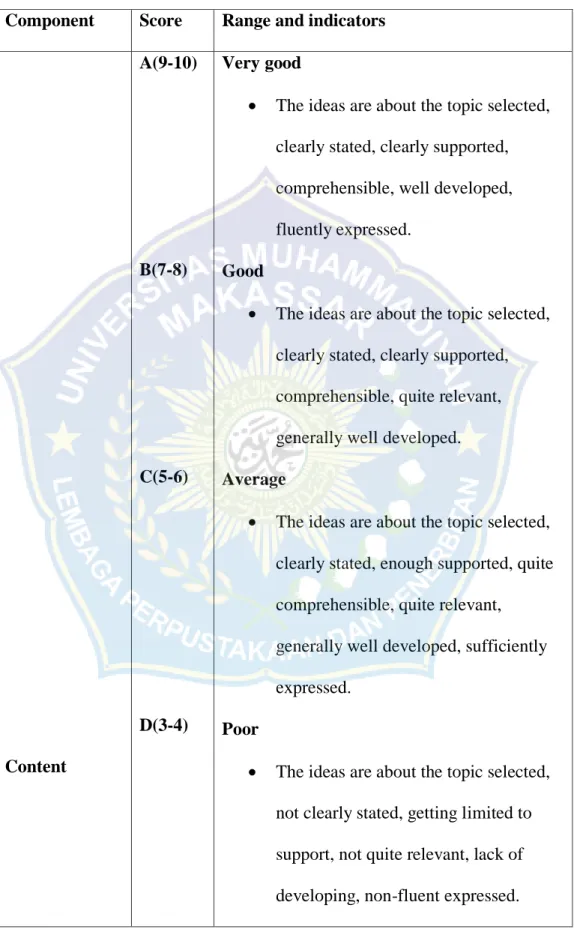
Scoring the students‟ writing composition by giving attention on five components. They way of getting score is based on the analysis scoring scale for writing adapted from Salija in Ryeni (2011: 30-34) for items 1 (content), 2 (organization), 3 (vocabulary), 4 (structure), and 5 (mechanics) are adapt from Depdiknas (2004) as follows.
Table 3.1.assessing the component of writing through scoring rubrics Component Score Range and indicators
Content
A(9-10)
B(7-8)
C(5-6)
D(3-4)
Very good
The ideas are about the topic selected, clearly stated, clearly supported, comprehensible, well developed, fluently expressed.
Good
The ideas are about the topic selected, clearly stated, clearly supported, comprehensible, quite relevant, generally well developed.
Average
The ideas are about the topic selected, clearly stated, enough supported, quite comprehensible, quite relevant,
generally well developed, sufficiently expressed.
Poor
The ideas are about the topic selected, not clearly stated, getting limited to support, not quite relevant, lack of developing, non-fluent expressed.
E(1-2) Very poor
The ideas are about the topic selected, enough to evaluate, incomprehensible, No communication of ideas,
incomprehensible, relevant, It has very poor of development of idea.
A(9-10)
B(7-8)
C(5-6)
D(3-4)
Very Good
The ideas are well organized, concise, coherent, relevant to outline, presented in logical sequencing.
Good
The ideas are adequate organized, quite concise, adequate cohesion, adequate coherence, relevant to outline,
sufficient sequencing.
Average
The ideas are generally organized, break out cohesion, generally
coherence, mostly relevant to outline, some logical sequencing
Poor
The ideas are almost loosely organized, inadequate cohesion, inadequate
Organization
E(1-2)
coherent, confuse and disconnected, somewhat relevant to outline, lack in logical sequencing
Very poor
The organization are not concise, incoherent, not enough to evaluate, not or almost not relevant to outline, not or almost not presented in logical
sequencing.
Vocabulary
A(9-10)
B(7-8)
C(5-6)
D(3-4)
E(1-2)
Very good
Almost paragraphs have appropriate and effective words
Good
Some words of paragraphs does not use an appropriate and effective words Average
Half words paragraph are not effective and inappropriate
Poor
more than half word of paragraph are not effective and inappropriate Very Poor
almost words of paragraph are not
effective and inappropriate
Structures
A(9-10)
B(7-8)
C(5-6)
D(3-4)
E(1-2)
Very Good
almost paragraph have correct structure (word order, pronouns, preposition, article, conjunction, tense, etc) Good
some structure of paragraph are incorrect (word order, pronouns, preposition, article, conjunction, tense, etc)
Average
half structure of paragraph are incorrect (word, order, pronouns, preposition, article, conjunction, tense, etc) Poor
more than half structures of paragraph are incorrect (word order, pronouns, preposition, article, conjunction, tense, etc)
Very poor
Almost the structures of paragraph are incorrect (word order, pronouns, preposition, article, conjunction, tense,
etc)
Mechanics
A(9-10)
B(7-8)
C(5-6)
D(3-4)
E(1-2)
Very Good
Almost words used in paragraph have correct punctuation, capitalization, and spelling
Good
Some the punctuation, capitalization, and spelling are incorrect
Average
Half of punctuation, capitalization, and spelling are incorrect
Poor
More than half of punctuation,
capitalization, and spelling are incorrect Very Poor
Almost the punctuation, capitalization, capitalization, and spelling re incorrect.
(Depdiknas : 2004)
2. Converting
The converting score used the following formula X = NS x 100
NT Where :
X : Score
NS : Score of students NT : Highest score
3. Classifying the score of the students in pre-test and post-test by employing the scoring system as follows:
Classification Score
Excellent 9,6-10
Very Good 8,6-95
Good 7,6-85
Fairy Good 6,6-75
Fair 5,6-65
Poor 3,6-55
Very Poor 0-3,5
(Depdikbud, 1985:8)
4. Calculating the percentage of the students‟ writing improvement in comprehending text by using formula :
P = Where:
P : Percentage F : Frequency
N : Amount of the sample, (Sudjana, 2007 : 129)
5. Calculating the mean score of the students‟ writing by using formula:
Where:
: Mean score
:The sum of all the score
:Total Number of students, (Gay L.R, et al, 2006:320)
6. Finding out the significant differences between the pretest and post-test by calculating the value of the test.
SD= √∑ ∑
Where:
SD : Standard deviation
∑ :The sum of the square; square each score and add up all the square ∑ :the square of the sum; add up the score and square the sum, or
total.
: Number of students, (Gay L.R, et al, 2006:321)
∑ D = N Were:
̅ : The mean of the different score
∑ : Standard Deviation
N : The total number of student, (Gay,1996:491)
t=
̅√∑ ∑
were :
t : Test of significant
̅ : The mean of the different score
∑ :the sum of D square ∑ : the sum of D
N : The total number of students, (Gay L.R., 2006:356)
49
RESEARCH FINDING AND DISCUSSION
A. Findings
The findings of this research presented the pre-experimental of the result of data about the students‟ ability in writing procedural text which is collected students by using pre-test, treatment and post-test.
The researcher collected data through pre-test that aims at knowing the students‟ ability before giving treatment. And at the last meeting, the researcher gave students post-test in order to know the students‟ writing ability after giving treatment, whether or not can significance improvement of students writing skill after taught by Extended Writing Project Assessment (EWPA). These findings were described as follows:
1. The students’ writing ability in pre-test and post-test
The raw scores of the students‟ ability through Extended Writing Project Assessment (EWPA) through tabulating the five components of writing, they are:
content, organizing, vocabulary, structure, and mechanics. The students are on the pre-test and post-test were follows:
Table 4.1
Rate Percentage and Frequency of the students score in component of content.
The illustrates that in the pre-test, there were 1 (5%) student got good score, 6 (30%) students got average score 13 (65%) students got poor score and none of them got very good and very poor score.
In the post-test, there were 14 (70%) student got good score, 6 (30%) students got average score and none of them got very good, poor, and very poor score.
No Classification Pre-test Post-test
F % F %
1 Very Good 0 0 0 0
2 Good 1 5% 14 70%
3 Average 6 30% 6 30%
4 Poor 13 65% 0 0
5 Very poor 0 0 0 0
Total 20 100% 20 100%
Table 4.2
Rate Percentage and Frequency of the students score in component of organization.
The illustrates that in the pre-test, there were 1 (5%) student got good score, 2 (10%) students got average score, 15 (75%) students got poor score, 2 (10%) students got very poor score and none of them got very good score.
In the post test, there were 9 (45%) students got good score, 9 (45%) students got average score, 2 (10%) students got poor score and none of them got very good and poor score.
No Classification Pre-test Post-test
F % F %
1 Very Good 0 0 0 0
2 Good 1 5% 9 45%
3 Average 2 10% 9 45%
4 Poor 15 75% 2 10%
5 Very poor 2 10% 0 0
Total 20 100% 20 100%
Table 4.3
Rate Percentage and Frequency of the students score in component of vocabulary.
The illustrates that in the pre-test, there were 1 (5%) students got good score, 6 (30%) students got average score, 13( 65%) students got poor score and none of them got very good and very poor score.
In the post-test, there were 13 (65%) students got good score, 6 (30%) students got average score, 1 (5%) students got poor score and none of them got very good and very poor score.
No Classification Pre-test Post-test
F % F %
1 Very Good 0 0 0 0
2 Good 1 5% 13 65%
3 Average 6 30% 6 30%
4 Poor 13 65% 1 5%
5 Very poor 0 10% 0 0
Total 20 100% 20 100%
Table 4.4
Rate Percentage and Frequency of the students score in component of structures
The illustrates that in the pre-test, there were 3 (15%) students got good score, 9 (45%) students got average score, 8 (40%) students got poor score and none of them got very good and very poor score.
In the post-test, there were 8 (40%) students got good score, 11 (55%) students got average score, 1 (5%) students got poor score and none of them got very good and very poor score.
No Classification Pre-test Post-test
F % F %
1 Very Good 0 0 0 0
2 Good 3 15% 8 40%
3 Average 9 45% 11 55%
4 Poor 8 40% 1 5%
5 Very poor 0 0 0 0
Total 20 100% 20 100%
Table 4.5
Rate Percentage and Frequency of the students score in component of mechanics.
The illustrates that in the pre-test, there were 1 (5%) students got good score, 2 (10%) students got average score, 15 (75%) students got poor score, 2 (10%) students got very poor score and none of them got very good score.
In the post-test, there were 5 (25%) students got good score, 13 (65%) students got average score, 2 (10%) students got poor score and none of them got very good and very poor score.
No Classification Pre-test Post-test
F % F %
1 Very Good 0 0 0 0
2 Good 1 5% 5 25%
3 Average 2 10% 13 65%
4 Poor 15 75% 2 10%
5 Very poor 2 10% 0 0
Total 20 100% 20 100%
Table 4.6
Rate Percentage and Frequency of the students score in pre-test
No. Classification
Content Organization Vocabulary Structures Mechanics Total
freq % freq % freq % Freq % freq % freq %
1 Very Good 0 0 0 0 0 0 0 0 0 0 0 0
2. Good 1 5 1 5 1 5 3 15 1 5 7 7
3. Average 6 30 2 10 6 30 9 45 2 10 25 25
4. Poor 13 65 15 75 13 65 8 40 15 75 64 65
5. Very Poor 0 0 2 10 0 0 0 0 2 10 4 4
Total 20 100 20 100 20 100 20 100 20 100 100
The illustrates that in the pre-test were 7 (7%) students got good score in component of content, vocabulary, structures, and mechanics, 25 (25%) students got average score in component of content, organization, vocabulary, structures, and mechanics, 64 (64%) students got poor score in component of content, organization, vocabulary, structure and mechanics, 4 (4%) students got poor score in component of organization and mechanics, none of them got very good score.
Table 4.7
Rate Percentage and Frequency of the students score in post-test
No. Classification
Content Organization Vocabulary Structures Mechanics Total Fre
q
% freq % freq % Freq % freq % freq %
1 Very Good 0 0 0 0 0 0 0 0 0 0 0 0
2. Good 14 70 9 45 13 65 8 40 5 25 40 40
3. Average 6 30 9 45 6 30 11 55 13 65 45 45
4. Poor 0 0 2 10 1 5 1 5 2 10 5 5
5. Very Poor 0 0 0 0 0 0 0 0 0 0 0 0
Total 20 100 20 100 20 100 20 100 20 100 100
The illustrates that in pre-test there were 49 (49%) students got good score in all component namely content, vocabulary, structures and mechanics, 45 (45%) students got average score in all component namely content, organization, vocabulary, structures and mechanics, 6 (6%) students got poor score in component oforganization, vocabulary, structures and mechanics, none of them got very good and very poor score.
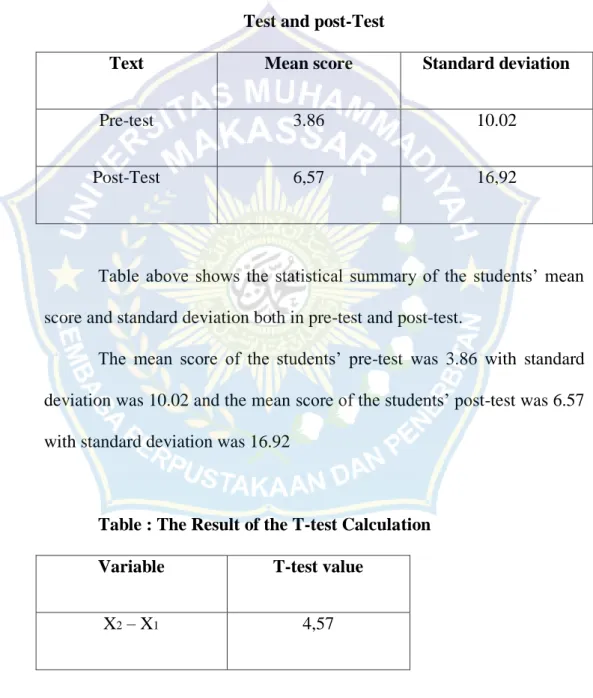
2. The Mean Score and Standard Deviation of the Pre-test and Post-Test Having calculated the result of the students‟ pre-test and post-test, the mean score and standard deviation of the students‟ ability in writing descriptive text through EWPA were presented in the following table :
table : the mean score and standard Deviation of the students’ Pre- Test and post-Test
Text Mean score Standard deviation
Pre-test 3.86 10.02
Post-Test 6,57 16,92
Table above shows the statistical summary of the students‟ mean score and standard deviation both in pre-test and post-test.
The mean score of the students‟ pre-test was 3.86 with standard deviation was 10.02 and the mean score of the students‟ post-test was 6.57 with standard deviation was 16.92
Table : The Result of the T-test Calculation Variable T-test value
X2 – X1 4,57
The illustrate that the value of t-test a greater than the value of t- table. It showed that there was significance between the resultof students‟
pre-test and post-test.
3. Hypothesis Testing
To find out the degree of freedom (df), the research used the following formula:
df = N-1 df = 20-1 = 19
For the level of significant (α) 0.5 and df = 19, then the value of t- table was 1.729 while the value of t-test 4.57. it means that t-test value was greater than t-table value was greater than t-table value (4,57 > 1.729).
Therefore, the null hypothesis (H0) was rejected and alternative hypothesis (H1) was accepted.
From analysis above, the researcher concludes that there was significant different between the pre-test and post-test of the students‟ writing ability in descriptive text through Extended Writing Project Assessment (EWPA) after being given treatments.
B. Discussion
The description of data collected through writing test as explained in the previous section showed that the students‟ ability in EWPA has been improved .it supported by the frequency and rate percentage of the result of the students‟ pre- test and post-test from the five components of writing.
In content, before the treatment, the students‟ still have much idea about the topic and ability in comprehending the subject or topic was very low. In this case, they had limited to knowledge of subjects. The treatment through EWPA helped them to improve their can be seen from the result of pre-test, none student got very good score and very poor score, only 1 (5%) student got good score but the post-test there was 14 (70%) students got good score and none of the students got very good, poor and very poor score.
In organization, before the treatment, the students were still confused how to express their idea clearly in paragraph, they could not organize their ideas well, and their ideas were not enough to evaluate. Mean while, after the treatment by doing EWPA, they could improve their ability in writing, their ideas were adequate organized, coherence and their ideas were relevant to outline. The treatment process helped them to arrange their ideas into a good statement. It can be seen from the result of pre-test, none student got very good score and 2 (10%) students got very poor score, but the post-test the student none got very poor score. It was supported by Nurbaya (2006) in her research stated that brainstorming technique can improve the writing skill in all of aspect of writing skill but very advance is organization.
In vocabulary, before the treatment, the students‟ were lack of vocabulary and most of them could not find words which were suitable with the topic. So, that it can make the meaning obscured. The treatment process gave interest topic and real live which were followed through EWPA helped to related suitable words with the topic. In this case, it helped them to use effective words of paragraph on
the post-test. It can be seen from the result of pre-test, none student got very good and very poor score, but there were 1 (5%) student got good score and 13 (65%) students got poor score. The post-test, there were 13 (65%) students got good score and only 1(5%) students got poor score.
In structures, before the treatment, the students‟ errors were use tenses, word order, pronouns, article, and preposition, for example “I have a pet. He is a rabbit. Her name is Blaca”, “my school is very big and the color is red, white and blue”. But after the treatment through EWPA, it‟s helped them to overcome those problems. The students‟ structure have correct (word order, pronouns, preposition, article, conjunction, tenses, etc), it can be seen from the result of pre-test, none student got very good and very poor score, it same with the post-test. But, the pre- test there was 8 (40%) students got poor score and the post-test only 1 (5%) students got poor score.
The last component is mechanics. Before the treatment, the students‟
writing was dominated by errors of spelling, punctuation, and capitalization. For example “ I have a pet She is a cat. her name is Prilly.” “I have my home. my home has seven room were three bad room, one living room, one bathroom, one kitchen, one family room.” But after treatment through EWPA from the teacher helped they overcome those problems. The ability of the students improved. It can be seen from the result of pre-test, there were 1 (5%) student got good score. The post-test there was 5 (25%) students got good score and none student got very good and very poor score. It indicated that the treatment was successful.
The mean score of the students‟ pre-test was 3.86 and the post-test was 6.51. It showed that the mean score of the students‟ post-test was greater than pre- test. The standard deviation of the students‟ pre-test was 10.02 and post-test was 16.92.
The value of the t-test was greater than t-table (4.57 > 1.729). based on the t-test, the researcher found there was a significant different between the result of pre-test and post-test.
The observation checklist of EWPA procedures was needed more time to successful of the method in teaching and learning process in the classroom.
Because the researcher must be more explain the material so the students could express their ideas in the paragraph and they could use the best vocabulary.
Looking at the result above, it was concluded that H0 was rejected while H1 was accepted. In other words, through Extended Writing Project Assessment (EWPA) is effective to enhance the students‟ writing ability in descriptive text of SMA PGRI 2 Tamalate Makassar.
CHAPTER V
CONCLUSION AND SUGESSTIONS
This chapter present the conclusion and suggestion based on and discussion of data analysis.
A. Conclusion
Based on the research finding and discussion above can be concluded that using Extended Writing Project Assessment (EWPA) enhance students‟ writing ability in descriptive text in SMA PGRI 2 Tamalate Makassar.
There is significant difference between the result of pre-test and post-test.
Before giving the treatment, the students still have low ability in writing; they could not express their ides, lack, of vocabulary, and using errors tenses spelling, punctuation and capitalization. After the treatment, the students could improve their knowledge in writing. It was proven by the mean score of pre-test (3.86) was lower than the mean score of post-test (8.51). At the level significant, the value of the (4,57) was greater than t-table (1.729).
B. Suggestions
Based on the conclusion above, the researcher gives some suggestions as follows:
1. The students are expected to increase their intensity in learning writing through Extended Writing Project Assessment (EWPA)
2. Teacher are suggested to use EWPA as one alternative among other teaching technique to explain writing material to improve students‟
ability in writing.
3. It is suggested for the future researcher, to conduct the research in a longer duration for the treatment, so further studies can be more effective.
BIBLIOGRAPHY
Ariyani. 2011. The effectiveness of learning community (LC) stategy in Writing descriptive Paragraph of the Students of First Year of SMK Kartini MAkasaar. A Thesis. FBS UNM.
Caudery, T. 1990. „The validity of timed essay tests in the assessment Handbook, Grade Eight. California: California Department of Education.
Dependibud. 2006. Petunjuk Proses Pelaksanaan Belajar Mengajar dan Petunjuk system Pendidikan. Jakarta: Depdikbud.
Depertdemen Pendidikan Nasional. 2003. Standar Kompetensi Mata Pelajaran Bahasa Inggris SMA & MA. Jakarta: Pusat Kurikulum, Balitbang.
Fatmawaty. 2009. Increasing the students’ writing proficiency through Think- Talk-Write method. A Thesis. Fakultas Keguruan Dan Ilmu Pendidikan.
Universitas Muhammdiyah Makassar.
Gay, L, R. 2006. Education Reseacrh: Competences for Analysis and Applications (Eight Edition). Colombus: pearson merril Prentice Hall publishing company.
Husain, Rahmi. 2008. Improving Students’ Writing Ability Through Six Steps of Writing. A Thesis FBS UNM.
Research Report SQA. 2010. Retrieved on:
(httpwww.sqa.org.uksqafiles_ReserchReport12_ExtendedWritingTasks.p df/ accessed 20 Juni 2016)
Rosnawati. 2011. Increasing Writing Ability of Twelfth Grade Students at SMA Nasional Makassar through Peer Assessment. A Thesis FBS. UNM Satriani. 2010. Implementation of Extended Writing Project Assessment to
Increase the Students’ Writing Proficiency. A Thesis Fakultas Keguruan Dan Ilmu Pendidikan Universitas Muhammdiyah Makassar.
Suniar. 2007. Improving the Writing Ability on Descriptive Paragraph of the second Year Student of SMPN 2 Takalar by Using Modeling technique. A Thesis. FBS. UNM.
Walker, Robin. And Carmen PerezRiu. 2008. Coherence Assessment of Writing Skill. ELT Journal.
Zang, Yun. 2008. Discussing the Extended Writing Project, ELT journal