
Tubercles are developed distally on all two dorsal spines and along the entire length of the second dorsal rays. A low-conical tubercle is present in the center of most of the exposed body scales, although the tubercles are smaller on the ventral side of the caudal peduncle.
BREEDING TUBERCLES IN FISHES COLLETTE 577
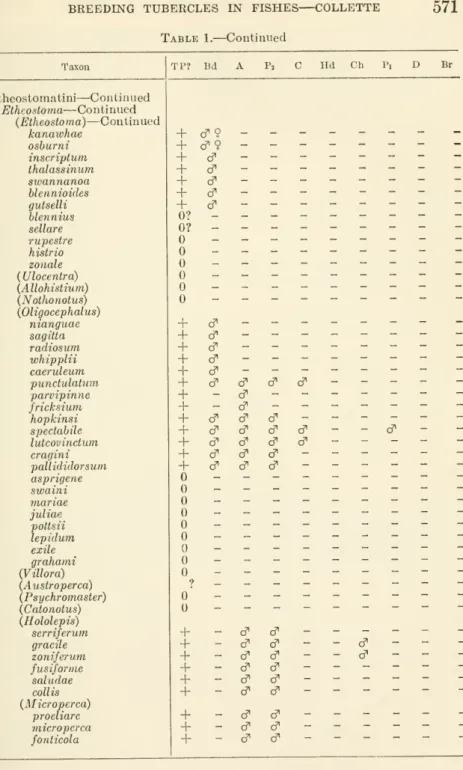
It has tubercles on 2–3 rows of scales on either side of the midventral row and on the posterior ventral part of the caudal peduncle. Tubercles are present on the ventral surfaces of all soft pelvic rays (but are apparently absent from the spine), dorsally on the distal parts of pelvic soft rays 1–3, and laterally on the anal spines and soft rays.
BREEDING TUBERCLES IN FISHES — COLLETTE 579 maximum tubercle development (CU 38055 and CU 38127, Georgia,
Oligocephalus) nianguae are well developed on the anal elements and, to a lesser extent, on the ventral surfaces of the pelvic rays. Large conical nodules develop on the spine and on all anal soft rays except the last 1-3.

BREEDING TUBERCLES IN FISHES — COLLETTE 583
In some respects the nigrum group is closer to the subgenus loa than to the stigmaeum group, although E. This tendency is shown to an extreme degree by one of Cole's (1957) undescribed subspecies of E. These buds appear to serve to protecting the tips of the rays during spawning and nest defense.
There are fleshy tips on the pectoral fin rays, which are most visible on the more ventral rays. Fleshy tips are present at the distal ends of the pelvic fin elements, but are not as pronounced as in E.
BREEDING TUBERCLES IN FISHES — COLLETTE 585
UMMZ) is smaller, has less well-developed pigmentation, and has the fin tubercles well developed and the ventral scale tubercles almost absent. This is in contrast to most tubercular arrows, which have tubercles that are better developed in more southern populations. Tubercles are not present on the scales above the analfin base or on the ventral surface of the caudal pedestal in any of the themes I have examined, but they are likely to be found to be present when additional material is examined.
Pelvic-fin tubercles are developed distal to the fork on the ventral surface of pelvic ray 3 and along the entire length of rays 4 and 5. USNM166055, Alabama, Alabama Dr., April 6) has poorly developed pelvic-fin tubercles, lacks anal-fin tubercles, and has ventral tubercles . starts one-third of v/ay posteriorly from pelvis to analfin origin and extends onto 3 rows of scales just anterior. BREEDING TUBERCLES IN FISH—COLLETTE 587the genital papilla, 0-2 rows over each side of the analph base, and.
BREEDING TUBERCLES IN FISHES — COLLETTE 587 the genital papilla, 0-2 rows above each side of the anal fm base, and
Kirtland, tetrazonum (Hubbs and Black), euzonum (Hubbs and Black), kanawhae (Raney), andosburni (Hubbs and Trautman) have reproductive tubercles on the ventral scales in both sexes. Richardskin kindly pointed me to a male caught on April 29 (CU 41893, New York, Allegheny R.) which has tubercles on about 20 pectoral scales, on all abdominal scales up to 6 rows, just before genital papilla, 4-5 rows above base of anal fin and 7 median ventral scales on caudal peduncle. The pelvic and anal fins of females are only lightly pigmented, while breeding males are completely black except for the white fleshy tips on the front parts of both fins.
Males with maximum tubercle development (USNM 162197) tubercleson 2 rows of scales on pelvic fins extending to 7 rows of scales per side just anterior to the genital papiUa, 4 rows over each side of the base of the anal fin and a total of 8 rows on the ventral caudal peduncle scales. In the original description by E. 1941), the holotype mentioned, as well as other males taken near the breeding season, had scales on the abdomen and underside. At maximum development, males have tubercles of 5-7 rows of midventral scales per side just in front of genital papilla, 3-5 rows over each side of anal fin base and on 4-8 rows on caudal peduncle.

BREEDING TUBERCLES IN FISHES — COLLETTE 591 further corroborated by similarities in the distribution of breeding
Miller, who is currently revising the taxonomy of this species, kindly supplied me with his notes on tubercles and drew my attention to two collections containing tubercular specimens. The tips of the pelvic spines and most of the soft rays are slightly more swollen in breeding males than in breeding females. Males are much darker, especially the head, chest and body, and the pelvic and anal fins.
The male mounts the female with his pelvic fins across her back and his tubercular undersides in contact with her sides (Winn, 1958a; 1958b, fig. 4). SmaU, low tubercles begin halfway posteriorly from the pelvic fins to the anal fin origin and extend beyond.
BREEDING TUBERCLES IN FISHES — COLLETTE 593
Winn (1958b, p. 172) noted that the males of two of the undescribed forms of Ulocentra (from the Barren and Green rivers in Kentucky) were larger than the females, had larger anal, first dorsal, and pelvic fins, and lacked reproductive tubercles. The testes and pigmentation of a spring-caught male (CU 37281, Tennessee, Cumberland R., March 26, 56 mm.) are well developed, and reproductive tubers are absent. Males in six collections collected later in the year (ANSP, UMMZ, USNM) had poorly developed testes and also no tubercles.
BREEDING TUBERCLES IN FISHES — COLLETTE 595 rocks in a spawning position similar to that described by Winn (1958b,
They are slightly raised, round mounds on the posterior edge of the scales, not pads as in the variatum group. Just anterior to the genital papilla, tubercles are present in about 6 rows of scales on each side. They are located in 5 rows of scales above each side of the analfin base and in 7 mid-ventral rows of scales on the caudal peduncle.
The tubercle patterns are similar in the larger males in the other collections, but the tubercles are smaller and are not developed on as many scale rows. None of the more than 120 females in these collections show signs of tubercle development and all. The female's pelvic fin and venter are spotless, the anal fin is moderately pigmented, and the dorsal fins are somewhat spotted and banded.
BREEDING TUBERCLES IN FISHES — COLLETTE 597 and the male mounts her with his pelvic fins clasped over her dor-
Males taken later in the spring (exact dates unknown) have similar tubercle distribution, but the tubercles are larger and extend farther into the rays. Bailey and Richards (1963) stated that reproductive tubercles are present on the lower surface of the pelvic fin, anal fin, and abdominal body scales of breeding males of E. Afewtubercles are present on the distal tip of the second anal spine and 5-10 promi- nent tubercles are present on all soft anal rays except the last half of the shoot.
Small but distinct tubercles are developed on the ventral surface of the proximal part of pelvic soft rays 3-5. Tubercles are also present on the anal rays of males taken in the Edisto drainage (CU 29850, South Carohna, March 28). Additional tubercle specimens are needed to determine whether tubercles develop on the pelvic fins and venter of E.
BREEDING TUBERCLES IN FISHES — COLLETTE 599 Tubercles were found on males of E. cragini collected from January 1
They are present on the anal spines and soft rays of males taken during this period, but develop best on the soft rays. On the ventral surfaces of the Upelvian fin elements, tubercles are present, varying in number from 5 (on the spine) to 30 (on the second soft ray). Tubes are also present on approximately seven rows of the ventral scales per side just anterior to the genital papilla and on approximately six rows along each side of the anal base.
No tubercles are present on the first anal column, a few are present on this second anal column, and there are 5–10 tubercles on each of the soft anal rays. There are no tubercles on the ventral surfaces of the pelvic fin elements, but four medium-sized specimens have several tubercles distally on the dorsal surface of soft rays 1 and 2. Ventral tubercles start halfway from the pelvis to the anal fin and extend for 4–5 scale rows just anterior to the genital papilla, 3 rows along each side of anal base and 5 midventral rows on caudal peduncle.
BREEDING TUBERCLES EST FISHES
COLLETTE 601
The larger size of males, the absence of tubercles, and the shape of the genital papilla in females are three of the characters that distinguish Villora from the subgenus Hololepis, which was synonymized by Bailey (in Bailey and Gosline, 1955). These characters help to justify my belief that Villora is a branch of the asprigene-swaininontuberculate group of the subgenus Oligocephalus (Collette and Yerger, 1962, p. 214). Males of E.australeJordan, the only known species in this Mexican subgenus, taken on 21 May (UMMZ 136124, Chihuahua) and 28 March (UF 10127, Durango) have slightly enlarged testes and no tubercles.
BREEDING TUBERCLES EST FISHES COLLETTE 603 Subgenus Psychromaster Jordan and Evermann
Maximum development occurs in mid-March in Texas, when
I think they will also be found on the pelvic rays if sufficient material becomes available (Collette, 1962 p. 149-150). Thousands of specimens examined were found on only a few specimens in 14 collections of the northern subspecies, E. Tubercles are present on E.f.fusiform from March 25 (CU 29983, NorthCarolina, Ellis Lake) to May 17-18 (CU collections , New Jersey).
BREEDING TUBERCLES IN FISHES — COLLETTE 605 velopment from March 25 to May 29. Tubercles are present on more
Tubercles are also present on the distal seven-eighths of all elements of the anal fin. TwomalesofE.proeliare (USNM 165959,Mississippi,Big BlackR., April 8) have tubercles on all elements of the anal fin, on the tip of the first pelvic ray, and on the entire length of pelvic rays 2-5. Seven other males in this collection (30-32 . mm.) have tubercles on the distal half of pelvic soft ray 3 and a few scattered tubercles on the distal end of the second and fourth soft rays.
Thus, it appears that the tubercles first form on the middle soft rays of the pelvic fin, spread to the other pelvic rays, and then develop on the anal fin rays. Tubercles are present along the entire length of the ventral surfaces of all pelvic elements and on the anal spines. Tubercles may have a stimulating function, especially in those species that have them on the underside of the pelvic fins.
BREEDING TUBERCLES IN FISHES — COLLETTE 607
The subgenus Boleosoma is composed of at least two groups: the non-tubercular nigrum group of five species and the tubercular stigmaeum group of three species, although in some other characters the chlorosomum of the latter group tends to be somewhat intermediate between the two . Other authors have previously pointed out the close relationships that members of the variatum group have with each other. The inscriptum group of five species differs from the variatum group in that only themales develop tubercles.
Four of the remaining five species (rupestre, histrio, zonale and blennius) currently classified in the subgenus form a closely related group of non-tuberculates. It will be necessary to await the description of the approximately nine new species of Ulocentra currently in the manu- .. scenario of Reeve M. Bailey before a full assessment of the relationships between the zonal group and Ulocentra can be made. The three forms of the nianguae group are very closely related, as noted by Bailey (1948) and Kuehne and Bailey (1961).
BREEDING TUBERCLES IN FISHES — COLLETTE 609
610 PROCEEDINGS OF THE NATIONAL MUSEUM
BREEDING TUBERCLES IN FISHES — COLLETTE 611
612 PROCEEDINGS OF THE NATIONAL MUSEUM vol. Smith) and yellow perch, Percaflavescens (Mitchill) from Lake of the Woods, Minnesota. Age and growth of the yellow perch, Perca flavescens (Mitchill), in Wisconsin waters of Green Bay and northern Lake Michigan.
BREEDING TUBERCLES IN FISHES — COLLETTE 613


