The types of all new species are deposited in the National Museum.^ The paratypes, when available, remain in the writer's collection. Metcalf, head of the Department of Entomology at the University of Illinois, under whose direction this study was done. 276 PROCEEDINGS OF THE NATIONAL MUSEUM VOL.87 evenly tightened, cut off at the top; last ventral segment twice as long as penultimate.
This species is most closely related to innotata Pic (1924, p. 23) and can be separated from the latter member of the genus by the binotate elytra, the peculiar character of the antennae, the broad distal segment of the maxillary palpi, and their larger size. From the former it can be separated by the angular insertion of the distal segment of the maxillary palpi, the much longer length of the posterior legs, the thin, filiform tarsi, and the much longer, acute anal style.
TAXONOMIC STUDY OF MORDELLIDAE — RAY 281 beyond middle of eyes ; pronotum piceous, with a pair of castaneous
Apart from the difference in color pattern, this species can be separated from its closest ally, dimidiata Champion (1891, p. 234), by the greater length of the fourth antennal segment, the extreme apex of the distal segment of the maxillary palp and very long. Elytra twice as long as wide (2 by 1 mm.), the sides distinctly attenuate in their apical two-thirds, broadly bent subapically, the apices individually rounded. Anal style half as long as apical ventral segment (1.2 by 0.82 mm.), narrow, attenuate at apex; last ventral segments, even penultimate.
TAXONOMIC STUDY OF INIORDELLIDAE RAY 283 MORDELLA MILITARIS, new species
Basis short, wide, lower, wider than pronotum; Black skin color, compressed antennae and legs, splotches of hind tibiae and tasteful genitalia. Elytra less than twice as wide (1.6 by 0.85 mm.), sides distinctly curved from base to apex, apices singly fringed. Anal style short (0.5 to 0.4 mm.), but one-fourth longer than apical ventral segment, very broad at base but one-third longer than broadfromadorsal view, sides straight, apex of rounded.
TAXONOMIC STUDY OF MORDELLIDAE — RAY 285 CALYCE MACULATA Pic
This species is allied to ozarJcensis Ray (1936a, p. 125) and can be separated from the last member of the genus by the additional ridge on the hind tibiae, the completely flavocastan condition of the head and pronotum, the more parallel and longer form. Form narrow, elongate, subparallel sides within a quarter of apex of elytra, widest base near pronotum. Distal segment of maxillary palp enlarged, subrectangular, slightly narrower subapically, lateral margin slightly convex, medial margin slightly concave, apical margin subangular, corners apically and basally rounded, two and two-thirds as long as wide ( Fig. 16, c).
Pronotumon - third wider than long (0.8 to 0.6 mm.), sides and apex rounded, basal angles obtuse, base arcuate, median lobe short but rounded. Elytra slightly more than twice as long as wide (1.7 x 0.8 nmi.), sides widest at base, subparallel to one-fourth of apex, thence strongly rounded, apex individually rounded. Posterior tibiae with two short, oblique ridges, not extending more than one-third of outer surface; basitarsi with two short ridges extending one-third to outer surface.
This species is most closely related to the species Sehioarzi^nova, described below, and can be distinguished from the latter member of the genus by the difference in the maculation of the elytra, the difference in the width of antennal segments 3 and 4, the peculiar shape of the distal segment of the antenna, the additional tooth on the tarsal claws, and the unusual condition of penultimate segment of anterior and intermediate tarsi. It can be distinguished from xanthopyga Champion (1891, p. 344), which it resembles in coloration, by the shorter length of the basal ridge of the posterior tibiae, the yellowish yellow condition of the pronotum, and the difference in the shape of the maxillary palpus. . Intermediate tibiae and tarsi of equal length; penultimate segment of anterior and intermediate tarsi filiform, excavation below, bearing.
Posterior tibiae with two oblique margins, the basal extending three-quarters, the other one-half, across the outer surface; basitarsi with two, second segment with one.
TAXONOMIC STUDY OF MORDELLIDAE — RAY 2^9
The distal segment of the maxillary palpus is enlarged, showing a sexually dimorphic form, namely: in the male, two anteapical segments thickened, the distal one elongated oval, sides subparallel, all angles. Anal part three times longer than apical ventral segment (0.45 by 0.15 mm), narrow, pointed towards apex; last ventral segment two and a half times longer than penultimate.
TAXONOMIC STUDY OF MORDELLIDAE — RAY 291
292 PROCEEDINGS OF THE NATIONAL MUSEUM VOL. 87
I TAXONOMIC
STUDY OF MORDELLIDAE— RAY 293
294 PROCEEDINGS OF THE NATIONAL MUSEUM VOL. 87
TAXONOMIC STUDY OF MORDELLIDAE — BAY 295 MORDELLISTENA EMARGINATA, new species
This species is related to diluta Champion (1891, p. 338) and can be separated from the last member of the genus by the black head, the equal length between the antennae. The distal segment of the maxillary palpi is enlarged, in the shape of an elongated, scaly triangle, the sides straight, the corners rounded (Fig. 16, j). Pronotum clearly wider than long (0.25 by 0.2 mm), sides rounded, basal angles obtuse, base curved, midbasal lobe short, rounded.
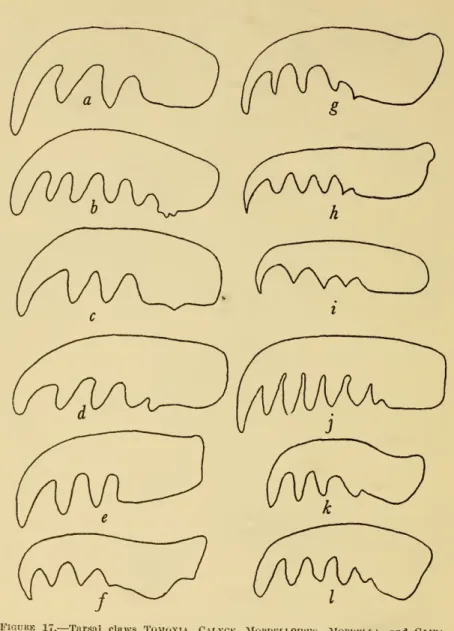
Elytra twice and one-third as long as wide (0.6 x 0.26 mm), sides parallel to a quarter of apex, thence acuminate and broadly rounded to apex, apices singly rounded. Intermediate tibiae and tarsi of equal length; penultimate segment of anterior and intermediate tarsi expanded, excavated below, bearing. Tarsal claws with two teeth, distal, one long, sharp, terminal, the other broad, short, central, both sides forming a right angle (Fig. 18, e).
TAXONOMIC STUDY OF MORDELLIDAE — RAY 297
1; 5-10 each successively shorter and narrower than the previous one; 11 as long as 1, fusiform, widest subbasaliy, weakening towards the apex. The distal segment of the maxillary palpi is enlarged, elongated, with the shape of a scaly triangle, sides and apex but slightly rounded (Fig. 16, k). Pronotum but slightly wider than long (0.56 by 0.52 mm), apex and sides rounded, basal angles obtuse, base curved, midbasal lobe short, rounded.
Elytra two and four-tenths longer than broad (1.26 by 0.52 mm.), the sides gradually narrowing to the apical one-fourth, where they become broadly rounded, the apices individually rounded. Posterior tibiae with a short subapical ridge, a short, and a long crest extending entirely to outer surface near basal articulations; basitarsi with two short, oblique ridges, each very oblique; second segment with a short, oblique spine. Anal style tAvo and two-thirds times as long as apical ventral segment (0.55 by 0.2 mm.), narrow, evenly attenuate apex.
Remarks.-Seven specimens: The type and a male paratype were taken at Panama City, Panama, April 12 (A. H. Jennings); the allotype and two female paratypes were taken at Paraiso, Canal Zone, Panama, on January 17, 1911, and April 18, 1911, respectively (E. A. Schwarz); a female paratype was taken at Pedro Miguel, Canal Zone. If this is the normal case for this and several other species, this is the first occurrence of such an omission in the family.
TAXONOMIC STUDY OF MORDELLIDAE — RAY 299 MORDELLISTENA SONORENSIS, new species
300 PROCEEDINGS OF THE NATIONAL MUSEUM VOL. 87
TAXONOMIC STUDY OF MORDELLIDAE — RAY 301 MORDELLISTENA FLAVICORNIS Champion
Anal style more than three times as long as the apical ventral segment, narrow, attenuated to the apex. Elytra twice as long as wide (2 by 1 mm), sides gradually narrowing from widest posthumeral position to apex, apices individually rounded. Anal style, three times as long as the apical ventral segment (0.9 by 0.3 mm), narrow, weakened to the apex, sides straight;
1891, p. 311), but it can easily be separated from the latter member of the genus by its much smaller size, different character of the antennal segments, broader terminal segment. Distal segment of maxillary feeler enlarged, somewhat pear-shaped, wide, mesal margin straight, lateral margin and apex broadly rounded, greatest width at apical third. Pronotum distinctly wider than long (0.95 by 0.85 mm), apex and sides rounded, basal angles subacute, forming a right angle, base arcuate, median basal lobe moderately convex, subtruncate.
Elytra distinctly more than twice as long as wide (2.1 by 0.95 mm.), sides subparallel on basal half, narrowly caudad, broadly rounded on caudal fourth, tips individually rounded. Anal style elongate, narrow, attenuate to apex, three times length of apical ventral segment (1.2 by 0.4 mm.); last ventral seg-. This species is most closely related to hexastigma Champion (1891, . p. 321) and can be separated from the latter member of the genus by the unicolored antennae, the different nature and position of the spots on the elytra, the much greater length and width of the fourth antennal segment, the different shape of the distal segment of the maxillary palpi, the small number of combiic ridges on the posterior tibiae and tarsi, and the smaller size.
Pronotum distinctly wider than long (0.85 by 0.7 mm), sides and apex rounded, basal angles obtuse, base arcuate, median basal lobe short but rounded.
TAXONOMIC STUDY OF MORDELLIDAE — RAY 305
306 PROCEDURE OF THE NATIONAL MUSEUM vol.87 . 0.37 mm), sides rounded, base curved, midbasal lobe short, rounded. Elytra twice as long as wide (1.02 by 0.53 mm), sides become weaker and narrower from basal third to apex, apices broad, individually rounded. Posterior tibiae with three unequal, oblique ridges extending halfway across the outer surface; basitarsi with three, second segment with two sloping edges, all extending halfway up the outer surface.
Anal style three times as long as the apical ventral segment (0.5 by 0.16 mm.), moderately robust, attenuate to the apex. This species closely resembles both in-fimaLeConte (1863a, p. 49) and tiai^a Ray (1936a, p. 127), but can easily be separated from either of these members of the genus by the black, enclosed area of pubescence on the elytra, the two-colored antennae and legs, the larger size, the greater number of comb-shaped ridges on the posterior tibiae and tarsi, the larger size and the greater length of the fourth antennal segment. Elyira two and three-tenths as long as wide (2.5 by 1.1 mm.), sides subparallel on basal three-quarters, thence broadly rounded to apex, tips individually rounded.
Pronotum distinctly broader than long (1.3 by 0.9 mm.), sides and apex rounded, basal angles obtuse, middle basal lobe short, rounded. Elytra slightly more than twice as long as wide (2.7 by 1.3 mm.), sides attenuate, broadest at base, slightly narrowed from last point to three-quarters length, where it is broadly rounded to apex, points individually rounded. Intermediate tibiae and tarsi equal in length; penultimate segment of anterior and intermediate tarsi widened, excavated below, with fifth segment on middle of its ventral surface, posterior tibiae with three oblique ridges, all extending less than half distance across outer surface;.
Anal style, but twice the length of the apical ventral segment (1.1 by 0.55 mm), firm, suddenly constricted in the middle, thence weakened to the apex, the latter narrowly truncated; last ventral segment only twice as long as penultimate.
TAXONOMIC STUDY OF MORDELLIDAE — RAY 309 MORDELLISTENA CHIAPENSIS, new species
As noted in the description above, there exists a distinct sexual difference in the condition of the anterior margin of the compound eye.
TAXONOMIC STUDY OF MORDELLIDAE RAY 311
312 PROCEEDINGS OF THE NATIONAL MUSEUM VOU 87
TAXONOMIC STUDY OF MORDELLIDAE — RAY 313
There is some variation in the color of the ventral surface and in the extent of the chestnut area on the front and clypeus.
LITERATURE CITED Broun, T