Moreover, the distribution of the species through forests and fields adjacent to the streams will make the meeting of individuals in. The remaining figures are drawn to scale - the same for all - and give an idea of relative sizes in different species. Cubital space on forewing with 2 transverse veins in addition to the one forming the inner side of the subtriangle; M4 and Cu^ on forewing with 3 rows of cells between level of nodus; 2 rows of cells between Mj and Mj^on forewing at level of distal endophstigma; arculus in front of the arm distal to the secondantenodal;.
A2 in hind wing rising near them in middle of lower side of subtriangle, the stamens being of about equal width throughout; arculusin frontwingate orproximaltosecond antenodal; 1 or 2 rows of cells between M^ and Mi^ on forewing at level of distalendophstigma; 2 cells between Mj and M, on forewing beginning nearer stigma than node; stigma with strap. Analare forewing 2 cells maximum width, barely 2 cells wide distal to level of triangle, and only a short distance; M^inCui on forewing parallel beyond nodus, 2 cells between them at level of nodus. No species of the subfamily Cordulegasterinsa have been reported for Burma or Siam, and none are represented in collections accessible to me, although representatives of three genera are known from India.

OROGOMPHUS SPECIOSUS De Selys
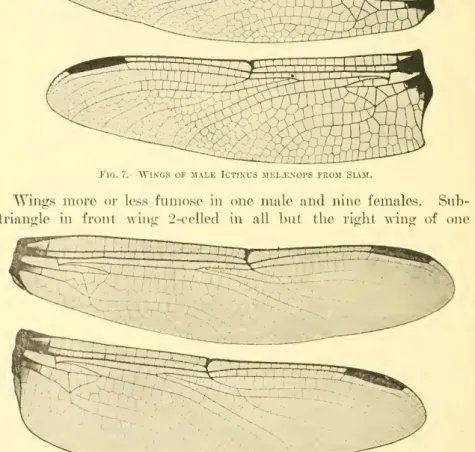
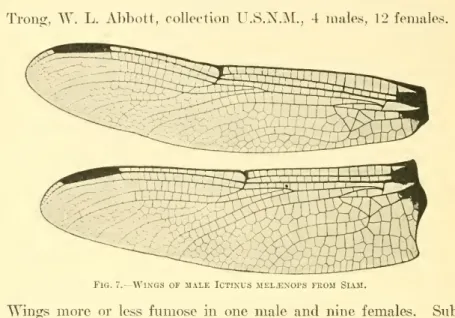
- ICTINUS MELiENOPS De Selys
- ICTINUS PERTINAX Hagen
- GOMPHIDIA ABBOTTI, new species
- SIEBOLDIUS JAPPONICUS De Selys
- MACROGOMPHUS SPECIES (parallelogramma group)
It can be recognized by the association of the following characters: Antehumeral yellow stripe, light or not interrupted; frown black, with a narrow yellow line; In rapax the abdomen is 47-52 mm, hindwing 40-44 mm; in prxcox the abdomen is 50-53 mm, hindwing 39-40 mm; in prxcox the basal black of the frown in the center connects to the black of the frown in front; in rapax yellow occupies the basal half of abdominal segment 3 and basal two-fifths of 4-6; in precox the yellow is reduced. The two remaining species of Gompliidia are immediately separated by the color of the head.
Lower lip dull brownish, the adjacent part of the posterior part of the eyes dull yellow; The rest of the head black, marked mth yellow as follows: Upper lip width a superior spot on each side, separated. Genital lobe represented on the edge of the segment by a low comb with 4-6 short black teeth; anterior lamina prominent, the middle third produced posteriorly as a smooth rounded tubercle;. From l^rugeri it differs by the 2-celled, not 3-celled, lower triangle of the forewing, by the dorsal.
In the case of the species of the quadratus group, in addition to several small differences, the greater complexity and remarkable curvature of the sectors can be noted, compared to the species belonging to the farallelogranma group. Borneo, and possibly Sumatra, the yellow dorsal thoracic spots do not extend laterally beyond the humeral suture, and the auricles of the male are entirely black. In abnormis De Selys, probably from Borneo, the thoracic spots extend completely over the sides of the thorax.
The following notes are from De Selys' summary of the species in Quatrieme Addition au Synopsis des Gomphines. De Selys, of India, Tonkin, and Anam, the outer and inner branches of the superior appendage of male are about equal in length, with a short lower tooth; inferiorappendageseen inpro- .. file with a double curve; back of occiput of female with a median. De Selys, of Sumatra, the outer branch of the superior appendage .. of the male is slightly shorter than the inner; branches of inferior . appendage straight; a small tubercle on either side of the occiput the female.
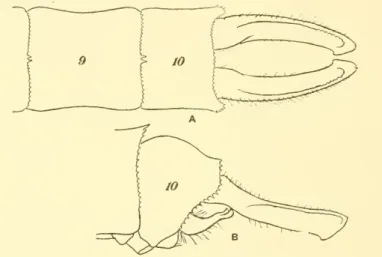
In the Burmeister parallelogram from Java and Sumatra .. the outer branch of the upper appendage of the male is slightly shorter than the inner; branches of lower appendage straight; posterior part of occiput in female slightly raised. Assaui, the outer branch of the upper appendage of the male is .. much shorter than the inner branch; branches of the appendix below. straight up; posterior part of occiput of female raised and conical. SHORT HAIR PRESENT ON ACCESSORIES NOT SHOWN IN PICTURES. . the upper appendage of the male is much shorter than the inner one; .. branches of lower appendage straight; female unknown.
DRAGONFLIES OP BURMA AND SIAM— WILLIAMSON. 291
LEPTOGOMPHUS INCLITUS De Selys
XXXIII. . in front; rhinariinn, nasiis and frown blackish, center of nasus yellowish, and frown above with yellow in front. Legs dark black, the underside of the first four femora and a larger part of the last femora yellowish.
LEPTOGOMPHUS GESTROI De Selys
Chest black; dorsal band confluent with mesothoracic half of collar. forming 7,"^ and antehumeral of equal width, yellow; sides and below pale yellow, with a blackish band on the second suture, merging above with a black area occupying the upper ends of both sutures and extending to the posterior margin of the thorax. Thorax black, yellow as follows: mesothoracic half-collar, narrowly interrupted in midline, joined on either side by dorsal striae to form 7; narrow antehumeral band ending above with rounded solitary spot; pale mark on middorsal; sides and below distinctly yellow, a black line on the upper half of the first suture, and a complete line on the second suture. Abdomen black, marked with yellow; 3-7 with dorsal yellow spots not reaching the ends of the segments, on 7 occupying only two-thirds of the basal segment ; 8-10 black.
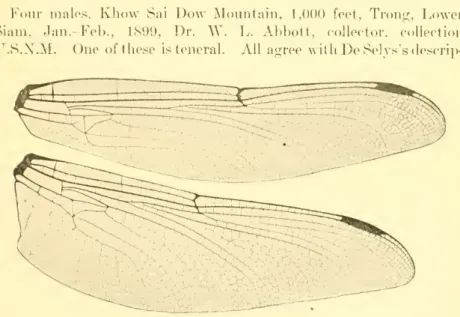
In vesiculos'us and ypsilon the blackness on the sides of the thorax does not form a distinct Y. The type of the genus and other species are Oriental, and two are found in India. 299position of these cross-veins is fixed, and .considering only the slight position of these cross-veins is fixed and .subject to but .slight changes, the first near the distal end of the sup('rtrian De Selys' collection. . of postanal cells, the first 2 unwhite, siiuilar in size and .sliape, the third broader and once divided; \., in liind wing;arisinij:;near the middle of the underside of the trian In the venation of the forewing, Burmagomplius is once separated from Gomphus by the parallelism of M^ and Cuj, a character common to several other genera, notahljOnycJiogom-pJius. The relatively strongly developed and widely branched lower abdominal appendage of the male indicates a certain measure. In the thoracic pattern, Burmagomplius is unique in Gomphinus so far as known in having dorsal lines confluent below on both sides with the antehumeral striae, and the upper end of the reduced antehumeral bones being represented by a rounded spot. It is a species very close to vermiculatus, but it is thinner, the striations of the chest are different, the lower appendage is thinner and longer. It is a species very close to vermiculatus, but more slender, the striations of the thorax different, the inferior appendage more slender, and much more. divaricate." Specimens from Anam and Tonkin are slightly larger,. abdomen 30-32 mm., and the antennodals and postnodals are more numerous; as described, the nasus is not spotted, and the pale dorsal stripe on the frons is divided; the black stripe on the first lateral suture is forked above, not reduced as in the specimens from Burma;. and the color pattern of the abdomen is slightly different, 9 bearing a small posterior spine, wliicli is not represented in my Considerable variation in the development of the longitudinal middorsal abdominal stripe is to be expected. In a male of melsenops it is present on the forewings, wanting on the hindwings; in a female of the same species it is present on one fi'ont wing, wanting on the other 3 wings.). It is likely that in life these are not the same color throughout, tending to green on the thorax and orange on the belly, except that the pale area of 9 is probably clear yellow, less than segment marks before it. Venationally, if one disregards the frequent presence of the basal antennodal of the second series, this species. and Japanese melsenops De Sely are similar to North America. Abdomen30 nnn.; hind wing- 33-34 mm.; male superior abdominal appendages twice as long as 10, turned downward at apex; lower appendage slightly shorter, in profile with 2 teeth, one at the first third, the other at the second third; female vulvar lamina half as long as 9, divided at apex into two points.. male abdominal appendages similar to hyforceps, but larger, the branches of the inferior not separated at base; female described as similar to hyforceps, but vulvar- lamina and occipital ])leat not mentioned. Based on specimens of both sexes, Martin takes this species from GompJius and places it .. in Onychogomphus: his description of F'^-ai.-ONYCHOGOMPHus saundersh .. the internal appendage does not suggest male abdominal appendages, the Onychogom'phus , however, and Kirby's shorthair son the appendages are figure, in the pattern of the thorax,. strongly suggests Gomphus pryeri. The veneration of the woman figured in this paper. is peculiar to the genus, as far as I know, by the position of the arculus in the forewing, slightly beyond the second antenodeal, and by the fact that the second postanal cell is divided into the hindwing. Thorax black above, mid-dorsal below narrowly yellow; yellow streaks joined below by continuous mesothoracic half-collar to form 7 on each side of carina; antehumeral yellow streaks represented by a spot above and a smaller line below; first lateral thoracic suture with a black line broken into 3 short lines; second side seam. 314 PROCEEDINGS OF THE NATIONAL MUSEUM. with a continuous but slightly wider black band; no trace of black posteriorl3^ Costa yellow, stigma black. In contrast, there is weak negative evidence for the form of the subordinate. addition against the referral of this specimen to Onychogotuphus, is very positive evidence for such a relationship, as shown by the venation shown herein. There are also minor differences in the shape of the triangles and subtriangles, and equally minor differences can be observed. These three are large species, with bellies around 55 mm. abdominal segments smitliii 3-7 have wider orange than black; black sommeri predominates in 3-6 and 7 has about half the basal yellow The character mentioned hj De Selys for the separation of sommeri and cocliinclinensis is. rib coloring above; in cocliincliinensis the yellow area on the ribs above is not moderately divided. with black color as in sommeri. 316 PROCEEDINGS OF THE NATIONAL MUSEUM. gompJius naninus, which is unique in the genus for its small size. it is the case with all other known men. SUMMARY,
BURMAGOMPHUS VERMICULATUS Martin