Proceedings of
the United States
National Museum
SMITHSONIAN INSTITUTION
•WASHINGTON, D.C.
Volume124 1968 Number3640
New Records
ofBirdsfrom
theHawaiian Leeward
Islands*By
Roger B. Clappand
PaulW. Woodward
In the spring of 1963 the Pacific
Ocean
BiologicalSurvey Program (POBSP)
of theSmithsonianInstitutionbegan
periodicsurveysof the islands of the Central Pacificbetween
latitudes 30°N and
10°S and
between longitudes 150°and
180°W. The
surveys were designed toamass
variedand
detaileddataon
thebiotaof the areain order thatamuch more
complete understanding of its naturemight
be developed thanwas
previously possible.One
of theProgram
goalswas
simply to discoverwhat
birds occurred on the different islandsand
to de- terminemore
precisely their exact status on each island. (For amore
thorough discussion ofPOBSP
aimsand
objectives, seeHumphrey,
1965.)
From February
1963 throughMarch
1967POBSP
field workers or research teams participated in 18 expeditions to one ormore
of theHawaiian Leeward
Islandsand made
biological surveys ofthem
for periods offrom
one to six days.For much
of the entire period a per-manent
field stationwas
operated onKure
Atoll,and
threemore
extended surveys, each of slightlymore
than a month's duration, weremade
onFrench
Frigate Shoals.As
one result of these surveys, a greatmany new
distributional recordswereobtained. Thispaperpresentsnew and
unusualrecordsof1 Paper No. 19, Pacific OceanBiological Survey Program.
2 Clapp, Research Curator; Woodward, ResearchAssistant: POBSP, Depart- ment ofVertebrate Zoology.
1
birds
from
theHawaiian Leeward
Islands of Nihoa, Necker,French
Frigate Shoals,Gardner
Pinnacles, Laysan, Lisianski, Pearland Hermes
Reef,Midway, and
Kure.The
records here presented are primarily of specimens collectedfrom February
1963 throughMarch
1967by members
of the PacificOcean
BiologicalSurvey Program
althoughwe
includesome
well-documented sight records as well.In addition, Dr. Alexander
Wetmore, who
visited theHawaiian Leewards
in 1923 (seeWetmore,
1925), has kindly permitted us to report several previously unreported specimens obtainedby him
duringhis trip.Common and
scientificnames
are takenfrom
the"American
OrnithologicalUnion
Checklist"(AOU,
1957), Vaurie (1959, 1965),and King
(1967). Procellariiformes,gulls,and
ternsarefrom
King,and
allotherspeciesare
from
the "A. O.U. Checklist" or,when
notinthatlist,
from
Vaurie.Major
alternatives of thecommon names
are listed in parentheses.Order of the species accounts follows Peter's "Checklist" (1931—
1967)
and Mayr and Greenway
(1956), with the exception of the Procellariiformes,which conform
to the recentrecommendations
ofW.
B. Alexander, et al. (1965).Whenever
possible, the age of vagrant birdswas
determined to discover whether their occurrencemight
be restricted to a particular age-class.Many
of the vagrants, however, were found as long-dead, very partial remains; consequently,no
such determinations could bemade.
A number
of the shorebirds collected during the fall could be agedby
the shape of the tibio-tarsus. Inyoung
of the year thisbone
be-comes
gradually thickerfrom
the distal to theproximal end, whereas, in adults, the sides of the legs are almost parallel formost
of their lengthand
thenflare out abruptly at theproximal end (R. Zusi, pers.comm.). This character is not reliable during the spring
and
is con- siderablymore
difficult to determine in the smaller species of shore- birds.We
thus include here ages for only those birds forwhich we
believe that our age-determinations are completely reliable.
Gulls
and
ducks were agedby plumage
characterswhen
possible.Kortright (1942)
and
the "BritishHandbook"
(Witherby, 1939) were usedassourcesofage charactersforducks; thelatterwork
(Witherby, 1941)and Dwight
(1901) were used for gulls.Molt
terminology in thesesourcesand
in this paper conforms toDwight
(1900, 1901).Many
of theplumages
observed inthespecimensof gullsand
ducks are aberrant in thatmolt
insome
feather tractswas
considerably re- tarded,presumably
in responsetoabnormal
environmental or physio- logical conditions.no. 3640
HAWAIIAN
BIRDS—
CLAPPAND WOODWARD 3
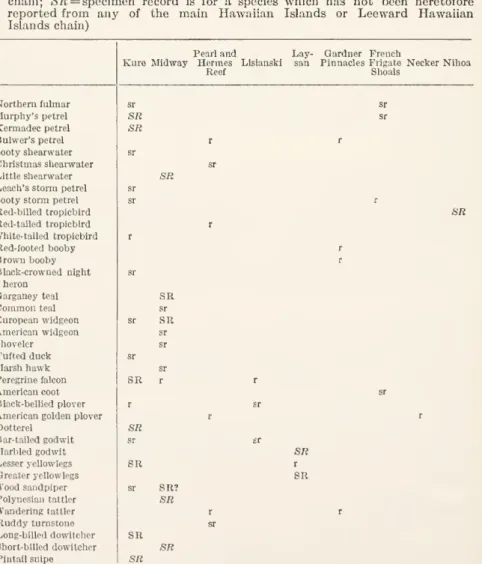
Table 1, at the end of the species accounts,summarizes
thenew
distributionalrecords of birds
from
theHawaiian Leeward
Islands.Acknowledgments. — The
authors gratefully acknowledge thosemembers
of the PacificOcean
BiologicalSurvey Program who made
thecollections
and
observationsupon
whichthispaperisbased.These
people are referred toby
lastname
only in the species accounts:A. Binion Amerson,Jr., Alan
H.
Anderson,David
A. Bratley, RichardS. Crossin, Paul G.
Dumont, Robert
R. Fleet, C. DouglasHackman,
Brian A. Harrington,Lawrence
N. Huber, J. VincentHoeman, Cameron
B. Kepler,Warren
B. King, T.James
Lewis,James
P.Ludwig,
Robert W.
McFarlane,Ralph W.
Schreiber,Fred
C. Sibley,Dennis
L. Stadel,Robert
S. Standen,Max
C.Thompson,
Jeffrey P.Tordoff, William O. Wirtz, II,
and George
S. Wislocki.We
also express our appreciation to Dr. Richard L. Zusi, Dr.Charles A. Ely,Dr.
Robert
L.Pyle,A.BinionAmerson,
Jr.,and David
Bridge,allofwhom
criticized themanuscript.Dr. AlexanderWetmore,
Dr. ClaytonM.
White, Dr. Lester L. Short, Jr., Dr. George E.Wat-
son, Dr. Charles A. Ely, Mrs. Roxie C. Laybourne,
David
Bridge, Patrick J. Gould,Robert
A. Sundell,and Max
C.Thompson
helped us with specificand
subspecific determinations. Mrs.Laybourne was
also especially helpful in aging gulls
and
ducks.We
should especially like tothank
Dr. GeorgeE.Watson
for hisencouragement and
advice in the preparation of themanuscript.Discussion.
— One hundred new
distributionalrecordsof 68 species of birdsare reportedherein, including 16 records ofspecies previously unrecordedfrom
either themain Hawaiian
Islands or theHawaiian Leeward
Islands. In addition, specimen verification is given for eight specieswhose
presence in theHawaiian
orLeeward
Islands heretofore has been based solelyon sight records.Eighty of the 100
new
records arefrom
but four islands:Gardner
Pinnacles, Pearland Hermes,
Kure,and Midway.
This preponderance ofrecordsfrom
thefirst three of these islands is in part an indication of therelativefrequency with which theseislandshad
been visitedby
observers in the pastbutreflects to only aslightly lesserdegree differ- ences in habitatfrom
island to island.Kure, Pearl
and Hermes, and Gardner
Pinnacleshave
been sur-veyed
very infrequently prior toPOBSP
visitsand
few of thesevisitswerereported subsequently.
Midway,
at the other extreme, has been surveyedand
reportedupon more
frequently thanany
otherLeeward
Island. Nonetheless, continued observation
by
thePOBSP
on this islandhas resultedinmore new
records thanforany
other islands butKure and
Pearland Hermes.
The
presence of certain habitats onMidway,
thosepresumably
most
attractive to the kinds of migrantsand
vagrants (e.g., ducks,4 PROCEEDINGS OF THE NATIONAL MUSEUM
vol. 124shorebirds, gulls) of
most
frequent occurrence in the Leewards, cer- tainly accounts in large part for the increment ofnew
records.Near
the overrun area of themain
airstrip is a series of smallponds
that probably attract wandering ducksand
gulls.These ponds
almost alwayshave muddy
margins that areparticularly attractive to shore- birds. Adjacent to theseponds
is a several-hundred-yard-long strip of low ground, oftenmarshy
duringrainy periods, that, at times, has ducksand
largenumbers
of shorebirds foraging onand
around it.The ponds and
the area nearby,from which most new
records forMidway have
been taken, arereferred to as the "overrunponds" and
"overrun area" in thespecies accounts.
The new and
unusual records obtainedby
thePOBSP
fall intotwo
categories.
One
group of records is of species that regularly occur in theHawaiian
chainbut which
representnew
records for individual islands.These
records of migrantsand
winter residents or breeding birds scarcely can be considered unusual,but
it is worthwhile todocument
their occurrencewhere
heretofore unrecorded.Some
of these constitute not onlynew
distributionalrecords but alsobreeding localityrecords: Christmas shearwater (Puffinus nativitatus), Bulwer's petrel (Bulweriabulwerii), sooty storm petrel (Oceanodroma tristrami), red-tailed tropicbird (Phaethon rubricauda),brown booby
(Sula leucogaster), gray-backed tern (Sterna lunata),brown noddy
(Anousstolidus),
and
blacknoddy
(Anous tenuirostris)The
other group of records is of species ofuncommon
or seldomdocumented
occurrence in theHawaiian Leeward
Islands.These
records consist of petrels, ducks,shorebirds, gulls,and
a heterogenous group of accidentals,composed
mainly of vagrant passeriformsbut
including wandering birds of prey, an alcid,and
a coot.A
largenumber
of theseforms are Palearctic in origin.Some
of the procellariiforms werebuds
that normally occur at sea in the vicinity of theLeewards and
thatwashed up
on the beach northern fulmar (Fulmarus glacialis), sooty shearwater (Puffinus griseus),and
Leach's petrel (Oceanodroma leucorhoa). Othershad
straggled farfrom
theirknown
range—
little shearwater (Puffinusassimilis),
Kermadec
petrel (Pterodromaneglecta), andMurphy's
petrel (Pterodromaultima).Of
the migrant ducks,some
records are of species that occur fre-quently in the
main Hawaiian
Islands in winter— American widgeon
(Mareca americana)and
shoveler (Spatula clypeata [see Medeiros, 1958]).These
birdsmay have come from North America
although the shovelers couldhave wandered
eastwardfrom
theOld
World.Other
records involve speciesonlyknown
to breedin theOld World
garganeyteal (Anasquerquedula),European
widgeon (Anas penelope),and
tuftedduck
(Aythyajuligula), whereas thecommon
teal (Anasno. 3640
HAWAIIAN
BIRDS— CLAPP AND WOODWARD 5
crecca)
may have
been either ofNorth American
or Asiatic derivation since specimenmaterialwas
inadequatefor subspecific determination.Judging
from
theirmoderate
to veryheavy
fat deposits,some
of these ducks were strongand
healthy— two common
tealand
a Euro- pean widgeon.Most
of the ducks, however,had
little orno
fat, were emaciated, or were found as beach-worn remains. This suggests that a majority of ducks reaching the islands fail to survive the winter.Tufted ducks, in particular, fared verybadly.
Only two
of the eight specimens obtained were strongenough
to fly.Three
of the others were soweak
that they were capturedby hand and
the remaining threewerefound dead.Records of wandering
and
migrant shorebirds are comprised, in part, of species that, althoughon
the"Hawaiian Check
List" (Bryan, 1958) oritssupplement (Udvardy, 1961b),arenotverifiedby Hawaiian
specimen records—
greater yellowlegs (Totanus melanoleucus), lesser yellowlegs (Totanusflavipes), knot (Calidris canutus),and
long-billed dowitcker(Limnodromus
scolopaceus). Other shorebird records are of speciespreviouslyunreported in theHawaiian and Leeward
Islands—
dotterel (Eudromiasmorinellus), pintailsnipe (Capellastenura), Poly- nesian tattler (Heteroscelus brevipes), short-billed dowitcher (Lim-
nodromus
griseus),marbled
godwit (Limosafedoa), ruff (Philomachus pugnax),and
one specieswhose
basis for inclusion in theHawaiian
fauna (AOLT, 1957)we have
not been able to discover:wood
sand- piper (Tringaglareola). Fiveof these seven species breed primarilyin theOld
World. Sincemany
of the sight records of shorebird species reportedfrom
themain Hawaiian
Islandsby Bryan and Udvardy and
in the recent issues of "Elepaio," areNorth American
species thatmay
be confused easilywithOld World
species (e.g., Charadrius semipalmatus with C. hiaticula, Erolia minutilla with E. temmincki,"common
snipe" with severalOld World
Capella species), it is im- portant thatsuch recordsbe substantiatedby
specimens.Gulls, particularly immatures, are frequent wanderers to the
Hawaiian and Leeward
Islands.Of
theseven species of gulls collected in theHawaiian Leeward
Islandsby
thePOBSP,
only one, the slaty-backed
gull (Larus schistisagus), is previouslyunknown from
the area. In this group of birds, as in the shorebirdsand
ducks, both Oldand New World
species are present.Two
species, Franklin's gull (L.pipixcan)
and
ring-billed gull (L. delawarensis), areNorth
American;two
forms, herring gull (L. argentatus vegae)and
slaty-backed gull (L. schistisagus), are Palearctic;and
three, glaucous-winged gull (L.glaucescens), glaucous gull (L. hyperboreus),
and
black-legged kitti-wake
(Eissa tridactyla), are Holarctic.Twelve
of the 39 gull specimens were found dead, either recentlydead
or as partial remains, indicating thatmany
(if not most) of the6 PROCEEDINGS OF THE NATIONAL MUSEUM
vol. 124gulls die
on
the islands towhich
theyhave
wandered.The
larger gulls (herring, glaucous, glaucous-winged, slaty-backed) apparently survive longeron
theLeeward
Islands than do the smaller species (ring-billed, Franklin's,and
black-legged kittiwake).Of
the 31 speci-mens
of larger gulls, only six were founddead
(two glaucous gullsand
four glaucous-wingedgulls).On
theother hand,two
of the eight smaller gulls (a ring-billed gulland
a black-legged kittiwake) were alivewhen
collected,and
oneof these, the kittiwake,was
injured.Thirty-four of the 39 gull specimens were subadult birds. Six of these 34 specimens wereintoo poorcondition to allowaccurate aging.
Of
theremaining 28, 10 werein firstwinter plumage, 13 werein firstnuptial plumage, one
was
molting into second winter plumage,and
fourwereinsecondwinter plumage.Frings (1965a, 1965b),
Amadon
(1965),and more
recently, Sibleyand McFarlane
(in press)have
discussed reasonswhy
gullshave
notbecome
established on tropical oceanic islands. Frings has suggested that both nonadaptability to local food sourcesand
inefficient pro- duction of fresh waterby
salt gland secretionmay
in part account for the absence of gullson most
oceanic islands.Amadon
suggested that unavailabilityoffoodis themore
probablecauseof theirabsence.Sibley
and McFarlane have
discussed theproblem
at length, pointing out reasonswhy
neither hypothesis is likely to be a wholly sufficient answer.Of
theremainingrecords,some
species evidentlywandered from
themain Hawaiian
Islands,where
theyhave
breeding populations black-crowned night heron (Nycticorax nycticorax),American
coot (Fulica americana), mockingbird(Mimus
polyglottos),and
house sparrow (Passer domesticus).One hawk
(Circus cyaneus hudsonius)was
ofNorth American
derivation but another (Falco peregrinus pealeiT)was
aNorth
Pacificform.The
alcid (hornedpuffin, Fraterculacorniculata)
may have come from
eitherNorth America
or Asia.The
barn swallow (Hirundo rustica gutteralis), red-throated pipit (Anihus cervinus), water pipit (Anthus spinolettajaponicus),and
sky- lark (Alauda arvensis pekinensis) are Palearctic forms, whereas thesnow
bunting (Plectrophenax nivalis townsendi) is representedby
the Pribilof-Aleutian form.SpeciesAccounts
NorthernFulmar Fulmarusglacialis rodgersii
(Fulmar)
POBSP
personnelhave
obtained four fulmar specimens thatwashed
up
on the beach onGreen
Island,Kure
Atoll, in early 1964.The
first specimen(USNM
492919), collected Jan. 16, 1964,was
the only oneno. 3640
HAWAIIAN
BIRDS— CLAPP AND WOODWARD 7
fresh
enough
to skin. Itwas
referred to the race F. g. rodgersiiby
Sundell.The
other three specimens(USNM
498110, February 26;USNM
498111,March
28;and USNM
498112,March
30) were skeletonized.On Sand
Island,Midway
Atoll, Bratley collectedtwo
partiallydecomposed
fulmars thathe found 100 feet apart on the north beach Aug. 15, 1964.Both
birds were preserved subsequently as skeletons(USNM
498113, 498114).The
earliest recordfrom
theHawaiian
area, however, is a hitherto unreportedbeach-driedmummy (USNM
489327) found on thebeach ofTern
Island, French Frigate Shoals,and
collectedby Wetmore, June
25, 1923.Fulmars have
been reported previouslyfrom Oahu
(King, 1959a)and from Midway
Atoll (Fisher, 1965), butnone have
been reported previouslyfrom
eitherKure
Atoll orFrench
FrigateShoals.Fulmarusg.rodgersiibreeds
from
Siberia tothePribilofand
Aleutian Islands(AOU,
1957).Murphy'sPetrel Pterodromaultima
A
female(USNM
492988) collectedby Ludwig,
Oct. 7, 1963,on Green
Island,Kure
Atoll,and
another female(USNM
497224) collectedby
Harrington as it flew overTern
Island,French
Frigate Shoals, on Sept. 9, 1966, are being reportedby Gould and King
(in press).There
areno
previous records of this petrelfrom any
of the islands of themain Hawaiian
orHawaiian Leeward
groups.This little-known petrel breeds only
on some
of the islands of the Australand Tuamotu
groups in the Central Pacific(Murphy,
1952).KermadecPetrel Pterodromaneglecta
A male (USNM
300679) collected onGreen
Island,Kure
Atoll, Apr. 30, 1923,by Wetmore
is beingreportedby Gould and King
(inpress).
The
present specimen constitutes the first specimen recordfrom any
of theislands of theHawaiian
area.This species nests on islands in the
South
Pacificfrom
theJuan Fernandez
Islands in the east toLord Howe
Island in the westand
recentlyhasbeen seenfrequently at sea in the Central Pacific (Gouldand
King, ibid.).Bulwer's Petrel Bulweriabulwerii
Sibley
and Amerson
estimated thatanadult populationof25 Bulwer's petrelswas
present onGardner
PinnaclesJune
16, 1963.Ten
nests were foundand
all contained eggs.POBSP
personnelhave
found Bulwer'spetrels on Southeast Island, Pearland Hermes
Reef, on three separate occasions. Fifteen adultsand
three nestswitheggswere foundJune
18-22, 1963: fiveadultswere seen Aug. 16-19, 1964;and
one largeyoung was
found Sept. 25-27, 1966.This species previously has been reported breeding on Nihoa, Necker, Laysan,
Midway, and French
FrigateShoals in theHawaiian Leewards
(Bailey, 1956; Richardson, 1957), but it has not been reported previouslyfrom
eitherGardner
Pinnacles or Pearland Hermes
Reef.SootyShearwater Puffinus griseus
Bratley found a sooty shearwater carcass
(USNM
496201)washed up on
the beachMay
18, 1965,on Green
Island,Kure
Atoll. Sixmore
specimens were taken at thesame
localityby Woodward
in the springof 1966(USNM
496557,Apr. 23, 1966;USNM
498253, 498254,May
4, 1966;USNM
496558,May
19, 1966;USNM
496559, 496560,May
28, 1966). Five of these specimens weredead
birds thatwashed up
on the beach.One
specimen(USNM
496558)was
captured alive as itswam
in the lagoon.Thisspecies breedsin Tasmania,
on
the islands intheNew
Zealand area,and
on islands nearCape Horn (AOU,
1957). Sootyshearwaters are regular migrants through the Central Pacificand have
been re- ported previouslyfrom Oahu,
in themain Hawaiian
Islands(Wood-
side
and
Walker, 1964),and from Midway
Atoll(Kenyon and
Rice, 1957; Fisher, 1965),and Laysan
Island (Bailey, 1956) in theHawaiian Leeward
Islands.They have
not been recorded previouslyfrom Kure
Atoll.
Christmas Shearwater Puffinus nativitatus
The POBSP
collected specimens of Christmas shearwatersfrom
one island oftheLeeward
Islandsfrom which
theyhad
notbeen recorded before.These
specimens(USNM
492965,Mar.
7, 1963;USNM
492966, Feb. 26, 1963)
were
collectedon
Southeast Island, Pearland Hermes
Reef.Since there are
no
previous records for thisislandand
sinceRobbins
(1966) gave
no
details of his observations of breeding birds onGreen
Island,
Kure
Atoll,we
includehere a shortsummary
ofPOBSP
breed- ing datafrom
these islands for the period 1964-1966 as follows:Kure
Atoll,Green
Island: Christmas shearwaters are present onKure
Atollfrom March
to October, reaching theirpeak numbers
(about 100 adults) duringthepeak
of thenestingseason,which
occursfrom May
through August. Nests with eggshave
been found in theno. 3640
HAWAIIAN
BIRDS— CLAPP AND WOODWARD 9 months
of April,May, and
June;downy
chicks were present inJune and
July;and
nearly fledged birds were present inSeptember and
October.The
breeding cycle as indicatedby
our data is quite similar to that reported for otherislands in theLeeward
chain.Pearl
and Hermes
Reef, Southeast Island:Far
fewer Christmas shearwaters occuron
Pearland Hermes
Reef than onKure
Atoll.The
largestnumber
of adults presentwas
about 20 birds Sept. 25-27, 1966, with smallernumbers
having been recorded in themonths
ofMarch,
June,and
August. Nestshave
been foundon two
occasions (anest containinganeggJune
18-22, 1963,and
threenestswithyoung
Sept. 25-27, 1966).
Thisspeciespreviouslyhasbeenreportedbreedingon Nihoa,
French
Frigate Shoals, Laysan,Lisianski,Midway, and Kure
intheHawaiian Leeward Chain
(Richardson, 1957; Robbins, 1966).Little Shearwater Puffinusassimilis (assimilis?)
On
Feb. 18, 1963,Amerson
collected amale
littleshearwater(USNM
492974) in a colony of
Bonin
petrels (Pterodroma hypoleuca) near the Chief Petty Officers'Club
onSand
Island,Midway
Atoll.The
testesof the specimen were 4
mm
long, indicating that the birdwas
not breeding. This specimen constitutes not only the first record forany
of theHawaiian
Islands,but
it is also the first record for theNorth
Pacific Ocean.Dr. Alexander
Wetmore, who compared
thespecimen with material at theAmerican Museum
of Natural History, informed us that inmost
regards the present specimenmatches
those of the race P. a.assimilis but that it has
more
whiteon
the under-tail coverts thanis typical ofP. a.assimilis. Puffinusassimilis breeds on theNorfolkand Lord Howe
Islands in the southwestern Pacific(Murphy,
1927).Leach's StormPetrel Oceanodromaleucorhoa leucorhoa (Leach'sPetrel)
On May
10, 1964, Wislocki found a Leach's storm petrel(USNM
494243)
washed up
on the beach ofGreen
Island,Kure
Atoll.The
specimenwas
identified subsequently as 0. I. leucorhoaby
Gould.A
second Leach's storm petrel that
washed up
on the beachwas
col- lected at thesame
locality Dec. 21, 1964,and was
preserved subse- quently as an alcoholic(USNM
503371).No
Leach's storm petrelshave
been reported hithertofrom Kure
Atoll orany
of the otherHawaiian Leeward
Islands.Bryan
(1965) reported another specimen thatwashed up
on the beach onOahu and
thatwas
collected Oct. 26, 1964. Still another specimen thatwashed up
on the beach atOahu was
collected Jan. 5, 1967 (Throp, 1967).273-0S6
—
68 2These
specimensand
others taken at sea near themain Hawaiian
Islands(POBSP,
unpubl. data) suggest thatsome
earliersightrecords attributed to the very similar Harcourt's storm petrel {Oceanodromacastro)
may
in facthave
been records of Leach's storm petrel (e.g.,records
by Munro
at sea nearNecker
Islandand Gardner
Pinnaclesand by Palmer
betweenKauai and
Niihau [Munro, 19441).The
subspecies 0.1, leucorhoabreedson the coastofJapan and
intheKurile,
Komandorskie, and
Aleutian Islands(AOU,
1957). It winters south to at leastthe equator in the Central Pacific (P. J. Gould, pers.comm.) and
even furthersouth in the eastern Pacific (G. E.Watson,
pers. comm.).
Sooty StormPetrel Oceanodromatristrami
(Tristram'sPetrel)
POBSP
personnelhave
collected fivesooty storm petrel specimens onGreen
Island,Kure
Atoll.The
first specimen(USNM
493026, Jan. 1, 1964), amale
with enlarged gonads,was
one oftwo
birds thatwere
observed digging at the base of aclump
of grass (Lepturus).Two
other specimens collected, a female
(USNM
494358,Mar.
1, 1965),and
amale (USNM
496223, Dec. 12, 1965)had
decidedly enlarged gonads.A
female(USNM
497297) collected Jan. 3, 1967,had
only slightly enlarged gonads.Other
sooty storm petrelswere
seen occasionallyfrom
1963 to 1967 in themonths from November
through January, butno
nestshave
been found.Two
sooty storm petrels were seen excavating aburrow on
Apr. 2, 1964.One
birdexamined
in thefield duringthe periodfrom
Dec. 30, 1966 throughJan. 5, 1967had
a completely bare brood patchand
anotherhad
apartiallybare brood patch. Itseems verylikelythat oneormore
pairsmay have
nestedonKure
Atollin thelastfouryears.On Mar.
14, 1967,Hackman
foundtwo
sooty storm petrel chicks, onedowny and
very small, the other about three-quarters grown, onWhale-Skate
Island,French
Frigate Shoals.Both
chicks were found in shallowburrows
under the grass.In the
Hawaiian Leeward Chain
this species has been reported breedingon
Laysan, Pearland Hermes, Midway, and
perhapsNecker
(Richardson, 1957)and
has been reportedfrom Nihoa
as well (Bryanand Greenway,
1944).None have
been reported previouslyfrom
either
Kure
Atoll orFrench
Frigate Shoals.Red-billedTropicbird Phaethonaethereusmesonauta
On June
15, 1923,Wetmore
collected animmature
female red-billed tropicbird(USNM
300977) as it flew overNihoa
Island.The
onlyother record
from
the vicinity of theHawaiian
Islands isMoynihan's
no. 3640
HAWAIIAN
BIRDS— CDAPP AND WOODWARD
11 (1957) sight recordoftwo
red-billedtropicbirdson Sand
Island, John- ston Atoll, in early April 1957.In the Pacific this species breeds
from
the Gulf of Californiaand
the Revilla Gigedo Islands to the Galapagosand
islands near the coast ofEcuador (AOU,
1957).Red-tailed Tropicbird Phaethonrubricauda
Munro
(1942) reported thathe had
seen "tropicbirds" flying over Pearland Hermes
Reef in July 1891.We have
found no otherlitera- ture records pertaining to the occurrence of this species on Pearland Hermes
Reef. Red-tailed tropicbirdshave
been reported previouslyfrom
all therestof theHawaiian Leeward
Islands (Bryanand
Green- way, 1944; Richardson, 1957;Kenyon and
Rice, 1958).A summary
of
POBSP
observations ofred-tailed tropicbirds on Pearland Hermes
Reef isgiven for each island as follows:Southeast Island:
An
estimated 15 adults present Feb. 28-Mar.
8, 1963; about 80 adults, five nestlings,and
24 eggsJune
18-22, 1963;sixadultsand two
eggsMar.
13, 1964; 15 adults, threenestlings,and
three eggs Aug. 16-19, 1964; 15 adultsand
three nestlings Sept.16-17, 1964; 15 adults
and
three nestlingsMar.
15-17, 1965; 10-15 adultsand
four eggs Sept. 7, 1966.North
Island:About
60 adults, fournestlings,and
15 eggsJune
23-24, 1963; about 40 adults, 15 nestlings,and
one egg Aug. 19-20, 1964; 10 adultsand
one nestling Sept. 17, 1964; 5-10 adultsand two
eggsMar.
17-18, 1965; about 10 adultsand two
eggsMar.
21-23, 1967.Seal Island:
Twenty
adultsand
six eggsJune
26, 1963; 15 adultsand two
nestlings Aug. 18, 1964.Grass Island: Five adults
and two
eggsJune
26-27, 1963; eight adultsand
onenestlingAug. 18, 1964; oneseen overislandMar.
22, 1967.White-tailed Tropicbird Phaethonlepturus
Kepler observed a white-tailed tropicbird as it flew
low
over the east beach ofGreen
Island,Kure
Atoll, Feb. 6, 1965. This species breeds in theHawaiian
Islands(AOU,
1957), has beenreported breedingon Midway
Atoll (Bailey, 1956), but has not been reported previouslyfrom Kure
Atoll.Red-footedBooby Sula sula
Sibley
and Amerson
observed animmature
or subadult red-footedbooby
roosting onGardner
Pinnacles,June
16, 1963.The
red-footed booby, a species of pantropical distribution in the world's oceans,breeds
commonly on most
of the islands of theHawaiian Leeward Chain
(Richardson, 1957),butitsoccurrenceon Gardner
Pinnacleshas not beenreported previously.Brown
Booby SulaleucogasterSibley
and Amerson
found abrown booby
incubatingtwo
eggson Gardner
Pinnacles,June
16, 1963.The
occurrenceand
breeding of this specieson Gardner
Pinnacles has not been reported previously.The brown
booby, a widespread inhabitant of tropical oceans, has been reported breeding onmost
of the other islands of theHawaiian Leeward Chain
(Richardson, 1957).Black-crowned NightHeron Nycticorax nycticorax (hoactli?)
Woodward
found the partiallydecomposed
remains(USNM
496776) of a black-crowned night heron in Scaevola bushes
on Green
Island,
Kure
Atoll,June
3, 1966.The
specimen, an adult, has the following measurements:wing
(chord) 295mm, culmen
77mm, and
tarsus 80mm. These measurements
are well within the range given for femaleNycticorax n. hoactliby
Peters (1930)and
are larger than those given for either sex ofN.
n. nycticorax.The
raceN.
n. hoactli breeds in themain Hawaiian
Islandsand
haswandered
previously toMidway
Atoll, 57 miles to the east ofKure
(Bryanand Greenway,
1944).
GarganeyTeal Anasquerquedula
On
Sept. 17, 1963,Ludwig
collectedtwo
juvenile garganey teal, amale and
a female,from an
overrunpond on Sand
Island,Midway
Atoll
(USNM
493451, 493452).These
birds constitute the first speci-men
recordsfrom any
of the islands of theHawaiian
area although this tealhas beenseenon two
other occasions.Walker
(1961) reported seeingone at apond
nearHilo, Hawaii,Mar.
20, 1961,and Gauthey
(1967) reported adrake seen at
Kahuku, Oahu, Mar.
21, 1967.Thisspeciesbreeds across northernEurasia
and
wintersfrom
north- ern Africaand
the Philippines south to equatorial Africa, the Sey-chelles, southernAsia,
and
casually to Australia (Vaurie, 1965).Common
Teal Anascrecca(Green-wingedTeal)
In 1963
Ludwig
collected four tealfrom
the overrun pondson Sand
Island,
Midway
Atoll, two, amale and
a female,on November
13(USNM
493479, 493480)and two
moderately fat femaleson Decem-
ber 4
(USNM
493455, 493456).At
least fivemore
teal were present.no. 3640
HAWAIIAN
BIRDS—
CLAPPAND WOODWARD 13
Since the specimens are all juveniles molting into their first winter plumage, no subspecific identifications can be
made.
In years pastspecimens
have
beencollectedon
Laysan,Maui, and Molokai
(Bryanand Green
way, 1944).At
least 15 sight records of tealon Oahu, Maui, and Hawaii have
appeared in the "Elepaio"since 1940, indicating that these teal are probably regular visitors to the
main Hawaiian
Islands.Teal, either A. c. crecca or A. c. carolinensis, previously
have
been reported onlyfrom Laysan and Midway
in theHawaiian Leeward
Islands. Rothschild (1893-1900) reported that Schauinsland
had
col- lected afemale on Laysan, Oct. 27, 1896. Fisher (1965) reported that smallgroupsof threeto eightbirds arenotuncommon on
thebrackishpond
atSand
Island,Midway
Atoll.Thisspeciesbreeds acrossEurasia
and North America (AOU,
1957).EuropeanWidgeon Marecapenelope
Clapp
collected a female,an
adult molting into winter plumage,on Sand
Island,Midway
Atoll, Jan. 12, 1965(USNM
493458).On Green
Island,
Kure
Atoll, an emaciated second winter femalewas
capturedby
CoastGuard
personnelNov.
10, 1964(USNM
494359),and Lewis
shot a first winter female thereon Nov.
14, 1965(USNM
496208).These
specimens are not only the first records forKure and Midway
Atolls, but also they are the first specimens collected
on any
of the islands of theHawaiian
area.This Eurasian species is a regular visitor to both coasts of
North America
(Vaurie, 1965)and
has been seenon Oahu and Hawaii
(Udvardy, 1961b).AmericanWidgeon Marecaamericana
Ludwig
found the remains of anAmerican widgeon
at an overrunpond
onSand
Island,Midway
Atoll, Dec. 4, 1963(USNM
496202).On
Jan. 12, 1964,Clapp saw
fourmore American
widgeonsinthesame
areaand
collected a very fat adultmale (USNM
493457) thatwas
molting into winterplumage.These
specimens are the first thathave
been collected onMidway,
butKenyon and
Rice (1957)saw
at leasttwo
birds of this specieson
Eastern Island,Midway
Atoll, during the winter of 1956-57.Two
more
were seenby
Fisher (1965) onSand
Island,Nov.
30, 1963.Laysan
Island is the only other island in theHawaiian Leewards
onwhich an American
widgeon specimen has been taken (Bryanand Green
way, 1944).This
duck
breeds primarily in northwesternNorth America from
Alaska to Wisconsin south to Coloradoand
northeastern California(AOU,
1957)and
is a regular winter visitor in smallnumbers
in themain Hawaiian
Islands (Udvardy, 1961a).Shoveler Spatulaclypeata
Ludwig saw two
shovelers Dec. 4, 19G3, onSand
Island,Midway-
Atoll.
During
the rest of the winter shovelers wereseen there at least six timesby POBSP
personneland
yet anotherwas
seen therein mid-January
1966.On
Apr. 30, 1964, Wislocki collected amale and
a female(USNM
493584, 493585) boththin, secondwinter birds.These
birds constitute thefirst specimenrecordsfrom Midway
Atoll.The
only other island in theHawaiian Leewards from
which shovelers areknown
is Laysan,where
several sight recordsand
one specimenhave
been obtained (Bailey, 1956).To
these recordswe add
aPOBSP
sight record of three shovelers that were seenon
the smallpond
north ofthe lagoonOct. 22, 1966.This species breeds mainly in northern
North
America, northern Europe,and
northern Asia,and
is of casual occurrence in themain Hawaiian
Islands(AOU,
1957).Tufted
Duck
AythyafuligulaOn
Oct. 29, 1963, Wirtz caughtan
emaciated female tuftedduck by hand
atGreen
Island,Kure
Atoll(USNM
493448).During
the faUand
winter of 1963,Clapp and Ludwig
collected four of at least seven seenon
the overrunponds
ofSand
Island,Midway
Atoll:November
13, 9,
USNM
493828;December
2, 9,USNM
493450;and December
4, cf,
?USNM
493449, 498077.These
birds were either sickand
emaciated or found dead.
The
following fall Wirtz collectedtwo more
tufted ducks in thesame
area.One was
shot Oct. 30, 1964(?USNM
494360)and
the otherwas
founddead Nov.
1, 1964(?USNM
498125).Kepler
saw
another in the overrunponds
Oct. 25, 1965,and
on Jan. 7, 1967,Huber
found a dried carcass of yet anothertuftedduck
(?USNM
497500) nearthe reservoirbetween
the runways.Those
specimens thatwere
preserved as skins (493448-493450, 493828, 494360) arealljuveniles,many
ofwhich
exhibita considerably retarded molt.The
only other recordsfrom
theHawaiian Leewards
are those of Fisher (1960, 1965).He
shotan
emaciatedmale
on Dec. 5, 1959, atSand
Island,Midway
Atoll,and saw
five others there inDecember
1963,
some
ofwhich
are probably thesame
birds as those reported above.The
tuftedduck
breedsfrom
Icelandand
the Scandinavian Penin- sula across northern Asia south to centralEurope and
central Asia.no. 3640
HAWAIIAN
BIRDS— CLAPP AND WOODWARD 15
It hasbeen recorded as avagrant in the Aleutian
and
Pribilof Islands(AOU,
1957).Marsh
Hawk
Circuscyaneus hudsonius(HenHarrier)
On
Oct. 30, 1964, Wirtzwas
toldby
military personnel onMidway
Atoll that
two hawks
with rusty underparts, white rumps,and
unbarred tails,had
beenseen recentlyon theatoll.The
following day, he collected animmature
femalemarsh hawk (USNM
494360) as itquartered low over Scaevola on Eastern Island,
Midway
Atoll. This subspecies is foundfrom
Alaska south to northernBaja
Californiaand
in other parts ofNorth America (AOU,
1957).Henshaw
(1902) reported that severalspecimenshad
been taken inOahu
but gaveno
further details.The
presentspecimen apparentlyisthe first seen or collected in the
Hawaiian
area since the late 19th century.PeregrineFalcon Falcoperegrinus (pealei?)
Standen
collected a female peregrine falcon(USNM
494363)Mar.
7,1965, asitflew over thebeach
and
overScaevolabushes at thewestern end ofGreen
Island,Kure
Atoll.The
specimen,which was
badly worn,had
very dark underpartsand
awing measurement
of 377mm.
Dr. Clayton
M. White
(in litt.) informed us that he identified the specimen as F.p. pealei on thebasis of theextremely heavilymarked
flanks
and
thighs but that "in every other regard the specimen is amatch
for darker examples ofF. p.japonensis." Falcop.japonensisisamigratoryrace that breeds
from
northeastern Siberia toKamchatka,
the Kuriles,and
northernJapan
(Vaurie, 1965) while F.p. pealei isbelieved to be a
more
sedentaryform
that breeds in theCommander and
Aleutian Islandsand
on islands off the coast of southern Alaska (Vaurie, 1965).Another
falcon, identified as a peregrineby POBSP
personnel,was
seen offshore of Lisianski IslandMar.
12, 1965,and
over the island onMarch
13and
14.On
the 13th, a roost that the falcon evidentlyhad
been usingwas
found in a Casuarina tree.The
remains ofmany
birds,atleast threegray-backed terns(Sternalunata),oneblack
noddy
(Anous tenuirostris), 47ruddy
turnstones (Arenaria interpres),and
20 golden plovers (Pluvialisdominica), found beneath the roost indicated that the falcon probablyhad
been present on the island for at least aweek
ormore
before the arrival of thePOBSP
field party.On Mar.
24, 1967,Hackman saw
still another peregrine falcon, an adult, flyingoverthethicklyinhabitedsection ofSand
Island,Midway
Atoll,
accompanied by
a large flock of white terns (Gygis alba).The
falcon
had
been present on the island since at least the precedingJanuary (Hackman,
pers. comm.).Sight records of peregine falcons
have
been reportedfrom Hawaii by Dunmire
(1961)and from Oahu by Ord
(1966),anonymously
(1966),
and by Donaghho
(1967).None have
beenreported previouslyfrom any
of theHawaiian Leeward
Islandsand no
specimenshave
beenreportedfrom any
of theHawaiian
Islands.American Coot Fulicaamericana
Amerson
found adead
coot(USNM
503194) Aug. 11, 1965, onTern
Island,
French
Frigate Shoals.The
birdwas
found in low Messer- schmidia over 100 feetfrom
the beach, suggesting that ithad
not beenwashed up on
the beach. Coots breed on themain Hawaiian
Islandsbut have
not been recorded previouslyfrom French
Frigate Shoals.Black-bellied Plover Squatarolasquatarola
(GreyPlover)
Clapp
collectedtwo
black-belliedplovers, amale and
afemale(USNM
494120, 494121),
Mar.
13, 1965, on the rocky eastbeach
of Lisianski Island.A
third specimenfrom
Lisianski(USNM
496779), a female,was
collectedby
CrossinJune
18, 1966, as it fed along the shoreline.Single black-bellied plovers
were
seenby POBSP
personnel onGreen
Island,
Kure
Atoll, in late October 1963and
in lateMay
1964.This species breeds
from
north-central Russia to northern Alaskaand
southwestern Baffin Islandand
migrates along the Pacific coasts ofboth
theOld and New Worlds (AOU,
1957). In theLeeward Hawaiian
chain black-bellied plovershave
been observed previouslyon Midway
Atoll(Donaghho,
1953-1954)and have
been collected previously onLaysan
Island (Bailey, 1956).They have
not been recorded previouslyfrom
eitherKure
Atoll or Lisianski Island.American GoldenPlover Pluvialisdominica
Fleet
saw
threeAmerican
golden ploverson Necker
Island Sept. 25, 1964,and Hackman saw two
thereMar.
10, 1967.POBSP
personnelhave
observed these ploverson
the variousislets ofPearland Hermes Reef
as follows:SoutheastIsland:
An
estimated 40 presentFeb.26-Mar.
8, 1963;five seen
June
18-22, 1963; three seenMar.
13, 1964; one seen Aug.16-19, 1964; about 150 present Sept. 16-17, 1964; "a
few"
seenMar.
15-17, 1965; nine countedMar.
21-22, 1965; about 175 present Sept. 27, 1966; 15-20 seenMar.
21-23, 1967.no. 3640
HAWAIIAN
BIRDS— CLAPP AND WOODWARD 17 North
Island:Three
seenJune
23-24, 1963; one seen Sept. 18, 1964; "afew" seenMar.
17-18, 1965.Seal Island:
A
"few"seenMar.
18, 1965;two
seenMar.
22, 1967.Kittery Island:
A
"few" seenMar.
18, 1965; one seenMar.
22, 1967.GrassIsland:
A
"few"seenMar.
19, 1965;two
seenMar.
22, 1967.This species is a regular winter visitor in the
Hawaiian Leeward
Islands (Bryanand Greenway,
1944), but it has not been reported previouslyfrom
eitherNecker
or Pearland Hermes
Reef.Dotterel Eudromias morinellus
Dumont
captured animmature
female dotterel(USNM
494299) in a mist net Sept. 9, 1964, onGreen
Island,Kure
Atoll.The
dotterelhad
been seen flying with flocks of golden plovers for several days before itwas
collected.No
specimens or sight records of dotterelshave
beenreported previouslyfrom any
oftheislands oftheHawaiian Leeward
Islands norfrom any
of themain Hawaiian
group. This species breeds in Siberiaand
has been reported previously as a straggler to Alaskaand
the northwestern United States. It has been recorded once breeding in Alaska(AOU,
1957).Bar-tailedGodwit Limosa lapponica baueri
Wislocki shot a female
(USNM
493478)Mar.
11, 1964,on
Lisianski Island.On May
9, 1966,Woodward saw two
bar-tailed godwitson
the southeast beach ofGreen
Island,Kure
Atoll.He
subsequently collected one ofthem (USNM
496599), amale
molting into nuptial plumage.These
godwitshave
been seen thrice onLaysan by POBSP
personnel.
One was
seenon thewestshoreofthelagoonSept. 19, 1964;two
wereseen foraging togetheron the eastand
southbeaches during the periodMar.
6-11, 1965;and
anotherwas
observed Oct. 21, 1966.SpecimensofL.I.baueri
have
beenreported previouslyfrom Laysan
(Rothchild, 1893)and Midway
(Fisher, I960) in theHawaiian
Lee- wards, butnone have
been reported previouslyfrom
eitherKure
or Lisianski.The
race L. I. baueri breeds in Siberiaand
northern Alaska (Vaurie, 1965)and
winters irregularly in smallnumbers
in central Polynesia.Marbled Godwit Limosafedoa
On
Oct. 21, 1966,POBSP
personnelsaw two marbled
godwitsfeeding in the lagoon atLaysan
Island.One
ofthem (USNM
496790)was
then collectedby
Lewisand
proved tobe an immature male
withheavy
fatdeposits.No
sightrecords of specimensofmarbled
godwits273-086—68 3
have
beenreported previouslyfrom any
oftheislands oftheHawaiian
area.
This species breeds
from
central Alaskaand
southernManitoba
south to centralNorth Dakota and
west-central Minnesota. It mi- grates along the California coastand
through the western interior ofNorth America (AOU,
1957).Lesser Yellowlegs Totanusflavipes
On Green
Island,Kure
Atoll, Aug. 30, 1964,Dumont
capturedan immature
female lesser yellowlegs(USNM
494297) in a colony of sooty terns (Sterna fuscata).The
birdwas
lying on theground and was
very emaciated.Another
lesser yellowlegswas
seenby POBSP
personnel onLaysan
Island Oct. 21, 1966. This birdwas
feeding withwandering
tattlersand two
greater yellowlegs withwhich
itwas compared
closely.Sightings of lesser yellowlegs
have
been reportedfrom
themain Hawaiian
orLeeward
Islands on six previous occasions: oncefrom Midway (Donaghho,
1953-1954), oncefrom Maui
(Bryan, 1962),and
four timesfrom Oahu
(Hatch, 1953;anonymous,
1964;anonymous,
1967; Gauthey, 1967).The
specimen collectedonKure
is thefirstreportedfrom any
of the islands of theHawaiian
areaand
also constitutes thefirstrecordfrom Kure
Atoll.The
sight recordfrom Laysan
is the first record of the lesseryellowleg's occurrence there.This species breeds
from
north-central Alaska east to northern Ontarioand
northwesternQuebec and
migrates south to thesouthern United States, Central America, Chile,and
Argentina(AOU,
1957).GreaterYellowlegs Totanus melanoleucus
On
Oct. 21, 1966, Harrington collected one(USNM
496780) oftwo
greater yellowlegsfrom
the lagoon atLaysan
Island.The
specimen, a very fatimmature
female,had
beenfeeding withwandering
tattlers(Heteroscelusincanum)
when
itwas
firstseen.Sight records of greater yellowlegs
have
been reported on seven previous occasionsfrom
themain Hawaiian
Islands (seeUdvardy,
1961b;anonymous,
1962; Ord, 1962)and
oncefrom Midway
Atoll in theHawaiian
chain(Donaghho,
1953-1954).The
bird taken onLaysan
constitutes the first specimen recordfrom
either themain
Hawaiian
orHawaiian Leeward
Islands. Greater yellowlegs breed across northernNorth America from
southern Alaska toNewfound-
landand
migrate south through the interiorand
coastal regions of the United States(AOU,
1957).no. 3G4o
HAWAIIAN
BIRDS— CLAPP AND WOODWARD 19
Wood
Sandpiper TringaglareolaLudwig
shot amale wood
sandpiper(USNM
493333) thathad
verylittlefaton Dec. 11, 1963, in theoverrunareaon
Sand
Island,Midway
Atoll.
Another
specimen(USNM
496777) ofunknown
sexand
withno
fat depositswas
collectedby
Bratley onGreen
Island,Kure
Atoll,
May
22, 1965.Wood
sandpipers are reported as "accidental inHawaii" (AOU,
1957), but
we have
been unable to discover the source of this statement.The
present specimens confirm the occurrence ofwood
sandpipers in the
Hawaiian
Islands and, so far aswe
can determine, constitute the first distributional recordsfrom Kure and Midway
Atolls.
PolynesianTattler Heteroscelus brevipes
(Gray-rumpedSandpiper)
Wirtz collected a moderatelyfat,
immature male (USNM
494300) on Eastern Island,Midway
Atoll, Oct. 30, 1964. This specimen con- stitutes the firstrecord of the occurrence of the Polynesian tattler in eitherthemain Hawaiian
orHawaiian Leeward
Islands. This species probablybreedsin easternSiberiaand
migratessouthalong the coasts of Japan, China,and
Indochina. It winters in the Philippineand
Caroline Islands south toNew Guinea and
Australiaand
has been recordedfrom
the PribilofIslands(AOU,
1957).WanderingTattler Heteroscelus
incanum
Sibley
and Amerson saw
onewandering tattler onGardner
PinnaclesJune
16, 1963.Wandering
tattlershave
been seen 15 timeson
the islets of Pearland Hermes
Reef.These
observations are givenby
islet as follows:
Southeast Island:
Three
seen Feb.26-Mar.
8, 1963; one seenJune
18-22, 1963;oneseenMar.
13, 1964;one ortwo
seenAug. 16-19, 1964; five seen Sept. 16, 1964; one seenMar.
21-22, 1965; four seen Sept. 25-27, 1966;two
seenMar.
21-23, 1967.North
Island:One
seenJune
23-24, 1963; one ortwo
seen Aug.19-20, 1964.
Grass Island:
One
seenJune
26-27, 1963.Seal Island:
One
seenMar.
14, 1964; one seenMar.
18, 1965;one seen
Mar.
22, 1967.Humphrey
Island:One
seen Aug. 18, 1964.Kittery Island:
One
seenMar.
22, 1967.Even
though wandering tattlers are regularwinter residentson
theHawaiian Leeward
Islands (Bryanand Greenway,
1944), their occur-rence
on
Pearland Hermes
Reefand Gardner
Pinnacles has not beendocumented
previously.Ruddy
Turnstone Arenariainterprcs(Turnstone)
Ruddy
turnstoneshave
been recorded on allPOBSP
visits to Pearland Hermes
Reef.A
shortsummary
of thenumber
observedon
each islandis as follows:Southeast Island:
About
200 present Feb.26-Mar.
8, 1963;15-20 seen
June
18-22, 1963; 178 countedMar.
13, 1964; about 75 present Aug. 16-19, 1964;an
estimated 500 present Sept. 16-17, 1964; "afew"
seenMar.
15-17, 1965; 86 countedMar.
21-22, 1965;about 350 present Sept. 27, 1966; about 100 present
Mar.
21-23, 1967.North
Island: 12 to 15 presentJune
23-24, 1963; about 75 present Sept. 17, 1964; 75-100 presentMar.
17-18, 1965.Grass Island:
One
seenJune
26-27, 1963; about 20 presentMar.
14, 1964; about 80 seen in oneflockMar.
22, 1967.Humphrey
Island: Fifteen present Sept. 17, 1964; "afew"
seenMar.
17, 1965.Kittery Island:
A
"few" seenMar.
17, 1965; one seenMar.
22, 1965; 15 seenMar.
22, 1967.Planetree Island:
One
seenMar.
22, 1965.Sand
Island:Four
seenMar.
22, 1965.Seal Island:
Twelve
seenMar.
22, 1965; 45 seen in one flockMar.
22, 1967.The
one specimen(USNM
494155) collectedby
thePOBSP on
Pearl
and Hermes Reef was
taken on Southeast Island Aug. 17, 1964.Although ruddy
turnstones are regular winter visitors to the islands of theHawaiian Leeward Chain
(Bryanand Greenway,
1944), their occurrenceon
Pearland Hermes Reef
hasnotbeenreportedheretofore.Long-billedDowitcher
Limnodromus
scolopaceusOn
Oct. 3, 1963, a moderately fat,immature male (USNM
493854)was
collectedby Ludwig on Green
Island,Kure
Atoll. Several other dowitchers ofunknown
species were seen onGreen
Island during thesame month but
were not collected.No
long-billed dowitchershave
been collected previously in either themain Hawaiian
orHawaiian Leeward
Islands,and none have
been reported previouslyfrom Kure
AtoU.From
1945 throughMay
1967, 15 sight records of dowitchers or long-billed dowitchers were published in the "Elepaio." Sincenone
were confirmedby
specimens, it is not possible to establishwhich
ofno. 3640
HAWAIIAN
BIRDS— CLAPP AND WOODWARD 21
the
two
sibling dowitcher species the records actually comprised although the long-billed dowitcher is included in the"Hawaiian
Checklist" (Bryan, 1958).This species breeds from northeastern Siberia
and
northwestern Alaska toMacKenzie and
migrates primarily through the western United States toMexico and Guatemala (AOU,
1957).Short-billedDowitcher
Limnodromus
griseuscaurinus Wirtz collected animmature
female(USNM
496057), one oftwo
dowitchers seen, Oct. 30, 1964, onSand
Island,Midway
Atoll.The
specimen, identified as L. g. caurinusby
Laybourne, constitutes thefirst record of the occurrence of the short-billed dowitcher in the
Hawaiian
area.Limnodromus
g. caurinus breeds in southern Alaska (Pitelka, 1950)and
migrates south along the Pacific coast ofNorth America
to at leastBaja
California(AOU,
1957).Pintail Snipe Capellastenura
On
Jan. 13, 1964,King
collected amale (USNM
493341) inan
open grassy area onGreen
Island,Kure
Atoll.No
pintail snipeshave
been reported previouslyfrom any
of the islands of theHawaiian
area. This species breeds
from
Siberia to northwesternManchuria and
winters south toMalaya
(Vaurie, 1965).Common
Snipe Capella gallinagodelirata Schreiber collectedan immature male (USNM
496778), later identi- fied as C.g. delicataby Thompson, from
anopen
fieldonGreen
Island,Kure
Atoll, Sept. 25, 1966.A
snipe, probably this bird,had
been seen daily for the preceding five days.This subspecies of the
common
snipe breedsfrom
northwestern Alaska east to centralLabrador and
south to California, northernWest
Virginia,and
Connecticut. It winters southto Central America, Venezuela,and
southern Brazil(AOU,
1957)and
has been reported several timesfrom
themain Hawaiian
Islands (Munro, 1944). In theLeeward
Chain, it hasbeen
reported previouslyfrom Laysan
(Bryanand Greenway,
1944) but this record is erroneous (Bailey, 1956).Knot
CalidriscanutusClapp
collected a very fat adult female(USNM
494130),Mar.
15, 1965,on
Southeast Island, Pearland Hermes
Reef.Another
knotwas
seenon Sand
Island,Midway
Atoll, Aug. 28, 1965,by
threePOBSP
members. The
latter birdwas
in breedingplumage and
the lengthydescription in the observers' field notes adequately confirms the identification.
The
specimenfrom
Pearland Hermes
constitutes thefirst specimen record
from
either themain Hawaiian
orHawaiian Leeward
Islands.The
sight record of theknot from Midway
con- stitutes the first record of this species' occurrence there.The
only other recordfrom
the entireHawaiian
area is aknot
seenon Oahu
Oct. 29, 1961 (Ord, 1962).
Knots
breed in arcticNorth America
east to Greenland, theNew
Siberian Islands,
and Wrangel
Island,and
migrate south principally along the coasts of theOld World (AOU,
1957).Sanderling Crocethia alba
Although
a regular winter resident in theHawaiian
area (Bryanand Greenway,
1944), sanderlings nonetheless are unrecordedfrom
several of the atolls
and
islands in theHawaiian Leeward
Chain.Specimens
have
been takenon Laysan
Islandand French
Frigate Shoals (Bailey, 1956),and
sightrecordshave
beenreportedfrom Mid- way
Atoll(Donaghho,
1953-54;Kenyon and
Rice, 1957)and Kure
Atoll (Robbins, 1966).
To
these recordswe add
specimen recordsfrom Green
Island,Kure
Atoll
(USNM
496975, Jan. 16, 1966),and Sand
Island,Midway
Atoll(USNM
493259, Sept. 14, 1963;USNM
493250, 493252,Nov.
13, 1963;USNM
493251, Jan. 12, 1964).New
sight recordsmade by
thePOBSP
includethe following:Lisianski Island:
An
estimated 20 sanderlings seenMar.
12-13, 1963,and Mar.
11-12, 1964;two
seen Sept. 18, 1964;fiveseenMar.
13, 1965; eight seenMar.
20, 1967.Pearl
and Hermes
Reef, Southeast Island:One
sanderling seen Feb. 26, 1963;two
seenMar.
13, 1964; one seenMar.
21, 1965;two
seenMar.
21-23, 1967. Seal Island:A "few"
seenMar.
5, 1963; one seenMar.
22, 1967. Grass Island:One
seen Feb. 5, 1963; three seenMar.
14, 1964;two
seen Aug. 18, 1964; three seenMar.
19, 1965.Sand
Island:One
seenMar.
14, 1964.Humphrey
Island:One
seen Aug. 18, 1964.North
Island:One
seen Aug. 19, 1964.Western Sandpiper Ereunetes mauri
Huber
collected a moderately fat,male
western sandpiper(USNM
497298) Dec. 30, 1966, on a
sandy
beach atGreen
Island,Kure
Atoll.Three
sight records of western sandpipershave
been reported pre- viouslyfrom Oahu
in themain Hawaiian
Islands (Udvardy, 1961b;Rockafellow, 1964), but
no
specimenshave
been collected previously inthat\reaand none have
beenreportedfrom
theHawaiian Leeward
Islands.
no. 3640
HAWAIIAN
BIRDS— CLAPP AND WOODWARD 23
Western
sandpipers breed along the coasts ofwesternand
northern Alaskaand
winterfrom
the coast of California, the coasts of the Gulf ofMexico and North
Carolina south on both coasts ofMexico
to northernSouth America (AOU,
1957).Pectoral Sandpiper Eroliamelanotos
In the last sixyears (1961-1966) at least 12 sight records of pectoral sandpipers
have
been reportedfrom
themain Hawaiian
Islands in"Elepaio,"
and
several sight recordshave
been reported previouslyfrom Midway
Atoll (see Bailey, 1956,and Udvardy,
1961b, for asummary
of these records).None
of these recordshave
been verifiedby
the collection of specimens.Four
specimenshave
been collected in themain Hawaiian
Islands,two from Hawaii
(Henshaw, 1902),and two from Oahu
(Bryan, 1905;and
a previously unreportedPOBSP
specimen,USNM
493229, col-lected Oct. 4, 1963, at PearlHarbor, Oahu).
No
specimenshave
been reported previouslyfrom
theLeeward
Chain.Specimens of pectoral sandpipers collected
by POBSP
personnelfrom
theHawaiian Leeward
Islands are listedby
each island as follows:Kure
Ato