In particular, I am grateful to have received the Barksdale Award from the Honors College; this financial support allowed me to travel to Sokone, Senegal and complete half of the data collection for this thesis. Similarly, I am grateful to have been supported by the Center for Population Studies, as this financial support also enabled me to collect data in Cleveland, Mississippi. Local food systems can be used to promote more equitable and sustainable development in communities internationally, but farmers often face challenges in further developing and promoting the systems in which they participate.
In addition to observations of the agricultural markets of the two communities, intensive interviews were conducted with ten farmers in Sokon and nine farmers in Cleveland. By analyzing farmers' perceptions of land ownership, food security, and government interactions, this study examines the successes and challenges farmers face in each community's food system. Farmers in Sokone appear to have greater food sovereignty with greater access to land and greater value of land for cultivation.
This comparative study discusses potential development policy implications arising from these findings, as they could lead to improved strategies for developing local food systems.
INTRODUCTION
This development study examines the use of local food systems to improve quality of life in the southern regions of the world. More specifically, this research examines two case studies of local food systems in two different areas. The three themes emerging from this research – access to land, food security and interaction with government – represent areas where efforts should be focused to further develop local food systems.
Moreover, the type of socioeconomic development fostered by local food systems can benefit producers as well as consumers, while promoting the well-being of those who participate. Successful aspects of Mississippi Delta local food systems are also analyzed to inform development efforts in Senegal. Ultimately, the study determines how a local food system can be further developed in each region by leveraging characteristics from the other.
Thus, to truly analyze the health and weaknesses of two local food systems, this study uses a food sovereignty.
LITERATURE REVIEW
Using a food sovereignty lens rather than just a food security perspective, this study highlights the roles of communities in changing their food systems to ensure sustainable access to local food. The concept of food sovereignty is addressed by Staudinger (2009) in a paper about the ability of local food systems to foster control within nations and communities over their food supply. Thus, the current study of producer participation and the development of local food systems is consistent with using a food sovereignty lens for analysis.
This is a timely critique that is addressed by the current study's focus on local food sovereignty. In reviewing this literature, this study can be considered a comparison of two case studies of local food systems analyzed within the framework of food sovereignty. In this way, local food systems can be used to improve social conditions while increasing food security.
This study thus focuses on using a food sovereignty analysis lens precisely to better evaluate local food systems with the goal of improving them.
DATA AND METHODS
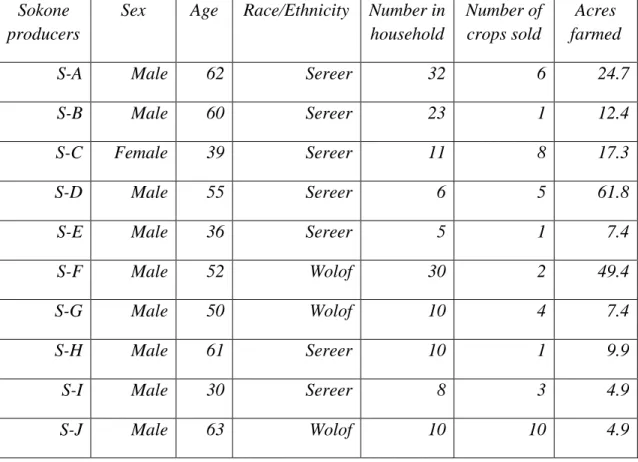
Much of the published literature reveals the potential of local food systems to succeed with producer participation, but there is a limited amount of comparative research literature that studies the successes and challenges of different local food systems with the aim of informing each other. In Sokone, the producers interviewed were mostly men, because although many of the sellers at the market are women, male producers also attend the market to socialize. Many of the respondents reported a large number of people living in their household; it is common for Senegalese men to have more than one wife and several children.
Three of the producers grow only one crop, peanuts, but all the multi-crop producers are vegetable and fruit growers. Essentially, the interview questions examine how segments of the local food systems function in these communities and what their effects are, using a food sovereignty analysis. These two frameworks each contribute to the study, but the food sovereignty perspective contributes a deeper analysis of the respective viability states of the local food systems.
The translator interpreted the producers' responses in French, which I am familiar with, for eight of the interviews. Two of the interviews were done in French as those producers spoke French and could communicate directly with me. The Senegalese portion of this project took place during July 2014 and was funded by a Barksdale award.2 The Cleveland, Mississippi portion was completed during the weekends of the fall 2014 semester with support from the Center for Population Studies at the University of Mississippi.
This was done by recording on copies of the field notes when responses were relevant to any of the three themes. The direction of the recommendations for improvement in this study, from Senegal to Mississippi as well as Mississippi to Senegal, is purposeful. Rarely are developing countries studied to discover what they do successfully, and this is a significant oversight of the current model of globalization.
Additionally, highlighting the success of Mississippi's food system is an important outcome of this project, as the state is also often overlooked as a model for improvement. As a result of this study, the vulnerabilities of both local food systems are revealed, which indicate the areas where local food system development efforts should be focused in order to improve the economic development of the community.
FINDINGS
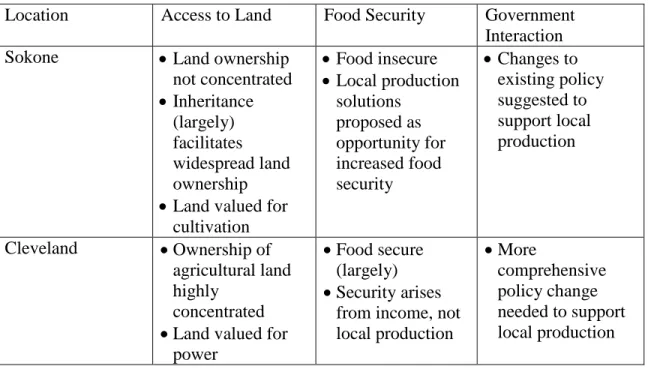
The purchase of land is an important related issue because several of the producers also found that purchasing land was not easy in the community. Satisfaction with land access is also important to study in the community, as only two of the producers interviewed stated that they were satisfied with the amount of land they either rented or farmed. In this way, land ownership is essential for understanding the state of food sovereignty in Sokone and the potential role it plays in the development of the community's local food system.
These descriptions of the benefits of owning land show that he values his land highly for several reasons. Land ownership appeared to be a source of power in this community, but interestingly, none of the farmers specifically mentioned cultivation. None of the producers, however, mentioned the land as an inheritance of more than one generation.
Interestingly, he was one of the producers who said that land ownership was not concentrated, although he wants to own a large amount of land for himself (C-B). In Sokone, only two of the interviewed producers answered positively that their community is food secure. The seven producers who found the Cleveland area to be food secure cited reasons for “American prosperity” (C-D), “government safety nets” (C-G), and that people “are self-sufficient even if stores close” (C-E).
When asked about their contribution to the food security of their families and communities, several producers considered their impact to be positive. Another producer said that grocery stores are an option, but that "a lot of customers in the market have their own garden" (C-D). Therefore, to analyze the real state of the local food system, high levels of food security are not necessarily an indicator of success and of these producers.
Another said the market fees act as a regulation on the farmers and allow “the mayor to take care of the market. By analyzing the farmers' perceptions of the government subsidies, it is clear that the farmers approve of them. Only one said that she was aware of the "Major Offensive" policy because the government will finance farm and food-related projects (S-C).
However, there is indeed a relationship between the market and the government, as some of the market's rules are decided by the government.
DISCUSSION
These changes can also allow farmers to further develop their operations, strengthening the local food system. These themes reveal where local food system development efforts should be focused to foster community economic development through local food systems. Using a food sovereignty lens to analyze these two case studies, the vulnerabilities of these two local food systems become apparent.
Although Cleveland is located in the context of a highly developed country, the lens of food sovereignty reveals how fragile the local food system is. Finally, a food sovereignty lens shows how public policies can influence and potentially improve the development of the local food system in ways that reflect the specific contexts of communities. However, Cleveland's small farmers need a more comprehensive change in public policy that will support the development of the local food system.
In Cleveland, policies that promote food independence could effectively improve the local food system and provide more authentic food security. To promote more authentic and diverse food security that depends on the local food system. However, this study focuses on the experiences of producers, as their participation is essential to establishing local food systems.
By placing political emphasis on food sovereignty as a tool for development and genuine food security, local food systems can flourish and enrich rural areas. These comprehensive benefits of local food systems make them a viable option for socio-economic development. This study thus contributes to the existing food systems literature by addressing the role that food sovereignty can play at the local level in assisting local food systems development.
Furthermore, using a food sovereignty framework more fully reveals the strengths and weaknesses of local food systems than a food security framework. Now that these vulnerabilities have been identified, the food sovereignty framework can guide efforts to develop local food systems that meet the needs of the producers who sustain them.