Pertama-tama mari kita panjatkan puji syukur kehadirat Allah SWT, Tuhan Yang Maha Esa. Karena rahmat dan bimbingan-Nya, kami dapat menghadiri Seminar Nasional Keanekaragaman Hayati Tanah-I di Hotel Marcopolo. Seminar Nasional Keanekaragaman Hayati Tanah-I mengangkat tema “Pengelolaan Keanekaragaman Hayati Tanah untuk Mendukung Keberlanjutan Produksi Pertanian Tropis”.
PERAN PENGELOLAAN TANAH DALAM
Jurusan Hama dan Penyakit Tumbuhan Fakultas Pertanian UNHAS Makassar 90245
Ulat (Agrotis ipsilon Hufn) merupakan hama yang sering menjadi permasalahan dalam budidaya tomat (Sastrosiswojo dan Setiawati, 1993). Di setiap lokasi diambil 3 sampel yaitu tanah kolong sampah, rumput dan singkong masing-masing berukuran 1 meter x 1 meter dan digali sedalam 30 cm. Tanah di bawah rumput dan singkong kaya akan bahan organik, meski tidak terlalu beragam.
Dari masing-masing lokasi yaitu tanah bekas limbah, rumput dan tanaman singkong diambil 3 contoh tanah masing-masing berukuran 1 m x 1 m, digali sedalam 30 cm. Kelabang tidak ditemukan pada seluruh tanah di bawah tanaman singkong, hanya ditemukan satu sampel kelabang. Tanah di bawah tanaman rumput dan singkong relatif miskin bahan organik, hanya satu atau dua jenis bahan organik.
Tanah di bawah limbah mempunyai keanekaragaman paling tinggi, disusul tanah di bawah singkong dan tanah di bawah rumput. Lingkungan yang sesuai dan ketersediaan makanan (bahan organik) yang melimpah mendukung kehidupan arthropoda di antara detritus.
Sampling
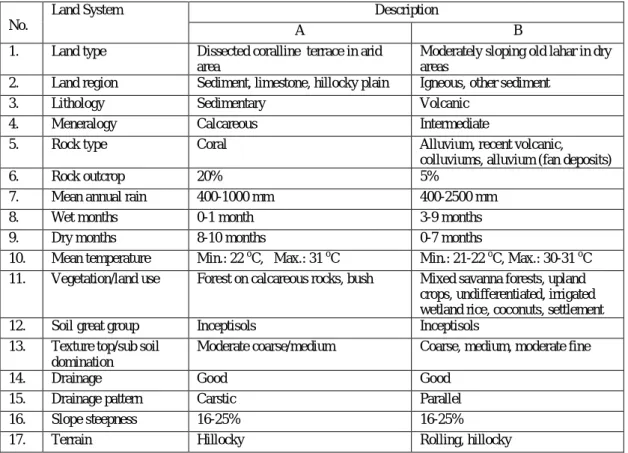
74 untuk wilayah desa Pemongkong kecamatan Jerowaru kabupaten Lombok Timur provinsi Nusa Tenggara Barat. Berada dalam sistem pertanahan BJN dan agroklimat C3 dan termasuk dalam kawasan hutan Gerhan Batu Kemalik I di desa Batu Kemalik kecamatan Penimbung kabupaten Lombok Barat provinsi Nusa Tenggara Barat (lihat Tabel 6).
Study Implementation
Data Analysis
The detailed results of the field observation and the qualitative observation of the environmental condition are presented in Table 1. It is clearly seen in Table 1 that the differences are found in: (1) the vegetation condition and the microclimate and (2) the environmental (soil) condition.
The Vegetation Condition and the Microclimate
A warmer microclimate (soil and air temperature) and soil moisture that is less humid than location B located in the agroclimate zone C3, so that plants do not experience a falling leaf phase in the dry season. Thus, it can be predicted that the percentage of canopy cover level will not change significantly compared to all parts of Site A which are in the extremely dry agroclimatic zone of E4 and where rainfall is unevenly distributed.
The Environmental (Soil) Condition
Sonokeling agroforestry is expected to lead to an increase in air temperature (Table 1) up to the 12 years, followed by a decrease in groundwater content. In addition, the presence of the different understorey vegetation in all parts of sites A and B (Table 1) has a different impact on the amount of litter on the soil surface.
Soil Physical Properties
Considering the overall satisfaction aspect expressed in DMR, the combined 10-year-old Sengon and Nimba agroforestry location gives the highest DMR which is 5.89. It is related to the textural condition of the soil, especially the high percentage of clay fraction, which is 35.9%. On the contrary, the lowest aggregate stability (2.53) was found in the 12-year-old Sonokeling agroforestry site.
This is due to the soil texture dominated by the sand fraction, which is 79.2%, which means that the soil is more porous with a porosity of 70.57%. The result of the water availability measurement indicates that the highest water availability was found in the combined 10-year-old Sengon and Nimba agroforestry location, which is 17.66%. Although the 12-year-old Sonokeling agroforestry has the highest porosity (70.75%), it has the lowest water availability, which is 8.60%.
The Soil Chemical Properties
Meanwhile, most of the organic materials in the 8-year-old Nimba agroforestry soil have further decomposed. The lowest organic content is found under 12-year-old Sonokeling agroforestry stands, which is 1.5%. The data in Table 5 also show that the highest Ntotal soil was found in the combined 10-year-old Sengon and Nimba agroforestry site.
In addition, the soil microorganism uses a large amount of N for its survival (Fisher and Binkley, 2000). 82 are 18 and 17 families of the macroarthropods were found in the 8-year-old Nimba agroforestry and combined 10-year-old Sengon and Nimba agroforestry, respectively. The results of the analysis of the debris fall in the locations of the study are presented in Table 8.
The results of the correlation analysis between macroarthropod diversity (population abundance) and litter quality (inorganic, Ntotal, C/N ratio, Lignin and Polyphenol) show that there is a highly significant correlation between macroarthropod population abundance at the Sengon agroforestry site 7 years old (A1) with its waste polyphenol content R2(adj) = 0.78**. The results of the 12-year Sonokeling agroforestry site correlation analysis show that macroarthropod abundance is inversely correlated with the C/N ratio (r = -0.82*).
The Dominan Macroarthropod Composition
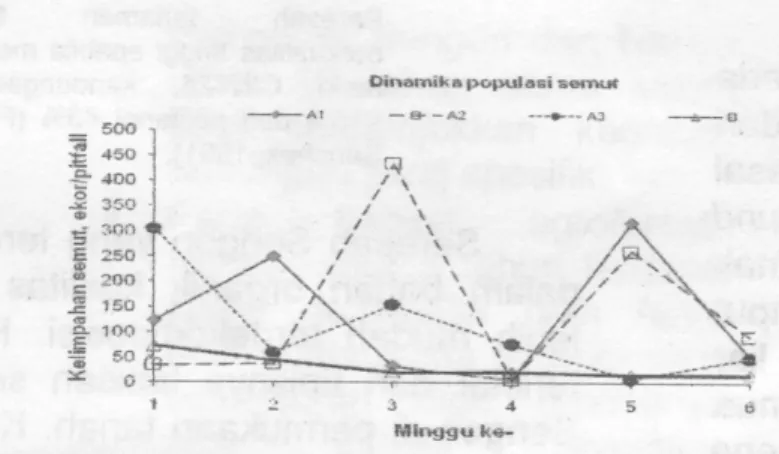
It shows that the polyphenol content of litter plays an important role in determining the abundance of the macroarthropod population at site A1. It means that most of the macroarthropods found in the sites do not prefer residues with high C/N ratio. Weekly observation of ant dynamics in each of the study locations.
The total number of families is higher than that found in the combined 10-year-old Sengon and Nimba agroforestry location, which is 17 with H'= 0.30. The average soil temperature in all parts of site A can generally be considered to be relatively even. The average soil temperature in the 10-year-old Sonokeling agroforestry site is lower (2-3 oC) than in all parts of site A.
Meanwhile, the measured soil moisture content of all parts of location A is in the range of 5-9%. Also the presence of the difference in the understorey vegetation is expected to affect the soil moisture.

The Organic Material Source
The low quality organic materials with the following criteria: C/N ratio > 25%, Lignin > 15% and Polyphenol > 3% (Palm and Sanches, 1991) will degrade more slowly. In addition to the quality of the organic materials, another determinant of decomposition rate is the activities of decomposing organisms (Swift et. al., 1979; Tian, 1992).
Conclusion
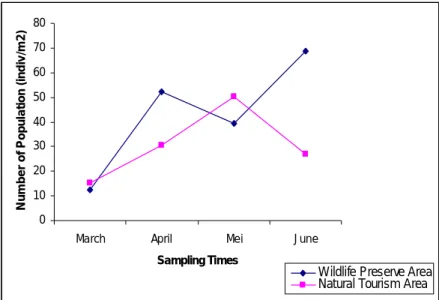
This study was conducted to study the abundance and diversity of benthic fauna including arthropods (insects, arachnids and spiders) and earthworms in response to the ecosystem change from nature reserve to tourism area in Telaga Warna. For comparison, benthic fauna was also taken from another location in Bogor, namely Situgede, Darmaga. The ecosystem changes from nature reserve to tourist area influenced the decline of the benthic fauna population, although benthic fauna diversity was slightly greater in the tourist area than in the nature reserve area.
At Situgede, the diversity of soil fauna was reduced in the home garden compared to the forest, although their abundance was higher in the home garden. This study aimed to study the abundance and diversity of soil fauna including arthropods (insects, arachnids and spiders) and earthworms in response to ecosystem change by wildlife conservation in the tourist area in Telaga Warna, Bogor. As a comparison, this study also assessed the abundance and diversity of soil fauna in different locations, namely forest and home garden ecosystems in Situgede, Darmaga.
So far, little work has been done on benthic fauna population and diversity in Telaga Warna Nature Reserve. Therefore, it was expected that the data obtained from this study would provide a general overview of the potency of benthic fauna diversity and their abundance in Telaga Warna Nature Reserve, but such data are still not available so far.
Soil Sampling
It is very important to preserve and conserve the variety of flora and fauna in Telaga Warna in order to preserve its underground biodiversity. Sustainable management of belowground biodiversity will increase the resilience and resilience of ecosystems and help conserve soil genetic resources. Soil fauna inventory information is also expected to be used as a consideration in environmental management and conservation, ecosystem health improvement, and ecosystem improvement.
Soil fauna were collected with a 20 cm diameter soil corer to a depth of 0-15 cm (Meyer 1996) from three randomly selected points along 50 m of each sampling line, so that 15 soil samples were collected from each location.
Extraction of Soil Fauna
Where ni is the number of individuals belonging to one of the S species (or groups of animals) in the sample and n is the total number of individuals in the sample.
Statistical Analyses
Keberadaan Collembola dipengaruhi oleh struktur tanah dan kandungan bahan organik tanah. 1983), di lahan pertanian jumlah penduduk Collembola mencapai 54%. Pengaruh umur dan jarak dari pusat perakaran jagung (Zea mays L.) terhadap jumlah mesofauna tanah (Trans √√x). Jumlah mesofauna tanah tidak hanya dipengaruhi oleh umur tanaman jagung, tetapi juga oleh jarak dari pusat akar.
Ringkasan analisis keanekaragaman mesofauna tanah pada berbagai umur dan jarak dari pusat perakaran jagung (Zea mays L.). Pada penelitian ini kandungan air tanah (± 19%) tergolong tinggi sehingga diduga hanya beberapa jenis mesofauna tanah yang mampu bertahan pada kondisi tersebut. Dari hasil uji korelasi (Tabel 5), kelimpahan mesofauna tanah berkorelasi positif terhadap pH tanah. 2000) menyatakan terjadi penurunan pH seiring bertambahnya jarak dari pusat akar.
Keanekaragaman mesofauna tanah tidak dipengaruhi oleh umur dan jarak dari pusat perakaran jagung atau interaksi antara keduanya. Dinamika populasi mesofauna tanah terjadi pada umur dan jarak yang berbeda-beda dari pusat perakaran tanaman jagung. Pengaruh penerapan teknik pengolahan tanah dengan herbisida isopropilamina glifosfat dan kadar nitrogen terhadap populasi cacing tanah dan mesofauna tanah di lahan kering Hajimena.
Kelimpahan seluruh individu nematoda pada lahan jagung dengan tiga sistem pengolahan tanah yang berbeda (T1 = pengolahan tanah konvensional, T2 = tanpa pengolahan tanah dengan mulsa jagung, dan T3.. tanpa pengolahan tanah dengan mulsa jagung dan kacang hijau), ns = tidak nyata dengan uji LSD pada umur 5 % tingkat signifikansi.