U R T H E D I T I O N
RESEARCH
FOR THE SOCIAL
SCIENCES ..,.
i i i i i i ,• .: ;;
L. BERG
FOURTH EDITION
• • • • • Illl I wwffMttiMf'fiVliainin-i-nTwiTii imrmTBUfirritTTiiu ,„, , „„ „
QUALITATIVE RESEARCH METHODS FOR THE SOCIAL SCIENCES
BRUCE L. BERG
California State University, Long Beach
ALLYN AND BACON oston • London • Toronto • Sydney • Tokyo • Singapore
Series Editor: Sarah L. Kelbaugh
Editor in Chief, Social Sciences: Karen Hanson Editorial Assistant: Lori Flickinger
Editorial-Production Administrator: Annette Joseph Editorial-Production Coordinator: Susan Freese
Editorial-Production Service and Electronic Composition: Karen Mason Composition Buyer: Linda Cox
Manufacturing Buyer: Julie McNeill Cover Administrator: Jenny Hart Cover Designer: Suzanne Harbison
CONTENTS
(Copyright © 2001,1998,1995,1989 by Allyn & Bacon A Pearson Education Company
160 Gould Street
Needham Heights, MA 02494 Internet: www.abacon.com
AH rights reserved. No part of the material protected by this copyright notice may be reproduced or utilized in any form or by any means, electronic or mechanical, including photocopying, recording, or by any information storage and retrieval system, without the written permission of the copyright owner.
Between the time website information is gathered and then published, it is not unusual for some sites to have closed. Also, the transcription of URLs can result in unintended typographical errors. The publisher would appreciate being notified of any problems with URLs so that they may be corrected in subsequent editions.
Thank you.
Library of Congress Cataloging-in-Publication Data Berg, Bruce Lawrence
Qualitative research methods for the social sciences / Bruce L. Berg. —- 4th ed.
p. cm.
Includes bibliographical references and index.
ISBN 0-205-31847-9
1. Social sciences—Research—Methodology. I. Title H61 .B4715 2000
300'.7'2—dc21
Printed in the United States of America 10 9 8 7 6 5 4 05 04 03 02
00-023770
Preface xiii
CHAPTER 1 Introduction 1
QUANTITATIVE VERSUS QUALITATIVE SCHOOLS OF THOUGHT 2 USE OF TRIANGULATION RESEARCH METHODOLOGY 4
QUALITATIVE STRATEGIES: DEFINING AN ORIENTATION 6 FROM A SYMBOLIC INTERACTIONS PERSPECTIVE 8 WHY USE QUALITATIVE METHODS? 10
A PLAN OF PRESENTATION 11 REFERENCES 12
CHAPTER 2
Designing Qualitative Research 15
THEORY AND CONCEPTS 15 IDEAS AND THEORY 16 LITERATURE REVIEW 19
The Two-Card Method 21 FRAMING RESEARCH PROBLEMS 24
OPERATIONALIZATION AND CONCEPTUALIZATION 25 DESIGNING PROJECTS 28
Setting and Population Appropriateness 29 Sampling Strategies 30
DATA COLLECTION AND ORGANIZATION 33 Data Storage, Retrieval, and Analysis 35 DISSEMINATION 36
IV CONTENTS CONTENTS
TRYING IT OUT 37 REFERENCES 37
CHAPTER 3 Ethical Issues 39
RESEARCH ETHICS IN HISTORICAL PERSPECTIVE 40 FROM GUIDELINES TO LAW: REGULATIONS
ON THE RESEARCH PROCESS 44
INSTITUTIONAL REVIEW BOARDS (IRBs) 45 IRBs and Their Duties 46
Clarifying the Role of IRBs 48 Active versus Passive Consent 50 Membership Criteria for IRBs 51 ETHICAL CODES 52
SOME COMMON ETHICAL CONCERNS IN BEHAVIORAL RESEARCH 53 PHYSICAL AND ETHICAL DANGERS IN COVERT RESEARCH 54 INFORMED CONSENT AND IMPLIED CONSENT 56
CONFIDENTIALITY AND ANONYMITY 57 Keeping Identifying Records 58
Strategies for Safeguarding Confidentiality 58 SECURING THE DATA 59
OBJECTIVITY AND CAREFUL RESEARCH DESIGN 60 TRYING IT OUT 62
REFERENCES 63
CHAPTER 4
A Dramaturgical L°o k at Interviewing 66 DRAMATURGY AND INTERVIEWING 67 TYPES OF INTERVIEWS 68
The standardized Interview 69 The Unstandardized Interview 69
The Semistandardized Interview 70 THE INTERVIEW SCHEDULE 72
SCHEDULE DEVELOPMENT 74
Question Order, Content, and Style 74 COMMUNICATING EFFECTIVELY 77
A FEW COMMON PROBLEMS IN QUESTION FORMULATION Affectively Worded Questions 78
The Double-Barreled Question 79 Complex Questions 79
Question Sequencing 79 PRETESTING THE SCHEDULE 80 LONG VERSUS SHORT INTERVIEWS 80 TELEPHONE INTERVIEWS 82
CONDUCTING AN INTERVIEW: A NATURAL OR AN UNNATURAL COMMUNICATION? 84 THE DRAMATURGICAL INTERVIEW 85
Interviewer Roles and Rapport 86
The Interviewer as a Self-Conscious Performer 89 Social Interpretations and the Interviewer 90 THE INTERVIEWER'S REPERTOIRE 93
Interviewers' Attitudes and Persuading a Subject 95 Developing an Interviewer Repertoire 96
Techniques to Get New Researchers Started 97 Taking the Show on the Road 98
The Ten Commandments of Interviewing 99 KNOW YOUR AUDIENCE 100
Curtain Calls 101
ANALYZING DATA OBTAINED FROM THE DRAMATURGICAL INTERVIEW 102
Beginning an Analysis 103 Systematic Filing Systems 103 Short-Answer Sheets 105
Analysis Procedures: A Concluding Remark 105 TRYING IT OUT 105
NOTES 107 REFERENCES 107
78
VI CONTENTS CONTENTS V l l
CHAPTER 5
Focus Group Interviewing 111
WHAT ARE FOCUS GROUP INTERVIEWS? I l l
THE EVOLUTION OF FOCUS GROUP INTERVIEWS 112 ADVANTAGES AND DISADVANTAGES OF
FOCUS GROUP INTERVIEWING 114
Focus Group Interviewing and Face-to-Face Interviewing 115 Focus Group Interviewing and Participant Observation 117 Focus Group Interviewing and Unobtrusive Measures 118 FACILITATING FOCUS GROUPS DYNAMICS:
HOW FOCUS GROUPS WORK 120 THE MODERATOR'S GUIDE 121
Introduction and Introductory Activities 121
Statement of the Basic Rules or Guidelines for the Interview 122 Short Question-and-Answer Discussions 122
Special Activities or Exercises 122
Guidance for Dealing with Sensitive Issues 123 BASIC INGREDIENTS IN FOCUS GROUPS 123
CONFIDENTIALITY AND FOCUS GROUP INTERVIEWS 127 RECENT TRENDS IN FOCUS GROUPS 129
CONCLUSION 130 TRYING IT OUT 130 NOTES 130
REFERENCES 131
CHAPTER 6
Ethnographic Field Strategies 133
ACCESSING A FIELD SETTING: GETTING IN 136 REFLECTIVITY AND ETHNOGRAPHY 139
The Attitude of the Ethnographer 139 The Researcher's Voice 140
Gaining Entry 144
BECOMING INVISIBLE 147 Dangers of Invisibility 148
A New Problem in Data Protection: The Case of Mario Brajuha 150 OTHER DANGERS DURING ETHNOGRAPHIC RESEARCH 151
WATCHING, LISTENING, AND LEARNING 153 How to Learn: What to Watch and Listen For 155 Field Notes 158
Analyzing Ethnographic Data 164
OTHER ANALYSIS STRATEGIES: TYPOLOGIES, SOCIOGRAMS, AND METAPHORS 165
Typologies 166 Sociograms 167 Metaphors 171
DISENGAGING: GETTING OUT 171 TRYING IT OUT 173
NOTE 173 REFERENCES 173
CHAPTER 7
Action Research 178
THE BASICS OF ACTION RESEARCH 180
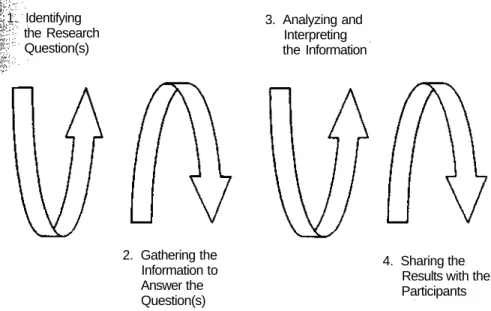
IDENTIFYING THE RESEARCH QUESTION(S) 181
GATHERING THE INFORMATION TO ANSWER THE QUESTION(S) 182 ANALYZING AND INTERPRETING THE INFORMATION 182
Procedures for Using Interview and Ethnographic Data 183 Guiding Questions of Analysis:
Why, What, How, Who, Where, When? 183 Descriptive Accounts and Reports 184
SHARING THE RESULTS WITH THE PARTICIPANTS 184 THE ACTION RESEARCHER'S ROLE 185
TYPES OF ACTION RESEARCH 185
Technical/Scientific/Collaborative Mode 186
A Practical/Mutual Collaborative/Deliberate Mode 186
V l l l CONTENTS CONTENTS IX
Emancipating/Enhancing/Critical Science Mode 187 TRYING IT OUT 187
REFERENCES 188
CHAPTER 8
Unobtrusive Measures in Research 189 ARCHIVAL STRATEGIES 190
Public Archives 191
Private Archives: Solicited and Unsolicited Documents 200 A Last Remark about Archival Records 203
PHYSICAL EROSION AND ACCRETION:
HUMAN TRACES AS DATA SOURCES 203 Erosion Measures 203
Accretion Measures 204
Some Final Remarks about Physical Traces 205 TRYING IT OUT 206
REFERENCES 207
CHAPTER 9
Historiography and Oral Traditions 210
WHAT IS HISTORICAL RESEARCH? 210 LIFE HISTORIES AND HISTORIOGRAPHY 213 WHAT ARE THE SOURCES OF DATA OF
HISTORICAL RESEARCHERS? 214 DOING HISTORIOGRAPHY:
TRACING WRITTEN HISTORY AS DATA 214 External Criticism 216
Internal Criticism 218 WHAT ARE ORAL HISTORIES? 219 TRYING IT OUT 222
REFERENCES 222
CHAPTER 10 Case Studies 225
THE NATURE OF CASE STUDIES 225 THE INDIVIDUAL CASE STUDY 226
The Use of Interview Data 226 The Use of Personal Documents 227
INTRINSIC, INSTRUMENTAL, AND COLLECTIVE CASE STUDIES 229 CASE STUDY DESIGN TYPES 229
Exploratory Case Studies 230 Explanatory Case Studies 230 Descriptive Case Studies 230
THE SCIENTIFIC BENEFIT OF CASE STUDIES 231 Objectivity and the Case Method 231 Generalizability 232
CASE STUDIES OF ORGANIZATIONS 233 CASE STUDIES OF COMMUNITIES 233
Data Collection for Community Case Studies 234 Community Groups and Interests 235
TRYING IT OUT 236 REFERENCES 236
CHAPTER 11
An Introduction to Content Analysis 238
ANALYSIS OF QUALITATIVE DATA 238 Interpretative Approaches 239
Social Anthropological Approaches 239 Collaborative Social Research Approaches 240 CONTENT ANALYSIS AS A TECHNIQUE 240
241 CONTENT ANALYSIS: QUANTITATIVE OR QUALITATIVE?
Manifest versus Latent Content Analysis 242
Blending Manifest and Latent Content Analysis Strategies 243
CONTENTS CONTENTS
COMMUNICATION COMPONENTS 243
WHAT TO COUNT: LEVELS AND UNITS OF ANALYSIS 244 CATEGORY DEVELOPMENT: BUILDING GROUNDED THEORY
What to Count 246
Combinations of Elements 247 Units and Categories 248 Classes and Categories 250 OPEN CODING 251
CODING FRAMES 253
A Few More Words on Analytic Induction 255 Interrogative Hypothesis Testing 256
STRENGTHS AND WEAKNESSES OF THE CONTENT ANALYSIS PROCESS 258
COMPUTERS AND QUALITATIVE ANALYSIS 259 Word Processors 261
Text Retrievers 261 Textbase Managers 261
Code-and-Retrieve Programs 262 Code-Based Theory Builders 262 Conceptual Network Builders 262
QUALITATIVE RESEARCH AT THE SPEED OF LIGHT 263 TRYING IT OUT 265
REFERENCES 265
245
Findings or Results 276 Discussion/Conclusion 277
References, Notes, and Appendices 278 PRESENTING RESEARCH MATERIAL 280
Disseminating the Research:
Professional Meetings and Publications 280
A WORD ABOUT THE CONTENT OF PAPERS AND ARTICLES 284 WRITE IT, REWRITE IT, THEN WRITE IT AGAIN! 284
A FINAL NOTE 286 NOTES 287 REFERENCES 287
Name Index 289 Subject Index 296
CHAPTER 12
Writing Research Papers: Sorting the Noodles from the Soup 268
IDENTIFYING THE PURPOSE OF THE WRITING:
ARRANGING THE NOODLES 268
DELINEATING A SUPPORTIVE STRUCTURE:
VISUAL SIGNALS FOR THE READER 269 The Abstract 271
The Introduction 273 Literature Review 273 Methodology 275
PREFACE
• • • • — MMIWMBMMM— —W | •••••••••••mfll
In this, the fourth edition of Qualitative Research Methods for the Social Sciences, my goal remains identical to that of previous editions: to offer a handbook for any- one interested in but unfamiliar with qualitative research methods. I continue to envision that this book will be used along with more general quantitative texts traditionally used in a research methods course as well as a stand-alone core text in courses on qualitative methods. Since the 1980s, the social sciences have developed a much more encompassing orientation toward research and have embraced qualitative techniques and texts in general research courses. This book, as a supplement to other methods texts, offers students a basic look at qualitative research techniques and analytic strategies in a clear-cut fashion. As a stand-alone text, Qualitative Research Methods for the Social Sciences offers stu- dents a solid grounding in many of the mainstream orientations commonly used in qualitative research today.
In this edition, I have revised material in the text and focused greater attention on methodological rigor. The research style presented in this edition remains chiefly sociological. The application of data-gathering and data- analytic strategies, however, is not designed exclusively for students of soci- ology or for sociologists. In fact, an increasing number of my readers have come from the disciplines of English, nursing, education, social work, and business, besides the more traditional social sciences such as psychology, anthropology, and criminology.
The book's central purpose remains a desire to instruct inexperienced researchers in ways of effectively collecting, organizing, and making sense from qualitative data. This edition also seeks to demystify the research process.
I believe that what makes the research process frightening for many is a fear of the unknown. When novice researchers learn how a process or technique works, it becomes comfortable, relaxed, and dare I say it—easy!
In keeping with my general pedagogical style, this edition of the book moves readers beyond the point of collecting data without knowing what to do with it. The goal is to get fledgling researchers to design, collect, and analyze data and then to present their results to the scientific community. This fourth edition continues to focus on current issues in the world of researchers, which include a serious concern about ethical behavior and protocols in research and a more reflexive and sensitive role for the researcher. Unlike many research texts, which place ethics in the last chapter, creating the subliminal image of ethics being less important than other elements in research, I have placed the discussion of ethics in the third chapter. My intention in doing so is to impress upon new researchers the importance of ethical concerns before they actually begin the research collection, organization, and analytic processes.
Y i n
XIV PREFACE PREFACE XV
As in previous editions of this book, I emphasize a more reflexive researcher role and recognize the benefits of this orientation. In several places throughout this text, researcher reflexivity and researcher voice are explained and discussed. In fact, the use of the first person (I, my, etc.), which I began using in the second edition of this book, is a small example of my more reflex- ive researcher's role and voice. The orientation offered in this text does not fully embrace all elements of reflexivity but discusses several of the basic ele- ments associated with this position. This is particularly true in the newly added Chapter 7, Action Research, which discusses how the researcher may collaborate with shareholding subjects in the research.
As something of a traditionalist, I continue to believe that researchers learn their craft through a combination of trial and error and "getting their hands dirty" with data. I also believe this process works best when guided by a more experienced researcher—a mentor. Yet even this approach works more effectively when the apprentice has a firm understanding of the basic elements of the research process. This book is designed especially for accom- plishing this purpose.
As has been true in each of the previous editions of this book, my per- sonal bias as a symbolic interactionist guides my choices and explanations.
Once again, I admit that all the techniques presented have been grounded in that theoretical approach. However, I continue to believe that the various techniques and strategies offered in this book can be equally effective when grounded in other theoretical perspectives. Inexperienced researchers should thus take my presentation as suggestions and recommendations toward establishing a research foundation and not as the only methodological orien- tation available to them.
Finally, it is my deepest hope that after reading this book, students will think about research in a positive and even playful manner. Research can be extremely enjoyable when undertaken in the proper frame of mind. Even a trip to Disneyland can be ruined if you focus too much on the costs, the congested traffic, or the long lines. Many people go to Disneyland and never even notice these inconveniences. Research can be like a trip to Disneyland: It can be excit- ing, interesting, and rewarding. But first, you must open your heart and mind to the research process.
I am also grateful to Kristen Esterberg, University of Massachusetts at Lowell; Daniel J. Klenow, North Dakota State University; Stephen Sweet, Cor- nell University; and Jean Thoresen, Eastern Connecticut State University—
readers and users of this book who provided constructive criticism as I set about revising this fourth edition. I remain indebted to Peter Adler, University of Denver; Robert Benford, University of Nebraska; Thomas G. Bloomberg, Florida State University; and James A. Pearsol, The Ohio State University, who reviewed earlier drafts of this book for Allyn and Bacon. Finally, I would like to thank Walter DeKeseredy, who for the past several editions has quietly offered me insightful constructive criticism.
ACKNOWLEDGMENTS
My thanks go to my family: my wife, Jill, and our two children, Kate and Alex. Their ongoing support while writing this and other projects—as well as in life—give me sustenance and strength. I continue to owe a debt of grati- tude to my students, who provide regular feedback on material in this book and keep me grounded. I thank them again for their honesty, their patience, and their instruction.
CHAPTER 1
• • • • • ii'iiiiiiiiiiiiiiiiiiiinriniiiiiiii • I I I I I I I I I I I I B I I I I I I I I I I I I I I I I niiininiiiiiiiii
INTRODUCTION
Many books discuss a variety of social scientific research methods; thus, you may reasonably question why anyone would bother writing another text.
However, a close examination reveals that although a great many texts have been written about such abstract concerns as research design and sophisti- cated statistical procedures for tabulating quantitative data, few books have concentrated on how to do qualitative research and analysis.
Several fundamental texts were in vogue during the late 1960s and 1970s, but now many of these classic qualitative texts have been permitted to go out of print (such as Becker, 1970; Bogdan, 1972; Bogdan & Taylor, 1975;
Denzin, 1978; Filstead, 1970; Glaser & Strauss, 1967; Schwartz & Jacobs, 1979;
Webb et al., 1966,1981). During the 1980s, several publishers began pressing books with qualitative orientations. Sage Publishing is responsible for a great many of these works. For example, they developed a string of short works called the Sage University Papers Series on Qualitative Research Methods. By 1989, the year the first edition of this text was published by Allyn and Bacon, Sage had published 16 books in their Qualitative Research Series. Also in 1989, Sage came out with several slightly lengthier works on qualitative methods in their Applied Social Research Methods Series (e.g., Denzin, 1989; Fetterman, 1989; Jorgensen, 1989).
A flutter of other qualitative reference works on methods arose during the 1980s (e.g., Berg, 1989; Kirby & McKenna, 1989; Strauss & Corbin, 1989;
Van Maanen, 1988). Yet, even with these spurts of qualitative research mater- ial, a decided imbalance remains in the literature on research methods in the academic community. While many quantitatively oriented research texts are published each year, only a few qualitative textbooks are available.
Ethnography saw a resurgence of sorts during the early 1980s, espe- cially among educational researchers (e.g., Bogdan & Biklen, 1982; Bredo &
Feinberg, 1982; Dobbert, 1982; Spindler, 1982). However, often these books, like those published in the various Sage series, were limited to single tech- niques. In 1987, Anselm Strauss produced an excellent text on qualitative analysis, and by the 1990s, an increased number of qualitative handbooks and sourcebooks became available. Some of the more notable ones included
CHAPTER ONE INTRODUCTION
Denzin and Lincoln (1994), Miles and Huberman (1994), and Weitzman and Miles (1995). Yet, many of these begin with the tacit assumption that data already have been collected or that the researcher at least knows how to go about the task of gathering data.
In contrast, this text focuses on innovative ways of collecting and analyz- ing qualitative data from natural settings, which are characterized by main- stream strategies, even though various dynamic—perhaps even radical—qual- itative innovations have emerged during the past several decades. But rather than offering glossy definitions for these strategies or confusing novice researchers with simplified versions, this text concentrates on basic procedures.
QUANTITATIVE VERSUS QUALITATIVE SCHOOLS OF THOUGHT
As Dabbs (1982) remarks, "Qualitative and quantitative are not distinct." Yet in many social sciences, quantitative orientations are often given more respect. This may reflect the tendency of the general public to regard science as related to numbers and implying precision. It is not the purpose of this text to argue against quantitative procedures; it is, instead, to demonstrate the fruitfulness and, often, the greater depth of understanding we can derive from qualitative procedures. Thus, the orientation of this book does not entirely either embrace or reject Kaplan's (1964, p. 206) statement that "if you can measure it, that ain't it!"
Certainly, qualitative methodologies have not predominated in the social sciences. After all, qualitative research takes much longer, requires greater clarity of goals during design stages, and cannot be analyzed by run- ning computer programs. Qualitative research methods and analytic strate- gies are not associated with high-tech society in the ways quantitative tech- niques may be. Nonetheless, as Bogdan (1972) makes clear, qualitative research has left its mark conceptually and theoretically on the social sciences.
The lasting contributions to social understanding from qualitative research, as well as the sheer number of contributing social thinkers, are significant.
Even though the virtue of qualitative research is seldom questioned in the abstract, its practice is sometimes criticized for being nonscientific and thus invalid. However, these critics tended to lose sight of the probability fac- tor inherent in quantitative practices and replaced it with an assumption of certainty. Of course, some qualitative research projects have been just as poorly conducted as have some quantitative studies, but one need not dis- miss the entire qualitative school of thought just because some studies inad- equately applied the paradigm and methods.
In his attempt to differentiate between quantitative and qualitative approaches, Dabbs (1982, p. 32) indicates that the notion of quality is essential to the nature of things. On the other hand, quantity is elementally an amount
of something. Quality refers to the what, how, when, and where of a t h i n g - its essence and ambience. Qualitative research thus refers to the meanings, concepts, definitions, characteristics, metaphors, symbols, and descriptions of things. In contrast, quantitative research refers to counts and measures of things. This distinction is illustrated in Jackson's (1968) description of class- room odors in an elementary school:
[The] odors of the classroom are fairly standardized. Schools may use different brands of wax and cleaning fluid, but they all seem to contain similar ingredi- ents, a sort of universal smell which creates an aromatic background that per- meates the entire building. Added to this, in each classroom, is the slightly acrid scent of chalk dust and the faint hint of fresh wood pencil shavings. In some rooms, especially at lunch time, there is the familiar odor of orange peels and peanut butter sandwiches, a blend that mingles in the late afternoon (following recess) with the delicate pungency of children's perspiration.
It would be impossible to capture the odors that Jackson alludes to with any type of count or measure. Clearly, certain experiences cannot be meaningfully expressed by numbers. Further, such things as smells can trigger memories long obscured by the continuing demands of life. Qualitative research strate- gies provide perspectives that can prompt recall of these common or half- forgotten sights, sounds, and smells.
Some authors associate qualitative research with the single technique of participant observation. Other writers extend their understanding of qualita- tive research to include interviewing as well. However, popular qualitative research additionally includes such methods as observation of experimental natural settings, photographic techniques (including videotaping), historical analysis (historiography), document and textual analysis, sociometry, socio- drama and similar ethnomethodological experimentation, ethnographic research, and a number of unobtrusive techniques.
American colleges have become pragmatic places where students train to get jobs rather than to obtain educations. As a consequence, students and graduates of social science programs increasingly use the research of others and/or conduct research themselves. Thus, students must confront the myr- iad problems associated with understanding empirical results as well as the process of research itself. This book provides much needed assistance for all researchers, including the inexperienced, through a discussion of various qualitative research strategies, design development, data organization and presentation, and analysis procedures.
Like other texts on qualitative methods, this one emphasizes method- ological strategies. However, methodology cannot be examined in a vacuum.
Instead, the core substance of qualitative sociological practice, including methods, theory, and substantive interests, has to be explored (Bogdan &
Taylor, 1975; Denzin, 1978; Lofland & Lofland, 1984; Miles & Huberman,
CHAPTER ONE INTRODUCTION
1994). In this text, data-gathering techniques are intentionally coupled with theoretical perspectives, linking method to theory. Data gathering, therefore, is not distinct from theoretical orientations. Rather, data are intricately asso- ciated with the motivation for choosing a given subject, the conduct of the study, and ultimately the analysis.
Advocates of such particular methodological styles of research as partic- ipant observation are frequently more concerned with asserting or defending their techniques than with indicating alternative ways of approaching the study subject. In contrast, this book describes in detail seven primary ways to collect qualitative data: interviewing, focus groups, ethnography, sociometry, unobtrusive measures, historiography, and case studies. These action research include an examination of the basic theoretical assumptions of each technique and advice on how to start each procedure and how to resolve problems that may arise. In addition, the technique of content analysis is related to grounded theory and the use of narrative ethnographies. This book also considers the ethical dimensions of conducting research on humans.
This fourth edition of Qualitative Research Methods for the Social Sciences begins with the assumption that the reader knows little or nothing about the research process. Chapter 2, therefore, offers a basic description of how to design a research project.
USE OF TRIANGULATION RESEARCH METHODOLOGY
Most researchers have at least one methodological technique they feel most comfortable using, which often becomes their favorite or only approach to research. This might be why many previous qualitative research texts presented only a single research technology (participant observation, interviewing, or unobtrusive measures). Further, many researchers perceive their research method as an atheoretical tool (Denzin, 1978). Because of this, they fail to recog- nize that methods impose certain perspectives on reality. For example, when researchers canvass a neighborhood and arrange interviews with residents to discuss their views of some social problem, a theoretical assumption has already been made—specifically, that reality is fairly constant and stable. Similarly, when they make direct observations of events, researchers assume reality is deeply affected by the actions of all participants, including themselves. Each method thus reveals slightly different facets of the same symbolic reality. Every method is a different line of sight directed toward the same point, observing social and symbolic reality. By combining several lines of sight, researchers obtain a better, more substantive picture of reality; a richer, more complete array of symbols and theoretical concepts; and a means of verifying many of these ele- ments. The use of multiple lines of sight is frequently called triangulation.
Triangulation is a term originally more common in surveying activities, map making, navigation, and military practices. In each case, three known
points or objects are used to draw sighting lines toward an unknown point or object. Usually, these three sighting lines will intersect, forming a small trian- gle called the triangle of error. The best estimate of the true location of the new point or object is the center of the triangle, assuming that the three lines are about equal in error. Although sightings could be done with two sighting lines intersecting at one point, the third line permits a more accurate estimate of the unknown point or object (Berg & Berg, 1993).
Triangulation was first used in the social sciences as a metaphor describ- ing a form of multiple operationalism or convergent validation (Campbell, 1956;
Campbell & Fiske, 1959). In these cases, triangulation was used largely to describe multiple data-collection technologies designed to measure a single con- cept or construct (data triangulation). However, Denzin (1978, p. 292) intro- duced an additional metaphor, lines of action, which characterizes the use of mul- tiple data-collection technologies, multiple theories, multiple researchers, multiple methodologies, or combinations of these four categories of research activities.
For many researchers, triangulation is restricted to the use of multiple data-gathering techniques (usually three) to investigate the same phenome- non. This is interpreted as a means of mutual confirmation of measures and validation of findings flick, 1983; Knafl & Breitmayer, 1989; Leedy, 1993;
Mitchell, 1986; Sohier, 1988; Webb et al., 1981). Fielding and Fielding (1986, p.
31) specifically address this aspect of triangulation. They suggest that the important feature of triangulation is not the simple combination of different kinds of data but the attempt to relate them so as to counteract the threats to validity identified in each.
Denzin (1978) insists that the multiple-methods approach is the generic form of this approach. But triangulation actually represents varieties of data, investigators, theories, and methods. Denzin (1978, p. 295) outlines these four categories as follows:
(1) Data triangulation has three subtypes: (a) time, (b) space, and (c) person. Per- son analysis, in turn, has three levels: (a) aggregate, (b) interactive, and (c) col- lectivity. (2) Investigator triangulation consists of using multiple rather than sin- gle observers of the same object. (3) Theory triangulation consists of using multiple rather than simple perspectives in relation to the same set of objects. (4) Methodological triangulation can entail within-method triangulation and between-method triangulation.
The research literature continues to support Denzin's (1970,1978) recom- mendation to triangulate during research. For example, Goetz and LeCompte (1984) describe its use as a means of refining, broadening, and strengthening conceptual linkages. Borman, LeCompte, and Goetz (1986) similarly stress that triangulation allows researchers to offer perspectives other than their own.
Chava Frankfort-Nachmias and David Nachmias (1996, p. 206) suggest that
^searchers can "minimize the degree of specificity of certain methods to
CHAPTER ONE INTRODUCTION
particular bodies of knowledge," by using "two or more methods of data col- lection to test hypotheses and measure variables; this is the essence of triangu- lation." Unfortunately, the practice of triangulation often does not move much beyond a single theoretical explanation or an alternative hypothesis (Fielding
& Fielding, 1986; Hammersley, 1984). This cursory use of the triangulation strategy fails to capture the essence of what Denzin (1978, p. 28) describes as the
"logic of triangulation":
I conclude that no single method will ever meet the requirements of interaction theory. While participant observation permits the careful recording of situations and selves, it does not offer direct data on the wider spheres of influence acting on those observed. Because each method reveals different aspects of empirical reality, multiple methods of observations must be employed. This is termed triangulation.
In a manner similar to those of Denzin (1978) and Webb et al. (1981), this book stresses several discrete yet intertwined strategies and techniques involved in each of the seven primary research schemes. In fact, the decision to discuss field research strategies under the broad umbrella of ethnography ensures the inclusion of a wide combination of elements, such as direct obser- vation, various types of interviewing (informal, formal, semiformal), listening, document analysis (e.g., letters or newspaper clippings), and ethnomethod- ological experimentation. Spradely (1979) calls this creating "an ethnographic record." Novice researchers are thus instructed in the use of research strategies composed of multiple methods in a single investigation. Denzin (1978, p. 101) also suggests that triangulation includes multiple data-collection procedures, multiple theoretical perspectives, and/or multiple analysis techniques. The use of multiple research-design strategies and theories increases the depth of understanding an investigation can yield (see also Janesick, 1994; Miles &
Huberman, 1983).
QUALITATIVE STRATEGIES:
DEFINING AN ORIENTATION
A simplistic explanation of qualitative techniques might lead researchers to believe in the adequacy of any procedure resulting in nominal rather than numerical sorts of data. Such an assessment, however, fails to appreciate both the theoretical implications of qualitative research and the basic purpose of scientific research in general. We do not conduct research only to amass data.
The purpose of research is to discover answers to questions through the application of systematic procedures.
Qualitative research properly seeks answers to questions by examining various social settings and the individuals who inhabit these settings.
Qualitative researchers, then, are most interested in how humans arrange
themselves and their settings and how inhabitants of these settings make sense of their surroundings through symbols, rituals, social structures, social roles, and so forth.
Research methods on human beings affect how these persons will be viewed (Bogdan & Taylor, 1975). If humans are studied in a symbolically reduced, statistically aggregated fashion, there is a danger that conclusions—
although arithmetically precise—may fail to fit reality (Mills, 1959).
Qualitative procedures provide a means of accessing unquantifiable facts about the actual people researchers observe and talk to or people represented by their personal traces (such as letters, photographs, newspaper accounts, diaries, and so on). As a result, qualitative techniques allow researchers to share in the understandings and perceptions of others and to explore how people structure and give meaning to their daily lives. Researchers using qualitative techniques examine how people learn about and make sense of themselves and others.
As Douglas (1976, p. 12) suggests, the methods used by social scientists fall along a continuum from totally uncontrolled (and perhaps uncontrollable) techniques arising in natural settings to totally controlled techniques of obser- vation. It remains, then, for researchers to choose their procedures keeping in mind the problems that may arise in specific research settings among certain research groups and in unique research circumstances. The analysis of qualita- tive data allows researchers to discuss in detail the various social contours and processes human beings use to create and maintain their social realities.
This is not to suggest that qualitative methods are without methodologi- cal rigor. In fact, good qualitative research can be very rigorous. As will be demonstrated in the chapters that follow, qualitative methods can (and should) be extremely systematic and have the ability to be reproduced by subsequent researchers. Replication and reproducibility, after all, are central to the creation and testing of theories and their acceptance by scientific communities.
In some methodological situations, this may include the use of various descriptive or nonparametric statistics (frequency distributions, proportions, ratios, chi-square, etc.). On the other hand, the orientation presented in this text should not be understood as intentionally promoting stark positivism.
Rather, the intention is to offer an introductory level of information develop- ing and conducting high-quality qualitative research. From my perspective, this means research that can stand the test of subsequent researchers examin- ing the same phenomenon through similar or different methods.
Theoretically, this explanation of the general purpose of qualitative research derives from a symbolic interactionist perspective that is central to the concept of qualitative methodology presented here. Symbolic interaction is an umbrella concept under which a variety of related theoretical orientations may be placed. The theme that unites the diverse elements of symbolic inter- action is the focus on subjective understandings and the perceptions of and about people, symbols, and objects.
8 CHAPTER ONE INTRODUCTION
FROM A SYMBOLIC
INTERACTIONIST PERSPECTIVE
Symbolic interactionism is one of several theoretical schools of thought in the social sciences. It involves a set of related propositions that describe and explain certain aspects of human behavior. Human beings are unique animals.
What humans say and do are the results of how they interpret their social world In other words, human behavior depends on learning rather than bio- logical instinct. Human beings communicate what they learn through sym- bols the most common system of symbols being language. Linguistic symbols amount to arbitrary sounds or physical gestures to which people, by mutual agreement over time, have attached significance or meaning. The core task of symbolic interactionists as researchers, then, is to capture the essence of this process for interpreting or attaching meaning to various symbols.
The substantive basis for symbolic interaction as a theory is frequently attributed to the social behavioral work of Dewey (1930), Cooley (1902), Parks (1915) Mead (1934,1938), and several other early theorists, but Blumer is con- sidered the founder of symbolic interactionism. In fact, he coined the term sym- bolic interaction. In articulating his view of what symbolic interaction is, Blumer (1969) first establishes that human beings account for meaning in two basic ways- First, meaning may be seen as intrinsically attached to an object, event phenomenon, and so on. Second, meaning may be understood as a
"psychical accretion" imposed on objects, events, and the like by people.
Blumer (1969, p. 5) next explains:
Symbolic interactionism . . . does not regard meaning as emanating from the intrinsic makeup of the thing, nor does it see meaning as arising through psy- chological elements between people. The meaning of a thing for a person grows out of the ways in which other persons act toward the person with regard to the thing- Their actions operate to define the thing for the person; thus, symbolic interactionism sees meanings as social products formed through activities of people interacting.
Blumer thereby suggests that meanings derive from the social process of people or groups of people interacting. Meanings allow people to produce various realities that constitute the sensory world (the so-called real world), but because these realities are related to how people create meanings, reality becomes an interpretation of various definitional options. Consequently, as Thomas states, "It is not important whether or not the interpretation is cor-
r e cj . jf men define situations as real, they are real in their consequences"
(Thomas &Swaine, 1928, p. 572).
For instance, the first day of each semester, students walk into their class- room and see someone who appears to be the professor. This supposed profes- sor begins to lecture, distribute syllabi, discuss course requirements, and con-
duct various other traditional first-day activities. Few, if any, students ask to see the professor's credentials. Yet the students, within certain limits, perform their roles as students so long as this professor continues to perform the role of instructor. Suppose that several weeks into the semester, however, the class is notified that the person they assumed to be a professor is really a local dog catcher who has no academic credentials. The question then becomes whether the reality of the classroom experience during the previous weeks is void merely because the dog catcher was incorrectly interpreted as a professor.
Although it would remain to be seen whether any information conveyed by the dog catcher was accurate, certainly, the classroom remained a classroom and students continued to perform their expected roles. From Thomas's perspec- tive, these youths had defined the reality as a class, and it became one for them.
Symbolic interactionists tend to differ slightly among themselves regard- ing the relative significance of various aspects of an interactionist perspective.
Several basic elements, however, tend to bind together even the most diverse symbolic interactionists. First, all interactionists agree that human interactions form the central source of data. Second, there is a general consensus that par- ticipants' perspectives and their ability to take the roles of others (empathy) are key issues in any formulation of a theory of symbolic interaction. Third, inter- actionists agree with Thomas (Thomas & Swaine, 1928) concerning "definitions of a situation": How inhabitants of a setting define their situation determines the nature and meaning of their actions as well as the setting itself.
Objects, people, situations, and events do not in themselves possess meaning. Meaning is conferred on these elements by and through human interaction. For example, the videocassette recorder (VCR) in a college class- room may be defined by the professor as a teaching device to be used for showing educational videos. For the student using a VCR in his or her dor- mitory to view rented movies, this instrument may be seen as a source of entertainment and pleasure, and for the inmate held in a maximum security prison who watches home movies sent from his or her family, it may be con- sidered a window to the outside world. The meanings that people attach to their experiences and the objects and events that make up these experiences are not accidental or unconnected. Both the experiences and the events sur- rounding them are essential to the construction of meanings. To understand behavior, one must first understand the definitions and meanings and the processes by which they have been created. Human behavior does not occur on the basis of predetermined lockstep responses to preset events or situa- tions. Rather, human behavior is an ongoing and negotiated interpretation of objects, events, and situations (Bogdan & Biklen, 1992). For the researcher to understand the meanings that emerge from these interactions, he or she either must enter into the defining process or develop a sufficient apprecia- tion for the process so that understandings can become clear.
Although social roles, institutional structures, rules, norms, goals, and
"te like may provide the raw material with which individuals create their def-
10 CHAPTER ONE INTRODUCTION 1 1
initions, these elements do not by themselves determine what the definitions will be or how individuals will act. In essence, symbolic interactionism empha- sizes social interactions (action with symbolic meaning), negotiation of defini- tions, and emphatic role-taking between humans (Gecas, 1981; Turner, 1978).
WHY USE QUALITATIVE METHODS?
Many researchers believe that the social sciences have depended too much on sterile survey techniques, regardless of whether the technology is appropri- ate for the problem. For instance, nurses, when encouraged to do research at all, are strongly urged to use scientific strategies of quantification over more sociologically or anthropologically oriented ones considered less scientific.
Unfortunately, clinical settings in which nurses are likely to conduct their research fail to meet most quantitative requirements for representativeness and sufficiency of sample size to allow statistically meaningful results.
For instance, let us say the average number of beds in a critical care unit varies between 8 and 12. Even when there are multiple units (such as in a med- ical intensive care unit or a cardiac intensive care unit), typically fewer than 40 cases are available at any given time. With regard to research strategy, such a situation should preclude most quantitative investigations. On the other hand, 40 cases would prove ample for a number of qualitative strategies. In fact, as Chapter 8 describes, a setting such as a hospital would provide researchers with numerous opportunities to implement unobtrusive measures.
It is also important to examine the reasons for the charge that qualita- tive methods are nonscientific. As Schwartz and Jacobs (1979, p. 4) point out,
"There are many, in both qualitative and quantitative sociology, who advo- cate and bask in the value of science." Further, Borman, LeCompte, and Goetz (1986, p. 51) have argued that criticism of qualitative approaches arises out of an "erroneous equation of the term 'empirical' with quantification, rather than with any real defect in the qualitative paradigm itself." Although vari- ous technologies may be used by different researchers, it turns out that every- one is doing science, provided that science is defined as a specific and sys- tematic way of discovering and understanding how social realities arise, operate, and impact on individuals and organizations of individuals.
Scientific researchers may thus emphasize a more positivist view or may be primarily interested in individuals and their so-called life-worlds. In the case of the former, positivists utilize empirical methodologies borrowed from the natural sciences to investigate phenomena. Quantitative strategies serve this positive-science ideal by providing rigorous, reliable, and verifiably large aggregates of data and the statistical testing of empirical hypotheses.
In the case of life-worlds, researchers focus on naturally emerging lan- guages and the meanings individuals assign to experience. Life-worlds include emotions, motivations, symbols and their meanings, empathy, and
other subjective aspects associated with naturally evolving lives of individu- als and groups. These elements may also represent their behavioral routines, experiences, and various conditions affecting these usual routines or natural settings. As Schwartz and Jacobs (1979) suggest, many of these elements are directly observable and as such may be viewed as objective. Nonetheless, cer- tain elements of symbolism, meaning, or understanding usually require con- sideration of the individual's own perceptions and subjective apprehensions.
A PLAN OF PRESENTATION
Having briefly outlined the basic assumptions and qualitative orientations of symbolic interaction, it is now possible to weave in various methodological strategies. Chapter 2 provides the basic information necessary for under- standing the research enterprise. This chapter discusses the research process and proposes a spiraling model to follow when developing a research agenda.
Chapter 2 also offers advice to the novice researcher about how to organize and conduct a literature review.
Chapter 3 considers a number of ethical concerns that are important for new investigators to understand before actually conducting research. Among the salient issues considered are covert versus overt research concerns, pri- vacy rights, human subject institutional review boards, and informed consent in human subject research.
In addition to providing a general discussion of various forms and styles of traditional interviewing techniques, Chapter 4 uses a kind of sym- bolic interaction known as dramaturgy and suggests an effective research strategy for conducting in-depth interviews.
Chapter 5 also addresses the area of interviewing but moves toward a specialized style, namely, group interviews or focus groups. This chapter examines the early origins of focus-group interviews, their development dur- ing the past several decades, and their growing use in the social sciences.
Chapter 6 builds on the foundation constructed by Chapters 1 through 4 and extends the research process into the natural setting by examining ethnography. Along with interviewing, Chapter 6 discusses watching and lis- tening, field notes, and a number of other field research concerns. This chap- ter examines ethnography both as a means of collecting data (what some call the new ethnography) and as an end in itself (narrative ethnographic accounts).
Chapter 7 considers a recent dynamic mode of research, namely, action research. Action research has a substantial history in educational and nursing research, but is moving rapidly into broader scientific endeavors, as well.
While Chapters 4,5, and 6 separately address the concept of interviewer reactivity, Chapter 8 offers several strategies that avoid reactivity entirely: It explores the use of unobtrusive measures.
12 CHAPTER ONE INTRODUCTION 13
As foreshadowed slightly in Chapter 8, the use of certain unobtrusive data has grown quite specialized. Chapter 9 examines a specialized and sys- tematic use of certain kinds of running records, namely, historiography. In addition to the use of records, Chapter 9 considers oral histories and life his- tories as variations in historiography.
Chapter 10 examines a technique used to study individuals in their unique settings or situations. This technique is commonly called the case study method. This chapter also discusses how case studies may be undertaken on communities and organizations.
Chapter 11, An Introduction to Content Analysis, dovetails with each of the preceding chapters on research technique. Included in this chapter are recommendations for how novice researchers may organize their data and begin to make sense of what may be volumes of notes, transcripts, and trace documents and artifacts. Chapter 11 also briefly considers the use of comput- ers to assist in this data-management scheme.
Chapter 12, the final chapter, offers recommendations for how novice qualitative researchers can disseminate their research findings.
Trying It Out, a section at the conclusion of each of the data-collection tech- nique chapters, offers suggestions for practicing each of the seven strategies.
REFERENCES
Becker, H. S. (1970). Sociological Work: Method and Substance. Chicago: Aldine.
Berg, B. L. (1989). Qualitative Research Methods for the Social Sciences. Boston: Allyn and Bacon.
Berg, B. L., & Berg, J. (1993). A reexamination of triangulation and objectivity in qualitative nursing research. Free Inquiry in Creative Sociology 21(1), 65-72.
Blumer, H. (1969). Symbolic Interactionism: Perspective and Method. Englewood Cliffs, NJ:
Prentice Hall.
Bogdan, R. (1972). Participant Observation in Organizational Settings. Syracuse, NY: Syracuse University Press.
Bogdan, R., & Biklen, S. K. (1982). Qualitative Research for Education. Boston: Allyn and Bacon.
Bogdan, R., & Biklen, S. K. (1992). Qualitative Research for Education (2nd ed.). Boston: Allyn and Bacon.
Bogdan, R., & Taylor, S. J. (1975). Introduction to Qualitative Research Methods. New York: Wiley.
Borman, K. M., LeCompte, M. D., & Goetz, J. P. (1986). Ethnographic and qualitative research design and why it doesn't work. American Behavioral Scientist 30(1), 42-57.
Bredo, E., & Feinberg, W. (1982). Knowledge and Values in Social and Educational Research.
Philadelphia: Temple University Press.
Campbell, D. T. (1956). Leadership and Its Effects Upon the Group. Columbus: Ohio State University Press.
Campbell, T. T., & Fiske, D. W. (1959). Convergent and discriminant validation by the multi- variate-multimethod matrix. Psychological Bulletin 56, 81-105.
Cooley, C. H. (1902). Human Nature and the Social Order. New York: Scribner.
Dabbs, J. M, Jr. (1982). Making things visible. In J. Van Maanen (Ed.), Varieties of Qualitative Research. Beverly Hills, CA: Sage.
Denzin, N. K. (1970). Sociological Methods: A Sourcebook. Chicago: Aldine.
Denzin, N. K. (1978). The Research Act. New York: McGraw-Hill.
Denzin, N. K. (1989). Interactive Interactionism. Newbury Park, CA: Sage.
Denzin, N. K., & Lincoln, Y. S. (1994). Handbook of Qualitative Research. Thousand Oaks, CA:
Sage.
Dewey, J. (1930). Human Nature and Conduct. New York: Modern Library.
Dobbert, M. (1982). Ethnographic Research: Theory and Application for Modern Schools and Societies. New York: Praeger.
Douglas, J. D. (1976). Investigative Social Research. Beverly Hills, CA: Sage.
Fetterman, D. M. (1989). Ethnography Step by Step. Newbury Park, CA: Sage.
Fielding, N. G., & Fielding, J. L. (1986). Linking Data. Newbury Park, CA: Sage.
Filstead, W. (1970). Qualitative Methodology: Firsthand Involvement and the Social World. Chicago:
Markham.
Frankfort-Nachmias, C, & Nachmias, D. (1996). Research Methods in the Social Sciences (5th ed.).
New York: St. Martin's Press.
Gecas, V. (1981). Contexts of socialization. In M. Rosenberg & R. H. Turner (Eds.), Social Psychology: Sociological Perspectives (pp. 165-199). New York: Basic Books.
Glaser, B., & Strauss, A. L. (1967). The Discovery of Grounded Theory: Strategies for Qualitative Research. Chicago: Aldine.
Goetz, J. P., & LeCompte, M. D. (1984). Ethnography and Qualitative Design in Educational Research. New York: Academic Press.
Hammersley, M. (1984). The researcher exposed. In R. Burgess (Ed.), The Research Process in Educational Settings: Ten Case Studies. New York: Taylor & Francis, Palmer Press.
Jackson, P. W. (1968). Life in Classrooms. New York: Holt, Rinehart, & Winston.
Janesick, V. J. (1994). The dance of qualitative research design. In N. Denzin & Y. S. Lincoln (Eds.), Handbook of Qualitative Research. Thousand Oaks, CA: Sage.
Jick, T. D. (1983). Mixing qualitative and quantitative methods: Triangulation in action. In J. Van Maanen (Ed.), Qualitative Methodology (pp. 135-148). Beverly Hills, CA: Sage.
Jorgensen, D. L. (1989). Participant Observation. Newbury Park, CA: Sage.
Kaplan, A. (1964). The Conduct of Inquiry. Scranton, PA: Chandler Publishing.
Kirby, S., & McKenna, K. (1989). Experience, Research, Social Change: Methods from the Margins.
Toronto: Garamond Press.
Knafl, K. A., & Breitmayer, B. J. (1989). Triangulation in qualitative research: Issues of concep- tion, clarity, and purpose. In J. M. Morse (Ed.), Qualitative Nursing Research: A Contemporary Dialogue. Rockville, MD: Aspen.
Leedy, P. D. (1993). Practical Research: Planning and Design (5th ed.). New York: Macmillan.
Lofland, J., & Lofland, L. H. (1984). Analyzing Social Settings (2nd ed.). Belmont, CA:
Wadsworth Publishers.
Mead, G. H. (1934). Mind, Self, and Society. Chicago: University of Chicago Press.
Mead, G. H. (1938). The Philosophy of the Act. Chicago: University of Chicago Press.
Miles, M. B., & Huberman, M. A. (1983). Qualitative Data Analysis. Beverly Hills, CA: Sage.
Miles, M. B., & Huberman, M. A. (1994). Qualitative Analysis: An Expanded Sourcebook (2nd ed.).
Thousand Oaks, CA: Sage.
Mills, C. W. (1959). The Sociological Imagination. New York: Oxford University Press.
Mitchell, E. S. (1986). Multiple triangulation: A methodology for nursing science. Advances in Nursing Science 8(3), 18-25.
Parks, R. (1915). Principles of Human Behavior. Chicago: Zalaz.
Schwartz, H., & Jacobs, J. (1979). Qualitative Sociology: A Method to the Madness. New York: Free Press.
Sohier, R. (1988). Multiple triangulation and contemporary nursing research. Western Journal of Nursing Research 10(6), 732-742.
Spindler, G. (1982). Doing the Ethnography of Schooling. Prospect Heights, IL: Waveland Press.
Spradley, J. p. (1979). The Ethnographic Interview. New York: Holt, Rinehart, & Winston.
Strauss, A. L. (1987). Qualitative Analysis for Social Scientists. New York: Cambridge University Press.
14 CHAPTER ONE
Strauss, A., & Corbin, J. (1989). Qualitative Research Methods. Newbury Park, CA: Sage.
Thomas, W. I., & Swaine, D. (1928). The Child in America. New York: Knopf.
Turner, V. (1978). Foreword. In B. Myerhoff, Number Our Days. New York: Simon and Schuster.
Van Maanen, J. (1988). Tales of the Field: On Writing Ethnography. Chicago: University of Chicago Press.
Webb, E., Campbell, D. T., Schwartz, R. D., & Sechrest, L. (1966). Unobtrusive Measures:
Nonreactive Research in the Social Sciences. Chicago: Rand McNally.
Webb, E. J., Campbell, D. T., Schwartz, R. D., Sechrest, L., & Grove, J. B. (1981). Nonreactive Measures in the Social Sciences. Boston: Houghton Mifflin.
Weitzman, E. A., & Miles, M. B. (1995). Computer Programs for Qualitative Data Analysis.
Thousand Oaks, CA: Sage.
CHAPTER 2
• • • •
DESIGNING QUALITATIVE RESEARCH
This chapter considers various ways of thinking about and designing research. It includes discussion of the relationships among ideas and theory, concepts—and what I have long believed is the most difficult facet of research—namely, operationalization. This chapter further offers a strategy for conducting literature reviews and explains the importance of carefully designing and planning research in advance. Let's begin with some thoughts about ideas, concepts, and theory.
THEORY AND CONCEPTS
In the natural sciences, there are certain patterns of relationships between things that occur with such regularity that they are deemed laws: occurrences of universal certainty. There are no such laws found in the social sciences. This does not, however, mean that social life operates in a totally chaotic or com- pletely irrational manner. Rather, social life operates within fairly regular pat- terns and, when carefully examined, these patterns make considerable sense.
One primary purpose of social scientific research is to make sense from these various patterns. This is accomplished by creating, examining and testing, and refining theory. What then is theory? Theory can be defined as a general and, more or less, comprehensive set of statements or propositions that describe different aspects of some phenomenon (Babbie, 1998; Hagan, 1993; Senese, 1997). In an applied context, theories can be understood as interrelated ideas about various patterns, concepts, processes, relationships, or events. In a for- mal sense, social scientists usually define theory as a system of logical state- ments or propositions that explain the relationship between two or more objects, concepts, phenomena, or characteristics of humans—what are some- times called variables (Babbie, 1992; Denzin, 1978; Polit & Hungler, 1993). The- ory might also represent attempts to develop explanations about reality or Ways to classify and organize events, describe events, or even to predict future occurrences of events (Hagan, 1993).
15
16 CHAPTER TWO DESIGNING QUALITATIVE RESEARCH 17
In order to construct theories, one needs some smaller components or what Jonathan Turner (1989, p. 5) calls the "basic building blocks of theory,"
namely, concepts. Concepts, then, are symbolic or abstract elements represent- ing objects, properties, or features of objects, processes, or phenomenon.
Concepts may communicate ideas or introduce particular perspectives, or they may be a means for casting a broad generalization. In terms of ideas, concepts are important because they are the foundation of communication and thought. Concepts provide a means for people to let others know what they are thinking, and allow information to be shared. Thus, instead of describing a youth who is involved with drugs and/or crime, truancy, or problems with parents and other adults, I might simply use the concept of delinquent to communicate these same elements (ideas).
An important part of developing social scientific theory is first to define relevant concepts that will be used in a given research project. As will be dis- cussed later in this chapter, one of the most important reasons researchers turn to previous studies and relevant literature about a topic to be studied is to identify relevant concepts and their definitions. Whenever a concept is used, it is important that the researcher makes clear what meaning is being attached to that term; in other words, what ideas are being attached. For example, a researcher may undertake a research project that intends to exam- ine alcoholism. But what exactly does this researcher mean by the concept alcoholism? Without further specification, some readers may interpret this concept to mean someone who drinks until blacking out. Others might understand the term to convey an image of someone who drinks to a point where he or she cannot hold a job. Still other people might interpret alco- holism as referring to people who cannot maintain regular relationships with other people. In effect, without specification concepts may represent a num- ber of diverse meanings. (Later this will be discussed as operationalization.)
IDEAS AND THEORY
Every research project has to start somewhere; typically, the starting point is an idea. Sometimes this idea originates because of a particular problem or sit- uation one actually experiences. For example, a nurse might observe a coworker coming to work under the influence of alcohol and begin to think about how alcohol would influence nursing care. From this thought, the idea for researching impaired nurses could arise. A counselor at a delinquency detention center might notice that many of her clients have been battered or abused prior to their run-ins with the law. From this observation, she might wonder how abuse might be linked with delinquency and how she could investigate this linkage. Or an elementary school teacher might notice that the most disruptive children in the class eat large amounts of sugary junk food during lunch. The teacher might think about the possibility that junk food is
in some way related to children's behavior and might wonder how he could test such an idea.
In some situations, ideas move from information you hear but may not actually experience yourself. For instance, you're sitting at home listening to the news, and you hear a report about three youths from wealthy families who have been caught burglarizing houses. You wonder: Why on earth did they do something like that? What motivates people who don't need money to steal from others? Or, you read in the newspaper that a man living around the corner from you has been arrested for growing marijuana in his garage.
You think back to the times you passed this man's house and smiled a greet- ing at him. And, you wonder: Why didn't I realize what he was up to? Who was he going to sell the marijuana to anyhow? From these broad curiosities, you might begin to think about how these questions could be explored or answered and how you might research these phenomena.
The preceding examples serve two important purposes. First, they point out how ideas promote potential research endeavors. But second, and perhaps more important, they suggest a central research orientation that permeates this book. This orientation is the attitude that the world is a research laboratory, and that you merely need to open your eyes and ears to the sensory reality that sur- rounds all of us to find numerous ideas for research. In fact, once you become familiar with this orientation, the biggest problem will be to filter out all the many possible researchable ideas and actually investigate one!
Most experienced qualitative researchers will agree that if you drop a qualitative investigator into any neighborhood, he or she will manage to identify a research idea, develop a research plan, and project potential research findings. This notion is likely to contrast dramatically with the inex- perienced researcher's fear that he or she cannot even think of anything worthwhile to research. There may be considerable truth to the optimistic view of experienced researchers. This does not mean, however, that all research ideas will be equally easy or interesting to research.
Some ideas will be more difficult to investigate than others. This is because those who control access to a given location—what the literature calls gatekeepers—or the subjects themselves may be reluctant or resistant to cooperate. Gatekeepers are discussed in greater detail in Chapter 6. Also, some ideas may initially seem extremely interesting, but become rather plain or uninspiring upon further investigation.
So, you begin with an idea. But how is this related to theory? There are some who argue that ideas and theory must come before empirical research.
This has been called the theory-before-research model (Nachmias & Nachmias, 1992, p. 46). This orientation has been nicely described by Karl Popper (1968), who suggests that one begins with ideas (conjectures) and then attempts to disprove or refute them through tests of empirical research (refutation).
In contrast to the theory-before-research proponents, there are some who
^gue that research must occur before theory can be developed. This orientation,



![TABLE 4.j Alcohol Use [Major Topic/Theme]](https://thumb-ap.123doks.com/thumbv2/123dok/12131731.0/62.1263.144.662.109.331/table-4-j-alcohol-use-major-topic-theme.webp)