Valuation of the economic value of mangrove tourism services threatened by the development of aquaculture ponds and the expansion of settlements is critical as input and consideration for the integration of ecological perspectives and economic concerns in decision-making. This research aims to estimate the economic value of the services of the Tongke-Tongke mangrove tourism area, Sinjai Regency, South Sulawesi, for conservation and sustainable management. To estimate the economic value of the mangrove tourism area, we used the market price method for direct use of mangroves, travel cost method (TCM) and contingent valuation method (CVM) for recreational and conservation values.
We estimated that the mangrove tourism area's total economic value (TEV) was about 35.16 million rupiahs (2.48 thousand USD) per year per hectare. Many visitors in this mangrove tourism area are willing to pay for the preservation and conservation of this mangrove area. This research aims to estimate the economic value of the mangrove tourism area of Tongke-Tonke, Sinjai District, South Sulawesi for proposals and consideration of conservation efforts and sustainable mangrove management.
This research produced a scientific article for publication in respected international journals and intellectual property rights in maps of the mangrove tourism area of Tongke-Tongke. Deforested mangrove area for expansion of and aquaculture pond (A) and settlement (B) in the mangrove tourism area of Sinjai District.
INTRODUCTION
10 Although mangrove tourism areas provide many services and mangrove rehabilitation actions have been implemented since 1984 through the local community's initiative (Amri, 2008), mangrove clearing for aquaculture ponds and settlement expansions still takes place in this area (Figure 1). This has had an impact on the decrease in mangrove area, loss of biodiversity and carbon emissions (Malik et al., 2020), and threats to tourism areas. The lack of awareness and understanding of mangrove ecosystem services and benefit values means that these factors are mostly not calculated and even ignored in policy making.
Decision-making commonly based on assumptions of greater net benefits without considering the loss of wider mangrove services and natural capital stocks (Brander et al., 2012). Given these critical issues, the research objectives are to estimate the economic value of mangrove tourism services for conservation and sustainable management in Sinjai District, South Sulawesi, as a case study. Assessing the economic value of mangrove services affected by aquaculture dams and settlement expansions is essential as a vehicle to integrate both ecological perspectives and economic considerations.
It is a way to increase understanding and awareness among stakeholders and policy makers of the importance of the mangrove ecosystem for conservation, sustainability and environmentally sound economic development.
LITERATURE REVIEW
Shrimp exports and foreign trade have become the main drivers of shrimp pond expansion through the clearing of mangroves (Malik et al., 2015). Such an evaluation will support reliable tools that can be used to shift the focus towards a green economy and guide policymakers in making sustainable decisions about the use of mangroves (Beaumont et al., 2008). In addition, it is a way to increase knowledge and awareness among stakeholders about the importance of the mangrove ecosystem for sustainable and environmentally sound economic development (Samonte-Tan et al., 2007).
Economic valuations of mangrove tourism services have been conducted in many geographical areas of the world. 2013) estimated the total economic value of mangrove tourism services in Bohol and Palawan, Philippines to be US$1039/year/ha and US$686/year/ha, respectively, using the travel cost method (TCM) and contingent valuation method (CVM). 2021) calculated that the annual economic contribution of Sundarban mangrove tourism to the Bangladesh economy was US$53 million/year using the zonal travel cost method (ZTCM).
Pascal (2014) reported that the economic value of mangrove tourism in Vanuatu was 47 thousand USD/year.
RESEARCH METHODS
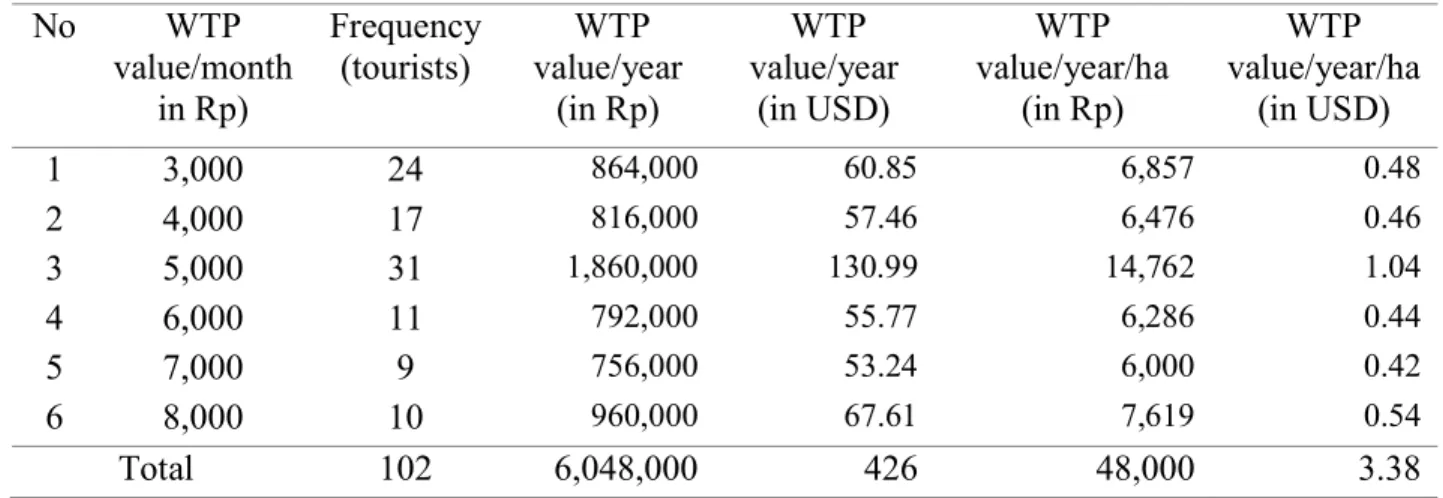
14 The mangrove cover areas in Tongke-Tongke villages is about 126 ha (BPS Kabupaten Sinjai, 2018), and Rhizophora sp. To estimate the total economic value of the mangrove tourism area, we used the market price method for direct use of mangroves, and travel cost method (TCM), and contingent valuation method (CVM) for recreation and conservation values, respectively (Carandang et al. ., 2013 ; Lynham et al., 2015). The data will be produced from a survey of households living around the mangrove ecotourism area and visitors, whether local or foreign visitors (Carandang et al., 2013).
The type of household questions included in the survey will relate to age, number of dependents, education, livelihood and income, understanding of mangrove functions and benefits, details of mangrove forest use (eg frequency of use) and the maximum amount they would have been willing to pay (WTP) for the conservation of the mangrove tourism area. Households will be selected by purposive sampling method, which addresses the connection and dependence on mangrove forests, such as fishermen, aquaculture farmers and firewood collectors. Meanwhile, the type of visitors' inquiries will also be related to the visitors' age, number of dependents, education, income, and travel cost (cost of transportation to and from the site, meals, and parking) (Carandang et al., 2013; Lynham et al., 2015) and selected by random sampling during the survey.
Where EWTP is the assumed value of average WTP; TWTP is total WTP; Wi is the value of WTP at i; Pfi is relative frequency; WTPi is the WTP responses to i; N is the number of respondents; and ni is the number of respondents to i who are willing to pay for the service; P the number of population.
RESULTS AND DISCUSSION
With a total mangrove area of 126 ha, the economic value was calculated to be 276 thousand rupees (US$19) per year per hectare (Table 1). Based on the cumulative results of the three economic values of the products, the total economic value of the mangrove forest from fishery products was 3.1 billion rupiah (US$145 thousand) per year or 629 thousand rupees (US$44). Furthermore, the highest number of visits per 1000 population comes from Sinjau District, while the lowest is from Makassar City (Table 3).
Although the city of Makassar has the highest population than others, the number of tourists from Makassar visiting this ecotourism area is the lowest (Table 4). Based on the economic value calculation, referring to the travel costs and the number of visitors per 1000 inhabitants (Table 5), we found that the total economic value per year is 4.34 billion rupiah (306 thousand USD), or per hectare 34.48 million rupiah. (USD 2,482). The main contribution comes from the Bone district due to its greater economic value per year per 1000 visits to the ecotourism area compared to the other three districts.
The total economic value of the mangrove tourism area (TEV) was 35.16 million rupees (US$2467) per year per hectare. Total economic value of mangrove tourism area Economic value Benefit value/year/ha.

CONCLUSIONS AND RECOMMENDATION
Model Ekonometrika Harga Ikan Laut Segar Seimbang di Pasar Produsen dan Konsumen” Jurnal Ekonomi Pembangunan dan Pertanian Volume 1 Nomor 1 ISSN Program Studi Ekonomi Pembangunan Universitas Negeri Makassar (Mei http://digilib.unm.ac.id/files/disk1 /17/ unm-digilib-unm-drabdrahim-809-1-6.jurna-).pdf. Perbandingan pendapatan per trip pada musim penangkapan ikan “Perahu Motor Tempel dan Perahu Layar Nelayan Tradisional” Jurnal Ekonomi Pembangunan dan Pertanian Jilid 3 Nomor 1 ISSN Program Studi Ekonomi Pembangunan Universitas Negeri Makassar (November http://digilib.unm.ac.id/ gdl php?mod=browse&op=read&id=unm-digilib-unm-drabdrahim-810 Margin distribusi dan pemasaran ikan laut segar dan perikanan tradisional share "Jurnal Ekonomi Pembangunan dan Pertanian Volume 3 Nomor 1 ISSN Program Studi Ekonomi Pembangunan Universitas Negeri Makassar (Mei.
Data Panel “Jurnal Ekonomi Pembangunan dan Pertanian Jilid 4 Nomor 1 ISSN Program Studi Ekonomi Pembangunan Universitas Negeri Makassar (November Estimasi Pendapatan Nelayan Penangkapan Kapal Motor Tempel) “ Jurnal Ekonomi Pembangunan dan Pertanian Jilid 5 Nomor 1, ISSN Kajian Ekonomi Pembangunan Program, Universitas Negeri Makassar (Mei Kajian Produksi Rumput Laut Bagi Nelayan Pesisir “Jurnal Ekonomi Pembangunan dan Pertanian Volume 6 Nomor 1, ISSN Program Studi Ekonomi Pembangunan, Universitas Negeri Makassar (November.
Respon Persembahan Ikan Laut Segar" Jurnal Ilmu Fundamental Indonesia Volume 2 Nomor 2, ISSN Lembaga Penelitian Universitas Negeri Makassar (oktober indeksirano: Sinta 4, DOAJ, Google Scholar) http://ojs.unm.ac.id/index.php / pinisi/artikel/view/2429. Jurnal Ekonomi Pembangunan dan Pertanian Volume 2 Nomor 2, ISSN Program Studi Ekonomi Pembangunan, Universitas Negeri Makassar (November. Pomlad 2015, Inštruktor, Oddelek za ekonomijo, UH-Mānoa, »Prinsip Ekonomi Mikro« [Dodiplomski študij], »Prinsip Ekonomi Mikro « [Dodiplomski ].
Instructeur herfst 2012, Departement Economie, UH-Mānoa “Principles of Microeconomics (Honors)” [Undergraduate] “The Ocean Economy” [Undergraduate]. Instructeur najaar 2011, Departement Economie, UH-Mānoa “Principles of Microeconomics (Honors)” [Undergraduate] “The Ocean Economy” [Undergraduate]. Najaar 2009 Instructeur, Departement Economie, UH-Mānoa “Principles of Microeconomics (Honors)” [Undergraduate] “Marine Resource Economics” [Graduate].
Spring 2009 Instructor, Department of Economics, UH-Mānoa “Principles of Microeconomics” [Undergraduate] Instructor, School of Ocean and Earth Science and Technology/College of Social Sciences, UH-Mānoa “Ocean Policy and Management”. Social Studies for Teachers: Thinking Historically in the Classroom” [Graduate], College of Social Sciences, UH-Mānoa, “Meiji Gakuin University Field Study” [Undergraduate], Department of Economics, UH-Mānoa “Environmental Economics” [Undergraduate], Department of Economics, UH-Mānoa. 2010: “Meiji Gakuin University Field Study” [Undergraduate], Department of Economics, UH- Mānoa, “Principles of Microeconomics” [Undergraduate], Department of Economics, UH-.