Rethinking American Electoral Democracy
Is the cure for the ills of democracy more democracy? Is it possible to have too much democracy in a well-functioning government? What should a model electoral democracy look like?
In this critical examination of the state of the American electoral process, Matthew Streb analyzes the major debates that embroil scholars and reformers on subjects ranging from the number of elections we hold and the use of nonpartisan elections, to the presidential nominating process and campaign finance laws. Ultimately, Streb makes an argument for a less burdensome democracy, a democracy in which citizens can participate more easily. This book is designed to get students of elections and American political institutions to think critically about what it means to be democratic and how democratic the United States really is.
Part of the Controversies in Electoral Democracy and Representation series, edited by Matthew J. Streb.
Matthew J. Streb is Assistant Professor of Political Science at Northern Illinois University. His books include: The New Electoral Politics of Race (University of Alabama); Academic Freedom at the Dawn of a New Century (Stanford University); Running for Judge (NYU); Law and Election Politics:
The Rules of the Game (Lynne Rienner); and Polls and Politics: The Dilemmas of Democracy (SUNY).
Series Editor: Matthew J. Streb
The Routledge series Controversies in Electoral Democracy and Representation presents cutting edge scholarship and innovative thinking on a broad range of issues relating to democratic practice and theory. An electoral democracy, to be effective, must show a strong relationship between representation and a fair, open election process. Designed to foster debate and challenge assumptions about how elections and democratic representation should work, titles in the series will present a strong but fair argument on topics related to elections, voting behavior, party and media involvement, representation, and democratic theory.
Rethinking American Electoral Democracy Matthew J. Streb
Redistricting and Representation: Why Competitive Elections Are Bad for America Thomas L. Brunell
Rethinking American Electoral Democracy
Matthew J. Streb
270 Madison Ave, New York, NY 10016 Simultaneously published in the UK by Routledge
2 Park Square, Milton Park, Abingdon, Oxon OX14 4RN Routledge is an imprint of the Taylor & Francis Group, an informa business
© 2008 Taylor and Francis
All rights reserved. No part of this book may be reprinted or reproduced or utilized in any form or by any electronic, mechanical, or other means, now known or hereafter invented, including photocopying and recording, or in any information storage or retrieval system, without permission in writing from the publishers.
Trademark Notice: Product or corporate names may be trademarks or registered trademarks, and are used only for identification and explanation without intent to infringe.
Library of Congress Cataloging in Publication Data Streb, Matthew J. (Matthew Justin), 1974–
Rethinking American electoral democracy / Matthew J. Streb.
p. cm.—(Controversies in electoral democracy and representation)
1. Elections—United States. 2. Democracy—United States.
I. Title.
JK 1976.S77 2008 324.60973–dc22
2007033709
ISBN10: 0-415-96138-6 (hbk) ISBN10: 0-415-96139-4 (pbk) ISBN10: 0-203-93108-4 (ebk) ISBN13: 978-0-415-96138-7 (hbk) ISBN13: 978-0-415-96139-4 (pbk) ISBN13: 978-0-203-93108-0 (ebk)
This edition published in the Taylor & Francis e-Library, 2008.
“To purchase your own copy of this or any of Taylor & Francis or Routledge’s collection of thousands of eBooks please go to www.eBookstore.tandf.co.uk.”
ISBN 0-203-93108-4 Master e-book ISBN
and
In memory of Judge Paul Boland, who dedicated his life to
protecting the rights of others
Contents
List of figures and tables x
Preface xi
Acknowledgments xiii
1 Creating a model electoral democracy 1
Criteria for a model electoral democracy 2 A few comments 5
Overview of the book 6
PART I
Rethinking the costs of voting 9
2 Factors that influence voter turnout 11
“Didn’t we just vote?” 11 Other barriers to voting 16
3 The offices we elect 26
Do we really need to vote for coroner? 27 The case of judicial elections 29
4 Direct democracy 44
What is the initiative process and how does it work? 45 Some misconceptions about the initiative process 47 Why the public supports the initiative process 54 The problems with the initiative process 57 Some potential reforms 60
Recall elections 61
PART II
Rethinking the mechanics of voting 65
5 Ballot laws 67
Getting on the ballot 67
Candidate information on the ballot 71 The order of candidates’ names on the ballot 75 Ballot design 77
6 Voting machines 80
Different types of voting machines 81 The problem with punch card ballots 82
The pros and cons of the remaining contenders 83 A word on Internet voting 89
So, what’s the solution? 92
PART III
Rethinking national elections 95
7 The redistricting process 97
How does the process work? 98 The goals of redistricting 99
What should be the goals of redistricting? 108
What process best achieves the goals of redistricting? 113
8 Presidential primaries 116
King Caucus and the smoke-filled rooms 117 Reforms to the presidential primary process 118
9 The Electoral College 133
What is the Electoral College? Why do we have it? 133 Arguments in favor of the Electoral College and why they
are flawed 136 The reasons for change 140
Attempts to reform the Electoral College 142 The future of the Electoral College 147
10 Campaign finance 151 A brief history of campaign finance reform 152
The concerns of campaign finance reformers 157 The favorite solution: publicly financed elections 160 A controversial solution 163
11 Conclusion: Moving toward a model electoral democracy 171 Revisiting the criteria for a model electoral democracy 171
Other improvements to American electoral democracy 175 The prospects for reform 177
Notes 179
Bibliography 201
Court cases 219
Index 221
List of figures and tables
Figures
2.1 Absentee voting and voter turnout rates in California,
1980–2004. 20
4.1 A map of states that use the initiative and recall. 46 5.1 The “butterfly ballot” used in Palm Beach County, FL
during the 2000 presidential election. 78
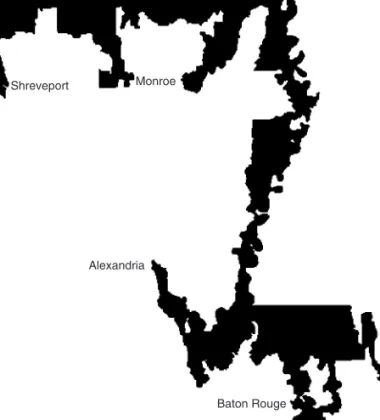
7.1 District map of the current Illinois 17th congressional district. 101 7.2 District map of Louisiana’s former 4th congressional district. 102
Tables
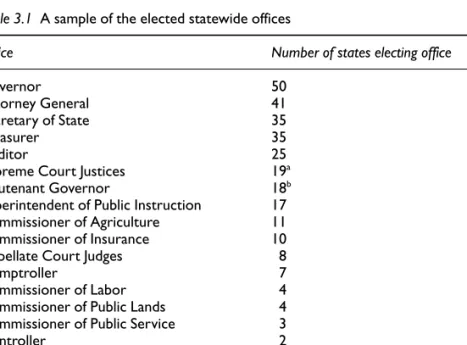
3.1 A sample of the elected statewide offices 27
4.1 Campaign expenditures on selected California propositions,
2004 (in millions of dollars) 48
Preface
The idea for this book started with a conversation I had with a former student during the height of the effort to recall former Californian governor Gray Davis. During the spirited conversation, the student made a passionate defense in favor of recalling Davis and argued that the effort was “democracy in action,”
to which I blurted out, “It may be democracy, but it is dumb democracy!”
Normally I would not be this direct with a student, but I was close with this particular student as I had him in several of my classes; I served as his thesis advisor, and we presented a paper together at a political science conference.
While we ultimately agreed to disagree, immediately after that conversation I began thinking about the many aspects of American electoral democracy that I considered to be “dumb”—some of which I had studied, such as nonpartisan elections and judicial elections, and some of which I had not, but always believed to be questionable, like the initiative process and the number of elected officials in the United States. I decided to write a book that would argue against many of these paradigms and the idea that “more democracy is always best.” As I started thinking through the project further, however, I wanted to make sure I didn’t take a tone that was too flip—it could easily sound more like something that Ann Coulter or Al Franken would write, and that was certainly something that I did not want (although at least Franken is funny). And, to be honest, arguing that many of these practices and institu- tions were “dumb democracy” was not fair. The more research I completed, the more I realized that there are persuasive arguments supporting the status quo. While I ultimately may not agree with these arguments, they are far from
“dumb.”
Furthermore, revising the “dumb democracy” angle allowed me to write a more comprehensive book, permitting the inclusion of more than just demo- cratic ideas that I questioned. This approach to writing the book naturally encouraged discussion of a wide array of subjects, some of which I supported, some of which I opposed, and some of which I either did not have a strong opinion on or on which I simply could not make up my mind. In other words, it allowed me to think about what a “model” electoral democracy should look like.
The reader should be forewarned. While I hope I have provided balanced coverage of the subjects that comprise this book, my point of view is clear.
Certainly not everyone will agree with all arguments in the book; many will no doubt disagree with me entirely, and others will likely have strong opinions about topics that I do not. Some readers may support my position, but for different reasons than I advocate. What I hope emerges from this book is a dialogue about American electoral democracy. While I would like to persuade some of my skeptics, the more important goal is to get people to critically assess what it means to be democratic and how democratic the United States really is; hence the title Rethinking American Electoral Democracy. We are fortunate enough to be active participants in this wonderful democratic experiment. Unfortunately, few of us stop to wonder how well the experiment actually works. One of the basic but underappreciated features of a system like that of the United States is it is open to change. Few, if any, of the specific practices should mindlessly be continued if another practice can better serve the purposes of a democracy.
Acknowledgments
Of all the research projects on which I have worked, this one was the most challenging. As a political scientist, rarely do I “stick my neck out” and make normative arguments. Instead, usually I have some theory that allows me to develop testable hypotheses. I collect data and see whether my theoretical expectations hold. This is not to say that such research cannot be criticized—
indeed, political scientists disagree all the time regarding the appropriate measurement of variables, whether a model is fully specified, and the like—but the nature of the criticism of such research is different. Normative arguments by definition are arguments about how the world should be, or, in this case, what makes a model democracy, and it must come as no surprise that many people have very different—and sometimes strong—views regarding such a question. Since this is the case, I have benefited enormously from the comments of many colleagues and the debates (and, in a few cases, heated arguments!) we have had about the subjects in this book.
First, I owe much to Michael Kerns at Routledge for his support of this project. I think Michael knew what I was trying to do in this book before even I did. He was instrumental in helping me think through the organization of the book. In addition to Michael, Beth Renner, Felisa Salvago-Keyes, and the rest of the Routledge staff were a pleasure to work with. Beth, in particular, provided valuable feedback on the clarity of my arguments.
Several of my political science colleagues have been immensely helpful as well. Seth Thompson endured many long conversations in his office as I first started to envision writing a book on electoral democracy. Lee Goodman, Michael McDonald, Brian Schaffner, Mike Wolf, Curt Wood, and Mike Wyckoff provided critical, but fair comments about individual chapters. I owe them all a beer, or in Wolf’s case a fruity drink with an umbrella in it. Brian Frederick was gracious enough to read the entire manuscript; his suggestions were always extremely useful and helped me to hone my arguments. Stephen Ansolabehere, Sharon Holmes, Bradley Smith, Charles Stewart, and Richard Winger all were kind enough to answer questions that I had about various subjects. In addition, Joshua Dyck, University at Buffalo, The State University of New York; Carl Klarner, Indiana State University; and Charles Prysby,
University of North Carolina at Greensboro all provided insightful and con- structive feedback in their reviews of my proposal.
Marjorie Campbell and Neil Wright provided excellent research assistance.
The Department of Political Science at NIU was kind enough to give financial support that allowed me to focus solely on finishing the book over the summer.
Finally, my family deserves a great deal of thanks for tolerating a summer in which dad wasn’t always at home. As always, Page gave me immense support and was kind enough to explain to the neighbors why professors actually have to work during the summer. More importantly, she told me to stop complain- ing when I became frustrated with writing. Logan made sure that dad didn’t work too hard, always talking me into hitting some balls off the tee or shooting some hoops. Fortunately, he doesn’t appear to have my athletic genes. Of all the people mentioned here, none has heard more about this project than Alex, who was always kind enough to provide an attentive audience at three in the morning while I gave him his bottle. Of course, he (or anyone else mentioned here) is not responsible for any holes in my arguments.
Creating a model electoral democracy
At the beginning of every semester of my “Introduction to American Govern- ment” course, I can be sure that the class will be comprised of students who have a wide range of interests and views. Unfortunately, there will always be some students who have no interest in American government and are taking the class to fulfill a core requirement. There are many students who are curious but skeptical about the American government. Often cynical, they think politi- cians are corrupt and elites dominate election outcomes and the formation of public policy. In their eyes, their voices will never be heard. And, certainly included as well are a few idealists who believe that they can make a difference and that their involvement is essential to the functioning of a healthy America.
While these students have different points of view regarding their interest in politics and their attitudes towards government, one belief unites almost all of them: the belief that democracy is a good thing, that people’s voices should be heard, and that any attempt to limit democracy is bad. However, democracy is a complex concept and, while the students know they like democracy, when confronted with questions about what a model electoral democracy should look like, differences in opinion quickly emerge.
My students are no different than the country as a whole. Most Americans with rudimentary knowledge of government are adamant proponents of demo- cracy; they believe that people should have control over their elected officials and be able to vote them out of office if the politicians fail to follow the popular will. But again, divisions develop when we move from an abstract concept of democracy to a more specific debate about what the rules and institutions of a well-functioning electoral democracy should be.
Let us assume that the students and most Americans are correct: democracy is a good thing. If we can agree on that, then the questions become how much and what kind of democracy should we have? Here is where differences in opinion become apparent. As political scientist Elisabeth Gerber writes, “All democracies face a fundamental problem in deciding how much political parti- cipation to allow and by whom.”1 Most Americans would likely agree that a direct democracy in which citizens are responsible for voting on all federal, state, and local policy is unworkable. But what about a limited direct democracy
where citizens have the ability to vote on certain state or local issues? In a representative democracy it is obvious that we must elect some government officials, but specifically who? We must have some rules regarding who is eli- gible to vote, but what should those rules be and how difficult (or easy) should it be for eligible voters to cast ballots?
Other questions emerge as well. It seems relatively uncontroversial that everyone’s vote should count equally, but how do we guarantee that and what trade-offs have to be made? What is the fairest way to best reflect the wishes of the people in primaries and general elections? Do we necessarily want competi- tive elections, and, if so, what is the best way to promote them? Would more or less money in the system be the answer? Who should appear on the ballot and how easy should it be for them to get on it? What mechanisms should be used to tally votes? The list of questions is nearly endless.
The goal of this book is to answer the question—If democracy, then what kind? The United States is the oldest, most established democracy in the world.
Unlike emerging democracies, our Constitution is firmly embedded. We do not have to be concerned with creating the appropriate institutions to promote democracy; they have been in place for more than 200 years. Our challenge then is not to develop an electoral democracy from scratch, but instead, as prominent democratic theorist Robert Dahl writes, “to perfect and deepen [American] democracy.”2
In this brief introductory chapter I discuss the criteria that drive the argu- ments for specific conditions of a model electoral democracy and provide an overview of the chapters to come.
Criteria for a model electoral democracy
In his often-cited book, On Democracy, Dahl argues that democracy refers to both an ideal, which is probably unattainable, and an actuality. “In every democratic country a substantial gap exists between actual and ideal demo- cracy,” Dahl writes. “That gap offers us a challenge: can we find ways to make
‘democratic’ countries more democratic?”3 Contrary to the common percep- tion, however, making a country more democratic does not necessarily require more democracy. Indeed, as argued at several points in this book, “demo- cratic” reforms enacted for the sake of creating more “democracy” are not always positive, and in fact can have negative effects, often making the country less democratic in the process. The solution isn’t always more democracy . . . it’s better, smarter democracy.
What is needed for that “better, smarter democracy?” The answer surely depends on an individual’s values. “When we try to decide what political institutions democracy actually requires, we rely . . . on evidence and empirical judgments,” Dahl continues. “Yet . . . what matters to us depends in part on our previous judgments about the meaning and value of democracy. Indeed, the reason we may be concerned with the shape of political institutions in the
actual world is that the values of democracy and its criteria are important to us.”4
There are several criteria that are needed for an ideal electoral democracy.
Citizens must have the ability to speak freely, to criticize (or even support) those who are currently in office and those who are trying to get there. While it is impossible for every voice to be heard equally, we must make sure that certain voices do not dominate the discussion. Additionally, the people must believe that the institutions and rules of a democracy are legitimate. While these criteria are all important, throughout this book I focus extensively on four criteria for a model democracy in particular, all of which revolve around the concept of “free and fair elections.”
One person, one vote
No criterion is more vital than the fact that people “should have equal and effective opportunities to vote.”5 It is imperative that different segments in society—the wealthy and the poor, the educated and uneducated, whites and racial or ethnic minorities—all have the same opportunity to vote and that barriers are not put in place to benefit one group at the expense of another.
Along the same lines, a central component of a model electoral democracy is the idea of “one person, one vote.” Each eligible voter in a democracy must have her vote counted the same as everyone else, regardless of an individual’s personal characteristics. All votes must not only count equally, but have the same probability of being counted as well. Moreover, the concept of “one person, one vote” applies not just to voting, but also to representation. In a system of government that includes a House of Representatives where seats are allocated based on population, it is essential that people receive equal repre- sentation. In other words, a system in which District A has 100 residents and District B from the same state has only 10 residents is flawed because the voices of residents in District B carry more weight than those in District A.
The potential for competitive elections
“ ‘A competitive struggle for the people’s vote’ is for many political scientists and political theorists the very definition of democracy,” writes political theor- ist Dennis Thompson.6 I concur. A model electoral democracy must have at least some competitive elections whose outcomes are in doubt before election day. Why? From a rational choice perspective, greater electoral competition should lead to higher voter turnout, which will contribute to the legitimacy of government.7 According to rational choice theorists, citizens decide to vote by subconsciously computing the following equation, known as the “Calculus of Voting:”
R=PB+D−C
R equals the reward a person obtains from voting. If R is positive, then the person casts a ballot; if R is negative, then the person abstains. P equals the probability that the person’s vote will determine the outcome of the election;
B is the benefits a person obtains from having one candidate elected over another; D is often known as the “citizen duty term,”8 and reflects the value that one places on voting as a duty of a citizen; C is the costs of voting, whether they be the informational costs of researching a person’s vote or the time costs required to actually cast a vote (that is, register, wait in line at the polls).
Studies find empirical support for the Calculus of Voting. When elections are close, the outcome of the election may be in doubt, leading more people to cast their ballots.9 Competitive elections produce greater media coverage and more efforts at voter mobilization, which provide citizens with additional information on which to cast their votes and hence lessen the costs of voting.10 Furthermore, competitive elections provide the greatest opportunity for cit- izens to influence the outcome of an election, which means that turnout will be higher.11 As important, competitive elections are more likely to produce moderate candidates;12 this limits polarization in government creating greater opportunities for compromise and making policy more reflective of public opinion. It promotes ethics in government because politicians who are corrupt are more likely to be removed from office or avoid corrupt practices in the first place. In other words, competitive elections promote government account- ability and responsiveness.13 Because of the enormous advantages that incum- bents have we must look for ways to level the playing field and make elections fairer, which, in turn, will make them more competitive.
This is not to say that every election needs to be competitive. Indeed, as I argue later in the book, too much competition can have negative outcomes.
But, the potential for competitive elections must exist to provide citizens with greater choice and to promote accountability. What do I mean by the potential for competitive elections? As one example, the cards should not be stacked against challengers who cannot compete with an incumbent’s fundrais- ing prowess. Incumbents must fear the possibility that a strong candidate could challenge and possibly defeat them.
Transparency
Voting should be private; other aspects of elections should not. Whether it is the selection of a party’s candidate, the counting of votes, the drawing of congressional districts, or the contributions of individuals and organizations to candidates and political parties, citizens should be able to view the process.
“When the requirement for transparency is violated,” write political scientists R. Michael Alvarez and Thad Hall, “the fundamental tenets of democracy are violated.”14
Rules that are not burdensome
The previous three criteria are generally not controversial, although how one achieves those goals certainly can be. There is likely to be significant debate over whether this last criterion is essential—or even ideal—in a model demo- cracy. In the eyes of many people, a model citizen should regularly participate in and deliberate about elections. Participation in elections is important, but the requirements for participation should not be overly onerous and—while some will disagree—I argue that they are.
Referring back to the Calculus of Voting equation, the costs of voting in US elections can be excessive. Americans are required to go to the polls more often to vote for more offices than citizens in any other country in the world.
Unnecessary barriers to voting are often placed in front of many citizens. In the majority of elections, citizens are not provided with important, reliable cues on the ballot that will help them determine their votes efficiently. We are faced with what seems to be never-ending campaigns where voters elect a candi- date and then are almost immediately bombarded with campaign literature, television advertisements, and contribution requests for the next election. All of these occurrences lead citizens to become fatigued with elections, some- thing that a system of government in which “the people rule” cannot afford.
This does not imply that the American public is not capable of making informed decisions. In this book I argue that we need to vote less, not because we are incapable, but because we are overwhelmed. I advocate a less burden- some democracy; not a simplistic democracy, but one in which Americans can more easily participate. Voting is important, but to expect Americans to be informed, even somewhat so, on all the issues we may vote on or offices we may vote for is unrealistic and, as I will argue, unnecessary.
A few comments
Before turning to the substantive chapters, it is important for me to make a few comments about what is, and is not, to come. First, writing a book such as this one means that inevitably some important topics will have to be left out.
Including every possible aspect of the rules and institutions of US electoral democracy would require a far longer book than I have the right to ask my readers to read. For example, questions such as whether felons, those with mental disabilities, or noncitizens should be able to vote will have to be left for another forum.
Along the same lines, in each chapter a concise and, I hope, persuasive case is made, but, due to space limitations, only the main issues within each subject can be covered. Indeed, each of the topics covered here could be the subject of another book (and most have). Each chapter provides readers with the significant background on these issues and gives them enough information to establish opinions of their own on these topics.
Also, debates about the appropriate rules and institutions of a sound elec- toral democracy are frequently clouded by partisan politics. Certainly there are ideological divisions that separate the parties regarding the best electoral reform. For example, Democrats and Republicans are likely to have different beliefs regarding the role of government in financing elections because of their competing views of government. However, too often, Democrats argue in favor of what will most benefit the Democratic party and vice versa with Republicans and the Republican party. Unfortunately, this trend is under- standable, given that politics is about power and the easiest way to get power and control the issue agenda is by winning elections. Certainly, then, partisans are going to want to shape the rules and institutions of electoral democracy in ways that make it most likely that their parties’ candidates win elections. But partisan arguments can be problematic when thinking about electoral reform.
Too often we become obsessed with protecting the party and not implement- ing reforms that would be fairest for the country. I have tried to be nonparti- san when making my case—and, fortunately, as a moderate partisan, this was not too difficult to do. When reading the book, I hope that you will do the same.
Overview of the book
The book is comprised of three parts. Part I is devoted to rethinking the costs of voting. It is here where the strongest argument is made that the rules of voting are too onerous. Observed in Chapter 2 are some of the reasons that influence turnout, including the fact that Americans must go to the polls far more often than is needed, that election day is not a holiday or held on a weekend, and that most states require residents to register to vote several weeks in advance of the election. Chapter 3 focuses on the number of elected officials for which Americans are asked to vote and examines one type of elec- tion in particular: those for judges. There is no reason why citizens must vote for so many offices. In particular, judicial elections are problematic because they threaten judicial independence, something that is crucial to protecting the rights of the minority. Chapter 4 looks at two types of direct democracy that exist in some states: the initiative and the recall. While both may be the purest examples of democracy, I argue that they should be used sparingly so as to not tie the hands of elected officials when creating policy.
Part II covers the mechanics of voting. Discussed in Chapter 5 are the laws required for a party’s candidate to be placed on the ballot as well as the format of the actual ballot itself. The requirements for third-party or independent candidates to get on the ballot should not be arduous so that citizens have an adequate number of choices when deciding how to vote, and the actual ballot should be as simple as possible so as to reduce the number of errors people can make when voting. Chapter 6 examines the methods used for counting votes. While no voting machine is perfect, optical scanner and electronic voting
machines offer the best chance to limit voting errors in the future. Less impor- tant is the machine that voters actually use, but that each voter in a state uses the same machine and that government conducts regular audits of election results.
Part III focuses on the rules of national elections. Chapter 7 questions the redistricting process in place in the majority of states and argues that redistrict- ing should be conducted by a nonpartisan state commission. Chapters 8 and 9 focus on presidential elections. Chapter 8 examines the increasingly contro- versial presidential primary process, while Chapter 9 discusses the always con- tentious Electoral College. In both cases, substantial reform is needed. The current primary process should be eliminated in favor of a national primary, while the Electoral College should be abolished in favor of a popular vote election with an instant runoff. Chapter 10 looks at one of the most complex aspects of electoral democracy: campaign finance. In order to promote more competitive elections, we should consider lifting the restrictions on campaign contributions. However, contributions by individuals and political organiza- tions must be disclosed for transparency and to provide voters with important information when deciding how to vote. Finally, Chapter 11 concludes with a brief discussion of how the arguments made throughout the book are consistent with the criteria listed for a model democracy in this chapter.
Rethinking the costs of voting
Part I
Factors that influence voter turnout
One day, shortly after we had just voted in a November midterm election, my wife was sorting the mail. She suddenly stopped when she came across her sample ballot for that March’s primary in Los Angeles. She looked at me incredulously, as though as a political scientist I was somehow responsible for scheduling elections, and said, “This is ridiculous. Didn’t we just vote?”
Apparently most Angelenos felt like my wife did, because when the March primaries to vote in certain districts for city council, board of education, and community college seats came, less than 13 percent of the eligible electorate voted. Slightly more than two months later, when voters were asked to go to the polls yet again to vote in the runoff election, barely more than 9 percent turned out to vote.
One of the most cherished rights we have as American citizens is the right to vote. And, though many of us may not use that right often, we certainly have plenty of opportunities to do so. Few countries in the world hold as many elections as the United States. As political scientist Ivor Crewe notes, “The average American is entitled to do far more electing—probably by a factor of three or four—than the citizen of any other democracy.”1 In fact, the average American is likely to be called to the polls more than twice a year, every year.2
The number of times Americans are asked to vote raises the costs of voting discussed in Chapter 1. The more we are asked to vote means the more we have to be informed and take the time to cast our votes. However, the number of election days is not the only barrier to voting that Americans face: in all states but one, citizens must register to vote, and in most cases must do so well before election day; the times and days in which citizens are asked to vote may make it difficult to do so; several states still have restrictive absentee voting laws or do not allow residents to vote early. This chapter examines these barriers to voting and argues that many of these barriers should be eliminated.
“Didn’t we just vote?”
The American electoral system is unique. We elect our president and lower house more often than any country. That, in and of itself, is not a problem. A
four-year term gives the president time to enact his agenda while still keeping him accountable to the people. The House of Representatives was designed by the framers of the Constitution to be the people’s “House.” Two-year terms, while I’m sure annoying to members of the House who constantly have to run for reelection, again promote accountability. But, as Crewe writes, the differ- ences between the United States and other countries do not stop with more frequent elections for president or the lower house. “No other country popu- larly elects its state governors and town mayors; no other has as wide a variety of nonrepresentative offices (judges, sheriffs, attorneys general, city treasurers, and so on) subject to election. Only one other country (Switzerland) can compete in the number and variety of local referendums” (emphasis in ori- ginal).3 On top of that, few countries hold primaries to nominate party candidates.4
This problem becomes further exacerbated when one considers that a solid majority of municipal elections are held at different times than presidential elections.5 As noted, in Los Angeles, voters are not only asked to vote in the even-year primaries and general elections for federal and state offices, but odd- year elections for local offices, such as mayor or city council. If no candidate receives a majority of the vote in the first electoral round, then voters are asked to go to the polls again to determine the runoff winner.
Los Angeles is not alone. Growing up in New Jersey, I had just assumed that campaign season was all year long. I would see candidates’ political signs on the neighbors’ front lawns. As soon as those came down, new signs would be placed for a different office. New Jersey is one of the few states (Kentucky, Louisiana, Mississippi and Virginia are the others) that elect its governor in odd years. As a result, New Jerseyans are asked to vote for high- profile races, both in a primary and general election, every three out of four years. Because the primaries are held in June and the general election in November, the following campaign starts almost immediately after the previous election.
The number of election days in California and New Jersey pale in com- parison to the state of Georgia. In 2004, for example, some Georgians had the good fortune of going to the polls five times in one year, and, potentially, could have voted a sixth time! Georgia held its presidential primary on March 2nd, which was on a different date than its general primary, July 20th, for offices like the House of Representatives. Georgia law states that candidates must receive a majority of the vote in the primary or they must face a runoff election, which was August 10th. The general election, like in the rest of the country, was held on November 2nd and a runoff election for several city offices and a statewide appellate court seat was held on November 23rd. The statewide turnout for the general election runoff was an astonishing 6 per- cent.6 Georgia also had a special election scheduled for September 21st to fill vacancies or for counties to hold referenda. It appears, however, that none were scheduled.
The problem with holding so many elections is that it leads to what some scholars call “hyper-democracy;” voters become fatigued and information costs increase greatly. Voting is not perceived as being special anymore.
Instead, voters are overwhelmed with election information. The constant campaigning is likely to turn off people to the political process. As I have mentioned, from a rational-choice perspective, potential voters measure the benefits and costs of voting as well as the likelihood of their vote making a difference. With so many elections, the costs of voting increase and, as a result, voter turnout is likely to decline. In fact, several studies have attributed the low turnout in the United States partially to the frequency of elections.7 To be fair, consolidating elections would probably have a minimal effect on voter turnout in November elections, which is the election the cited studies analyzed.
However, consolidating elections would have an enormous effect on voter turnout in local elections.8 You certainly would not see roughly 10 percent of the public voting for their city council as was the case in the previously men- tioned Los Angeles election. Some may argue that the 2003 Los Angeles municipal election is an outlier, and that voter turnout is really much greater in other local elections. Although turnout is higher in some cases, it usually remains quite low. In a study of turnout in Californian municipal elections, political scientists Zoltan Hajnal and Paul Lewis find that the mean turnout for eligible voters in city council elections is only 32 percent.9 In many cases, turnout consistently falls below 10 percent of the voting-age population.10 According to political scientist Louis DeSipio, turnout in local elections is no more than 10 to 20 percent of eligible voters.11 Even statewide elections suffer from extremely low voter turnout. Jack Doppelt and Ellen Shearer note that the combined turnout for two statewide 1998 Texas primaries (a regular one and a runoff) was 14 percent of registered voters.12
It is tough to argue that democracy is functioning well when turnout is so low in so many different elections. While I have never been a proponent of increasing turnout for the sake of increasing turnout, we do run the risk of becoming an elite democracy in which only a small number of citizens partici- pate regularly. Some people might charge that as long as everyone is eligible to vote, there is not a problem. No one is keeping citizens from voting and if only 10 percent of the public care enough to vote, then so be it. My students often make this argument, to which I respond that I should hold the review session for the midterm at 6:00 a.m. Tuesday and change my offices hours to Saturday and Sunday mornings from 7:00 till 8:00 a.m. All can come, but it is likely that even strong students who normally take advantage of review sessions or office hours will not attend. Due to this inconvenient scheduling, good students are disadvantaged. Similarly, good citizens are disadvantaged when so many elections are scheduled.
To make matters worse, turnout in these inconveniently scheduled elections is highly skewed. Studies find consistently that the costs of voting are greater for the poor or less educated.13 Little information is usually accessible in these
races and they are often nonpartisan (see discussion in Chapter 5), creating a huge information gap. Thus, we are electing officials based on what a few thousand (and in some cases less) citizens believe. Even many people who normally participate, who regularly vote in presidential elections or midterm elections, may find the number of elections overwhelming and the lack of information available daunting. “[A]t the local level where policies are most likely to be implemented and where a majority of the nation’s civic leaders are being elected,” write Hajnal and Lewis, “important public policy decisions are being made without the input of the most affected residents.”14 And, while empirical studies question whether higher voter turnout matters at a national level,15 Hajnal and his colleague Jessica Trounstine find evidence that it does at the local level.16
Even if the 10 percent turnout was reflective of the general population and voting was not so taxing, there are other reasons to oppose holding so many election days. Conducting elections is expensive. For instance, Fulton County, GA, in which the city of Atlanta lies, spends roughly $2 million per election, and Fulton County is only one of 158 counties within Georgia, although it is the largest. This is significant money that is being spent, not once or twice, but potentially six times in one year. On a smaller level, DeKalb County, IL budgeted $455,600 for its 2006 elections, which comprised 17 percent of the county’s general fund.17 Per capita, elections in DeKalb County are actually more expensive than those in Fulton County.
However, consolidating elections is difficult because of federalism. The US Constitution gives Congress the power to control the “Times, Places, and Manner” of holding elections for Congress or the president, but it has no power over state or local jurisdictions regarding when or how many state and local elections are held. Some county and local governments are reluctant to merge their election days with those for federal offices. If a presidential election is held in conjunction with a mayoral election, for example, many voters may go to the polls intent on voting for a presidential candidate and, at the same time, vote for a mayoral candidate of the same party for no other reason than partisanship. One could imagine an election in which the Democratic presi- dential candidate excites and mobilizes party members who otherwise might not vote. Those people who are mobilized might then vote for the Democratic mayoral candidate simply because the person is a Democrat, not because of the person’s qualifications or ideas. In other words, some fear that a Democratic presidential candidate’s popular platform will influence the outcome of a local election. Were the local election to be held on a different date, they feel that the influence of national politics would be less strong.
It is possible that national trends could influence state or local races, but empirical evidence indicates that, recently anyway, they have not. Presidential coattails have basically disappeared in presidential elections.18 In 1992, the Democratic party lost 10 seats in the House and had no gain in the Senate, even with Bill Clinton’s convincing victory over George H.W. Bush. In 1996,
Democrats gained a small increase in the number of representatives, but lost two Senate seats. In 2000, George W. Bush’s razor-thin win did not bring with it an increase in congressional seats. In fact, the Republicans lost two seats in the lower chamber and four seats in the upper chamber. And, in 2004, while Republicans picked up four seats each in the House and Senate, gains in the House could be attributed largely to a controversial redistricting plan in Texas designed to weaken several incumbent Democrats. Certainly, congressional races are not the same as local races and unfortunately little empirical research has examined the effects of presidential coattails on local elections, but it is not unreasonable to think that the effects of national elections on local races might not be as pronounced as people believe.
Another concern of state and local election officials is that, by consolidating elections, voters will be less informed about state and local elections; they will not cast thoughtful votes. If state and local elections are held separately from national elections, opponents of consolidating elections argue, only those citi- zens who care enough to inform themselves will vote. Those who can’t be bothered will stay home. If local elections were held at the same time as presi- dential elections, then many uninformed voters about local elections would be mobilized and, once at the polls, may vote in the local elections just for the sake of voting. Opponents also argue that consolidating municipal elections with federal and state elections will create a long, confusing ballot. Yet, some empirical evidence indicates that voters pick and choose which offices they vote for, based on the information they have regarding the office.19 Voting tenden- cies are such that people often refrain from voting when they are not familiar with the candidates running for a particular office. According to this data, the idea that voters will jump on the party bandwagon and vote for all the candi- dates belonging to one party is certainly not a guarantee. As likely is that voters simply will not vote for elections they know nothing about.
Moreover, while in a democracy the quality of a person’s vote is always a concern, separating state and local elections from federal elections is not a guarantee of smart voting; and it is not a reason to purposely lessen voter turnout. First, as argued in the next few chapters, the number of offices for which we vote should be reduced drastically, initiatives should be restricted, and nonpartisan elections should be eliminated. All of these actions would lessen the costs of voting immensely, allowing citizens to focus more energy on local elections, even when they are held in conjunction with state and federal elections. Second, as Hajnal and Lewis assert, the concern about voter attentiveness and knowledge is a strong argument “for civic education, voter outreach campaigns, higher quality media coverage of local races, and inten- sive campaigning by candidates for mayor and council. They are . . . not good arguments for scheduling local elections so as to knowingly reduce public participation.”20
While a discussion of the quality of election news coverage would fill an entire book and is not the focus here, local newspapers and news stations could
do more to cover local races. The trend away from locally owned television and radio stations is a concern because coverage of local races may become even sparser.21 Nevertheless, the media needs to focus on municipal elections more than it currently does. Often around the Superbowl, World Series, or NCAA basketball tournament, newspapers create a section devoted to coverage of that event. This same thing could be done for elections. Citizens would then have a convenient place to turn for election coverage. The section need not focus just on federal or state elections, although those elections would still likely command the most coverage, but could also include regular commen- tary on elections for mayor, city council, and school board. As it stands, the coverage of most nonpresidential races is extremely sparse. The news media has an obligation to inform the public about contested races, and is failing to do so. Fortunately, with the rise of the Internet, the media’s limited coverage of local politics becomes less of a concern because voters now have access to more information than ever before online.
Though it is unlikely that all localities will combine their elections with those for federal and state offices, at least one study uncovers a trend in a positive direction. In a survey of Californian county clerks, Hajnal and Lewis find that more than 40 percent of the cities have changed the timing of municipal elections recently “with the vast majority of those switching from stand-alone elections to elections concurrent with statewide contests.”22 This is a step in the right direction and hopefully one that other localities will follow.
Other barriers to voting
It is not just the number of times people are asked to vote that makes American elections different from most other countries’ elections, but the fact that other institutional obstacles to voting exist in the United States that do not in many other countries. Now, let’s turn to a discussion of each of these barriers.
Voter registration and election day registration
One voting requirement that separates the United States from most other countries is that, in all states but North Dakota, citizens must register to vote.
The registration requirement makes voting a two-step process: citizens must first register before they can vote. Opponents of voter registration argue that it lessens turnout because the costs of voting increase.23 For example, G. Bingham Powell finds that automatic registration would increase voter turnout in the United States by 14 percentage points.24 As Steven J. Rosenstone and Raymond E. Wolfinger note, “Registration is often more difficult than voting. It may require a longer journey, at a less convenient hour, to complete a more com- plicated procedure—and at a time when interest in the campaigns is far from its peak.”25
Although registration requirements have generally been left for the states to
decide, in 1993, President Bill Clinton signed the National Voter Registration Act (NVRA) into law. Among other things, this act, also known as the Motor Voter Law, was designed to make it easier for people to register by allowing them to do so at various government offices including the Department of Motor Vehicles. While roughly 22 million people have registered to vote under NVRA, the success of the legislation is not clear.26 In 1996—the first presiden- tial election since the implementation of the law—voter turnout was the lowest it had been since 1924.27 Turnout rates in midterm and presidential elections since 1996 have not risen significantly.
Another registration modification that reformers have pushed to increase turnout is election-day registration (EDR), also known as same-day voter registration. Under EDR, potential voters must still register, but they can do so on the day of the election. Eight states, including Idaho, Maine, Minnesota, Montana, New Hampshire, Wisconsin, Wyoming, and most recently, in 2007, Iowa, allow same-day voter registration. The remaining states all have registra- tion closing dates of several days before the election up until 30 days before the election.
One result of EDR that seems clear is that voter turnout is higher in states that allow for same-day registration than in states that do not. According to Demos, an advocacy organization that strongly supports EDR, the national voter turnout average for EDR states in 2004 was 75.1 percent compared to only 63.2 percent for non-EDR states. The same trend held in 2000. These are admittedly simplistic analyses; after all, they do not allow for a wide array of factors that influence voter turnout. However, numerous multivariate analyses of EDR and voter turnout indicate that same-day registration can increase turnout rates anywhere from roughly 3 to 10 percent.28
There are a few reasons why same-day registration leads to higher voter turnout. First, as the election draws nearer, interest in the election rises.
Political scientist Thomas Patterson, an advocate of EDR, finds that people increasingly think about and discuss the election as election day gets closer.29 In other words, by the time people are paying attention to the races, the deadline to register may have already passed.
Second, EDR makes it easier for various groups of people, including the young and those who regularly move, to vote. According to one analysis, voter turnout rates of 18–24-year olds who lived in EDR states was 18 percentage points higher than their counterparts in non-EDR states.30 Younger people generally do not have the history of voting that older people do and may not follow the campaign season until near the end. Those who go away to college also may decide that they want to register to vote in their college town, but fail to do so before the registration deadline. Same-day registration helps those who have recently moved as well. For example, roughly 40 million people moved between 2002 and 2003.31 These people tend to be young, nonwhite, and poor—groups that are already less likely to be registered.32 With the excep- tion of a few people that may have moved but remained in their original
precinct, everyone else must reregister. If the move occurred close to the registration deadline, people may forget to register because of the chaos of the move and some may have actually moved after the registration deadline. This is a mistake that I almost made. When I moved to Illinois a few years ago, being a good political scientist, I immediately registered to vote. A few months later we moved into our new house, in a different city from where we were tempor- arily staying and where I was registered. Being a bad political scientist, I forgot to reregister right away. Fortunately, I remembered to do so the day before the registration deadline.
Few people, even opponents of EDR, question whether voter turnout increases when same-day registration is allowed, although there is disagreement over how large the effects will be. The debate is not over whether turnout increases, the debate is over at what costs. Critics of EDR assert that it increases voter fraud and is expensive, and that people should not be able to vote at the last minute when they have thought little about the election.
One of the most outspoken opponents of EDR is journalist John Fund. In his book, Stealing Elections: How Voter Fraud Threatens Our Democracy, Fund contends that same-day registration is an awful idea because it opens up the possibility for all sorts of voting irregularities. He notes, for example, that the US Postal Service returned roughly 3,500 election day registration confirm- ations as undeliverable; in other words, a significant number of people cast ballots on election day in precincts in which they did not live.33
We must consider the possibility that EDR could lead to more voter fraud, but the concern over voter fraud is exaggerated. With proper identification requirements and access to computerized records, voter fraud is far less likely to occur and certainly not likely to be rampant. People who register on elec- tion day should be required to show proof of residence like a recent utility bill, credit card bill, or closing or leasing documents.34 For example, New Hampshire requires its residents to complete an affidavit and show proof of age and residency. These requirements work to eliminate the possibility that people can “move into” an area for a day to vote, as Fund contends.
If EDR is implemented, then more hiring and training of poll workers will be necessary. In fact, Montana Secretary of State Brad Johnson supports a bill that would eliminate same-day voter registration in the state because the lines to vote in some precincts in the 2006 midterm election were so long.35 The hiring and training of more poll workers would no doubt lead to greater costs.
However, I am often amazed on what governments are and are not willing to spend money. The costs would not be prohibitive; if they were, no state would have EDR, and the benefits could be great.
The biggest concern that I have with same-day voter registration is that people might decide to vote at the last minute, based on a thirty-second com- mercial they saw on television or because their friends encouraged them at the last minute to do so. I would like to think that people spend time weighing the pros and cons of candidates and deliberate about the election with family,
friends, and colleagues. In fact, in 2004, residents of California had the opportunity to vote in favor of same-day voter registration. I was one of the 59 percent of people who voted against the measure and residents of Colorado also voted down a similar initiative in the same year. At the time, I agreed with Californian Governor Gray Davis, who felt that “voters who go to the polls ought to have a minimum amount of information about what they are voting on.”36 (Perhaps the larger concern I had was that the proposition had no provision for separating the ballots of those who registered on election day from those who did not, which would keep election officials from verifying that the person registering on election day is indeed an eligible voter in the precinct.)
After more reflection, though, I started to think that my argument was flawed. To go back to Davis’ quote, there is nothing guaranteeing that people who register early to vote have a minimum amount of information on what they are voting. In fact, people often vote based on nothing more than a candidate’s partisan affiliation, gender, race, or ethnicity, even when they have not registered on election day.37 These cues are usually available to voters, regardless of when they registered. Finally, telling someone what they should or should not be basing their votes on is elitist. If people want to cast votes based on one 30-second spot they saw before they left for work on election day, then that is their right. This is no different than people who cast votes for someone because the candidate is good looking or because they like the candi- date’s name. People regularly cast votes based on nothing more than the advice of family, friends, or colleagues. Why does it matter if my wife tells me who to vote for 30 days before the election or on election day? In hindsight, same-day registration is something that states should seriously consider. Evidence indicates that it will increase turnout, especially among groups who are less apt to vote, and the elections in states that have implemented it appear to function well and certainly no worse than states that have not instituted the reform.
Liberalized absentee voting laws and early voting
The easing of voter registration laws is not the only proposal reformers advo- cate to ease the burdens of voting. A great number of states are passing laws that make it more convenient to vote absentee or allow you to vote in person before election day. In 1978, California became the first state to make absen- tee ballots available to any voter who requested one. Until that time, absentee voters had to provide evidence that they would be unable to get to the polls on election day (for example, because they were away at school, away on business, disabled). Since California’s reform, 19 states have followed suit.38 In 2001, California went one step further by allowing registered voters to permanently request that absentee ballots be sent to their homes. Before, although voters were not required to have an excuse for voting absentee, they still had to go through the process of requesting an absentee ballot. In California and now
Utah and Washington as well, that is no longer the case; when people initially request an absentee ballot, they can also ask that one be sent permanently.
Similar to same-day voter registration, the goal of liberalizing absentee vot- ing laws is to expand the electorate. Using California as an example again, it is clear that more people are voting absentee. Figure 2.1 shows the percentage of the electorate in California voting absentee in presidential elections covering 1980–2004.39 While slightly more than 5 percent of Californians cast their ballots by absentee in 1980, that percentage grew steadily to close to 33 per- cent in 2004. In the 2006 primary elections, this percentage reached almost 47 percent. It is not clear, however, that absentee voting is actually expanding the electorate. As Figure 2.1 also illustrates, the percentage of eligible voters cast- ing their ballots has not increased. The results in Figure 2.1 are similar to what more rigorous studies of the influence of liberalized absentee voting laws find regarding voter turnout. While liberalized absentee laws change the kinds of people who vote absentee,40 they have a minimal effect at best in terms of increasing voter turnout.41 There is some speculation that the lack of a signifi- cant increase in voter turnout is because the costs associated with mobilization make it more difficult for parties to muster voters over such a long period of time.42
In addition to liberalized absentee laws, other states allow voters to cast their ballots early in places such as clerks’ offices, libraries, or supermarkets.
Again, the goal here is to make voting more convenient by giving people more opportunities to go to the polls. As with liberalized absentee laws, most studies
Figure 2.1 Absentee voting and voter turnout rates in California, 1980–2004.
Source: California Secretary of State webpage.
find marginal effects of early voting on turnout rates.43 The people who take advantage of such reforms are people who are already likely to vote.44 In other words, liberalized absentee laws and early voting are not expanding the elect- orate; they are simply making it easier for people who usually vote to do so.
Oregon has gone one step further, requiring that all Oregonians vote by mail. Roughly 30 days before an election, ballots are sent to registered voters who then have the option of sending back their ballots via the mail or dropping it off with an election administrator before election day. The process of voting cannot get any easier than having a ballot sent directly to you in the mail. While there is some evidence that all-mail voting does increase turnout, it seems to benefit those who are already more likely to vote.45 Once more, habitual voters benefit by lowering the costs of voting; however, apparently the costs of voting are not lessened enough to bring many new people into the electorate.
Even if turnout did increase significantly as a result of the less restrictive absentee laws, early voting, and vote by mail, some people have questioned the wisdom of encouraging more voting not done at a precinct. First, there is concern about the possibility for increased fraud and voter coercion. In the privacy of a voting booth, the ballot is truly secret; that is not necessarily the case when one votes absentee. Moreover, it is possible that someone who is not the voter herself completes the absentee ballot. While several states require signatures to verify who the voter is, “most states do not routinely check signatures either on applications or on returned ballots.”46 As John Mark Hansen concludes in his report for the Task Force on the Federal Election System, “Certainly, the potential for fraud is present, and all the more so because so much of the process is beyond the supervision of election officials.”47
It is not simply fraud that concerns critics of liberalized absentee laws and early voting. With the opportunity to vote early, election day now becomes election days or an election period. In Maine, voters can cast ballots three months before election day!48 The problem with this, opponents argue, is threefold. First, the nature of campaigns changes immensely. Because voters can begin voting so far before election day, candidates must get their message to the public that much faster. This means that candidates must raise money earlier and campaigns are likely to become negative sooner, as well. Second, early voters have not had the opportunity to consider all of the facts that arise during the election. Fund goes so far as to argue that the inability of voters to take into account all the information that arises during a campaign may have cost Al Gore the presidency. While Fund has no empirical evidence for his claim, he notes that the revelation the weekend before election day of George W. Bush’s “driving under the influence” (DUI) charge in 1976 convinced many voters to cast their ballots for Gore. Absentee or early voters who may have changed their minds because of the charge could not change their votes.
While it is true that the nature of campaigning is different and that voters cannot evaluate the candidates based on the entire campaign, these problems
are lessened by the fact that most early voters tend to be highly partisan.49 Because their minds are likely made up well before election day, it is unlikely that they would vote differently if they were exposed to new information. The third problem with allowing people to vote over a period of a few weeks is that it undermines the ideal of an important civic ritual. There is something to be said for having a day where everyone votes. Hansen writes:
Election Day is one of the few opportunities Americans have to do some- thing important together as a nation. It is the one time when the Ameri- can people come together to govern themselves through the choice of their leaders. To critics, to make participation in this important civic rite a matter to be pursued at an individuals’ convenience is to undermine the sense of our nationhood, our common experience in the government, of, by, and for the people.50
However, many Americans do not seem to share Hansen’s values as conveni- ence is often listed as the main reason why people vote absentee.51
Political scientists R. Michael Alvarez and Thad Hall argue that the concerns of those opposed to liberal absentee laws or early voting are exaggerated.52 For instance, they note that there is no research that indicates that people who vote early have diminished civic values than those who do not vote early. Nor does research find that early voters are less informed than precinct voters. Likewise, although the authors state that the concerns about fraud and privacy are real, they note that there is little evidence of widespread coercion or lack of privacy when voting by mail. In fact, Alvarez and Hall claim that reforms such as less restrictive absentee laws and early voting are beneficial because they actually give local election administrators more control over voting by lessening the reliance on poll sites, poll workers, and voting equipment vendors. Alvarez and Hall are happy, then, that the trend is clearly moving in the direction toward enacting provisions to allow citizens to vote early.
Times and dates of elections
Another obstacle to voting that Americans face that citizens of many other countries do not is that in the United States election day is neither a holiday nor is it held on the weekend. As a result, it may be difficult for some people to get to the polls. When I lived in Los Angeles, I experienced this firsthand. I lived about 45 minutes from campus and had to teach an 8:00 a.m. class. I also had a late afternoon class and by the time I got home (after fighting Los Angeles traffic) I almost arrived after the polls had closed.
Support for making election day a national holiday appeared to gain some momentum after the National Commission on Federal Election Reform, cre- ated after the 2000 elections and headed by former Presidents Gerald Ford and Jimmy Carter, endorsed the idea. The Commission supported moving