Semiotics and Verbal Texts
How the News Media Construct a Crisis
Jane Gravells
POSTDISCIPLINARY STUDIES IN DISCOURSE
Series Editors Johannes Angermuller
University of Warwick Coventry, United Kingdom
Judith Baxter Halsecombe House Minehead, United Kingdom
Postdisciplinary Studies in Discourse engages in the exchange between discourse theory and analysis while putting emphasis on the intellectual challenges in discourse research. Moving beyond disciplinary divisions in today's social sciences, the contributions deal with critical issues at the intersections between language and society.
More information about this series at http://www.springer.com/series/14534
Semiotics and Verbal Texts
How the News Media Construct a Crisis
ISBN 978-1-137-58748-0 ISBN 978-1-137-58750-3 (eBook) DOI 10.1057/978-1-137-58750-3
Library of Congress Control Number: 2016959556
© The Editor(s) (if applicable) and The Author(s) 2017
The author(s) has/have asserted their right(s) to be identified as the author(s) of this work in accordance with the Copyright, Designs and Patents Act 1988.
This work is subject to copyright. All rights are solely and exclusively licensed by the Publisher, whether the whole or part of the material is concerned, specifically the rights of translation, reprinting, reuse of illustrations, recitation, broadcasting, reproduction on microfilms or in any other physical way, and transmission or information storage and retrieval, electronic adaptation, computer software, or by similar or dissimilar methodology now known or hereafter developed.
The use of general descriptive names, registered names, trademarks, service marks, etc. in this publication does not imply, even in the absence of a specific statement, that such names are exempt from the relevant protective laws and regulations and therefore free for general use.
The publisher, the authors and the editors are safe to assume that the advice and information in this book are believed to be true and accurate at the date of publication. Neither the publisher nor the authors or the editors give a warranty, express or implied, with respect to the material contained herein or for any errors or omissions that may have been made.
Cover image © PM Images / Getty Cover design by Oscar Spigolon Printed on acid-free paper
This Palgrave Macmillan imprint is published by Springer Nature The registered company is Macmillan Publishers Ltd. London
The registered company address is The Campus, 4 Crinan Street, London, N1 9XW, United Kingdom Birmingham, United Kingdom
vii
I undertook the research for this book to satisfy an interest in the ways in which language and business interconnect, and in particular to con- sider the language surrounding companies in crisis. Many books have been written from a business perspective on crisis communication, but my concern was about how the “lay” person came to understand crisis events. It seemed to me that major news events such as disasters and crises came and went, and that our perception of them changed over time—not just that we, or the media on our behalf, tired of them and moved on to the next big thing, although this may be true. But also that we understood them in a different way with the passage of time, that they came to represent something other than an agglomeration of events. I became interested in the BP Deepwater Horizon explosion of 2010 for its wide-reaching effects including business, environmental, financial and human outcomes. One of the things the book is “about” is certainly the Deepwater Horizon explosion and crisis. However, this is not a hand- book about the language of crisis communication. It explores how we know what we think we know about crises such as the BP events. So another thing the book is about is news media representation—how is a story such as Deepwater Horizon mediated by different publications, and over time?
Exploring a phenomenon as broad and disjointed as the media repre- sentation of a crisis called for an ambitious research approach, and so the
main thing the book is about is considering ways in which we can inves- tigate a linguistic representation and understand its way of making mean- ing. This book is importantly about methodology—how, practically, can we investigate such a fragmented, diverse and unbounded phenomenon as the media coverage of a crisis? In particular, I was interested in ways of looking at written coverage. Many tools and approaches were available for me to do this, and I discuss some of these in Part I, but none were fully suited to the flexible, emergent and holistic research process I had in mind.
I saw this as an area where an alternative and systematic research option can be useful, and from the study of semiotics I sought to reclaim some of the concepts and terminology which have most recently (and effectively) been more the province of the study of visual and other signs. Barthes’
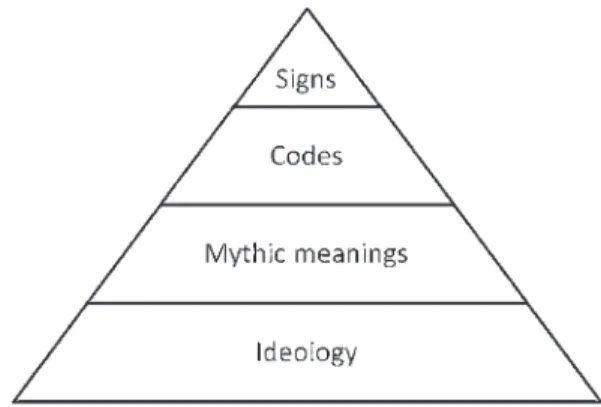
view that communication makes meaning at different levels—the sign, the code, mythic meaning and ideology—provided a framework within which to situate a flexible analysis, and I set out such a framework in Part II. This section can be read as a “how to” guide to conducting research within a broad semiotic perspective. Using a wide range of examples from written news media texts about the BP Deepwater Horizon events, it dem- onstrates how to conduct a written analysis of those discursive features which are most relevant to the researcher’s own particular data set. I drew, secondly, on Peirce’s view that signs can be understood as having iconic, indexical and/or symbolic form, as an explanatory concept to describe and interpret the analysis findings, and this is explored in Part III.
These several strands of semiotic theory, media social practice, real- world illustration and direct linguistic application relate closely to the concerns of this book series, which takes a postdisciplinary perspective on the study of language. The work in this book relates to topics of interest in the study of applied linguistics, media studies and business commu- nication. It sets out a relationship between theory and practice, moving from the understanding of a theoretical framework to its practical appli- cation, to the explication of results through another theoretical approach.
This book would not have been written without Judith Baxter’s invalu- able input and guidance and I thank her and Johannes Angermuller for the opportunity to write for this series. Thanks to Chloe Fitzsimmons at Palgrave Macmillan for her support in bringing the book to print and to Jonathan Gravells for his reading of the first drafts and his constant
encouragement. Any remaining failings in the book are my own. I am very grateful to the Spectator for allowing the use of the Bernie cartoon, which I found to my delight very early in the research process. I began my work on the BP crisis with a set of four interviews—two in London and two in New Orleans—with people who had been very close to the BP events in different ways. My informants generously shared their time and their insights about the events in the Gulf, allowing me to see the crisis from perspectives other than those of the media texts I was working with.
I would like to add a final word about the BP crisis. Over the six years I have been involved with studying the media language of this crisis, it could have become too easy to treat it as an abstract, though fascinating, case study: an example of the multifarious ways in which we use language to fulfil a social need. Indeed, my contention is that our understanding of the crisis is, in one sense, a construction of language. Yet the explo- sion had tragic material consequences—11 people lost their lives and 17 were injured. The spill caused significant damage to wildlife as well as to the jobs and welfare of countless working people, particularly in the industries of fishing and tourism. As part of my research I visited a senior academic in marine environmental sciences at the University of New Orleans, and a journalist who had covered the story from the first day for a New Orleans newspaper, and I was left in no doubt about the human and environmental cost of the events of April 2010. I hope I treat these stories with respect in this book.
Alrewas
2016 Jane Gravells
xi
xiii
Part I Written language and semiotics 1
1 Researching the Representation of a Crisis 3 2 Semiotic Discourse Analysis 27 Part II A Barthesian conceptualisation of written language 43
3 Theoretical Foundations 45
4 Data Collection and Research Principles 75 5 A Barthesian Analysis of the BP Data in Four Stages 83 6 Stage 1: Contextualisation of the BP Texts 89 7 Stage 2: Preliminary Analysis of the BP Texts 101
8 Stage 3: A Depth Analysis at the Level of the Sign 111 9 Stage 3: A Depth Analysis at the Level of the Code 127 10 Stage 3: A Depth Analysis at the Level of Mythic Meanings 167
11 Stage 3: A Depth Analysis at the Level of Ideology 179 12 Stage 4: A Holistic Analysis of a Single Text 191 Part III A Peircean conceptualisation of written language 199
13 Theoretical Foundations 201
14 A Peircean Interpretation of the BP Data 213 Part IV Concluding thoughts 241 15 Other Events, Other Contexts 243 References 249 Index 265
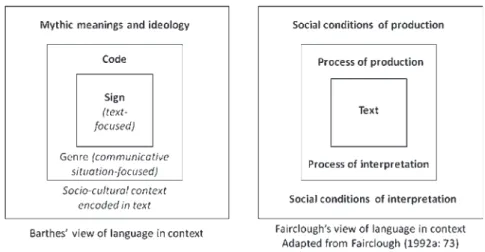
xv Fig. 2.1 Perspectives and tools of written text analysis 28 Fig. 3.1 A semiotic heuristic for considering written language 48 Fig. 3.2 Barthes’ and Fairclough’s views of language in context 72 Fig. 6.1 A genre categorisation of news texts 93 Fig. 7.1 Nine linguistic features for analysis 109 Fig. 9.1 Notional progression of text types in BP data 141 Fig. 9.2 Texts embedded intertextually “In Too Deep:
BP and the Drilling Race that Took it Down”
(M2 PressWIRE, 27.4.2011) 152
Fig. 13.1 Distance of sign forms from the object 208 Fig. 14.1 A linear view of iconic, indexical and symbolic phases 236
xvii Table 4.1 Sample of BP-related texts from Nexis UK database 79
Table 5.1 Four stages of data analysis 87
Table 6.1 Geographical source of items mentioning BP events 2010–12 90 Table 6.2 BP oil spill texts by genre 2010–12 93 Table 6.3 Proportion of media text dealing directly with
BP oil spill 2010–12 98
Table 8.1 Analysis of naming terms for the BP
Deepwater Horizon events 113
Table 8.2 Social actors in 2010–12 BP texts 116
Table 9.1 Instances of modality in the 2010–12 texts 155 Table 9.2 Summary of findings—modality and appraisal 165 Table 10.1 The occurrence of metonyms in the 2010–12 BP texts 168 Table 10.2 The occurrence of metaphors in the 2010–12 BP texts 174 Table 14.1 Summary of findings from depth analysis 214 Table 15.1 A comparative study by political party 245 Table 15.2 A comparative study of a political issue over time 246
Table 15.3 A comparative study by mediums 246
Part I
Written Language and Semiotics
© The Author(s) 2017 3
J. Gravells, Semiotics and Verbal Texts, Postdisciplinary Studies in Discourse, DOI 10.1057/978-1-137-58750-3_1
1
Researching the Representation of a Crisis
A Semiotic Account of a News Story
In this book, I make a broad claim about news media representation. I suggest that whole sets of texts, whole representations of events, have lin- guistic commonalities which can be investigated. In this view, the linguis- tic picture constructed by the media immediately after an event is quite different from the picture we get some years later, even taking account of important variations by news genre, channel, publication style and so on.
It is these large flows of social meaning that I propose we can investigate systematically using semiotic concepts. Consider these two examples of news coverage concerning the BP Deepwater Horizon oil rig explosion of 2010.
1. The oil is now about 20 miles (32 kilometres) off the coast of Venice, Louisiana, the closest it’s been to land. But it’s still not expected to reach the coast before Friday, if at all.
BP, which was leasing the Deepwater Horizon, said it will begin drill- ing by Thursday as part of a $100 million effort to take the pressure
off the well, which is spewing 42,000 gallons (159,000 litres) of crude oil a day. (Carleton Place (Canada), 27.4.2010)
2. The ditty by the two singers included the lines: “When I hear that BP story, Green and yellow melancholy, Deepwater despair.” (Coventry Evening Telegraph, 27.4.2012)
Example 1 is drawn from a Canadian newspaper (Carleton Place) one week after the explosion, and deals with the ongoing attempt to cap the leaking oil well. It is packed with information of a certain kind—times, places, amounts of money and volumes of oil, as well as the reported voice of BP. The second example appeared in the Coventry Evening Telegraph (UK) on the same date two years later. It is still of the genre “news report”, but this time its topic is a protest about BP’s environmental record. This extract also draws on reported voices, but in this case the commentary on the BP crisis is expressed through an artistic genre—the protest song.
The phrase “green and yellow melancholy”, alluding here to the BP logo colours, is taken from Shakespeare’s “Twelfth Night” (Act II, Scene iv).
These two news pieces make meaning of the crisis in very different ways, and in this book I will explore what these changes in meaning-making are, how and when they occur, and how we can examine the shape of media representations through systematic language analysis.
The book explores a number of connected themes. Its primary focus is the semiotic analysis of written verbal text. I will explore whether con- cepts common in the study of semiotics, and more usually applied to non-verbal sign systems, can be deployed as frameworks for investigating stretches of text (discourse) and shed light on how they make mean- ing. In this conceptualisation, collections of texts such as news media representations of a story can be regarded as signs with their own sets of characteristics. In other words, I will consider whether text 1 above has anything in common with other texts written at the same time on the same topic, and if so, what that tells us about how the press made sense of the BP events at that time. I propose that text 2 seems to me to be different in kind from text 1. What evidence can I marshal to support that instinct? How are the texts (demonstrably, analysably) different, and what does that tell us about how the view of the crisis has changed? In suggesting that semiotic frameworks have something to offer in the study
of written texts, I will be considering semiotic concepts as epistemologi- cal foundations for a practical methodology.
I take it that written text is a sign—a privileged sign no doubt—but still one type of sign system amongst many. Writing sits alongside speech, still image, film, gesture, music and so on as a resource for making mean- ing, and it has been the enterprise of semiotics to explore the ways by which such resources are exploited, managed, combined and systema- tised by their users for myriad communicative purposes in an infinite variety of contexts. Following Barthes’ (1972) insights that diverse cul- tural phenomena can be understood as a sign or representation, scholars of multimodality have investigated the regularities (the “grammar”) of a range of semiotic modes including visual images (Kress & van Leeuwen, 2006), typography (van Leeuwen, 2006), music (e.g. Monelle, 1999), film (e.g. Machin & Jaworski, 2006), as well as the interaction of these modes (e.g. Iedema, 2003).
It is perhaps surprising, however, that the scholar sitting down to engage with written texts from a semiotic perspective—in other words, asking how does this text make social meaning?—may find that her options for analysis are constrained. In considering written text as one mode amongst many she may find that text in multimodal artefacts, such as advertising or websites, is analysed as much for its visual properties, for example, font, position and layout, as for the contribution to meaning inherent in its lexico-grammar. I call this approach the “text-as-graphic”
approach, and touch on this again in the next chapter. Alternatively, Systemic Functional Grammar (Halliday & Matthiessen, 2004) provides a comprehensive analysis framework within which analysts can give an account not only of verbal language but also of other modes, in par- ticular still and moving image (Kress & van Leeuwen, 2006). Systemic Functional Grammar provides an account of verbal language within the clause and sentence and, and inter-sentential connections through the study of cohesion (Halliday & Hasan, 1976). However, the concerns of a semiotic account of text representations may also be broader, for exam- ple, an investigation of the role of metaphor, or intertextuality, or how writers have chosen to name events.
I argue in this book for an approach which offers an alternative to these ways of studying written text. I suggest that there are a number of
concepts in the field of semiotics which are useful as explanatory frame- works. Suppose our scholar of the preceding paragraph has a broad inves- tigative agenda. Her need is for an account which is:
• Emergent. She does not wish to approach the text with a presupposi- tion of what she might find, but rather to let the data “speak for themselves”.
• Comprehensive. Her analysis should give a picture of the text at all its levels, from close text analysis to social meaning-making.
• Critical without an agenda for emancipation.
• Flexible in terms of analysis tools.
• Multimodal in that written text can be analysed within the same epis- temological framework as other semiotic modes.
Using news data related to the BP Deepwater Horizon disaster spanning a two-year period, I will illustrate how a number of theoretical concepts drawn from semiotics can be useful as starting frameworks to build a comprehensive, critical, situated description of written texts. I will move from a micro-analysis of word choice to a macro-analysis of whole sets of texts, arguing that these can be construed as signs in themselves, with shared characteristics of ideological significance. I started this chapter with two quotations from the news coverage of the BP crisis. In order to show the interplay between semiotic theory and practical discourse analysis, I will apply the semiotic principles I will describe to this real-life example of a business crisis constructed through the news media.
The text extracts at the beginning of this chapter are drawn from a very particular linguistic context—news media coverage—and this is another key theme. This book is partly a story about a story: how it starts, grows, develops and changes. The lives of stories in the news media are tightly bound to the conventions and practices of news writing, and the lan- guage usages I discuss here will be very different from the discursive con- struction of the BP story, say, at the pub. The analysis of the story needs to be grounded in an understanding of how news media construct news.
The principles in which I ground my analysis practices are, nevertheless, transferable to other contexts, genres and registers. They could equally be used to examine our pub conversation about the BP crisis, as long as
they take account of the conventions and practices of pub conversation.
And while the news media are still highly influential in shaping how we understand events in the world around us, their influence is increasingly fragmented by both the proliferation of professional news outlets and the increase in “lay” interpretations of the news, particularly through the Internet. In proposing that the news media make identifiable “pictures”
of news stories at given times, I also acknowledge that these pictures are multifaceted and shifting mosaics made up of different media profes- sional and individual voices.
The next section of this chapter sets out some general observations about the characteristics of news media stories, practices and genres. My specific illustration is the explosion on the BP-leased Deepwater Horizon oil-drilling platform on 27 April 2010, and its business aftermath, and this introductory chapter concludes with a brief account of how the news story developed over the two subsequent years.
Researching News Stories
The scholarship on news stories is extensive. Recent work takes it as read that far from being a representation of an external reality, news writing is highly culturally-situated and dependent on conventional journalistic practice. Stories are mediated at every level, through selection and choice of emphasis, through journalistic practices and constraints, through their structure, format and co-text, and in terms of their language. The ways stories are presented vary considerably by type of publication (tabloid, quality/broadsheet, online), channel (print, online, TV, radio) and genre of news writing (“hard news” article, feature, editorial, financial report and so on), as well as displaying idiosyncratic features of individual writ- ers. There is no version of a news story which can be taken as definitive, and choices made by writers about representation of a story are always ideologically grounded, in that they are a product of culturally-specific convention and are subject to influence by those groups and individuals with access to “voice” (Blommaert, 2005).
A brief review of the four areas I mention above—story selection; jour- nalistic practice; structure/format and language—as well as overarching
conventions of genre – places the approach I discuss here into context.
The semiotic approach I propose is not intended to replace but to com- plement this work into the language of news representation. A semiotic account of a news story only makes sense when we understand what news stories “look like” and why.
Story Selection
Given that news outlets need to select what is included in publications (they cannot cover everything), then certain characteristics make some stories far more likely to be considered newsworthy than others. Galtung and Ruge (1973) found that stories with certain criteria dominated news publications. Based on these criteria, the BP story was an obvious can- didate for being reported, being of significant size and intensity, unex- pected, unambiguously catastrophic and involving elite nations. The larger point is that what is considered news is not naturally predeter- mined, but selected and prioritised according to journalistic codes. These codes are culture-specific, and reflect the ideologies of politics, power and social agreement that are at play within large institutions like media organisations. While story-selection procedures are broadly shared by the media (a story such as the BP events would be likely to appear in most national news publications) they also vary by publication—tabloids and quality newspapers regularly choose different lead stories, or select differ- ent aspects of the stories they report on (Bignell, 2002).
Apart from the topic of the stories selected, certain individuals and organisations have a strong influence over which stories are prioritised.
Fowler (1991) and others give accounts of the many stakeholders involved in producing news articles, from the news outlet proprietors, editors, journalists and other staff, to those routinely consulted about affairs in the public eye (politicians, business representatives, non- commercial organisations, community representatives, the police and so on) and those only consulted expediently (e.g. eyewitnesses and victims of crime).
Of these, some will have greater and more regular access to representa- tion than others, and it follows that these will have a greater influence on which stories are chosen and how they are eventually presented for public consumption. Van Dijk (1996: 86) summarises:
Most obvious and consequential are the patterns of access to the mass media: who has preferential access to journalists, who will be interviewed, quoted and described in news reports, and whose opinions will thus be able to influence the public? That is, through access to the mass media, domi- nant groups also may have access to, and hence partial control over, the public at large. (Emphasis in original)
Accounts of influence outside and inside publications focus on money or political interest or both. Proprietors and editors of newspapers may have an overt political stance that is made more or less clear to their reading public, and is relevant to story selection and emphasis. Also less obvious is the influ- ence of advertisers, usually a major source of income for mass- media publica- tions. Advertisers buy space in publications whose readership and stated values already fit their own, but researchers have argued that there is evidence that their money buys a degree of influence over content (Roberts & McCombs, 1994), and it is certainly the case that the perceived behaviour of publica- tions affects advertising spend, as the demise of the News of the World in the UK after phone-hacking scandals shows. Touching on economic factors and the priority given to advertising, Cotter (2010: 193) writes of the “news hole”—namely, “what is open to editorial content—news stories—after the advertising has been positioned”. Other influence on content and language use has been shown to come from pressure groups, PR agencies and corporate communications departments, all of whom have close relationships with the media as part of their function (e.g. Burt, 2012). Examining another dimen- sion of influence, Scollon (1998) contends that journalists largely orient their writing towards other journalists. In recent years the public has gained a voice in story selection, as “what’s trending” on the Internet becomes an early indi- cator of likely stories of interest, and Twitter provides reaction and feedback to stories from known and unknown voices, shaping the future direction of representation.
Journalistic Practice
The language of news media texts cannot be separated from the context in which they are produced, and this study of how a particular story comes to be constructed needs to take account of the writing and editing
practices that constrain news writing, from the collection and selection of information, to the organisation of stories to meet the particular news cycles and space constraints of the publication. Such time and space con- siderations might range from the daily cycle of a print newspaper with its relatively regular number of pages, to a 24-hour TV channel, to a news website with regularly updated content and space considerations that are only limited by writing resources.
Far from compiling information for news stories from scratch, news organisations have at their disposal a complex, ongoing network of infor- mation sources. These include press releases from corporations and insti- tutions, and news agencies such as Reuters and Agence France Presse which are positioned as neutral and unaffiliated in their standpoint.
Agencies distribute news stories via newswires to other news organisa- tions, mainly newspapers, television and radio. The customer publica- tion may use the output in full or in part, so repeated forms of words in different publications are common. A large number of the BP stories in the data set derived from news agencies, and repetition, in particular of reported speech, is a notable feature of the data. Other sources include the publication’s own reporters “on the ground” in various locations at home and abroad, who often initiate the coverage of breaking news, as well as contacts in business, Parliament, the police, pressure groups, uni- versities and other groups and institutions. Bignell (2002: 88) calls these:
“accessed voices” to whom the media have access and who expect access to the media. The discourses of these groups therefore become the raw mate- rial for the language of news stories, since news language is parasitic on their discursive codes and ideological assumptions.
As these relationships develop, some of the contacts develop considerable journalistic skills themselves, with business communications departments writing press releases in such a way that they can be used almost unaltered (Jacobs, 1999), universities developing a sense of what lies within a theoret- ical piece of research that makes it an item of general interest (Baxter, 2014) and the police finding ways of using media access to the public that can contribute to the effectiveness of their own work.
Some of the most interesting work in writing and editing practices has taken an ethnographic approach to tracking the life cycle of articles, and looking at what selections, deletions and other changes are made in the process and why. Cotter (2010: 88) gives a comprehensive account, including in particular the role of the story meeting in “[d]eciding what’s fit to print”. She argues that these meetings are a less visible, but poten- tially more revealing reflection of a publication’s priorities and values than the editorial pages. Van Hout and Macgilchrist (2010) follow a story from press release to publication, and find that framing decisions, that is, the selection and emphasis of certain information elements at the expense of others, can be due as much to technical and space constraints as to ideological considerations.
Structure and Format
News writing is a highly recognisable “genre colony” (Bhatia, 1993), not least because of its repeated structures. For the hard news report, one typi- cal structure is the “inverted pyramid”. The use of a section at the start that summarises all key points results in a story that is not chronological, but rather has temporal shifts, and journalists learn to present information in a conventional hierarchy, through which narrative sequences are necessarily reordered. The inverted pyramid structure appears to facilitate a brief but accurate assimilation of “the facts”; however, the headline and lead do not summarise the story, but rather point to the issues of maximum societal disruption (White, 1997). Bird and Dardenne (1988: 77) point out that this structure can encourage a partial, and highly directed, reading.
Feature articles are more likely to follow a conventional narrative struc- ture, with events often related in chronological order, which entails certain other linguistic regularities, such as a high presence of deictics and con- necting words (Fulton, Huisman, Murphet, & Dunn, 2005). The typical narrative structure means that the “point of closure” (i.e. the outcome) of a feature tends to be near the end, rather than at the beginning, as it is in the hard news story. Another key news genre, the editorial, tends to be struc- tured quite differently again, using patterns of rhetoric and argumentation such as Problem–Solution or Problem–Denial–Correction (Winter, 1994).
The language of news is organised not only by structuring strategies within the text, but graphically upon the page, and issues of medium and formatting can be relevant to how a story is construed. The traditional print medium is characterised by columnar formatting and clear framing of text items. Online news, on the other hand, generally exhibits a much looser layout and is less constrained by space, as well as having additional affordances such as hyperlinks to related stories within and outside the news website, multimodal options including still images, video clips and sound files, and opportunities for interaction between news writers and readers. The effects of these looser graphic formats on the verbal language of news include longer stories, greater access to voice by non-professional writers and deictic expressions to guide the reader to alternative informa- tion options.
News Media Language
Language choices in the news media concern how information is com- municated once selected. The canonical descriptive work on the register of newspaper language is that of Biber, Johansson, Leech, Conrad and Finegan (1999). Biber et al. were able to isolate through corpus analysis a number of features which were characteristic of news texts, for example, a high use of nouns and prepositional phrases, a low use of pronouns and a high proportion of complex phrases compared with other text types. They found the present tense to be used more than the past tense, because, although news items tend to describe past events, they make use of historic present tense commentary, as well as direct quotation.
However, Biber et al.’s work does not take account of the differences between newspaper types (tabloid and quality) or types of news item such as the hard news report, feature, soft news, editorial, all of which are distinctive in their language characteristics. Even within one newspaper type, the stories that are presented as “hard news” will have a different set of linguistic conventions from “soft news” stories. Because language usage by newspaper type (e.g. tabloid and quality) and by media sub-genre (e.g. hard and soft news) can be so varied, Biber et al.’s concept of a newspaper language has been challenged (e.g. Landert, 2014) for being so broad as to be unhelpful as an explanatory category.
Studies of the collection, writing and editing practices discussed above overlap with research into specific language usages within media and news writing. Most research into this topic adopts a broadly critical perspective on the language studied, and writers who work within the field of Critical Discourse Analysis have found media texts to be a particularly productive data source for the study of the exercise and maintenance of power. Key works on the language of the media from this critical perspective include Fairclough (1995b, 2000), van Dijk (1985, 1988) and Fowler (1991). A recent challenge to the assumption of manipulative intent in the press has been made by Martin (2004) and Macgilchrist (2007), who argue that some media pieces challenge and reframe dominant ideologies in a way that runs counter to expectation. They call this enterprise “Positive Discourse Analysis”. Similarly, the ethnographic work mentioned above emphasises the role of writing practices as much as ideological choices in motivating the language of news stories.
Media language is usually the product of many voices. These will almost certainly be those of the journalist and sub-editor, but can, as discussed above, include interviewees, directly or indirectly quoted, and other voices that are partly or wholly unattributed, drawn from general debates, background research, and written input from interested parties.
This form of intertextuality in the news media is explored in work such as Bednarek (2006), Oliveira (2004) and Macgilchrist (2007). Studies of intertextuality in news articles also indicate the extent to which journal- ists can converge around ways of presenting information (e.g. naming practices) partly because so many of their sources are shared, and much of their writing is drawn from others’ previous work on the same news item.
Ready access to global accounts both in print and on television increases the resources that are available for journalists to draw on as source texts to be either endorsed or challenged. Other work on intertexts considers the extent to which writers variously align themselves with, or distance themselves from, others’ texts and voices using speech presentation strate- gies, modality resources (Roberts, Zuell, Landmann, & Wang, 2008) and the Appraisal System (Martin & White, 2005; White, 1997).
Despite this frequent use of shared resources, the lexis used by tabloid and broadsheet newspapers has been found to be specific not only to each format (Conboy, 2007) but also to individual publications, through the
imposition of style guides (Cameron, 1995; Cotter, 2010). Each publica- tion will identify with a certain audience and set of values, and will select newsworthy items and language usages appropriate to this positioning.
Tabloid newspapers use a more oral and conversational style (Bignell, 2002;
Fowler, 1991), marked by contractions, slang, idioms, nicknames, indi- cations of spoken emphasis such as italics or bold type and a restricted set of vocabulary, which, while not always representing its readers’ own language use, is recognisable and shared. This oral style connotes famil- iarity, camaraderie and entertainment. Quality newspapers, on the other hand, tend to use a style that connotes authority, formality and serious- ness. Vocabulary and structures belong to a more “written” and formal register, with longer sentences, no creative misspelling and a preference for metaphor over puns. Quality newspapers, through their patterns of modality and personal pronouns, are more likely to give an impression of objectivity and even-handedness in contrast to the impression of subjec- tivity and shared values given by tabloids.
As well as these differences by newspaper type, genres of news writing have distinctive patterns of topic, structure and language choice, which are both recognisable and constitutive of their type. These differences in news genres are an important explanatory factor for changes in the BP story, and are worth reviewing here.
The News Report
Scholars of news media regularly make a distinction between “hard news”
and “soft news” (Bird & Dardenne, 1988; Fulton et al., 2005; Martin &
White, 2005; White, 1997). Bird & Dardenne suggest that hard news is
“important” whereas soft news is “interesting”. Fulton et al. (2005: 143) further describe the difference:
“Hard” news reports on politics, economics, the doings of the powerful and international affairs—in other words, on those aspects of a nation’s public life that are considered to have the greatest influence on the lives of its citizens. It is contrasted with “soft” news, which is about “human inter- est”, about celebrity, crime, the small scale and domestic.
It is not only the content of the story, but the discursive approach and positioning that distinguish hard and soft news reports. In the case of a disaster such as BP Deepwater Horizon, for example, the main news story might present the latest overview of events, while a soft news story still on the same topic might turn to family stories of victims, or the heroic actions of a single participant.
Large-scale events such as political, business and financial crises, as well as accidents and disasters, are generally reported as hard news, and a number of features of style and structure are associated with these types of report, for which I will use the term “news report”. Although the term
“hard” implies definitive, objective and factual, the news report genre cannot be considered a representation of fact—as there is no single objec- tive reality to be reported on. Rather, news reports are one of the many discursive practices that mediate our perception of events. News writing comprises a complex set of practices, constraints and choices, all of which mitigate against a neutral representation. Fulton et al. (2005: 232) write that “objectivity is a style, a set of linguistic practices that we have learned to recognise as signifiers of factuality and impartiality”. The authors draw attention to a number of these practices in factual reporting (2005: 233):
• High proportion of empirical information regarding dates, places, times, amounts of money and so on.
• Third-person narration; narrative voice externalised and elided.
• Lack of modality; preponderance of declarative (i.e. not conditional) verbs indicating certainty.
The aim of such strategies is to present an authorial (and institutional) voice which presents itself as “neutral and anonymous and thus as directly and mechanically determined by the events it portrays” (White, 1997: 129).
However, suggesting that a news report places an emphasis on empiri- cal information does not imply that opinion and evaluation play no part—on the contrary, comment from eyewitnesses and experts is an essential feature of news reporting. What is significant is that such comment is clearly positioned as being separate from the (neutral) fac- tual report, usually through the use of direct and indirect quotation.
As Martin and White explain (2005: 168, emphasis in original), in these types of text “those values of judgement which occur are always
mediated through attribution (the journalistic author is never their immediate source)”. As judgements are overtly positioned as personal opinion through attribution, the rest of the report is, by contrast, posi- tioned as objective and neutral. This is related to the third point above, where modality and (un)certainty are available to both the journalistic voice or reported voices but, the authors argue, are less typical of the journalistic voice in hard news. In Chap. 9 I will go on to problematise further the assumptions about the use of modality in hard news.
The “objective” strategies mentioned above are not used uniformly in news articles. White (1997: 108) finds that quality and tabloid pub- lications alike commonly use what he calls “intensified lexis” (he cites
“axed” for “dismissed”, “shake-up” for “reorganisation” and “torrential rains lashed” for “heavy rain fell”). Figurative language such as metaphor can introduce “an element of modality or appraisal which enlivens (and ideologically positions) an otherwise bald account” (Fulton et al., 2005:
232). And a hard news article following the inverted pyramid structure can contain a section in narrative feature article style, which may serve not only to engage the reader, but to emphasise by contrast the claims to objectivity of the rest of the piece. One of the early BP texts tells the story of the escape of a cook from the burning rig. The article in its entirety is a hard news article, but the section which recounts the cook’s story is told largely in reported speech, as a chronological narrative, adding a different dimension to the unembellished prose. Further, the impersonal, objec- tive style is not uniformly used across types of newspaper. As mentioned earlier, tabloid discourse is typically more personal, conversational and subjective than that of quality newspapers.
These tensions between impartiality and evaluation, and neutral and subjective language reflect the challenges for news journalists in meeting the conflicting aims of representing the world “as it is”, taking account of institutional interests, and engaging the reader.
The Feature Article
In rhetorical terms, news reports are positioned as primarily realising a descriptive act. Other types of mass media journalism are more evaluative, and these can include feature articles, editorials, blogs and commentary pieces as well as reviews and letters pages.
Feature articles position their information and participants in quite a different way from news stories. Features are not tied directly to the news of the day, and because of this can be “slotted in” when there is space to be filled. Unlike news stories, they do not present “just the facts”, but generally present human interest stories within a much broader, less time-bound way (Cotter, 2010). Bird and Dardenne (1988) make a use- ful distinction between the “chronicle” that is primarily descriptive, and the “story” which follows a more subjective, narrative pattern. They point out that while the former is more aligned with journalistic values that foreground a perspective of objectivity, the latter approach is more suc- cessful in engaging readers, and suggest that media writing typically seeks a balance between the two, which can be more or less successful.
As well as the narrative structure already discussed, other generic char- acteristics of the feature article are that represented participants are often recognisable stereotypes brought to life by quotations, and that there can be a conflict or parable, leading to the outlining of a (shared) moral posi- tion. Landert (2014) notes a high usage of first- and second-person pro- nouns in soft news. Where there is a third-person narrator, the viewpoint of the writer is foregrounded, and he/she directs the attention towards the desired reading.
The Editorial, Blog, Commentary and Reviews
In considering evaluative texts, a number of issues to do with language choices are relevant. The language of judgement and evaluation is far more likely to appear in articles that analyse events than articles that report them. Martin and White (2005) propose that evaluative texts are rich in expressions that communicate judgements in the areas of affect, ethics and aesthetics. As discussed in earlier comments on the differences between the quality and popular press, emotive and judgemental lexis can be a feature of both news reports and opinion pieces in the popu- lar press, whose concern is to reinforce values that they share with their readers, whereas the quality press tend to avoid evaluative language in news reports. Just as news reports are said to exhibit a lack of modality, in evaluative texts, the writer is more likely to indicate his/her own view
on propositions through the use of modal expressions. This applies not only to the expression of (un)certainty, (in)ability and permission/obliga- tion, but to the degree of “modal responsibility” exhibited in the modal expressions chosen (e.g. the choice between “it seems to me that” and “I think that”) (Thompson, 2004). As a final point, one of the rhetorical acts performed by editorials and blogs is to persuade the reader of the validity of a point of view, and this genre frequently exhibits rhetorical features associated with persuasive argument, such as end-focus or tri- colon forms, as well as argumentation structures such as variations on Problem–Solution structures.
I mention weblogs as a particular type of commentary writing partly because they appear in a different channel from print news, and this can imply different language characteristics, and partly because their writers are less constrained by the influences and practices that are typical of journalistic writing for institutional publications. Weblog writers are not necessarily trained journalists, but can be lay individu- als with a particular interest in a topic. Herring et al.’s (2004) genre analysis of weblogs identifies diverse types, from those that share simi- larities with editorials and/or letters to the editor, to those that have commonalities with the personal journal, and those that invite an exchange of views. The authors found overall that writers exaggerated the extent to which weblogs offered an interactive, multimodal, exter- nally-oriented form of participation in the news. Rather, they tended to be “individualistic, intimate forms of self-expression” (Herring et al.
2004: 1). Weblogs which deal with the news enjoy easier access to a voice by non-professional writers, fewer space constraints and are typically less heavily-edited than their printed equivalents. These and other characteristics of online news affect the linguistic output, often resulting in a more informal, individual and provocative writing style, and this was clearly exhibited in the BP texts. The recent demise of the print edition of The Independent newspaper in favour of online only is one indicator that non-institutional voices will be increasingly present in news language given the interactivity of the digital medium.
In Summary: Difference and Sameness in News Reporting
One of the critical aspects for the study of sets of news stories is the role of these different genres and sub-genres in the overall representation. How significant a presence are news articles in relation to features, or editorial or arts reviews in the telling of the story? The choice of genre in itself has semiotic meaning (why is a story considered to be a “news story” rather than a “feature story” for example) and our analysis approach should take account of choice of genre and how this changes over time. The conven- tions of these genres will play a large part in shaping our understanding of how to interpret the story. When the proportion of any one news genre increases or decreases, then our overall sense of how we are to understand the story changes.
I have argued to this point that news media language and structures are highly varied by genre, challenging Biber et al.’s conception of a single newspaper register. However, there is a case for sameness as well as difference in newspaper writing, and a degree of standardisation of language across publications is also evident. I have already touched on the intensified lexis shared by tabloid and quality press. Conboy (2007: 108) shows how repeated forms of words activate an understanding of shared values and ideologies—he uses the example “our boys” to describe British soldiers on active duty. Cotter (2010: 71) explains how reports of ongoing news sto- ries recycle language expressions used in previous news reports in “boil- erplate” formulations. The use of press releases and newswires encourages repetition of the same, readily-available wording. For example, in my BP data I repeatedly encountered this quotation from 2010, “We’ve never seen anything like this magnitude” by George Crozier, “oceanographer and executive director at the Dauphin Island Sea Lab in Alabama”. The quotation appears six times in my full 2010 data set, which represents only a fragment of what was written in the week following the explosion.
It is credible to suggest that George Crozier’s words became a resonant part of the BP story as understood by the English reading public. Cotter (2010: 192) writes:
News discourse is rule-governed, routinized, and follows on from profession- specific norms and routines. Journalistically, standardization involves the rules of writing for the appropriate modality […] the news- gathering conventions of the profession […] and the proliferation of core journalistic ideals such as balance of sources, attribution of sources, and responsiveness to audience. (Emphasis in original)
It can be argued, then, that what we have termed “news media discourse”
is characterised by both homogeneity and fragmentation. Different types of news item, news publication and channel entail differences in tone, framing, story selection, structure and emphasis, depending on the work each has to do and the audience each addresses. Within each spe- cialist media output—an editorial in the online version of an English- speaking newspaper in India, say, or the financial pages of the Mail on Sunday—various patterns of language can be found which both reflect and construct a version of reality consistent with their social purpose and audience. Conversely, the significant (and increasing) sharing of resources, agency accounts, eyewitness accounts, press conferences, previ- ous news texts as well as conventions of language usage constitute a move towards homogeneity.
I will draw on aspects of both sameness and difference in news media writing as I present an analysis of the BP data. The rest of this chapter introduces the BP news story: as archetype and as specific exemplar of a business crisis.
Crisis and Communications
I turn first to the BP crisis as archetype. The choice of business crises as objects for linguistic research is persistently relevant, as business crises appear regularly on both the front and business pages of news publica- tions (and their online equivalents). Over the last 30 years our perception of global events has changed considerably: the speed of communications technology and the proliferation of online and offline media channels have allowed us virtually instant access to information about events across the world. Events such as natural disasters that were once considered entirely
out of our control are now subject to scrutiny as we become aware of our own part in environmental change. In the world of business, an aware- ness of unpredictability has been incorporated into the fabric of corporate strategic thinking. At a time when many organisations operate in a diverse global environment, when the pace of technological development is accel- erating and when corporate actions are more visible and more deeply scru- tinised than ever before, most business organisations practise some form of crisis planning. Business studies students are taught that flexibility will be a key skill in the “real” world, and that business strategies that prioritise ongoing learning are replacing the linear planned strategies of the twen- tieth century, as the operating environment becomes more volatile and unpredictable (Mintzberg, Ahlstrand, & Lampel, 1998).
However, even against a backdrop of chronic flux, certain business crises stand out. Over the past few years alone, there has been consider- able public attention paid to, for example, the BP Deepwater Horizon oil spill, the collapse of various financial institutions, including Lehman Brothers, AIG and Northern Rock, unethical practices within some divi- sions of News International and fraudulent claims by Volkswagen about the emission levels in its vehicles. Crises that stand out in the media are often not only those that are significant in size or impact, but those that appear to exemplify some particular aspect of modern life. For whatever reason, certain crises are given more attention and move from controlled private setback to major public affair. It is worth noting at this point that I regard the word “crisis” as contentious. Since I take the viewpoint that social phenomena are both shaped by and shape discourse, it follows that my calling the phenomenon a “crisis” (rather than, say, “disaster”, or
“event” or “set of events” or any alternative descriptor) already implies a set of presuppositions. I address this point through an investigation of naming practices for the BP events.
Organisational crises are defined as events characterised by high conse- quence and low probability, ambiguity and decision-making time pressure.
An organizational crisis is a low-probability, high-impact event that threat- ens the viability of the organization and is characterized by ambiguity of cause, effect, and means of resolution, as well as by a belief that decisions must be made swiftly. (Pearson & Clair, 2008: 3)
Within this general definition, writers have found types of crisis to be significant in determining business response. Coombs (2004) proposes typologies based on attribution of responsibility: Victim Crisis (e.g. natu- ral disasters); Accidental Crisis (e.g. technical errors); Intentional Crisis (e.g. human error and misdeeds). In media coverage of the Deepwater Horizon oil spill, all three of these have been suggested as relevant at certain points, but the most applicable category would seem to be the
“Accidental Crisis”. In Accidental Crises, the organisation may be per- ceived as potentially negligent but not wilfully damaging.
A crisis is not viewed as a single event, but as a process, consisting of a number of phases (Hale, Dulek, & Hale, 2005; Pearson & Mitroff, 1993), most commonly characterised as crisis prevention, crisis response, and recovery from the crisis. Fink (1986) amplifies the prevention stage to propose five stages: crisis mitigation, planning, warning, response and recovery, and in keeping with business priorities the focus of attention here is on planning and prevention. My area of interest, which is media coverage, only starts at the point when the crisis is made public, and relates only to the final two of Fink’s five stages—response and recov- ery. This view of progressive stages can imply that the set of responses to a crisis follows a linear pattern from start to finish. However, Hale et al. (2005: 123) suggest that an iterative pattern is more likely, whereby responses are made, assessed, revised and made again. It is self-evident that the language used to describe and inform stakeholders about a crisis can be critical to how it progresses. These assessment and revision stages of crisis response often relate to the success or otherwise of particular communication strategies, as well as the technical and logistical handling of crisis consequences.
With regard to communication and message strategies, it is clear that the type of crisis will affect the organisational response in terms of tone and content, as stakeholder views are generally determined by the compa- ny’s perceived role in originating the crisis. These organisational responses are typically communicated to the media through press releases, press con- ferences, and television and press interviews. In the case of the BP events, television and press interviews were frequent and high profile. What is ultimately published in the media (our area of interest here) is of course not under the control of the organisation, although research shows the
significant presence in media writing of corporate press releases, which are often reproduced more or less verbatim. The tone of the organisa- tional response is likely to be picked up and either endorsed or dismissed by the publication depending on its political stance and likely readership response. Response strategies are tailored to the intended audience, and Stephens, Malone, and Bailey (2005) draw on stakeholder theory to dis- cuss the shifting importance of varying stakeholders at a time of crisis.
The intended audience for crisis response communication is found to make a difference to structure and tenor, as well as content and level of detail.
This is particularly crucial for crises that require technical explanation, as is the case for BP Deepwater Horizon. Just as media writing is multi- voiced, so business communication is co-created by individuals, includ- ing the Chief Executive Officer, the Communications Director and other writing professionals involved, as well as by the company culture, and the norms of the industry within which it operates. The balance between the corporate and the personal in crisis communications is a potentially inter- esting aspect for language study. BP itself encountered well-publicised dif- ficulties in finding an effective public communications approach.
The BP Story
As a specific exemplar of a crisis, BP Deepwater Horizon constitutes a particularly appropriate case for research in that it can be seen as a single set of events, and is therefore more manageable as a research topic than, for example, the UK’s financial crisis that dates from 2007 and is still a media topic today. Both causes and consequences of the BP crisis are mul- tidimensional—encompassing human, technical, environmental, politi- cal and business aspects. There is a great quantity of available data: much was written in the immediate aftermath of the events of 20 April 2010, as well as later with hindsight. It continues to be referenced widely today, as an example of new challenges to the PR industry (e.g. Burt, 2012), as an archetype of a multibillion dollar compensation case (e.g. in Cahalan, 2012) and, in July 2012, in an HBO television series The Newsroom, with a script by Aaron Sorkin and in a 2016 feature film. BP Deepwater Horizon offers an exemplar of speakers and writers competing for the right to define the history of a crisis.
The media story is as follows. On 20 April 2011 an oil-drilling rig in the Gulf of Mexico, which was operated by Transocean on behalf of BP, exploded; 11 rig workers were killed, and 17 were injured. BP’s report on the crisis (BP incident investigation team, 2010), as well as a US National Commission report for the president (National Commission on the BP Deepwater Horizon Oil Spill and Offshore Drilling, 2011), described how a series of faults and failures contributed to the cata- strophic event, each of which in isolation might have been controlled.
These included the suitability of the design of the well, faults in the construction (particularly the failure of the cement fixing), the failure of various early warning systems, the failure of the blowout preventer and human error. In his book telling the story of the BP Deepwater Horizon explosion and BP’s subsequent handling of the crisis, Bergin (2011) sug- gests that this range of direct causes can be situated within two broad background contexts—a management and organisational culture within BP that encouraged productivity improvements at the expense of health and safety, and a US regulatory system for the industry made lax by the historically strong influence of oil interests on the US government.
Heading the handling of the media story personally, Tony Hayward, the CEO of BP at the time of the explosion, had very early tried to dis- sociate BP from the failures leading to the disaster (Bergin, 2011) and named its partners on the rig, particularly Transocean, as being primar- ily to blame, while accepting BP as ultimately “responsible” in the sense defined by the US Environmental Pollution Act of 1990. The BP report names eight failures, of which seven can be attributed to sub-contractors.
The National Commission report highlighted nine causal factors, which were very similar to those BP identified, but placed the blame “at BP’s door” for seven or possibly eight of these.
From a media perspective, the focus of the story changed over the con- siderable period in which it was covered by news outlets, and these myriad aspects of the story make it of particular interest for research, as the crisis is shown in the media to have resonance from a number of socio-cultural perspectives. The search for the 11 missing men was abandoned within a few days, and Tony Hayward and his team expressed their deep condo- lences for the tragic loss of life. Crisis teams, both technical and commu- nications, were assembled immediately, and work on both fronts carried
on day and night. There was significant uncertainty about controlling the oil spill; the rig was working in deeper water than had been attempted before, and there had been so many equipment failures in the lead-up to the explosion that standard options for containment were no longer avail- able. From the onset of the crisis, Tony Hayward insisted personally on being the face and voice of BP during this crisis period (Bergin, 2011: 228).
The BP communications team was trying to control speculation, but had limited information to impart, and journalists working on the story at the time recount the frustration within the media community as questions at press conferences were heavily restricted. These restrictions had the outcome that journalists sought interpretations from a range of sources.
After a week of daily press releases concerning the efforts to block the oil spill, Quarter 1 financial results for BP were issued. Some of the news stories mentioned the financial results in passing, while financial reports and business pages mentioned the oil spill in terms of its likely impact on the business health of the company.
The Deepwater Horizon oil well was finally capped in July of 2010 after 12 weeks of oil spillage. In September 2010 Tony Hayward was forced to resign, owing to concerns about his management of the spill, and his han- dling of the media. He was replaced as CEO by American Robert Dudley, previously head of BP’s joint Russian venture TNK-BP. BP accepted legal responsibility for the spill; that is, that in a specific legal sense they accepted that they were liable for clean-up and other compensation costs.
With the cooperation of local agencies, they coordinated a significant clean-up operation. Compensation mechanisms were set in motion for individuals and communities affected by the spill, and compensation dis- putes, as well as more positive stories, were the focus of much media coverage. Compensation payments ran concurrently with legal proceed- ings to determine the causes of and specific responsibility for the spill.
The results of BP’s own investigation into the incident were published in September 2010 (BP incident investigation team, 2010), and those of the National Commission on the BP Deepwater Horizon Oil Spill and Offshore Drilling were published the following January (2011). Apart from their different readings of the “facts” mentioned above, the tone and presentation of the two reports are substantially different. The BP report reads something like a UK Government report, using plain language that
suggests objectivity. The National Commission Report from the USA, in contrast, is given an informal title (“Deep Water”), is illustrated with non-technical photographs and is dedicated on the first page to those who died and their families. These two texts on their own provide an early insight to how even broad agreement on the “facts” of the case can give rise to significantly different discursive constructions of the crisis.
Once clean-up operations in the Gulf were finished, the waters of the Gulf and its wildlife continued to be monitored by BP and other US agencies.
The costs of the clean-up and compensation, estimated at over $40 billion by March 2014, as well as the sale of assets to fund them, left BP in a fragile financial position, exacerbated by falling oil and gas prices in early 2012.
Large legal settlements were still being made in 2015. BP entered into several high-profile sponsorships, most notably as an official partner of the London 2012 Olympic Games and as sponsor of the World Shakespeare Festival.
This overview of events indicates how, over the two years for which I examined media data, the core story of the explosion and the subsequent environmental disaster was supplemented by other related events and actions, for example, the clean-up operation and the legal process of com- pensation. But there were more profound changes in the story than can be accounted for by this additional content. The language used by the media to construct the story of the crisis changed in fundamental ways: in the representation of certainty, for example, in referencing the crisis and in associating it with other events. Taken together, these changes can be under- stood as shifts in media representation from one perspective to another.
Understanding these shifts involves taking a broad and holistic view of the data and I suggest that conceptualisations from the study of semiotics can be used to provide a fresh perspective on the study of written texts.
© The Author(s) 2017 27
J. Gravells, Semiotics and Verbal Texts, Postdisciplinary Studies in Discourse, DOI 10.1057/978-1-137-58750-3_2
2
Semiotic Discourse Analysis
Researching Written Text
The key concern of this book is to offer a way of looking at written verbal text through the lens of semiotics; in other words, it will consider how meaning is made in the particular sign system of writing. To illustrate this approach, it will investigate a certain event—the BP Deepwater Horizon crisis—within a particular context: written news media output.
Having considered both illustration and context in Chap. 1, I turn now to the main focus of the book—a semiotic understanding of written text.
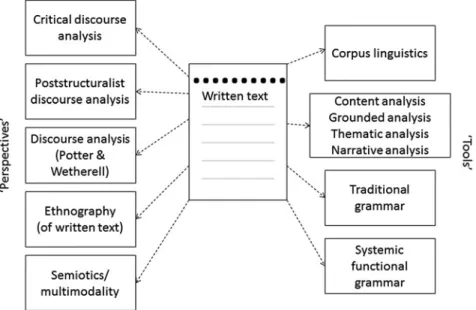
It is useful to locate this proposed approach alongside other analytical approaches to written text. The diagram in Fig. 2.1 depicts some of the more widely used approaches to the analysis of written text. It is not an exhaustive account, and the approaches are not necessarily discrete. Not only do more perspectives and methods exist, but language researchers can and do make use of multiple methodological resources to answer their research questions. When researchers handle written text, they often start from a theoretical perspective or standpoint such as Critical Discourse Analysis (CDA) or a semiotic perspective, and proceed to examine data using diverse “tools” (methods) for analysis, such as content
analysis or grammatical analysis. So, while I regard the “perspectives” in the diagram as being relatively discrete, the tools are not. For example, scholars working under the broad umbrella of Potter and Wetherell’s Discourse Analysis have used content analysis (Potter & Reicher, 1987), Conversation Analysis (Speer, 2001) and poststructuralist approaches (Wetherell, 1998) in their work. Corpus analyses can be used in the ser- vice of critical accounts, in the analysis of computer-mediated discourse, and even to support and contextualise other “bottom-up” methods such as grounded analysis. An essential element of the approach I will outline in this book is that it has the flexibility of assembling a “toolkit” from a range of linguistic research methods.
The following brief overview of the “tools” and “perspectives” named in Fig. 2.1 is intended to locate the approach I propose in a wider view of text analysis. All of the approaches and tools mentioned have been used to examine media data and all would have been possible options for examining the BP data. None, however, fully addressed the breadth of the research questions with the degree of flexibility I sought, and I explore this position further, as I discuss alternative approaches below.
Fig. 2.1 Perspectives and tools of written text analysis
Tools
On the right-hand side of Fig. 2.1 is a set of tools or methods which can be used singly or in combination to investigate aspects of language use.
Corpus Linguistics
While corpus linguistics has always been concerned with the study of large data sets, or corpora, the advent of computer technology has enabled work to be carried out on millions of items quickly and accurately, and corpus anal- ysis can now be undertaken by all researchers with computer access through accessible software programmes. The key benefit of corpus approaches to language is that large-scale analysis can uncover patterns of language u