i ie
eee
Gorprialit Nese
COPYRIGHT DEPOSIT:
Still Alive and Still Champion
From ‘' THE FARMER'S VOICE” FOR JANUARY, 1906.
The famous racer ‘‘Jay Eye See’’ as he is today.
There are few owners and lovers of horse flesh familiar with racing records of the past decade, who would need to be told, even with the above picture removed, what the cabalistic “Jay Eye See” stands for.
This spelling out of the initials of a great manufacturer of the last generation was once a name to conjure with; and even yet it is widely known as the appellation of one of the most remarkable little horses that ever trod the turf. But there are very few people indeed, outside of those living in Racine, Wis., who know, and who will not be greatly surprised to know. that this famous little horse is still alive. That, however, is the fact, vouched for not only by divers and sundry reputable persons, but by the camera-that-cannot-lie as well. The photograph which accompanies this article was taken last summer. It shows that Jay Bye See is not only in existence, but very much alive, and still handsome enough for any gentlemen to drive—if he were allowed the privilege.
For no harness isever put on Jay Eye See’s back. His is a horse’s paradise. Nothing is required of him but that he live and enjoy himself.
This is an unusual distinction even for a blooded horse, and the steps by which Jay Eye See has attained it are interesting.
He came to Mr. J. I. Case as a colt in 1878— was one of a bunchof horses purchased by that gentleman in Kentucky, the lot also including Phallas, the trotting stallion. Jay Eye See, therefore, at the present writing, is 28 years old. It used to be told of him by his trainer, Ed..
Bither, that Jay Eye See was about the awkwardest horse he ever struck, and the hardest to breakin. It required great perseverance to get him to trot at all, and Bither has said that he came near giving up the job many times betore the horse finally began to show form in 1883. In that year he was entered in several races and made good showings. The next year, 1884, at Providence, R. I., he made his famous record of 2:10 to an old style high-wheeled sulky, the best mile that had been trotted up to that time.
There are two curious things about that record. The first is, that it scarcely became 24 hours old—Maud S. lowered it next day. The second is, that’as a part of Jay Eve See’s right in his title, it still stands.
For Jay Eye See, notwithstanding he never again raced in competition, is still the champion combination trotter and pacer of the world.
It was eight years after the Providence performance, in 1892, when Mr. Case’s son Jackson conceived the idea of teaching Jay Eye See to pace. The hobbles were accordingly brought out and the little horse was hooked up. But the hobbles worried and fretted him so that Mr.
Case ordered them taken off before a quarter of a mile had been covered.
Then came the surprise. When Mr. Case got back into the sulky, Jay Eye See immediately began topace—and he was a pacer ever after.
That is what he wanted to be in the beginning—he was a natural born pacer, and that is why his trainers had such a hard time getting him totrot. There is no telling what records might have come Jay Eye See's way, if only he had been allowed to pick his own gait sooner.
In 1893, with only one sound leg under him, he went against time at Independence, Iowa, and paced the mile in 2:0644, This gave him the title previously referred to and he still holds it. Horses have since trotted faster than 2:10 and others have paced faster than 2:064, es no one horse has ever done both.
There are a great many horse owners who have no compunctions whatever about selling an animal assoonas it ceases to be a big money maker; J. I. Case, Sr., however, was not that type of man. At one time he was offered $50,000 for Jay Eye See, but he would not even consider it. His horses were something more to him than mere financial invest- ments—he loved them for theirown sakes. Jay Eye See remained his owner’s favorite when his racing days were over as he had been before, and Mr. Case never ceased to find pleasure in his ownership of the little horse. Since the death of his son, Jackson Case, Jay Eye See has never been harnessed.
Jay Eye See is held in trust by the J. I. Case Plow Works, of Racine, Wis,, which is owned and controlled by Mr. H. M. Wallis, the president of the Company, and the heirs of J. I. Case, Mr. Wallis is a son-in-law of the original J. I. Case, and to him we are indebted for the above interesting particulars.
“And,’’ says Mr. Wallis. ‘Jay Eye See wes not the only record- breaker J. I. Case gave his nameto. He also founded a factory for the purpose of making record-breaking farm implements—and we are still making them today, under the same name and in the same factory.
The Plow of Perfeci Control
Is a tongueless plow that plows straight and plows right under every kind of condition and with every kind of team. It hasa unique and original hitch in connection with a landing lever which gives you absolute control of the landing of your plow at all times. If the team happens to crowd one way or the other, a slight movement of the lever affects a change of draft and holds the plow to its work, maintaining a straight and uniform furrow.
In throwing dirt uphill, this landing lever prevents the bottom from running in too far. In throwing dirt down hill, it holds the plow to its work, without having to continually guide the team, and it gives perfect control for width of cut at all times as stated.
But these are not all of the important points of superiority of the Spinner Sulky by any means. Ask your nearest J. I. C.
dealer about the rest of them, or write direct to us for catalogue.
J. f. GASE PLOW WORKS, Racine, Wis.
THE FARMER’S FAVORITE.
The J. I. Case Triumph is the farmer’s favorite because it is the lightest draft Sulky Plow ever invented. This has been repeatedly demonstrated and proven in fields all over this country. Itis accom- plished by the adjustment provided for carrying the bottom in sucha position in the ground as to carry the rear of the landside up from the bottom of the furrow and away from the furrow bank. This adjust- ment is an exclusive J. I. Case feature.
That feature, together with the fact that both furrow wheels are always under eontrol of the pole by means of a spring connection, so that the plow is handled just like a wagon, makes it exceedingly light on the horses.
The Triumph is also easy on the driver, because only one motion of one lever is necessary to raise or lower the bottom and at the same time level the frame. The J. I. Case Triumph therefore is a labor saver for both man and horse,
Another important point to remember is that the Triumph enters the ground point first and heel up, and it comes out point first and hee! down—just like a walking plow. And when the plow bottom is in the ground, it will stay in and plow ground so hard that no other make of moldboard plow can handle it successfully. The real test for a sulky plow is when the ground is so hard that a walking plow cannot be used—then watch the J.I. Case Triumph. You will find it does the work when the other much boasted hard ground sulkies are in the shed with the walking plows. Mark well our claim—the J. I. Case Triumph will plow hard ground.
Let us tell you more about it. Ask for our printed matter.
J. 1. GASE PLOW WORKS, Racine, Wis.
11 GASES n=" FOOT-LIFT
== SULKY PLOW ==
What is accomplished in the Triumph Sulky Plow with one motion of one hand lever, is accomplished inthe J. I. Case Self-Leveling High Foot Lift Sulky Plow with one motion of the Foot Lever, viz: it raises or lowers the bottom and levels the frame with one operation.
And, remember, it raises the bottom clear up into the frame—six inches above the ground. Other foot lift plows lift the bottom in- dependently of the frame (and then only two or three inches above the ground) which makes it necessary to manipulate one or more hand levers in addition to the foot lever in order to raise the bottom six inches and level the frame, and this has to be done at the end of each furrow, making it tiresome for the operator. In the J. I. Case the operation is more simple and easier. The plow bottom is lifted from plowing position six or more inches in the ground to full six inches out of the ground by one movement of the foot lever, and more—is leveled by the same movement. Hence in the J. I. C. Foot Lift you have not only a High Foot Lift in fact but a Self-Leveling High Foot Lift.
This SELF-LEVELING HIGH FOOT LIFT feature is a J. I. Case improvement.
These are several of the distinctive J. I. C. features. For further information apply to our nearest dealer or write
_ J. 1. GASE PLOW WORKS, Racine, Wis.
J. 1. CASE TEXAS CASE, JR.
COMBINED CULTIVATOR.
. Strong, Durable and.
Up-to-date.
“S Fa
» ei 3 AEE
==
—— OTe oe cen
ere ry EE
THE GANGS are madeof extra heavy steel pipe, specially manu- factured for us, and repeated tests have shown that they are much stronger than gangs madeof extra heavy gas pipe, Such as are com- monly used in other makes of cultivators.
LONG DISTANCE AXLES—The wheels have capped hubs which keep the dirt out. In greasing wheel is not removed, simply the cap unscrewed, filled with grease and screwed on again. This forces the old grease out and keeps wheel perfectly lubricated fordays. This is another point of J. I. Case quality.
POLE ADJUST MENT.—The rear end of the pole is equipped with aclevis casting so that it can be raised or lowered, thus adjusting the front endsof the gangs for penetration. This often saves separate adjustment of each shovel.
THE BALANCE LEVER can be conveniently operated from the seat. With it all neck weight is removed from the team,
THE JOCKEY gives quick adjustment for spread of Gangs, without the operator leaving the seat.
These are some of the reasons why you should buy the Texas Case, Jr, cultivator, but there are more of them—fully explained in our Texas catalogue. It is free. Write for it.
J. 1. GASE PLOW WORKS, Racine, Wis.
J. I. C. COTTON AND CORN PLANTER.
The biggest yield from every field is partly due to the ase of the right implements. This one gives it. it works right in hard or soft, rough or smooth ground.
Note ‘i m Rear Shovels are carried on springs independent this of sweep and opening shovels. They can be used special W floating or locked down and can be depressed by J. 1. C. feature. the foot to cover in low places. One movement of lever raises or lowers all working parts and throws dropping device in or out of gear. When parts are up there is good clearance. Can plant on ridge or in furrow without change of parts.
Operator can see seed dropping and knows how machine is working.
Dropping device is gear driven and always works and distributes seed evenly. J. I. C. is the most COMPACT Cotton and Corn Planter.
MADE ONLY BY
J. 1, CASE PLOW WORKS, Racine, Wis.
J. 1. GASE DISG HARROW
re vate:
The Scrapers are the slicer style, which scrape the dirt from the center of the disc to the outer edge, and when not being operated, rest at or near the center of the disc, and in that position prevent the dirt from sticking to the disc. For sticky ground they are the best scrapers known.
Chilled Ring Bearings are used on the J. I. Case Disc Har- row, which are in every way the best bearings yet devised for a Disc Harrow, Because
They wear longer;
They do not clog up or work loose;
They are easier, lighter draft;
And another important advantage is they cost less. J. I. Case Chilled Ring Bearings are worth 20 cents per pair, or four pair to the harrow, 80 cents. Other makes range from 40 to 75 cents per pair. At 40 cents, per pair, a full set would cost $1.60, and at 75 cents per pair, $3.00.
The difference in cost, in favor of the J. I. Case harrow Bearing is from 80 cents to $2.20 per harrow.
Insist on getting a J. I. Case the next time. Made by
J. 1. CASE PLOW WORKS, Racine, Wis.
J. 1. GASE EDGE DRO PLANTER
Better Crops and Bigger Crops
are certain with it.
Actual tests in the field prove this.
P
“*Half The Crop is in The Drop”
and J. I. C. surpasses all others in accuracy of drop.
The corn never wedges, the valves cannot clog. The plates being shaft driven, and the clutch certain in action, the movement of the plates is positive.
The wire having only to operate valves and clutch the strain on same is light—hence it lasts longer.
The check ts perfect regardless of speed of team.
Vo change of partsin changing from hill to drill drop.
It is strong, durable and light. Works right, plants right and does it all the time.
You need one if you want accuracy of drop.
Remember, “‘Half the Crop is in the Drop.”
Made only by
J. 1. CASE PLOW WORKS - RACINE, WIS.
J. |. Gase TRIUMPH S2k¢
J. f. CASE COMPETITOR’S
TRIUMPH GANG { yc.) GANG
Plows 8 Miles in half Plows 6% Miles in half a day with 4 horses. a day with 5 Horses.
DIFFERENCE
In favor of the J. I. Case Triumph in one day’s
plowing: ‘Three Miles and One Horse.
That was the experience of two brothers in Missouri, whose names and address we will furnish on application. What better argument can we offer in favor of the Light Draft qualities of the J. I. C.
Triumph? We have more evidence if you want it.
Sole Manufacturers:
J. 1, GASE PLOW WORKS - Racine, Wis.
.
J, |, GASE ECLIPSE RIDING us CULTIVATOR t%..
Balance Levergood clearance and = ©=»- Within _ easy reach
View of row alread. cnpmmmeemeree nD of Operator.
Double Lifting Sprimgs make gangs easy to handle and yet work perfectly while cushion effect permits the gang to be forced down when crossing dead furrows, etc.
Independent Depth Adjuster permits depth of each gang to be independently adjusted for working on side hills and in dead furrows.
Telescope Axle gives adjustable width of wheels.
Gangs can be adiusted up or down, in or out, to change their distance apart and regulate suction so shovels will always go into the ground whatever its conditions.
Adjustable Shovel Standards, shovels can be set as desired.’
Perfect Lubricating Capped Wheel Hub keeps dirt out,!
forces old grease out and keeps wheel perfectly lubricated for, days and then it is only necessary to remove Cap, fill it with grease and screw it on again.
A Cultivator that does the best work with the least labor on the part of Operator.
oy J. f. GASE PLOW WORKS, Racine, Wis.
FARM IMPLEMENTS
WITH AN INDIVIDUALITY OF THEIR OWN
Each Machine Has Points of Merit That Are Strictly J. I. Case Features
The implements described in the preceding pages are but a few of our most representative products. The J. I. Case line includes all styles of walking, sulky and gang Plows; Middle Bursters, walking and riding Listers, Harrows, Disc Planters, Cotton and Corn Planters, Drills, Cultivators, Stalkcutters, Transplanters, etc.
These implements are remarkable in many ways, but the most remarkable thing about them, and the thing that should interest you most, is what they will do.
J. I. Case implements have become famous because they give superior results in the field; and the reason for these results is—J. I. Case method. "We employ the highest priced experts, and buy the best materials we can get; but back of all this is the experience of our organization, which keeps them ahead of all competition.
The evidence that we have an exclusive method is the fact that nearly every implement that we make has features not found in any similar implement of other make. And these fea- tures are not experiments, but tried and proven successes.
If you are interested in implements that not only look good on the dealer’s floor; but make good in actual service as well, let us send you our new catalog. It is a demonstration of
‘‘Case quality" that will surprise you. It shows why J. I. Case implements do more work in less time, while requiring the min- imum expenditure for labor and repairs; and it proves that they do it.
Catalog is free for the asking. Address
J. 1, CASE PLOW WORKS - Racine, Wis.
The FARM /
ENCYCLOPEDIA
2 ae
PTE c
, aa c
Yr RLV SP ES) =
CLIFFORD MANNING
EDITORS
GENERAL: Dewitt C. Wing, Editorial Staff, “Breeder's Gazette’
CORN : Prof. P. G. Holden, Iowa State College and Experiment Station.
COTTON: Prof. R. L. Bennett, Cotton Expert, Texas Experiment Station.
WHEAT: C.P. Bull, Assistant Agriculturist, Minne- sota Experiment Station.
HOGS : A. J. Lovejoy, Roscoe, Illinois.
SHEEP : Jos. E. Wing, Author of “The Winter Lamb,” and ‘Sheep Farming in America.”
POULTRY: Miller Purvis, Peotone, Illinois.
BEES: Holverson Bros., Durand, Illinois.
Published by J. I. CASE PLOW WORKS
RACINE, WISCONSIN
LIBRARY of CONGRESS Two Copies Received
JAN 15 1906
Copyright Entry -L71398 5 CLASS Ov XXe, No.
ASI ONT SG
COPY 8B
COPYRIGHT, 1905, BY
J. I. CASE PLOW WORKS.
VP BOR A Coe
The idea of this work is to group together the more important facts of farming in a plain and compact guide for reference. The farmer who has not time to study through the larger publications and select what he wants will find here a great deal of information in a small space and yet specific enough for his purpose.
What can be done in the way of securing better crops by proper selection of seed, soil, cultivation, etc.; the re- sults obtainable from proper feeding and caring for farm animals, and many other problems of the farm, garden, or dairy are often unknown to and unsolved by the farmer, only because new methods are not tried. Prog- ress never comes from clinging to old methods, and new crops, new methods of cultivation, new schemes for feed- ing are sure to increase the knowledge of the experimen- ter, as well as swell his bank account.
To quote a specific instance: If the information here given on the important subject “Corn,” enables the farmer to increase his yield but one bushel per acre he has been repaid a thousand times in cash for the time he spent in gaining his information, and has aded to his store of knowledge facts that will earn him—by each year’s in- creased yield—a handsome sum indeed.
Too, it is fair to assume that of the millions of dol- lars lost through disease and insect pests, a large part might have been saved by the application of tried methods cf prevention. The timely use of an efficacious remedy
may keep an entire herd or flock from extinction, and one successful treatment destroying or warding off insect pests may save an entire crop, the value of which runs into thousands of dollars.
These two aims, the increase due to the right crop being grown in favorable soil under correct methods of cultivation, and, the insurance of a crop through pre- ventative measures, have been kept in mind in that part of the work dealing with field, garden, and orchard crops. In the part treating of live stock, poultry, and other animal life, the same thought has been borne in mind, that right methods of breeding, feeding, and growth on the one hand, and sanitary and protective measures on the other, are what the farmer most needs.
The whole, it is confidently believed, makes a concise treatise to which the experienced farmer, orchardist, or herdsman may satisfactorily refer, as well as being of
exact use to the beginner.
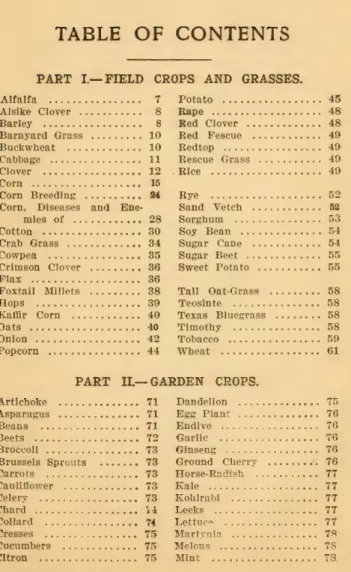
TABLE OF CONTENTS
PART I—FIELD CROPS AND GRASSES.
PARLE Lu ta Sse dci 5: a laiieie aihes aries Et) BHR OLBLON never creleilohahedseverete ions 45 Allsikey Clover |\:)s\-/-/e%s s/s \0.6 Sil HARA DON sl vaisvaevatetat ee elailapavallav ate 48 EP LOVA aye tieheiierelenaset ete bre ole Sie Red) Clovers. cis istesekeheisheve ts 48 Barnyard Grass ... VOW Red) Mescue |) ive tucleieerevorete 49 SUCK WINE tlh neteiellelete: cietsiel eee 10 FRGC LOM acietticrshepotienvevetarshers 49 WADA BE cleyeral Wiclavsve sale lsvevajeve 11 Rescue Grass) 2 hee clei s sere 49 COTO VET sieie stadelelalcrsietelete\'s 12 125 Kor WIA SASH UHISPA En NE SVU) Si HVC 49 Gorn tem Caneties Aelalale alee ce AA ets
Corn Breeding Beli aa 13a fe Ce ST PUTRI Mat tS 52 Corn, Diseases and SEne- Sana@iiVietehi ci severrareuetecels 52 MICS OL eva we caiatecc ls es 28 I NSOLLTMMIN tLe eqe ei keaielsielcleke 53.
COEGoriiae ine wists aioe elanaiets -. 30 Soy, | Beaman. clewkectetiauene 54 OraD Erase) isis sfelsie sacle ~. 34 Sugari@aney eiviaenwaclelels 54 WOW DERN Rina sia) erenaie erent EMS OM SULSAL WESEC bihceiiailcielensvenehonate 55 Crimgony Glovers cs celts . 36 Sweet VPOtato aya cievsheicieseliaue 55 EDT EDNa vai VeN Ten ele vol acciteuars elele 36
Hoxtaily Millets yeh cle siete SOr i all OatsGrassy ise clelevelee 58 LOD Siaiiaiedeceuederedsnsbasiela ele slicers 39 TPEOSINTE NM ese ovale. eles a cishelets 58 RTO OLY Wolssis eichelararolsie 40 Pexas MBIMESTASS Wy steleieeieye 58 WATS atleletslevclcierelaistordierczeye's 40 PRT OG YA) eve ihaieieelstaleverattetere 58 ONTO etele eta acrarte atereneleelets 42 Tobacco - 59 Fopeorn)!) ss. enehel hela salle SAA INI MCAEN Tocca) Nel elicheneietn eres Stele Ok
PART II.—GARDEN CROPS.
EAT EUCHORKO NN ele ta ately avers oh ale\terels TA oe DATGeliony jayenoicdareierhars ' 75 PAISDATAOTIS Niele aici bis tele ielialereiete 71 1 Ofegeaith] 24 Ela Rais Ea a OU ERO Clones 76 ASCO WMere sdeie ul spAlshepalaiel elie yg BIN Giver ie inion aetebede evens 76 BS GOGSierestee ena ehaleiecouvatelale aianhis Garliay nary ay caelatehoratetela 76 STOCCOIU Me a cisalaisiaeeletels I (MAT U Ga bans {oy arect PANE MN Banari Vato 76 Brussels Sprouts ... So ROLOUNGYs © HELL) nisteral sirens 76 Warrots yin rseeveiu evee Sie aie ou ELORSe-Ravadtsh W)\\si sisters aielelevens 17 Cauliflower ie punewe eee Bg Ri NRC eva a es ah hla CULT Ts WET ARV sre tne roleK Nene eto lol e Ni Gebd ES OMIPA DL yer bi del share seintctelane 17 COLA 2 1) 010 IN CRN ed PS WUE? Nan Ds) 2) <'s} AY a RAP OSL RT ALD vig Collard eye aiay vem ee Mice $ Met Cat) 250k REN Aap bee eats T¢
RETASSESUI Hichal nil ai ae todeie te TRUONG EEN ch ry cbs tha eas Cai ey MN Be 78
@UCTIMPELS a dislsnievelelersiete 75 IMelTOn Sie aa cd Reasnene alts 78 CONT Ee) ci gi a a AN ar IN pac SIE 15 avs Gh oem NUPHRS Ma a EAA eee 4 FU HO RN 78.
MasShroom isis Uelereieteis eve V8) Pumpkingy Vic ccs ues eietee 80 Bn GUY aez) ao WANN OS as LR EO 79) PRadishes: iis /ie sacar 81 CO): WIE VA B Eun De POA rUES ALN 79 Rhubarb). /cisi. ote rea evenereene 81 IPAESLE Vin ieisierslaieseieteversievstevals (9). Rutabagas) css Seveisel sere 81 IParsni perenne vsone nes igri: 79 Salsify Ve. .G eRe 82 PORE ae aie elchedoioleyeheiavauatete 80 Squash: Oey ney ees coe 82 (IPOBS iil ete telecon aleiene elelerete SOy i) OMA) este) eiese Aislene oneratetans 82 IPEPDELSiialseveleaihranclinlalenedanens 80 Purnips)) te) o)clels/ other alereraverete 83
PART III—LIVE STOCK AND DAIRYING.
SGOT cities cietsisiicls tue areteyevels SE), ELOTSO | ala varethe c, atale/ol erate a abet 100 Calera eerie i Naser ule een 85 Os Gil YMRS IEE ats it 105 1D Ys bahar bay aU eRN iy De el ere MRI ery 90 Sheep ys be terete yee 105 Feeding Farm Animals... 93 Pedigree Registry Associa- GORE eieuoleveiststehare neve satiate ‘94 IB KOT WIGIGGG God Hac onc 109 PTO ie ey erate teoetayeeh os etenins ote tonite 95
PART IV.—POULTRY AND BEES.
POUWLEDY si Povele io ealene lotrel neha TS) SPIPOONS ho isuereisia toa enene 127 Turkeys Wale ala neve) atatlersGlicey GAVE DDLES ile Dane eis oiecetelene neers 127 DOLCE Sis spaviel as siic ic pads ca: te eetlavonete 124 Beekeeping ..-... Pare GEESE iste reall Mie ekeilels sleieis 126
PART V.— MISCELLANEOUS.
Administration of Medicine.180 Propagation and Planting WM SCOEIGES He seiieleisisis! aiieheleltens 131 Table sce ccapeve iene 133 Planting) Pabley ise eieiecis 132 Medicines for the Horse. .135 Gestation Table ... -. 1384 Data Regarding Breeding. 136
The Farmer’s Encyclopedia PART I
FIELD CROPS AND GRASSES
ALFALFA:
Common name of lucerne, a clover-like, leguminous forage plant. It may be grown in practically any part of the United States. In many sections red clover is grown instead of alfalfa, but, where the rainfall is scant, alfalfa is of greater value.
Soil.— Any well-drained soil produces good alfalfa, but the best results are had from rich sandy loams, clay and wet lands being fatal to a long stand. As a good catch can be used indefinitely — 25 or 50 years without renewal — this is important. Plowing should be deep, care being taken that there are few weeds, as they would choke out the young plants, which do not mature for three years.
Seeding.— Different climates require different treat- ments. It may be sown as soon as the danger from frost is over in the northern states; in the south it is planted in September or February, while in California and adjacent states from August to December 15, and from February to April is the rule.
In the north and east the seed is sown broadcast, requir- ing 20 to 25 pounds of seed, when a forage crop is wanted;
if drilled in for a seed crop one-half as much seed is suffi- cient. High mowing is necessary to prevent the crop going to seed and to kill weeds. This mowing must be some time before final frosts the first year, or the plants will winterkill.
In the irrigation sections the crop does well, but plants
‘will be destroyed if water stands on them over two days.
Harvesting.— Alfalfa makes the best hay if cut when first blooming. It should be handled like clover, which
8 THE FARMER’S ENCYCLOPEDIA.
see. From 2 to 6 cuttings may be had per season, depend- ing upon the locality. Five tons per acre cured hay is a common yield, while 5 to 10 bushels of seed may be reckoned upon. The second crop is usually the one har- vested, being cut when the pods show dark brown. Some growers prefer a binder for harvesting and the use of the machine is rapidly coming into use.
Use.—Like clover, alfalfa is an excellent fertilizer, while its food value is first-class. For young stock, especially hogs and sheep, there is no better food than alfalfa hay.
The same care should be taken in pasturing cattle and sheep on young or wet alfalfa as on clover.
Diseases and Enemies.—Alfalfa is subject to root-rot, a fungous growth working downward from the surface of the ground. It is best met by crop rotation, by trench- ing the infected area or by an application of kerosene or salt. Leaf spot, in which brown spots of irregular growth form on the leaves on their upper surface, is the disease most destructive to alfalfa. It is best to burn over the field each fall to avoid infection of next year’s crop. Cut worms also attack alfalfa. Treatment for cut worms will be found under corn. Dodder, small, twining, almost leafless plants, which destroy alfalfa by suctorial roots, may be killed by mowing before the plant blossoms. The space should then be burned over, or if it be considerable the field should be plowed and put mto a different crop.
Screening will prevent the seed being planted with alfalfa which should be carefully watched for the smaller seeds.
ALSIKE CLOVER:
Favorably known and widely cultivated in mixtures for meadows and pastures, especially in low and wet marshy ones in the Middle and New England states. In the South it is not so successful nor so highly valued. It is never advisable to sow alsike alone because a better and larger amount of forage is produced when it is grown with grasses. It may be sown with oats to advantage. Redtop and alsike are as much a standard mixture for wet mead- ows as timothy and red clover for the better and drier uplands.
BARLEY:
Species of grain used especially for making malt, from which are prepared beer, ale, and porter, also used ex- tensively for stock feeding, and to some extent for human food. It matures as far north as Canada.
BARLEY. fa The first state in the production of barley is California.
The following states also yield extensive quantities, in the order named: Minnesota, Wisconsin, North Dakota, lowa and South Dakota.
Soil.—To obtain a good malt barley it should be grown on a light loose soil, preferably that containing lime. When the ground is a clay or clay loam a larger quantity of grain is obtained. For market purposes malting barley is generally preferred as a better seller. Barley requires a deep plowing and soil pulverized and is a good crop to follow another for which the land has been well fertilized.
Seeding.—The time of seeding depends upon the locality.
In the North it is sown between spring wheat and oats, the plants being sensitive to frost and also subject to dam- - age by drouth or bad weather. In the South barley is
grown for pasturing rather than for seed, being sown in September or early in October. This makes it an excellent pasture. It may be pastured in the winter as well as in the fall and spring. When broadcasted or on rich soil, 10 pecks to the acre is ample and when conditions are not so favorable 8 pecks is sufficient. The seed should be put in about 3 inches in depth.
Fertilizing.—_A grain having little protein but rich in starch, may be grown on a light soil well fertilized. The purpose of the crop must be kept in mind in fertilizing as different soils and fertilizers produce grain suited for different purposes.
Barley is grown more for feed every year and less for sale. There has been a prejudice against it because difficult to handle and often if not well threshed contains beards which are injurious to stock. This, however, is remedied by better threshing methods.
Harvesting.—As the color of the grain affects the price where it is to be sold for malting, attention must be paid to the color which the grain will show when threshed.
Dark grain is not favored, the highest price being paid for bright. Grain cut late is liable to be dark, a good time being about two days after the grain is in the dough.
The grain will be discolored by heavy dews or rain and should be carefully shocked and stacked as soon as possible. The West produces the best and brightest barley for malting purposes, as there is little dew and few rains to discolor it.
Varieties.—There are two classes of barleys: the hulled and hulless. Hulled barleys are two, four and six-rowed, the two-rowed variety being held the best for malting.
10 THE FARMERS ENCYCLOPEDIA.
For feeding the six-rowed is best. Hulless barley is grown only for feeding purposes, the main varieties being the white and the black.
Value for Feeding.—Barley ranks about the same as wheat or corn as a grain for feeding. Its feeding value is possibly somewhat more than that of oats. It is best fed ground and usually good results are had by feeding with ground corn. When fed to horses, however, the hulled grain is preferable. Hogs grown for bacon do par- ticularly well when fed on barley.
t is not necessary to take such care in harvesting barley for feed, as discolored grain is of as much use for feed as though it were perfectly clear. Barley grown for hay is not of great feeding quality and is only put in where other plants do not mature.
Enemies.—There are two kinds of smut which render barley worthless—covered smut and naked smut. It at- tacks the kernels, massing them together in a form which hardly separates when threshed. Naked smut is similar to covered smut but breaks apart as soon as the kernels mature. To treat smut in barley seed it should be given a preliminary soaking of from 4 to 8 hours, then be sub- jected to hot water at 132 degrees F. for five minutes.
Besides the smuts attacking barley it is subject to ergot, rust, joint worm, Hessian fly and grain aphis.
BARNYARD GRASS:
Requires a rich and somewhat moist soil. It is coarse and succulent, and is not easily cured into hay, but it is quite valuable for soiling and for the silo, as it yields heavily, and produces an unusual amount of seed.
BUCKWHEAT:
A minor grain grown principally for flour. It is some- times grown as a honey plant and sometimes for green manure. The greater part of the buckwheat crop of the United States comes from New York and Pennsylvania, though the other states grow small amounts.
Seeding.—Buckwheat is planted late and is often sowed where corn or some other crop has failed. It matures in about 70 days. The seed may be either drilled or broad- casted, from two to three pecks being sown per acre.
Harvesting.—The grain ripens unevenly and it is best to cut the crop soon after the first seeds ripen. It is
CABBAGE. 11 usually threshed in the fall, as it cannot be stacked be- cause it draws moisture and is thereby damaged.
Yield.—Good ground yields about 40 bushels per acre.
CABBAGE:
A cole crop, grown for the dense rosette or head of leaves. Grown commercially on an extensive scale in many parts of the country, and large profits are often realized.
Net returns in excess of $100 per acre are frequent among experienced growers near good markets.
Soii— A deep soil which is cool and has the power to hold an abundance of moisture is to be preferred. Sandy loams are almost ideal. Any land for cabbage must be thoroughly drained. There is no danger of making land too rich for this crop. About 30 loads of good stable manure may be applied per acre. About half of this
‘amount should be applied and plowed under and the other applied after the soil is plowed and its incorporation with the land effected by means of harrowing. Very coarse manure cannot be so applied.
Seeding.— For early planting in gardens, seed may be sown in shallow boxes kept in the house and the plants transplanted at the proper time. Fall or mid-season varie- ties are sown in beds outdoors and the plants removed when ready to transplant. Commercial growers sow the seed for early planting in hotbeds and transplant from them as soon as weather conditions seem to warrant.
Plants are made hardy by removing the sash a short time every other day for a week or ten days before planting.
Plants are set from early spring until about the first of July in Wisconsin and other northern locations. The Imported Holland seed, also the Danish, is grown exten- sively in that region for market. It should be planted about 30 inches apart each way. The ground is marked off with a marker similar in form to a common hand hay- rake. Four to six ounces of seed are required per acre.
Transplanting.— Commercial growers use a transplant- ing machine which will set from 30,000 to 45,000 plants in a day, or about 3 to 5 acres. It is a most ingenious machine, requiring two men to feed the plants into it. The plants are then handled by the machine or the fingers, as they are called, and placed in the ground and at the same time there is.an automatic arrangement whereby a jet of water is poured on the ground just where the plant has been set. These machines are thoroughly practical and they can be bought at a reasonable figure, and it will pay even the small grower to use them.
12 THE FARMER’S ENCYCLOPEDIA.
Cultivation Hand cultivators are used only on very small places. Where cabbage is grown largely the two-
‘acre walking or riding cultivator is used. Prominent manufacturers of implements have recently provided a
‘closer range of adjustment, so that cabbage may now be
‘cultivated the same as corn.
Harvesting.— Commercial growers prefer to sell the
‘crop in the fall. In summer and until late fall the cab- bages are cut and packed in crates for shipment, 50 to 100 in a erate. Heads of uniform size should be crated,
‘and the smaller ones sold or retained for manufacture
‘into krout. Live stock breeders grow or buy large quan- ee fi cabbage for feeding to sheep and other varieties
‘of stock.
Storing.— Cabbage may be stored for winter — keeping
‘in a trench 4 feet wide and about 14 inches deep. Pull up the cabbages without shaking the dirt off the roots and place them head downwards in the trench, having previously covered the bottom of the excavation with straw. Wrap the leaves of each plant closely around the head and place the cabbages very close together, throw a few inches of straw over them and cover with about two inches of dirt. Later, when the weather is colder, throw on a little more dirt, and when freezing weather comes put on still more, so as to guard against their freezing.
Varieties— For early cabbage the Charleston Wake- field is unexcelled. For second early, the Newark Flat Dutch and Henderson Early Summer are favorites with, many commercial growers. As a main-season variety the Premium Flat Dutch and Holland and Danish from im- ported seed is probably the best for northern locations.
Cabbages have several enemies: Root maggots, against which slips of tarred paper have been used successfully;
cabbage worms, which may be destroyed with pyrethrum or kerosene emulsion, and club roots for which there is no known remedy, except the rotation of crops; rot is a dis- ease of the root extending into the head.
One ounce of seed will produce 1,500 to 3,000 plants.
Ready for use in 100 to 160 days.
CLOVER:
One of the various species of plants numbering about 150 varieties, mostly low herbs, found chiefly in the tem- perate regions of the northern hemisphere. Some varieties are merely weeds, but many are valuable as food for stock.
CLOVER. 13 The most important use of the clovers is that of forage, though they are also excellent renovators of the soil, their long roots running deep downward and their growth above ground obtaining nitrogen from the air, later to be given to the soil upon the decay of the plants.
The most important species of clover are the common red clover, the mammoth red clover—sometimes called sapling clover—crimson or scarlet clover, white clover and alsike clover. Sweet clover and alfalfa are sometimes called clovers, though not properly so named. ‘
Red Clover (Common) or June Clover.—In the northern, central and eastern states this is one of the most important forage crops. In the south cowpeas takes its place, and in the west alfalfa is commonly grown. Besides its use for hay it is extensively used for green manure. Depending upon the locality, clover lives two or more years, being from one to two feet in height and producing two crops of hay each season. But one crop of seed can be grown per season from clover, as the first flowers are not cross fertilized. An average yield of clover hay is 144 to 3 tons per acre.
Soil——Red clover may be grown on almost any soil, but a well drained clay loam is best. A good growth of clover denotes a good chance for almost any crop as wheat, oats or corn, as any of these will flourish where a good crop of clover grows. To renew land worn out by exhaustive cropping clover is one of the best mediums to be had, as it renders the soil friable and adds the nitrogen to it.
Seeding.—Clover is sown broadcast at a depth of about one-half inch, 10 to 12 pounds per acre where used alone being sufficient. Timothy and clover is a standard mixture in many parts of the United States, about 6 pints per acre being used.
In the North fall seeding is liable to kill and should consequently be seeded in the spring, often good results
‘being had from seeding on the snow in March or later.
Sometimes where winter wheat is put in in the fall and the timothy and clover mixture is used the timothy is best sown with the grain in the fall, the clover to be added in the spring. A better stand of clover is usually obtained from seeding with wheat than with oats, rye or barley.
In buying clover seed especial care should be taken to secure seed free from weeds, as it is often mixed with weed seed. Some of the seeds sometimes found in clover are dodder, buckhorn, broadleaf plaintain and yellow trefoil.
14 THE FARMER’S ENCYCLOPEDIA.
Haying.—The time for cutting clover for hay is when about three-fourths of the plants are in bloom. It is then most valuable for forage and if cut later is too woody.
The leaves are particularly valuable for forage. Care should be taken not to let the hay get too dry, as the leaves will fall. For making hay, as soon after cutting as the leaves wilt the hay should be raked and put in small cocks. About one day, if the weather is clear, is sufficient for curing. It should be packed close in the mow and should be allowed to cure for some time, air being kept out of the barn as much as possible.
Silage.—As a silage crop clover is second to corn, being superior to hay cured in the ordinary manner. For silage clover should be cut the same as though it were to be used for hay. It should, however, be put in the silo direct from the mower. As the main reason for the spoiling of silage is the bulking up of the material, allowing the ad- mission of air, clover should be run through the cutter before putting in the silo. Because of the fact that clover silage does not depend upon sunshine for curing makes it much more valuable than when used as hay, as in this way a great quantity of excellent forage may be secured.
Seed.—As the hulls of the first crop are generally not well filled, the second crop is the one cut for seed, being cut when the clover heads are ripe and show dark brown.
Clover is cut for seed with a mower and handled as though it were hay, though a method often practiced is to cut it with a binder as grain is usually harvested. When so cut it is not threshed out as much in handling and less seed is lost than when cut with a mower. The ordinary”
yield is one or two bushels per acre.
Feeding Value.—As a fodder for sheep and cattle clover hay is in the first class. It is more dusty than timothy and not so well liked by horses and should not be fed to them as a main food on this account. Poultry are often given steamed clover hay in the winter. As a pasture, clover is adapted to any of the domestic animals. Cattle and sheep should not be turned upon clover pasture when the plants are damp, either from rain or dew, as wet clover will produce bloat. There is little danger from this after they have become used to the pasture, however, not being as dangerous as alfalfa under the same conditions. Clover is especially good for hogs.
Green Manuring.—The best plan for using clover for green manure is to turn under the whole crop. Pasture it during summer and turn under in fall.
CORN. 15 Varieties—The mammoth red clover resembles closely the common species, but is much larger and is later in maturing. When mixed with timothy it matures about the same time, and but one crop is secured. Crimson clover is best adapted to the middle and south Atlantic states, making one of the best orchard winter covering crops known. Alsike clover resembles both the common red clover and the white clover, the blossom being pinkish white. It is adopted to certain conditions where common red clover or alfalfa will not grow, standing freezing in good shape. The common white clover is but little sown, but spreads itself into meadows and pastures. It is valu- able for bees.
Enemies.— Stem-rot produces swellings on the stem;
leaf-spot produces black spots on the leaves, and rust, a reddish powder, injures the quality of the plant. The midge may be prevented by cutting the first crop very early; the clover hay-worm feeds upon the hay. It may be destroyed by fumigation with bisulphide of carbon.
The clover leaf midge attacks the leaf but does not damage the plant to any great extent. Root borers may be de- stroyed by plowing infested fields in June so as to kill the grubs by exposure to the sun. There are perhaps 200 other species of insects which attack clover, such as wireworms, cutworms, locusts, ete.
CORN:
Maize, the most common and important field plant of the United States; also its seed. The importance of corn is best shown by the fact that four times as many bushels are grown as wheat. In 1905 10,000,000,000 bushels were grown in the United States. With the exception of Alaska every state and territory grows corn. To a larger extent than any other crop, corn has been studied and ex- perimented with, and the farmer can gain more from a care- ful study of what has been done in corn culture and breed- ing, than from years of individual experiment.
Soil—The ideal soil for corn is rich, moist, mellow loam, deep and warm. This is common in the corn-belt states. Well-manured pasture land and clover sod are favorites for turning under for corn in the Mississippi valley. While the corn plant, because of its branching roots six to eight feet in length will grow on poor soils, it will not produce good grain unless the soil is rich enough to provide for a good growth of stalk. So, too, the best yield of ears is not obtained unless the stalks have made a normal growth. For this reason some other plants will
16 THE FARMER'S ENCYCLOPEDIA.
produce small or fair crops on soil too poor to produce corn.
For instance, a cotton plant adjusts its yield of lint to the fertility of the soil, a small plant producing a small number of bolls containing lint of as good quality as that from a larger plant bearing many more bolls.
Plowing.—Where there is danger from drouth or from grubworms, cutworms, and cornworms, fall plowing is to be preferred. A common custom is to plant upon the spring plowed land after dragging or pulverizing. In sec- tions where there is much rain during winter, it is better not to harrow fall-plowed lands in the autumn, especially fine clay soils in a rolling country. In comparative tests of fall and spring plowing, preceding a dry summer, the fall-plowed fields have generally yielded better. Deep spring plowing and spring subsoiling often result in dimin- ishing crops, especially if done after the spring rains.
Depth of Plowing.—For a deep, rich soil, deep plowing is best done if done in the fall. For thin clay soils in some parts of the country subsoiling is better than very deep plowing, because it does not turn the compact clay to the surface, yet loosens the soil to a good depth. The plowing should not be at the same depth from year to year, as by such a practice the soil is not mixed well; a hard sur- face is left at the bottom of the furrows where the horses walk and the plows drag. A little subsoil turned to the surface each year allows the elements to act upon it, lib- erating plant food, and as it becomes mingled with surface soil and vegetable growth, the soil depth will be increased.
To accomplish these results it is well to plow a little deeper each year for several successive seasons, and then for oné season give a plowing at about half the depth of the deepest plowing.
Planting.—Throughout the chief corn-growing sections it is the general experience that corn planted early gives the best yield. In the northern states there is little choice as to time of planting. Corn should be planted as soon as the ground is sufficiently warm; most of it is planted between the Ist and 20th of May. Corn should not, of course, be planted in cold or wet ground simply because the calendar shows that the usual planting time has arrived;
the right time will suggest itself to the intelligent farmer.
More than 90 per cent of corn is now planted by means of a check rower or two-horse planter. One man and team can plant in straight rows in both directions across the field fifteen to eighteen acres per day, thus admitting of cross cultivation.
CORN. 17 There is an old saying that ‘When oak leaves are as big as a mouse’s ear it is time to plant corn.” Fields planted early frequently escape attacks of the bud-worm, while later plantings of the same year suffer severely.
If the seed has been properly selected and graded by running) it through a fanning mill, the modern corn- planting machines with the new edge-drop or improved round-hole plates can be made to drop with remarkable accuracy. ‘The proper depth to plant must be governed by the character of the soil. If it is a stiff, heavy clay containing plenty of moisture at planting time, 1 inch is sufficiently deep; but if it is a light open, dry soil, 2 to 3 inches is advisable. If the corn is planted deeper than 3 inches there is danger that the seed will rot before it sprouts, or if it finally grows will give weak, sickly plants.
The lister is used for plowing and planting fields that have been thoroughly plowed and also for planting directly in last year’s cornfield or stubble field without previous preparation. This latter practice, however, is not recom- mended for shallow or stiff clay. By planting in a deep furrow as is done with the lister in some sections weeds in the corn rows are covered by cultivation, and as the fur- row becomes filled by cultivation the root system is placed at a greater depth. This requires a special cultivator but the corn is thus better enabled to endure drouth, and the stalks are not so easily blown down. On soils where corn can be listed without previous preparation of the ground this method saves labor, but it can be successfully employed only on very deep loose soils.
Experiments in lowa have shown that there was no difference between hills and drills where there was the same number of stalks. For example, three stalks 42 Inches apart have given the same results as where the stalks were 14 inches apart. In the corn-belt the usual distance between rows and between hills in the rows is 3% feet. This gives 3,556 hills per acre. If planted thicker than this, the weight of the stover increases and the pro- duction of ears decreases. Small-growing varieties should be planted thicker than varieties producing tall stalks.
When grown for silage or fodder thicker planting is prac- ticed.
The distance for planting in a particular soil should be decided upon and the planter adjusted to plant accurately and regularly. The custom of planting a little thicker than the stand of stalks desired is not a good one. A harrow or weeder may be used when needed to break a surface crust
18 THE FARMER’S ENCYCLOPEDIA.
or kill young weeds that start before the corn is up or large enough to be worked with other implements.
There is small danger of cultivating too deeply the first time because the plants are small and the root system undeveloped, so that no injury will result to the roots.
Care should be taken, however, not to cover any of the plants. To this end fenders should be used on the cul- tivators. During the succeeding cultivations great care should be exercised not to cultivate deeply, as then root pruning will be done, and the food and moisture supply
4 :
fy
7,
Ay a
“7 1
Root development of corn.
of the plants thus curtailed. Probably the greatest injury is done when the corn is laid by, as there is a feeling that this being the last chance at the weeds the cultivator should be let go down. On the contrary, this is the time to cultivate shallow. Deep culture at the outset is believed to insure deeper rooting by the plants and thus enables them better to withstand drouth and the effects of deep cultivation later in the season. Surface culture, however, has invariably given better results than deep culture when both have been applied continuously during the growing
season,
CORN. 19 Many comparative experiments of deep and shallow cultivation have been made, and the results favor shallow cultivation. There are but few occasions when deep cul- tivation is preferable. If excessive rains have packed the soil and kept it water soaked deep cultivation will help to dry and aerate it. Breaking or pruning of the roots of the plants must be avoided so far as possible. If roots are pruned the plants will rapidly produce other roots, but it will be at the expense of the vitality and food supply.
After the plants have reached a height of two feet, the soil, even in the middle of the rows, should not be cultivated deeper than three and one-half inches, and three inches or less is usually better. For retaining soil moisture: a loose soil mulch two or three inches in depth should be main- tained.
Corn should be cultivated often enough to keep down the weeds and to constantly maintain a loose dust mulch.
To this end a greater number of cultivations will be neces- sary when rains cause the surface soil to run together and crust. This crust must be broken and the soil mulch re- stored, or evaporation will soon rob the soil of its moisture.
The longer the drouth the more frequent should be the eultivations. After a mulch has been produced its frequent stirring is necessary, in order to prevent the ground from becoming hard and losing moisture rapidly. One object of cultivation is to restore the soil mulch as soon after a‘rain as the condition of the ground will permit. If this time is allowed to pass and the ground becomes hard and baked dry, the crop will suffer greatly, for the cultivation of hard, dry ground breaks it up into clods, allowing the air to penetrate and causing more injury than if such cul- tivation had not been given at all. Many crops are cut short by stopping the cultivation because the corn is too tall for the use of the double cultivator without breaking down the stalks. If the condition of the soil demands it shallow cultivation should continue so long as it can be given with suitable implements without injuring the plants.
Harvesting.—Where the crop is wanted for fodder it should be cut when the blades first begin to dry and the kernels are well dented. When grain is the object the ear should be well ripened. When both fodder and grain are wanted, it should be harvested at a time intermediate be- tween these two stages. For silage dent varieties should be cut when well dented and flint varieties just after glazing has taken place.
There are many methods of harvesting corn—husking in the field, husking from the shock, “snapping” or “picking”
in which the husks are left on the ear, cutting by hand or
20 THE FARMER’S ENCYCLOPEDIA.
with the modern corn harvesters. When corn is husked or snapped in the field, stock is usually turned in after gathering. In order to obtain the most feed from the crop it should be put in the shock.
Varieties.—Dent corn and flint corn are the two broad classes of field varieties. The former is grown almost exclusively in the corn-belt; the latter in New England and the South. Dent corn has the following characteris- tics: Wedge-shaped kernels with pits or dents at top;
heavy crops, woody stalk. Flint corn has a hard, smooth kernel, more or less oval, with smooth top; is of rapid growth; stalks not so woody as dent corn; easily handled;
preferable for silage. Dent corn has two types, white and yellow, there being practically no difference in either feed- ing value or yield. White has slightly outyielded yellow corn in some parts, but the difference is not material.
Names of varieties are often not distinctive because of mixing of names by seed-corn dealers and the mixing of varieties by cross-pollination effected by the*wind, so a varietal name is of little significance in comparison with the vigor, productiveness, and purity of the seed. Leaming is as constant and well recognized a variety as exists, yet seed ears purchased under this name in Connecticut or New York are, in appearance and productive ability, usually as unlike ears of Leaming purchased in Ohio or Illinois as they are unlike ears of other varieties. However, corn breeders have been at work for years to counteract this condition, and have selected seed for deep kernels, small cobs and well-filled tips and butts, and produced varieties which may be considered standard. The Illinois Seed Corn Breeders’ Association recognizes seven breeds of corn (four of yellow), namely, Leaming, Reid’s Yellow Dent, Golden Eagle and Riley’s Favorite, and (three of white), namely, Boone County White, Silver Mine and White Superior.
Seed.—It is wonderful what can be and has been done by the use of proper seed for planting. Where corn is pur- chased from a grower, it should be bought on the ear.
The chief characteristics of good seed corn are as follows:
Cob, small, with tip almost entirely and butt well covered;
kernels thickly placed in straight rows and having ker- nels full and plump at the tip next the cob. The ears should be sound and firm.
Some of the points to be observed in the selection of seed corn are:
(1) Size and shape of ear; ear should approach as nearly as may be a uniform diameter from end to end.
CORN. 21